
An Unlikely Hero for GLBT Rights
Posted: December 6, 2010 Filed under: GLBT Rights | Tags: DADT, Joe Lieberman, repeal DADT 7 CommentsJoe Lieberman has been a worrisome type of Democrat and a cantankerous Independent. In many ways, Lieberman 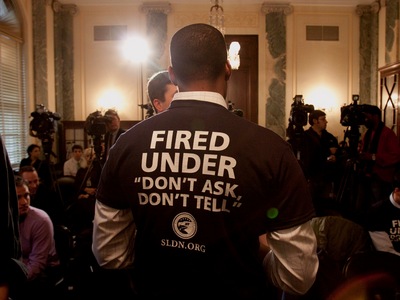 represents the Blue Dawg type of Democrat that frustrates many of us that are more liberal. What really has amazed me, however, is how he’s really sticking up for the repeal of DADT. Lieberman’s always been pro-choice, which makes him unlikely ever to be successful in the Republican party even with his hawkish stances on the war, Israel, and key economic issues. This is despite his status as a senator from the North East where those kinds of things tend to be more tolerated. Lieberman can still surprise. Take this headline from The Hill: Lieberman wants Senate to stay in session until it repeals ‘Don’t ask’ policy.
“Sen. Lieberman believes that there are at least 60 votes to repeal ‘Don’t Ask, Don’t Tell’ this year, provided that leadership allows time for sufficient debate and amendments,” Lieberman spokeswoman Erika Masonhall said. “Wanting to go home is not an acceptable excuse for failing to pass a bill that provides essential support for our troops and veterans and failing to take action that the president, the secretary of Defense and the chairman of the Joint Chiefs of Staff have called for.”
The senator also appeared to endorse Washington Post columnist Jonathan Capehart’s demand that the Senate stay in session in a tweet on Monday.
Democrats appear to have the 60 votes necessary to overcome any GOP-led filibuster of the defense bill, because some Republicans — like Sens. Susan Collins (Maine) and Scott Brown (Mass.) — have said they support the repeal.
But all 42 GOP senators have vowed to block any legislation from moving forward until the Senate passes an extension of expiring Bush-era tax cuts for all income brackets.
Ah, yes, those Republican defenders of the uber wealthy. This time they’re standing in front of progress for our troops. Proponents of the repeal have activated their calling trees and letter writing campaigns.
But Nat Butler, a gay Vietnam veteran who lied about his sexual orientation to serve in the military, was more pessimistic. He said that although eight out of ten respondents on Wednesday agreed to take action, he feared that the repeal would ultimately fail because Senator John McCain of Arizona is determined for DADT to remain in place.
Other veterans at the emergency phone bank were more optimistic about the chances of repeal. Michael Young, a straight former Marine, said that he served with a bisexual man during his time in the military. When his comrades first found out about the man’s sexual orientation, they were surprised, but once the initial shock wore off, business proceeded as usual. Given Young’s comrades’ response, and the responses of other people he has spoken to, he said that he thinks people generally support repeal.“But it’s always important for me to remember that I live in a rare cross-section, in Boston, Massachusetts. I’m optimistic, but I’m also prepared to do more,” said Young.
WAPO has an article up explaining how the clock is ticking for the repeal.
But the biggest barrier is the calendar. Although a repeal bill passed the House in May, and there appear to be enough votes for it in the Senate, there are only two weeks left in the lame-duck session. Other priorities, such as negotiating a compromise on extending Bush-era tax cuts, have consumed congressional leaders.
Repeal advocates are growing convinced that time may be running out. “The rules of the Senate can capture you when you end up in the 12th hour,” said Aubrey Sarvis, executive director of the Servicemembers Legal Defense Network.
The White House summoned repeal advocates for a private meeting Friday at which, sources said, administration officials told them they would not trade this priority for others. The officials were bullish, saying that Defense Secretary Robert M. Gates and Joint Chiefs of Staff Chairman Mike Mullen would not have testified this past week if they did not believe the bill could reach Obama’s desk before January.
That could be critical. The repeal effort would have to start over next year with the new Congress, which is decidedly more Republican and less energized to get rid of the policy.
It’s time for the Senate to take action on this and put it to rest. At this point, it can only be causing undue stress on gay service men and women and the military itself. Having an outstanding issue that should be solved by now just creates a weird environment in any organization. This is especially true since the release of the study showed there was no particular reason to support the DADT edict. Good for Joe Lieberman for finally standing up for one issue that truly represents the Democratic Party.
Friday Reads
Posted: November 12, 2010 Filed under: just because, morning reads | Tags: Currency appreciation, Daily Beast Newsweek Merger, hot money, repeal DADT, secret war on Yemen, web spying 59 Comments
Anji Allen "Books, Cup and Flowers"
Good Morning!!!
Well, the on and off again relationship between The Daily Beast and Newsweek is on again. They’ve got more issues with mergers than a couple of teenagers.
The New York Post‘s Keith Kelly tweets tonight that Mr. Harman, reached by telephone, said: “It’s not done yet.” And Advertising Agereports that while the sides are “close to finalizing a deal,” the announcement is only “possible” for Friday morning. With two powerful egos at a negotiating table, no deal is final until it is final. But Mr. Harman and Mr. Diller have broken through on the major issues between them, according to one source, and a deal is all but complete.
If you ever need proof of the corporate agenda and money impacting policy positions within the Beltway, this is it. WAPO has an article up revealing how many of the Cat Food Commission staffers were actually paid by outside entities. Wanna guess what types of companies contributed employees to the effort? How about those that are after our social security dollars to fund their casino operations?
Kennelly and other liberal-leaning critics say they are particularly troubled by the influence of Peterson, a billionaire and former investment banker who began a $6 million campaign this week urging lawmakers to cut the deficit. Peterson, co-founder of the Blackstone Group investment fund, paid for a series of town hall meetings this year that included participation by deficit commission members. He also funds the Fiscal Times, a digital news organization that focuses on federal debt issues.
Best blue ribbon panel money can buy!!!
A pentagon survey evidently shows that dropping DADT will not cause wartime strife. So what the heck is Obama waiting for? Just sign an executive order and get it over with already! I’ve had it with this dilly dallying around with discrimination.
The findings summarized in a lengthy report that the Pentagon is preparing to send to President Obama about the potential effects of repealing the military’s “don’t ask, don’t tell” policy have been relayed to The Washington Post ahead of the game, and from the (secondhand) look of it, the policy’s days may well be numbered if the Department of Defense heeds those findings
Okay, I’m back on currency war topics again. This is from Nouriel Roubini on ‘New Rules for Hot Money’ at Project Syndicate. This is the money that will cross borders in search of higher returns from those developing markets that are in good shape. I think you’ll remember me telling you about 9 months ago that that was my investment strategy so I’ll just put this in as some kind of notification to you that I have money in this strategy. It’s not a lot of money, but, hey it’s hot!!! (And, I’ve done real well recently so I’m probably going to cut and run shortly too, so don’t take this as any indication of me saying do this, please! )I’m going to excerpt Roubini’s explanation. It’s also one of the reasons that the dollar weakens and other currencies appreciate because if you want to invest in bonds from Thailand, you don’t use dollars, you use the Baht. So, high demand for baht, low demand for dollars, exchange rates for baht are the price of the baht and so the baht gets more expensive. The interesting points this explanation are on what policy makers can do in response to this phenomenon. Also, there’s a point you have to separate the potential for a bubble vs. actual appreciation.
Capital flows to emerging-market economies have been on a boom-bust merry-go-round for decades. In the past year, the world has seen another boom, with a tsunami of capital, portfolio equity, and fixed-income investments surging into emerging-market countries perceived as having strong macroeconomic, policy, and financial fundamentals.
Such inflows are driven in part by short-term cyclical factors (interest-rate differentials and a wall of liquidity chasing higher-yielding assets as zero policy rates and more quantitative easing reduce opportunities in the sluggish advanced economies). But longer-term secular factors also play a role. These include emerging markets’ long-term growth differentials relative to advanced economies; investors’ greater willingness to diversify beyond their home markets; and the expectation of long-term nominal and real appreciation of emerging-market currencies.
There’s some important analysis up at the WSJ by economist Robert E Hall who is one of the folks that actually dates the start and end of recessions and booms. He’s basically talking about how dysfunctional monetary policy is now because we’re in a liquidity trap.
In a paper presented Thursday at a Federal Reserve Bank of Atlanta conference, Mr. Hall calculates that loose credit earlier in this decade resulted in consumers buying 14% more long-lasting items — from cars and dishwashers to houses — than they would have if credit conditions had remained as they were in the previous decade.
The recession was marked by those overextended households cutting spending and saving more in the face of hard times. The problem now is that the normal tool used to revive consumer spending and hiring — cutting interest rates well below the inflation rate — isn’t available because rates are nearly at zero. So unemployment has remained stuck at a high level, currently 9.6%.
Mr. Hall, who also serves as chairman of the National Bureau of Economic Research’s Business Cycle Dating Committee — the group that officially pronounces the start-date of recessions and recoveries — concludes that the only way to get the job market growing is to institute monetary policies “that emulate the effect of low real rates — making current purchasing cheaper than future.” That should be music to the ears of many at the Fed, which just launched a controversial program to buy government bonds aimed at getting the economy growing faster.
Yves over at Naked Capitalism has found more evidence of BOA fraudulent foreclosures. This time they’re pulling stuff in the state of Kentucky. We’ll just have to see what newly minted Senator Rand Paul says about that, won’t we?
The bank position so far has been that problems so far are mere mistakes and “sloppiness”. But as we’ve described repeatedly, the problems with securitzations run much deeper than that. It appears that the parties to the deal often failed to take the time consuming steps necessary to convey the note (the borrower IOU) to the trust as stipulated in the contract governing the deal, the pooling and servicing agreement. The PSA required that each note in the deal had to be signed by multiple intermediary parties before it got to its supposed final resting place, a trust. And that had to take place by closing or at most 90 days thereafter.
Many foreclosures show this process was not observed on a widespread basis: the notes were assigned (as in transferred) to the trust right before closing, a violation of the PSA, the New York trust statutes that govern virtually all mortgage securitization trusts, and IRS rules for these trusts (REMIC). When foreclosure defense attorneys started contesting these assignments, suddenly a new ruse started to show up: allonges, which are sheets of paper that contained the needed endorsements, would magically appear out of nowhere. The problem is that an allonge is supposed to be used only when there is no space left on the note for endorsements, including margins and the reverse side, and when it is used, it is supposed to be so firmly attached to the original as to be inseparable. But these “ta da” allonges were always somehow discovered at the custodian, quite separate from the note.
How long can the Justice Department turn a blind eye to these things? There’s too many states involved and too many loans for it not to be a systemic procedure. Follow the details over there and I think you’ll see the evidence is strong.
Speaking of corporate malfeasance, have you read about GOOGLE recently? You might want to find out if the company’s been spying on you, because it appears they’re doing so as a matter of course.
Ardent Google critic Consumer Watchdog has called on Congress to hold hearings on a major privacy breach by the Internet search engine giant, and insists that CEO Eric Schmidt should come to Washington to testify.
The group says Congress should get involved even though the Federal Communications Commission (FCC) is already investigating.
That probe is important, but Congress is “the best venue to get a full explanation,” the group said Thursday in a letter to House lawmakers on the House Energy and Commerce Committee, which has jurisdiction over Google.
Google admitted last month that it collected and stored private user data, including passwords and e-mails, from Wi-Fi networks. Critics have termed the incident Google’s “Wi-Spy” breach.
Seems you don’t have to look over your shoulder any more to see if some one is following you. They’re doing it under your nose and fingers.
Glenn Greenwald continues to believe the Terrorism is being used an excuse to erode freedom of speech. You can read his latest at Salon. More importantly, I found a link to Justin Elliot’s latest on Obama and how he’s escalating the secret war in Yemen. Whoa!!!
The Obama Administration has U.S. military trainers on the ground in Yemen and has already launched an attack and possibly multiple attacks in the country, drawing relatively little public attention and virtually no debate in Congress. Analysts and news reports suggest that the administration is now poised to escalate the secret war in Yemen, possibly by launching drone attacks targeting suspected terrorists.
The attention of the U.S. media briefly re-centered on Yemen late last month after explosives originating from the Gulf nation were found on two cargo planes in Britain and Dubai. The Obama Administration has fingered the Yemen-based group Al Qaeda in the Arabian Peninsula (AQAP) as responsible for the failed attempt. (AQAP also claimed responsibility.) This is the same group that claimed responsibility for the failed attempt by Nigerian national Umar Farouk Abdulmutallab to blow up a Detroit-bound plane on Christmas Day 2009.
But less attention has been paid to U.S. attacks on targets in Yemen — of which there have been at least two since 2002 — and the U.S. military role in training Yemeni forces as well as helping them carry out air strikes.
And you thought last stop was Vietnam, Iraq, Afghanistan? Yup, way to go PEACE candidate!
Alright, that’s enough from me. I’m going through my recipes to look for some good New Orleans recipes to share on Treats thread tonight. I’m giving you some warning so you’ll be prepared to share any that you’ve got that are just plain good ol’ down home cookin’.

 peej
peej Carissa
 bostonboomer
 dakinikat
 ecocatwoman
 mablue2
 Mama Lopez
 peggysue22
 quixote
 skydancingguestblogger
 Mona (aka Wonk the Vote)



 Sky Dancing
Recent Comments