
Thursday Reads: Elite Boarding School Rape Culture
Posted: August 20, 2015 Filed under: Crime, Criminal Justice System, morning reads | Tags: "slaying" girls, Concord NH, J.W. Carney, misogyny, Owen Labrie, rape, rape culture, Senior Salute, Sexism, St. Paul's School 36 Comments
St. Paul’s School in Concord, NH
Good Morning!!
I’ve been following the rape trial that is going on right now in New Hampshire. The testimony of the alleged victim of a rape at St. Paul’s School suggests that this exclusive private boarding school has an educational environment suffused with sexism, misogyny, and rape culture. We’ve all heard about the many colleges and universities where rape has been ignored and minimized. Is rape culture also widespread in secondary schools around the country? Probably, but at St. Paul’s the acceptance of sexual assault is apparently quite explicit.
I’m not sure how to frame this, so I’m going to begin with some early stories about the trial and go from there.
Associated Press: Rape case points to sordid tradition at elite prep school.
Aerial view of St. Paul’s School
St. Paul’s School boasts a glittering roster of alumni that includes senators, congressmen, a Nobel laureate and the current secretary of state. The elite prep school also allegedly has a sordid tradition of sexual conquest where graduating boys try to take the virginity of younger girls before getting their diplomas.
Details of a practice authorities say was called the “Senior Salute” were spelled out in stark terms by a former prefect at the New Hampshire school who is charged with raping a 15-year-old girl on the roof of a campus building in May 2014.
Owen Labrie, now 19, has pleaded not guilty to several felonies. When his trial begins Monday, prosecutors are expected to call current and former students to testify about the sexual culture at one of the country’s most selective boarding schools.
Labrie, of Tunbridge, Vermont, talked openly about the tradition when he was interviewed by Concord police. On a campus where upperclassmen studiously avoid their younger peers in most settings, Labrie told a detective some students “take great pride” in having sex with older students before they leave school.
Labrie also told the detective of a contest where boys compete to “score” with the most girls, keeping a running tally written in indelible marker on a wall behind washing machines. The school kept painting over the scoreboard so it eventually was moved online. He acknowledged to the detective he was “trying to be number one,” the detective wrote.


The New Chapel at St. Paul’s School
The school administrators were well aware of this “tradition” and, according to one counselor, were “trying to educate students against ‘sexual scoring.'”
Excuse me? That sounds pretty weak. What happened to actually banning a practice and explicitly policing the behavior at time time it “traditionally” takes place?
Labrie was an outstanding student who had been accepted to Harvard until the rape accusations surfaced. Harvard now says he’s no longer listed as a student.
Labrie’s defense attorney is well-known and expensive Boston lawyer J.W. Carney, who also defended notorious gangster Whitey Bulger.
Some background on St. Paul’s School:
Founded in 1856, St. Paul’s is an Episcopal school nestled on 2,000 pastoral acres on the outskirts of downtown Concord, New Hampshire’s capital. It enrolls about 530 students and admitted girls for the first time in 1971. Tuition, room and board currently clocks in at $53,810.
The school belongs to the Eight Schools Association, a sort of Ivy League for prep schools that includes Choate Rosemary Hall and Hotchkiss in Connecticut, Phillips Academy Andover, Deerfield Academy and Northfield Mount Hermon School in Massachusetts, The Lawrenceville School in New Jersey and Phillips Exeter Academy in New Hampshire.
Secretary of State John Kerry graduated from St. Paul’s in 1962, alongside former FBI Director Robert Mueller. Doonesbury creator Garry Trudeau is an alum as are 13 U.S. ambassadors, three Pulitzer Prize winners, two World Series of Poker winners, actor Judd Nelson and sons of the Astor and Kennedy families, according to the school’s website.
The school also has a robust international presence: 17 percent of the 2014-15 class came from 25 countries and notable alums include Bernard Makihara, the former CEO of the Mitsubishi Corporation, and Edmund Maurice Burke Roche, a conservative member of the British Parliament and the maternal grandfather of Diana, Princess of Wales.

Owen Labrie’s mugshot
Labrie told police that he didn’t have sex with the alleged victim. Instead, he claims “in a moment of restraint” and “divine inspiration” he decided not to have intercourse with the 15-year-old girl even though she was “eager” to do so. He also explained that the girl lied because “it’s a “great source of pride for younger students” to have sex with seniors.
WTF?! Then why would she go through the nightmare of a trial in she knows she’ll be humiliated and shamed?
The Boston Globe: Prosecutor: St. Paul’s rape suspect talked about ‘slaying’ girls as part of hookup contest.
Prosecutors say Labrie arranged for a tryst with the girl at St. Paul’s School in a secluded machine room in a school building, prosecutors say he took it further than she wanted it to go.
took the stand late Tuesday afternoon, answering questions about her upbringing and how she ended up at St. Paul’s, where she enrolled as a freshman in 2013.
Today, the girl is testifying about what led to that night in the machine room. She initially rebuffed his message, thinking it was a form letter he sent to lots of girls.
Owen Labrie had been making a list of girls to hook up with months before a 15-year-old accused him of sexually assaulting her at their elite New England prep school, but her name was the only one written in capital letters, a prosecutor said Tuesday….
There was a game above it all: a storied hookup contest among the school’s upperclassmen called the “Senior Salute.” Labrie and his friends talked about “slaying” girls, with April and May referred to as SLAYpril and SLAY, Deputy Merrimack County Attorney Catherine J. Ruffle said.
“This case is about Owen Labrie sexually assaulting a 15-year-old girl,” Ruffle said in her opening statement. “It’s about how he thought about this for months.
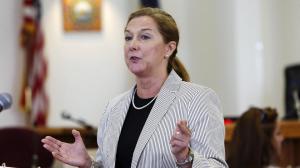
Prosecutor Catherine Ruffle delivers her opening arguments against Owen Labrie to the jury in the Merrimack County Superior Court, Tuesday, Aug. 18, 2015, in Concord, N.H.(AP Photo/Jim Cole, Pool)
The girl testified on Tuesday and Wednesday and she was reportedly very emotional, describing her confusion, fear, and lack of control over what happened; but she also described how she felt responsible for what happened and, tried to soothe Labrie’s feelings. She didn’t want to cause an uproar, because her older sister was graduating from the school two days later and she (the victim) didn’t want to make it all about her.
NBC News: St. Paul’s School Rape Trial: Accuser Tells Court ‘I Felt Like I Couldn’t Say No.’
A 16-year-old girl who says she was raped at a prestigious New Hampshire prep school returned to the witness stand on Wednesday, recounting a secret date with an older boy that turned suddenly aggressive.
The girl described her confusion as he groped her in secluded room of a campus building at St. Paul’s School in Concord, New Hampshire in May 2014. “I felt like I was frozen,” she said through tears as she described the accused, Owen Labrie, kissing and biting her and trying to pull down her underwear.
As the groping continued, she said, “I felt like I had no control. I felt like I couldn’t say no.”
A little later, the girl said, she did say no. But as the alleged attack continued, she said she tried to zone out, looking at the ceiling and trying to ignore the pain. That continued through what she described as unwanted sexual intercourse, she said.
“I didn’t want to believe that this was happening to me,” the girl said under questioning from Deputy Merrimack County Attorney Catherine Ruffle.

Recent St. Paul’s School graduate Owen Labrie, right, stands with one of his lawyers, J.W. Carney, as jurors view the school grounds, Tuesday, Aug. 18, 2015, in Concord, N.H. (AP Photo/Jim Cole, Pool)
More from the Manchester Union Leader:
The girl, who was 15 at the time, said Labrie, then 18, sent her what she considered to be a “senior salute,” an invitation from a senior to a girl in the lower classes for a meeting that could result in as little as a kiss or as much as sexual intercourse….
The young girl Labrie was pursuing said she knew of the tradition because her older sister was also a senior at St. Paul’s in 2014.
So her first reaction was to refuse, but Labrie sent an envoy, a friend of the girl, to plead his case and she succumbed to the flattery and agreed to meet him.
Part of the reason for agreeing was his claim to have keys to one of the buildings whose roof was off limits to students. She liked the idea of being able to see a view not available to most students.
She said she expected there would be kissing involved “but that’s all.”
But she was wrong.
She said he took her to the building rooftop, but then back inside the unlighted mechanical room. There he started by kissing her, then, despite her efforts to stop him, he removed her bra and pants and sexually assaulted her.
She said at one point he laughed and said: “You are such a tease.”
When it was over, she said, “I couldn’t believe what had just happened to me.”
The girl said when Labrie was finished with her he left her get dressed and go back to her dorm, where she met up with her girlfriends and told them what happened.
Deputy Merrimack County Attorney Catherine Ruffle had the girl read copies of email and Facebook messages between Labrie and herself, messages that were projected on a large screen for jurors.
The girl explained that her friends dictated the messages she sent to Labrie about him using protection.

St. Paul’s School
The text messages the girl sent to Labrie are the center of the defense case that she “was a “willing participant” in the sex. I’ll get to that in a minute. First a few more details on the assault from MSNBC:
“I felt like I was frozen,” the accuser said.
“I felt so scared,” she added. “I had no idea what was going on. I had never been put in a situation like that.”
Her second day on the witness stand, the girl continued recounting the events that led to the alleged assault….
The girl said that she and Labrie stood briefly on the roof, and that later, inside an industrial area. She said that the two began kissing and removed some clothing when Labrie became too aggressive, biting her chest and forcing himself on her.
The girl grew emotional as she recounted the intimate details of the encounter, responding to questions from the prosecutor as her family looked on from reserved seating, and telling the court that she didn’t kick or scream as the encounter went on.
“In that moment, I wasn’t strong enough,” the girl said.
She later told the court she said ‘no’ three times. “I don’t know how I could have made it more clear,” she said.

Owen Labrie’s defense attorney Jaw W. Carney, left, gives his opening arguments Tuesday, Aug. 18, 2015, in Merrimack County Superior Court in Concord, N.H. (AP Photo/Jim Cole)
The cross examination began yesterday and continues today. As I said above, the biggest problem for the prosecution is that this young girl was very focused on not making a scene or being “bitchy.” She was seemingly very concerned about upsetting Labrie or generally calling attention to herself. From the MNSNBC article cited above:
Still, the girl was pressed by prosecutor Catherine Ruffle, the Deputy Merrimack County Attorney, about an email exchange she had with Labrie after the incident, in which Labrie described her as “an angel.”
Reading from copies of the messages displayed on a courtroom projector, the girl told the court that she replied: “You’re quite an angel yourself, but would you mind keeping the events of this evening to yourself for now?”
Asked why she had called Labrie an angel, the girl said she was trying not to upset him.
“It was almost like I was sticking to the script that he was offering,” she said of his email. “I thought it would be rude otherwise to ignore it, or it would cause him to approach me again if I ignored it. I was afraid of him coming after me again.”
In subsequent messages over Facebook, the girl told the court, she asked Labrie if he wore a condom and he assured her he had, and inquired if she was taking birth control medication.
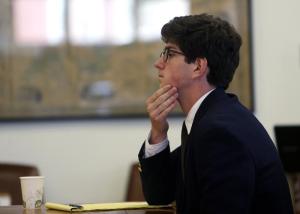
Owen Labrie in court
Just one last article, from The Boston Globe: Why was the prep school girl so nice to the man she says raped her?
To the defense attorneys of Owen Labrie, the now-19-year-old man accused of raping the girl last year on the campus of their prestigious New England prep school, the message and others like it are obvious evidence that she was not raped, that she was a willing participant in what happened in that dark room. Why else would she chat and giggle and seemingly flirt in some cases if what happened was rape and not a consensual encounter between two teens?
The explanation of the girl, now 16 and on the witness stand in a Concord, New Hampshire courtroom: She didn’t want to offend him. She was trying to be polite. She didn’t want to be “bitchy,” or a “withering little girl.”
And so her chats replying to him in cutesy French phrases, lamenting the loss of her favorite earring, calling him a good guy, paint a blurry picture of how she really felt after what she now calls a rape.
Personally, I can relate to what this girl says. She was only 15 and says she was a virgin.
Part of the reason why she agreed to Labrie’s emailed invitation for a “Senior Salute” on May 30, 2014 in the first place was out of fear she was too rude when she initially rebuffed him.
“I felt bad I’d sent such an attacking response back,” said the girl, who Boston.com is not naming. “I thought that I was rude and that I was wrong and I had been wrong about everything.”
The girl knew the reason Labrie sent her a flowery email asking to spend time with her. Senior Salute was well known on campus as an attempt to hook up with as many people as possible before graduation. Prosecutors said Labrie and his friends made it a game, competing to see how many girls they could “slay” before they left school.
During the assault itself, she said, she was still thinking about him and his feelings. Right after telling him that no, she didn’t want his face between her legs, and pulling his face away, she laughed.
“I wanted to be easygoing,” she said. “I wanted to not cause a conflict. I didn’t want to come off as bitchy or … I didn’t want to cause any trouble.”
Wincing, walking back to her dorm, she told no one. She wouldn’t even tell her best friend, whom she sat with immediately after the encounter, what really happened. She didn’t want to burden her with her issues.
As she saw her sister graduate, and took her exams, she kept quiet. Her family wasn’t on campus to worry about her and her problems, they were there to celebrate her sister.
Read the rest at the link, if you can. I’ve already quoted too much.
So . . . What do you think? As always, this is an open thread.
Tuesday Reads
Posted: August 18, 2015 Filed under: morning reads, Republican politics, U.S. Politics, Women's Rights | Tags: #BlackLivesMatter, abortion, attitudes toward women in biblical times, Bill Clinton, forced pregnancy, Hillary Clinton, Nate Silver, Oliver Willis, rape, religion, Valerie Tarico 34 Comments
Good Morning!!
I’m getting a slow start again today. We’re having another heat wave here, and its throwing my circadian rhythms off. It’s hard to get to sleep at night because it’s so hot, and then I wake up at around 5AM when it has cooled down some, then fall back into a deep sleep and wake up a few hours later feeling drugged. I’m just drinking my iced coffee now and trying to get myself going. The good news is that at this time of year it does cool down quite a bit at night.
Hillary Clinton is in the news this morning, and as usual, even when she does something positive like requesting the release of all of her State Department emails or hold a meeting with activists and then release the video, the media reports it in a negative light. Here’s the video:
Part 1
Part 2
I hope Hillary supporters will watch the videos and not just read the media reports; because she gives intelligent, sensible answers. I linked to a blog post by Oliver Willis a few days ago in which he suggests that the activists are focusing on getting Hillary to say she’s sorry for things her husband did in the 1990s instead of pushing for real changes in policies. He was right.
The Hill reports: Clinton tells Black Lives Matter activists: ‘You’re not going to change every heart.’
“All I’m saying is, your analysis is totally fair, it’s historically fair, it’s psychologically fair, it’s economically fair. But you’re going to have to come together as a movement and say, ‘Here’s what we want done about it,’ ” Clinton says to a few members of the movement in the video posted by GOOD Magazine.
“Because you can get lip service from as many white people as you can pack into Yankee Stadium and a million more like it,” Clinton adds later. “Even for us sinners, find some common ground on agendas that can make a difference right here and now in people’s lives.”
Clinton met with the group of Boston-area Black Lives Matter activists last week after they were shut out of an event in the early voting state of New Hampshire that they planned to protest. A spokesman said they watched from an overflow room and met with Clinton afterward.
“I don’t believe you change hearts. I believe you change laws, you change allocation of resources, you change the way systems operate,” Clinton continues later in the exchange.
Activists who spoke with Clinton appeared on MSNBC last night to criticize her for “ducking responsibility” for policies of Bill Clinton’s administration that led to mass incarceration of black people.
Why is it that no one seems to understand that Bill and Hillary Clinton are two separate people with separate views of the world? Do they really believe that the wife of a president makes the laws of the land?
Still, Hillary did respond to the accusations. CNN:

The activists, led by Daunasia Yancey, founder of Black Lives Matter in Boston, pressed Clinton on her family’s role in promoting “white supremacist violence against communities of color.”
Clinton acknowledged during the conversation that laws put into place by her husband, former President Bill Clinton, did not work out as planned.
“I do think that there was a different set of concerns back in the ’80s and the early ’90s. And now I believe that we have to look at the world as it is today and try and figure out what will work now,” she said. “And that’s what I’m trying to figure out and that’s what I intend to do as president.”
But Clinton also told the protestors that she was “not sure” she agreed with the activists that her husband’s policies were racist.
“I do think that a lot of what was tried and how it was implemented has not produced the kinds of outcomes that any of us would want,” she said. “But I also believe that there are systemic issues of race and justice that go deeper than any particular law.”
But for some reason all the activists wanted was for Hillary to show contrition in some way. Was she supposed to break down sobbing? I’m not sure what they wanted. Read more about it at CNN.
Julius Jones is the man on the right.
The first video starts with [Julius] Jones spending three minutes going over America’s history of violence toward black people, ending with Clinton’s role in perpetuating mass incarceration. He concluded with a thoughtful question on what that means to Clinton personally — “Now, they may have been unintended consequences, but now that you understand the consequences, what in your heart has changed that’s going to change the direction of the country?” he asked — and a Clinton aide interrupted before she could answer.

Specifically, what was Hillary’s role in this? Do they believe she was actually running the country with Bill as just a figurehead? Continuing,
Clinton started off with a standard politician answer, recapping her lifelong advocacy for minority children, then offered some insight into how she wants to frame the issue on the campaign trail. “Once you say that this country has still not recovered from its original sin, which is true, the next question by people who are on the sidelines, which is the vast majority of Americans, is ‘So, what do you want me to do about it?'” she said. “I’m trying to put together in a way that I can explain it and I can sell it, because in politics if you can’t explain it and you can’t sell it, it stays on the shelf.” ….
Jones objected to Clinton suggesting that Black Lives Matter needs to have clearer policy goals to get the rest of the country onboard. “I say this as respectfully as I can: If you don’t tell black people what we need to do, then we won’t tell you all what you need to do,” Jones said, adding that “this is and has always been a white problem of violence” and there isn’t much black people can do to stop it.
Really? So candidates and activists should not communicate about changes in legislation and policy? As Oliver Willis noted, the activists don’t seem focused on policies for the future. I really hope this analysis is wrong, but it does sound like this movement may go the way of Occupy Wall Street if they don’t start telling candidates what policies they would support.

Hillary and Julius Jones
I know you’ve probably seen the headlines suggesting that Hillary is no longer the most likely candidate to get the Democratic nomination, so I won’t bother posting them. Here’s a response from Nate Silver, based on actual data: Hillary Clinton’s Inevitable Problems.
Clinton’s favorability rating has, in fact, fallen quite a lot, to an average of about 42 percent favorable and 48 percent unfavorable in recent polls.
Numbers like those, when combined with the “emailgate” scandal and Sen. Bernie Sanders’s position in the polls (he’s now running very close to Clinton in New Hampshire, although not in Iowa or nationally), have a lot of commentators saying Clinton’s campaign has had an unexpectedly rough start. “Hillary is probable, but no longer inevitable,” wrote David Horsey of the Los Angeles Times, assessing her chances to win the nomination.
Horsey is right to deal in probabilities rather than certainties. Personally, I give Clinton about an 85 percent chance of becoming the Democratic nominee. (The general election is a whole different story.) That’s a pinch higher than betting markets, which put her chances at 75 to 80 percent.
But those betting markets, unlike some pundits, haven’t changed their assessment of Clinton much. In the markets, her probability of winning the nomination is still close to its all-time high and has barely budged in the past few months, rarely falling much below 75 percent or rising much above 80 percent.
Emailgate? #feelthebern? Clinton’s declining favorables? The betting markets think everything that’s happened to Clinton so far in the campaign is pretty much par for the course. It’s not that these markets are clairvoyant; they presumably didn’t know there would be a scandal involving Clinton and her email server, for instance. But it was a pretty good bet that there would be some scandal involving Clinton. (It’s not as though there is an absence of them to pick from.) Likewise, while you might or might not have identified Sanders as the person to do it, it was a pretty good bet that somechallenger to Clinton would be situated about where Sanders is in the polls. So events like these were “priced in” to her stock. Let’s look at each of them in a bit more depth.
Please go read the rest at the FiveThirtyEight link above.

Valerie Tarico
I’d like to call your attention to an essay by Valerie Tarico published at Raw Story: Republicans want 10-year-old girls to give birth to ‘rape’ babies — here’s what the Bible sas about that. Tarico is a former evangelical christian who is now a psychologist who writes about “the intersection between religious belief, psychology and politics, with a growing focus on women’s issues and contraceptive technologies that she thinks are upstream game changers for a broad range of challenges that humanity faces.”
In her lengthy essay, Tarico demonstrates that in the Bible women have no function except to bear children and serve men. They are not seen as autonomous human beings who should have choices about any aspect of their lives. We all know this, but reading the biblical examples she gives is still highly enlightening.
More interesting reads, links only:
The Intercept: Why Did the FBI Spy on James Baldwin?
People: Donald Trump Reports for Duty (Jury Duty That Is!) After Five Summonses.
Business Insider: ‘Dilbert’ creator: There’s a ‘clown genius’ behind Donald Trump’s campaign — and it’s why he’s unstoppable.
Washington Post: State Department flags 305 more Clinton e-mails for review. (Go down several paragraphs and you’ll learn that none of the emails were classified at the time and Clinton is not being accused of any wrongdoing. The review of the emails is simply for the purpose of deciding what material should be released under the Freedom of Information Act.)
Reuters, via Raw Story: Scott Walker tries channelling Trump in attempt to kick-start sinking campaign.
Bankok Post: Bangkok blast: the Hindu shrine beloved by Buddhists.
USA Today: Police release footage of suspect in Bangkok bombing.
Matter: I Watched 14 Police Officers Take Down a One-Legged Homeless Black Man Outside Twitter HQ.
NPR: For The First Time, Women Will Graduate From Army’s Rigorous Ranger School.
What stories are you following today?
Tuesday Disgusting Behavior Open Thread
Posted: July 28, 2015 Filed under: U.S. Politics | Tags: Donald Trump, Ivana Trump, open thread, rape 24 Comments
Good Afternoon!!
This blog is just barely limping along. JJ is dealing with family issues, Dak is trying to help a friend who is in fear of her life from an abusive husband, and I’m dealing with urgent dental problems. And would you believe I still have itching on my arms and neck? It doesn’t make it easier that the news is filled with just plain horrible, awful, disgusting stuff these days. So here’s a really disgusting open thread.
Yesterday it was Bill Cosby the serial rapist. Today it’s Donald Trump and marital rape. You’ve probably already read or at least heard about the article by Tim Mak and Brandy Zadrozny at The Daily Beast yesterday about the time Ivana Trump accused her husband Donald of raping her.

Ex-Wife: Donald Trump Made Me Feel ‘Violated’ During Sex.
Ivana Trump’s assertion of “rape” came in a deposition—part of the early ’90s divorce case between the Trumps, and revealed in the 1993 book Lost Tycoon: The Many Lives of Donald J. Trump.
The book, by former Texas Monthly and Newsweek reporter Harry Hurt III, described a harrowing scene. After a painful scalp reduction surgery to remove a bald spot, Donald Trump confronted his then-wife, who had previously used the same plastic surgeon. He suggested Dr. Nicole Schrader to be his surgeon because of her skills.
“Your fucking doctor has ruined me!” Trump cried.
What followed was a “violent assault,” according to Lost Tycoon. Donald held back Ivana’s arms and began to pull out fistfuls of hair from her scalp, as if to mirror the pain he felt from his own operation. He tore off her clothes and unzipped his pants.
“Then he jams his penis inside her for the first time in more than sixteen months. Ivana is terrified… It is a violent assault,” Hurt writes. “According to versions she repeats to some of her closest confidantes, ‘he raped me.’”
Ivana ran to another room, locked herself in and cried all night. The next day Trump asked her coldly about her torn out hair, “Does it hurt?”

When the Daily Beast writers contacted Trump’s “special counsel” Michael Cohen, he was outraged and threatening.
Michael Cohen, special counsel at The Trump Organization, defended his boss, saying, “You’re talking about the frontrunner for the GOP, presidential candidate, as well as a private individual who never raped anybody. And, of course, understand that by the very definition, you can’t rape your spouse.”
“It is true,” Cohen added. “You cannot rape your spouse. And there’s very clear case law.”
Obviously, that is false. New York state criminalized marital rape in 1984, before the incident described in the Ivana’s deposition. Marital rape is now a crime in all 50 states. Cohen then threatened the writers.
“I will make sure that you and I meet one day while we’re in the courthouse. And I will take you for every penny you still don’t have. And I will come after your Daily Beast and everybody else that you possibly know,” Cohen said. “So I’m warning you, tread very fucking lightly, because what I’m going to do to you is going to be fucking disgusting. You understand me?”
“You write a story that has Mr. Trump’s name in it, with the word ‘rape,’ and I’m going to mess your life up… for as long as you’re on this frickin’ planet… you’re going to have judgments against you, so much money, you’ll never know how to get out from underneath it,” he added.
Of course Ivana is now denying that what happened was rape, but from the description she gave a the time it certainly was a violent sexual assault in which she was held down and raped. Of course Ivan was forced to sign an agreement that prevents her from ever saying anything negative about her ex-husband or their marriage, so she can’t really be honest about what she thinks of the incident anyway.

There’s much more to the story. Go read the whole sorry thing at The Daily Beast if you haven’t already.
This is what the Republican Party has done to this country. This repulsive buffoon Donald Trump is leading the race for the GOP presidential nomination, and the rest of the clown car aren’t much better.
In a response to the Daily Beast Story, the Trump campaign told Business Insider:
A representative for Trump, who is now a front-runner in many polls of the Republican primary, provided a statement to Business Insider that said the incident was “old news and it never happened.” The person also said Ivana Trump made up the “rape” allegation as part of an effort to “exploit” Trump during their divorce proceedings in the early ’90s.
“This is an event that has been widely reported on in the past — it is old news and it never happened,” the Trump representative said. “It is a standard lawyer technique, which was used to exploit more money from Mr. Trump especially since he had an ironclad prenuptial agreement.”
Today Trump lawyer Michael Cohen tried–and failed–to clean up the mess he made yesterday. People make mistakes and sometimes these mistakes can be costly, if you need any legal help then contact Gruber Law Offices.

From The Huffington Post: Donald Trump’s Lawyer Apologizes For ‘Inarticulate Comment’ About Spousal Rape.
“As an attorney, husband and father there are many injustices that offend me but nothing more than charges of rape or racism,” Cohen said in a statement to CNN. “They hit me at my core. Rarely am I surprised by the press, but the gall of this particular reporter to make such a reprehensible and false allegation against Mr. Trump truly stunned me. In my moment of shock and anger, I made an inarticulate comment — which I do not believe — and which I apologize for entirely.”
Cohen had some choice words for The Daily Beast, saying he planned to “come after” the publication.
“So I’m warning you, tread very f—ing lightly, because what I’m going to do to you is going to be f—ing disgusting. You understand me?” Cohen said, according to CNN.
OK, so now you’re threatening reporters for doing their job. Ever hear of the first amendment? But I guess this is how things are handled in Trump World. I don’t think it will work much longer in the world of politics. At least I hope not.

And for the record, from Think Progress: Memo To Donald Trump: Here’s What The Law Actually Says About Raping Your Spouse.
Cohen’s claim that sex between spouses cannot legally be rape was once true, although it is rooted in a definition of marriage that our society abandoned decades ago. Under the English common law, which still shapes much of American law, a woman became little more than her husband’s property when she said “I do” at the altar. As Sir William Blackstone wrote in a widely cited explanation of the common law rule of marriage, “[t]he very being or legal existence of the woman is suspended during the marriage, or at least is incorporated and consolidated into that of the husband; under whose wing, protection and cover, she performs everything.”
Under this traditional definition of marriage, a wife’s financial identity was subsumed into her husband’s. Though she could retain title over real estate, such land was managed and controlled by her husband. The husband actually gained legal ownership of his wife’s remaining property.
Significantly, the common law also held wives to be sexually subservient to their husbands. A husband “cannot be guilty of a rape committed by himself upon his lawful wife,” Sir Matthew Hale wrote in a 1736 treatise on the common law. “[B]y their mutual matrimonial consent and contract the wife hath given herself up in this kind unto her husband,” Hale added, and this consent was something “she cannot retract.”
This vision of the wife as a kind of sexual property continued until surprisingly recently in the United States. The 1962 draft of the Model Penal Code, a proposed set of criminal laws drafted by legal scholars seeking to encourage uniform laws throughout the states, provided that the crime of rape could only occur when a “male . . . has sexual intercourse with a female not his wife.” Nebraska, the first state to abolish the marital rape exemption, did not do so until 1976.
After Nebraska took this step, however, the remaining states followed fairly quickly. In 1993, North Carolina became the last state to repeal the old rule holding that a husband could not rape their wife.
So . . . what do you think? Again, this is an open thread.
Tuesday Reads: Emily Yoffe and the Problem of Sexual Assault on College Campuses
Posted: June 2, 2015 Filed under: Crime, Criminal Justice System, morning reads, Women's Rights | Tags: binge drinking, Emily Yoffe, rape, sexual assault on college campuses, Slate Magazine 34 Comments
William W. Churchill, Woman Reading on a Settee
Good Morning!!
This morning I read a long article by Emily Yoffe at Slate about The Hunting Ground, a documentary about rape on college campuses, How The Hunting Ground Blurs the Truth. I haven’t seen the film, but Yoffe says that CNN plans to show it in the future so maybe we’ll all get to see it eventually. Anyway, I thought I’d present Yoffe’s arguments and some of the responses to her previous posts on the subject and see what you think.
In the article, Yoffe focuses one of the cases presented in the film, listing a number of facts and inconsistencies that she says were ignored by the filmmakers. She also demonstrates a great deal of sympathy for the man who allegedly committed the sexual assaults.

Arthur M. Hazard, Woman Reading in an Interior
Some excerpts:
The recent documentary The Hunting Ground asserts that young women are in grave danger of sexual assault as soon as they arrive on college campuses. The film has been screened at the White House for staff and legislators. Senate Democrat Kirsten Gillibrand, who makes a cameo appearance in the film, cites it as confirmation of the need for the punitive campus sexual assault legislation she has introduced. Gillibrand’s colleague Barbara Boxer, after the film’s premiere said, “Believe me, there will be fallout.” The film has received nearly universal acclaim from critics—the Washington Post called it “lucid,” “infuriating,” and “galvanizing”—and, months after its initial release, its influence continues to grow, as schools across the country host screenings. “If you have a daughter going to any college in America, you need to see The Hunting Ground,” the MSNBC host Joe Scarborough told his viewers in May. This fall, it will get a further boost when CNN, a co-producer, plans to broadcast the film, broadening its audience. The Hunting Ground is helping define the problem of campus sexual assault for policymakers, college administrators, students, and their parents.
The film has two major themes. One, stated by producer Amy Ziering during an appearance on The Daily Show, is that campus sexual assaults are not “just a date gone bad, or a bad hook-up, or, you know, miscommunication.” Instead, the filmmakers argue, campus rape is “a highly calculated, premeditated crime,” one typically committed by serial predators. (They give significant screen time to David Lisak, the retired psychology professor who originated this theory.) The second theme is that even when school administrators are informed of harm done to female students by these repeat offenders, schools typically do nothing in response. Director Kirby Dick has said that “colleges are primarily concerned about their reputation” and that “if a rape happens, they’ll do everything to distance themselves from it.” In the film, a former assistant dean of students at the University of North Carolina, Melinda Manning, says schools “make it difficult for students to report” sexual assault in order to avoid federal reporting requirements and to “artificially keep [their] numbers low.”
One of the four key stories told in the film illustrates both of these points. It is the harrowing account of Kamilah Willingham, who describes what happened during the early morning hours of Jan. 15, 2011, while she was a student at Harvard Law School. She says a male classmate, a man she thought was her friend, drugged the drinks he bought at a bar for her and a female friend, then took the two women back to Willingham’s apartment and sexually assaulted them. When she reported this to Harvard, she says university officials were indifferent and even hostile to her. “He’s dangerous,” she says in the film of her alleged attacker, as she tries to keep her composure. “This is a rapist. This is a guy who’s a sexual predator, who assaulted two girls in one night.” The events continue to haunt her. “It’s still right up here,” she says tearfully, placing a hand on her chest.

William W. Churchill, Leisure
You’ll probably have to read the entire article to get a full understanding of this case, but this should give you a sense of where Yoffe is coming from:
I looked into the case of Kamilah Willingham, whose allegations generated a voluminous record. What the evidence (including Willingham’s own testimony) shows is often dramatically at odds with the account presented in the film.
Willingham’s story is not an illustration of a sexual predator allowed to run loose by self-interested administrators. The record shows that what happened that night was precisely the kind of spontaneous, drunken encounter that administrators who deal with campus sexual assault accusations say is typical. (The filmmakers, who favor David Lisak’s poorly substantiated position that our college campuses are rife with serial rapists, reject the suggestion that such encounters are the source of many sexual assault allegations.) Nor is Willingham’s story an example of official indifference. Harvard did not ignore her complaints; the school thoroughly investigated them. And because of her allegations, the law school education of her alleged assailant has been halted for the past four years.
Yoffe has a history of denying the seriousness of the problem of campus rape (even though in this article she twice *says* it’s a serious issue). Her position seems to be that if college women just stopped getting drunk, rape on campus would be a minor or nonexistent problem.
I found it interesting that she refers to David Lisak’s research on campus rapists as a “theory,” and characterizes his work as “poorly substantiated.” The link to her evidence that Lisak’s work is somehow problematic goes to another article written by Yoffe in which she cites Lisak and another researcher explaining that it’s important to be aware that the (pretty large) sample of UMass students that Lisak used may not be typical of all college populations. This is a standard caveat given in most psychology research papers, because studies on human beings can rarely be representative of the population as a whole. The results need to be considered in the light of other studies and studies of varied populations. That doesn’t invalidate the findings.

Here’s the article in which Yoffe finds fault with Lisak’s research: The College Rape Overcorrection. Again, you probably should read the whole thing, because I can’t represent her arguments in a brief excerpt. Still, here’s a bit of it:
In recent years, young activists, many of them women angry about their treatment after reporting an assault, have created new organizations and networks in an effort to reform the way colleges handle sexual violence. They recognized they had a powerful weapon in that fight: Title IX, the federal law that protects against discrimination in education. Schools are legally required by that law to address sexual harassment and violence on campus, and these activists filed complaints with the federal government about what they describe as lax enforcement by schools. The current administration has taken up the cause—the Chronicle of Higher Education describes it as “a marquee issue for the Obama administration”—and praised these young women for spurring political action. “A new generation of student activists is effectively pressing for change,” read a statement this spring announcing new policies to address campus violence. The Department of Education has drafted new rules to address women’s safety, some of which have been enshrined into law by Congress, with more legislation likely on the way.
Unfortunately, under the worthy mandate of protecting victims of sexual assault, procedures are being put in place at colleges that presume the guilt of the accused. Colleges, encouraged by federal officials, are instituting solutions to sexual violence against women that abrogate the civil rights of men. Schools that hold hearings to adjudicate claims of sexual misconduct allow the accuser and the accused to be accompanied by legal counsel. But as Judith Shulevitz noted in the New Republic in October, many schools ban lawyers from speaking to their clients (only notes can be passed). During these proceedings, the two parties are not supposed to question or cross examine each other, a prohibition recommended by the federal government in order to protect the accuser. And by federal requirement, students can be found guilty under the lowest standard of proof: preponderance of the evidence, meaning just a 51 percent certainty is all that’s needed for a finding that can permanently alter the life of the accused.
More than two dozen Harvard Law School professors recently wrote a statement protesting the university’s new rules for handling sexual assault claims. “Harvard has adopted procedures for deciding cases of alleged sexual misconduct which lack the most basic elements of fairness and due process,” they wrote. The professors note that the new rules call for a Title IX compliance officer who will be in charge of “investigation, prosecution, fact-finding, and appellate review.” Under the new system, there will be no hearing for the accused, and thus no opportunity to question witnesses and mount a defense. Harvard University, the professors wrote, is “jettisoning balance and fairness in the rush to appease certain federal administrative officials.” But to push back against Department of Education edicts means potentially putting a school’s federal funding in jeopardy, and no college, not even Harvard, the country’s richest, is willing to do that.

Again, Yoffe focuses sympathetically on one case involving a male student at the University of Michigan, Drew Sterrett. She also cites research by Callie Marie Rennison and Lynn Addington, who found that non-college women are in greater danger of rape than college women. She doesn’t address the issue that universities are entrusted by parents with protecting young people who may be away from home for the first time.

In an article from October 2013, Yoffe really gets to the point: College Women: Stop Getting Drunk. It’s closely associated with sexual assault. And yet we’re reluctant to tell women to stop doing it. Again, just a brief excerpt:
Let’s be totally clear: Perpetrators are the ones responsible for committing their crimes, and they should be brought to justice. But we are failing to let women know that when they render themselves defenseless, terrible things can be done to them. Young women are getting a distorted message that their right to match men drink for drink is a feminist issue. The real feminist message should be that when you lose the ability to be responsible for yourself, you drastically increase the chances that you will attract the kinds of people who, shall we say, don’t have your best interest at heart. That’s not blaming the victim; that’s trying to prevent more victims.
Experts I spoke to who wanted young women to get this information said they were aware of how loaded it has become to give warnings to women about their behavior. “I’m always feeling defensive that my main advice is: ‘Protect yourself. Don’t make yourself vulnerable to the point of losing your cognitive faculties,’ ” says Anne Coughlin, a professor at the University of Virginia School of Law, who has written on rape and teaches feminist jurisprudence. She adds that by not telling them the truth—that they are responsible for keeping their wits about them—she worries that we are “infantilizing women.”
So perpetrators are “responsible for committing their crimes,” but women are the ones who should change their behavior. Why not keep criminals off college campuses and try to prevent both male and female students from drinking so much? Yoffe explains her reasoning at the end of the article:
I’ve told my daughter that it’s her responsibility to take steps to protect herself. (“I hear you! Stop!”) The biological reality is that women do not metabolize alcohol the same way as men, and that means drink for drink women will get drunker faster. I tell her I know alcohol will be widely available (even though it’s illegal for most college students) but that she’ll have a good chance of knowing what’s going on around her if she limits herself to no more than two drinks, sipped slowly—no shots!—and stays away from notorious punch bowls. If female college students start moderating their drinking as a way of looking out for their own self-interest—and looking out for your own self-interest should be a primary feminist principle—I hope their restraint trickles down to the men.
If I had a son, I would tell him that it’s in his self-interest not to be the drunken frat boy who finds himself accused of raping a drunken classmate.

She is correct that women are affected more quickly by alcohol than men, but is that a reason to focus only on college women’s responsibility for preventing sexual assaults? She actually believes that we should just hope that if women drink less, men will emulate them? Good luck with that.
I’ve found several responses to Yoffe’s previous articles. I’ll watch to see the reactions to the latest one which came out yesterday. Here are some links you can check out if you’re interested.
Emma Gray at Huffington Post: What Slate Gets So Wrong About College Women And Sexual Assault.
Alexander Abad-Santos in The Wire: Slate Forgot That the One Common Factor in Rapes Are [sic] Rapists.
Kate McDonough at Salon: Sorry, Emily Yoffe: Blaming assault on women’s drinking is wrong, dangerous and tired.
Erin Gloria Ryan at Jezabel: How To Write About Rape Prevention Without Sounding Like An Asshole.
Jennifer Baker at Psychology Today (also cited in the main post): Campus Rape Skepticism. How Not to ‘Debunk’ Research.
Josh Beitel at Medium: A Rebuttal to Emily Yoffe’s College Rape Overcorrection.
As always, this is an open thread, so feel free to post your thoughts and links on any topic in the comment thread.
Thursday Reads: Did Nepotism at The Washington Post Contribute to Irresponsible Reporting on the UVA Rape Story?
Posted: December 11, 2014 Filed under: Crime, Criminal Justice System, morning reads, Violence against women, War on Women, Women's Rights | Tags: fraternities, gang rape, nepotism in journalism, rape 40 Comments
Good Morning!!
Have you ever wondered how extremely young men are able to get jobs at elite newspapers like The Washington Post right out of college?
Take for example T. Rees Shapiro, who has led the charge to not only discredit the Rolling Stone story on the problem of rape on the University of Virginia campus but also efforts to dismiss and humiliate Jackie, one of the women interviewed by Rolling Stone writer Sabrina Rubin Erdley .
However flawed the Rolling Stone article may have been, it was about much more than Jackie’s story. It illustrated a culture of minimization of rape that had existed had UVA for at least 30 years, in which women who reported being sexually assaulted were discouraged from going to the police, their complaints were not treated seriously, and accused perpetrators were not seriously investigated or punished.
Shapiro’s career has been greatly enhanced by his dismantling of Jackie’s story about a violent rape that allegedly took place in 2012. As a consequence of his efforts to dismantle Jackie’s story, T. Rees Shapiro has appeared on numerous television programs and received praise from many quarters. Most likely his youth enabled Shapiro to con Jackie into trusting him enough to talk to him “several times.”
Last night, I decided to take a quick look at young Mr. Shapiro and his career development path. How did he get such an elite journalism job at the young age of 27?

In 2009, Shapiro graduated from Virginia Tech, where he wrote for the student newspaper. In 2010, he was hired by the Washington Post as a copy boy. He soon graduated to writing obituaries, and in 2010 became an education reporter for the Post.
Clearly T. Rees (Nicknamed “Trees,” get it?) is a real go-getter, but he also has connections. His father Leonard Shapiro was a sportswriter for The Washington Post for 38 years, and his mother Vicky Moon is a writer and photographer who is apparently a fixture in Virginia society. Would Shapiro have gotten the Washington Post job without those connections? Maybe, but I doubt it.
When he wrote about Jackie, Shapiro emphasized several times that she was using her “real nickname,” thus enabling trolls like Chuck C. Johnson to find her and try to publicly out her. Shapiro was also able to locate Jackie’s so-called “friends” and get their after-the-fact critiques of Jackie’s story. Shapiro doesn’t say whether Jackie told him she still considers these people to be her friends.
In his critiques of the Rolling Stone article and specifically of Jackie’s story, Shapiro chose not to write about the other women who were interviewed by author Sabrina Rubin Erdley or to get input from experts on rape and traumatic memory. Would a more mature reporter have done so, rather than simply picking apart Jackie’s story? Would a female education reporter have thought to do that?

Leonard Shapiro, former WaPo sportswriter and father of T. Rees Shapiro
Despite the Post’s attacks on Jackie, the University of Virginia does in fact have a rape problem. UVA is one of 86 schools being investigated by the Department of Education for mishandling rape complaints. Four Virginia schools are on the DEA list.
From Huffington Post in July: For Years, Students Have Accused Virginia Universities Of Botching Sexual Assault Cases.
Four universities in Virginia are currently being investigated by the U.S. Department of Education’s Office for Civil Rights for possible Title IX violations specifically related to sexual violence — JMU, the University of Virginia, the College of William & Mary and the University of Richmond. Two other schools in the state, the Virginia Military Institute and Virginia Commonwealth University, faced Title IX reviews that concluded this spring….
Each of the investigations at the Virginia schools, like that at JMU, was sparked by federal complaints.
UVA’s investigation is unusual in that it started in 2011, but remains open. The Education Department declined to say why the investigation was so long-running, and noted “that some cases take longer than others due to the nature and complexity of the issues involved.”
(Emphasis added).
In fact, UVA is one of only 12 schools that that the Department of Education has “flagged for a total compliance review.”
Another Washington Post reporter, Nick Anderson, writes that the inconsistencies in Jackie’s story will not end the federal investigation of UVA.
The University of Virginia was under the microscope for its handling of sexual assault cases long before Rolling Stone magazine weighed in with the account of a student who said she was gang-raped at a fraternity house.
The emergence of fresh questions about that account — including the fraternity issuing a rebuttal, doubts voiced by some who know the woman, and a statement from Rolling Stone’s managing editor on Friday acknowledging “discrepancies” in her version of events — will not suddenly cancel that scrutiny.
A federal investigation of U-Va.’s response to sexual violence, begun in June 2011, continues. It is one of the longest-running active probes of its kind in the nation. U-Va. remains one of the most prominent of about 90 colleges and universities facing such investigations by the U.S. Department of Education’s Office for Civil Rights.
Student and faculty activists for sexual assault prevention, given a national platform in recent days, are unlikely to let the issue fade away. Skeptics will still wonder why the university has not expelled anyone for sexual misconduct in the past decade. Parents of prospective applicants, also mindful of the slaying of sophomore Hannah Graham after she disappeared in September, still want assurances that the Charlottesville campus is safe.
Perhaps most important, University President Teresa A. Sullivan laid out a detailed road map this week for a comprehensive review of the campus culture, touching on sexual assault, alcohol, Greek life and university oversight.

Francesca Bessey
Since rape on campus is such a huge issue, shouldn’t education reporters like T. Rees Shapiro be more knowledgeable about sexual assault and its traumatic effects? One journalist, Francesca Bessey thinks so.
From Huffington Post: Thought the Rolling Stone Article Was Bad? Try Other Rape Journalism. Here’s her assessment of the Washington Post coverage:
The actual discrepancies introduced by the Washington Post are few: one, the individual whom Jackie claimed brought her to the fraternity was apparently a member of a different fraternity; and, two, a student who allegedly came to Jackie’s aid claimed she initially gave a different account of what happened that night. The fraternity also released a statement denying knowledge of the assault, or that there was a social function the night Jackie believes she was assaulted.
For someone who knows little to nothing about rape, fraternities, or the contemporary college party scene — which unfortunately seems to characterize a lot of the coverage thus far — these discrepancies might initially seem like gaping holes in Jackie’s story.
However, as any medical professional or victim advocate will tell you, trauma-related memory inconsistencies are extraordinarily common in cases of sexual assault, often manifesting in the survivor describing the incident to first responders as less severe than it actually was. Such plasticity of memory is not unique to rape cases; the FBI, for example, notes that “there can be a wide range of after effects to a trauma,” which can impact on a victim of a violent crime or the victim’s family members. A list of these effects includes confusion, disorientation, memory loss and slowed thinking. Psychological research has long demonstrated that humans reconstruct, rather than recall, memory, which is why eyewitness testimony is considered one of the most dubious forms of evidence in a court of law.
Why have journalists covering this story given more credence to statements by the fraternity and friends who were portrayed very negatively in the Rolling Stone article than to Jackie’s version of events?
…it is important to note that the so-called “inconsistencies” in Jackie’s story don’t necessarily invalidate her version of events. The fraternity’s statement is in no way more credible than Jackie’s own word — in fact, I would argue less so, given the sheer prevalence of fraternity rape. It would be foolish to assume that a fraternity’s formal denial of “knowledge of these alleged acts” means that they did not occur (with or without current leadership’s knowledge), as it would be foolish to rule out that the “date function” Jackie thought she was invited to wasn’t pure pretense in the first place. It is also within the realm of possibility that Jackie was brought to the party by a man who didn’t necessarily belong to the fraternity, even that he misled her about his membership in the frat. It is also possible that the student who gave a different version of how he found Jackie that night, lacks credibility or is himself having trouble recalling events.
Ultimately, these are all details significant to a police or journalistic investigation, upon which the responsibility is on law enforcement and journalists to figure out. For Jackie, however, it doesn’t change much. It doesn’t change her experience of violent assault, or those of countless students like her, many of whose stories are also featured in the article in question. It does not change the majority of the material in the original article: not the debasing lyrics of the UVA fight song; not the person who hurled a bottle at Jackie’s face the first time she tried to speak out; not the 38 students who appeared in Dean Nicole Eramo’s office in just one academic year to discuss incidents of sexual assault, despite the fact that not one student has ever been expelled from UVA for a sexual offense.
In light of these facts, in light of my own rape and the rapes of too many of my friends at the hands of their peers, I do wonder: Whose credibility is really to be doubted here? Jackie’s or the public peanut gallery that has diluted sexual assault down to a number and a date?
Again, I don’t want to personally denigrate T. Rees Shapiro. He writes well, and he has done a fine job of locating sources at the University of Virginia–both in this case and in his previous reporting on in writing on the Hannah Graham murder case–probably because his youth helps him connect with college students only a few years younger than he is. But his analysis of a survivor’s story has suffered from his lack of knowledge and experience about campus sexual assault and rape in general.
I want to share two more articles that offer a more sophisticated take on these subjects–written by women with long journalistic experience.

Sally Kohn
From CNN, Rape culture? It’s too real, by Sally Kohn.
We don’t yet know all the facts behind the now-infamous, poorly fact-checked story in Rolling Stone about an alleged gang rape at the University of Virginia. What we do know: Rolling Stone at first blamed the alleged victim, “Jackie” — rather than its own journalistic sloppiness — for so-called “discrepancies” (before changing its callous statement).
And new reporting by the Washington Post does reveal that Jackie’s friends, cited in the story, say they are skeptical about some of the details. Still, they all believe that Jackie experienced something “horrific” that night, in the words of one, and we do know that Jackie stands by her story. Most of the doubts about it were apparently raised by those she’s accusing, including the fraternity and main alleged assailant — whom, I guess, we’re supposed to believe instead. But one other thing we do know is that gang rapes just like what Jackie is alleging do happen — too often, and all over America.
While Rolling Stone’s reporting was clearly shoddy, some writers who initially poked holes in Jackie’s story did so for ideological motives. For instance, even before the reporting lapses were revealed, conservative commentator Jonah Goldberg called Jackie’s story unbelievable. “It is not credible,” Goldberg wrote in the Los Angeles Times. “I don’t believe it.”
Instead, Goldberg insisted, Jackie’s account was “a convenient conversation for an exposé of rape culture,” something, incidentally, Goldberg also doubts to be real. “‘Rape culture’ suggests that there is a large and obvious belief system that condones and enables rape as an end in itself in America,” Goldberg later wrote in National Review. It’s all hogwash, says Goldberg, alleging that the very idea of “rape culture” is just “an elaborate political lie intended to strengthen the hand of activists.”
In other words, whatever the reality of what happened to Jackie, Goldberg and others were skeptical because they simply don’t believe rapes like that happen with the participation of groups of assailants, let alone the complicity of bystanders. This is where they’re mistaken.
Kohn then lists several extreme examples of gang rapes that resemble Jackie’s description–most of which we have covered here.

Also from CNN, In 2014, rape rage drove feminism’s ‘third wave’, by Nina Burleigh.
Historians could look back on this year as the beginning of feminism’s third wave.
The year was momentous for feminism. For the first time, rape victims and their supporters emerged from the shadows in significant numbers and started naming names — to significant effect. Women, their voices amplified by social media and with the support of a small but growing cohort of men, have been exposing and shaming venerable American institutions such as the NFL, Ivy League and non-Ivy League colleges, and the entertainment icon Bill Cosby.
First wave feminists won the right to vote. The second wave got us the right to work. But even with those advances, women have remained fundamentally restricted by the threat and terrible secret of sexual assault.
This year, emboldened and connected by social media, college women formed a powerful grassroots movement that led to universities such as Harvard being publicly named and shamed for not addressing women’s rape reports. They brought the issue of campus sexual assault into the White House, where Barack Obama became the first President to use the words “sexual violence.” The Department of Education released a list of universities under investigation for mishandling sexual violence cases, often letting even repeat predators off with barely a slap on the wrist.
These young women had been silent until social media enabled them to come together, even though thousands of miles apart, share debilitating secrets and then act with the confidence that safety in numbers provided.
I hope you’ll read the rest at the link.
I only hope that irresponsible journalism perpetrated by Rolling Stone and the even more irresponsible reaction to it have not set back the cause of protecting young women on college campuses from sexual violence.

 peej
peej Carissa
 bostonboomer
 dakinikat
 ecocatwoman
 mablue2
 Mama Lopez
 peggysue22
 quixote
 skydancingguestblogger
 Mona (aka Wonk the Vote)



 Sky Dancing
Recent Comments