
Thursday Reads
Posted: December 8, 2011 Filed under: #Occupy and We are the 99 percent!, 2012 presidential campaign, Barack Obama, birth control, children, Crime, Media, Reproductive Rights, Republican presidential politics, Team Obama, U.S. Politics | Tags: Department of Health and Human Services, Detroit, Elizabeth Warren, Eric Boehlert, FBI, FDA, food stamps, Gov. Rick Snyder, Iowa Caucuses, Jame's O'Keefe, Jorleys Rivera murder, Karl Rove, Kathleen Sebelius, Lobbyists, Massachusetts Senate race, Michigan emergency managers, Missouri, Mitt Romney, New Hampshire primary, Newt Gingrich, Ohio, Plan B, polls, rape, Red Sox, Rep. John Conyers, Rep. Peter King, Ryan Brunn, South Carolina, Verizon scam 19 Comments
Good Morning! It has been dark and dreary here for weeks it seems. I know the sun has come out a few times, but most of the time it has been either raining or about to rain. I think I’m beginning to suffer from seasonal affective disorder (SAD). Or maybe it’s just watching the 2012 presidential campaign. Either way, we’re talking dark and depressing.
On Tuesday Newt Gingrich told Larry Kudlow (yeah, I know) of CNBC that Obama is the “food stamp president,” and he (Gingrich) will be running against him as the “candidate of paychecks.”
“We are going to have the candidate of food stamps, the finest food stamp president in the American history in Barack Obama and we are going to have a candidate of paychecks.”
The former House Speaker went on to say Obama represents a hard-left radicalism. He, on the other hand, wants big tax cuts and big cuts in the federal government.
LOL! Obama is the furthest thing from a radical, and I doubt if he gives a damn about food stamps. I don’t know how Gingrich gets away with this stuff. Oh yeah, the media sucks. He spewed more lies too:
Gingrich also reiterated his claim that he is not a lobbyist. While he’s been steadily rising in the polls, he’s also been under scrutiny for his consulting work with mortgage giant Freddie Mac.
“I do no lobbying; I’ve never done any lobbying. It’s written in our contracts that we do not do any lobbying of any kind. I offer strategic advice,” he said. “The advice I offered Freddie Mac was, in fact, aimed at how do you help people get into housing.”
Gingrich also referred to himself in the third person in talking about the sad ending of his career as Speaker of the House.
“The job of the Democrats was to get Newt Gingrich. They couldn’t beat any of our ideas so they decided to try to beat the messenger,” he said. “I think it actually will help people understand what happened in that period and how much of it was partisan.”
Poor Newt. He’s filthy rich, but he can’t stop obsessing about the paltry help poor and unemployed people get from food stamps. Last week he claimed that food stamp use has increased dramatically under Obama and that recipients use their food stamp money to take vacations in Hawaii. According to Politifact as reported in USA Today:
PolitiFact, a fact-checking project of the Tampa Bay Times, noted in May that Bush made “more aggressive efforts to get eligible Americans to apply for benefits,” and new rules took effect to broaden eligibility for the assistance. At the time, PolitiFact said:
Gingrich oversimplifies when he suggests that Obama should be considered “the most successful food stamp president in American history,” because much — though probably not all — of the reason for the increase was a combination of the economic problems Obama inherited and a longstanding upward trend from policy changes. On balance, we rate Gingrich’s statement Half True.
As for Gingrich’s claim that food stamps can be used to go to Hawaii, the federal government has clear rules about the Supplemental Nutrition Assistance Program (or SNAP). Basically, you can buy groceries or the seeds and plants from which you can grow your own food.
Right now Gingrich is the clear front runner for the Republican nomination. According to a new CNN poll, he has double-digit leads in three of the first four primaries, Iowa, South Carolina, and Florida. And he is catching up with Romney in New Hampshire. According to the poll, much of Gingrich’s support is coming from tea party types.
I wonder if these folks realize that when back in the day, when Newt was one of the most powerful people in DC, his fellow Conservatives worked hard to get rid of him? And some of them still don’t want him back in power.
As former House Speaker Newt Gingrich trumpets his leadership skills in his quest for the 2012 Republican presidential nomination, a different picture of his stewardship emerges from some GOP lawmakers who served with him during a failed 1997 coup attempt against the controversial speaker.
Twenty disgruntled Republicans in the House of Representatives squeezed into then-Rep. Lindsey Graham’s office in July 1997 and rebelliously vented about Gingrich. They were tired of his chaotic management style, worried that he was caving in to then-President Bill Clinton, and sick of constantly having to defend him publicly on questions about his ethics or his latest bombastic statement.
“Newt Gingrich was a disaster as speaker,” said Rep. Peter King, R-N.Y.
As Gingrich seeks to gain the world’s most powerful office, it’s worth recalling that when he once held great power in Washington, his own conservative Republican lieutenants rebelled against his rule less than four years after he led them to House majority status for the first time in 40 years. And their disaffection evidently helped persuade him to step down as speaker the next year and leave office.
King, for one, still believes that Gingrich’s widely disparaged egotistical complaining about the poor treatment he perceived from then-President Clinton on an Air Force One flight in 1995 is why Republicans suffered blame for federal government shutdowns later that year.
“Everything was self-centered. There was a lack of intellectual discipline,” King said
Karl Rove has an op-ed in today’s Wall Street Journal in which he blasts Gingrich’s pathetic campaign organization.
In the short run, Mr. Gingrich must temper runaway expectations. For example, his lead in the RealClearPolitics average in Iowa is 12 points. But what happens on Jan. 3 if he doesn’t win Iowa, or comes in first with a smaller margin than people expect?
That could happen in part because Mr. Gingrich has little or no campaign organization in Iowa and most other states. He didn’t file a complete slate of New Hampshire delegates and alternates. He is the only candidate who didn’t qualify for the Missouri primary, and on Wednesday he failed to present enough signatures to get on the ballot in Ohio. Redistricting squabbles may lead the legislature to move the primary to a later date and re-open filing, but it’s still embarrassing to be so poorly organized.
That’s because Gingrich had no expectation of doing this well. He just entered the race so he could sell his books and his wife’s films. But it turns out Gingrich will be on the ballot in Ohio after all. As for Missouri, Gingrich claims he didn’t want to be on the ballot there because the primary is non-binding.
In a press conference in New York City today, former House Speaker Newt Gingrich declared that he never intended to qualify for the ballot in Missouri and that failing to meet the deadline was “a conscious decision, not an oversight.”
The primary is non-binding; it is followed a month later by caucuses where Missourians pick their convention delegates. But every other major candidate is participating in the primary, which gives the public an idea of where Show Me State voters stand.
“We have never participated in beauty contests,” Gingrich said when asked about his failure to qualify for the ballot. “We didnt participate in Ames [the Iowa straw poll], we didnt participate in P5 [a Florida straw poll].” ….
But failing to qualify for the ballot was widely seen as a sign of Gingrich’s lack of campaign organization.
Another sign is the papers he filed in New Hampshire. His papers were sloppily written in pen and he fell 13 short of the required 40 delegates.
It’s going to be interesting to see what happens. I think Romney should still win New Hampshire, but the question is how many Southern states he can carry. Of course I’d be enjoying watching the Republican primary mess a lot more if there were a liberal Democratic candidate to vote for.
Oh, Romney did come in first in one poll: the one that counted the number of jokes told about the Republican candidates on late night TV.
OK, I’ll let go of my obsession with Republican nomination campaign for now and give you some other things to read.
Last Friday, Eric Boehlert of Media Matters may have been the intended victim of a right wing James O’Keefe-type scam designed to make him look like hypocrite for writing in support of the Occupy movement.
It was the middle of the day on Friday, and Eric Boehlert heard a knock on the door. A senior fellow at Media Matters, a nonprofit watchdog that challenges conservative news outlets, Boehlert works from his Montclair, N.J., home.
A short, bearded man stood outside, holding a clipboard and wearing a Verizon uniform. He asked Boehlert if he’d be willing to take a customer survey. Verizon had, perhaps coincidentally, been at the house a week earlier to handle a downed wire. Boehlert quickly agreed and noted that a Verizon worker had actually failed to show up when he said he would.
But the interview questions got weird and then weirder. The man kept talking about Boehlert being rich and being able to work at home, Boehlert began to smell a ratf*ck.
“After he mentioned my salary and that I work from home, all the bells went off, and this is not who this guy says he is. Therefore, I kind of lost track of the exact wording of the question, but it definitely was like very accusatory of me and I’m a hypocrite and how do I have this supposedly cushy job while I’m writing about real workers and the people of the 99 percent,” said Boehlert.
“So there was this pause, and I said, ‘You work for Verizon?’ And he just sort of looks back at me and [says], ‘Will you answer the question? Will you answer the question?’ And I said, ‘Can I see your Verizon ID?’ And he wouldn’t produce any Verizon ID, and I think he asked me another time to answer the question. And basically I just said, ‘I’m done so you can leave now.'” ….
By now he [Boehlert] had realized that the man was likely pulling a political stunt, and James O’Keefe’s notorious “To Catch a Journalist” project came to mind as a possibility.
“The only sort of comical part was he forget which way he was supposed to run in case I started following. He ended up sort of in the road, and he sort of turned left and then right,” said Boehlert. “The last I saw him he was in a full sprint down my street running away from my house.”
In the Massachusetts Senate race, Elizabeth Warren is ahead of Scott Brown 49% to 42%, her biggest lead so far. But some people are *very concerned* because at a recent candidate’s event Warren was asked if she knew in which recent years the Red Sox had won the World Series, and she answered 2004 and 2008 instead of 2004 and 2007. Horrors! Paul Waldman has a very funny piece about it in The American Prospect.
In today’s election news, a candidate for the World’s Most Deliberative Body is facing an earth-shattering scandal because she said “2008” when she should have said “2007,” demonstrating to all that she is utterly incapable of representing the interests of ordinary people. As the normally even-tempered Taegan Goddard indignantly described it, “Elizabeth Warren (D) and the rest of the Democratic field for U.S. Senate in Massachusetts couldn’t answer a simple question about the Boston Red Sox at a forum yesterday. Apparently, they learned nothing from Martha Coakley’s (D) defeat two years ago…”
Here’s what Waldman had to say about this nonsense:
I don’t think anyone in Massachusetts could in good conscience vote for someone who is unable to identify both the state’s fourth-largest city and its third most commonly spoken language. I mean, what are we supposed to do, send someone to the Senate who doesn’t have a command of all master of state-related trivia? The answer is clearly to amend the Constitution so 12-year-old winners of the state geography bee can become senators.
Reporters, I beg you: If you’re going to discuss this “gaffe” and others like it, do your audience a service and explain why this is supposed to matter. And I don’t mean just by saying, “This reminds people of when Martha Coakley called Curt Schilling a Yankee fan, damaging her candidacy.” I mean explain specifically what exactly misremembering the Sox series victories as 2004 and 2008 instead of 2004 and 2007 tells us about the kind of senator Elizabeth Warren would be. Does it mean that despite all the other evidence to the contrary, she really doesn’t care about ordinary people and will upon taking office immediately introduce legislation to make the purchase of brandy snifters and riding crops tax-deductible? Then what?
Yesterday a got an e-mail from Rep. John Conyers (D-MI) about an attempted Republican takeover of the Detroit city government. Bloomberg had a piece about it yesterday.
Detroit has the highest concentration of blacks among U.S. cities with more than 100,000 residents, according to U.S. Census Bureau data. It will exhaust its cash by April and may run up a deficit topping $200 million by June.
Last week, Governor Rick Snyder, a white Republican, ordered a review that may lead to appointment of an emergency manager, rekindling rancor in a city scarred by race riots in 1967. Detroit lost one-quarter of its population since 2000 — much of it to largely white suburbs.
Four Michigan cities are controlled by emergency managers. All have populations that are mostly black. If Detroit joins them, 49.7 percent of the state’s black residents would live under city governments in which they have little say.
Michigan’s emergency managers have sweeping authority to nullify union contracts, sell assets and fire workers. Snyder has said he doesn’t want one for Detroit, though he called the city’s financial condition severe enough to warrant help.
Michigan citizens are currently collecting signatures to put repeal of the law on the ballot in 2012.
A maintenance man Ryan Brunn, 20,has been charged with the brutal sexual assault and murder of 7-year-old Jorleys Rivera, who disappeared on Friday in Canton, GA.
Keenan said Brunn, who has no known criminal record, had keys to both the empty apartment and the trash compactor bin where Rivera’s body was placed.
“We are confident that Brunn is the killer and that is why he is in custody,” Keenan said, declining to detail what evidence investigators have against him….
Keenan said investigators focused on Brunn after receiving information from the public. Brunn had been under police surveillance since Tuesday night. Keenan said the investigation will continue for several months.
“This is a mammoth case,” Keenan told reporters at a news conference in Canton. “We believe that this horrendous crime was planned and calculated, and we’ve recovered a lot of evidence.”
At least he was caught quickly. But another innocent young child is gone.
Yesterday the Obama administration overruled the decision of the FDA to make Plan B available without a prescription to women of all ages.
Wednesday, the Department of Health and Human Services upheld their decision to dispense Plan B One-Step—a one-pill emergency contraceptive—to young women only with a doctor’s prescription, overruling an FDA request to make the drug available over the counter to women of all ages. The restriction only applies to women under the age of 17. In a statement on the HHS website, Secretary Kathleen Sebelius outlined the administration’s reasoning: The FDA’s conclusion that the drug is safe, she says, did not contain sufficient data to show that people of all ages “can understand the label and use the product appropriately.” The outliers, she says, are the 10 percent of girls who are physically capable of child-bearing at 11.1 years old, and “have significant cognitive and behavioral differences.” HHS makes no mention of women older than 11 and younger than 17—statistically, those far more likely to be having sex, according to the Guttmacher Institute.
Wednesday, the Department of Health and Human Services upheld their decision to dispense Plan B One-Step—a one-pill emergency contraceptive—to young women only with a doctor’s prescription, overruling an FDA request to make the drug available over the counter to women of all ages. The restriction only applies to women under the age of 17. In a statement on the HHS website, Secretary Kathleen Sebelius outlined the administration’s reasoning: The FDA’s conclusion that the drug is safe, she says, did not contain sufficient data to show that people of all ages “can understand the label and use the product appropriately.” The outliers, she says, are the 10 percent of girls who are physically capable of child-bearing at 11.1 years old, and “have significant cognitive and behavioral differences.” HHS makes no mention of women older than 11 and younger than 17—statistically, those far more likely to be having sex, according to the Guttmacher Institute.
So if you’re under 17 and you’re raped, you’re going to have to figure out how to see a doctor and get a prescription. Isn’t that just ducky?
I’ll end with some better news for women. The FBI has decided to expand the definition of rape.
An October vote by the Advisory Policy Board’s UCR subcommittee recommended the board at-large change the definition of “rape” to “penetration, no matter how slight, of the vagina or anus with any body part or object, or oral penetration by a sex organ of another person, without the consent of the victim.”
Activists said the new definition was needed because the current one does not recognize that men can be raped, women can rape women, inanimate objects can be used to commit rape or that rapes can occur while the victim is unconscious.
Many local law enforcement agencies use a much broader definition of “rape” than the FBI, causing thousands of sex crimes to go unreported in federal statistics.
The FBI had been under pressure by the Feminist Majority Foundation, which launched an email drive urging the agency to update the definition.
Now let’s start doing more to protect women and children from rapists.
That’s all I’ve got. What are you reading and blogging about today?
Boy Scouts covered up sexual abuse of boys for decades, according to “perversion files.”
Posted: October 29, 2011 Filed under: child sexual abuse, children | Tags: Boy Scouts of America, child molestation, child sexual abuse, pedophiles, rape, Rick Turley 10 Comments
Beginning at least in the 1920s, the Boy Scouts of America (BSA) kept records of incidents and accusations of child sexual abuse which they referred to as the “perversion files,” according to the LA Times. Every effort was made to cover up these incidents, which were not reported to law enforcement.
Those records have surfaced in recent years in lawsuits by former Scouts, accusing the group of failing to exclude known pedophiles, detect abuses or turn in offenders to the police.
The Oregon Supreme Court is now weighing a request by newspapers, a wire service and broadcasters to open about 1,200 more files in the wake of a nearly $20-million judgment in a Portland sex abuse case last year.
The Scouts’ handling of sex-abuse allegations echoes that of the Catholic Church in the face of accusations against its priests, some attorneys say.
“It’s the same institutional reaction: scandal prevention,” said Seattle attorney Timothy Kosnoff, who has filed seven suits in the last year by former Scouts but was not involved in the Oregon case.
The article focuses in detail on the exploits of one abuser, Rick Turley, who began insinuating himself into scout groups when he was just 18 years old. He learned that scouts provided a ready source of young boys to take advantage of. He actually told the interviewer that “it was easy.” He managed to bounce around to troops in California and British Columbia over nearly two decades.
Turley said one call to police by Scouting officials in 1979 “probably would have put a stop to me years and years and years ago.” Instead, he “went back to the Scouts again and again as a leader and offended against the boys,” said Turley, who said he has learned to control his impulses.
“That person who was Rick Turley was a monster,” he said.
Turley is now 58. Maybe he can control his impulses, maybe not. But I wouldn’t leave him alone with a little boy.
It looks like this could blow up into a huge scandal. I hope the press can get their hands on those files.
Amanda Knox: Victim of “Outlandish” Misogyny
Posted: October 4, 2011 Filed under: Crime | Tags: Amanda Knox, Giuliano Mignini, Meredith Kercher, miscarriage of justice, misogyny, murder, Nina Burleigh, rape, Rudy Guede, scapegoating, superstition 15 Comments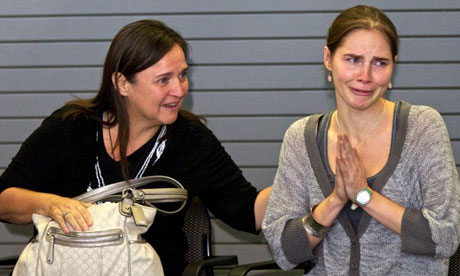
An emotional Amanda Knox and her mother at press conference in Seattle
Thank goodness, Amanda Knox is finally free! Apparently the Prosecutors in Perugia still plan to appeal, but the U.S. should never allow her to be returned to Italy. Years ago, I read a long piece in the NYT about this case, and I was horrified at the accusations that were hurled at this young woman. I never thought she would be convicted in the first place, and that it took this long for the conviction to be reversed is an outrage.
Knox was a victim of anti-Americanism, as Joseph Cannon wrote, but most of all she was a victim of fear and hatred of the feminine. There’s a very good article in the LA Times today by Nina Burleigh that I think most women can identify with, although the misogyny and superstition behind the Knox conviction were extremely bizarre. Burleigh writes:
There was almost no material evidence linking Knox or her boyfriend to the murder, and no motive, while there was voluminous evidence — material and circumstantial — implicating a third person, a man, whose name one almost never read in accounts of the case. It became clear that it wasn’t facts but Knox — her femaleness, her Americaness, her beauty — that was driving the case.
In person, in prison and in the media, Knox was subjected to all manner of outlandish, misogynistic behavior. A prison “doctor” (he has never stepped forward publicly) tested a sample of Knox’s blood and then informed her she was HIV-positive, prompting Knox to list every man she’d had sex with. Authorities passed the names of seven men to reporters from the British tabloid pack, who printed it. Soon thereafter, Knox was told the doctor was mistaken and she didn’t have AIDS.
Outside prison walls, Italian criminologists were opining in the media and eventually on the witness stand that because the body had been covered with a blanket, the killer was surely female because such an act was evidence of feminine “pieta.”
Finally, there were the prosecution’s operatic closing arguments, repeated almost verbatim in the appeal that ended last week. Knox was a “luciferina” — a she-devil — capable of a special, female duplicity. She was “dirty on the inside.” Always, even from the defense lawyers, the closing arguments ended with appeals to God, in a medieval courtroom with a peeling fresco of the Madonna on the wall and a crucifix hanging above the judge.
Long story short: Knox returned from visiting her boyfriend on the night after Halloween in 2007 to find her roommate Meredith Kercher raped and murdered. Although, as Nina Burleigh points out in the LA Times article linked above, 1 in 5 women in Europe have been sexually assaulted and 98% of the perpetrators are men, Knox and her boyfriend were immediately suspected.
A local man, Rudy Guede, was convicted of the crime in 2008. But that wasn’t good enough for the prosecutor. He made up a story out of whole cloth: the story of an American girl who was a “witch” and had masterminded the Satanic rape and murder of her roommate. Never mind that Knox was a naive young woman who hadn’t even had a boyfriend until she was 19. She had dreamed all her life of going to college in Italy, and had worked multiple jobs during high school to save up the money to go to Perugia. What possible motive could she have had to organize this horrible crime just a a couple of months after she had achieved her dream?

Prosecutor Giuliano Mignini
From the New York Post, another article by Nina Burleigh:
The story of Amanda Knox in Italy is of media, misogyny, mistranslation, misbehavior — but chiefly superstition. Kercher’s death was a terrible but simple act of sexual aggression against a young woman in her home. Yet while a prosecutor in the United States might see only the forensic evidence, the motives and the opportunity — the small-town Italian prosecutor Giuliano Mignini saw something more. It was a Halloween crime, and that was one of the first clues to register with Mignini, called to the crime scene fresh from celebrating All Souls’ Day, a day when proper Italian families visit their dead.
And on scene was a pale, light-eyed 20-year-old girl who, prosecutors said in their closing arguments last week, had the look of a “she-devil.”
Mignini always included witch fear in his murder theory, and only reluctantly relinquished it. As late as October 2008, a year after the murder, he told a court that the murder “was premeditated and was in addition a ‘rite’ celebrated on the occasion of the night of Halloween. A sexual and sacrificial rite [that] in the intention of the organizers … should have occurred 24 hours earlier” — on Halloween itself — “but on account of a dinner at the house of horrors, organized by Meredith and Amanda’s Italian flatmates, it was postponed for one day.”
Unbelievable! Read the entire article for some startling insights into the roots of Mignini’s fantasies. I guess we should be grateful that church and state are still somewhat separate in the U.S., but for how long?
Finally, yesterday Knox was freed. Here’s the scene in the courtroom:
Knox arrived in Seattle earlier today, where she spoke to supporters:
“I’m a little overwhelmed right now,” Knox said, adding that looking down from the airplane on her flight home was surreal.
“Thanks to everyone who believed in me, who has defended me, who supported my family,” Knox said before tearing up. “My family’s the most important thing right now and i just want to go be with them.”
Knox then appeared to be too overcome with emotions to continue.
I wish her well, and hope she’ll be able to recover from her nightmarish experience. Meanwhile, we have another example of the extreme misogyny that is still so powerful around the world. Dakinikat gave us another reminder in her post about earlier today. We know from what happened to Hillary in 2008 and the attacks on women’s reproductive freedom that have taken place over the past few years that fear and hatred of women is right below the surface here in the U.S. as well.
Time to Change the Federal Definition of Rape
Posted: September 28, 2011 Filed under: U.S. Politics, Violence against women, Women's Rights | Tags: crime statistics, definition of rape, FBI, rape, sexual assault 15 Comments
Remember awhile back when Republicans in the House tried to pass a law that would allow a woman who had been raped to have an abortion paid for only in the case of “forcible rape?” At the time, there was an uproar on-line and in the corporate media, and the wording of the bill was changed.
At the time, I somehow missed the fact that the official definition used by the FBI in keeping track of crimes statistics not only defines rape as forcible, but also only as vaginal penetration of a female. That leaves out anal and oral rape, rape with objects, and rape of a person who is unconscious, drunk, or drugged by the rapist. It also leaves out rapes of males. Here’s the FBI definition of rape:
“the carnal knowledge of a female, forcibly and against her will”
There’s a story in The New York Times today about efforts to make that definition a whole lot broader and more realistic.
Thousands of sexual assaults that occur in the United States every year are not reflected in the federal government’s yearly crime report because the report uses an archaic definition of rape that is far narrower than the definitions used by most police departments.
This means that local police departments use one definition for their own records and the archaic FBI definition for federal reporting of crime statistics.
“The public has the right to know about the prevalence of crime and violent crime in our communities, and we know that data drives practices, resources, policies and programs,” said Carol Tracy, executive director of the Women’s Law Project in Philadelphia, whose office has campaigned to get the F.B.I. to change its definition of sexual assault. “It’s critical that we strive to have accurate information about this.”
Ms. Tracy spoke Friday at a meeting in Washington, organized by the Police Executive Research Forum, that brought together police chiefs, sex-crime investigators, federal officials and advocates to discuss the limitations of the federal definition and the wider issue of local police departments’ not adequately investigating rape.
So when we hear from the feds that crime rates are dropping, we’re getting false or distorted information, at least as it applied to rape.
According to a September 16, 2010 article at Change.org by Elizabeth Renter, another problem caused by the FBI’s limited definition of rape is that forcible, vaginal rape is the only form of sexual assault that is defined as a Part I office in the FBI’s annual crime report.
While the FBI recognizes other acts as a form of sexual assault, rape is the only crime which they classify as a Part I offense in the Uniform Crime Report, an annually published record of crime rates across the country.
Law enforcement agencies nationwide submit data to the FBI for inclusion in the UCR. Despite this report being completely voluntary, there is said to be a 93 percent participation rate. And though there are always shortcomings and margins of error with any system designed to track crime, the UCR is considered the go-to report when politicians, reporters or other officials need to cite crime statistics. Because of this, it would be in the self serving interest of some agencies to show lower crime rates, to reflect that their crime control techniques are really working when they really aren’t.
But the police wouldn’t do that — would they?
Over the past few years, several metropolitan police forces have come under scrutiny for their handling of rape cases. Baltimore, Philadelphia, New York and Cleveland are just a few cities where law enforcement is alleged to have mishandled or completely ignored reports of rape.
Renter links to a series of investigative articles in the Baltimore Sun that demonstrated that Baltimore Police were discounting more rape reports than any other city in the U.S.
More than 30 percent of the cases investigated by detectives each year are deemed unfounded, five times the national average. Only Louisville and Pittsburgh have reported similar numbers in the recent past, and the number of unfounded rape cases in those cities dropped after police implemented new classification procedures. The increase in unfounded cases comes as the number of rapes reported by Baltimore police has plunged — from 684 in 1995 to 158 in 2009, a decline of nearly 80 percent. Nationally, FBI reports indicate that rapes have fallen 8 percent over the same period.
According to the NYT article linked above, an FBI subcommittee will begin considering a change of their definition of rape on October 18. The New York Times article is the only one I could find dealing with this issue today–except for a reference to the article at the Daily Beast.
Let’s hope other major media outlets pick up this story and run with it. Rape is already assumed to be greatly under-reported. Now we learn that it may not be so much under-reported, but instead minimized or not taken seriously by local police departments.
Missouri school district protects children from critically acclaimed books, but not from rape.
Posted: August 16, 2011 Filed under: Surreality, Violence against women, Women's Rights | Tags: lawsuit, Missouri, rape, Republic School District, sexual assault, sexual harrassment, Springfield, Vern Minor 29 Comments
Vern Minor, Superintendent, Republic School District
This is one of the most outrageous stories I have ever come across. Via Jezabel, the family of a girl in Springfield, Missouri has filed a lawsuit against the Republic School District, claiming the girl was harrassed, sexually assaulted, and raped by a male student on school property.
The suit, filed July 5, alleges when the girl — a special education student — told officials about the harassment, assault and rape that occurred during the 2008-09 school year, they told her they did not believe her. She recanted.
The suit also alleges that, without seeking her mother’s permission, school officials forced the girl to write a letter of apology to the boy and personally deliver it to him. She was then expelled for the rest of the 2008-2009 school year and referred to juvenile authorities for filing a false report.
The suit notes that school officials did not report the girl’s accusation to law enforcement officials, as they are mandated by law to do. Not only that, they apparently didn’t even read the girl’s psychological evaluation–in the school’s files–which described her as “conflict adverse, behaviorally passive” and likely to “forego her own needs and wishes to satisfy the request of others around so she can be accepted.”
In 2010, the girl was “allowed” to return to school, and the harrassment and assaults continued.
In February 2010, the boy allegedly forcibly raped the girl again, this time in the back of the school library. While school officials allegedly expressed skepticism of the girl, her mother took her to the Child Advocacy Center and an exam showed a sexual assault had occurred. DNA in semen found on the girl matched the DNA of the boy she accused, the suit says.
The boy was taken into custody in Juvenile Court and pleaded guilty to charges, the suit says. The specific charges are not stated in the suit.
So there is no question whatsoever that the second rape took place–in the school library! But the school district’s response to the suit claims that the girl’s accusations are “frivolous and have no basis in fact or law.” They further claim that the girl “failed to…protect herself,” and so whatever happened to her was her own fault.
Ironically, this is the same school district that recently banned Kurt Vonnegut’s brilliant novel Slaughterhouse Five and Sara Ockler’s Twenty Boy Summer from their school curricula and libraries. The books were banned by school board members all of whom except one had never read either book, but had been shocked by newspaper column by a Missouri State professor.
Wesley Scroggins, a business professor at Missouri State University, who also pioneered a movement to reshape middle school sex-education classes in Republic’s schools, wrote in a column last year that Vonnegut’s classic contained enough profanity to “make a sailor blush,” and warned that “Twenty Boy Summer” was similarly dangerous.
“In this book,” Scroggins wrote, “drunken teens also end up on the beach, where they use their condoms to have sex.”
Apparently books about consensual sex are wrong, but rapes that take place in the school library are just fine. And if a girl reports being raped, she’ll have to apologize to the boy who did it for speaking up.
This case is very reminiscent of the case of the cheerleader in Texas who was forced to pay damages because she refused to cheer for her rapist, a basketball player. It also reminds me of the case in Muncie, Indiana, in which a girl was raped on school property, and when she reported it, school administrators interrogated the girl and held her for hours in the principal’s office, refusing to report the crime to police.
What is it with school officials who refuse to protect girls from sexual harrassment and rape? The mother of the girl in Muncie is also suing the school system as well as the 16-year-old rapist’s family.
I hope both of these families are successful and that having the pay the settlements will force these school districts to get serious about sexual assault.
Meanwhile, Republic school superintendent Vern Minor should be fired immediately.

 peej
peej Carissa
 bostonboomer
 dakinikat
 ecocatwoman
 mablue2
 Mama Lopez
 peggysue22
 quixote
 skydancingguestblogger
 Mona (aka Wonk the Vote)



 Sky Dancing
Recent Comments