
Tuesday Reads: Margaret Thatcher’s “Dark Legacy,” Death of a Feminist Revolutionary, and Mitch McConnell’s Ugly Plans
Posted: April 9, 2013 Filed under: morning reads, U.S. Politics, War on Women, Women's Rights | Tags: Andrew Sullivan, Ashley Judd, austerity, David Corn, feminist history, Margaret Thatcher, Mitch McConnell, Poverty, Shulamith Firestone, Susan Faludi 33 Comments
Good Morning!!
The death of Margaret Thatcher is still dominating the news this morning. It seems she was one of those public figures that inspired varied but passionate reactions–you either loved her or hated her.
Andrew Sullivan loved her it seems.
I was a teenage Thatcherite, an uber-politics nerd who loved her for her utter lack of apology for who she was. I sensed in her, as others did, a final rebuke to the collectivist, egalitarian oppression of the individual produced by socialism and the stultifying privileges and caste identities of the class system. And part of that identity – the part no one ever truly gave her credit for – was her gender. She came from a small grocer’s shop in a northern town and went on to educate herself in chemistry at Oxford, and then law. To put it mildly, those were not traditional decisions for a young woman with few means in the 1950s. She married a smart businessman, reared two children and forged a political career from scratch in the most male-dominated institution imaginable: the Tory party.
She relished this individualist feminism and wielded it – coining a new and very transitive verb, handbagging, to describe her evisceration of ill-prepared ministers or clueless interviewers. Perhaps in Toynbee’s defense, Thatcher was not a feminist in the left-liberal sense: she never truly reflected on her pioneering role as a female leader; she never appointed a single other woman to her cabinet over eleven years; she was contemptuous toward identity politics; and the only tears she ever deployed (unlike Hillary Clinton) were as she departed from office, ousted by an internal coup, undefeated in any election she had ever run in as party leader.
Her policies “inspired” the revolutionary reactions that created a “cultural transformation.”
Thatcher’s economic liberalization came to culturally transform Britain. Women were empowered by new opportunities; immigrants, especially from South Asia, became engineers of growth; millions owned homes for the first time; the media broke free from union chains and fractured and multiplied in subversive and dynamic ways. Her very draconian posture provoked a punk radicalism in the popular culture that changed a generation. The seeds of today’s multicultural, global London – epitomized by that Olympic ceremony – were sown by Thatcher’s will-power.
And that was why she ultimately failed, as every politician always ultimately does. She wanted to return Britain to the tradition of her thrifty, traditional father; instead she turned it into a country for the likes of her son, a wayward, money-making opportunist. The ripple effect of new money, a new middle class, a new individualism meant that Blair’s re-branded Britain – cool Britannia, with its rave subculture, its fashionistas, its new cuisine, its gay explosion, its street-art, its pop music – was in fact something Blair inherited from Thatcher.
Of course Sullivan no longer lives in Great Britain, and he has the means to avoid the worst effects of the elite’s austerity policies regardless of where he lives. Others aren’t so fortunate.
The Guardian reports: Margaret Thatcher’s death greeted with street parties in Brixton and Glasgow; Crowds shout ‘Maggie Maggie Maggie, dead dead dead’ during impromptu events.
Several hundred people gathered in south London on Monday evening to celebrate Margaret Thatcher‘s death with cans of beer, pints of milk and an impromptu street disco playing the soundtrack to her years in power.
Young and old descended on Brixton, a suburb which weathered two outbreaks of rioting during the Thatcher years. Many expressed jubilation that the leader they loved to hate was no more; others spoke of frustration that her legacy lived on.
To cheers of “Maggie Maggie Maggie, dead dead dead,” posters of Thatcher were held aloft as reggae basslines pounded.
Clive Barger, a 62-year-old adult education tutor, said he had turned out to mark the passing of “one of the vilest abominations of social and economic history”.
He said: “It is a moment to remember. She embodied everything that was so elitist in terms of repressing people who had nothing. She presided over a class war.”
Builder Phil Lewis, 47, a veteran of the 1990 poll tax riots, said he had turned out to recall the political struggles the Thatcher years had embroiled him in. “She ripped the arsehole out of this country and we are still suffering the consequences.”
Just as Ronald Reagan did to the U.S.–and we’re still suffering the consequences.
Here’s a video from Brixton.
Hugo Young, Thatcher biographer, writes in The Guardian: Margaret Thatcher left a dark legacy that has still not disappeared. For Young, a positive was Thatcher’s indifference to her popularity with the public.
I think by far her greatest virtue, in retrospect, is how little she cared if people liked her. She wanted to win, but did not put much faith in the quick smile. She needed followers, as long as they went in her frequently unpopular directions. This is a political style, an aesthetic even, that has disappeared from view. The machinery of modern political management – polls, consulting, focus groups – is deployed mainly to discover what will make a party and politician better liked, or worse, disliked. Though the Thatcher years could also be called the Saatchi years, reaching a new level of presentational sophistication in the annals of British politics, they weren’t about getting the leader liked. Respected, viewed with awe, a conviction politician, but if liking came into it, that was an accident.
But this attitude “didn’t come without a price” and “Thatcher left a dark legacy…”
What happened at the hands of this woman’s indifference to sentiment and good sense in the early 1980s brought unnecessary calamity to the lives of several million people who lost their jobs. It led to riots that nobody needed. More insidiously, it fathered a mood of tolerated harshness. Materialistic individualism was blessed as a virtue, the driver of national success. Everything was justified as long as it made money – and this, too, is still with us.
Thatcherism failed to destroy the welfare state. The lady was too shrewd to try that, and barely succeeded in reducing the share of the national income taken by the public sector. But the sense of community evaporated. There turned out to be no such thing as society, at least in the sense we used to understand it. Whether pushing each other off the road, barging past social rivals, beating up rival soccer fans, or idolising wealth as the only measure of virtue, Brits became more unpleasant to be with. This regrettable transformation was blessed by a leader who probably did not know it was happening because she didn’t care if it happened or not. But it did, and the consequences seem impossible to reverse….
[I]t’s now easier to see the scale of the setback she inflicted on Britain’s idea of its own future. Nations need to know the big picture of where they belong and, coinciding with the Thatcher appearance at the top, clarity had apparently broken through the clouds of historic ambivalence.
At least the British media isn’t trying to canonize Thatcher as the corporate media in the U.S. did to Reagan.
A Less Remarked Upon Death: Shulamith Firestone
At The New Yorker, Susan Faludi pays tribute to a feminist icon of the 1970s, “Death of a Revolutionary: Shulamith Firestone helped to create a new society. But she couldn’t live in it.”
When Shulamith Firestone’s body was found late last August, in her studio apartment on the fifth floor of a tenement walkup on East Tenth Street, she had been dead for some days. She was sixty-seven, and she had battled schizophrenia for decades, surviving on public assistance. There was no food in the apartment, and one theory is that Firestone starved, though no autopsy was conducted, by preference of her Orthodox Jewish family. Such a solitary demise would have been unimaginable to anyone who knew Firestone in the late nineteen-sixties, when she was at the epicenter of the radical-feminist movement, surrounded by some of the same women who, a month after her death, gathered in St. Mark’s Church In-the-Bowery, to pay their respects.
The memorial service verged on radical-feminist revival. Women distributed flyers on consciousness-raising, and displayed copies of texts published by the Redstockings, a New York group that Firestone co-founded. The WBAI radio host Fran Luck called for the Tenth Street studio to be named the Shulamith Firestone Memorial Apartment, and rented “in perpetuity” to “an older and meaningful feminist.” Kathie Sarachild, who had pioneered consciousness-raising and coined the slogan “Sisterhood Is Powerful,” in 1968, proposed convening a Shulamith Firestone Women’s Liberation Memorial Conference on What Is to Be Done. After several calls from the dais to “seize the moment” and “keep it going,” a dozen women decamped to an organizing meeting at Sarachild’s apartment.
I well remember reading Firestone’s book, The Dialectic of Sex: The Case for Feminist Revolution. It was mind-blowing stuff in those days.
In the late nineteen-sixties, Firestone and a small cadre of her “sisters” were at the radical edge of a movement that profoundly changed American society. At the time, women held almost no major elected positions, nearly every prestigious profession was a male preserve, homemaking was women’s highest calling, abortion was virtually illegal, and rape was a stigma to be borne in silence. Feminism had been in the doldrums ever since the first wave of the American women’s movement won the vote, in 1920, and lost the struggle for greater emancipation. Feminist energy was first co-opted by Jazz Age consumerism, then buried in decades of economic depression and war, until the dissatisfactions of postwar women, famously described by Betty Friedan in “The Feminine Mystique” (1963), gave rise to a “second wave” of feminism. The radical feminists emerged alongside a more moderate women’s movement, forged by such groups as the National Organization for Women, founded in 1966 by Friedan, Aileen Hernandez, and others, and championed by such publications as Ms., founded in 1972 by Gloria Steinem and Letty Cottin Pogrebin. That movement sought, as now’s statement of purpose put it, “to bring women into full participation in the mainstream of American society,” largely by means of equal pay and equal representation. The radical feminists, by contrast, wanted to reconceive public life and private life entirely.
What a brilliant tribute by Faludi. It’s well worth the read.
Mother Jones’s David Corn has gotten his hands on a tape of “a private meeting between the Senate GOP leader and campaign aides reveals how far they were willing to go to defeat” Ashley Judd.
On February 2, Mitch McConnell, the Republican leader in the US Senate, opened up his 2014 reelection campaign headquarters in Louisville, Kentucky, and in front of several dozen supporters vowed to “point out” the weaknesses of any opponent fielded by the Democrats. “They want to fight? We’re ready,” he declared. McConnell was serious: Later that day, he was huddling with aides in a private meeting to discuss how to attack his possible Democratic foes, including actor/activist Ashley Judd, who was then contemplating challenging the minority leader. During this strategy session—a recording of which was obtained by Mother Jones—McConnell and his aides considered assaulting Judd for her past struggles with depression and for her religious views….
For much of the Judd discussion, McConnell was silent as aides reviewed the initial oppo research they had collected on Judd and weighed all the ways they could pummel her. The recording was provided to Mother Jones last week by a source who requested anonymity. (The recording can be found here; a transcript is here.) McConnell’s Senate office and his campaign office did not respond to requests for comment.
The aide who led the meeting began his presentation with a touch of glee: “I refer to [Judd] as sort of the oppo research situation where there’s a haystack of needles, just because truly, there’s such a wealth of material.” He ran through the obvious: Judd was a prominent supporter of President Barack Obama, Obamacare, abortion rights, gay marriage, and climate change action. He pointed out that she is “anti-coal.”
But the McConnell gang explored going far beyond Judd’s politics and policy preferences. This included her mental health. The meeting leader noted:
She’s clearly, this sounds extreme, but she is emotionally unbalanced. I mean it’s been documented. Jesse can go in chapter and verse from her autobiography about, you know, she’s suffered some suicidal tendencies. She was hospitalized for 42 days when she had a mental breakdown in the ’90s.
So what? Mitch McConnell is a sick, closeted, hateful old freak who appears to lack any semblance of human feelings.
I’m running out of space, so I’ll add a few more links in the comments. I hope you’ll do the same. What are you reading and blogging about today?
Monday Reads
Posted: November 12, 2012 Filed under: morning reads | Tags: fiscal ramp, Poverty, Romney fail 54 Comments Good Morning!
The most recent vivisection of Mitt Romney’s political career is in the NY Review of Books and is written by Garry Wills. It looks at a batch of losers and wonders which path Romney will choose. My guess is it will have nothing to do outside of the realm of increasing his personal wealth or church standing. Shallow Mitt will continue his life in the bubble.
What public service do we expect from Mitt Romney? He will no doubt return to augmenting his vast and hidden wealth, with no more pesky questions about where around the world it is stashed, or what taxes (if any) he paid, carefully sheltered from the rules his fellow citizens follow.
Barry Goldwater, after his massive defeat, stayed true enough to his principled conservatism that the modern Republican Party was a beneficiary of his legacy—a beneficiary but not the determiner of that legacy. It was Goldwater himself who told the heir to his influence, Richard Nixon, that it was time to cleanse the White House by leaving it. Though Goldwater was a factor in the Southern strategy of Nixon, he was no racist, and no fanatic of any stripe. He was an acidulous critic of the religious right and a strong advocate for women’s rights (like abortion). He had backbone.
What vestige of a backbone is Romney left with? Things he was once proud of —health-care guarantees, opposition to noxious emissions, support of gay rights and women’s rights, he had the shamelessness to treat as matters of shame all through his years-long crawl to the Republican nomination.
Other defeated candidates compiled stellar records after they lost. Two of them later won the Nobel Prize—Jimmy Carter for international diplomacy, Al Gore for his environmental advocacy. John Kerry is still an important voice for the principles he has always believed in as a Democrat. Michael Dukakis carries on as the college professor he always was, with no need to reject or rediscover any of the policies he championed. Robert Dole joined with McGovern in international nutritional projects.
One of the most off-the-wall suggestions was offered on MTP. Historian Doris Kerns Goodwin suggested that Shallow Mitt should join the Obama administration as some kind of jobs czar. WTF has she been smoking? Why would any one want to hire the father of shipping jobs to China to oversee bringing jobs back to the US? Why would Obama want this race baiter in his administration? The man specialized in stuff that wrecked the country? What could we possibly learn from him but how to damage the US for personal wealth and gain?
Pulling Romney in as a business czar for the Obama administration is a popular idea being volleyed around among liberal circles. Recently, a CNN panel enthusiastically endorsed Romney for Secretary of Business. Perhaps Romney’s opinion of adding a new office to government was forgotten.
“I don’t think adding a new chair in his cabinet will help add millions of jobs on Main Street,” Romney said while on the campaign trail, adding, “His solution to everything is to add another bureaucrat … I don’t think adding a new chair in his Cabinet will help add millions of jobs on Main Street. We
don’t need a Secretary of Business to understand business. We need a president who understands business.” The idea that Romney would accept the position of “another bureaucrat” is as likely as Obama repealing and replacing Obamacare.
Kerns dropped this suggestion right in the middle of a discussion about the economy, the fiscal cliff, the problem of declining growth of business, and a “mandate to compromise.” The host, David Gregory, agreed recent polls indicated a majority favored Romney over Obama to fix the economy, put America back to work and grow business.
Disco Dave’s Dance Party has reached a new level of irrelevance. I would have never thought that possible.
Melissa Harris-Perry turns the national conversation to poverty and reminds us that ‘Those Aren’t Numbers. Those Are People’.
MSNBC host Melissa Harris-Perry debut a new regular segment Sunday focusing on poverty, which she noted many people did not want to touch, even as the national poverty rate remained at 15 percent of the population last year, or just over 46 million people, with 21.9 percent of them being minors.
“Let me be crystal clear,” she said. “Those aren’t numbers. Those are people.”
President Barack Obama’s administration, Harris-Perry noted, has already at least broached the subject; days before his re-election, a campaign spokesperson cited programs like Choice Neighborhoods, Promise Neighborhoods and others in a response to The Nation as proof Obama took the issue seriously.
You can watch her panel on the main link.
Yesterday, I wrote a post talking about the crazy fairy tales that Republicans tell themselves and others about trickle down economics. It’s been shown to be a failure by every empirical study possible and yet, they still won’t give it up. It’s so bad that they are still pushing the voted-down Romney version of it as the answer to the fiscal curb.
Sen. Saxby Chambliss (R-GA): On ABC’s This Week, Chambliss said, “Bowles-Simpson said, look, eliminate all these tax credits and tax deductions. You can generate somewhere 1 to 1.2 trillion in additional revenue. You can actually lower tax rates by doing that. And I think at the end of the day, what’s got to happen, George, we’ve got to get this economy going again.
Rep. Tom Cole (R-OK): In a Friday column, House Budget Committee member Cole wrote: “However, raising tax rates is not the only way to increase revenue, nor is it the best way. Speaker Boehner has proposed comprehensive tax reform to raise revenue and lower rates. Eliminating inefficient loopholes and deductions will generate economic growth while creating a simpler, fairer tax code.”
Rep. Kevin Brady (R-TX): In a Wednesday Tweet, House Ways and Means Committee member Brady opined: “Stronger economic growth from tax reform that lowers rates and closes loopholes will generate higher revenue to bring the deficit down.
Rep. Eric Cantor (R-VA): In a letter to his Republican caucus, the House Majority Leader wrote: “What would be best is a fundamental reform of the tax code that lowers rates, broadens the base, makes America’s businesses competitive again, and reduces the burden imposed by taxes on work and investment.”
Rep. Dave Camp (R-MI): In a Wednesday press release, the House Ways and Means Chairman wrote: “There is a better path forward than simply increasing tax rates, and one in which both sides can claim victory. We can address both our jobs crisis and our debt crisis by focusing on tax reform that strengthens the economy. There is bipartisan support for tax reform that closes loopholes and lowers rates.”
Rep. Tom Price (R-GA): On Fox News Sunday, House Republican Policy Committee Chairman Price, a member of both the Ways and Means and Budget Committees, said “We can increase revenue without increasing the tax rates on anybody in this country.”
I’m not sure if you waded through my wonk yesterday, but just recently the CBO announce there would be no significant damage done to the economy should Congress let the Bush Tax Cuts expire for the wealthiest Americans.
The non-partisan Congressional Budget Office says there will be no significant negative impact on the economy should the lower rates on the wealthiest Americans be allowed to expire. And the notion that lowering rates will magically create more revenue is indeed a right-wing pipe dream.
There’s one more look at how the Romney loss has highlighted differences in the US population. This break down shows the regional clashes as analyzed by Colin Woodward at Bloomberg. There’s some interesting looks at why the Appalachia region may not have taken to Obama’s messages.
President Barack Obama explicitly embraced the notion that we are all in the same boat, that we will succeed or fail as a community, that the successful ought to make sacrifices for the common good. On the stump and in his victory speech, he presented these as American ideals, and they are in the sense that they are the central founding principles of Yankeedom, the section of the country colonized by the early Puritans and their descendants. The Puritans believed they were God’s chosen people and, as such, would be rewarded or punished collectively. They came to this continent to create a religious utopia, a “light on the hill,” a godly community to serve as an example for the world. Ever since, Yankees have had faith in their ability to engineer a more perfect society through public institutions. Their culture, more than any other, has prized the common good above individual aspiration, often celebrating self-denial as a virtue.
Many other, equally American cultures look upon this philosophy with skepticism, even revulsion, and none more so than the people of Greater Appalachia. This nation was founded in the early 18th century by wave upon wave of rough, bellicose settlers from the war-ravaged borderlands of Northern Ireland, northern England and the Scottish lowlands, whose culture included a warrior ethic and deep commitments to individual liberty. Here “freedom” is broadly understood to mean having the fewest possible encumbrances on individual action. If Yankee ideology seeks to make a community free of tyrants, Appalachia’s sticks up for each person’s freedom to become a tyrant.
Jonathan Chait says we did in fact have a class war during the election season this year.
The telling phrase came when Obama turned away from the thank-yous and patriotic hymnals into the guts of his remarks. “Despite all our differences,” he transitioned, “most of us share certain hopes for America’s future.” The key term here is “most,” as opposed to “all”—“most” meaning less than 100 percent and possibly as little as 51 percent. He attributed to most Americans a desire for great schools, a desire to limit debt and inequality: “a generous America, a compassionate America.”
Obama then proceeded to define the American idea in a way that excludes the makers-versus-takers conception of individual responsibility propounded by Paul Ryan and the tea party. Since Obama took office, angry men in Colonial garb or on Fox News have harped on “American exceptionalism,” which boils our national virtue down to the freedom from having to subsidize some other sap’s health insurance. Obama turned this on its head. “What makes America exceptional,” he announced, “are the bonds that hold together the most diverse nation on Earth. The belief that our destiny is shared; that this country only works when we accept certain obligations to one another and to future generations.” Obama invoked average Americans living out this ethos of mutual responsibility (such as a “family business whose owners would rather cut their own pay than lay off their neighbors,” the example of which stands at odds with the corporate ethos of a certain Boston-based private-equity executive). And even the line about red states and blue states began with the following statement: “We are greater than the sum of our individual ambitions.”
Presumably more was at work here than mere uplift. The president was establishing the meaning of his victory. Even in the days leading up to Tuesday, clouds of dismissal had already begun to hover overhead. The election was “small,” in the words of one story in the conventional-wisdom-generating machine Politico, and “too narrow and too rooted in the Democratic base to grant him anything close to a mandate,” in the words of another. “I don’t think the Obama victory is a policy victory,” sniffed Romney adviser Kevin Hassett. “In the end what mattered was that it was about Bain and frightening people that Romney is an evil capitalist.”
Like every president, Obama won for myriad reasons, important and petty. But his reelection was hardly small and hardly devoid of ideas. Indeed, it was entirely about a single idea. The campaign, from beginning to end, was an extended argument about economic class.
So, that’s some of the things that I’ve been reading. What’s on your reading and blogging list today?
Friday Reads
Posted: June 1, 2012 Filed under: morning reads | Tags: Climate change, global warming, Poverty, PRENDA 44 Comments Good Morning!
We passed an ominous milestone recently. Have we crossed the Rubicon with climate change?
Monitoring stations in the Arctic have confirmed atmospheric carbon dioxide measurements exceeding 400 parts per million (ppm), far past the acknowledged safe limit of 350 ppm.
Global levels of carbon dioxide—the most prevalent heat-trapping gas—are around 395 ppm, but Arctic levels signal where global trends are headed, and scientists are confident that levels will soon eclipse this ominous milestone worldwide.
According to the Washington Post, Jim Butler, the global monitoring director at the National Oceanic and Atmospheric Administration’s Earth System Research Lab in Boulder, Colorado, said “The fact that it’s 400 is significant. It’s just a reminder to everybody that we haven’t fixed this and we’re still in trouble.”
Preceding the Industrial Revolution, global levels of carbon dioxide were believed to be around 275 ppm. The meteoric rise in carbon pollution is mainly attributed to fossil fuel dependence, such as burning coal and oil for gasoline. Forest depletion and oceanic biodiversity loss complicate matters by diminishing nature’s ability to absorb and repurpose carbon dioxide.
According to the Christian Science Monitor, former Vice President Al Gore wrote via email, “The news today, that some stations have measured concentrations above 400 ppm in the atmosphere, is further evidence that the world’s political leaders—with a few honorable exceptions—are failing catastrophically to address the climate crisis. History will not understand or forgive them.”
The UK Guardian reports that 28 top US corporations are working hard to block any action meant to prevent or stop climate change.
An analysis of 28 Standard & Poor 500 publicly traded companies by researchers from the Union of Concerned Scientists exposed a sharp disconnect in some cases between PR message and less visible activities, with companies quietly lobbying against climate policy or funding groups which work to discredit climate science.
The findings are in line with the recent expose of the Heartland Institute. Over the years, the ultra-conservative organisation devoted to discrediting climate science received funds from a long list of companies which had public commitments to sustainability.
The disconnect in this instance was especially stark in the researchers’ analysis of oil giants ConocoPhillips and ExxonMobil, and the electricity company DTE energy.
But even General Electric Company, which ranks climate change as a pillar of its corporate policy on its website, had supported trade groups and thinktanks that misrepresent climate science, the researchers found.
Caterpillar Inc, despite its public commitment to sustainability, also worked behind the scenes to block action on climate change. The company spent more than $16m (£10.3m) on lobbying during the study, with nearly five times as much of that spent lobbying to block climate action than on pro-environmental policies.
Other big corporate players were fairly consistent with their public image. Nike and NRG Energy Inc lobbied in support of climate change policy and supported conservation groups.
Peabody Energy Corporation, which produces coal, was ranked the most obstructionist of any of the companies. It spent more than $33m to lobby Congress against environmental measures and supporting trade groups and think tanks which spread disinformation about climate science, the researchers found.
“The thing we found most surprising in doing this research is just how all 28 companies expressed concern about climate change,” said Francesca Grifo who heads the UCS scientific integrity programme. “But when we took a deeper look we found that a lot of the actions they took weren’t connected to the messages.”
The result of the disconnect was growing confusion about climate science, the researchers said. That made it more difficult to push for environmental protections.
Republicans continue to chip away at abortion rights. The House is zeroing in on “sex selection” abortions. These are not a big issue in this country but could be a big issue for Republicans because the rhetoric almost always centers on Asian countries in a way that’s offensive to Americans of Asian heritage.
Republicans long ago lost African American voters. They are well on their way to losing Latinos. And if Trent Franks prevails, they may lose Asian Americans, too.
The Arizona Republican’s latest antiabortion salvo to be taken up by the House had a benign name — the Prenatal Nondiscrimination Act — and a premise with which just about everybody agrees: that a woman shouldn’t abort a fetus simply because she wants to have a boy rather than a girl.
The problem with Franks’s proposal is that it’s not entirely clear there is a problem. Sex-selection abortion is a huge tragedy in parts of Asia, but to the extent it’s happening in this country, it’s mostly among Asian immigrants.
For Franks, who previously tried to pass legislation limiting abortions among African Americans and residents of the District of Columbia, it was the latest attempt to protect racial minorities from themselves.
“The practice of sex selection is demonstrably increasing here in the United States, especially but not exclusively in the Asian immigrant community,” he announced on the House floor Wednesday afternoon. He quoted a study finding that male births “for Chinese, Asian Indians and Koreans clearly exceeded biological variation.”
The Bill even has one of those weird Republican names like offensive missiles called “peace keepers.” It’s called PRENDA or Prenatal NonDiscrimination Act.
The Prenatal Nondiscrimination Act (PRENDA), H.R. 3541, was defeated in a 246-168 vote. While that’s a clear majority of the House, Republicans called up the bill under a suspension of House rules, which limits debate and requires a two-thirds majority vote to pass. In this case, it would have required more support from Democrats.
Twenty Democrats voted for the bill, while seven Republicans opposed it. The bill would have needed 30 more yeas to pass.
Suspension votes are normally used for noncontroversial bills, but the GOP-backed measure was clearly controversial. Republicans have occasionally put controversial bills on the suspension calendar in order to highlight that Democrats oppose certain policies.
Boehner said he will try again later. So much for the Republican lies about being all about the jobs.
Just when you think the state Republican groups can’t get more extreme you find out something like this item in Pennsylvania.
Republicans in Luzerne County, Pennsylvania have elected Steve Smith, a lifelong white supremacist with close ties to neo-Nazi groups and groups like Aryan Nations, to the county’s GOP Committee.
The elections, which took place in late April, were certified by the committee two weeks ago, and Smith notified supporters of his victory last week by posting a message to the online forum White News Now.
The Southern Poverty Law Center has documented Smith’s participation with known skinhead organizations like Keystone State Skinheads, (now Keystone United) which he co-founded in 2001. And his racist activism extends far beyond violent rhetoric as well, into actual violence:
In March 2003, he and two other KSS members were arrested in Scranton for beating up Antoni Williams, a black man, using stones and chunks of pavement. Smith pleaded guilty to terrorist threats and ethnic intimidation and received a 60-day sentence and probation.
Smith is also an active member of local Tea Party groups, a network that he used to gain support for his bid for the committee seat. According to the SPLC, Smith referred to the Tea Party as “fertile grounds for our activists.”
Our economy continues to have some of the highest poverty rates in the developed world. Seven million kids and mothers are in poverty. Georgetown Law Professor and advisor to the Kennedys and Bill Clinton explains why this is so devastating to our country’s future as well.
Peter Edelman: Extreme poverty means having an income of less than half the poverty line. That’s less than $9,000 a year for a family of three. The stunning fact is that in 2010, there were 20.5 million people who had incomes that low. And perhaps even more disturbing — 6 million people have no income other than food stamps (SNAP). That means an income at one third of the poverty line or less than $6,000 a year for a family of three. You can’t live on that.
So, these are people who are really in extreme trouble. In fact, many of them will get out of extreme poverty fairly quickly, and that makes it even more inexcusable not to have a basic safety net for them when their income dips so low. How do they survive? We don’t really know. They obviously have to have the support in one way or another of family and friends– if they have such networks. They sleep on couches, they move around a lot. If they can find casual work to get a little extra money, they do. But they are in a very tough place. The percentage of people in extreme poverty has doubled since 1976, so it is getting worse.
Public benefits, which are not counted in official poverty figures insofar as they’re not paid in cash, make the situation a little better, but not much. The fact that there could be 6 million people who only have food stamps is because of another fact: that welfare –Temporary Assistance for Needy Families (TANF) — is basically unavailable in many states in the country. In Wyoming, for example, 4% of poor children in the entire state — that’s 644 people including the mothers — receive cash assistance. In 19 states, fewer than 20% of poor children are receiving cash assistance. So that’s how you can have 6 million people living only on food stamps. About 7 million of those in extreme poverty are mothers and children. We can only imagine the damage that this does to the children. It really is a crisis, and very few people are aware of it.
So those are the stories that I’m following this week. What’s on your reading and blogging list today?
Just Exactly What Qualifies Mitt Romney to be POTUS?
Posted: February 3, 2012 Filed under: 2012 presidential campaign, 2012 primaries, U.S. Economy, U.S. Military, U.S. Politics | Tags: America the Beautiful, Center for American Progress, children in poverty, coal mining, environment, goal mining, lack of qualifications, Mit Romney, National Parks, oil drilling, Poverty, public lands, Romney contributors, Romney super pac 22 Comments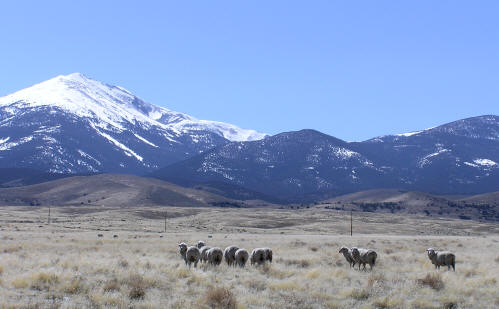
"The purple mountain majesties" of Great Basin National Park
Via Think Progress, yesterday Mitt Romney sat for an interview with the editorial board of the Reno Gazette-Journal. Today, the conservative newspaper endorsed Romney for the Republican nomination in advance of the Nevada caucuses tomorrow.
During the interview, Romney was asked whether, if elected, he would consider permitting the state of Nevada to buy back public lands that are currently held by the Federal government. Here’s his response:
I don’t know the reason that the federal government owns such a large share of Nevada. And when I was in Utah at the Olympics there I heard a similar refrain there. What they were concerned about was that the government would step in and say, “We’re taking this” — which by the way has extraordinary coal reserves — “and we’re not going to let you develop these coal reserves.” I mean, it drove the people nuts. Unless there’s a valid, and legitimate, and compelling governmental purpose, I don’t know why the government owns so much of this land.
So I haven’t studied it, what the purpose is of the land, so I don’t want to say, “Oh, I’m about to hand it over.” But where government ownership of land is designed to satisfy, let’s say, the most extreme environmentalists, from keeping a population from developing their coal, their gold, their other resources for the benefit of the state, I would find that to be unacceptable.
Public lands in Nevada – and other western states—actually provide an enormous economic boost and sustain hundreds of thousands of jobs. Indeed, recent Interior Department statistics show that federally managed public lands in Nevada provided over $1 billion in economic impacts and supported 13,311 jobs in 2010 (and this statistic doesn’t even include the economic impacts of Forest Service lands, managed by the Department of Agriculture). Recreation, energy and minerals, and grazing and timber all play a part in the economic effects that public lands provide to Nevada. Activities like skiing at Lake Tahoe, boating at Lake Mead, and hiking at Great Basin National Park all take place on public lands.
Do you suppose Romney has even heard of Teddy Roosevelt? Or was the conservationist President insufficiently “conservative” for today’s Republican Party? Today “conservatives” don’t seem to care about conserving the beauty of nature for all Americans. It sounds like Romney is more interested in milking public lands for coal, gold, and oil than preserving their beauty so that in the future children can learn “to fall in love with America” as he was able to do? (h/t Think Progress).
A couple of days ago in, Romney sang “America the Beautiful” at a campaign appearance at a retirement community in Florida.
But what will Romney’s policies do to the beauty of our country? The folks at Think Progress made a video about it.
What else hasn’t Mitt Romney “studied” about our country? Well, he doesn’t seem to be aware that America’s social safety net is pretty weak and that his economic policies will completely shred what’s left of social programs like food stamps, Medicaid, Medicare, and Social Security.
Romney doesn’t seem to be aware that the number of Americans living in “deep poverty” is the highest it’s been in 35 years.
More than 20 million Americans live in a household with income of less than half the federal poverty rate, the level social scientists often use as a category for the very poor, according to census data for 2010. Last year that meant an annual income below $11,057 for a family of four.
The portion of the population in that category was the highest in at least 35 years and has almost doubled since 1975, from 3.7 percent then to 6.7 percent in 2010.
Romney told CNN on Feb. 1 that “I’m not concerned about the very poor” because they have many programs to help them. He later clarified his remarks, telling reporters on his campaign plane that low-income people have an “ample safety net,” including Medicaid, housing vouchers, food stamps and the Earned Income Tax Credit.
I wonder if Romney knows that one in five American children lives in deep poverty? Frankly, I doubt it. And just think of all those fetuses who don’t get proper nutrition and health care because their pregnant mothers are poverty-stricken. Mitt probably hasn’t “studied” that yet, because he really just doesn’t care.
Now Romney is claiming he “misspoke” when he told CNN’s Soledad O’Brien–twice!–that he’s not concerned about the very poor, because they have an “ample safety net.” But O’Brien doesn’t buy it. And, as NPR points out Romney even made the same remark about the poor to the press corps on his campaign plane after the CNN interview.
So what has Romney “studied?” And if he hasn’t familiarized himself with two of the most important issues facing Americans today–the environment and poverty–why on earth does he want to be president anyway? Is it because he’s an expert on foreign policy? Well, no. Not really.
So why does this man want to be President of the United States? He’s repeatedly told us that he knows how to create jobs and manage an economy. But then, why didn’t he do that when he was governor of Massachusetts?
Numbers are important in evaluating Mitt Romney, but the focus should not be on the $250 million estimated fortune he amassed at Bain Capital, or the $374,00 in speaking fees he took in last year, or even on the roughly 15 federal percent tax rate he paid.
The most important number is 47 — Massachusetts’s rank in job creation when he was governor. This is the number that most calls into question Romney’s own current job application.No job is comparable to the presidency, but the closest thing to it is governor of a large state — an executive position in public office, where the welfare of millions of people is the charge. Unlike a corporate executive, whose overriding goal is to make profits for investors, the president and governors have the same central goal — improving the well-being of the entire population. The first priority, usually, is the overall economy.
Indeed, Romney won office in 2002, after shouldering aside Acting Governor Jane Swift, with a pledge to use his business experience and connections to bring jobs to Massachusetts. He failed, dreadfully.The 47 figure is one Romney cannot escape. During his four years in office, Massachusetts ranked 47th in overall job growth — only 0.9 percent compared with 5.3 percent nationally. Romney has countered that the unemployment went down appreciably — from 5.6 percent to 4.7 percent during his term.
How could so few new jobs translate into a healthy-looking decline in unemployment? The answer is simple — and not so healthy: Working-age adults were packing up and moving out. Many were replaced, fortunately, by immigrants. But overall, Massachusetts was one of only two states to have no growth in its resident labor force during Romney’s term.
So what exactly qualifies Mitt Romney to be President of the U.S.? And why does he want the job? Perhaps it has something to do with the folks that are funding his campaign?
Goldman Sachs $496,430
JPMorgan Chase & Co $317,400
Morgan Stanley $277,850
Credit Suisse Group $276,250
Citigroup Inc $267,050
Bank of America $211,650
Barclays $203,650
Kirkland & Ellis $201,701
HIG Capital $188,500
PriceWaterhouseCoopers $179,300
Blackstone Group $170,550
Bain Capital $144,000
EMC Corp $127,800
Wells Fargo $126,200
UBS AG $123,900
Elliott Management $121,000
Citadel Investment Group $118,625
Bain & Co $116,050
The Villages $98,300
Sullivan & Cromwell $97,150
Or maybe the moguls who are funding his super pac “Restore Our Future,” 10 of whom gave $1 million or more?
What will become of “America the Beautiful” if Romney and his multimillion-dollar backers achieve their goals?
Blame or Shame? When It Comes to America’s Kids, Where Do We Stand?
Posted: October 13, 2011 Filed under: children, U.S. Economy, U.S. Politics | Tags: children, food insecurity, hunger, obesity, Poverty 38 Comments
Don’t know about you but to me the blame game has hit the hyper-drive button. Whether it be Fundamentalists claiming that the country’s economic difficulties are God’s payback for licentious living or Herman Cain pointing to the unemployed as being responsible for their own unemployed status, the mounting accusations are deafening and ultimately unproductive. The Right blames the Left; the Left blames the Right. Libertarians blame anything that smacks of cooperative, interdependent governance, yearning for circa 1900, a Paradise Lost. And the Anarchists? They blame the world.
The one segment of the population that has virtually no voice over the current US economic tailspin are the children. But like any vulnerable, powerless group, they are caught in the crosshairs.
A recent headline not only caught my attention but stunned me by its implications. One in four American children are now categorized as “food insecure.” I initially misread this label as ‘hungry, absolutely food deprived.’
Not necessarily true.
According to a report sponsored by the Institute of Medicine (IOM) food insecurity is defined as follows:
Limited or uncertain ability to acquire acceptable foods in socially acceptable ways (Anderson, 1990).
The IOM points out that this ‘insecurity’ can be cyclical in nature. Mom and/or Dad have work one month with adequate hours and money to buy food for the family and the next month their hours are cut. Less hours, less money, less food. Or, as is the case for many middle-class families, the jobs they once depended on simply vanish and nutrition suffers. Or a family is living on a meager monthly wage that runs out before the month is over; so food is available at the beginning of the month and in short supply as the month goes on. Walmart has confirmed this cyclical nature, reporting that their customers, many of whom are low-wage or government-assisted households, are running out of funds before the end of each month. The company has spotted the pattern in their sales records—thin at the end of the month, a big spike at the start. The rising cost of food has only complicated matters.
But wait! Haven’t we been awash in data warning about the growing problem with childhood obesity? Michelle Obama has used her office as First Lady to address not only the problem but accompanying health concerns–diabetes, for instance, a silent killer and a condition that’s expensive to treat. How can we have food insecurity and obesity at the same time? A paradox, for sure.
Again, not necessarily.
A study reported in the American Journal of Clinical Nutrition (Drewnowski A, Specter SE. Poverty and obesity) indicates that meager incomes will affect a family’s behavior when it comes to food. When faced with bills to pay—rent, utilities, expenses to get to and from work, etc.—a family head will limit funds to those needs where the cost is not fixed. This behavior directly impacts the purchase and selection of food. When purchases are made, low-income families will steer towards calorie-dense foods, selections high in sugar and fat but low in cost.
You gotta do what you gotta do, as my Mama once said.
Though there is contradictory data for the effects of calorie-dense food on children, particularly young children, we do have data indicating the link between food selection and obesity in low-income women. This from the IMO:
Researchers and the public increasingly are recognizing that obesity and food insecurity co-exist in the same families, communities, and even the same individuals. For example, recent research suggests that household food insecurity may be related to increased weight in women.
The paradox is explained, at least in part: food insecurity is linked to poverty and particular food selection, which can play havoc on weight. This makes sense to any of us who have had weight problems [Peggy Sue raises her hand because of a childhood weight problem]. Genetics, metabolism, emotional factors, physical activity are certainly factors, too. But food selection plays an important role. Nutritional experts are now seriously questioning the sort of foods we’re feeding our kids in school programs and other government-assisted nutritional outreaches.
Finally, symbolizing the growing number of American kids in poverty and those tumbling into the ‘food insecurity’ category, Sesame Street has added a new, cameo-appearing Muppet—Lily, the hungry kid. This move has already come under attack by PBS critics, who claim that this is simply another ploy to reinforce the Nanny State, a pulling of heart strings by left-of-center activists.
But here’s what we know: 25% of American children are now categorized as ‘food insecure.’ That represents 17 million children, a number which spikes during the summer when school is in recess. Food insecurity can result in cyclical, end-of-the-month nutritional deficits and/or possible obesity because of calorie-dense food selection. Our children, all our children, represent the future.
Who do we blame? It’s easy, even tempting to point fingers or take self-righteous, politically-charged stands.
But if we continue the blame game, point fingers without pushing to alleviate our rising poverty rates and the subsequent food insecurity of our children? Then shame on us.
Additional information can be found at Feeding America:
The stats on rising poverty and food insecurity in the US are nothing short of . . . staggering.
And check out Map the Meal Gap, where you can see how your state, your region measures up in food security/insecurity statistics:
http://feedingamerica.org/hunger-in-america/hunger-studies/map-the-meal-gap.aspx
A final note: I am very happy to be joining the fine staff of Sky Dancing. Everyone has been kind, encouraging and helpful as I put my toe in the water. This is a new venture for me, a different sort of writing than I normally do. But I’m looking forward to join the discussion and analyses from a different vantage point. And learn as I go.

 peej
peej Carissa
 bostonboomer
 dakinikat
 ecocatwoman
 mablue2
 Mama Lopez
 peggysue22
 quixote
 skydancingguestblogger
 Mona (aka Wonk the Vote)



 Sky Dancing
Recent Comments