
Republicans in Wonderland
Posted: May 21, 2011 Filed under: 2012 presidential campaign, Economy | Tags: fiat currency, flat tax, Herman Cain, lies, Mitt Romney, Politico, Tim Pawlenty, voodoo economics 21 Comments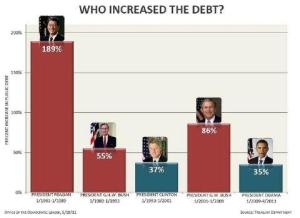 Republicans embrace and peddle voodoo economic memes whereever they can. They all hold Ronald Reagan up as the godfather of great economics. Just look at that graph to determine who exactly is responsible for the current deficit which they all think is a terrible problem. Even odder are their “unorthodox” economic policy prescriptions. Here’s some of the more egregious suggestions as provided by Politico.
The Republican field is filled with potential candidates who have called for radical overhauls of the tax code, the abolition of the IRS, an end to the Federal Reserve central bank— and even a return to the gold standard.
Oddly enough, Mitt Romney is the only one that actually talks real economics. The rest of them are in some bizarro world where math never adds up. If Tim Pawlenty hasn’t disappeared by 6 pm CST, we may have to deal with his odd views in a debate where odd views will prevail. Pawlenty is scheduled to announce his candidacy on Monday.
In one particularly striking recent moment, former Minnesota Gov. Tim Pawlenty railed against “fiat currency” in a recent appearance on Fox — a signal to a narrow constituency of voters who believe that America’s woes began when it abandoned the gold standard in the 1930s. He also has gone on the record supporting a flat tax — a single-rate income tax that would eliminate the bracket system. The single tax rate for all is a simple concept but would probably involve wiping out the current tax code — including many popular deductions and credits — just to generate enough revenue.
“I support a flatter tax rate. I don’t know if we can get to a flat tax in one leap, but moving in a flatter, more transparent direction, absolutely,” Pawlenty said on Larry Kudlow’s CNBC show in March.
Newt Gingrich has also indicated support for an across the board 15% flat tax.
Gov. Mitch Danielscalled for a value-added national sales tax paired with a flat tax. (Jon Huntsman passed a flat tax as governor of Utah, but hasn’t articulated a national platform.) And Paul wants no income or sales taxes at all, envisioning a government funded with tariffs, highway fees and excise taxes.
Further into the field, the plans get more exotic.
Herman Cain has backed the ‘Fair Tax’ plan, a proposal with a small, well-organized and vocal constituency, which would impose a national sales tax of just under 25 percent and abolish the income tax system. He has also backed a possible return to the gold standard — but only after we “significantly pay down our national debt, stabilize and grow our economy,” spokeswoman Ellen Carmichael told POLITICO.
Our economy has always used a progressive tax rate. We’ve never really considered value-added taxes or national sales taxes because we know these kinds of taxes hit the poor hardest. Social Security is about the only real regressive tax that’s been enacted. However, disabling a reasonable capital gains tax has giving enormous wealth to the major rich who receive bonuses and inherit trust funds. The suggested Republican tax schemes are most likely unworkable and would hit the middle class hard. This would be especially true of those who are financing homes.
The odd calls for gold standards, eliminating the Federal Reserve Bank, and possibly even ending fiat currency are all insane suggestions that shouldn’t even merit a public platform. Academic research has indicated that monetary policy has been mostly effective since the 1980s in achieving its intent. Also, the Fed’s structure and laws have been copied by every other economic entity that’s formed within recent history because it’s been so successful. The most important aspect is to keep monetary policy out of the hands of politicians.
“Fiscal policy, I can see how we might want to have a broader debate. With monetary policy, it’s harder to see that,” said Mark Zandi, chief economist of Moody’s Analytics. “The strong consensus view is that the Fed has done a very good job — that it was put in a very difficult position.”
“I think there’s less sympathy for the argument that Federal Reserve needs a significant overhaul,” said Zandi.
But, facts and peer-reviewed research don’t appear to phase these folks.
Sen. Jim DeMint (R-S.C.), a supporter of the Fair Tax, faced attacks in his own state for supporting what Democrats cast as a massive sales tax increase. Gleeful Democrats simply neglected to mention that DeMint’s proposed policy would have also abolished the IRS. Similar attacks on Fair Tax candidates have occurred in other races. And this cycle, Herman Cain has already faced a similar tough questioning about his support for the Fair Tax in the most recent GOP presidential debate.
“According to the experts, the practical effect of a Fair Tax would be a tax cut for the wealthy and a tax increase for the middle class,” Fox’s Chris Wallace pointed out.
“Your experts are dead wrong — because I have studied the Fair Tax for a long time,” said Cain to loud audience applause.
So, who would you believe? Economists or some CEO of a small time pizza chain? The fact that these guys get a pretty receptive audience in the GOP is appalling until you see where the support comes from. For some reason, the GOP has done a pretty good job ginning up support via xenophobic, homophobic, and gynophobic dog whistles and making economic statements that were never true and would never happen. Since their voters reward them, there appears to be no end to the insane suggestions for economic policy that comes out of their mouths.
Monday Reads
Posted: November 1, 2010 Filed under: morning reads | Tags: midterm elections, Politico, protesting, Russ Feingold 32 Comments
Good Morning!!!
It’s the morning before America gets to grind its axe in polling places around the country. It’s still looking bleak for the Democratic Party and even though Michael Steele was managing expectations yesterday, the Republicans still seem poised to get control of the House.
This is from Alex Isenstadt at Politico. Be sure to check it out because the Biden picture at the top is just a hoot!
There is nearly uniform consensus among Democratic campaign professionals that the House is gone — the only question, it seems, is how many seats they will lose.
While few will say so on the record for fear of alienating party officials or depressing turnout, every one of nearly a dozen Democratic House consultants and political strategists surveyed expect a GOP majority to be elected Tuesday — the consensus was that Democrats would lose somewhere between 50 and 60 seats.
A senior party consultant who was on the low end with his predictions said the party would lose between 40 and 50 seats. On the high end, one Democratic consultant said losses could number around 70 seats.
Be prepared for Agent Orange as Speaker of the House. Gridlock may become our best friend if he gets into his agenda. There’s also an article there by Ben Smith on Russ Feingold’s last stand. If we lose him to this sudden plague of locusts that’s infested politics the last couple of years it will be a damned shame.
But Feingold appears on the brink of going down in a national tide that’s blind to distinction. Infuriatingly to the Wisconsin Democrat, he’s been painted not as a leftist — the usual attack against him — but as, of all things, a Washington insider. He’s been forced to defend a claim to independence that he feels is self-evident – “A guy did his doctorate at Princeton on this,” he says indignantly – against an opponent who likes to ask, what kind of a maverick would vote for this year’s health care overhaul?
Meanwhile, on the economic front, Dean Baker, Brad DeLong and Mark Thoma do what I really didn’t want to do yesterday. They ventured into David Broder’s silly piece about escalating the hostilities with Iran so we could boost the economy. Broder needs to be gagged. Those three said about the same thing but with much more clarity and data so I’ll send you to them this morning to see for yourself. Thoma says he doesn’t think he’s capable of that much shrill, Baker says the Broder column wasn’t a joke, and Delong says thinks there should be resignations at WAPO all day along over the mere hint of something stupid like that, let alone the out and out suggestion.
Here’s a bit of a Baker:
If spending on war can provide jobs and lift the economy then so can spending on roads, weatherizing homes, or educating our kids. Yes, that’s right, all the forms of stimulus spending that Broder derided so much because they add to the deficit will increase GDP and generate jobs just like the war that Broder is advocating (which will also add to the deficit).
So, we have two routes to prosperity. We can either build up our physical infrastructure and improve the skills and education of our workers or we can go kill Iranians. Broder has made it clear where he stands.
The Washington punditry clearly needs a house cleaning. Oh, speaking of which, we were discussing the lost ‘art’ of protesting some yesterday. Yves Smith at Naked Capitalism has a great editorial up on how protesting works. Wow!!! Image that!!!
It’s astonishing to see how Americans have been conditioned to think that political action and engagement is futile. I’m old enough to have witnessed the reverse, how activism in the 1960s produced significant advances in civil rights blacks and women, and eventually led the US to exit the Vietnam War.
I’m reminded of this sense of despair almost daily in the comments section. Whenever possible action steps come up, virtually without fail, quite a few will argue that there is no point in making an effort, that we as individuals are powerless.
I don’t buy that as a stance, particularly because trained passivity is a great, low cost way to hobble people who have been wronged.
It’s nice to know that it’s not just us, it’s just not the US, and it’s not all in our heads. The quote concerning the Brits and their Banksters made me realize that a lot more of us are in this together than we think.
Well, I have to go to university today to do my research work since my hard drive is dead and I haven’t got notification about when the new one gets delivered. Supposedly, by Thursday. I have a replacement blackberry on the way too. The Blackberry ap for WordPress has been a heaven send this weekend.
Hopefully, you can look forward to some new voices on the frontpage as well as familar ones this week as we seek to expand our issues and discussion forums here! Guess that does bring some meaning to the old saying that when one door shuts another one opens. We’ll let it be a surprise unless any of them want to self-announce right now!
So, what’s on your reading and blogging list today?
I’m with him …
Posted: August 18, 2009 Filed under: Health care reform, president teleprompter jesus, Surreality, Team Obama, Voter Ignorance | Tags: James Carville, Paul Krugman, Politico, Public Option Comments Off on I’m with him … I have to say, I’m with my neighbor James Carville on this one … put a decent health care reform out there and let the Republicans kill it. I’ve said over and over that without a vital public option, it’s neither about the health care or the reform. It’s about the lobbyists and an administration win and I don’t think we should go for it. Carville thinks it would send a good signal to the country about how little Republicans are willing to come to the table in the name of what’s good for American and bi-partisanship if they fight health care reform vehemently. Let them show themselves as obstructionists while we trot out people bankrupted by underinsurance, folks who lost relatives to insurance companies who ration health care, and people who can’t even access the basics enough to be treated for the most treatable of diseases. Let them all be seen on TV saying no well baby care and prenatal care to their fetus fetishists.
On CNN’s “State of the Union,” Democratic strategist James Carville became the first leading Democrat to suggest publicly that there might be political advantage in letting Republicans “kill” health care.
“Put a bill out there, make them filibuster it, make them be what they are, the party of no,” Carville said. “Let them kill it. Let them kill it with the interest group money, then run against them. That’s what we ought to do.”
This weekend’s comments by White House officials simply acknowledged the long-obvious reality that the idea of a government-run insurance plan was partly a bargaining chip.
Bargaining chip? WTF? What exactly do we get if the public option is off the table?
Krugman says the public option may be a signal on Obama’s trustworthiness that not every one is seeing. Okay, finance/economics lesson time again. Signaling theory is based on the idea that that market reacts rationally to publicly available information. So, for example, if I want to signal that my company is worth more than the average company, I want to find a way to signal that to the market I’m superior so they’ll run up my stock price to recognize me as a superior company. Then I can rake in bonuses and capital gains. I could borrow money in the commercial market, for example, that gives me a Aaa rating. This signals raters who are assumed to be in the know find my company to be a good bet compared to others that they rate lower. This signal should push up my stock price.
So what kind of signal do we have here? Well, Krugman argues that the public option is one of the ways Obama can ‘signal’ that he’s still a progressive democrat and he’s signaling that he’s a sell out without realizing it. He points out that the public option debate has turn into a signal on who should buy stock in what Obama says. Signals are based on the market knowing what actions can be trusted, however. You have to trust that some one who gives a company the Aaa rating really has some inside proprietary information and believe they are a reliable, trustworthy source of rating. Krugman says the Obama administration is sending out bad signals and doesn’t even realize it.
If progressives had real trust in Obama’s commitment to doing the right thing, the administration would have broad leeway to do deals. But the president doesn’t command that kind of trust.
Partly it’s a matter of style — as many people have noted, he has been weirdly reluctant to make the moral case for universal care, weirdly unable to show passion on the issue, weirdly diffident even about the blatant lies from the right. Partly it’s a spillover from his other policies: by appointing an economic team that’s Rubin redux, by taking such a kindly attitude to the banks, he has squandered a lot of progressive enthusiasm.
Add in the dealmaking as part of the health care process itself, and progressives can be forgiven for having the impression that Obama (a) takes them for granted (b) is way too easily rolled by the other side.
So progressives have their backs up over one provision in health care reform that’s easy to monitor. The public option has become not so much a symbol as a signal, a test of whether Obama is really the progressive activists thought they were backing.
And the bizarre thing is that the administration doesn’t seem to get that.
So, who’s signals should we trust? Carville? Krugman? Obama?
Please Digg!!! Share!!! Tweet!!!


Add to: Facebook | Digg | Del.icio.us | Stumbleupon | Reddit | Blinklist | Twitter | Technorati | Furl | Newsvine

 peej
peej Carissa
 bostonboomer
 dakinikat
 ecocatwoman
 mablue2
 Mama Lopez
 peggysue22
 quixote
 skydancingguestblogger
 Mona (aka Wonk the Vote)



 Sky Dancing
Recent Comments