
Romney Campaign, Spoiled Billionaire Donors Actually Believed They Would Win
Posted: November 8, 2012 Filed under: 2012 presidential campaign, Barack Obama, Mitt Romney, racism, U.S. Politics, War on Women | Tags: African American voters, Andrew Cohen, Banksters, GOTV, Instagram, John Sununu, Kevin Roose, Nate Silver, occupy Wall Street, Peter Brandt II, Politico, private equity, race baiting, spoiled billionaires, turnout models, voter enthusiasm, voter suppression, Wall Street 59 Comments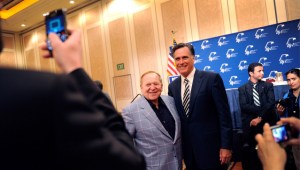
Mitt Romney with billionaire donor Sheldon Adelson
I’ve been reading some of post-election articles in which the Village pundits try to explain why Mitt Romney lost the election. Apparently Romney and his campaign staff really did think they were going to win. They were even planning an 8-minute fireworks display over Boston Harbor after Romney won!
While the rest of us were absorbing Nate Silver’s predictions and his logical, math-based explanations of the polls, Republicans were making fun of Silver and convincing themselves that Romney voters were more enthusiastic than Obama voters, that polls were sampling the wrong kinds of voters, and that some magical “Romney wave” would sweep them into power.
At the same time, they didn’t understand that their constant race-baiting, their campaign to suppress Democratic voters, and their war on women’s reproductive rights might arouse some anger among the groups they disrespected–anger that could turn into a steely determination to get out and vote no matter how difficult it turned out to be.
In Politico’s summing up, “Romneyworld reckoning begins,” I read these striking paragraphs:
Multiple Romney sources buzzed about one number in particular: 15 percent. According to exit polls, that’s the share of African-Americans who voted in Ohio this year. In 2008, the black percentage of the electorate was 11 percent. In Virginia and Florida, exit polls showed the same share of African-Americans turned out as four years ago, something that GOP turnout models did not anticipate.
“We didn’t think they’d turn out more of their base vote than they did in 2008, but they smoked us,” said one Romney operative. “It’s unbelievable that that they turned out more from the African-American community than in 2008. Somehow they got ‘em to vote.”
Gee, maybe African Americans aren’t as dumb, lazy, and shiftless as John Sununu thinks! Maybe they didn’t appreciate Mitt Romney’s repeated dog whistles and his disrespect toward President Obama.
Andrew Cohen at the Atlantic thinks the voter suppression campaign is the main reason Romney lost. Cohen writes:
May I suggest instead a simple, elegant overriding theory on why we won’t have a Romney Administration in 2013? No serious political party in America — no legitimate party in any viable democracy — can win an election by suppressing votes. So long as the Republican Party endorses (and enacts) voting laws designed to make it harder for registered voters to vote, so long as Republican officials like Ohio’s Jon Husted contort themselves to interpret those laws in a restrictive fashion, the Republicans will continue to play a loser’s game.
That’s my theory, anyway, and I’m sticking to it. Having covered for the past two years the voting rights front in this epic election cycle, I have come to believe that the Republicans will begin to win presidential elections again only when they start competing for votes with the substance of their ideas.
At Balloon Juice, Dennis G. reacted to the same section of the Politico article that struck me as so stupid; and he offers anecdotal evidence to support voter suppression reaction argument:
Here is the thing that Team Mitt and Team Wingnut failed to understand: that when you insult folks and dismiss them, they tend to get mad and they tend to want to kick your ass.
Mitt and the Wingnuts have run a four-year campaign that is only a blond hair’s width away from calling the President a nigger every single day. They are focused like a laser beam on promoting white rage and using every dog whistle they can think of to get the message across. White folks heard them and so did people of color. Team Mitt is surprised that African-American turnout increased over 2008, but that is only because they are incapable of thinking of these folks as people.
As I knocked on door after door in a black neighborhood in Columbus, it was clear that folks heard the Mitt/wingnut code-talking and that it pissed them off. They heard the endless disrespect of the President and the general contempt for anybody who is not white that has become the core message of the modern conservative movement. They heard it and they decided to kick Mitt’s ass in the voting booth.
Hey, I’m an old white woman and I was so angered by the race baiting that I was determined to vote against the guy who did it and encouraged it!
Take a look at what happened in Philadelphia:
In a city where President Obama received more than 85 percent of the votes, in some places he received almost every one. In 13 Philadelphia wards, Obama received 99 percent of the vote or more.
Those wards, many with large African American populations, also swung heavily for Obama over John McCain in 2008. But the difficult economy seemed destined to dampen that enthusiasm four years later.
Not to worry. Ward leaders and voters said they were just as motivated this time.
“In this election, you had to point out to the people what was at stake. And in many cases, they felt that the Romney doctrine was not going to favor the working man,” said Edgar “Sonny” Campbell.
No kidding. But I’d be shocked if a lot of the motivation didn’t come from the poorly disguised racism emanating from Romney and Ryan and their surrogates.
And now let’s turn to those whiny billionaires who thought they could buy the White House and failed miserably. Kevin Roose writes at New York Magazine about a conversation he overheard:
Two months ago, in a dimly lit corner banquette at an exclusive club in the meatpacking district, two well-known billionaires sat down — at a table well within earshot of mine — to have a good bitch about the state of the union.
“The last four years have been a disaster,” said one man, a hedge fund manager who supported President Obama’s 2008 campaign but decided to sit this election out. The primary reason for his disillusionment, he said, was that the country under Obama had grown hostile to wealth, and to those who had accumulated vast amounts of it.
“People work their asses off to get where they are, and they get punished,” he said. “I wanted to fly my friend to Davos this year, and people were like, you’re not going to fly the jet to Davos, are you? How will that look to the Occupy people? I’m like, what the fuck are you talking about? I worked hard for this!”
“It’s a scary reality,” said the other billionaire, once a prominent Democratic donor.
Of course President Obama was extremely friendly to Wall Street during his first term, and the banksters did extremely well while most Americans bore the brunt of the Great Recession that Wall Street caused. But the banksters’ tender feelings were hurt when the President referred to them as “fat cats” and held them responsible for hurting middle- and working-class people.
According to Roose,
Wall Street turned very quickly against Obama, and it made a massive bet that they could put a private equity guy in the White House. The bet turned out to be risky and unhedged — the equivalent of wagering a billion dollars on an exotic derivative that would either triple in value or become totally worthless, with no possible results in the middle….
Backing Romney was a tactical decision, but it was also a psychological one. Under a Romney administration, these donors believed, no longer would they need to hang their heads, hide their jets, and apologize for their success. The social order would be restored, and they could walk proud once more.
What could be more pathetic? These Wall Street titans gambled billions on Romney and got absolutely nothing back. In fact they’ve now lost their leverage over Obama, leaving him free to be even more dismissive of their concerns. Bwaaaaahahahahahahaha!!
Do you ever wonder what effect these self-pitying and self-involved billionaires have on their ultra-privileged offspring? One of them, Peter Brandt II, put on quite a display on election night. The Grio reports that Brandt,
the 18-year-old son of billionaire publisher Peter Brant Sr. and former Victoria’s Secret supermodel Stephanie Seymour [reacted to Obama’s reelection by threatening to kill President Obama].
In a series of text messages to his friend Andrew Warren, which were reprinted by Jezebel, Warren whined about how a second Obama term would make him “poor.” Brant II then claimed, “I have a contingency plan. Kill Obama hahaha.”
Brandt was so proud of his “joke,” that he posted the entire text exchange on Instagram.
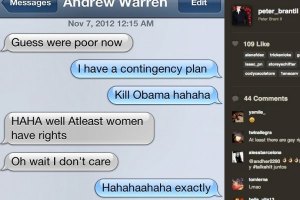
Here’s a little more of Brandt’s brand [pun intended] of humor, including this delightful tweet:
Harry & Peter Brant@HarryPeterBrant
H:yay Obama and all, but am i the only person who is DYING for Hill DOG to run in 2016! that stylish mullet needs to be in the oval office.
7 Nov 12
Thank goodness the assholes lost this time.
Is Tagg Romney Wielding New Power in Mitt’s Campaign?
Posted: October 9, 2012 Filed under: 2012 presidential campaign, Mitt Romney, U.S. Politics | Tags: Ann Romney, Ed Kilgore, Jim Vandehei, Mike Allen, Politico, Romney family rebellion, Stuart Stevens, Tagg Romney, Taylor Marsh, TBogg 25 Comments
Mitt, Tagg, and Ann Romney
Politico is out with a new “insider” piece on the Romney campaign by the usual suspects, Mike Allen and Jim Vandehei. They report that there has been a “family rebellion,” led by Ann Romney and articulated within the campaign by the Romneys’ eldest son Tagg.
According to Allen and Vandehei, Ann and Tagg have been fuming for months about how campaign aides–especially previous Politico-identified scapegoat Stuart Stevens–have forced Romney to avoid specifics about what he would do as president and instead focus on attacking President Obama’s economic policies.
Chief strategist Stuart Stevens — whom the family held responsible for allowing Romney’s personal side to be obscured by an anti-Obama economic message — has seen his once wide-ranging portfolio “fenced in” to mainly the debates, and the television advertising that is his primary expertise, according to campaign officials. Tagg Romney, channeling his mother’s wishes, is taking a much more active role in how the campaign is run.
The family rebellion, long building despite Mitt Romney’s initial reluctance to change, reached a climax in September, amid mounting evidence that the status quo was doomed to failure. The course correction came after internal polls showed him losing nearly every swing state and a loud chorus of second-guessing among prominent conservatives.
Allen and Vandehei claim that:
When the history of this campaign is written, the family intervention will be among the most important turning points in the Romney saga. Until the weeks before the first presidential debate, the candidate sided with Stevens over his family’s skepticism, accepting the strategist’s view that the best way to win was to point out President Barack Obama’s flaws and articulate generic promises to do better.
The campaign is hopeful that the new supposedly moderate Mitt can now reveal his “true self” with the support of the right wing Republican base which is now so thrilled over Romney’s debate performance that they’ll give him some leeway to be more like the Romney he was as Governor of Massachusetts.
Behind the scenes, the high command has changed with the candidate. Senior adviser Ed Gillespie, for instance, has rising responsibility for the campaign’s broad message. Campaign manager Matt Rhoades is commanding the stagecraft, the insiders said. And Sen. Rob Portman (R-Ohio), originally brought in as Romney’s debate sparring partner, has become a close and trusted adviser.
But the biggest change in the ecology, according to the insiders, is the more assertive role of Tagg Romney, who has been “making sure that his father’s environment is such that he’s relaxed when he goes up to do things, and making sure that he’s not over-programmed, and is protected from the cacophony of advice,” a family friend said.
There’s just one problem with this new Politico narrative: Tagg Romney told the New York Daily News today that the Politico story is nonsense.
A recent POLITICO story quoted an unnamed family friend as saying Tagg Romney would be working behind the scenes at being “more assertive in making the organization work better, cleaning up some of the organizational dysfunction.”
But Tagg Romney said that’s simply not the case.
In fact, he said he hasn’t been to a strategy meeting in more than a year, and the last time his father specifically solicited his advice on a campaign issue was in considering his selection of a running mate.
“It sounds like a great story, but it’s not based in reality at all,” he said of the suggestion that he’d be the one to broker peace between warring factions inside Romneyland.
“I’ve never approached anyone about wanting to play that role. No one has approached me,” he said.
“This is not spin, the team really gets along well. There’s no internal squabbling or fighting for territory or turf.”
Tagg says, although he has been involved in fund raising and made campaign stops in support of his dad’s presidential bid, he’s just too busy with his own private equity firm and his six kids to get involved in the nut’s and bolts of the Romney organization in Boston.
I don’t know which of these stories is more accurate, but here are a few blog reactions to the Politico story.
Taylor Marsh bought the Allen-Vandehei version completely–she says it’s “the story of the fall campaign season.” I don’t read her daily, but based on this post, Marsh appears to have reverted to her old anti-Obama ways and seems to be almost rooting for a Romney win.
The man who was elected governor of Massachusetts was always going to be Mitt Romney’s strong suit in the general election. It’s why Eric Eric Fehrnstrom’s Etch-a-Sketch gaffe was so alarming. Wiping the slate clean from the hard right primary contortions that allowed Romney to win the nomination had to be the move they’d make at some point. Not finding it sooner will be the reason Romney loses if he doesn’t prevail.
….
Mitt Romney’s challenge was not only to seduce the Republican base and get the nomination, but to be able to shed the wingnuttery in the general and present himself as Governor Mitt when it mattered, the man closer to his core. A core founded in fundamentalist patriarchy moored in deep religiosity, which is different from wingnuttery.
Ann Romney saw him through the first task, but she and Tagg Romney saw that the second shift wasn’t happening and with it the man they believe can fix this country was losing his chance at history. So, they stepped in and the result is what we saw at the debate.
Love Romney or hate him, what the debate revealed was a man comfortable in his own skin for the first time in over a year. Was that the Romney rebellion manifest setting Mitt free? To Team Obama’s chagrin, just maybe, though it’s too soon to tell.
Apparently Marsh doesn’t know much about Romney’s record in Massachusetts. And she thinks Romney has a core!
Ed Kilgore is more skeptical.
Somewhat counter-intuitively, the Politico Pair argues that “the family” combined forces with restive conservatives wanting a “clear choice” message to topple the steady-as-you-go approach of Stevens. Here’s how they square that circle:
[O]ne big reason for hope inside the Romney campaign is that conservatives were so down on the campaign before the debate — and so rapturous during it — that they will give him a lot of maneuvering room to talk in more moderate ways.
As I’ve tried to demonstrate here and here, however, the Moderate Mitt Meme is mighty thin and based on an infrastructure of lies and evasions. Under sustained attack from the Obama campaign, how long is Romney going to be able to get mileage out of such brave defiance of the Right as admitting there might be some place in the world for regulation of business; how long can he get away with pretending his “health care plan” prevents discrimination against people with pre-existing conditions; how long can he brazen his way through the mendacious math of his tax plan, or avoid the many extremist positions that Obama did not bring up during the first debate? Remember, BTW, that the first time Romney (or Ryan) must engage seriously with criticism of his actual agenda, all that conservative tolerance for “moderation” will vanish.
That makes more sense to me, but I think TBogg’s take is my favorite so far: Gang Ann Style
Smug future-dowager queen Ann Romney is very sick and tired of You People not loving that man of hers like she loves that man of hers, so she and her gang of lying-ass sons, led by eldest crazy-eyed blank-shooter Tarkus, held down Romney campaign chief strategist (I know… I was surprised they had a “strategy” too) Stuart Stevens and cut off his
hairinfluence.….
This had to be done because Mitt Romney, who has been sold to us as a decisive and brilliant businessman who SAVED THE OLYMPICS and made BILLIONS of dollars which he then stashed in off-shore tax havens, is actually just one of those goofy hapless bumbling dads (Homer) from the sitcoms who must be continually reined in by his adoring yet amusingly exasperated wife (Marge). Except, in this case, the role of the sensible mom with a heart of gold is played by Angela Landsbury from the Manchurian Candidate (without the oily style but with 70% more bitchface) and Mitt is dopey drunken empty-headed James Gregory.
Feel free to either discuss the Romney rebellion or use this as an open thread.
Rainy Saturday Reads: Why Romney Is Losing
Posted: September 29, 2012 Filed under: 2012 presidential campaign, Mitt Romney, morning reads, U.S. Politics | Tags: 47 percent, Alex Pareene, backstabbing aides, Joan Walsh, Nate Silver, Politico 53 Comments
A rainy day on Boston’s Commonwealth Ave.
Good Morning!!
It’s a rainy Saturday in Boston, and I’ve got a nasty cold. I overslept and I don’t have much energy, but do have a few links to get you started today. There’s lots of talk right now about how Romney’s “47 percent” comments have hurt him. A number of pundits didn’t think it was a big deal at first, but are now changing their tunes.
Nate Silver sees signs that Romney’s callous words are taking a toll.
After a secretly recorded videotape was released on Sept. 17 showing Mitt Romney making unflattering comments about the “47 percent” of Americans who he said had become dependent on government benefits, I suggested on Twitter that the political impact of the comments could easily be overstated.
“Ninety percent of ‘game-changing’ gaffes are less important in retrospect than they seem in the moment,” I wrote.
But was this one of the exceptional cases? A week and a half has passed since Mr. Romney’s remarks became known to the public — meaning that there’s been enough time to evaluate their effect on the polls.There’s a case to be made that they did damage Mr. Romney’s standing some.
Read Silver’s take at the link (if you haven’t already).
Jonathan Chait comes right out and admits he was wrong:
I’ve been wrong before, and I’ll be wrong again, but I may never have been as wrong as I was when I initially predicted that Mitt Romney’s heinous diatribe against 47 percent of America would have little direct impact on the election. It’s an absolutely crushing blow. Obviously it doesn’t guarantee his defeat — if a secret video surfaces depicting Obama promising to impose Sharia law in his second term, Romney will stand a good chance of coming back — but it destroys his public standing in ways that make a comeback nearly impossible.
….
The damage of the remarks is twofold. Obviously, it deeply reinforces the worst stereotypes voters have of Romney. Indeed, the fact that he is currently running ads trying to make the case that he does care about all of America testifies to the grim position in which Romney finds himself. If you’re trying to clear the threshold of “does this candidate hate me” six weeks before the election, you’re probably not on the verge of closing the sale.
Worse still, the comments destroy Romney’s fundamental credibility. Here America sees what he says behind closed doors. Nothing he can say in public can possibly overcome the damage of these comments, because voters will quite correctly assume that he is telling them what they want to hear. George W. Bush’s campaign figured out how to do this to both Al Gore and John Kerry — by painting them as liars, Bush destroyed them as a message delivery platform. Romney has, essentially, done it to himself.
At Salon, Alex Pareene responds to Jonathan Chait by arguing that what is really hurting Romney is Ryan’s plan to kill Medicare: Why Ryan is worse for Romney than “47 percent.” It’s short, but sweet. Read it at the link.
TPM has a piece on How Democratic Ads Are Exploiting Romney’s ‘47 Percent’ Moment
The usual sports metaphors barely do justice to how easy it is, in theory, to build an attack ad around your opponent demanding half the country “take personal responsibility and care for their lives.” Softball pitch down the plate? Kickball, maybe? Tee ball?
Evidence is mounting that Mitt Romney’s leaked remarks about how 47 percent of Americans see themselves as “victims” are doing significant damage to his campaign both nationally and in key swing states around the country. While the hidden camera video has gotten plenty of play on its own in the press, Democrats are piling on as much as possible with a growing number of attack ads.
The degree of difficulty may be low, but the current body of ads connect Romney’s quotes to an impressive array of themes in a very short amount of time. Here’s how Democrats are using the hidden camera footage as a Swiss Army knife of messaging.
Ad videos and commentary at the link.
As Romney stumbles, the knives are coming out. Politico is the usual place for Romney campaign leaks, and sure enough, yesterday there was another backstabbing story putting all the blame on the lousy candidate: In the End, It’s Mitt.
It isn’t the chair or the ho-hum convention. Or the leaked video. Or Stuart Stevens. Or the improving economy. Or media bias. Or distorted polls. Or the message. Or Mormonism.
It’s Mitt.With Republicans everywhere wondering what has happened to the Mitt Romney campaign, people who know the candidate personally and professionally offer a simple explanation: It’s the candidate himself.
Slowly and reluctantly, Republicans who love and work for Romney are concluding that for all his gifts as a leader, businessman and role model, he’s just not a good political candidate in this era.It kills his admirers to say it because they know him to be a far more generous and approachable man than people realize — far from the caricature of him being awkward or distant — and they feel certain he would be a very good president.
“Lousy candidate; highly qualified to be president,” said a top Romney official. “The candidate suit fits him unnaturally. He is naturally an executive.”
That makes no sense. If Romney can’t run his own campaign then how on earth would he run the White House and lead the country? It’s only September, and these guys are trying to save their own asses.
Joan Walsh points out that it’s the candidate’s message that people can’t stand: When the Dogs Won’t Eat the Dog Food.
In the end I think Romney killed his own campaign, not because he’s a bad person – he may be – but because, in addition to his ineptness, he came to symbolize what’s wrong with our economy, in every way. The tax rate he pays is a scandal. Shoveling millions of tax-free dollars to his sons is, too. Bain Capital was no job creator (unless you count Bain execs); the firm borrowed money to buy companies, saddled the companies with their debt and made huge fees, whether or not the firm survived.
I said long ago that Romney “is the poster boy for the top 1 percent,” and that it would hurt him with struggling voters. But I didn’t know how much it would hurt him. In the end, maybe he’d have survived coming off like a cross between Thurston Howell III and Montgomery Burns, if we hadn’t heard his remarks about “the 47 percent.” Together, his sheltered wealth, high finance career and plutocrat’s sneer are making it nearly impossible for him to be elected.
But not completely impossible.
Nearly impossible. Not impossible. The other side has so much money and so few scruples these last six weeks could get uglier. We don’t know the toll voter suppression laws will take. And forget about those newfangled laws, there’s old-fashioned GOP voter suppression – robocalls and fliers giving voters the wrong day as Election Day or changing their polling place, voter intimidation, or a shortage of ballots or voting machine in dense Democratic districts.
That should be enough to get you started. I’ll add more links in the comments, and I look forward to clicking on yours. Have a great weekend!
Saturday Reads: President Obama’s Acceptance Speech
Posted: September 8, 2012 Filed under: 2012 presidential campaign, Barbara Ehrenreich, Civil Liberties, Civil Rights, Mitt Romney, morning reads, U.S. Economy, U.S. Military, U.S. Politics | Tags: acceptance speech, Charles P. Pierce, citizenship, democracy, Democratic National Convention 2012, Howard Kurtz, Michael Tomasky, Nielson ratings, Peter Beinart, Politico, self-government, Tom Junod 68 Comments
Good Morning!
Generally speaking the pundits didn’t care for President Obama’s acceptance speech on Thursday night. It’s not surprising that the guys at Politico thought it “fell flat.”
A surprisingly long parade of Democrats and media commentators described the speech less as a failure than a fizzle—an oddly missed opportunity to frame his presidency or the nation’s choice in a fresh or inspirational light.
Even those who liked the president’s performance generally went no further than saying that he was effective in doing a job that needed to be done, in a tough-minded if prosaic style.
These shoulder-shrug reactions confront Obama with a question no one expected to be asking when the week in Charlotte began: How did a president for whom stirring speeches were the engine of his rise to power manage to give, at best, only the third-most compelling speech at a convention devoted to his own re-election?
But even more liberal commentators found Obama’s speech wanting. Peter Beinart called it “underwhelming and anticlimactic.”
Obama’s acceptance speech had two apparent goals: The first was to lay out an agenda for the next four years so people feel they have something forward-looking to vote for. The second was to recapture the sense of hope that defined Obama’s 2008 campaign.
On paper, he did both things. But what the speech lacked was a coherent explanation of the nightmare this country has gone through for the last four years. Republicans are laying the Great Recession at Obama’s feet. Obama is saying that Republicans created it and, if elected, will make it worse. To win that argument, Obama needed to explain why the financial crisis happened, and he didn’t. Yes, he mocked the GOP for proposing tax cuts as the answer to every problem, but the financial crisis didn’t happen because of tax cuts. It happened, in large measure, because Republican and some Democratic politicians—blinded by free-market fundamentalism and Wall Street largesse—allowed bankers to create unregulated markets in which they gambled the savings of millions of Americans, knowing that if their bets failed, they wouldn’t be the ones to lose their homes and their life’s savings.
Obama should have told that story, and then gone at Romney for doubling down on the ideology that almost brought America to its knees. Then he should have contrasted that with his own interventions to protect people who the market has failed: whether they be auto workers or people with sick kids.
Michael Tomasky called it Pedestrian and Overconfident
Let’s be blunt. Barack Obama gave a dull and pedestrian speech tonight, with nary an interesting thematic device, policy detail, or even one turn of phrase. The crowd sure didn’t see it my way. The delegates were near delirium; to what extent they were merely still feeding off the amassed energy of the previous two nights I can’t say.
And swing voters watching at home? They probably weren’t as bored as I was, but it seems inconceivable that they’d have been enraptured. This was the rhetorical equivalent, forgive the football metaphor, of running out the clock: Obama clearly thinks he’s ahead and just doesn’t need to make mistakes. But when football teams do that, it often turns out to be the biggest mistake of all, and they lose.
Nevertheless, the final night of the Democratic Convention drew about 35.7 million viewers. The second night of the convention, when Bill Clinton spoke pulled in more views than the Giants-Cowboys game that played opposite the Convention coverage, about 25.1 million people–but nowhere near the number who watched the speeches by Vice President Biden and President Obama. Mitt Romney’s acceptance speech attracted 30.3 million viewers.
Howard Kurtz reported that Obama’s acceptance speech was deliberately “low-key.”
While the pundits are generally calling the president’s Thursday night address mediocre, Obama and his advisers had taken great pains to avoid soaring rhetoric that might have been derided as empty.
Indeed, they extensively tested the president’s speech in dial groups, a type of focus group where voters twist dials to register approval or disapproval of specific passages, and say it tested off the charts. The reaction, they say, was more positive than to Obama’s 2008 acceptance speech in Denver.
In short, the president deliberately dialed it down, stopping well short of the altitudes he is capable of reaching. Perhaps that will prove to be a mistake, but the decision to go with a less rousing approach was carefully considered.
The campaign’s primary goal at the Democratic convention was to provide a concrete sense of what Obama would do in a second term. That was what independent voters wanted, according to the research, and that was the focus in Charlotte.
Personally, I thought the first half of Obama’s speech was underwhelming, but I’ve never been a big fan of his speeches. About half-way through I thought the speech became more interesting. I was impressed that Obama admitted how difficult the job is and that he has questioned himself at times and that he has been “changed” by being President of the United States. I think the best evaluation of the speech that I read yesterday was by Tom Junod at Charles Pierce’s blog: President Obama Falls Back to Earth, Transformed. Junod’s thesis statement: “We should have known that Barack Obama would emerge from this convention conventionalized — that is, as a more conventional politician than he was when he went in. Or that we ever thought he could be.”
He didn’t rise to the occasion on Thursday night; he not only didn’t reinvent the possibilities of political language, he used language that many people had to feel they’d heard before. His speech was disappointing until, with about ten minutes to go, it acknowledged disappointment, and so began its rise. “The times have changed — and so have I,” he said. “I’m no longer just a candidate. I’m the president.” Of course, he was reminding us of his power; the fact of his presidency has become an argument for his presidency. But he was also reminding us that as a candidate who rose to power on the politics of pure potential, he is, as president, a fallen man. “And while I’m proud of what we’ve achieved together, I’m far more mindful of my own failiings, knowing exactly what Lincoln meant when he said, ‘I have been driven to my knees many times by the overwhelming conviction that I had no place else to go.'”
This was where the speech turned, and became, in its statement of humility, a statement of rousing power. “I ask you for your vote,” he said, and his commonplace words had a beseeching quality that put them outside the realm of political performance. He had failed to transform his office, and failed to transform our politics, but he sounded fully aware that he had been himself transformed.
He had started out as the Cassius Clay of our politics, brash and blinding, with an abilty to do things in the ring that no one else had ever thought of — with an ability to be untouchable. Now he stood inside the ring of stars on the blue carpeted stage of the Democratic National Convention as the Muhammad Ali whose greatness was proven after he returned to boxing bigger, slower, harder-hitting but also easier to hit. Oh, Ali got touched, all right, and since he lost his skill at avoiding punches he had to find the skill of taking them. He became a prodigy not of otherworldly gifts but rather of sheer will, and so it was with Obama in his speech on Thursday night. At an event that paid endless tributes to our wounded warriors, he rebranded himself as something of a wounded warrior himself; and at the very moment when those who remembered 2008 hoped he might say something that no one had ever heard before and maybe even reinvent, one more time, the possibilities of a word as hackneyed as hope itself, he instead completed his hard-won journey to convention.
Of course I never thought Obama was anything but an ordinary, conventional politician. As everyone here knows, I never bought the “hope and change” schtick. I never saw Obama as a great liberal savior. I was impressed with his acceptance speech, because he showed humility. By the end of the speech I was convinced that this man had matured in office, and because of that, I saw hope for his second term.
Apparently, Charlie Pierce never saw the transcendent Obama either.
I never heard the music.
People told me it was there. People told me it sang to them. People told me that its chords touched them deeply in their hearts. I watched as it make them weep and cheer. I watched as it moved them while I stood there, an unbeliever at the grotto, seeing only rocks and weeds where everyone around me saw and heard and joined in something altogether transformative. I was there in Boston when the president gave the speech that first sent him rocketing up the charts, and I didn’t hear it. Since then, I have seen him give an acceptance speech, an inaugural address, a Nobel oration, and three State of the Unions, and the only thing I remember about any of the latter is that he got heckled by some peckerwood from South Carolina, and that he called out the corporate meat-puppets of the Supreme Court in what I still believe is the finest — and certainly, the most prescient — moment of his presidency.
But I never found the poetry in it all. I thought he was a good, smart orator with some uniquely gifted writers and a talent for creating a warm and comfortable context in which people could take what they believed were all their best instincts out for a walk. I still believe that. He still reaches people at depths that I cannot fathom. He still reaches them in frequencies beyond my poor ability to hear.
That is pretty much how I’ve always reacted to Obama’s speeches. But in his convention speech, I thought I saw something more substantive. And it gave me hope. Pierce was impressed with Obama’s reference to “…the hard and frustrating and necessary work of self-government.”
That I heard. That I understood. It is not musical. It is not in any way poetic. But it is a clear line drawn between the president and the person and the party that would like to take his job from him. It is now an article of absolute faith among Republicans that “the government” is an entity separate from “the American people,” which they say the same way that the old Jesuits talked about “the mystical Body of Christ.” It is now an ironclad commandment of conservative orthodoxy that “the government” is something parasitic and alien. There is a reason why conservatives talk about “government” and not “self-government,” because to refer to the latter is to concede that “the government” is really the most basic product of our political commonwealth, that it is what we produce among ourselves so as to order the production of everything else that we do together. This is not an idle distinction. It is the entire message of last week’s Republican convention, and it is the entire message of the campaign they are planning to run, and, make no mistake, it resonates deeply with millions of people because it has been spoonfed to them as a kind of noxious anesthetic for almost foty years now, a long enough time for it to seem as though it is the natural order of things.
“…the hard and frustrating and necessary work of self-government.”
Make no mistake. This little throwaway line was the most direct, and the most serious, challenge that the president threw down at the feet of the Republican ticket on Thursday night because it strikes at the very essence of four decades of conservative political philosophy. We create “the government” we have. “The government” is not imposed from without. It is our creation. Its proper operation is our responsibility. If we do not like the way it operates, we do the hard and frustrating and necessary work to change the way it does. If we believe that it is being hijacked, we do the hard and frustrating and necessary work of using the tools of self-government to run the moneychangers out of the place. If we do not like the way the person we vote for is doing the job with which we have entrusted him — if he, say, allows the crooks who brought down the economy to walk away free, or if he perpetuates policies antithetical to civil liberties, or if he gets a little too cozy with fracking or if he gives away too much in some Grand Bargain — then we do the hard and frustrating and necessary work of self-government to hold his damn feet to the fire and say, “No further.”
Please go read the whole thing if you haven’t already. Obama articulated the key difference between today’s Republicans and the rest of us. They hate government and believe it should do nothing for people, just fund national defense and aid corporations. Most Democrats still believe that Government has a role in making people’s lives better, in ensuring that even the weakest and most vulnerable among us have rights to “life, liberty, and the pursuit of happiness.”
At the same time we citizens have the responsibility to stand up to our leaders, to voice our needs and our values, to remind our leaders that they work for us and there are certain things we won’t tolerate–whether that’s privatizing social security and medicare, limiting women’s rights, killing people with unmanned drones, limiting voting rights or some other policy that is important to us.
I think Obama’s speech got the job done. It made the convention delegates happy, and it laid a foundation for the arguments he will make over the final few weeks of the campaign. I hope he will continue to emphasize the importance of citizenship–of the necessity of every American being involved in “self-government.” That is the price of democracy.
Now what are you reading and blogging about today? This is an open thread!
Telling the Truth is “Controversial” and “Incendiary” at Politico
Posted: June 30, 2012 Filed under: The Media SUCKS, U.S. Politics | Tags: Ann Romney, Bill Press, Current TV, Joe Williams, journalistic ethics, Martin Bashir, Mitt Romney, MSNBC, Politico, racial bias 26 Comments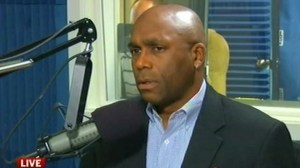
Former Politico White House Reporter Joe Williams
This morning, Politico fired their White House Reporter Joe Williams for supposed “incendiary” remarks that he made in an appearance on MSNBC’s Martin Bashir show last week. He had been suspended after complaints from ultra-right-wing outlets Breitbart.com and The Washington Free Beacon.
POLITICO reporter Joe Williams has been suspended pending review of recent controversial comments he made on television and Twitter, POLITICO editors informed staff late Thursday night.
On MSNBC today, Williams made a remark suggesting Mitt Romney was only comfortable around white people. The video was first flagged by conservative website Washington Free Beacon. Breitbart.com ran the video and also flagged a series of tweets Williams had written that made fun of the Republican candidate, particularly in regard to his wealth.
“Regrettably, an unacceptable number of Joe Williams’s public statements on cable and Twitter have called into question his commitment to this responsibility,” POLITICO’s founding editors John Harris and Jim VandeHei wrote in a memo to the staff. “His comment about Governor Romney earlier today on MSNBC fell short of our standards for fairness and judgment in an especially unfortunate way.”
Here is the appearance in question, followed by a transcript of the offending comments:
Transcript:
It’s very interesting that he does so many appearances on “ Fox & Friends .” And it’s unscripted. It’s only time they let Mitt off the leash, so to speak. But it also points out a larger problem he’s got to solve if he wants to be successful come this fall. Romney is very, very comfortable, it seems, with people who are like him. That’s one of the reasons why he seems so stiff and awkward in some town hall settings, why he can’t relate to people other than that. But when he comes on “ Fox & Friends,” they are like him, they’re white folks who are very much relaxed in their own company, so it really is a very stark contrast, I think, and a problem that he has not been able to solve to date, and he’s going to have to network harder if he’s going to try to compete.
Frankly, I have no problems with any of that. I think it’s demonstrably true that Romney is more comfortable with people like himself–whether they’re right-wingers, rich people, or white people. Williams’ tweets are a little more inappropriate. Here’s a collection of them at Breitbart.com. The worst was a retweet of a penis joke about Ann and Mitt.
So what are Politico’s “standards?” Supposedly they want their reporters to be objective and unbiased. Really? The site was founded by two conservatives, John Harris and Jim VandeHei, who were previously at the Washington Post. In my opinion, Politico has a definite Republican slant–in fact I’ve always thought of it as a Republican blog.
I’m not alone in my point of view on this. Here’s TBogg’s characterization of the firing:
The ankle-nippers at Big Dead Andy’s Big Mausoleum of Otherwise Unemployables have claimed another head to be mounted on their wall of Black People We Don’t Like Because They Are Black People. In this case, Joe Williams from the Beltway Daily Racing Form known as Politico
.
This is probably a rude question, but how many black reporters does Politico employ? I’m sure there must be a few, but Williams is was the only one I’m aware of. And Breitbart is now an acceptable arbiter on journalistic ethics? Seriously?
I think it’s understandable that Williams would be thinking in terms of race as well as ideology when he refers to Romney’s comfort level on Fox and Friends. I suppose Fox’s token black guy Juan Williams may occasionally appear on the show, but would Romney even be comfortable with Juan Williams? Remember when he was booed at a Republican debate for asking some questions about Newt Gingrich’s attitudes about poor people and food stamps? I don’t recall Romney protesting the audience’s vile reaction.
At the African American blog NewsOne, Syracuse University Professor Boyce Watkins has a different take on the suspension than Joe Williams’ former bosses at Politico:
[T]here’s a pattern and unfortunately Joe has been affected by it. For the most part, being born a Black man who speaks conscientiously or accurately about issues of race effectively defines you to be a rogue. There isn’t much of a disconnect between the Black man who is stopped and frisked on the street, and the Black male professor/journalist/doctor/lawyer who has his capabilities questioned, even when he does nothing wrong.
Cornel West was a rogue at Harvard for seeking to reengage the black community. I was a trouble maker in elementary school when I answered questions without raising my hand. Barack Obama was defined as a radical leftist by the Republican Party for saying that the wealthy should pay slightly higher taxes. It’s easy for black men to be marginalized very quickly in most mainstream environments, primarily because people are waiting for you to say something that they can define to be volatile or dangerous.
In media, the pattern is quite the same: Just a couple of years ago, Marc Lamont Hill was ambushed by the Right Wing and fired from Fox News for no good reason. After that, Roland Martin was suspended from CNN for making remarks that I personally didn’t agree with, but were acceptable to many millions of African Americans. The consistent and unfortunate reality for many African Americans who work with mainstream (read: White-owned) media organizations is that you must either be a good little boy who goes along with the program or you have to “take your black ass back to the ghetto.” Most of these organizations have little interest in true and meaningful diversity of ideas, they only want to have a black face or two at the table so they can pretend that they are making racial progress.
I’m sure Joe Williams saw the writing on the wall as soon as he was suspended without pay. That’s probably why he went on Current TV on Wednesday, without getting approval from his Politico masters, and spoke honestly once again.
Williams acknowledged to host Bill Press that he made “errors in judgment” but pointedly blamed right wing publications such as The Daily Caller and Breitbart.com for relentlessly reporting on Williams’ purported liberal bias. “Certainly they’re in the business of gathering scalps and we’ve seen it,” he said. He said the story quickly became “about him” rather than what he said. This made him uncomfortable.
After several patronizing attempts by Press to school him on journalistic ethics, Williams said:
“We are paid to observe, but we are not blind.” The host asked if Williams would apologize to Romney. He said if he did that, then “a lot of other people would have to as well.” Further, he said his thoughts on white people are nothing new and that he should not have to apologize: “I probably should have selected my words more carefully. In some people’s minds they were incendiary.”
And finally,
Williams declared that the Washington Press Corps. as a whole has a problem with minority hires and said Politico is no exception.
I’d say he knew he was already gone and had nothing to lose–so why not speak the truth? I’m hoping MSNBC will continue to use Williams as a commentator. He’s far more insightful than hacks like Howard Fineman and Richard Wolffe.

 peej
peej Carissa
 bostonboomer
 dakinikat
 ecocatwoman
 mablue2
 Mama Lopez
 peggysue22
 quixote
 skydancingguestblogger
 Mona (aka Wonk the Vote)



 Sky Dancing
Recent Comments