
Just Exactly What Qualifies Mitt Romney to be POTUS?
Posted: February 3, 2012 Filed under: 2012 presidential campaign, 2012 primaries, U.S. Economy, U.S. Military, U.S. Politics | Tags: America the Beautiful, Center for American Progress, children in poverty, coal mining, environment, goal mining, lack of qualifications, Mit Romney, National Parks, oil drilling, Poverty, public lands, Romney contributors, Romney super pac 22 Comments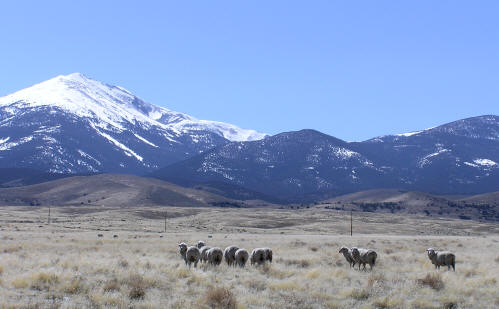
"The purple mountain majesties" of Great Basin National Park
Via Think Progress, yesterday Mitt Romney sat for an interview with the editorial board of the Reno Gazette-Journal. Today, the conservative newspaper endorsed Romney for the Republican nomination in advance of the Nevada caucuses tomorrow.
During the interview, Romney was asked whether, if elected, he would consider permitting the state of Nevada to buy back public lands that are currently held by the Federal government. Here’s his response:
I don’t know the reason that the federal government owns such a large share of Nevada. And when I was in Utah at the Olympics there I heard a similar refrain there. What they were concerned about was that the government would step in and say, “We’re taking this” — which by the way has extraordinary coal reserves — “and we’re not going to let you develop these coal reserves.” I mean, it drove the people nuts. Unless there’s a valid, and legitimate, and compelling governmental purpose, I don’t know why the government owns so much of this land.
So I haven’t studied it, what the purpose is of the land, so I don’t want to say, “Oh, I’m about to hand it over.” But where government ownership of land is designed to satisfy, let’s say, the most extreme environmentalists, from keeping a population from developing their coal, their gold, their other resources for the benefit of the state, I would find that to be unacceptable.
Public lands in Nevada – and other western states—actually provide an enormous economic boost and sustain hundreds of thousands of jobs. Indeed, recent Interior Department statistics show that federally managed public lands in Nevada provided over $1 billion in economic impacts and supported 13,311 jobs in 2010 (and this statistic doesn’t even include the economic impacts of Forest Service lands, managed by the Department of Agriculture). Recreation, energy and minerals, and grazing and timber all play a part in the economic effects that public lands provide to Nevada. Activities like skiing at Lake Tahoe, boating at Lake Mead, and hiking at Great Basin National Park all take place on public lands.
Do you suppose Romney has even heard of Teddy Roosevelt? Or was the conservationist President insufficiently “conservative” for today’s Republican Party? Today “conservatives” don’t seem to care about conserving the beauty of nature for all Americans. It sounds like Romney is more interested in milking public lands for coal, gold, and oil than preserving their beauty so that in the future children can learn “to fall in love with America” as he was able to do? (h/t Think Progress).
A couple of days ago in, Romney sang “America the Beautiful” at a campaign appearance at a retirement community in Florida.
But what will Romney’s policies do to the beauty of our country? The folks at Think Progress made a video about it.
What else hasn’t Mitt Romney “studied” about our country? Well, he doesn’t seem to be aware that America’s social safety net is pretty weak and that his economic policies will completely shred what’s left of social programs like food stamps, Medicaid, Medicare, and Social Security.
Romney doesn’t seem to be aware that the number of Americans living in “deep poverty” is the highest it’s been in 35 years.
More than 20 million Americans live in a household with income of less than half the federal poverty rate, the level social scientists often use as a category for the very poor, according to census data for 2010. Last year that meant an annual income below $11,057 for a family of four.
The portion of the population in that category was the highest in at least 35 years and has almost doubled since 1975, from 3.7 percent then to 6.7 percent in 2010.
Romney told CNN on Feb. 1 that “I’m not concerned about the very poor” because they have many programs to help them. He later clarified his remarks, telling reporters on his campaign plane that low-income people have an “ample safety net,” including Medicaid, housing vouchers, food stamps and the Earned Income Tax Credit.
I wonder if Romney knows that one in five American children lives in deep poverty? Frankly, I doubt it. And just think of all those fetuses who don’t get proper nutrition and health care because their pregnant mothers are poverty-stricken. Mitt probably hasn’t “studied” that yet, because he really just doesn’t care.
Now Romney is claiming he “misspoke” when he told CNN’s Soledad O’Brien–twice!–that he’s not concerned about the very poor, because they have an “ample safety net.” But O’Brien doesn’t buy it. And, as NPR points out Romney even made the same remark about the poor to the press corps on his campaign plane after the CNN interview.
So what has Romney “studied?” And if he hasn’t familiarized himself with two of the most important issues facing Americans today–the environment and poverty–why on earth does he want to be president anyway? Is it because he’s an expert on foreign policy? Well, no. Not really.
So why does this man want to be President of the United States? He’s repeatedly told us that he knows how to create jobs and manage an economy. But then, why didn’t he do that when he was governor of Massachusetts?
Numbers are important in evaluating Mitt Romney, but the focus should not be on the $250 million estimated fortune he amassed at Bain Capital, or the $374,00 in speaking fees he took in last year, or even on the roughly 15 federal percent tax rate he paid.
The most important number is 47 — Massachusetts’s rank in job creation when he was governor. This is the number that most calls into question Romney’s own current job application.No job is comparable to the presidency, but the closest thing to it is governor of a large state — an executive position in public office, where the welfare of millions of people is the charge. Unlike a corporate executive, whose overriding goal is to make profits for investors, the president and governors have the same central goal — improving the well-being of the entire population. The first priority, usually, is the overall economy.
Indeed, Romney won office in 2002, after shouldering aside Acting Governor Jane Swift, with a pledge to use his business experience and connections to bring jobs to Massachusetts. He failed, dreadfully.The 47 figure is one Romney cannot escape. During his four years in office, Massachusetts ranked 47th in overall job growth — only 0.9 percent compared with 5.3 percent nationally. Romney has countered that the unemployment went down appreciably — from 5.6 percent to 4.7 percent during his term.
How could so few new jobs translate into a healthy-looking decline in unemployment? The answer is simple — and not so healthy: Working-age adults were packing up and moving out. Many were replaced, fortunately, by immigrants. But overall, Massachusetts was one of only two states to have no growth in its resident labor force during Romney’s term.
So what exactly qualifies Mitt Romney to be President of the U.S.? And why does he want the job? Perhaps it has something to do with the folks that are funding his campaign?
Goldman Sachs $496,430
JPMorgan Chase & Co $317,400
Morgan Stanley $277,850
Credit Suisse Group $276,250
Citigroup Inc $267,050
Bank of America $211,650
Barclays $203,650
Kirkland & Ellis $201,701
HIG Capital $188,500
PriceWaterhouseCoopers $179,300
Blackstone Group $170,550
Bain Capital $144,000
EMC Corp $127,800
Wells Fargo $126,200
UBS AG $123,900
Elliott Management $121,000
Citadel Investment Group $118,625
Bain & Co $116,050
The Villages $98,300
Sullivan & Cromwell $97,150
Or maybe the moguls who are funding his super pac “Restore Our Future,” 10 of whom gave $1 million or more?
What will become of “America the Beautiful” if Romney and his multimillion-dollar backers achieve their goals?
Political Cage Match: Professor versus Puffed-Up Congressman
Posted: November 25, 2011 Filed under: Congress, corruption, education, Environment, U.S. Politics | Tags: ANWR, Arctic National Wildlife Refuge, conservation, Douglas Brinkley, House Natural Resources Committee, oil drilling, Rep. Don Young (R-Alaska), Republicans 9 Comments
Rep. Don Young (R-Alaska)
Last Friday historian Douglas Brinkley testified before the House Natural Resources Committee on the topic of preserving the Arctic National Wildlife Refuge. The Republicans, of course, have been trying for years to open it up to oil drilling. Brinkley, whose latest book is The Quiet World: Saving Alaska’s Wilderness Kingdom, 1879-1960, argued that preserving one of the last truly wild places in the U.S. should trump helping the oil companies make more money.
Alaska Rep. Don Young (who had skipped most of the testimony) broke into Brinkley’s presentation, calling the historian by the wrong name and saying his testimony was “garbage.” Then the two had a hilarious shouting match. IMO, Brinkley came out the winner, but judge for yourself:
Young: If you ever want want to see an exercise in futility … That side has already made up its mind and this side has already made up its mind. I call it garbage, Dr. Rice, it comes from the mouth –
Brinkley: It’s Dr. Brinkley. Rice is a university – I know you went to Yuba [a community college] and you couldn’t graduate.
Young: Well, okay, I can call you anything I want if you sit in that chair. You just be quiet! You be quiet!
Brinkley: You don’t own me. I pay your salary.
Young: I don’t own you, but I can tell you right now—
Brinkley: I work for the private sector, you work for the taxpayer.
Next, committee chairman Doc Hastings interrupted and lectured Brinkley. But Young was still “pissed right now.”
Finally, Brinkley said he was surprised to
hear a congressman today say there’s nothing in his district. It’s boring. It’s flat. It’s not exciting. I don’t know a representative who doesn’t love their district. Every state in America’s landscape is beautiful if you love it. But some people love money more than their homeland or where they live, and I’m afraid that that’s why this fight has to keep coming up 50 years later, we’re still trying to tell people the Arctic refuge is real. It belongs to the American people.
On Friday evening, Brinkley appeared on The Ed Show on MSNBC to discuss his experience with Rep. Young.
A week later, the Congressional cage match is still causing controversy. At the Minnesota Post, Don Shelby, a friend of Brinkley’s wrote a column about the dust up.
Brinkley told me he knew that Congressman Young, at another hearing, had waved a walrus penis bone at Mollie Beattie, the incoming chief of the Fish and Wildlife Service. Brinkley may have read the Rolling Stone article about Young that quotes the congressman as saying, “Environmentalists are a self-centered bunch of waffle-stomping, Harvard-graduating, intellectual idiots.” The quote continues, “[They] are not Americans, never have been Americans and never will be Americans.” ….
Brinkley should not have been surprised that Congressman Young showed up late and missed the bulk of the historian’s testimony. Young is often cited as the congressman missing more votes than any other member of the House. Brinkley would have known that Young was the co-sponsor, with discredited Alaska Sen. Ted Stevens, of the bill to pay for the infamous “bridge to nowhere.”
Brinkley told me: “Everyone knows that Young is just a menacing blowhard. He has a history of being rude, he browbeats and he’s snotty toward anyone who cares about the environment.”
I asked Brinkley if he was surprised that Committee Chair Doc Hastings took Young’s side and continued lecturing the historian. “No,” said Brinkley. “They are tied together at the hip. They are both oil company factotums. They are a tag team.”
Young claims that Brinkley is just milking the incident to sell books. Brinkley told a Houston TV station
that his students applauded when he walked into class. “I have received now hundreds and hundreds of emails from people all over, I’ve not received one negative one,” he said. “I’ve had my entire Rice University and including Texas conservatives cheering me on for standing up to his bullying tactics.”
I’m not usually much of a fan of Brinkley’s, but I have to applaud him on this one. I don’t care if he’s doing it to sell books. Greedy, incompetent politicians like Don Young need to be revealed for what they are: pigs at the trough.

 peej
peej Carissa
 bostonboomer
 dakinikat
 ecocatwoman
 mablue2
 Mama Lopez
 peggysue22
 quixote
 skydancingguestblogger
 Mona (aka Wonk the Vote)



 Sky Dancing
Recent Comments