
Tuesday Reads: Black Lives Matter More Than Candidates’ Hurt Feelings
Posted: August 11, 2015 Filed under: Criminal Justice System, Democratic Politics, morning reads, U.S. Politics | Tags: #BlackLivesMatter, Bernie Sanders, Hillary Clinton, Martin O'Malley, Obamabots, Racism 42 Comments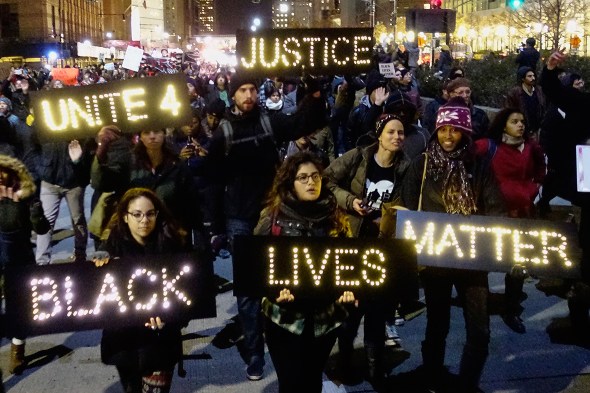
Good Morning!!
There has been quite a bit of discussion the past couple of days about the protesters who have been disrupting speeches by Bernie Sanders and Martin O’Malley. Why aren’t they doing this to Republicans? Why are they being so rude to Bernie Sanders, who many years ago marched for civil rights? There are people responding to these questions. Will the white people doing the questioning listen to the answers?
Here’s one response from Jamil Smith at The New Republic: #BlackLivesMatter Protesters Are Not the Problem. One year after Michael Brown’s death, both liberals and conservatives are still getting it wrong.
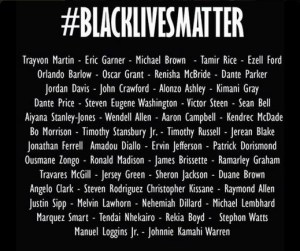
The activist group #BlackLivesMatter emerged out of the rage and mourning that accompanied George Zimmerman’s acquittal for the murder of Trayvon Martin more than three years ago. However, the first time that the hashtag—and its accompanying message—entered the American lexicon to stay was one year ago this past Sunday, when Michael Brown, another unarmed black teenager, was gunned down by a Ferguson, Missouri police officer, less than one month after an NYPD chokehold took Eric Garner’s life. On Sunday night, Ferguson reverted to its younger, violent self again, complete with a commemorative protest on West Florissant Avenue being met with police and things turning tragically violent in short order. And two days before the anniversary of Brown’s death, Christian Taylor became the 24th unarmed black man killed by police in 2015.
We might not have heard about Taylor in previous years because attention on black men, women, and children suffering violence and death at the hands of police, in particular, is now at a level unseen perhaps since the 1999 killing of Amadou Diallo. That’s backed up by a new Gallup pollindicating that Americans describing themselves as “satisfied with the way blacks are treated in U.S. society” is lower than it’s been since before the turn of the millennium. Ever since Ferguson, it’s evident that #BlackLivesMatter, in many respects, has worked.
In the last year, #BlackLivesMatter has—much like Occupy years beforehand—fundamentally changed the national conversation about a major societal ill. The movement has made millions of people aware of the white supremacy they either perpetuate themselves or support with their silence. With the emergence of the 2016 presidential campaign, #BlackLivesMatter’s demands have become more acutely focused on the candidates, pushing for policy platforms that address structural racism. Yet, as we mark one year since Brown’s death, we’ve seen both liberals and conservatives—from Senator Bernie Sanders’ supporters to Dr. Ben Carson’s—painting #BlackLivesMatter as a divisive force in U.S. racial relations. That someone might consider those fighting racism to be more divisive than racist people or structures would be laughable if black men in America weren’t seven times more likely to die by cop than white men.
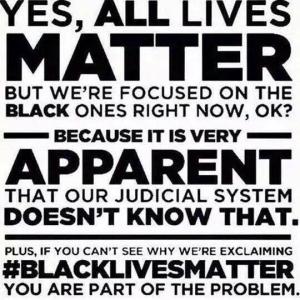
Yes, supporters of Bernie Sanders are upset that his events have been disrupted by black women protesting the killing of black men and women by police officers. Supposedly Sanders wants radical changes in the system, buit what are his proposals for changing structural racism in law enforcement?
More from Jamil Smith:
Sanders, given to touting his record of working for civil rights and uttering names like Sandra Bland since the Netroots incident, experienced a second interruption during a planned event in Seattle on Saturday. Two women and one man claiming affiliation with #BlackLivesMatter disrupted the event before the Vermont senator could speak. Some Sanders backers in the crowd booed when they were told that one of the women, Marissa Johnson, would get her say before the candidate. “Bernie, you were confronted at Netroots at by black women,” Johnson said before adding, “you have yet to put out a criminal justice reform package like O’Malley did.”
Having already responded to the crowd’s boos by telling them that they proved how “racist” the reputably liberal Seattle is, Johnson also called for a four-and-one-half minute-long moment of silence for Brown. Instead, more shouting from the crowd followed, including, per reports, shouts of “arrest her.” Sanders, rather than letting the protesters have their say and responding, left the stage. The event concluded without him speaking. A chorus of his supporters took to social media to question Johnson’s tactics—as if that’s what mattered most—and to tell anyone who dared question why Sanders didn’t have a set of racial-justice proposals that they somehow already existed. They were wrong.
A page entitled “Racial Justice” only appeared on his site early Sunday morning, containing a long list of proposals. A campaign representative reached out to me to say that those proposals, in the works for the three weeks since Netroots, were derived from a speech that’s been on the site since July 25. Given the pressure being put on them and the urgency they showed in creating the platform, it’s odd that the campaign put it online, essentially, under the cover of darkness.
The policies on Sanders’s racial justice page, while surely more welcome than none at all, are undeniably blurrier than those O’Malley put forth, and need considerably more specificity and clarity. There’s a lot of the typically forcefully liberal language Sanders likes to employ in order to inspire, but it seems even more fanciful than the O’Malley plan. But those ideas are certainly signs that he is hearing #BlackLivesMatter’s message. The problem isn’t so much him as it is his supporters, cursing protesters and later, on social media, touting their guy’s record whenever they are challenged on his (heretofore) lack of a platform regarding structural racism.
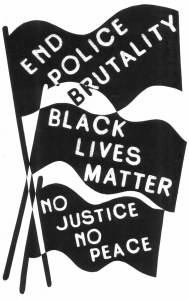
Please go read the whole article if you want to understand the anger of the #BlackLivesMatter protesters. Personally, I didn’t know that the movement began long before the killing of Michael Brown. Here’s some background from one of the founders in a piece at The Feminist Wire dated October 7, 2014: A Herstory of the #BlackLivesMatter Movement by Alicia Garza.
I created #BlackLivesMatter with Patrisse Cullors and Opal Tometi, two of my sisters, as a call to action for Black people after 17-year-old Trayvon Martin was post-humously placed on trial for his own murder and the killer, George Zimmerman, was not held accountable for the crime he committed. It was a response to the anti-Black racism that permeates our society and also, unfortunately, our movements.
Black Lives Matter is an ideological and political intervention in a world where Black lives are systematically and intentionally targeted for demise. It is an affirmation of Black folks’ contributions to this society, our humanity, and our resilience in the face of deadly oppression.
We were humbled when cultural workers, artists, designers and techies offered their labor and love to expand #BlackLivesMatter beyond a social media hashtag. Opal, Patrisse, and I created the infrastructure for this movement project—moving the hashtag from social media to the streets. Our team grew through a very successful Black Lives Matter ride, led and designed by Patrisse Cullors and Darnell L. Moore, organized to support the movement that is growing in St. Louis, MO, after 18-year old Mike Brown was killed at the hands of Ferguson Police Officer Darren Wilson. We’ve hosted national conference calls focused on issues of critical importance to Black people working hard for the liberation of our people. We’ve connected people across the country working to end the various forms of injustice impacting our people. We’ve created space for the celebration and humanization of Black lives.
As their slogan spread to the mainstream, the creaters of the #BlackLivesMatter movement saw others trying to change the meaning of their words:
The Theft of Black Queer Women’s Work
Suddenly, we began to come across varied adaptations of our work–all lives matter, brown lives matter, migrant lives matter, women’s lives matter, and on and on. While imitation is said to be the highest form of flattery, I was surprised when an organization called to ask if they could use “Black Lives Matter” in one of their campaigns. We agreed to it, with the caveat that a) as a team, we preferred that we not use the meme to celebrate the imprisonment of any individual and b) that it was important to us they acknowledged the genesis of #BlackLivesMatter. I was surprised when they did exactly the opposite and then justified their actions by saying they hadn’t used the “exact” slogan and, therefore, they deemed it okay to take our work, use it as their own, fail to credit where it came from, and then use it to applaud incarceration.
I was surprised when a community institution wrote asking us to provide materials and action steps for an art show they were curating, entitled “Our Lives Matter.” When questioned about who was involved and why they felt the need to change the very specific call and demand around Black lives to “our lives,” I was told the artists decided it needed to be more inclusive of all people of color. I was even more surprised when, in the promotion of their event, one of the artists conducted an interview that completely erased the origins of their work–rooted in the labor and love of queer Black women.
Read more at the link.

Has Bernie Sanders responded to the prosecution of African American journalist Wesley Lowery yet? From yesterday’s Washington Post:
A Washington Post reporter who was arrested at a restaurant last year while reporting on protests in Ferguson, Mo., has been charged in St. Louis County with trespassing and interfering with a police officer and ordered to appear in court.
Wesley Lowery, a reporter on The Post’s national desk, was detained in a McDonald’s while he was in Missouri covering demonstrations sparked by a white police officer fatally shooting an unarmed black 18-year-old.
A court summons dated Aug. 6 — just under a year after Lowery’s arrest — was sent to Lowery, 25, ordering him to appear in a St. Louis County municipal court on Aug. 24. The summons notes that he could be arrested if he does not appear.
“Charging a reporter with trespassing and interfering with a police officer when he was just doing his job is outrageous,” Martin Baron, executive editor of The Post, said in a statement Monday. “You’d have thought law enforcement authorities would have come to their senses about this incident. Wes Lowery should never have been arrested in the first place. That was an abuse of police authority.
“This latest action represents contemptible overreaching by prosecutors who seem to have no regard for the role of journalists seeking to cover a major story and following normal practice,” Baron continued.
It seems the powers that be in Ferguson have learned very little. Democratic candidates should address this issue and so should Bernie Sanders, independent socialist.

I’ll end with this post by Melissa McEwan at Shakesville: Sanders and #BlackLivesMatter, Again.
I can understand why Sanders was aggravated that his event was disrupted, and I can understand why people who had been waiting for an hour and a half to hear him speak were aggravated that his event was disrupted. But here’s the thing: If you are positioning yourself as a candidate who advocates for radical change, or you are supporting a candidate on the basis that he advocates for radical change, then surely you should be able to get on board with providing space to people who are involved with a campaign that advocates radical change.
If disrupting a rally is too radical for you, I don’t know how you expect to disrupt systems of institutional oppression, which will take way the hell more than an unexpected change in a campaign event schedule.
Don’t pretend you’re supporting revolution when you’re really just supporting a change in management.
Sanders then released a “Statement on Seattle Protesters,” reading in total: “I am disappointed that two people disrupted a rally attended by thousands at which I was invited to speak about fighting to protect Social Security and Medicare. I was especially disappointed because on criminal justice reform and the need to fight racism there is no other candidate for president who will fight harder than me.”
I’m going to go ahead and say: Maybe that’s true! Maybe there really is no other candidate currently running for president who will fight harder for dismantling racism than Bernie Sanders! Maybe it’s also true that each of the candidates currently running will take different approaches, and, because the activists involved with #BlackLivesMatter aren’t a monolith, there will be disagreement on whose approach is best. And maybe, no matter how good any of the white Democratic presidential candidates are on racial issues, it won’t be good enough. Maybe the inescapable fact is that white people must let black people speak on the large platforms created by and for white candidates.
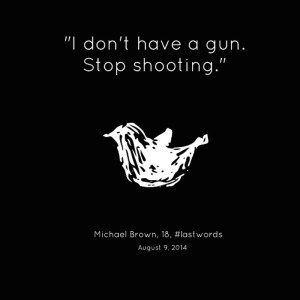
Again, please go read the whole thing, especially if you are supporting Sanders. Personally, I support Hillary Clinton. I like Bernie, but I think it’s time for a woman President of the U.S. Sanders has no chance to win the Democratic nomination–he’s not even a Democrat! But he isn’t the problem. The problem is his supporters, who remind me of the Obamabots of 2008. Let Bernie handle this situation. My guess is he’ll respond to the #BlackLivesMatter movement, because he’s an intelligent man. He’ll probably get it right in the long run. I think Hillary Clinton will too.
This is an open thread. Please post your thoughts and links on any topic in the comments to this post, and have a great day.

 peej
peej Carissa
 bostonboomer
 dakinikat
 ecocatwoman
 mablue2
 Mama Lopez
 peggysue22
 quixote
 skydancingguestblogger
 Mona (aka Wonk the Vote)



 Sky Dancing
Recent Comments