Posted: December 31, 2025 | Author: bostonboomer | Filed under: just because | Tags: CIA strike in Venezuela, Donald Trump, ICE as Trump secret police, Kennedy Center, Marijuana, New Year's Eve 2025, Trump crushing dissent, U.S. Constitution, Venezuela boat strikes |
 Good Day!!
The endless “holiday season” will be over soon, and it will be 2026. Nothing will have changed. We’re still stuck with Trump and he is still a psychopathic malignant narcissist with dementia. Here are the stories leading the news on this final day of 2025.
Trump and Venezuela
Trump blabbed about a secret CIA strike inside Venezuela. He just can’t keep his mouth shut.
The Independent: CIA carries out first drone strike on Venezuelan soil in latest escalation of Trump admin’s attacks on ‘narco terrorists.’
The CIA reportedly carried out a drone strike earlier this month on a dock in Venezuela that the United States has alleged is a port for trafficking drugs, marking a major escalation of the Trump administration’s military actions in the Caribbean.
The U.S. government believed the site was used by members of Venezuelan gang Tren de Aragua to store and ship drugs overseas, according to CNN.
No one was present at the port at the time of the strike, according to the network’s source. Still, the operation allegedly destroyed the facility, even if it represented just one of many such docks along Venezuela’s coastline that might be used by smugglers. The strike is the first known U.S. operation inside the country.
President Donald Trump appeared to acknowledge the operation during an interview Friday, saying U.S. military assets struck a “big facility where ships come from.”
Asked again on Monday, the president said American forces had attacked “the dock area where they load the boats up with drugs.”
“So we hit all the boats, and now we hit the area,” the president added. “It’s the implementation area, that’s where they implement, and that is no longer around.” [….]
The episode marks the latest escalation of tensions between the United States and Nicolas Maduro’s regime after the Coast Guard seized a second sanctioned oil tanker last week and pursued a third, following months of deadly strikes on alleged drug boats in the Caribbean and eastern Pacific that have killed more than 100 people.
Read more at the link.
Analysis by Stephen Collinson at CNN: CIA strike brings Trump closer to grave new year decisions on Venezuela.
President Donald Trump has thrust the country into a significant new phase in his showdown with Venezuela with a CIA strike on a port facility.
But as he approaches grave new decisions on even greater escalations, his team has not yet spelled out a clear consistent public rationale for its actions.
Nor has it prepared the country for what might come next.
Top officials haven’t explained how long the massive naval buildup in the Caribbean will last or what US service members will be asked to do in an operation that is already raising legal and constitutional alarms.
Neither Trump nor his top foreign policy aides have sketched a preferred endgame for the confrontation, which has climbed a ladder of escalation: from diplomatic pressure to strikes against alleged drug-trafficking boatsin the Caribbean to a blockade against oil tankers to, now, a land attack.
If the goal really is to overthrow President Nicolás Maduro, as recent comments from top officials and the logic of the deployment imply, there’s been no White House effort to show Americans the administration is planning for the aftermath. This is an especially relevant point given the quagmires that developed after US military action to topple the rulers of Iraq, Afghanistan and Libya.
Trump doesn’t recognize any responsibility to inform the American people of is plans, if there are any. He sees himself as a dictator.
A bit more from Collinson:
Rep. Adam Smith, the top Democrat on the House Armed Services Committee, told CNN’s Brianna Keilar Tuesday that the CIA attack was a significant sharpening of US pressure and raised a knot of thorny questions.
“Where it goes from here, I think, is the thing to be concerned about, because Trump clearly wants to drive Maduro from power,” Smith said, arguing that boat strikes and other means of duress didn’t seem like they would have the intended effect. If they don’t, Smith continued, “What is Trump prepared to do next? How far is he willing to take this effort at regime change in Venezuela?”
Perhaps Trump’s fogginess is deliberate. If the buildup and steady escalations are part of a psychological operations campaign to wrong-foot Maduro or to persuade his regime cronies they’d be safer without him, confusion and disorientation could act as weapons. Even from the outside, it’s obvious the CIA strike on the port facility — in which, sources said, no one was killed — is a performative warning that far greater US capabilities can be brought to bear.
Yet the more serious the situation gets — especially now the US has crossed the threshold into land attacks — the more acute is the obligation to inform Americans of the administration’s plans. The founders never envisaged presidents being able to wage war on a whim. And large and intractable conflicts have sometimes started with discrete actions that mushroom into consequences that can cascade out of control. Take Vietnam as an example.
Read the rest at CNN.
One more on Trump’s illegal Venezuela operations from The New York Times (gift link): Grim Evidence of Trump’s Airstrikes Washes Ashore on a Colombian Peninsula.
A thunderous boom rang out through the windless late-afternoon air. Seconds later, smoke began rising out of the sea as if the horizon were on fire.
Watching from the shore on Nov. 6, Erika Palacio Fernández whipped out her phone, she said, unwittingly recording the only verified and independent video known to date of the aftermath of an airstrike in the Trump administration’s campaign against what it calls “narco-terrorists.”
Two days later, on that same shore, a scorched 30-foot-long boat itself would wash up. Then, two mangled bodies. Then charred jerrycans, life jackets and dozens of packets that were observed by The New York Times and were similar to others that have been found after anti-narcotics operations in the region. Most packets were empty, though traces of a substance that looked and smelled like marijuana were found in the lining of a few.
The assortment of singed flotsam appears to be the first physical evidence of the U.S. campaign, which has destroyed 30 vessels and killed more than 100 people in the Caribbean and eastern Pacific. Every other struck boat is presumed to have sunk along with its crew and cargo. The U.S. military has offered no evidence that the boats it has destroyed were transporting illicit substances or belong to criminal networks.
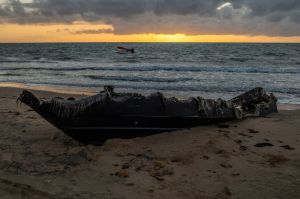
Remains of a burned boat on the beach near Puerto López on the Guajira Peninsula in Colombia.
A Times analysis matched the wreckage of the boat to the one in a video posted by Defense Secretary Pete Hegseth on the night of Nov. 6, hours after Ms. Palacio took her video. Mr. Hegseth described the strike as having targeted a vessel in the Caribbean operated by an unnamed “designated terrorist organization.” He said the strike killed three people and took place in international waters.
The Times analysis of Ms. Palacio’s video indicates the strike took place in the Gulf of Venezuela, where Colombia and Venezuela have long disputed their maritime boundary. The analysis could not determine the exact location of the strike.
The shape of the wreckage, a slender design typical of speedboats, matches that of the boat targeted in the video shared by the Defense Department, the Times analysis found, and shows damage to the boat’s hull and interior structure consistent with the impact of an airstrike. The military video shows the boat exploding and on fire beneath a large plume of smoke.
That such rare, tangible evidence is coming to light nearly two months after the early November strike is a testament both to the remoteness of the Guajira Peninsula, where the wreckage was found, and the lack of a sizable presence of the Colombian state in the area. The region is governed semiautonomously by an Indigenous community, the Wayuu, whose more than half a million people straddle the border between Colombia and Venezuela.
So Trump and Hegseth are blowing up boats carrying Marijuana–a substance that is legal in 24 states and more for medical use.
Trump’s takeover of the Kennedy Center
The Independent: More events planned for the Kennedy Center are canceled in protest of Trump adding his name to the building.
More artists have announced they are backing out of upcoming dates at the Kennedy Center in Washington, D.C., in protest of President Donald Trump’s takeover, and recent potentially illegal renaming of the institution as the Trump-Kennedy Center.
Jazz supergroup The Cookers announced on its website it will not be performing across a series of two New Year’s Eve concerts.
“Jazz was born from struggle and from a relentless insistence on freedom: freedom of thought, of expression, and of the full human voice,” the group wrote in a statement. “Some of us have been making this music for many decades, and that history still shapes us.”
“I would never even consider performing in a venue bearing a name (and being controlled by the kind of board) that represents overt racism and deliberate destruction of African American music and culture,” Billy Harper, a saxophonist in the group, reportedly added in a statement to Jazz Stage.
The Doug Varone and Dancers troupe on Monday added that it will not carry out a planned April performance at the center.
The group wrote in a statement on Instagram that while it opposed the president’s decision to replace the center’s bipartisan board in February with a group of allies who later installed him as chairman, it initially still planned to carry out the engagement. That changed when center’s board voted earlier this month to rebrand the institution the Trump-Kennedy Center, according to the statement.
“We can no longer permit ourselves nor ask our audiences to step inside this once great institution,” the statement said. “The Kennedy Center was named in honor of our 35th President who fervently believed that the arts were the beating heart of our nation, as well as an integral part of international diplomacy. We hope in three-year’s time, that the Center and its reputation will return to that glory.” [….]
The wave of cancellations follows the news that drummer and vibraphonist Chuck Redd canceled a longstanding Christmas Eve jazz concert at the center in protest of the name change.
The Washington Post: Kennedy Center changed board rules months before vote to add Trump’s name.
The Kennedy Center adopted bylaws earlier this year that limited voting to presidentially appointed trustees, a move that preceded a unanimous decision this month by board members installed by President Donald Trump to add his name to the center.
The current bylaws, obtained by The Washington Post, were revised in May to specify that board members designated by Congress — known as ex officio members — could not vote or count toward a quorum. Legal experts say the move may conflict with the institution’s charter.
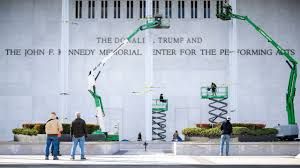 Trump took over the Kennedy Center in February, purging its board of members he had not appointed. The months that followed saw struggling ticket sales and programming changes that began to align the arts complex with the Trump administration’s broader cultural aims, culminating with the annual Kennedy Center Honors hosted by the president.
Days later, on Dec. 18, the board voted to add the president’s name to the institution, and within 24 hours it was on the website and the building itself: “The Donald J. Trump and The John F. Kennedy Memorial Center for the Performing Arts.” [….]
The Kennedy Center lists 34 presidentially appointed board members, including Trump himself as chair, and 23 ex officio seats. The center’s president, Richard Grenell, is also an officer of the board.
The federal law that established the Kennedy Center designates specific government and federal positions — including the librarian of Congress; the mayor of Washington, D.C.; the secretary of the Smithsonian Institution; and the majority and minority leaders of the Senate — to serve as ex officio members.
The law identifies them as part of the board of trustees, which it directs to maintain and administer the facility as a living memorial. But it does not distinguish between voting and nonvoting members, which has been a point of ambiguity in the days following the vote to rename the Kennedy Center….
A former Kennedy Center staffer with knowledge of board proceedings, who spoke on the condition of anonymity out of fear of retribution, told The Post that ex officio members were “always included in debate and discussion” during their tenure, but the person did not recall a time when those members’ votes were counted.
“Theoretically they could vote, but our practice was not to have them vote or count toward quorum,” the person said, noting they were not aware of the new leadership’s practices at the center.
Trump’s secret police force
The Washington Post (gift link): ICE plans $100 million ‘wartime recruitment’ push targeting gun shows, military fans for hires.
U.S. Immigration and Customs Enforcement officials are planning to spend $100 million over a one-year period to recruit gun-rights supporters and military enthusiasts through online influencers and a geo-targeted advertising campaign, part of what the agency called a “wartime recruitment” strategy it said was critical to hiring thousands of new deportation officers nationwide, according to an internal document reviewed by The Washington Post.
The spending would help President Donald Trump’s mass-deportation agenda dominate media networks and recruitment channels, including through ads targeting people who have attended UFC fights, listened to patriotic podcasts or shown an interest in guns and tactical gear, according to a 30-page document distributed among officials in this summer detailing ICE’s “surge hiring marketing strategy.”
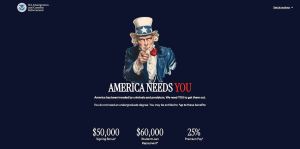
Uncle Sam looms large on ICE’s recruitment site.
The Department of Homeland Security has spoken publicly about its fast-tracked effort to significantly increase ICE’s workforce by hiring more than 10,000 new employees, a surge promoted on social media with calls for recruits willing to perform their “sacred duty” and “defend the homeland” by repelling “foreign invaders.” The agency currently employs more than 20,000 people, according to ICE’s website.
But the document, reported here for the first time, reveals new details about the vast scale of the recruitment effort and its unconventional strategy to “flood the market” with millions of dollars in spending for Snapchat ads, influencers and live streamers on Rumble, a video platform popular with conservatives. Under the strategy, ICE would also use an ad-industry technique known as “geofencing” to send ads to the phone web browsers and social media feeds of anyone who set foot near military bases, NASCAR races, college campuses or gun and trade shows.
The document was also distributed among ICE officials in the days after the agency published a request for bids seeking contractors who could use “precise audience targeting, performance media management, and results-driven creative strategies” to “accelerate the achievement of [its] recruiting goals.” The language in the published bid closely mirrored language in the strategy document. That same month, DHS awarded two marketing firms nearly $40 million to support ICE’s public affairs office “recruitment campaign,” according to federal awards data.
It’s unclear how much of the spending and strategy have been carried out. But the plans outlined in the document have coincided with a rush of recruitment ads online seeking Americans who will “answer the call to serve.”
The rapid-recruitment approach is unlike anything ICE has ever pursued, said Sarah Saldaña, a director of ICE during the Obama administration, who recalled the agency filling its open positions through local police departments and sheriff’s offices with appeals to officers’ interests in federal public-safety work.
Use the gift link to read the rest.
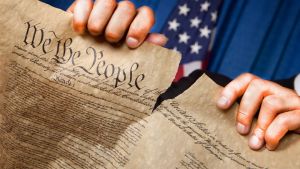
Trump wants to cancel the Constitution
Heather Cox Richardson at Letters from an American: December 30, 2025
The hallmark of the first year of President Donald J. Trump’s second term has been the attempt of the president and his cronies to dismantle the constitutional system set up by the framers of that document when they established the United States of America. It’s not simply that they have broken the laws. They have acted as if the laws, and the Constitution that underpins them, don’t exist.
As soon as the 2024 election results were clear, billionaire Elon Musk, who had supported Trump’s campaign both through his purchase of Twitter—now X—and with $290 million in cash, posted on social media: “Novus Ordo Seclorum,” Latin for “New World Order.” Although he won with less than 50% of the vote, Trump announced that he had an “unprecedented and powerful mandate.” Musk would head a new “Department of Government Efficiency” that Musk vowed would cut at least $2 trillion from the federal budget.
Musk and his operatives muscled their way into government offices and gained access to computer systems. With strokes of a keyboard they eliminated jobs and programs, including, as Musk put it, feeding “into the wood chipper” most of the U.S. Agency for International Development, the government agency aimed at combating disease and malnutrition around the globe. That dismantling has caused the deaths of hundreds of thousands of people.
The Cato Institute, a libertarian think tank, recently concluded that while the Department of Government Efficiency did not actually reduce spending, it did cut almost 10% of federal employees, a key goal of Office of Management and Budget director Russell Vought, a key author of Project 2025.
 And, crucially, it put operatives in virtually all government departments and agencies, where they gained access to privileged information about Americans, including citizens, legal residents, and undocumented immigrants.
Musk and DOGE also established the idea that the unelected officials in the Trump administration could do whatever they wished, without regard to the laws or the Constitution. The Constitution, judicial precedent, and the 1974 Impoundment Control Act all make it very clear that the power of the purse belongs to Congress. As the elected representatives of the American people, only members of the House of Representatives and the Senate can determine how the nation’s money is spent. Then the president must “take Care that the laws be faithfully executed.”
Democrats objected to the administration’s dramatic usurpation of the power of Congress, but Republicans did not complain. Most backed the administration’s claims it was eliminating “waste, fraud, and abuse.”
Although Republicans controlled both chambers of Congress, meaning that Trump should have been able to get any legislation he wanted, he continued to try to get around the Constitution by declaring nine “emergencies” that would permit him to act without congressional oversight. This reliance on emergencies reflected the ideas of Nazi political theorist Carl Schmitt, whose writings were followed by right-wing leaders, including billionaire Peter Thiel and the man who influenced him, Curtis Yarvin. Schmitt argued that power belongs to the leader who can exploit emergencies that create exceptions to the constitutional order, enabling him to exercise power without regard to the law.
Click the link to read the rest.
Nora Benavidez at The New York Times (gift link): I Counted Trump’s Censorship Attempts. Here’s What I Found.
“We took the freedom of speech away.”
That was part of President Trump’s explanation in October of his executive order that purports to criminalize burning the American flag. Though his words fail as a constitutional rationale, they inadvertently distill many of his efforts at smothering dissent during the past 11 months.
Since returning to office, Mr. Trump and his administration have tried to undermine the First Amendment, suppress information that he and his supporters don’t like and hamstring parts of the academic, legal and private sectors through lawsuits and coercion — to flood the zone, as his ally, Steve Bannon, might say.
Some examples are well known, such as when ABC briefly took Jimmy Kimmel off the air after Brendan Carr, the chairman of the Federal Communications Commission, objected to a reference in one of Mr. Kimmel’s monologues about the killing of Charlie Kirk. Other examples received less attention, but by my count, this year there were about 200 instances of administration attempts at censorship, nearly all of which I outline in a new report.
Mr. Trump’s playbook isn’t random. It employs several recurring modes of attack.
The president has tried to cow the press. His administration banned Associated Press reporters from certain parts of the White House and Air Force One because the outlet uses “Gulf of Mexico” rather than the term Mr. Trump prefers, “Gulf of America.” It tried and failed to force some of the nation’s biggest news organizations to agree to restrictions on coverage of the Pentagon. He has said critical coverage of his initiatives is “really illegal.”
A journalist from El Salvador, Mario Guevara, was arrested while reporting on a No Kings protest in Georgia; he was detained for more than three months, then deported. At an Oval Office meeting between Mr. Trump and Crown Prince Mohammed bin Salman of Saudi Arabia, an ABC News correspondent, Mary Bruce, asked about the killing of the Saudi journalist Jamal Khashoggi and about the Jeffrey Epstein files. Mr. Trump replied by berating her at length, at one point describing one of her questions as “insubordinate” — a characterization that upends the entire notion of a free press.
The administration has used immigration status to try to suppress political speech. In March, Mahmoud Khalil, a green card holder and a leader of pro-Palestinian demonstrations on the Columbia campus, was arrested and detained by immigration officials for several months. That month, Rumeysa Ozturk, a student visa holder, was arrested by immigration officials and detained for several weeks, apparently because she was an author of an opinion essay criticizing Tufts University for its response to the Israel-Hamas war.
It seems almost no one is beyond the scope of administration efforts to muzzle views or decisions that conflict with Mr. Trump’s agenda: After Federal District Court Judge James Boasberg ruled against the administration in a case involving the deportation of Venezuelans to El Salvador, Mr. Trump called for the judge to be impeached. A trainee was dismissed from the F.B.I.’s academy, apparently for having displayed an L.G.B.T.Q. Pride flag. The F.B.I. also appears to have fired agents for kneeling during George Floyd protests.
Use the gift link to read the rest.
Those are my recommended reads for today. I still can’t see very well, so please forgive any mistakes. Take care everyone!
Did you like this post? Please share it with your friends:


 peej
peej Carissa
 bostonboomer
 dakinikat
 ecocatwoman
 mablue2
 Mama Lopez
 peggysue22
 quixote
 skydancingguestblogger
 Mona (aka Wonk the Vote)



 Sky Dancing
Recent Comments