
Monday Reads
Posted: April 1, 2013 Filed under: morning reads | Tags: David Stockman, gold bug hysterics, history of April Fool, inheritance taxes, Le Poisson d'Avril, Mike Konczal 34 Comments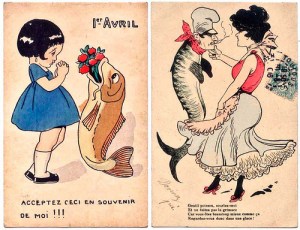 Today is April Fool’s Day so watch out for those sadistic tricksters!! It’s known as April Fish Day in France. I found a vintage French postcard for you so you will know that I’m not April Foolin’ you!!
The origins of April Fools’ Day are obscure. The most commonly cited theory holds that it dates from 1582, the year France adopted the Gregorian Calendar, which shifted the observance of New Year’s Day from the end of March (around the time of the vernal equinox) to the first of January.
According to popular lore some folks, out of ignorance, stubbornness, or both, continued to ring in the New Year on April 1 and were made the butt of jokes and pranks on account of their foolishness. This became an annual tradition, according to this version of events, which ultimately spread throughout Europe.A major weakness of the calendar-change theory is that it fails to account for an historical record replete with traditions linking this time of year to merriment and tomfoolery dating all the way back to antiquity.The Romans, for example, celebrated a festival on March 25 called Hilaria, marking the occasion with masquerades and “general good cheer.”Holi, the Hindu “festival of colors” observed in early March with “general merrymaking” and the “loosening of social norms,” is at least as old.
It’s not unreasonable to suppose that the calendrical changes of the 16th and 17th centuries served more as an excuse to codify a general spirit of frivolity already associated with the advent of spring than as a direct inspiration for April Fools’ Day.
Here’s one of my favorite April Fool’s hoax of all times. It’s from the BBC an it’s broadcast of the Swiss Spaghetti Harvest of 1957.
Today in France, those who are fooled on April 1 are called the “Poisson d’Avril” (the April Fish). A common prank (especially among school-aged children) is to place a paper fish on the back of an unsuspecting person. When the paper fish is discovered, the victim is declared a “Poisson d’Avril.”
While it is not clear of the origins of fish being associated with April 1, many think the correlation is related to zodiac sign of Pisces (a fish), which falls near April.
If you are looking for an easy way to prank your friends or family, doodling or cutting out a paper fish and sticking it on the back of an unsuspecting victim is an easy (though admittedly juvenile) way of commemorating the origins of April Fools’ Day.
Of course as someone who enjoys France in large part because of all the amazing food, my personal favorite part about Poisson d’Avril are the plethora of bakeries and cholocatiers that make fish shaped French pastries and chocolates in honor of the holiday. Carol Gillot, who writes the blog Paris Breakfasts, has a great collection of such fish-shaped treats on her blog.
So, I do have few economics links today to share with you. BB sent me a link to this David Stockman op-ed. I frankly thought it an April Fool’s Day prank by the NYT but it seems Mr. Stockman has been bitten by the gold bug. He appears to be having public fits.
The future is bleak. The greatest construction boom in recorded history — China’s money dump on infrastructure over the last 15 years — is slowing. Brazil, India, Russia, Turkey, South Africa and all the other growing middle-income nations cannot make up for the shortfall in demand. The American machinery of monetary and fiscal stimulus has reached its limits. Japan is sinking into old-age bankruptcy and Europe into welfare-state senescence. The new rulers enthroned in Beijing last year know that after two decades of wild lending, speculation and building, even they will face a day of reckoning, too.
THE state-wreck ahead is a far cry from the “Great Moderation” proclaimed in 2004 by Mr. Bernanke, who predicted that prosperity would be everlasting because the Fed had tamed the business cycle and, as late as March 2007, testified that the impact of the subprime meltdown “seems likely to be contained.” Instead of moderation, what’s at hand is a Great Deformation, arising from a rogue central bank that has abetted the Wall Street casino, crucified savers on a cross of zero interest rates and fueled a global commodity bubble that erodes Main Street living standards through rising food and energy prices — a form of inflation that the Fed fecklessly disregards in calculating inflation.
These policies have brought America to an end-stage metastasis. The way out would be so radical it can’t happen. It would necessitate a sweeping divorce of the state and the market economy. It would require a renunciation of crony capitalism and its first cousin: Keynesian economics in all its forms. The state would need to get out of the business of imperial hubris, economic uplift and social insurance and shift its focus to managing and financing an effective, affordable, means-tested safety net.
So, what are economists saying about this full on meltdown? Business Insider calls the four page essay an “unhinged screed”.
Former Reagan budget director David Stockman has a new book coming out on Tuesday, and he’s warming up the public with a massive piece in today’s New York Times titled Sundown in America, which basically says the future of America bleak because of massive government debts, crony capitalism, bailouts, megabanks, the removal of the gold standard, and even green energy.
The piece can truly be characterized as Hard Money Buzzword Bingo, as Stockman tries to get in as many scare lines as possible.
Check out this one sentence where he talks about bubbles, Wall Street casinos, the Crucifixion of savers, commodities Main Street, a “Great Deformation”, and a rogue central bank:
Instead of moderation, what’s at hand is a Great Deformation, arising from a rogue central bank that has abetted the Wall Street casino, crucified savers on a cross of zero interest rates and fueled a global commodity bubble that erodes Main Street living standards through rising food and energy prices — a form of inflation that the Fed fecklessly disregards in calculating inflation.
It just goes on and on like this, but his final suggestion is to run for the hills:
The United States is broke — fiscally, morally, intellectually — and the Fed has incited a global currency war (Japan just signed up, the Brazilians and Chinese are angry, and the German-dominated euro zone is crumbling) that will soon overwhelm it. When the latest bubble pops, there will be nothing to stop the collapse. If this sounds like advice to get out of the markets and hide out in cash, it is.
It’s hard to know where to begin poking holes in the whole thing, but probably the most telling and self-contradicting aspect, is the fact that he traces the original sin of the economy back to FDR taking the US off of the gold standard.
Paul Krugman calls him a “cranky old man” which I frankly think should be the new moniker for the republican party. Give up GOP. Take up COM.
Shorter David Stockman:
We’ve been doomed, yes doomed, ever since FDR took us off the gold standard and introduced unemployment insurance. What about those 80 years of non-doom? Just a series of lucky accidents. Now we’re really doomed. I mean it!
Actually, I was disappointed in Stockman’s piece. I thought there would be some kind of real argument, some presentation, however tendentious, of evidence. Instead it’s just a series of gee-whiz, context- and model-free numbers embedded in a rant — and not even an interesting rant. It’s cranky old man stuff, the kind of thing you get from people who read Investors Business Daily, listen to Rush Limbaugh, and maybe, if they’re unusually teched up, get investment advice from Zero Hedge.
 Paul Thoma just gives him the wingnut of the day award. Kids Prefer Cheese actually provide some wonky responses and says he’s thrown a massive hissy fit. Stockman really does appear to have views totally disconnected from economic history and reality. I give up everything nice I’ve ever said about him. This one op-ed shows he’s really off his rocker. My favorite characteristic comes from the ever mild mannered Jared Bernstein. Now remember, I’ve been quoting economists only here.
He has a featured piece in today’s NYT which, while about 11.8% absolutely and totally on target, is mostly a horrific screed, an ahistorical, dystopic, Hunger-Games vision of America based on debt obsession and willful ignorance of macroeconomics and the impact of market failure.
The first sign of a problem here comes from a mash-up of statistics in the introduction that looked wrong. I’m not sure what he did, but business investment is up 1.4% per year since early 2000, not 0.8% as Stockman claims, and why start there anyway (he seems to do so because that’s when the stock market last peaked—whatever…)? Actually, business investment has been a pretty strong performer over this expansion, up 6.6% per year since 2009Q3. To measure payroll growth from the early 2000s also masks huge variation. Stockman claims almost no growth annually, but private payrolls are up over 2% per year since they started growing in early 2010.
But here’s the challenge with a piece like this: despite the better statistics you get when you chose different dates, there’s no question that the American economy is seriously underperforming and that bad policy is implicated. It’s just that the culprits aren’t the ones he thinks they are.
In fact, like most crazed rants, it’s hard to pick out the argument, but I think it’s this: for almost a century, economic policy makers have…um…made policy, and that’s led to cheap money, high indebtedness, crony capitalism, and econo-moral-turpitude.
Everyone’s implicated, left and right. Keynes didn’t understand macro, Nixon abandoned the discipline of the gold standard, Bush II spent recklessly, Greenspan and Bernanke’s were and are reckless monetary hippies, even Paul Ryan’s a big spender (!), Obama’s policies are “hopelessly glib” (whatever that means), and the central banks of China and Japan are “monetary roach motels.”
Eisenhower gets some love, presumably for running some budget surpluses, though Clinton’s larger surpluses (as a share of GDP) are not mentioned.
Like I said, I thought the NYT’s as playing April Fool’s Day one day early in not only printing this but giving it so much space!

 peej
peej Carissa
 bostonboomer
 dakinikat
 ecocatwoman
 mablue2
 Mama Lopez
 peggysue22
 quixote
 skydancingguestblogger
 Mona (aka Wonk the Vote)



 Sky Dancing
Recent Comments