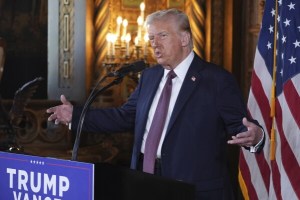
Trump holds forth at his Mar-a-Lago press conference.
Trump isn’t in office yet, but he is already dominating the news. It’s difficult to believe, but I think he is actually getting crazier.
Trump 2.0 is going to be chaos to the nth degree. I have no doubt that it will make his first term look sane by comparison. He is aging noticeably–he’s approaching 80–and his dementia is getting worse.
As we all know, this time there won’t be sane handlers trying to hold back his worst inclinations; he will be surrounded by MAGA loyalists who will do whatever he wants. It’s going to be awful, and getting through what’s coming is going to be tough.
Again, he’s not even waiting until he’s sworn in to begin causing trouble. Yesterday he held a “press conference” during which he came off as truly psychotic. In case you missed it (I couldn’t bear to watch), here are some media write-ups.
David E. Sanger at The New York Times: Dripping Faucets and Seizing Greenland: Trump Is Back and Chaos Ensues.
There was talk of the rising number of beached whales in Massachusetts, the victim, the president-elect said, of those windmills that have been erected off the coast. They “are driving the whales crazy, obviously.”
There was a vow to rename the Gulf of Mexico, by presidential decree, to the “Gulf of America.” And then there was Donald J. Trump’s refusal to rule out using military force to seize the 51-mile Panama Canal on national security grounds, along with the 836,000 square miles of Greenland, the world’s largest island.
Mr. Trump’s family and supporters like to say “We are so back!” and they are, without doubt. Yet as the man who will be president again spun out threats and angry denouncements of the Biden administration and personal grievances for more than an hour on Tuesday in the living room of his Mar-a-Lago club, something else was back: the chaotic stream-of-consciousness presidency.
Mr. Trump has returned to our daily national cognizance, even though one could argue he never really left. Tuesday’s news conference was a reminder of what that was like, and what the next four years may have in store.
He waxed on about a favorite complaint during his first term: Shower heads and sink faucets that don’t deliver water, a symbol of a regulatory state gone mad. “It goes drip, drip, drip,” he said. “People just take longer showers, or run their dishwasher again,” and “they end up using more water.”
Then he moved on to the prospect of a military clash with Denmark. After refusing to rule out the prospect of coercing a NATO ally with the use of force if it remained reluctant to turn over property the president-elect coveted, Mr. Trump suggested that Denmark had a dubious claim on Greenland anyway.
Don Jr. and his buddies in Greenland yesterday
“People really don’t even know if Denmark has any legal right to it, but if they do, they should give it up, because we need it for national security,” he said.
As for Panama, he insisted the United States had to defend against an urgent national security threat from China, though the situation around the canal was little changed from the last time Mr. Trump sat in the Oval Office.
“It might be that you’ll have to do something,” he said with signature vagueness, when asked about his suggestion that the only solution to this problem may be military force.
There was a lot of déjà vu in Tuesday’s news conference, recalling scenes from his first presidency. The conspiracy theories, the made-up facts, the burning grievances — all despite the fact that he has pulled off one of the most remarkable political comebacks in history. The vague references to “people” whom he never names. The flat declaration that American national security was threatened now, without defining how the strategic environment has changed in a way that could prompt him to violate the sovereignty of independent nations.
But there were also several differences in this version of Mr. Trump that are easy to overlook in a man who can move, in an instant, from the failures of American plumbing to the need to revive the territory-grabbing spirit of President William McKinley.
President Trump has created a massive gulf in America.
No, I am not talking about the half baked promise “to be changing the name of the Gulf of Mexico to the Gulf of America” that Trump announced in his news conference on Tuesday. The gulf that our country actually is going to have is the one between our current reality and the one we will be experiencing when Trump takes office on Jan. 20.
This news conference, which was the first since Trump’s re-election was certified by Congress, was a wild one — even by Trumpian standards. In a little over an hour behind a podium at his Mar-a-Lago beach club, the president-elect, along with promising to rename an ocean basin, threatened potential military force against Panama and Denmark. He also suggested he might use “economic force” to make Canada the 51st State.
“They should be a state,” Trump said of one of America’s closest neighbors and allies.
And, if Hamas doesn’t release the remaining hostages taken in the October 7th attack before Trump’s inauguration, Trump vowed that would also result in a massive show of force.
“If they’re not back by the time I get into office, all hell will break out in the Middle East,” Trump said. “It will not be good for Hamas and it will not be good frankly for anyone. All hell will break out.”
Trump’s feverish foreign policy visions were mixed up with his other weird obsessions and blatant lies. He ranted about President Joe Biden’s efforts to promote electric power and suggested heat generated this way will make you “itch.” As he vowed to make “major pardons” for some of his supporters who attacked the Capitol during the January 6 insurrection, Trump reiterated some of his preferred, debunked conspiracy theories about that day including that, the FBI is concealing the identity of the unknown pipe bomber and that, somehow, the Middle Eastern terrorist group Hezbollah might have played a role in the violence.
“We have to find out about Hezbollah. We have to find out about who exactly was in that whole thing because people that did some bad things were not prosecuted,” Trump said….
The whole thing was objectively bizarre and it’s difficult to track how much of Trump’s comments were bluster or how many of these wild ideas are even remotely feasible. Can you even effectively rename an ocean? Does he really intend to try to essentially annex Canada? Would he really consider using military force to take over Greenland or the Panama Canal? Would the military stand for that? Would Congress?
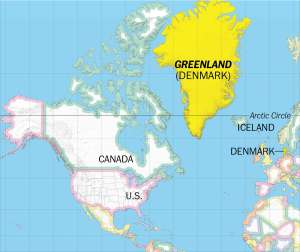
President-elect Donald J. Trump’s attention returned Tuesday to an idea that has fascinated him for years: acquiring Greenland for the United States. In a news conference on Tuesday, he refused to rule out using military or economic force to take the territory from Denmark, a U.S. ally.
“We need Greenland for national security purposes,” he said, arguing that Denmark should give it up to “protect the free world.” He threatened to impose tariffs on Denmark if it did not.
Earlier in the day, Mr. Trump wrote on social media that the potential American acquisition of the Arctic territory “is a deal that must happen” and uploaded photos of his eldest son, Donald Trump Jr., who was visiting Greenland….
Greenland
After the news conference, Denmark sharply rebuked the proposal, saying that the world’s largest island is not for sale, and the prime minister of Greenland, Mute B. Egede, rejected Mr. Trump’s designs on the territory. “Greenland belongs to the people of Greenland,” Mr. Egede said. “Our future and fight for independence is our business.” [….]
Greenland’s vast ice sheets and glaciers are quickly retreating as the Earth warms through accelerating climate change. That melting of ice could allow drilling for oil and mining for minerals such as copper, lithium, nickel and cobalt. Those mineral resources are essential to rapidly growing industries that make wind turbines, transmission lines, batteries and electric vehicles.
Because of higher temperatures, an estimated 11,000 square miles of Greenland’s ice sheets and glaciers have already melted in the past three decades, an area roughly the size of Massachusetts….
The melting ice in the Arctic is also opening up a new strategic asset in geopolitics: shorter and more efficient shipping routes. Navigating through the Arctic Sea from Western Europe to East Asia, for example, is about 40 percent shorter compared to sailing through the Suez Canal. Ship traffic in the Arctic has already surged 37 percent over the past decade, according to a recent Arctic Council report.
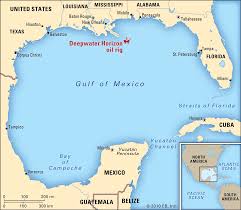
Donald Trump on Tuesday said the United States would change the name of the Gulf of Mexico to the Gulf of America, and the president-elect seemed to tie the prospective renaming to his long-standing grievances with Mexico’s handling of immigration, drug trafficking and trade.
“We’re going to be changing the name of the Gulf of Mexico to the Gulf of America,” Trump said at a news conference at his Mar-a-Lago Club in Palm Beach, Florida. “ … What a beautiful name, and it’s appropriate.”
The president-elect subsequently decried the Mexican government for allowing migrants to “pour” into the United States, saying Mexico “can stop them and we’re going to put very serious tariffs on Mexico and Canada because Canada, they come through Canada, too.”
Trump provided no additional details about how he planned to implement the name change, but the comments sparked immediate questions about whether a president has the authority to rename an international body of water and prompted at least one Republican member of Congress to draft legislation.
That member of Congress was Marjorie Taylor Greene.
Here’s what we know about what Trump can and cannot do to rename the gulf….
The Gulf of Mexico is a 218,000-square-mile oceanic basin connected to the Caribbean Sea and the Atlantic Ocean through the Florida Straits and the Yucatán Channel. It spans from the eastern coast of Mexico and the southeastern coast of the United States to the western end of Cuba….
There are existing mechanisms to rename places recognized by the federal government. However, if the federal name change becomes official, that does not mean that other nations will recognize it.
The U.S. Board on Geographic Names is a federal interagency organization that is responsible for maintaining uniform geographic name usage throughout the federal government. The board operates under the interior secretary. The board’s Foreign Names Committee is responsible for standardizing foreign place names. The committee is composed of representatives from federal agencies, including several appointees specializing in geography and cartography. Members are appointed every two years.
While the BGN does not create names for geographical features, it approves or rejects names proposed by others based on its established policies. A recent example of the board’s work includes approval of replacement names for all features that included the word “squaw,” which is used as a derogatory slur toward NativeAmerican women. The name changes were made after an order by Interior Secretary Deb Haaland in 2021. Haaland is the first Native person to serve as a Cabinet secretary.
Trump probably doesn’t know that Mexico and Canada, along with the U.S., are each parts of “America.”–that is, the continent of North America. Of course changing the name is ridiculous and idiotic, but so is Trump.
During the “press conference,” Trump also said that the changes Mark Zuckerberg is making to his social media platforms are in response to his (Trump’s) threats to imprison the the billionaire social media owner.
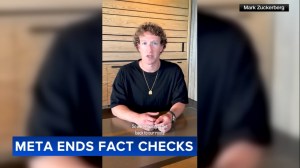
Meta CEO Mark Zuckerberg announced a series of major changes to the company’s moderation policies and practices Tuesday, citing a shifting political and social landscape and a desire to embrace free speech.
Zuckerberg said Meta will end its fact-checking program with trusted partners and replace it with a community-driven system similar to X’s Community Notes.
The company is also changing its content moderation policies around political topics and undoing changes that reduced the amount of political content in user feeds, Zuckerberg said.
The changes will affect Facebook and Instagram, two of the largest social media platforms in the world, each boasting billions of users, as well as Threads.
“We’re going to get back to our roots and focus on reducing mistakes, simplifying our policies and restoring free expression on our platforms,” Zuckerberg said in a video. “More specifically, here’s what we’re going to do. First, we’re going to get rid of fact-checkers and replace them with community notes similar to X, starting in the U.S.”
Zuckerberg pointed to the election as a major influence on the company’s decision and criticized “governments and legacy media” for, he alleged, pushing “to censor more and more.”
“The recent elections also feel like a cultural tipping point towards, once again, prioritizing speech,” he said. “So we’re going to get back to our roots and focus on reducing mistakes, simplifying our policies and restoring free expression on our platforms.”
These two sections outlining speech (written or visual) are new additions:
We do allow allegations of mental illness or abnormality when based on gender or sexual orientation, given political and religious discourse about transgenderism and homosexuality and common non-serious usage of words like “weird.”
We do allow content arguing for gender-based limitations of military, law enforcement, and teaching jobs. We also allow the same content based on sexual orientation, when the content is based on religious beliefs.
Another section that specifically banned making dehumanizing references to transgender or non-binary people as “it” or referring to women “as household objects or property or objects in general” has been removed entirely.
The opening statement about what the policies are “designed to allow room for” that previously listed only health or positive support groups has changed too (new additions marked in bold):
People sometimes use sex- or gender-exclusive language when discussing access to spaces often limited by sex or gender, such as access to bathrooms, specific schools, specific military, law enforcement, or teaching roles, and health or support groups. Other times, they call for exclusion or use insulting language in the context of discussing political or religious topics, such as when discussing transgender rights, immigration, or homosexuality. Finally, sometimes people curse at a gender in the context of a romantic break-up. Our policies are designed to allow room for these types of speech.
The section that specifically banned targeting people or groups “with claims that they have or spread the novel coronavirus” has also been removed.
Meta on Tuesday announced sweeping changes to how it moderates content that will roll out in the coming months, including doing away with professional fact checking. But the company also quietly updated its hateful conduct policy, adding new types of content users can post on the platform, effective immediately.
Users are now allowed to, for example, refer to “women as household objects or property” or “transgender or non-binary people as ‘it,’” according to a section of the policy prohibiting such speech that was crossed out. A new section of the policy notes Meta will allow “allegations of mental illness or abnormality when based on gender or sexual orientation, given political and religious discourse about transgenderism and homosexuality.”
Previously, such comments would have been subject to removal under the policy. The changes to Meta’s hateful conduct policy were first reported by Wired.
Meta had hinted in its announcement about its content moderation policy changes Tuesday morning that it would get rid of restrictions on certain topics, such as immigration and gender identity, and allow more political discussions. But the updated policy shows just how quickly Meta is moving to enact CEO Mark Zuckerberg’s vision for “free expression.”
Meta on Tuesday also announced it would do away with its network of independent fact checkers in the United States and will instead rely on user-generated “community notes” to add context to posts. It also said it would adjust its automated systems that scan for policy violations, which it says have resulted in “too much content being censored that shouldn’t have been.” The systems will now be focused only on extreme violations such as child sexual exploitation and terrorism.
Basically, it’s open season on women and LBGTQ+ people.
Please take care of yourselves today and every day for the next 4 years.
Did you like this post? Please share it with your friends:
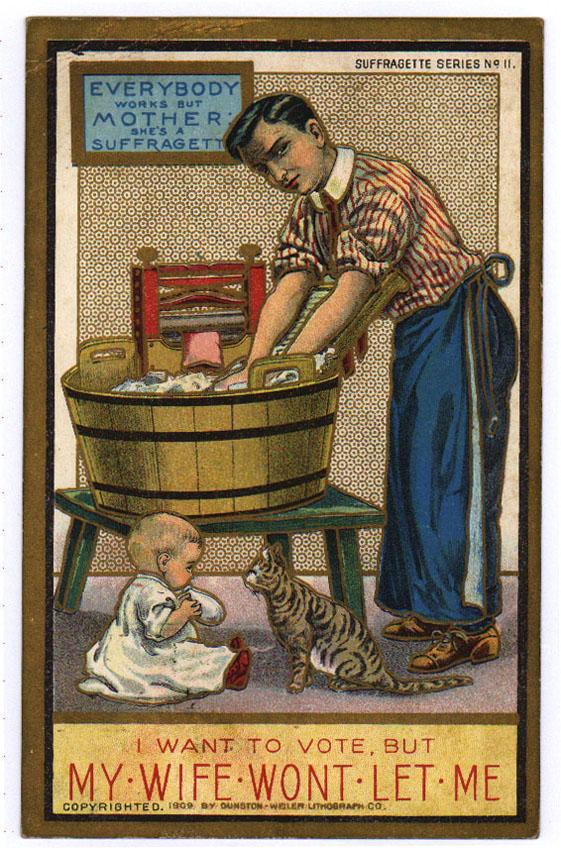
I recently learned that cats were used by both sides during the battle for women’s suffrage. They were used on posters and postcards to supposedly dehumanize women fighting for the right to vote, but were also used in support of women’s suffrage.
The women’s suffrage movement was an exceptionally controversial topic in both the United States and England. Postcard manufacturers hired artists to create visually appealing postcards about women’s suffrage. A popular subject was the suffrage cat, which was used for both pro- and anti-suffrage messaging. In Victorian culture, the cat was often associated with the female sphere; the indoor cat represented the passive, ideal homemaker, and the outdoor cat was brazen, feral and fallen. Defining how the cat was intended to be viewed as a symbol in women’s suffrage postcards can be a challenge, as seen in some of the selections below.
At that link, you can see descriptive text about some of the images I’ve posted here.
In the 1800s and early 1900s, many women and men supported women’s suffrage (the right to vote). There were, however, people that opposed the idea. One of the prevailing beliefs was that voting power would diminish a woman’s role as caretaker of the family. Some women and men felt so strongly about this that they founded anti-suffragist organizations. Cartoonists also created advertisements and postcards supporting anti-suffragists. These ads often featured animals to make a point.
In popular mainstream culture at the time, women were associated with animals perceived as passive, like cats. Social norms dictated that middle class, white women should stay in the home. Men, however, were expected to occupy public spaces and partake in physical exercise. As a result, men were often associated with physically active animals like dogs. Anti-suffrage artists used these animals symbolically in their cartoons.
Cats were more often used in British anti-suffragist ads. Anti-suffrage organizations in Britain used cats to try to make the point that women were simple and delicate. The cartoons implied that women’s suffrage was just as absurd as cat suffrage because women (and cats) were incapable of voting.
Cats were also used symbolically in some American anti-suffrage ads. A number of American cartoons showed men at home with a cat, taking care of the children. The cat symbolized a loss of the man’s masculinity. Some people believed that if women participated in politics, men would be left at home to raise the children.
Suffragists took back the meaning of the cat in 1916. That April, suffragists Nell Richardson and Alice Burke started a cross-country road trip in a two-seater car they called “The Golden Flier.” Members of the press at the send-off ceremony in New York City reported that the car looked like “a little yellow ant scuttling off through the crowds of limousines and autotrucks which lined the streets” (New York Tribune, April 07, 1916).
Over the next several months, the women stopped in New Jersey, Maryland, Virginia, Ohio, Texas, California, Washington and other states across the country to talk about the importance of women’s suffrage. During their trip, the women adopted a cat that became their unofficial mascot. They named him Saxon, after the manufacturer of the Golden Flier.
Over the next several months, the women spent long hours standing on street corners and in public parks making speeches about suffrage. Alice Burke commented that they were in the sun so often that they let their “noses blister and burn” and their “hair sizzle.” Burke and Richardson were not the only ones enduring the hot weather. Burke wrote in her diary:
The little black kitten is suffering as much as we are from the heat, but he keeps under a cover, and all we can see around the corner of it is a pink nose and a youthful whisker.” (New York Tribune, May 29, 1916)
Now for some news. The mainstream media and some Democrats are still trying to get President Biden to end his campaign for a second term; but last night he gave a speech to an enthusiastic audience in Detroit that should begin to quiet the naysayers. I hope you were able to watch it, because it was impressive. Biden spoke extemporaneously for 35 minutes–no teleprompter and no notes. And the audience loved it. They chanted “Don’t you quit” and “We’ve got your back.” These people are the base of the Democratic Party, and they still love Joe Biden. Biden is also up 2 points on Trump in the latest polls, despite the massive efforts to bring him down.
Here’s the speech:
It’s difficult to find honest reporting on the speech, because most in the press are still hoping to end Biden’s campaign. I really think some of these “journalists” really want Trump back in the White House because they think it will further their careers. Here’s just one example from Politico: Inside Biden’s sputtering campaign to restore Dems’ confidence.
Three of Joe Biden’s senior aides entered a Senate Democratic lunch on Thursday armed with internal and external polls showing the presidential race still within the margin of error, hoping to keep this last bastion of support from abandoning his embattled campaign.
During a difficult and at times tearful meeting with Mike Donilon, Steve Ricchetti and Jen O’Malley Dillon, senators aired concerns about the president’s ability to serve for another four years, his path to defeat former President Donald Trump and the effect Biden’s poor polling might have on Democrats running down the ballot, according to five people familiar with the meeting who were granted anonymity to describe private discussions.
But by the end of the lunch, Sen. John Fetterman of Pennsylvania had enough.
“You have legacies, too,” Fetterman said, according to the people, asking what those legacies would become “if you fuck over a great president over a bad debate.”
Then, the first-term senator called the question: Who was with him — committed to sticking with Biden as the party’s nominee?
No more than four people signaled that they were, according to four of the people familiar with the meeting. While not every Senate Democrat was in attendance and some had trickled out of the lunch already, Fetterman, Sens. Chris Coons of Delaware and Tammy Duckworth of Illinois thought Biden should continue.
The paltry show of support for Biden behind closed doors revealed that for all the indecision about whether and how to confront Biden, elected Democrats’ confidence in the president had plunged to a ruinous low. While Senate Democrats have largely kept quiet publicly, Biden may have to plow ahead despite an overwhelming lack of confidence from his former Senate colleagues. The majority of the Democratic caucus left Thursday’s meeting just as, if not more, concerned about the path the party is on with Biden atop the ticket.
Of course, the naysayers are always anonymous. Fuck them! Use you name or STFU.
DETROIT — President Joe Biden tore into the “right-wing Project 2025” and made it a central theme of his speech at a rally Friday in battleground Michigan as he seeks to put a lid on Democratic calls that he withdraw from the presidential race.
“Folks, Project 2025 is the biggest attack on our system of government and on our personal freedom that’s ever been proposed in the history of this country,” Biden told the crowd, adding that the initiative “is run and paid for by Trump people” and is “a blueprint for a second Trump.”
Biden, rousing the crowd with a more energetic performance than usual, said it would unleash a “nightmare” on the country if his Republican rival is elected and implements it. “Another four years of Donald Trump is deadly serious. Project 2025 is deadly serious,” Biden said, describing it as a threat to American values
When he took the stage, Biden was greeted to chants of “Don’t you quit!” and “We got your back!” The president told them there’s “a lot of speculation lately” about whether he’ll stay in the race.
“I am running, and we’re going to win!” he said….
Biden is zeroing in on Project 2025 as a mechanism to unify the Democratic Party as it splinters over his future in the race, following a shocking debate performance that some in the party see as politically fatal to his re-election prospects. Numerous voters at the rally stood by him and voiced displeasure with the Democrats calling on him to step aside. And it was clear the right-wing document has caught on across within the Democratic Party as a rallying cry for those eager to keep Trump out of the White House.
A Biden aide said the president’s campaign plans to continue focusing on Project 2025 at next week’s GOP convention.
Kapur asked voters about Project 2025:
Before Biden’s remarks at the Detroit rally, the first seven Michigan voters NBC News spoke to were all aware of Project 2025 — and had strong opinions on it.
“It’s horrific. It would totally dismantle our democracy, fill the whole government with loyalists to Trump,” said Deanna Zapico, of Royal Oak. “It would be like Hitler in 1933. There wouldn’t be an election in a long time. That’s my fear.”
“I’m sharing it with everybody,” Zapico said.
Deborah Fuertes, of Brighton, summed it up in one word: “Scary.”
“This is an existential threat,” she said.Trump’s “name’s all over that thing,” said Angela Heard, a sales manager based in Grosse Pointe Woods. “If we don’t get our s— together we’re gonna be like ‘The Handmaid’s Tale.’”
A sweeping proposal for how Donald Trump should handle a second term in office has sparked concern for its implications on the role of federal government and its calls to eliminate a number of basic human rights.
The 2025 Presidential Transition Project, more commonly known as Project 2025, released a 900-page manifesto last year titled “Mandate for Leadership: The Conservative Promise.” The policy guidebook — compiled by the conservative think tank Heritage Foundation in partnership with more than 100 other conservative organizations — lays out a far-right, Christian nationalist vision for America that would corrode the separation of church and state, replace nonpartisan government employees with Trump loyalists and bolster the president’s authority over independent agencies.
Heritage Foundation President Kevin Roberts, a rumored candidate for Trump’s chief of staff in a second term, promoted his group’s extreme positions during a July interview, saying, “We are in the process of the second American Revolution, which will remain bloodless if the left allows it to be.”
Down with the tomcats
Shortly after Roberts’ controversial interview, Trump attempted to distance himself from Project 2025, saying on Truth Social that he knows “nothing” about it and has “no idea who is behind it,” before adding that he disagrees with some of its propositions.
While Project 2025 is not formally a part of Trump’s campaign platform, it has been led and supported by several influential people in his orbit. The project’s top leaders all worked in Trump’s White House and a number of the manifesto’s contributors also served in the Trump administration, including but not limited to former Housing and Urban Development Secretary Ben Carson and imprisoned former trade adviser Peter Navarro.
Equally damaging to Trump’s claim that he is unfamiliar with Project 2025 is that he worked closely with the Heritage Foundation when he was first elected president. He was provided a similar “Mandate for Leadership” back in 2016, and enacted nearly two-thirds of the group’s proposals within his first year in office.
The Heritage Foundation also reportedly played a behind-the-scenes role on Trump’s presidential transition team and had a significant hand in staffing the administration.
Alvord also addressed Project 2025’s goal of eliminating the wall between church and state.
Project 2025 establishes a framework for guiding the federal government through a biblical lens. Across nearly 1,000 pages, the mandate pushes an unpopular interpretation of the Christian agenda that would target reproductive rights, LGBTQ+ people and people of color by effectively erasing mention of all related terms, protections and troublesome historical accounts.
Though the mandate accuses the “woke” left of infringing on people’s religious freedoms, its policies are rooted in a singular, extremist view of how society should function based on its authors’ own Christian nationalist values. It repeatedly calls for the punishment, even imprisonment, of people who do not conform to the think tank’s platform.
The proposed policies in Project 2025’s mandate stem from four stated goals. In its words: restoring the family as the centerpiece of American life, dismantling the administrative state, defending the nation’s sovereignty and securing God-given individual rights.
Through a holistic approach to restructuring the government, it would seek to give Trump heightened authority to enact his backers’ platform in every city and state — often encouraging the president to creatively subvert congressional approval.
Read the rest at People Magazine. It’s very detailed.
Speaking of Christian nationalism, ProPublica has an investigative article on a shadowy organization of rich people working to influence the 2024 election. Andy Kroll and Nick Surgey: Inside Ziklag, the Secret Organization of Wealthy Christians Trying to Sway the Election and Change the Country. The subhead reads: “The little-known charity is backed by famous conservative donors, including the families behind Hobby Lobby and Uline. It’s spending millions to make a big political push for this election — but it may be violating the law.”
A network of ultrawealthy Christian donors is spending nearly $12 million to mobilize Republican-leaning voters and purge more than a million people from the rolls in key swing states, aiming to tilt the 2024 election in favor of former President Donald Trump.
These previously unreported plans are the work of a group named Ziklag, a little-known charity whose donors have included some of the wealthiest conservative Christian families in the nation, including the billionaire Uihlein family, who made a fortune in office supplies, the Greens, who run Hobby Lobby, and the Wallers, who own the Jockey apparel corporation. Recipients of Ziklag’s largesse include Alliance Defending Freedom, which is the Christian legal group that led the overturning of Roe v. Wade, plus the national pro-Trump group Turning Point USA and a constellation of right-of-center advocacy groups.
1908
ProPublica and Documented obtained thousands of Ziklag’s members-only email newsletters, internal videos, strategy documents and fundraising pitches, none of which has been previously made public. They reveal the group’s 2024 plans and its long-term goal to underpin every major sphere of influence in American society with Christianity. In the Bible, the city of Ziklag was where David and his soldiers found refuge during their war with King Saul.
“We are in a spiritual battle and locked in a terrible conflict with the powers of darkness,” says a strategy document that lays out Ziklag’s 30-year vision to “redirect the trajectory of American culture toward Christ by bringing back Biblical structure, order and truth to our Nation.”
Ziklag’s 2024 agenda reads like the work of a political organization. It plans to pour money into mobilizing voters in Arizona who are “sympathetic to Republicans” in order to secure “10,640 additional unique votes” — almost the exact margin of President Joe Biden’s win there in 2020. The group also intends to use controversial AI software to enable mass challenges to the eligibility of hundreds of thousands of voters in competitive states.
In a recording of a 2023 internal strategy discussion, a Ziklag official stressed that the objective was the same in other swing states. “The goal is to win,” the official said. “If 75,000 people wins the White House, then how do we get 150,000 people so we make sure we win?”
According to the Ziklag files, the group has divided its 2024 activities into three different operations targeting voters in battleground states: Checkmate, focused on funding so-called election integrity groups; Steeplechase, concentrated on using churches and pastors to get out the vote; and Watchtower, aimed at galvanizing voters around the issues of “parental rights” and opposition to transgender rights and policies supporting health care for trans people.
In a member briefing video, one of Ziklag’s spiritual advisers outlined a plan to “deliver swing states” by using an anti-transgender message to motivate conservative voters who are exhausted with Trump.
But Ziklag is not a political organization: It is a 501(c)(3) tax-exempt charity, the same legal designation as the United Way or Boys and Girls Club. Such organizations do not have to publicly disclose their funders, and donations are tax deductible. In exchange, they are “absolutely prohibited from directly or indirectly participating in, or intervening in, any political campaign on behalf of (or in opposition to) any candidate for elective public office,” according to the IRS.
Critics shredded Meta’s decision to ease restrictions placed on former President Donald Trump’s Instagram and Facebook accounts.
Axios reported Friday the social media titan planned to soon roll back limits it placed on Trump’s accounts as it aimed to allow for more parity leading up to the Nov. 5 election. The tech giant said a minor violation could lead to his accounts being suspended up to two years or restricted.
The move comes more than a year after he was reinstated to the platforms but with limits such as suspensions and advertising restrictions for violating company rules.
Stunned social media critics blasted the decision.
“So the despotic threats worked?” asked @JenBaty, pointing to Trump’s threat on Truth Social that the “ZUCKERBUCKS (sic),” a reference to Facebook cofounder Mark Zuckerberg, “will be sent to prison for long periods of time.”
Trump has previously said Zuckerberg “cheated” in the 2020 election.
“Why isn’t he being prosecuted?” he wrote last year. “The Democrats only know how to cheat. America isn’t going to take it much longer!”
A few stories on the Republican National Convention in Milwaukee next week:
So it can be hard for some to swallow that Milwaukee is playing host to former President Donald Trump and the Republican National Convention this coming week while rival Chicago, the larger city just 90 miles to the south, welcomes President Joe Biden and Democrats in August.
It didn’t help smooth things over with wary Democrats after Trump used the word “horrible” when talking about Milwaukee just a month before the convention that begins Monday.
Adding to the angst, Milwaukee was supposed to host the Democratic National Convention in 2020, but it didn’t happen due to COVID. Owners of local restaurants, bars and venues say the number of reservations that were promised during the RNC aren’t materializing. And protesters complained the city was trying to keep them too far away from the convention site to have an impact.
“I wish I was out of town for it,” Jake Schneider, 29, said as he passed by the city’s statue of Fonzie, the character played by Henry Winkler in the 1970s sitcom “Happy Days” that was set in Milwaukee. “I’m not super happy that it’s the Republican Party coming to town.” [….]
Ryan Clancy, a self-described democratic socialist who is a state representative and serves on the Milwaukee County Board, puts it more bluntly: “It is shameful that we rolled out the red carpet for the RNC.”
Former President Donald Trump will be officially renominated next week to be the Republican Party’s standard-bearer for the third presidential election in a row as he seeks to return to the Oval Office.
GOP delegates from around the country will gather in Milwaukee for the Republican National Convention, with much of the country following along through the primetime speeches each night.
These speeches have historically allowed presidential candidates to unify discord from aggressive primary campaigns, and the conventions offer a high-profile platform to sway undecided voters.
While an official list of speakers hasn’t yet been announced, here are some of the people who’ve reportedly been tapped to demonstrate their support for Trump on stage next week.
The list includes Donald Trump, Jr., Ron DeSantis, Sean O’Brien (Teamsters president), David Sacks (Elon Musk’s pal), Kari Lake, Elise Stefanik, and more. She’s not listed, but I heard that Margery Taylor Green will also speak.
Donald Trump will be rubbing elbows in Milwaukee with a crowd that may include dozens of witnesses and alleged co-conspirators in his criminal cases — people he has sworn not to communicate with about details of the charges against him.
Avoiding them may not be possible for the former president during the four-day convention, creating an unusual dynamic, and a potential legal liability for Trump, against the backdrop of a national nominating convention.
1911
“If I were a Trump attorney, my biggest fear might be that Trump finds himself in close quarters with a defendant and starts running his mouth off,” said Anthony Kreis, a law professor at Georgia State University.
Several false electors for Trump in 2020 who were charged with crimes in Arizona, Nevada and Georgia are expected to be at the Republican National Convention. In addition, many of Trump’s former White House aides who testified to grand juries in Washington and Florida are likely to be on hand. Though the roster of speakers hasn’t been publicly shared, there’s a high likelihood that others embroiled in Trump’s alleged crimes — a long list of GOP officials and activists — will also be there.
The situation is, like many things associated with Trump, unprecedented, and it’s hard to gauge the likelihood that an interaction in a crowded convention hall could become legally perilous for the former president. But it’s not zero, according to legal experts.
“I imagine the tight scripted nature of the convention will help isolate Trump from that danger,” Kreis said. “But you also never know.”
General attacks on the prosecutions he’s facing in Washington, Florida and Georgia — familiar themes in Trump rallies and speeches — or superficial encounters with people involved in his cases are unlikely to raise prosecutors’ eyebrows. But legal experts say there are lines Trump could cross if he mentions codefendants or witnesses by name or has more substantive interactions with them. And even general remarks, whether scripted or extemporaneous, could present risks if they could be interpreted as pressure on witnesses against cooperation or an attempt to influence their future testimony.
Those are my recommended reads for today. I hope you find something that interests you.
Did you like this post? Please share it with your friends:
The Sky Dancing banner headline uses a snippet from a work by artist Tashi Mannox called 'Rainbow Study'. The work is described as a" study of typical Tibetan rainbow clouds, that feature in Thanka painting, temple decoration and silk brocades". dakinikat was immediately drawn to the image when trying to find stylized Tibetan Clouds to represent Sky Dancing. It is probably because Tashi's practice is similar to her own. His updated take on the clouds that fill the collection of traditional thankas is quite special.
You can find his work at his website by clicking on his logo below. He is also a calligraphy artist that uses important vajrayana syllables. We encourage you to visit his on line studio.


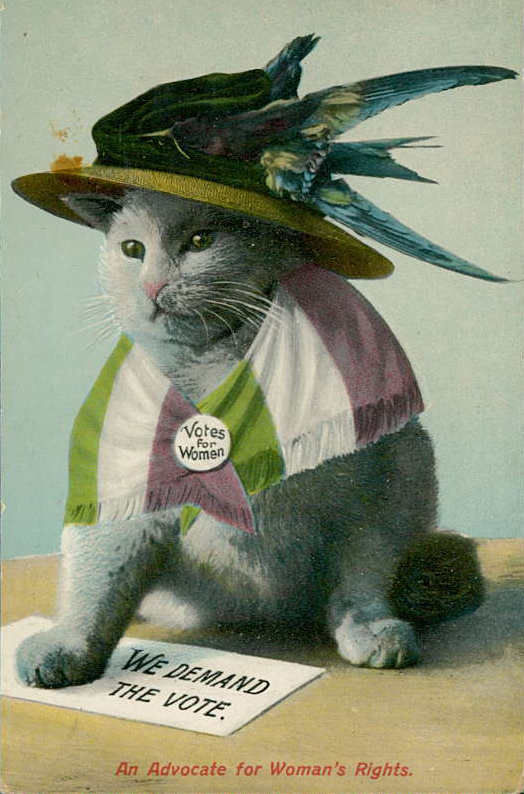 I recently learned that cats were used by both sides during the battle for women’s suffrage. They were used on posters and postcards to supposedly dehumanize women fighting for the right to vote, but were also used in support of women’s suffrage.
 Now for some news. The mainstream media and some Democrats are still trying to get President Biden to end his campaign for a second term; but last night he gave a speech to an enthusiastic audience in Detroit that should begin to quiet the naysayers. I hope you were able to watch it, because it was impressive. Biden spoke extemporaneously for 35 minutes–no teleprompter and no notes. And the audience loved it. They chanted “Don’t you quit” and “We’ve got your back.” These people are the base of the Democratic Party, and they still love Joe Biden. Biden is also up 2 points on Trump in the latest polls, despite the massive efforts to bring him down.
 Biden, rousing the crowd with a more energetic performance than usual, said it would unleash a “nightmare” on the country if his Republican rival is elected and implements it. “Another four years of Donald Trump is deadly serious. Project 2025 is deadly serious,” Biden said, describing it as a threat to American values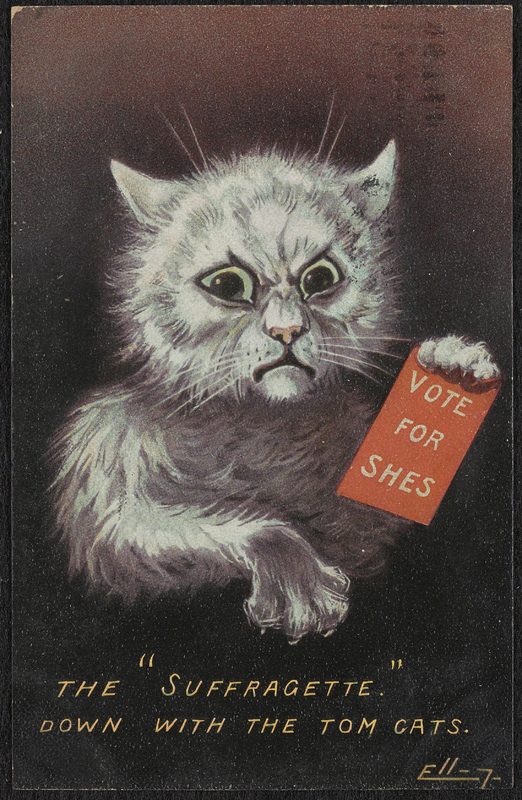

 The move comes more than a year after he was reinstated to the platforms but with limits such as suspensions and advertising restrictions for violating company rules.

 peej
peej Carissa
 bostonboomer
 dakinikat
 ecocatwoman
 mablue2
 Mama Lopez
 peggysue22
 quixote
 skydancingguestblogger
 Mona (aka Wonk the Vote)



 Sky Dancing
Recent Comments