
Wednesday Reads: Trump in Davos and Other News
Posted: January 21, 2026 Filed under: just because | Tags: American democracy, Canadian Prime Minister Mark Carney, Davos Switzerland, Denmark, Donald Trump, Epstein Files, Greenland, ICE violence in Minnesota, Lawrence O'Donnell, Lisa Cook, Radley Balco, Renee Good, Scott Bessent, Trump Greenland obsession, US Treasury bonds, World Economic forum 6 CommentsGood Afternoon!!
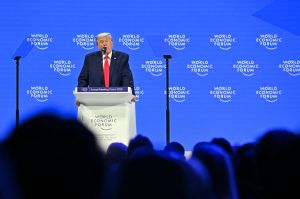
Trump rambles on and on in Davos.
This morning I woke up and turned on the TV to see our “president,” easily the stupidest president in American history, walking hunched over and tired in Davos to give another long, rambling, nonsensical, insulting “speech” to the assembled political and business leaders. He spoke for 70 minutes and it seemed much longer.
I watched the speech for awhile, but it was the same old garbage he talks about off the cuff to the assembled press in the oval office. He went on and on in his old man voice, attacking allies, demanding that Greenland be handed over to him, ranting about windmills–all to complete silence from the audience. How could they sit there and watch this embarrassing display of abject stupidity?
I don’t expect this post to make much sense, because I’m just soooo angry!
The big headline, according to the legacy media is that Trump announced he won’t “take Greenland by force.”
Politico: Trump rules out using force to acquire Greenland.
President Donald Trump ruled out military force to acquire Greenland in his remarks Wednesday to the World Economic Forum in Davos, Switzerland, providing a momentary sense of relief to Europe after weeks of worry that the U.S. would enter a confrontation with NATO.
“We probably won’t get anything unless I decide to use excessive strength and force, where we would be, frankly, unstoppable, but I won’t do that,” Trump said. “That’s probably the biggest statement I made, because people thought I would use force, but I don’t have to use force. I don’t want to use force.”
Trump said Wednesday that he wants to see negotiation to acquire what he called “a piece of ice.”
The president, though, warned Denmark that if it doesn’t give up Greenland to the U.S., “we will remember.”
He argued in his remarks that the U.S. can protect “this giant mass of land” better than Europe can, insisting that taking over Greenland wouldn’t be a threat to NATO but would instead enhance security for the alliance. While the president’s obsession with Greenland has accelerated in recent weeks, his pledge to not use force to acquire the island marks a shift in his rhetoric.
“I don’t want to use force,” he added. “All the United States is asking for is a place called Greenland, where we already had it as a trustee but respectively returned it back to Denmark not long ago after we defeated the Germans, the Japanese, Italians and others in World War II. We gave it back to them.”
He added that it was “stupid” for the U.S. to not keep the island after the war. Still, Trump downplayed the significance of his threats against Greenland, arguing it’s a trade-off for the years of support the U.S. has given to NATO allies.
“What I’m asking for is a piece of ice, cold and poorly located,” he said. It’s a very small ask, compared to what we have given them for many, many decades.”
What does that mess of words really mean? Nothing. Trump is the world’s worst liar and he’s insane. Not to mention stupid. Nothing he says can be believed.
Check this out from CNBC: Scott Bessent says U.S. is unconcerned by Treasury sell-off over Greenland, calls Denmark ‘irrelevant.’
“Denmark’s investment in U.S. Treasury bonds, like Denmark itself, is irrelevant,” U.S. Treasury Secretary Scott Bessent told reporters Wednesday at the World Economic Forum in Davos, Switzerland.
The “sell America” trade was in full swing Tuesday after President Donald Trump and European leaders escalated tensions over Greenland. U.S. stocks and bond prices tumbled, sending yields spiking.
It comes as Trump’s threats to impose 10% tariffs on eight European countries as part of his push to take over Greenland spooked markets. The levies would come into force on Feb. 1, Trump said, and later rise to 25%.
Europe’s holdings in U.S. Treasurys, however, have been tipped as a potential countermeasure.
Danish pension operator AkademikerPension said Tuesday it was selling $100 million in U.S. Treasurys. The decision was driven by “poor [U.S.] government finances,” said Anders Schelde, AkademikerPension’s investing chief.
When Bessent was asked how concerned he is about European investors pulling out of Treasurys, Bessent said at a news conference at the World Economic Forum: “Denmark’s investment in U.S. Treasury bonds, like Denmark itself, is irrelevant.”
“That is less than $100 million. They’ve been selling Treasurys for years, I’m not concerned at all.”
Really? I’d like to hear what Daknikat has to say about this.
Another North American leader–Canada’s Mark Carney– gave a powerful speech that made sense. The New York Times: Canada Flexes on Global Stage With an Eye to Its Own Survival.
Prime Minister Mark Carney of Canada delivered a stark speech in Davos, Switzerland, on Tuesday, prompting global political and corporate leaders in the audience to rise from their seats for a rare standing ovation.
He described the end of the era underpinned by United States hegemony, calling the current phase “a rupture.” He never mentioned President Trump by name, but his reference was clear.
The speech came as President Trump doubled down on his threats to take Greenland away from Denmark, saying he would slap fresh tariffs on European powers as punishment for their support of Greenland’s sovereignty.
Global leaders have been scrambling to find a unified response.
“Every day we’re reminded that we live in an era of great-power rivalry,” Mr. Carney said. “That the rules-based order is fading. That the strong can do what they can, and the weak must suffer what they must.”
And he warned, “The middle powers must act together because if we’re not at the table, we’re on the menu.”
He would know.
Mr. Trump started his second presidential term making claims on Canada as the 51st state and threatening Canada’s previous leader, Justin Trudeau, whom Mr. Trump publicly derided, with unilaterally scrapping agreements that have governed the relationship between the neighboring countries for over a century….
Mr. Carney chastised other leaders too, many of whom would have been following his speech in Davos, for not standing up for their interests.
“There is a strong tendency for countries to go along to get along,” he said. “To accommodate. To avoid trouble. To hope that compliance will buy safety. It won’t.”
Mr. Carney made clear he is choosing a different path.
He wrote his own speech, according to a government official, who spoke on condition of anonymity to discuss the inner workings of his team, which is a departure since speeches of this magnitude are usually prepared by high-level staffers with the leader’s input.
Mr. Carney, a former investment executive who has served as the governor of Canada and England’s central banks, has attended the global gathering about 30 times, according to his office….
Mr. Carney spoke not long after Mr. Trump had posted an altered image on social media that featured a map of American flags superimposed over both Canada and the United States, as well as Greenland.
Of course Trump responded with insults. Axios: Trump responds to Carney: “Canada lives because of the United States.”
President Trump said in Davos on Wednesday that Canada should be “grateful” to the U.S. for the “freebies” it receives because of the two nations’ relationship.
Why it matters: Trump’s dig at Canada came a day after Prime Minister Mark Carney delivered his own warning at the World Economic Forum over the “rupture” of the world order.
Driving the news: “Canada lives because of the United States,” Trump said Wednesday before taking a direct jab at Carney. “Remember that, Mark, the next time you make your statements.”
- Trump said Carney “wasn’t so grateful” in his address.
- Carney avoided naming Trump in his speech — a strategy a Canadian official previously told Axios was deliberate. However, the official indicated that Carney’s remarks were aimed squarely at the president’s recent actions.
Zoom out: As Trump pushes a vision of hemispheric dominance — coupled with threats of the U.S. making its northern neighbor the “51st state” — Ottawa has reportedly started preparing for how to repel a U.S. invasion.
Trump is a complete and utter asshole.
A couple more reads on Trump’s wrecking ball:
Andrew Egger at The Bulwark: Puttering Toward Annihilation.
Growing up, I never really understood Aesop’s fable about the goose that laid the golden egg. It’s a cautionary tale about greed and hubris: A farmer with a miraculous goose that lays a solid-gold egg every morning gets fed up with passive wealth generation and figures killing the bird will speed things along. But alas: He finds no store of eggs within and realizes he butchered his meal ticket for nothing. The moral’s straightforward, but it never really worked for me as a story. Like, come on: Nobody’s that stupid.
Well, almost nobody, I guess.
As long as I live, I don’t think I’ll get over this pure, dumb fact: Trump told his fans he had to blow up the liberal order because it was the only way to secure the very benefits the liberal order was already bringing us.
Trump insists America needs Greenland as a strategic positioning ground from which to restrain Russia and China in the Arctic. But thanks to the liberal order, this was something we already enjoyed. Through the magic of multilateral cooperation, we were able to treat someone else’s territory as though it were our own for the purposes of military positioning—not by bribing or intimidating them, but because they agreed their interests and our interests aligned.
Trump insists America needs to blow up America’s preexisting economic relationships to ensure America gets an advantageous position in international trade. But America already had such an advantageous position: an orderly world economic system that had lavished previously unimaginable prosperity on America and to the entire globe, with us at the proverbial (and very profitable) head of the table.
It’s not just that Trump had the hubris to think he could hero-ball the country to a better deal by canceling a century of history and starting over. It’s that his own broken personality—his miserable meanness, his dispositional inability to cooperate with and trust others—has always prevented him from understanding what was good about the deal we had to begin with. The idea that multipolar agreements could be better for America, in some cases, than outright ownership—that, say, we already have everything we need from Greenland—he rejects as ridiculous. Ownership, he told the New York Times, is “what I feel is psychologically needed for success. . . . I think that ownership gives you a thing that you can’t do, whether you’re talking about a lease or a treaty.”
He really is determined to burn everything down if he can’t get his own way on everything.
Jonathan Lemire wrote at The Atlantic before the speech (gift link): Davos Man May Burn the Whole Thing Down.
Franklin D. Roosevelt famously illustrated with a simple metaphor the need for a healthy transatlantic alliance. Justifying his decision to lend Great Britain warships and other military supplies in the early days of World War II, Roosevelt likened it to loaning a neighbor a garden hose to put out the fire consuming his house. Sure, Roosevelt charitably wanted to help a neighbor in need. But it was self-interested too; if the neighbor could extinguish the blaze, it wouldn’t spread to FDR’s home. The United States benefited from the friendship—and the buffer—that allies could provide.
Today, Donald Trump will fly to Europe. Ukraine is already ablaze. And now the president is ready to set a bunch of new houses on fire.
The president will speak at the World Economic Forum in Davos, Switzerland, tomorrow, and he appears prepared to shatter the nearly 80-year-old NATO alliance in order to seize Greenland. In his quest to claim a strategically located island of ice and rock, Trump has turned against his nation’s most stalwart friends. He has antagonized and mocked panicked European leaders, threatened punishing tariffs on countries that object to his plans, and pointedly not ruled out using military force. Trump’s thirst for Greenland—even if he stops short of ordering an armed invasion—threatens to unravel the partnership born from the ashes of World War II that has, in the decades since, ensured the spread of peace, prosperity, and democracy on both sides of the Atlantic.
Today marks one year since Trump’s return to office, and in that time, he has fundamentally reshaped the United States’ relationship with the rest of the world. But nothing has upended the global order more than what would happen if he follows through on his threats toward Greenland. The island, of course, belongs to Denmark, which says that it is not available for the taking. Troops from Europe have been dispatched to the territory, and Greenland’s prime minister warned his populace to prepare for an invasion. If Trump were to persist, Denmark could trigger NATO’s Article 5 mutual-defense pact, and then the unthinkable could occur: American soldiers firing on Europeans while Russian President Vladimir Putin’s dream of NATO’s self-immolation is thoroughly realized.
The annual meetings in Davos, normally a clubby gathering of business titans and political leaders, have been consumed by talk of what Trump may or may not do. European leaders have found themselves scrambling on strategy—appeasement? Defiance? Compromise? Early this morning, Trump posted screenshots of text messages that revealed the dilemma facing those leaders. (Lesson to everyone: Be careful what you text the guy unless you want the world to see.)
In one message, Mark Rutte—the secretary general of NATO, who has prized warm relations with Trump—praised the president’s foreign policies, then vowed that he is “committed to finding a way forward on Greenland.” But in another, French President Emmanuel Macron, whose relationship with Trump has been turbulent, admitted: “I do not understand what you are doing on Greenland.” In fact, Trump couldn’t be more clear, as he demonstrated once again by circulating a pair of presumably AI-generated images on social media. In one, he’s planting an American flag in Greenland. In the other, he’s lecturing European leaders in the Oval Office with a map behind him that depicts Greenland as part of the United States. (Canada and Venezuela too.)
Trolling close U.S. allies has seemingly been an unofficial policy of Trump’s second administration since its first days, beginning with Vice President Vance lecturing Europe in Munich on the virtues of free speech. But this time feels different for those nervously waiting in snowy Switzerland. The president’s address to the forum tomorrow is poised to be a defining moment, and Trump plans to make the unequivocal case that the United States should have Greenland, a senior White House official told me.
Pretty good predictions, except for Trump’s claim he won’t use force.
A few non-Davos stories:
Did you watch Lawrence O’Donnell last night? He still insists that Trump’s Greenland obsession is really a way to distract the press from the Epstein files. I think he could be right. If you didn’t see it, I recommend watching it now.
Lauren Gambino at The Guardian: American democracy on the brink a year after Trump’s election, experts say.
Three hundred and sixty-five days after Donald Trump swore his oath of office and completed an extraordinary return to power, many historians, scholars and experts say his presidency has pushed American democracy to the brink – or beyond it.
In the first year of Trump’s second term, the democratically elected US president has moved with startling speed to consolidate authority: dismantling federal agencies, purging the civil service, firing independent watchdogs, sidelining Congress, challenging judicial rulings, deploying federal force in blue cities, stifling dissent, persecuting political enemies, targeting immigrants, scapegoating marginalized groups, ordering the capture of a foreign leader, leveraging the presidency for profit, trampling academic freedom and escalating attacks on the news media.
The scale and velocity of what he has been able to accomplish in just a year have stunned even longtime observers of authoritarian regimes, pushing the debate among academics and Americans from whether the world’s oldest continuous democracy is backsliding to whether it can still faithfully claim that distinction.
“In 2025, the United States ceased to be a full democracy in the way that Canada, Germany or even Argentina are democracies,” Steven Levitsky and Daniel Ziblatt, the prominent Harvard political scientists and authors of How Democracies Die, and the University of Toronto professor Lucan Way, wrote in Foreign Affairs last month. They argued that the US under Trump had “descended into competitive authoritarianism”, a system in which elections are held but the ruling party abuses power to stifle dissent and tilt the playing field in its favor.
There is no universally accepted definition of democracy. Some argue the US is a “flawed” or “illiberal” democracy, or a democracy facing substantial “autocratization” – a process that began long before Trump came to power a decade ago but which his presidency has rapidly accelerated. Still, others believe the concerns are overblown, or reflect an intense partisan dislike of the current president.
Since Trump’s first term, scholars have warned that it can happen here. But many now say this moment is different – not only because Trump’s approach is more methodical and his desire for vengeance more pronounced, but because he now faces far fewer internal constraints.
Read more at the link.
Hunter Walker at Talking Points Memo: Trump Marks First Year In Office With Unhinged Racist Rant Targeting ‘Very Low IQ’ Somalis.
President Donald Trump spent the first anniversary of his second term on Tuesday pitching himself to the American people from behind the White House briefing room podium. In nearly two hours of remarks, Trump seemingly sought to address his cratering approval by running through a list of his supposed accomplishments. His remarks also included a series of vicious, racist remarks about Somali people and other immigrants.
I think Trump likes this photo.
“They all ought to get the hell out of here, they’re bad for our country,” Trump said of the Somali population at one point during the extraordinary rant.
At multiple points during his remarks, Trump indicated he felt the need to make his case directly because his team was not up to the task. A slew of anniversary polls show the president’s numbers are currently underwater with notably steep declines in voter approval of the president’s handling of his signature issues: immigration and the economy. Those figures have come amid slow job growth and violent raids staged by Trump’s Immigration and Customs Enforcement agency.
“Maybe I have bad public relations people, but we’re not getting it across,” Trump said as he argued the economy is particularly strong since he returned to office.
Trump came equipped with a couple of binders including one labeled “ACCOMPLISHMENTS.” Yet as he read through the provided list, Trump repeatedly raged against the Somali population, including suggesting that they are of inferior intelligence. Trump first turned to the topic as he alluded to the ongoing ICE raids in Minnesota, which have been met with massive protests. The state is home to the country’s largest Somali population and the federal crackdown has come amid a wave of right-wing influencers making exaggerated claims about alleged daycare fraud in the community.
“Nineteen billion dollars at a minimum is missing in Minnesota, given to a large degree by Somalians. They’ve taken it,” Trump said. ”Somalians, can you imagine? And they don’t do it — a lot of very low IQ people. They don’t do it. Other people work it out and they get them money and they go out and buy Mercedes Benzes.”
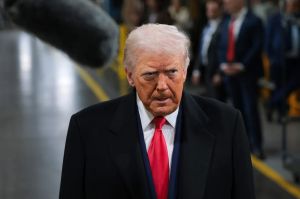
What a fucking asshole!
The New York Times: Supreme Court Considers Trump’s Attempt to Fire Fed Governor Lisa Cook.
The Supreme Court will consider Wednesday whether President Trump can fire Lisa Cook from the Federal Reserve board, in a case that tests the longstanding independence of the central bank, with potentially major consequences for the economy.
The court’s conservative majority has repeatedly allowed Mr. Trump to oust leaders of other independent agencies as he moves to expand presidential power and seize control of the federal bureaucracy. But the justices have signaled that the Fed may be different and uniquely insulated from executive influence because of its structure and history.
Lisa Cook
The case lands as the administration has dramatically escalated its attacks on the Fed, apparently aimed at remaking its board and lowering interest rates. The Justice Department this month opened a criminal investigation into whether Jerome H. Powell, the Fed chair, lied to Congress about cost overruns related to the Fed’s renovation of its headquarters.
Mr. Powell, whose term as chair ends in May, forcefully pushed back on the threat of criminal charges, saying it was a result of the Fed setting borrowing costs “based on our best assessment of what will serve the public, rather than following the preferences of the president.”
The investigation prompted a backlash from Republicans, international policymakers, Wall Street and some Trump allies, who warned that the central bank’s independence and credibility was at risk.
It also threatened to complicate Mr. Trump’s plans to name Mr. Powell’s replacement as chair — and, legal experts said, the Supreme Court case being heard on Wednesday.
The justices agreed to hear Ms. Cook’s case on an expedited basis, and are likely to rule quickly on her status as litigation continues in the lower courts. The outcome of the case could determine how much latitude Mr. Trump and future presidents have to influence the direction of the powerful central bank, which Congress intentionally tried to insulate from political pressures.

One more from Radley Balco at The New York Times (gift link): I’ve Covered Police Abuse for 20 Years. What ICE Is Doing Is Different.
Police agencies in the United States kill more than 1,000 people each year. After many of those deaths, the agencies involved put out statements. Those statements often use what’s known as the exonerative voice to minimize officers’ involvement. The first statement from the Minneapolis Police Department after George Floyd’s death, for example, said that the officers at the scene “noted that he appeared to be suffering from medical distress.” Quite the understatement. These communications often cast events in a light most favorable to the officers involved, sometimes to the point of deception. Too often, they’ll try to smear the deceased by citing a criminal record or suggesting a drug addiction or gang affiliation.
Renee Good
I have been covering policing for more than 20 years and have read and parsed a lot of these statements. The Department of Homeland Security’s response after the Immigration and Customs Enforcement agent Jonathan Ross shot and killed Renee Good in Minneapolis this month is something else entirely.
For all their flaws, typical communications from police officials usually include a modicum of solemnity. There are assurances that there will be a fair and impartial investigation, even if those investigations too often turn out to be neither. There’s at least the acknowledgment that to take a human life is a profound and serious thing.
The Trump administration’s response to Ms. Good’s death made no such concessions. There were no promises of an impartial investigation. There was no regret or remorse. There was little empathy for her family — for her parents, her partner or the children she left behind. From the moment the world learned about her death, the administration pronounced the shooting not only justified but an act of heroism worthy of praise and celebration.
It isn’t just the lying; it’s that the lies are wildly exaggerated and easily refutable. All the evidence we’ve seen so far, including a meticulous Times forensic analysis of the available footage, makes clear that at worst, Ms. Good mildly obstructed immigration enforcement, disobeyed ambiguous orders or perhaps attempted to flee an arrest. None of those are capital crimes, nor do law enforcement officers get to dole out punishment in such cases. At one point, President Trump justified her shooting by claiming she’d been “very disrespectful” to immigration officers. That isn’t a crime at all.
The lies this administration is telling about Ms. Good aren’t those you deploy as part of a cover-up. They’re those you use when you want to show you can get away with anything. They’re a projection of power.
For the past decade or so, since the protests in Ferguson, Mo., America has engaged in a high-stakes dialogue about police abuse and accountability, the militarization of law enforcement and the push and pull between public safety and civil liberties. Those discussions, while occasionally heated, have been based on a shared understanding that the primary job of domestic law enforcement is to serve the public. What Mr. Trump is doing with federal immigration forces has rendered those debates obsolete.


 peej
peej Carissa
 bostonboomer
 dakinikat
 ecocatwoman
 mablue2
 Mama Lopez
 peggysue22
 quixote
 skydancingguestblogger
 Mona (aka Wonk the Vote)



 Sky Dancing
Recent Comments