
Monday Reads
Posted: April 25, 2011 Filed under: Foreign Affairs, Gitmo, Kuwait, Libya, Morrocco | Tags: Congresswoman Giffords, Easter Island, Guantanomo detainees, Kuwait, Libya Transitional National Council, Moai, Morroco, Peaceful protests, Space Shuttle Endeavor 14 Comments Good Morning!
There’s some news up from Wikileaks and WAPO on the current status of detainees held at Gitmo that I thought worth mentioning. First, WAPO had a big feature up on Sunday explaining why Obama may have difficulty dealing with the remaining detainees and why the the facility hasn’t been closed.
This account of the unraveling of Obama’s pledge to close Guantanamo is based on interviews with more than 30 current and former administration officials, as well as members of Congress and their staff, members of the George W. Bush administration, and activists. Many of them would speak about internal or sensitive deliberations only on the condition of anonymity.
The one theme that repeatedly emerged in interviews was a belief that the White House never pressed hard enough on what was supposed to be a signature goal. Although the closure of Guantanamo Bay was announced in an executive order, which Obama signed on Jan. 22, 2009, the fanfare never translated into the kind of political push necessary to sustain the policy. “Vulnerable senators weren’t going out on a limb and risk being Willie Hortonized on Gitmo when the White House, with the most to lose, wasn’t even twisting arms,” said a senior Democratic aide whose boss was one of 50 Democrats to vote in 2009 against funding to close Guantanamo. “They weren’t breathing down our necks pushing the vote or demanding unified action.”
UK’s The Telegraph has this latest Wikileak on the detainees themselves and the loosie goosie rationale used to hold them. It now seems that many will never see trial let alone a release date.
Al-Qaeda terrorists have threatened to unleash a “nuclear hellstorm” on the West if Osama Bin Laden is caught or assassinated, according to documents to be released by the WikiLeaks website, which contain details the interrogations of more than 700 Guantanamo detainees.
However, the shocking human cost of obtaining this intelligence is also exposed with dozens of innocent people sent to Guantanamo – and hundreds of low-level foot-soldiers being held for years and probably tortured before being assessed as of little significance.
Both articles are long but well-worth the read. There is additional information in the NYT in their “Guantanamo Files” section that demonstrates the unreliability of information gained through torture. It also shows how many of the detainees were held or considered risks. You’ll be horrified by the thin evidence. Just about anything was considered proof of Al Quaeda membership.
The guide shows how analysts seized upon the tiniest details as a potential litmus test for risk. If a prisoner had a Casio F91W watch, it might be an indication he had attended a Qaeda bomb-making course where such watches were handed out — though that model is sold around the world to this day. (Likewise, the assessment of a Yemeni prisoner suggests a dire use for his pocket calculator: “Calculators may be used for indirect fire calculations such as those required for artillery fire.”) A prisoner caught without travel documents? It might mean he had been trained to discard them to make identification harder, the guide explains. A detainee who claimed to be a simple farmer or a cook, or in the honey business or searching for a wife? Those were common Taliban and Qaeda cover stories, the analysts were told. And a classic Catch-22: “Refusal to cooperate,” the guide says, is a Qaeda resistance technique.
While we’re already reading the Brit Press, I’d like to give a shout out to a really interesting article at The Independent 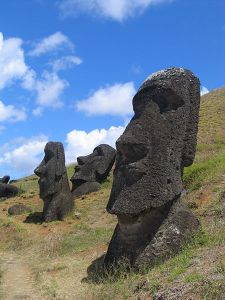 which looks at the mystery that is Easter Island. Evidently there is a new theory about the moai and the ecology on the island.
In their new book, The Statues that Walked: Unravelling the Mystery of Easter Island, to be published in June, Dr Lipo and Professor Hunt present their evidence that Polynesian colonists arrived in 1200, up to 800 years later than the conventional theory claims, and immediately modified the environment with slash-and-burn agriculture. The effect this had on the giant palm forest was magnified by the rats that arrived with them. The rodent population, feeding extensively on palm seeds, exploded. Dr Lipo argues that deforestation didn’t make things much worse for humans. Rapa Nui was no tropical paradise. It’s an old volcanic island and many of the nutrients in the soil had already been washed away. Burning the giant palms actually helped, but the settlers soon turned to a technique called stone mulching, in which freshly broken volcanic rocks are planted in the poor soil to add nutrients and cut down on erosion. The same people who used rock mulching and greeted the Dutch could have moved the moai from Rano Raraku, the quarry where they were carved, to the shore, he says. The statues seem designed to allow small groups of men to move them by rocking them, as you would a refrigerator. Similar suggestions have been made in the past, but experiments indicated that the moai would have been worn away by the time they got to the coast. Dr Lipo, aided by anthropologist Sergio Rapu, the island’s first native governor under Chilean rule, thinks he has found a way around this, with more rocking and less shuffling.
In some happy news, Representative Giffords has the okay from her doctors to watch the launch of Space Shuttle Endeavor. The congresswoman’s recovery from shots to the head continues to astound many.
Friday, the Arizona congresswoman will witness her husband’s own inspiring moment: Commanding the space shuttle Endeavour on its last launch. Doctors have cleared Giffords, who was shot in the brain at a January 8 event in Tucson, to attend the scheduled launch in Florida, a source close to her said Sunday. The source told CNN Senior Medical Correspondent Elizabeth Cohen that Giffords will be accompanied by a nurse. There will be no doctor or medical assistance on board. The source was not sure what kind of plane Giffords will be going on, but it will not be a commercial airliner. “She’ll probably be going either Wednesday or Thursday,” the source said. Asked by “The CBS Evening News With Katie Couric” what Giffords’ reaction was to the decision allowing her to go, Kelly replied, “I think she said, ‘awesome’ and she pumped her fist.”
The Democracy contagion in the MENA region continues. Peaceful protesters in Morocco are demanding constitutional reforms.
Thousands of protesters have participated in rallies in cities across Morocco, demanding social and economic reforms. They called for an end to corruption, and want more jobs for the increasing number of university graduates who face joblessness. The peaceful protests are predominately working class in tone, demanding constitutional reforms and new parliamentary elections. The marches on Sunday were organised by the February 20 movement, which has led protests for the past two months, with support from Morocco’s best-known Islamist movement, Adl wal Ihsan, which is barred from politics in the North African kingdom. Morocco’s King Mohammed VI has already pledged changes to the constitution for the first time in 15 years, but protesters remain sceptical about the possibility of real change.
The government of Kuwait has donated $180 million to the rebels in Libya. They have not yet formally recognized the rebel shadow government but are trying to help within the limits of the UN resolution.
Kuwait on Sunday gave 50 million dinars ($180 million) to the Libyan opposition Transitional National Council (TNC), its chief Mustafa Abdel Jalil said. “This amount will help us pay part of the salaries of employees,” Jalil told reporters after talks with Emir Sheikh Sabah al-Ahmad al-Sabah. “We are in need of urgent assistance.” Kuwait’s Foreign Minister Sheikh Mohammad Sabah al-Salem al-Sabah said “Kuwait will provide large and urgent humanitarian aid through the national council.” Sheikh Mohammad said Kuwait and the TNC “will work closely so that it becomes the legitimate channel of the Libyan people,” but stopped short of officially recognising the council. “Recognition is a secondary issue,” Abdel Hafiz Ghoqa, spokesman for the TNC in Benghazi told reporters, adding that the quality of cooperation with Kuwait showed the friendly nation’s “approval” for east Libya’s nascent government. France, Gambia, Italy and Qatar are the only countries so far to have recognised the TNC, Libya’s parallel government.
Isn’t it amazing how one storekeeper in Tunisia who was frustrated with his government turned into the spark that lit a match that put so many people on fire for democratic reform? Most of these countries are either ruled by monarchs or dictators. The middle class and well-educated are tired of no opportunity and all the looting of national treasure for the benefit of the very few. Even with the violence and loss of life, it is exciting to read about ordinary people who have just had enough and are taking their future into their own hands. It makes you want to fight for what we’re losing every day.
So, that should get things started! What’s on your reading and blogging list today?

 peej
peej Carissa
 bostonboomer
 dakinikat
 ecocatwoman
 mablue2
 Mama Lopez
 peggysue22
 quixote
 skydancingguestblogger
 Mona (aka Wonk the Vote)



 Sky Dancing
Recent Comments