
DOD Embraces the Green Giant While Keystone XL Looks Increasingly Unattractive
Posted: January 27, 2012 Filed under: Environment, Environmental Protection, Gulf Oil Spill, health hazard, toxic waste, U.S. Military, U.S. Politics | Tags: Department of Defense, going green, Keystone Pipeline, renewable energy, tar sand oil 9 Comments Frankly, I was surprised by President Obama’s comments in his SOTU address about the Department of Defense’s solar program, a project that would not only provide energy to military installations but generate enough additional energy to supply ¾ million American households.
Well, lo and behold, this is not idle chatter.
Turns out ground has been broken on a 13.78-megawatt solar power system at the Naval Air Weapons Station at China Lake, CA. The project is expected to provide over 30% of the facility’s annual energy requirement and save an estimated $13 million in costs over the next 20 years. This is in keeping with a larger strategic plan to reduce the Defense Department’s reliance on foreign oil, shrink its annual $4 billion energy bill and ensure energy security in the event of a natural disaster or other unforeseen events [sounds ominous].
A year-long study indicated that of DOD’s huge landholdings in the Mojave and Colorado deserts, across which seven military bases in California were considered– Fort Irwin, China Lake, Chocolate Mountain, Edwards, Barstow, Twentynine Palms and El Centro—and two in Nevada [Creech and Nellis], 30,000 acres were deemed suitable acreage for solar production. Future facilities could produce 7 gigawatts of electricity. To put this in perspective that’s roughly equal to 7 nuclear power plants, sufficient to supply full electricity to the 5 California bases 30 times over, enough in excess to supply 780,000 California households.
This push for renewable energy use by the military has also been taken to the battlefield, namely Afghanistan. Last year, the 3rd Battalion 5th Marines began operating with Ground Renewable Energy Networks, Solar Portable Alternative Communications Energy Systems, LED lighting systems, Solar Shades, and Solar Light Trailers. In addition to reduced fuel savings, reports indicate that alternate energy use in remote locations decreases resupply convoy runs and subsequently the danger of IED attacks. Lives saved is a definite plus.
But there’s more. Army installations force-wide have implemented a 2020 goal of net-zero energy consumption, which means reducing energy consumption, and then producing power through renewable sources.
Kristine M. Kingery, director of the Army’s sustainability policy, said pilot installations in the program are “striving toward” goals the Army wants met by 2020. “With Net Zero, the idea is not just replace the energy with renewables,” Kingery said. “It’s the reduction, the repurposing, conservation and efficiency. Reduce usage, and replace what you are using with renewables.”
As the largest institutional energy consumer in the world, the Defense Department is providing a major infusion of funding for research and development and application of renewable energy projects, including advanced biofuels, the world’s largest rooftop solar project involving 127 bases, advanced fuel cells and advanced grid technology, just to name a few.
What I find remarkable about all this activity is how DOD’s push puts the Keystone pipeline controversy in an entirely different light.
As you may recall, the Republican objection to President Obama’s recent rejection of Keystone’s proposal was presumably all about jobs. The numbers have been wildly overstated. The State Department, at best, estimated 5000-6000 temporary construction jobs created, not the 100,000 jobs Speaker Boehner recently cited. Or the 250,000 that TransCanada finally arrived at. But more importantly, claims have been made that the pipeline would help break our dependence on foreign oil. This, too, has been proven patently false since the tar sand crude, once refined, had already been contracted for export to Latin America and Europe. Even the material for the pipeline [primarily steel] was being supplied not by American suppliers but by India.
This a classic battle–the old vs. the new. And who is leading the way? The United States Military, an institution of conservative values, has taken the bull by the horns and said: Time to move on, boys. The Era of Conservation and Renewable Energy is at hand.
There’s also the environmental impact of the pipeline, the danger of a leak, something pipeline supporters have openly mocked. What is rarely mentioned is that tar sand oil requires heat and pressure to move the sludge-like material along its 1700-mile journey from the Alberta sand fields to Texan refineries. Tar sand oil is toxic and very corrosive, making leaks far more likely.
What could happen?
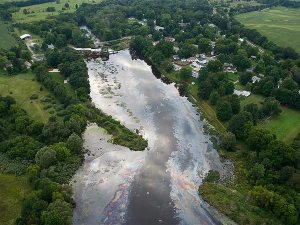
Unfortunately, we’ve had a graphic example of exactly what could and did happen. In Michigan, a tar sands leak, estimated at over 800,000 gallons, polluted 30 miles of the Kalamazoo River, July 2010.
And Quelle Surprise! There was a resultant cover up.
Recall the Gulf of Mexico, BP and the environmental disaster of nightmarish proportions.
Then remember that the United States Military has clearly gotten the message and acted upon it: The Age of Fossil Fuel, the rush for Black Gold is coming to an end. The way forward financially and security-wise is colored Green.
Which would you rather see–this?
Or this?

Personally? I’ll take door number 2 and follow the generals into the future.
Controversial Keystone Pipeline put on Hold
Posted: November 10, 2011 Filed under: Environment | Tags: Keystone Pipeline 5 Comments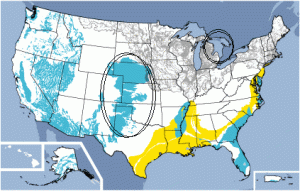 I was rather surprised to see that the state of Nebraska played a big role in getting President Obama to delay a decision on the Keystone Pipeline. Nebraska is a sparsely populated state with an overwhelmingly old, white, Republican profile. This does seem to wreak of a ‘not in my back yard’ kind of protest but I have to agree that there’s a lot at stake if the oil leaks. You can’t run anything through Nebraska that doesn’t endanger the Ogallala aquifer which is an important source of clean water. It is expansive and important to quite a few industries, communities, critters and people. You can see that it spreads under the entire state and the western sections of Kansas, Oklahoma, and Texas if you look at the map up there on the left. Yup, it’s a nifty map for a change!!
The impacted states are all highly reliable Republican but the zone is basically home to thousands of ranches and farms that rely on the aquifer. The decision has been delayed until after the election which seems a suspiciously convenient time even though Nebraska is a reliably Republican state.
The State Department said in a statement that it was ordering a review of alternate routes to avoid the environmentally sensitive Sand Hills region of Nebraska, which would have been put at risk by a rupture of the 1,700-mile pipeline carrying a heavy form of crude extracted from oil sands formations in Alberta, Canada, to refineries in Oklahoma and the Gulf Coast.
The move is the latest in a series of administration decisions pushing back thorny environmental matters beyond next November’s presidential election to try to avoid the heat from opposing interests —business lobbies or environmental and health advocates — and to find a political middle ground. Mr. Obama delayed a review of the nation’s smog standard until 2013, pushed back offshore oil lease sales in the Arctic until at least 2015 and blocked issuance of new regulations for coal ash from power plants.
The proposed project by a Canadian pipeline company, TransCanada, similarly put President Obama in a political vise, squeezed between the demand for a secure source of oil and the thousands of jobs the project will bring, and the loud agitation of environmental advocates who threatened to withhold electoral support next year if he approved it.
Mr. Obama said in an interview with an Omaha television station last week that he would make the ultimate decision about the pipeline, but sought to portray Thursday’s announcement as solely a State Department matter and not the result of political calculation.
“I support the State Department’s announcement today regarding the need to seek additional information about the Keystone XL pipeline proposal,” the president said after the announcement. “Because this permit decision could affect the health and safety of the American people as well as the environment, and because a number of concerns have been raised through a public process, we should take the time to ensure that all questions are properly addressed and all the potential impacts are properly understood.”
He said he remained committed to a politically balanced diet of increased domestic oil and gas production combined with incentives for the development of carbon-free alternatives.
While environmental groups welcomed their temporary victory on the pipeline project, some expressed skepticism about the president’s motives. Glenn Hurowitz, an environmental activist and senior fellow at the Center for International Policy, said the delay could leave the final decision in the hands of Mr. Obama’s Republican successor.
“This decision just puts off a green light for the tar sands by a year,” Mr. Hurowitz said in an e-mailed statement. “That’s why I’m a little dismayed at suggestions that this kick-the-can decision means environmentalists will enthusiastically back President Obama in 2012. Is the price of an environmentalist’s vote a year’s delay on environmental catastrophe? Excuse me, no.”
This definitely pits the farming/ranching pioneering west against the oil industry and those industries and communities reliant on oil. It should be an interesting fight to watch since the pipeline threatens a lot of pristine habitat–including the amazing Sand Hills–as well as the aquifer. Having endured the Gulf Oil Spill, my suggestion to my old home state is to fight this with everything you’ve got. They’ll put your lifestyle and your livelihoods in danger because there are a lot more of them with power than you.

 peej
peej Carissa
 bostonboomer
 dakinikat
 ecocatwoman
 mablue2
 Mama Lopez
 peggysue22
 quixote
 skydancingguestblogger
 Mona (aka Wonk the Vote)



 Sky Dancing
Recent Comments