Portrait of Vsevolod Emilievich Meyerhold, by Pytr Konchalovsk, 1938
Today’s big political story: House Republicans’ efforts to impeach President Biden for supposed corruption involving his son Hunter is in deep trouble. You probably heard that their star witness has been indicted and arrested for lying to the FBI. On top of that, his “evidence” came from the Kremlin. Republicans are the Putin Party. Here’s the latest:
The former FBI informant charged with lying about the Bidens’ dealings in Ukraine told investigators after his arrest that Russian intelligence officials were involved in passing information to him about Hunter Biden, prosecutors said Tuesday in a new court filing, noting that the information was false.
Prosecutors also said Alexander Smirnov has been “actively peddling new lies that could impact US elections” after meeting with Russian spies late last year and that the fallout from his previous false bribery accusations about the Bidens “continue[s] to be felt to this day.”
Smirnov claims to have “extensive and extremely recent” contacts with foreign intelligence officials, prosecutors said in the filing. They said he previously told the FBI that he has longstanding and extensive contacts with Russian spies, including individuals he said were high-level intelligence officers or command Russian assassins abroad.
Prosecutors with special counsel David Weiss’ team said Tuesday that Smirnov has maintained those ties and noted that, in a post-arrest interview last week, “Smirnov admitted that officials associated with Russian intelligence were involved in passing a story about Businessperson 1,” referring to President Joe Biden’s son, Hunter Biden.
The revelations about Smirnov’s alleged foreign contacts were disclosed as part of prosecutors’ arguments to keep him jailed ahead of trial – though a federal judge later granted Smirnov’s release with several conditions, including GPS monitoring and the surrender of his two passports. Smirnov declined to answer questions as he left the courthouse Tuesday evening.
Prosecutors alleged that Smirnov “claims to have contacts with multiple foreign intelligence agencies,” including in Russia, and that he could use those contacts to flee the United States.
The explosive revelation comes amid backlash over how Smirnov’s now-debunked allegations played into House Republicans’ impeachment inquiry into the president.
Read more details at CNN.
From the Associated Press:
A former FBI informant charged with making up a multimillion-dollar bribery scheme involving President Joe Biden, his son Hunter and a Ukrainian energy company had contacts with Russian intelligence-affiliated officials, prosecutors said Tuesday.
Prosecutors revealed the alleged contact as they urged a judge in Las Vegas to keep Alexander Smirnov behind bars while he awaits trial. But U.S. Magistrate Judge Daniel Albregts allowed Smirnov to be released from custody on electronic GPS monitoring.
Joan Brown, Noel in the Kitchen (circa 1964).
He is accused of falsely telling his FBI handler that executives with the Ukrainian energy company Burisma paid Hunter and Joe Biden $5 million each around 2015 — a claim that became central to the Republican impeachment inquiry in Congress….
According to prosecutors, Smirnov admitted in an interview after his arrest last week that “officials associated with Russian intelligence were involved in passing a story” about Hunter Biden. They said Smirnov’s contacts with Russian officials were recent and extensive, and said Smirnov had planned to meet with one official during an upcoming overseas trip….
Prosecutors said Smirnov, who holds dual U.S.-Israeli citizenship, falsely reported to the FBI in June 2020 that executives associated with Burisma paid millions of dollars to Hunter and Joe Biden in 2015 or 2016.
But Smirnov had only routine business dealings with the company starting in 2017 and made the bribery allegations after he “expressed bias” against Joe Biden while he was a presidential candidate, according to prosecutors.
He is charged with making a false statement and creating a false and fictitious record. The charges were filed in Los Angeles, where he lived for 16 years before relocating to Las Vegas two years ago.
Smirnov’s claims have played a major part in the Republican effort in Congress to investigate the president and his family, and helped spark what is now a House impeachment inquiry into Biden. Democrats called for an end to the probe after the Smirnov indictment came down last week, while Republicans distanced the inquiry from his claims and said they would continue to “follow the facts.”
Republicans’ main witness in their efforts to impeach Joe Biden has already been charged with lying to the FBI. Now he has also admitted to having ties to Russian intelligence officers.
Alexander Smirnov, a longtime FBI informant with ties to Ukraine, had claimed to have proof of Biden and his son Hunter accepting bribes from a Ukrainian oligarch. Republicans repeatedly touted Smirnov’s claims in their quest to impeach the president. But last week, the Justice Department announced that it was charging Smirnov with making a false statement and creating a false record related to the bribery allegation.
Now, in a detention memo filed Tuesday, the Justice Department revealed that Smirnov confessed that Russian intelligence officers helped him smear Hunter Biden.
“During his custodial interview on February 14, Smirnov admitted that officials associated with Russian intelligence were involved in passing a story about” the younger Biden, the filing said.
Smirnov also told the FBI that he had had repeated contact with a Russian official who, as Smirnov told it, was “the son of a former high-ranking Russian government official, someone who purportedly controls two groups of individuals tasked with carrying out assassination efforts in a third-party country, a Russian representative to another country, and … someone with ties to a particular Russian intelligence service.”
Laurie Simmons, Blonde-Aqua Sweater-Dog (2014).
Smrinov initially tried to spread the Biden Ukrainian corruption story just before the 2020 election, but Justice Department prosecutors are warning that Smirnov’s “misinformation” goes far beyond that.
“He is actively peddling new lies that could impact U.S. elections after meeting with Russian intelligence officials in November,” they said in the filing.
The memo notes that Smirnov himself reported several meetings with Russian officials as recently as December 2023.
The charges against Smirnov are the latest major fail in Republicans’ attempts to impeach Biden, which has been nothing but a comedy of errors. For almost a year, the GOP has insisted that Biden and his son are guilty of corruption. Republicans have not produced a shred of concrete evidence of their claims, but they have repeatedly upheld accusations from a supposedly credible but confidential FBI source (whom we now know is Smirnov) as reason enough to keep investigating the president.
Attorneys for Hunter Biden on Tuesday moved to dismiss tax-related charges brought by special counsel David Weiss in California, accusing prosecutors of selectively targeting President Joe Biden’s son, violating a statute of limitations, and filing duplicative charges on three counts of failure to pay and tax evasion.
“The special counsel has gone to extreme lengths to bring charges against Mr. Biden that would not have been filed against anyone else,” Hunter Biden’s attorney Abbe Lowell said in a statement.
“Prosecutors reneged on binding agreements, bowed to political pressure to bring unprecedented charges, overreached in their authority, ignored the rules and allowed their agents to run amok, and repeatedly misstated evidence to the court to defend their conduct. It is time to hold the special counsel accountable and dismiss these improper charges,” Lowell said.
Weiss’ office charged Hunter Biden in December with nine felony and misdemeanor charges stemming from his failure to pay $1.4 million in taxes for three years during a time when he was in the throes of addiction. Hunter Biden has pleaded not guilty to all charges.
The back taxes and penalties were eventually paid in full by a third party, identified by ABC News as Hunter Biden’s attorney and confidant, Kevin Morris.
In his motions on Tuesday, Lowell reiterated many of the arguments he waged in his efforts to dismiss three additional felony counts Biden faces in Delaware – charges to which Biden has also pleaded not guilty.
Lowell claimed that the tax indictment is the result of a selective and vindictive prosecution stemming from political pressure, that Weiss was not properly appointed special counsel and therefore lacks authority to file charges, and that an immunity agreement struck by the two parties last summer remains in effect.
Lowell also argued that the statute of limitations for Biden’s alleged failure to pay taxes in 2016 expired in April 2023.
As Donald Trump’s legal troubles consume more and more of his time, they’re also consuming more of his donors’ money—and there’s a huge hole in the bucket.
On Tuesday, Trump’s “Save America” leadership political action committee reported raising just $8,508 from donors in the entire month of January, while spending about $3.9 million, according to a new filing with the Federal Election Commission.
Nearly $3 million of that overall spending total was used for one purpose: to pay lawyers.
At the same time, the Trump campaign itself reported a net loss of more than $2.6 million for the month of January. It raised about $8.8 million while spending around $11.5 million, according to a separate filing made public on Tuesday.
The filings reveal that Trump is continuing to burn through his donors’ funds as he struggles to feed two massive cash drains—astronomical legal bills stemming from numerous civil cases and four criminal indictments, plus the costs of a national presidential campaign….
Jean-François Millet, Shepherdess and Her Flock (1862–63).
Despite reporting almost no donations in January, the Save America PAC—a group Trump launched days after the 2020 election, ostensibly to fund legal challenges—actually increased its bottom line by more than $1 million, ending the month with nearly $6.3 million on hand.
However, that increase can’t be chalked up to new donations. It’s entirely due to a $5 million transfer from a different pro-Trump super PAC, which is still in the process of refunding $60 million that the former president demanded back last year, as his legal bills threatened to put Save America, his legal slush fund, into bankruptcy.
Despite reporting almost no donations in January, the Save America PAC—a group Trump launched days after the 2020 election, ostensibly to fund legal challenges—actually increased its bottom line by more than $1 million, ending the month with nearly $6.3 million on hand.
However, that increase can’t be chalked up to new donations. It’s entirely due to a $5 million transfer from a different pro-Trump super PAC, which is still in the process of refunding $60 million that the former president demanded back last year, as his legal bills threatened to put Save America, his legal slush fund, into bankruptcy.
The recent news about possible Russian space nukes reminds us that we live in a very insecure world. That is why perhaps none of Donald Trump’s four criminal cases is more troubling than the federal prosecution brought by special counsel Jack Smith for mishandling classified documents. Unfortunately, the judge handling the case, Aileen Cannon—a last-minute appointment rushed through in the waning days of the Trump administration—has proved herself to be by far the worst of the jurists overseeing these momentous cases. Her decisions during the investigative phase of the case strayed wildly from precedent, leading to brutal reversals by the U.S. Court of Appeals for the 11th Circuit. Now Smith appears to be preparing to ask that body to overturn at least one and possibly two of her decisions. In our view, while he is there on those other issues, he should also petition them to remove her from the case.
Why do we think Smith might be headed to the court of appeals? In part because he has already sought reconsideration for the latest of Cannon’s unlawful orders. This is a step that is warranted only in rare circumstances, including when a judge has made a “clear error” that led to “manifest injustice.” In this instance, at Trump’s behest, Cannon has decided to unseal the identities of two dozen potential witnesses, along with sensitive information they provided to the government. The “clear error” Smith identifies is striking: He alleges that Cannon applied the wrong legal standard in making this decision, requiring him to make a far more stringent showing than should be needed to protect these names. In his motion for reconsideration, Smith shows that the case law—including the very cases Cannon herself cited in her order—does not establish the unreasonable hurdles she wants him to clear.
The recent news about possible Russian space nukes reminds us that we live in a very insecure world. That is why perhaps none of Donald Trump’s four criminal cases is more troubling than the federal prosecution brought by special counsel Jack Smith for mishandling classified documents. Unfortunately, the judge handling the case, Aileen Cannon—a last-minute appointment rushed through in the waning days of the Trump administration—has proved herself to be by far the worst of the jurists overseeing these momentous cases. Her decisions during the investigative phase of the case strayed wildly from precedent, leading to brutal reversals by the U.S. Court of Appeals for the 11th Circuit. Now Smith appears to be preparing to ask that body to overturn at least one and possibly two of her decisions. In our view, while he is there on those other issues, he should also petition them to remove her from the case.
Why do we think Smith might be headed to the court of appeals? In part because he has already sought reconsideration for the latest of Cannon’s unlawful orders. This is a step that is warranted only in rare circumstances, including when a judge has made a “clear error” that led to “manifest injustice.” In this instance, at Trump’s behest, Cannon has decided to unseal the identities of two dozen potential witnesses, along with sensitive information they provided to the government. The “clear error” Smith identifies is striking: He alleges that Cannon applied the wrong legal standard in making this decision, requiring him to make a far more stringent showing than should be needed to protect these names. In his motion for reconsideration, Smith shows that the case law—including the very cases Cannon herself cited in her order—does not establish the unreasonable hurdles she wants him to clear.
Mary Cassatt, Little Girl in a Blue Armchair (1878).
In his motion for reconsideration, Smith also argues that Cannon minimizes the risk of real-world harm and witness intimidation these individuals would face. He notes that there is a “well-documented pattern in which judges, agents, prosecutors, and witnesses involved in cases involving Trump have been subject to threats, harassment, and intimidation.” Cannon’s cavalier attitude is dangerous for the potential witnesses whose identities could be revealed. As Smith asserts in his brief, “a court’s duty is to prevent harms to the witnesses or the judicial process ‘at their inception.’ ” Cannon appears willing to abdicate that duty.
In response to Smith’s reconsideration motion, Cannon ordered Trump to respond by Friday. That will set up a dramatic ruling by Cannon: Either she reverses her position—which would be an admission that she was fundamentally mistaken about the law in a way that caused “manifest injustice”—or she leaves her ruling in place, putting individuals in jeopardy and twisting the law to help Trump. At that point, Smith may have enough ammunition to seek her reassignment from the 11th Circuit.
Beyond that contretemps, there is a second possible dispute that may be headed to the court of appeals shortly. Earlier this month saw two days of hearings on whether the defendants in the case will get access to highly classified documents under the Classified Information Procedures Act. That statute allows the government to petition the court to redact, summarize, or even withhold classified information in a criminal case. Notably, the CIPA provides the government with the ability to immediately and swiftly appeal. Thus, even if Smith loses a ruling related only to a single document, the statute allows him to go straight to the 11th Circuit.
Some stories out today provide details on Trump’s plans for the U.S. if he somehow gets back into the White House.
An influential think tank close to Donald Trump is developing plans to infuse Christian nationalist ideas in his administration should the former president return to power, according to documents obtained by POLITICO.
Spearheading the effort is Russell Vought, who served as Trump’s director of the Office of Management and Budget during his first term and has remained close to him. Vought, who is frequently cited as a potential chief of staff in a second Trump White House, is president of The Center for Renewing America think tank, a leading group in a conservative consortium preparing for a second Trump term.
Christian nationalists in America believe that the country was founded as a Christian nation and that Christian values should be prioritized throughout government and public life. As the country has become less religious and more diverse, Vought has embraced the idea that Christians are under assault and has spoken of policies he might pursue in response.
CRA’s work fits into a broader effort by conservative, MAGA-leaning organizations to influence a future Trump White House. Two people familiar with the plans, who were granted anonymity to discuss internal matters, said that Vought hopes his proximity and regular contact with the former president — he and Trump speak at least once a month, according to one of the people — will elevate Christian nationalism as a focal point in a second Trump term.
The documents obtained by POLITICO do not outline specific Christian nationalist policies. But Vought has promoted a restrictionist immigration agenda, saying a person’s background doesn’t define who can enter the U.S., but rather, citing Biblical teachings, whether that person “accept[ed] Israel’s God, laws and understanding of history.”
On Tuesday, Politico published an exposé of the secret plans of The Center for Renewing America think tank, described as “a leading group in a conservative consortium preparing for a second Trump term.” Led by Russell Vought, who once worked as Trump’s director of the Office of Management and Budget, the group has drafted a blueprint to turn the U.S. into a “Christian nationalist” country. The group argues that “freedom is defined by God, not man,” which is a fancy way of saying that they oppose most human rights. Subsequently, they are calling for an end to free speech, by using the Insurrection Act to quell protests. The coalition also expressed support for “overturning same-sex marriage, ending abortion and reducing access to contraceptives.”
Former President Donald Trump likened the $355 million judgment against him in a New York civil trial to the death of Russian opposition leader Alexei Navalny during a Fox News town hall on Tuesday evening.
“It is a form of Navalny. It is a form of communism or fascism,” he said, before going on to attack the judge in the case, Arthur Engoron, who he called a “nut job.”
Trump compared himself to Navalny, the outspoken critic of Russian President Vladimir Putin, who died in prison on Friday, on several occasions during the event. Earlier in the town hall, Trump praised Navalny as a “very brave guy” because he chose to return to Russia, where he had been jailed since 2021, though Trump said he “probably would have been a lot better off staying away and talking from outside.”
“People thought that could happen and it did happen,” Trump said, referring to Navalny’s death. “And it’s a horrible thing.”
Asked about outrage over Navalny’s death, Trump said, “It’s happening here.” He said his indictments are “all because of the fact that I’m in politics.”
Trump refrained from blaming Putin for the death, as President Joe Biden and former U.N. Ambassador Nikki Haley, Trump’s sole remaining credible primary opponent, have done.
Trump’s remarks amounted to a doubling down on his controversial post on Truth Social on Monday that “the sudden death of Alexei Navalny has made me more and more aware of what is happening in our Country.”
Lock him up.
That’s all the news I have for you today. What are your thoughts? What other stories are you interested in?
Did you like this post? Please share it with your friends:
Yesterday the press again focused on the Hur report that found no crimes in President Biden’s inadvertent possession of classified documents from his time as Vice President. But reporters only cared about one tiny portion of the report, in which Hur said Biden would be sympathetic to a jury because he comes across as a “well meaning elderly man with a poor memory.”
The gossip columnists at the NYT and WaPo were out in force. I’m not going to dignify these yellow journalists by excerpting their articles. It’s James Comey in 2016 all over again, except that the Hur report didn’t come out less than 2 weeks before the November election.
Meanwhile, the mainstream media overlooks Trump’s confusion, verbal flubs, and inability to form coherent sentences. Just last night he gave a speech full of examples of his cognitive issues.
The former president slurred when saying the word “subsidies,” said “dino-dollars” instead of “dollars,” and even said he doesn’t like being frontpage news every time he “said one word a little bit mispronunciation.” He also said that three years ago things were great, despite that being when Joe Biden became president, and he claimed twice there were no terror attacks during his tenure as president. He also said that Biden hasn’t spoken in months despite him addressing the press last night.
The flubs drew wide criticism from online onlookers.
Democratic youth activist Harry Sisson, in response to the ex-president’s “subsidies” flub, said, “Yikes.”
“Trump is slurring his speech again claiming that ‘Rich people are given $7,000 subsies.’ Uh…subsies?” he asked. “I’m not sure what that is and I don’t think anyone else does either. He can’t say subsidies properly so he must have dementia. Right, Republicans?”
Regarding the “subsies,” former prosecutor Ron Filipkowski said, “Dementia Trump is staring at the teleprompter, pauses to think about it, and still can’t say it.”
In yet another instance pointed out by the Biden-Harris HQ account on social media, Trump “gets distracted with bizarre story.”
“I know all about the marbles. I can tell you every marble,” Trump said.
Trump also appeared to mistake what day it was, saying, “If I wasn’t here, I’d be having a nice Saturday afternoon.” He said that, of course, on a Friday. This one was also picked up by Biden-Harris HQ.
Imagine if Biden were that befuddled? The press would have a field day.
The Biden campaign and the White House have landed on an initial strategy for responding to special counsel Robert Hur’s report that has spurred questions about the president’s fitness to hold office: Attack Hur and the media covering the report.
Woman Holding Black Cat, by TAkehisa Yumeji, 1919
The morning after Biden flashed anger at Hur for what he and other senior advisers argue was an inappropriate and excessive focus on his age, Ian Sams, a spokesperson for the White House counsel, sparred with the press corps for cherry-picking findings in the report, which he suggested was written in a way to shield Hur from political pressure from Republicans.
“I know it’s hard to wade through 400 full pages,” he said. “The report lays out example after example of how the president did not willfully take classified documents.”
Behind the scenes, Biden advisers in both the White House and his campaign were more scathing. One Biden ally said the report angered some of his supporters and, as a result, it was rallying them to his defense.
“People who are supporters of Biden are looking at that thinking that’s a cheap shot and he was playing politics,” the ally said.
The White House’s simmering animosity toward the media also burst into the public. One Biden aide said the media was “shameful” in its handling of the highly sensitive political moment.
“Hur couldn’t make his case and he takes partisan, personal and untrue swipes at Joe Biden,” one aide, who requested anonymity to speak frankly about internal views of the president’s team, said. “[He] did it so the media would take the bait, and none of you have learned a damn thing since 2016.”
The aide was referring to another fraught episode when then-FBI Director James Comey determined that while Democratic presidential nominee Hillary Clinton had been “extremely careless” in handling classified information, she would not face charges for using a private email server.
On Sunday, Speaker of the House Mike Johnson went on television and mixed up Iran and Israel. “We passed the support for Iran many months ago,” he toldMeet the Press, erroneously referring to an aid package for the Jewish state. Last night, the Fox News prime-time host Jesse Watters introduced South Dakota Governor Kristi Noem as hailing from South Carolina. I once joined a cable-news panel where one of the participants kept confusing then–Attorney General Jeff Sessions with Representative Pete Sessions of Texas. I don’t hold these errors against anyone, as they are some of the most common miscues made by people who talk for a living—and I’m sure my time will come.
Yesterday, President Joe Biden added another example to this list. In response to a question about Gaza, he referred to the Egyptian leader Abdel Fattah al-Sisi as the president of Mexico. The substance of Biden’s answer was perfectly cogent. The off-the-cuff response included geographic and policy details not just about Egypt, but about multiple Middle Eastern players that most Americans probably couldn’t even name. The president clearly knew whom and what he was talking about; he just slipped up the same way Johnson and so many others have. But the flub could not have come at a worse time. Because the press conference had been called to respond to Special Counsel Robert Hur’s report on Biden’s handling of classified documents, which dubbed the president an “elderly man with a poor memory,” the Mexico gaffe was immediately cast by critics as confirmation of Biden’s cognitive collapse.
Tama the Cat by Hiroaki Takahashi
But the truth is, mistakes like these are nothing new for Biden, who has been mixing up names and places for his entire political career. Back in 2008, he infamously introduced his running mate as “the next president of the United States, Barack America.” At the time, Biden’s well-known propensity for bizarre tangents, ahistorical riffs, and malapropisms compelled Slate to publish an entire column explaining “why Joe Biden’s gaffes don’t hurt him much.” The article included such gems as the time that then-Senator Biden told the journalist Katie Couric that “when the markets crashed in 1929, ‘Franklin Roosevelt got on the television and didn’t just talk about the princes of greed. He said, “Look, here’s what happened.”’” The only problem with this story, Slate laconically noted, was that “FDR wasn’t president then, nor did television exist.”
In other words, even a cursory history of Biden’s bungling shows that he is the same person he has always been, just older and slower—a gaffe-prone, middling public speaker with above-average emotional intelligence and an instinct for legislative horse-trading. This is why Biden’s signature moments as a politician have been not set-piece speeches, but off-the-cuff encounters, such as when he kneltto engage elderly Holocaust survivors in Israel so they would not have to stand, and when he befriended a security guard in an elevator at The New York Times on his way to a meeting with the paper’s editorial board, which declined to endorse him. And it’s why Biden’s key accomplishments—such as the landmark climate-change provisions of the Inflation Reduction Act, the country’s first gun-control bill in decades, and the expected expansion of the child tax credit—have come through Congress. The president’s strength is not orating, but legislating; not inspiring a crowd, but connecting with individuals.
As part of his Don Quixote-like quest to avoid criticism, Attorney General Merrick Garland has binged on special counsel appointments throughout his tenure at the U.S. Department of Justice.
Now, following a string of debacles, including allowing Special Counsel John Durham to continue his useless four-year probe of the Mueller investigation—elevating the Hunter Biden prosecutor, David Weiss, to special counsel status after a half-decade of investigation—Garland’s hand-picked Special Counsel Robert Hur has produced a report on President Joe Biden’s handling of classified information that rivals former FBI Director James Comey’s infamous political hatchet-job on Hillary Clinton’s campaign.
Hur concludes what everybody already knew—namely that no criminal charges are warranted in Biden’s handling of classified materials—but gratuitously slams Biden’s fitness for office by describing him as a “sympathetic, well-meaning elderly man with a poor memory.” By allowing this unprofessional, partisan dig to be published, Garland plays right into the hands of former President Donald Trump and the extreme right’s ageist attacks on the president.
by Ayako Ishiguro
To be fair, maybe Hur was only trying to exercise what he thought was proper prosecutorial discretion in not bringing a weak case. Or perhaps, he may just be an inept, clumsy writer/editor.
But it was Garland’s responsibility to ensure that Hur’s report did not stray from proper Justice Department standards. Garland should have known the risks when he picked Hur—who had clerked for conservative Chief Justice William Rehnquist, served as the top aide to Deputy Attorney General Rod Rosenstein, who assisted Bill Barr’s distortion of the Mueller Report, and who was a Trump-appointed U.S. Attorney.
The bottom line is that Hur has produced a report that should have reassured the American people that President Biden did nothing wrong, but instead supplies Biden’s political rivals with ammunition for baseless attacks on Biden’s fitness for office.
Hur opens his report in a way that invites misinterpretation, by stating he “uncovered evidence that President Biden willfully retained and disclosed classified materials.” But Hur waits until the next paragraph to state that the evidence does not establish Biden’s guilt beyond a reasonable doubt.
The verb “uncovered” suggests evidence was hidden and only Hur’s skillful investigation discovered it. Nothing could be further from the truth, as the rest of the report demonstrates that President Biden hid nothing from the investigation and was entirely forthcoming. Hur’s wording also makes it sound like he believes Biden committed a crime, but he just can’t prove it when his report actually concludes there is a lack of evidence of Biden possessing criminal intent to commit a crime.
A report explaining the reasons for declination should be written in a very factual, non-pejorative way. Hur should have simply said that the evidence found in the investigation did not support a recommendation of criminal prosecution, and then gone on to explain what evidence had been evaluated.
Joe Biden has told aides and outside advisers that Attorney General Merrick Garland did not do enough to rein in a special counsel report stating that the president had diminished mental faculties, according to two people close to the president, as White House frustration with the head of the Justice Department grows.
Cats practicing their music, Utagawa Kuniyoshi
The report from special counsel Robert Hur ultimately cleared Biden of any charges stemming from his handling of classified documents that were found at Biden’s think tank and his home. But Hur’s explanation for not bringing charges — that Biden would have persuaded the jury that he was a forgetful old man — upended the presidential campaign and infuriated the White House.
Biden and his closest advisers believe Hur went well beyond his purview and was gratuitous and misleading in his descriptions, according to those two people, who were granted anonymity to speak freely. And they put part of the blame on Garland, who they say should have demanded edits to Hur’s report, including around the descriptions of Biden’s faltering memory.
In White House meetings, aides have questioned why Garland felt the need to appoint a special counsel in the first place, though Biden has publicly said he supported the decision.
While Biden himself has not weighed in on Garland’s future, most of the president’s senior advisers do not believe that the attorney general would remain in his post for a possible second term, according to the two people.
A bit more:
“This has been building for a while,” said one of those people. “No one is happy”
Frustration within the White House at Garland has been growing steadily.
Last year, Biden privately denounced how long the probe into his son was taking, telling aides and outside allies that he believed the stress could send Hunter Biden spiraling back into addiction, according to the same two people. And the elder Biden, the people said, told those confidants that Garland should not have eventually empowered a special counsel to look into his son, believing that he again was caving to outside pressure.
Garland moved sooner in his investigation into former President Donald Trump’s election interference, a trial may already be underway or even have concluded, according to two people granted anonymity to discuss private matters. That trial still could take place before the election and much of the delay is owed not to Garland but to deliberate resistance put up by the former president and his team.
A plea to my Democratic friends: It’s time to start calling Joe Biden a great president. Not a good one. Not a better choice than Donald Trump. Joe Biden is a historically great president. Say it with passion backed by the conviction that it’s true.
Because it is.
Yes, the desire to see the 2024 election as a choice between a normal, stable president versus an erratic thug under indictment in multiple states is seductive. But don’t base a campaign on that contrast. Don’t go into 2024 with the game plan to win because Donald Trump is an existential threat to democracy. That’s true, he is, but that’s only making the case that Donald Trump shouldn’t be president. It’s not the reason Joe Biden should be reelected.
Joe Biden should remain president because of his historic level of achievement here at home while standing on the side of freedom versus tyranny in the largest land war in Europe since World War II, a role no American president has played since the Roosevelt-Truman era. Be bold. Walk into this campaign with swagger and confidence and pride.
It’s become a 2024 trope that Donald Trump is the only Republican whom President Biden could beat, and that Biden is the only Democrat whom Trump could defeat. Like a lot of things in politics, it’s true if you accept it. But that acceptance is voluntary. Reject that framing for the industrial political complex bullshit that it is, brought to you by the same class of experts who knew without question that Bill Clinton was dead in June 1992, when he was running third to Ross Perot and George Bush, with 24 percent of the vote.
Stop the nonsense that only a weak opponent gives Joe Biden a chance to win. It’s more than wrong—it’s dangerous, completely misjudging Donald Trump’s strength. Trump is dominating a contest for a presidential nomination like no candidate in modern history because he’s the weakest candidate?
No. Donald Trump is going to win the Republican nomination easily, be endorsed by all his opponents not named Christie or Hutchinson, and emerge from the primaries better positioned to face an incumbent president than any candidate since Ronald Reagan in 1980. If you don’t want to wake up with Trump as your president a year from now, stop fantasying that Trump might not be the Republican nominee. End the whining about a Trump-Biden choice that only helps Trump and get about the business of uniting behind a great president.
A bit more:
As someone who worked in Republican campaigns for almost 30 years, I say without hesitation that the Democratic Party is the only pro-democracy party in America. But guys, why do so many of you have this need to act like ungrateful children of wealthy parents—impossible to please and always demanding more? Name a president who accomplished as much in his first term.
A shapeshifting cat, by Utagawa Kuniyoshi
The stock market is hitting record highs. Unemployment is at a record low, with 14 million new jobs. Talk to small-business owners, and the biggest problem they are facing is finding workers. A child born in the first Republican “infrastructure week” would have been entering grade school by the time President Biden passed the largest public spending initiative in American history. As a Republican media consultant, I made hundreds of ads about the high cost of prescription drugs. But it took President Biden to give Medicare the power to directly negotiate with Big Pharma to lower prices and cap the cost of insulin for Medicare beneficiaries at $35. For all the bitching about gas prices, the United States is now producing more oil than any country in history. Yes, more than Russia or Saudi Arabia, and that’s one of the reasons gas prices are now lower in inflation-adjusted prices than in 1974. Yeah, I know, fossil fuels suck, and the world should run on solar power. But the Biden administration also launched a $7 billion solar power investment project.
What is most amazing is that Biden got this done in a world in which the majority of Republicans believe he is not a legal president. Ponder that for a minute. You are a White House staffer working to help pass Biden initiatives, and you are dealing with members of Congress and senators who don’t just disagree with your boss—they think he’s an illegitimate president.
Wake up and show some gratitude. You wanted student loan forgiveness. You got it, for three million borrowers. You wanted a president who would finally pass gun safety legislation. You got the most comprehensive bill in nearly 30 years, the Bipartisan Safer Communities Act, which passed with the support of 15 Republican senators and 14 Republican House members, opening the door to some hope that laws on gun violence might finally start to reflect the wishes of the majority of the country. Maybe you’re a Democrat who actually cares about the federal deficit, unlike the Republicans who fake concern. Since Biden took office, the deficit has decreased by $1.7 trillion.
Yesterday, Dakinikat wrote about Jack Smith’s arguments to Judge Aileen Cannon that secret grand jury information from government witnesses should not be made public or given to Trump and his co-defendants. Yesterday Cannon ordered Smith to hand over the files today. It’s not clear yet what will happen, but Smith could appeal this to the 11th Circuit. One reason Smith wants to keep the documents sealed is because there is an active investigation of witness intimidation involved.
Federal authorities are currently investigating a series of threats made online to a potential witness related to special counsel Jack Smith’s classified documents case against former President Donald Trump, according to a new court filing from Smith’s team.
In the filing late Wednesday in federal court in Florida, Smith’s team asked U.S. District Judge Aileen Cannon, the judge overseeing the case, to let them file an exhibit under seal because, they wrote, “The exhibit describes in some detail threats that have been made over social media to a prospective Government witness and the surrounding circumstances, and the fact that those threats are the subject of an ongoing federal investigation being handled by a United States Attorney’s Office.”
“Disclosure of the details and circumstances of the threats risks disrupting the investigation,” the filing said.
The targeted witness was not identified.
The three-page filing discussing the probe was submitted as part of a dispute between Smith’s team and Trump’s lawyers over how much information should be redacted — or totally withheld from public view — in certain court filings.
In their filing Wednesday, Smith’s team urged Judge Cannon to let them file the exhibit completely under seal because, they said, simply redacting names or other parts of the document could still “provide information to the suspect to which he/she may not otherwise be entitled.”
Donald Trump and his legal team will receive unredacted FBI witnesses’ reports as part of the classified documents case after Special Counsel Jack Smith failed in his bid to withhold the information.
Beauty and the Cat , by Kunisada Utagawa
Judge Aileen Cannon, who is overseeing the trial against the former president, ordered federal prosecutors to hand over unredacted materials sought by Trump’s legal team in discovery, as well as the two other co-defendants in the case, Walt Nauta and Carlos De Oliveira….
On Thursday, Smith accused Cannon of making a “clear error” when she allowed that the documents be handed over. He said in filings that the move would reveal the identities of numerous potential witnesses, as well as potentially exposing them to “significant and immediate risks of threats, intimidation, and harassment.” Newsweek contacted the Department of Justice on Saturday via email.
Cannon had originally paused deadlines for Smith’s team to hand over the documents while she considered the special counsel’s motion. However, the stay lasted only a few hours, and later she ruled on Friday that the information must be delivered to Trump and the other defendants by Saturday, February 10.
The judge ruled that the information, including the names of potential witnesses, will be sealed from the public until a later court order.
Cannon, who was nominated to the bench by Trump, has long faced calls to recuse herself from the case after she made a number of decisions that favored the former president; these include ones that could potentially delay the start of the trial, scheduled for May.
Twitter lawyers are still suggesting that Jack Smith may take his case to the 11th Circuit. I’ll post in the comments if anything happens.
A crucial system of ocean currents may already be on course to collapse, according to a new report, with alarming implications for sea level rise and global weather — leading temperatures to plunge dramatically in some regions and rise in others.
Using exceptionally complex and expensive computing systems, scientists found a new way to detect an early warning signal for the collapse of these currents, according to the study published Friday in the journal Science Advances. And as the planet warms, there are already indications it is heading in this direction.
The Atlantic Meridional Overturning Circulation (the AMOC) — of which the Gulf Stream is part — works like a giant global conveyor belt, taking warm water from the tropics toward the far North Atlantic, where the water cools, becomes saltier and sinks deep into the ocean, before spreading southward.
The currents carry heat and nutrients to different areas of the globe and play a vital role in keeping the climate of large parts of the Northern Hemisphere relatively mild.
For decades, scientists have been sounding the alarm on the circulation’s stability as climate change warms the ocean and melts ice, disrupting the balance of heat and salt that determines the currents’ strength.
While many scientists believe the AMOC will slow under climate change, and could even grind to a halt, there remains huge uncertainty over when and how fast this could happen. The AMOC has only been monitored continuously since 2004.
Scientists do know — from building a picture of the past using things like ice cores and ocean sediments — the AMOC shut down more than 12,000 years ago following rapid glacier melt.
Now they are scrambling to work out if it could happen again.
This new study provides an “important breakthrough,” said René van Westen, a marine and atmospheric researcher at the University of Utrecht in the Netherlands and study co-author.
Read the rest at CNN. Maybe Quixote will comment on this story if she comes by.
I hope everyone is having a great weekend!
Did you like this post? Please share it with your friends:
National security officials are used to shaking off absurd conspiracy theories, but the latest rumor that’s gripped MAGA world just hits different.
The claims by Fox News and far-right influencers that pop star Taylor Swift is part of a Pentagon “psychological operation” to get President Joe Biden reelected, and somehow rig the Super Bowl to benefit Kansas City Chiefs tight end (and Swift’s boyfriend) Travis Kelce, has been met with forehead slaps in the national security world.
“The absurdity of it all boggles the mind,” said one senior administration official, granted anonymity because they were not authorized to comment publicly on the matter. “It feels like one of those ‘tell me you are a MAGA conspiracy theorist, without telling me you are a MAGA conspiracy theorist’ memes.”
Let’s go back to December: A wild theory gained traction on far-right corners of social media after Swift was named Time magazine’s person of year on Dec. 6. Last month, Fox News host Jesse Watters did a segment about the idea, playing a clip from a NATO conference that he said backed up the theory that Swift was part of a Pentagon “psy-op,” or psychological operation, for combating online information.
“It’s real. The Pentagon psy-op unit pitched NATO on turning Taylor Swift into an asset for combating misinformation online,” Watters said.
Robert Downey Jr.
The Pentagon responded at the time, but the rumors continued to proliferate on social media. Influential MAGA types are now promoting the dizzying notion that Swift’s relationship with Kelce — another right-wing anti-hero after appearing in an ad for pharmaceutical giant Pfizer promoting the Covid and flu vaccines — is part of a plot by the NFL and Democratic Party for Swift to endorse Biden at the Super Bowl.
Faced with an onslaught of journalist questions about the theory, spokesperson Sabrina Singh was ready for it.
In the name of being honest, Singh vehemently denied Swift is part of a DOD operation.
“We know all too well the dangers of conspiracy theories, so to set the record straight — Taylor Swift is not part of a DOD psychological operation. Period,” Singh told POLITICO.
I’m sure MAGA world will just find a way to work this denial into their nutty theories. Unfortunately, Swift is going to need serious protection from the Trump crazies.
The United States launched attacks Friday against 85 sites in Iraq and Syria used by Iranian forces and Iran-backed militants, its first retaliatory strikes for the killing of three American soldiers in Jordan last weekend, U.S. officials said.
U.S. military forces struck targets at seven facilities tied to attacks on U.S. personnel in the region, National Security Council spokesman John Kirby told reporters. U.S. Central Command said the facilities included command and control operations, intelligence centers, rockets and missiles, and drone storage sites.
Stephen King
“Our response began today. It will continue at times and places of our choosing,” President Joe Biden said in a statement. “The United States does not seek conflict in the Middle East or anywhere else in the world. But let all those who might seek to do us harm know this: If you harm an American, we will respond.”
The Biden administration had made clear that the U.S. would take military action after the drone attack by Iran-backed militants at a remote U.S. base in Jordan, in which more than 40 others were wounded. Biden attended the dignified return of the three slain U.S. soldiers at Dover Air Force Base earlier Friday.
President Biden met Friday with the families of American service members killed last month in a drone strike in Jordan and participated in a dignified transfer, a solemn ceremony in which the troops’ remains return to the U.S.
The president and first lady Jill Biden attended the ceremony at Dover Air Force Base along with other U.S. officials, including Defense Secretary Lloyd Austin and Gen. C.Q. Brown, chair of the Joint Chiefs of Staff.
The president and first lady looked on with their hands over their hearts as three flag-draped coffins were removed from a C-5 plane and taken by military personnel to a van.
The Pentagon on Monday identified the soldiers, who all served in the Army Reserve and were assigned to Georgia’s Fort Moore. The soldiers are Sgt. William Jerome Rivers, 46, of Carrollton, Ga.; Spc. Kennedy Ladon Sanders, 24, of Waycross, Ga.; and Spc. Breonna Alexsondria Moffett, 23, of Savannah, Ga.
Biden spoke Tuesday with the families of the fallen service members to express his condolences, and he met with them in person Friday.
“They risked it all,” Biden said Thursday at the National Prayer Breakfast. “And we’ll never forget [their] sacrifices and service to our country.”
The three troops were killed, and roughly 40 others were injured in a drone strike in Jordan near the Syrian border Sunday. The White House has attributed the attack to the Islamic Resistance in Iraq, an umbrella group that contains different militias backed by Iran.
In the world of President Donald Trump, he has paid his respects to “many, many” returning soldiers killed in the line of duty, with daughter and top presidential aide Ivanka Trump adding that “each time” she has stood by his side at one of these ceremonies, it has hardened his resolve to bring troops home.
In the real world, Trump has traveled to Dover Air Force Base in Delaware exactly four times ― fewer than half as many times as his vice president ― and avoided going at all for nearly two years after getting berated for his incompetence by the father of a slain Navy SEAL, according to a former White House aide who spoke on condition of anonymity.
Bill Owens, the father of William “Ryan” Owens, refused to shake Trump’s hand at that Feb. 1, 2017, encounter, the aide said, and then told Trump that he was responsible for his son’s death for approving the disastrous raid in Yemen without bothering to understand the risks.
“He refused to go back for two years, he was so rattled,” the aide said, adding that the main reason Trump had approved the raid just five days after taking office was that predecessor Barack Obama had refused to do so.
What’s more, Trump made the decision at a social dinner that included his son-in-law and top adviser, Jared Kushner, and then-chief strategist Stephen Bannon, rather than his National Security Council staff.
“You can count on one hand the number of times Donald Trump has been to Dover,” said Jon Soltz, chairman of the progressive political group VoteVets and an Iraq War veteran. “There simply is no bottom when it comes to what he’ll lie about. I wish there was more outrage about Trump lying about the dignified transfer of the fallen for political reasons, because as a veteran it really disgusts me.”
Just a reminder of the embarrassment to his country Trump was and is.
Before I get to the new about Trump’s legal woes, I was amazed that The New York Times actually published a somewhat positive story about Vice President Kamala Harris: Kamala Harris Bolsters Biden for 2024 and Lays Groundwork for 2028, by Reid Epstein and Maya King.
When President Biden pushed Democrats to place South Carolina first on their presidential primary calendar, the geography for the party’s political strivers changed. They are now working to build support not in mostly white Northern places but in a Southern state with a predominantly Black primary voting base that better represents the modern Democratic Party.
So when Vice President Kamala Harris arrived on Friday in Orangeburg, S.C., for her ninth visit to South Carolina since taking office, she came as a known quantity. While she and Mr. Biden are running for renomination without serious challengers, the relationships she has developed in the state are expected to play a part in lifting their ticket to a comfortable triumph on Saturday in the party’s first recognized primary election.
Sigourney Weaver
Ms. Harris’s trip, as well as her college tour last year and an ongoing circuit to defend abortion rights and promote the Democratic agenda, also served two larger purposes: working to shore up Mr. Biden’s lingering vulnerabilities with Black voters and young voters, and keeping the first woman and first woman of color to serve as vice president at the forefront for the next presidential contest in 2028.
Perhaps the most influential Democrat in South Carolina is already on board with Ms. Harris as a future White House candidate.
“I made very clear months ago that I support her,” said Representative James E. Clyburn, whose 2020 endorsement of Mr. Biden before his state’s primary election helped rejuvenate the former vice president’s struggling campaign and carry him to the nomination. “That’s why we got to re-elect the ticket. Then you talk about viability after that.”
“There is an unspoken language between the vice president and African American women in this state,” said Trav Robertson, a former chairman of the South Carolina Democratic Party. “She doesn’t have to go into a room and say things — because they already know they have a shared experience.”
Read the rest at the NYT.
The legal news is kind of depressing–Trump is succeeding with his delay tactics.
It is unclear when exactly the trial will now start, but the case has been on pause for nearly two months — Trump’s team requested a stay on Dec. 7, and it was granted on Dec. 13 — which would mean the soonest the trial could start would likely be late April or early May.
A start date in early May could easily mean the trial won’t conclude until after the Republican National Convention, scheduled for July 15-18 in Milwaukee.
In a previous order, Chutkan reiterated that a total of seven months was “sufficient time” for Trump to prepare for trial, not including the time the case has been on pause.
Friday’s ruling comes as the D.C. Circuit Court has not yet decided on whether the former president is immune from prosecution. A panel of federal appeals court judges heard oral argumentson Jan. 9, and the case is on an expedited schedule.
“The court will set a new schedule if and when the mandate is returned,” said the court orderfrom Chutkan.
In December, when a federal appeals court agreed to hear former President Donald J. Trump’s sweeping claims to be immune from charges of plotting overturn the 2020 election, it laid out a lightning-fast briefing schedule, asking the defense and prosecution to file their papers on successive Saturdays during the Christmas and New Year’s holidays.
Elvis Presley
A three-judge panel of the U.S. Court of Appeals for the District of Columbia Circuit also moved with unusual alacrity in setting up a hearing for arguments on the issue, scheduling the proceeding on Jan. 9, just one week after all of the papers were submitted — a remarkably short window by the standards of the judicial system.
But after sending up what appeared to be clear signals that they intended to swiftly resolve this phase of the immunity dispute — which lies at the heart of both the viability and timing of Mr. Trump’s trial on the election subversion charges — the appeals court judges have yet to issue a decision….
The disconnect between the expectations set up by the panel’s early moves to expedite the case and the weeks that have now accumulated without a ruling has captured the attention of some legal experts who are closely watching the case.
It has also caught the eye of Mr. Trump’s lawyers, who have been watching from the sidelines with something akin to quiet glee. Each day that passes without a ruling bolsters their strategy of seeking to postpone the trial until after the presidential race is decided.
So what’s going on? It seems there could be another judge like Aileen Cannon trying to help Trump.
“It is surprising, given how quickly they moved to have this appeal briefed and argued, for the court to not yet have issued a decision,” said Stephen I. Vladeck, a University of Texas at Austin law professor who specializes in federal courts. “It’s surprising both just because of how fast they moved and because of the broader timing considerations in this case — both the March 4 trial date and the looming specter of the election.”
It is impossible at this point to gain real insight into what is going on among the members of the panel, which is composed of two judges appointed by President Biden and one placed on the bench by President George H.W. Bush.
The latter judge, Karen L. Henderson, had previously dissented from expediting the immunity appeal and has voted in Mr. Trump’s favor in several previous politically charged cases. As the panel’s senior jurist, Judge Henderson has the authority to write the opinion if she is in the majority. And she faces no deadline to complete the job.
Professor Vladeck said that many people in the legal community had been speculating about what Judge Henderson’s role in the delay might be, though he also noted that no formal rule prevented the other two judges on a panel from moving ahead in issuing a ruling on their own.
While that would be a “breach of judicial decorum,” he said, Judge Henderson’s colleagues — Florence Y. Pan and J. Michelle Childs — could in theory release a decision without her.
So far that’s not happening–just more obstruction. And after this court gives their opinion, the case might go to the Supreme Court for more delays.
Robert De Niro
Judge Cannon is stalling the stolen documents case, and the case in Georgia is also facing difficulties. It’s looking like the first criminal trial Trump will face is the one over paying hush money to Stormy Daniels. From The Washington Post:
Trump’s legal team had already been preparing for the New York case to be first, according to people familiar with the discussions who spoke on the condition of anonymity to describe internal strategy. Some Trump advisers view the New York case as the weakest of the four and believe that indictment last March helped Trump rebuild support among Republicans, these people said. Many advisers think the GOP reaction to Trump’s criminal charges would have been different if another case — related to possession of classified documents — had come first.
So instead of hearing evidence about efforts to block a U.S. election or improperly keep highly classified U.S. secrets, the first jury to weigh alleged crimes by Trump as he again runs for president could be focused on sordid allegations of a long-ago sexual encounter with an adult-film star. Trump has pleaded not guilty to all the charges against him.
“This was the first indictment of Trump but quickly became seen as the runt of the litter, compared to bigger, more consequential cases,” said Ronald Kuby, a veteran criminal defense lawyer in New York. He said the New York trial may be a “garden-variety fraud case,” but its simplicity is also its saving grace.
“Unlike the D.C. case, this does not involve any question of presidential immunity. Unlike the Florida documents case, this does not involve the lengthy proceedings that are needed in cases where classified information is at issue, and unlike the Georgia case, it is not a sprawling indictment of 18 people — there’s one defendant,” Kuby said. “And the evidence that has been made publicly available is compelling.”
I guess one criminal conviction is better than none.
This is crazy: I guess some FBI agents didn’t want to do a surprise search of Mar-a-Lago, and when they did do it, they may have missed something important.
Special counsel Jack Smith’s team has questioned several witnesses about a closet and a so-called “hidden room” inside former President Donald Trump’s residence at Mar-a-Lago that the FBI didn’t check while searching the estate in August 2022, sources familiar with the matter told ABC News.
As described to ABC News, the line of questioning in several interviews ahead of Trump’s indictment last year on classified document charges suggests that — long after the FBI seized dozens of boxes and more than 100 documents marked classified from Trump’s Mar-a-Lago estate — Smith’s team was trying to determine if there might still be more classified documents there.
According to sources, some investigators involved in the case came to later believe that the closet, which was locked on the day of the search, should have been opened and checked.
As investigators would later learn, Trump allegedly had the closet’s lock changed while his attorney was in Mar-a-Lago’s basement, searching for classified documents in a storage room that he was told would have all such documents. Trump’s alleged efforts to conceal classified documents from both the FBI and his own attorney are a key part of Smith’s indictment against Trump in Florida.
Benedict Cumberbatch
Jordan Strauss, a former federal prosecutor and former national security official in the Justice Department, called the FBI’s alleged failure to search the closet “a bit astonishing.”
“You’re searching a former president’s house. You [should] get it right the first time,” Strauss told ABC News.
In addition to the closet, the FBI also didn’t search what authorities have called a “hidden room” connected to Trump’s bedroom, sources said.
Smith’s investigators were later told that, in the days right after the search, some of Trump’s employees heard that the FBI had missed at least one room at Mar-a-Lago, the sources said.
According to a senior FBI official, agents focused on areas they believed might have government documents.
Special counsel Jack Smith used a routine legal filing Friday to offer a forceful public rebuttal against Donald Trump’s claims that his criminal prosecution for allegedly hoarding classified documents has been infected by politics and legal impropriety.
The 68-page document began with what Smith’s team described as an effort to correct false assertions the former president had made about the nature of the case against him.
“It is necessary to set the record straight on the underlying facts that led to this prosecution,” the prosecutors argued. “The government will clear the air on those issues … because the defendants’ misstatements, if unanswered, leave a highly misleading impression.”
What followed was a lengthy recitation of the events that led prosecutors to suspect Trump had been squirreling reams of classified records at his Mar-a-Lago estate. Rather than the bloodthirsty partisan endeavor Trump describes, prosecutors say federal officials from the National Archives, intelligence community and White House counsel’s office took “measures” and “incremental” steps to retrieve the documents — often in coordination with some of Trump’s own designated advisers — before escalating the matter as the former president continued to resist.
The approach taken in the legal brief is somewhat unusual for the Justice Department. Though the filing was submitted to U.S. District Judge Aileen Cannon, at times it sounded like an opening argument to a jury Trump could face in the future or the first chapter of a report meant to detail investigative findings to the public.
It’s unclear whether the “misimpressions” prosecutors say they’re trying to correct are ones they fear Cannon could fall prey to, whether the target audience for the brief is a larger one, and how the Fort Pierce, Fla.-based Trump appointee will respond to the tactic.
The substance of the prosecution brief is aimed at countering the demands by Trump and his two co-defendants — Walt Nauta and Carlos DeOliveira — for access to a broad range of documents from across the government that the defense attorneys contend could be useful in defending their clients. They’ve asked Cannon to consider massive executive branch agencies and the White House as appendages of Smith’s prosecution team — a decision that could open their files to defendants beyond the typical evidence-sharing that occurs for witnesses in criminal proceedings.
Sam Elliot
Here’s the most shocking part of the brief:
The brief is also peppered with factual claims that make Trump’s behavior sound more serious and egregious. When discussing the defense’s request for more information from the Secret Service, prosecutors assert that their interaction with the federal agency that guards the president and his family underscored Trump’s recklessness in keeping a large volume of classified information at his Florida home, which also serves as a social club and a site for political and social events with lengthy guest lists.
The Secret Service reported that “of the approximately 48,000 guests who visited Mar-a-Lago between January 2021 and May 2022, while classified documents were at the property, only 2,200 had their names checked and only 2,900 passed through magnetometers,” the prosecution filing says.
All while Trump left secret documents in a bathroom, on a ballroom stage, and in a storage room located near the swimming pool.
There is an assumption, probably particularly among those who cover the news and those who read it, that Donald Trump’s legal travails are common knowledge. We talk about things like the potential effects of a Trump conviction on the 2024 presidential election with the assumption that this would be an event that rose to the nation’s consciousness, triggering a response from both his supporters and detractors.
But this is a sort of vanity: Just because it is interesting to us certainly doesn’t mean it is interesting to others. Polling released by CNN on Thursday shows that only a quarter of voters seek out news about the campaign; a third pay little to no attention at all.
As it turns out, even major developments often fly under the average American’s radar. New polling conducted by YouGov shows that only a bit over half of the country on average is aware of the various legal challenges Trump faces. And among those Republicans on whose political support he depends? Consistently, only a minority say they are aware of his lawsuits and charges.
YouGov presented American adults with eight legal scenarios to judge the extent of the public’s awareness. Two were invented: that Trump faces charges related to emoluments or related to drug trafficking. Happily, less than a quarter of respondents said those legal threats actually existed.
The other six were real. The one that was familiar to the most people was the federal classified-documents case that is moving forward in Florida; 6 in 10 Americans said they were aware of that case. The one that had the least awareness was the civil suit in New York in which a judge determined that he’d fraudulently inflated the value of his assets. Just under 50 percent of Americans knew about that.
But the pattern among Republicans is clear. At most, 45 percent of Republicans said they knew about legal issues: specifically, the documents case and his being found liable for assaulting the writer E. Jean Carroll. Only a quarter knew about the value-inflation suit, and only 4 in 10 knew about the criminal charges in Manhattan related to the hush money payments to adult-film actress Stormy Daniels.
And with that, I’ll turn the floor over to you. What’s do you think about all this? What else is on your mind?
Did you like this post? Please share it with your friends:
Winter Moonlit Scene by Hendricks Hallett ( American, 1847-1921)
We finally got some snow here in the Boston area. It snowed overnight on Monday and for most of the day yesterday. It’s also quite cold, but our weather can’t compare to the deep freeze that has hit the South. Dakinikat’s house was only 54 degrees indoors this morning!
There’s another storm moving across the Midwest and it will dump more snow in the East over the weekend. I talked to my sister in Portland, OR last night, and they are also getting below normal temperatures. She said there was an ice storm happening when I called her.
In the news, there’s quite a bit about Trump’s legal messes. This post will focus on those as well as some SCOTUS news.
Yesterday was the first day of the second E. Jean Carroll defamation trial. Trump chose to show up, even though he doesn’t need to be there. He’s in court again today; I have to assume he is there trying to intimidate Carroll. Here’s the latest:
Donald Trump attended the first day of his civil defamation trial, watching as a jury was selected to determine how much, if any, damages the former president must pay to E. Jean Carroll for his 2019 defamatory statements about Carroll’s sexual assault allegations….
Trump watched as prospective jurors were asked about their political donations to him and his political opponents, whether they believed the 2020 election was stolen and how they got their news. He left court before opening statements to travel to New Hampshire for a campaign event Tuesday evening with the primary one week away.
Trump may return to New York later this week for the rest of the trial, and his lawyers have suggested he could testify in the case, though the judge has ruled that Trump cannot try to contest a previous jury’s verdict that he sexually abused and defamed Carroll….
Trump left court Tuesday before opening statements began, where Carroll’s lawyer Shawn Crowley told the jury that it had already been proven that Trump sexually assaulted Carroll in a high-end department store in the 1990s.
That jury’s finding stemmed from statements Trump made in 2022, while the current case is dealing with statements Trump made while he was president in 2019.
“Donald Trump sexually assaulted E. Jean Carroll. He managed to get her alone in an empty department store one evening and sexually assaulted her. That’s a fact,” Crowley said. “That fact has been proven and a jury sitting in the exact seats where you’re sitting now found that it happened.”
Crowley said that Trump’s attacks on her while he was president “unleashed his followers” and caused her to receive threats. “Trump was president when he made those statements, and he used the world’s biggest microphone to attack Ms. Carroll to humiliate her and to destroy her reputation,” Crowley said.
The damages awarded to Carroll “should be significant, very significant,” her lawyer argued.
“You will also be asked to decide how much money Donald Trump should have to pay as punishment for what he’s done and to deter him and others from doing it again,” Crowley said, noting Trump continued to post about her on social media, even as the trial got underway on Tuesday.
Carroll II, the second trial of Donald Trump for defaming E. Jean Carroll by lying about his sexual assault of her, got underway in Manhattan yesterday, and it’s shaping up to be a colossal financial threat to the former president.
Having lost in Carroll I, where a jury concluded he had raped Carroll, Trump is barred from contesting the fact of the rape in Carroll II. The only question is how big are her damages for his defamation.
Spiders from Mars, Phyllis Shafer (American, b.1958)
While jury verdicts are notoriously difficult to predict, this case has the potential to do to Trump what a DC federal jury did to Rudy Giuliani in the defamation case brought against him by Georgia election workers Ruby Freeman and Shaye Moss. The Giuliani jury reached a verdict against him of $148 million, including punitive damages.
Like Giuliani, Trump has been defiant throughout the two Carroll trials, constantly repeating the defamatory statements with impunity, and persisting in attacking the plaintiff even while trial was underway.
Trump was in court Tuesday as jury selection got underway, but his social media operation launched what was clearly a pre-planned full-scale attack on Carroll, including repeating the defamation. (It was perhaps not a coincidence that a key Trump lawyer resigned the night before.)
Trump is risking a substantial punitive damages award by continuing to attack his accuser. It does appear to be a calculated risk, not merely shooting from the hip inadvisably. And that should only fuel the arguments Carroll can make to the jury about how severely it should punish Trump for his misconduct.
In opening statements, Carroll’s lawyers seized on the morning’s developments to urge the jury to make Trump pay until it hurt enough to get him to stop defaming Carroll:
A New York federal judge snapped at a lawyer for Donald Trump on Wednesday after she again asked for a delay in his sex assault defamation trial so that the former president could attend his mother-in-law’s funeral.
“I said sit down!” Judge Lewis Kaplan told Trump’s lawyer Alina Habba.
Habba replied, “I don’t like to be spoken [to] like that … I will not speak to you like that.”
Kaplan shot back, “It is denied. Sit down.”
The judge several times has rejected Habba’s request for a delay in the civil trial in U.S. District Court in Manhattan so that Trump can attend the funeral of Melania Trump’s mother, Amalija Knavs, in Florida on Thursday without missing attending the trial that day.
The tense exchange, which Trump was in court to see, came shortly before the writer E. Jean Carroll was called to the witness stand to testify on the trial’s second day.
Sunset Lake Koocanusa, Patrick Markle, contemporary Canadian artist
From Twitter, NBC’s Kyle Griffin provided quotes from Carroll’s testimony:
“I’m here because I was assaulted by Donald Trump and when I wrote about it, he said it never happened. He lied. And he shattered my reputation.” [….]
E. Jean Carroll on the stand: “I’m 80 years old, so I spent 50 years building a reputation as a magazine and magazine journalist, both in articles and an advice column … People appreciated my articles because I stuck to the truth and used the facts.”
“Previously I was known simply as a journalist, and now I’m known as a liar, a fraud, and a whack job.”
“He has continued to lie. He lied last month. He lied on Sunday. He lied yesterday.” [….]
“To have the president of the United States, one of the most powerful persons on earth, call me a liar for three days and say it 26 times — I counted them. It ended the world I had been living in and I lived in a new world.” [….]
E. Jean Carroll says ever since she came forward with her claim of Trump sexually assaulting her, messages from people haven’t stopped — sometimes receiving hundreds per day. Carroll says the common themes are: accusing her of being a liar, hurting actual victims, and saying she’s ugly.
A federal appeals court won’t reconsider a ruling that allowed special counsel Jack Smith to access private communications from Donald Trump’s Twitter account.
But even as the court declined to revisit the issue on Tuesday, the court’s conservative judges united to scold their liberal colleagues and the lower-court judge who initially decided the case. Those prior rulings, the conservatives said, amounted to a significant, unjustified erosion of executive privilege.
“Judicial disregard of executive privilege undermines the Presidency, not just the former President being investigated in this case,” the judges wrote in an opinion authored by Trump appointee Neomi Rao.
All four Republican-appointed judges on the D.C. Circuit Court of Appeals extolled the virtues and importance of the president’s right to confidential communications and advice, even though they concluded that the underlying dispute over Smith’s access to Trump’s private Twitter messages was moot.
Ucluelet Sundown, Nicholas Bott (Dutch-Canadian, 1941-2021
Last February, as part of Smith’s investigation of Trump’s bid to subvert the 2020 election, prosecutors obtained a voluminous trove of Trump’s Twitter data after secret court proceedings. A district judge ordered the company, now known as X, to turn over the data without informing Trump, and a three-judge panel of the D.C. Circuit later upheld that decision.
That precedent, the D.C. Circuit’s Republican-appointed judges worried Tuesday, could lead federal and state prosecutors to invade a sitting president’s privileged materials — without advance notification — by simply accessing the materials via a third party like a social media or phone company.
The four conservatives ultimately agreed with seven Democratic-appointed judges on the court that the earlier decision of the three-judge panel — which upheld a $350,000 contempt fine against Twitter — should not be revisited by the full bench of the appeals court. Indeed, despite the lengthy exposition on the merits of executive privilege, no D.C. Circuit judge even called for a vote on rehearing the case by the full bench.
We can’t forget Aileen Cannon and her consistent efforts to help Trump in the stolen documents case.
On Friday, District Judge Aileen Cannon issued a new order in the Donald Trump classified documents case adding to the mountain of evidence that she is firmly in the former president’s pocket. Trump appointed Cannon in 2020 and the Senate confirmed her appointment in the days after he lost the 2020 election. It’s deeply offensive to the rule of law for judges to bend the law to benefit those who put them on the bench. Sadly, Cannon does just that.
Cannon’s new ruling rejected special counsel Jack Smith’s entirely standard request that she order Trump to state whether he intends to rely on an “advice of counsel” defense ahead of the trial, currently scheduled for May 20. Advance notice of the defense helps expedite a trial because defendants asserting it need to provide additional discovery to prosecutors—raising the defense means that defendants must disclose all communications with their attorneys, as the defense waives the attorney–client privilege.
Judge Cannon’s brief order asserted that Smith’s motion was “not amenable to proper consideration at this juncture, prior to at least partial resolution of pretrial motions” and further discovery.
Sound innocuous? It’s anything but. Instead, it’s part of a pattern we’ve already seen of Cannon laying the groundwork for delaying Trump’s trial—until it’s too late for a jury to be empaneled and the case tried to verdict before the election.
That is, of course, just what Trump has been angling for.
Back in November, Cannon issued an order slow-walking all pretrial motions in the case. As Politico reported, she “has postponed key pretrial deadlines, and she has added further slack into the schedule simply by taking her time to resolve some fairly straightforward matters.”
René Magritte, The Echo, 1944
As Brian Greer, a former Central Intelligence Agency attorney, told Politico, Cannon’s decision not to expedite pretrial motions “could be seen as a stealth attempt to delay the ultimate trial date without actually announcing that yet.”
New York University law professor Andrew Weissmann, the mild-mannered and knowledgeable former deputy to special counsel Robert S. Mueller, put it with uncharacteristic bluntness: “Judge Cannon’s bias is showing over and over again.” On Twitter he declared her to be “in the bag for Trump.”
By continuing to maintain the trial date while rendering the date virtually impossible to keep, Cannon evidently hopes to maintain plausible deniability from charges like Greer’s or Weissmann’s. At the same time, her pretense that the trial will commence on schedule prevents any attempt by Fulton County, Georgia, District Attorney Fani Willis to seek to advance into May the scheduling of her prosecution of Trump for attempting to interfere with Georgia’s 2020 election.
Former President Donald Trump’s legal team in a series of new filings on Tuesday signaled that they plan to argue that the intelligence community and the investigation into classified documents found at Mar-a-Lago was “politically motivated and biased.”
The lawyers in a filing to Trump-appointed U.S. District Judge Aileen Cannon accused special counsel Jack Smith of withholding records from Trump and flouting “basic discovery obligations,” according to The Messenger.
Trump attorneys Chris Kise and Todd Blanche alleged that Smith’s team is “seeking to avert its eyes from exculpatory, discoverable evidence in the hands of the senior officials at the White House, DOJ, and FBI who provided guidance and assistance as this lawless mission proceeded, and the agencies that supported the flawed investigation from its inception such as NARA, the Office of the Director of National Intelligence (‘ODNI’), and other politically-charged components of the Intelligence Community.”
The filing requested reams of additional materials from Smith’s team, arguing that the “prosecution team” is larger than the FBI and DOJ.
“The prosecution team includes the Intelligence Community agencies and components that participated in the investigation, such as during classification reviews and damage assessments,” Trump’s lawyers wrote. “This includes the Office of the Director of National Intelligence and the agencies identified in…the Indictment as ‘equity’ holders of some of the documents at issue: the Central Intelligence Agency, the Defense Department, the National Security Agency, the National Geospatial Intelligence Agency, the National Reconnaissance Office, the Department of Energy, and the Statement [sic] Department.”
Former U.S. Attorney Joyce Vance told MSNBC that the filing furthers the “fantastical narrative that Trump is the victim” of a politicized federal branch.
Vance said that while it may be “warranted” for Smith’s team to go back and talk to all of the FBI and DOJ personnel involved in the case, the other parts are “just completely out of bounds.”
“They want the special counsel to go and work with the entire intelligence community to turn over everything in the intelligence community’s possession that touches on anything to do with this,” said Vance. “So I think the safe thing to say is that we should wait for Jack Smith’s response, which will undoubtedly be pretty harsh, given what the defense is requesting here.”
Vance added that the filing also gives Judge Cannon, who has repeatedly delayed proceedings in the case, the “opportunity to delay things even further.”
At what point will it be time for DOJ to appeal to the 11th Circuit?
What’s happening in the Supreme Court? I’ll be brief:
The Supreme Court is about the hear a very scary case. Joyce Vance from Civil Discourse last night: Tomorrow at the Supreme Court.
Tomorrow, Wednesday, the Supreme Court will hear argument in Loper Bright Enterprises v. Raimondo, a pair of cases we’ve discussed in the past that could let conservatives achieve a long-term goal: Disassembling what they call the nanny state and what I think of as executive branch agencies that conduct the nation’s business day in and day out. The goal is to undo 40 years of administrative jurisprudence (so much for precedent!) and end the federal government’s ability to establish and administer rules that balance differing interests and make life better for all of us. Administrative agencies use their expertise to balance different interests and implement procedures on matters like health and safety concerns or consumer financial protection. Because that involves costs and limitations on businesses that can prevent them from being as profitable as they would like to be, some folks oppose leaving these decisions in the hands of career public servants. You will be able to listen to the oral argument here.
Sunset on Mugnone river, 1884, Ulvi Liège (Italian, 1859 – 1938)
Loper Bright is an effort to end or at least severely limit the reach of Chevron deference, a longstanding doctrine that determines when the courts are supposed to defer to an executive branch agency’s interpretation of a law. In 1984, the Supreme Court ruled that courts should defer to administrative agencies’ interpretation of laws when the statutory text is silent or ambiguous. That permits experts and career professionals to decide how to implement vague laws. This case is about whether the courts should substitute their judgment for those of experts on issues involving science, medicine, environmental protection, and so forth.
Conservatives have long sought to prevent federal agencies, like the EPA but also others, from regulating businesses. This case involves a sympathetic-looking small business, overwhelmed by an agency regulatory decision, to make the case that courts should be making the call, not “bureaucrats”. The cornerstone of these cases is the implication that the nanny state is making life impossible for the little guy.
The conservative group Alliance Defending Freedom described Loper Bright like this: “A National Marine Fisheries Service regulation requires that herring fishing boats allow an additional person on board their small boats to serve as a monitor, tracking compliance with federal regulations. The fishermen must also pay the monitor’s salary of around $700 per day. Overall, the regulation reduces fishing profits by about 20%. Loper Bright Enterprises, a fishing company in New England, and other fisheries sued to challenge this federal government rule, arguing that NMFS lacked statutory authority to force them to pay for these monitors.” Of course, this narrative ignores the importance of monitoring. And the point of the litigation isn’t really to provide relief for small businesses. It’s all about shifting decision-making about the regulation of big business out of the hands of agencies and into the courts, where conservatives believe they get a better reception. This has been the work of decades—ever since the Chevron case was decided.
Read more at Civil Discourse.
Neil Gorsuch is in the spotlight for this case. Three pieces to check out:
As the Supreme Court gears up to decide if Donald Trump’s claims of immunity from prosecution are legitimate, another case in front of the court threatens to upend special counsel Jack Smith’s prosecution of him, Politico reported.
Incredible Winter Evening, by Paul Evans, 2023
The case, Joseph W. Fischer v. United States, has raised the issue of whether the Department of Justice has been improperly using a law originally aimed at curbing financial crimes to prosecute Jan. 6 defendant Joseph Fischer. As Politico points out, if the Court rules in Fischer’s favor, it would undermine Smith’s use of the law against Trump, as well as other Jan. 6 defendants.
Two of the four counts in Smith’s indictment are for obstruction of an official proceeding and for conspiracy to do so. According to Politico, those crimes “are part of a relatively recent criminal statute governing financial disclosures known as the Sarbanes-Oxley (or “SOX”) Act, which was enacted following the Enron corporate accounting scandal, and which makes it a crime to obstruct an official proceeding of the U.S. government.”
So far, the Justice Department has used the law to charge over 300 Jan. 6 defendants, and more than 150 have been convicted.
Fischer, as well as other defendants, argues that the “obstruction of an official proceeding” part of the law was only meant to apply narrowly to financial crimes — not the broad definition as relied on by the government.
“The impact of Fischer on the Jan. 6 trial against Trump might not be known until after the Supreme Court wraps up its term in June, at which point it could knock out half of Smith’s counts against Trump. And it could also disrupt the convictions of many Jan. 6 defendants already serving time for their role in the insurrection,” Politico’s report stated.
There is a distinct difference between what’s been happening in two Trump Cases. The one about mishandling and stealing National Security Documents is being handled in Florida by Judge Ailen Cannon. The case in DC is being handled by Judge Tanya Chutkan. This is the case where Trump is indicted for illegally conspiring to overturn his loss to President Biden in the election. Both are the result of work done by Special Counsel Jack Smith. Both cases have also had ongoing issues with Trump harassing court officials and possibly committing witness tampering. The Prosecution has been arguing that Trump has been undermining confidence in the Judicial System and scaring off potential jurors.
U.S. District Judge Tanya Chutkan is chugging along with jury selection in Donald Trump’s federal election subversion case, despite attempts to delay the proceedings by the former president’s legal team.
On Thursday, Chutkan endorsed a set of jury procedures that note prospective jurors will fill out a preliminary questionnaire on February 9, just over three months away. (As a reminder, Trump’s trial is scheduled to begin on March 4, 2024, one day before Super Tuesday.)
Certain language in the court order also hints that Chutkan is getting wise to Trump’s antics.
After slapping Trump with a gag order in the D.C. trial for leveraging his platform on social media and at speaking arrangements to lambaste prosecutors and office clerks associated with the case, Chutkan’s legal outline reads more like a warning to his defense to keep the former president from trash-talking his own jury.
“The parties must ensure that anyone permitted access to sensitive juror information understands that he cannot publicly disclose the information, and no party may provide jurors’ identifying information to any other entity (e.g., the defendant’s campaign) that is not part of the defense team or Government team assisting with jury selection,” Chutkan wrote.
The date, just three months from now, breezes past concerns over other possible Trump-induced delays in the trial. In October, Trump’s legal team claimed presidential immunity in the D.C. case charging him with plotting to overturn the 2020 presidential election results, in an attempt to argue that Trump’s actions fell within his White House responsibilities.
First, on Thursday, Judge Chutkan gave us some idea of what the schedule in D.C., where Trump is scheduled to go to trial in March, looks like. She has ordered the lawyers to confer in advance of January 9 and submit proposed jury questions to her by that date. She will resolve any conflicts (there are bound to be quite a few) between the parties about what questions should be asked, and on February 9, she will begin the process of selecting a jury.
Hundreds of District of Columbia residents will be summoned to the E. Barrett Prettyman Federal Courthouse on February 9 to fill out the jury questionnaire the judge finalizes. That leaves plenty of time to select a jury in advance of the March 4 start date for Trump’s trial. In D.C., Trump will stand trial alone, although the indictment includes mention of conduct by unnamed and unindicted co-conspirators. We still don’t know if any of them will be testifying as cooperating witnesses for the government, including those like Sidney Powell and Kenneth Chesebro who previously pled guilty in Fulton County, Georgia.
Second: late Thursday evening, Trump appealed the gag order—readers of Civil Discourse know that it’s actually a (very) limited restraining order—to the Court of Appeals for the District of Columbia. And, he asked that court to suspend the gag order for as long as the appeal takes, something Judge Chutkan had previously declined to do.
Trump is actually asking the court to take several steps. He wants the court to enter a stay, which would mean the gag order won’t be in place during the the appeal. That could be take a while since Trump indicates his intent to appeal to the Supreme Court if he loses in the court of appeals. He asks the court to rule on his request by November 10, just over a week away. Finally, while the court decides whether to enter that stay, Trump wants them to enter a brief administrative stay immediately, so that he can get out from under the gag order pronto.
Of course, they hate the gag order. Trump cannot control his flagrant, abusive outbursts on all things related to every case. The restrictions imposed by Chutkan and Judge Engoran in the New York Trump Fraud Case have been nearly tailored to ensure Trump does not harass potential jurors, witnesses, or court employees. Trump harassment usually leads to the need for protection and arrests of crazed Trump fans. You may read about the specifics of the gag orders and Trump’s legal team’s argument at Vance’s Substance. Let’s return to the third reason, which dovetails into the decisions made by Judge Cannon in the other case.
The real question is, how long it will take the appellate courts to sort this out? The clock is ticking, and Trump is increasingly transparent about his desperation to delay his criminal trials until after the election. While the appeal of the gag order shouldn’t slow things down, what’s coming behind it are the four motions to dismiss Trump has filed (presidential immunity plus three others, which we will take up next week), some of which he can appeal before trial if he loses. With the gag order, Trump has asked the court to decide a motion in a week. It’s certain that if he returns to the appellate court seeking rulings on some of those motions, he’ll be content to see the courts take up as much time as possible, and preferably until after election day in 2024, to render their decision and return the case for trial. Delay when it helps him, speed when it harms him. Certainly the courts can see through that?
That’s the question raised by tonight’s third development. In the Mar-a-Lago case, the Special Counsel’s office filed a pleading entitled “Notice of Defendant’s Motion To Stay Proceedings In The District Of Columbia.” Interesting that they felt they needed to give Judge Aileen Cannon in Florida insight into what Trump was doing in the D.C. case.
The pleading referenced a hearing Judge Cannon held the previous day. In that hearing, Trump’s lawyers argued that the May trial date for the Mar-a-Lago case was too soon. Part of their argument was that because of the March 4, 2024, date in D.C., if the Mar-a-Lago case went to trial as scheduled on May 20, 2024, Trump would be required to be in two places at once.
Leave aside for the moment the Special Counsel’s estimate the trial in the District of Columbia will take four to six weeks, which would give Trump and his lawyers at least a five-week grace period in between the two trials. Here’s what the Special Counsel’s office wanted to make sure Judge Cannon was aware of: Trump’s lawyers failed to disclose to her that shortly after her hearing concluded, Trump asked Judge Chutkan in D.C. to delay his trial there for as long as it took the courts to decide his motion to dismiss that indictment on presidential immunity grounds. (If you need a refresher on Trump’s presidential immunity motion, here.)
The timing of Trump’s motion to delay the D.C. trial meant it had been in the planning stages for at least several days—lawyers don’t produce legal briefs like that in the space of an hour without advance planning. Most lawyers, consistent with the obligation to be candid to the court, would have alerted Judge Cannon that they were about to file a motion to delay the D.C. case. That didn’t happen here.
That raised eyebrows in the Special Counsel’s office, so lead Mar-a-Lago prosecutor Jay Bratt filed the notice to ensure that the record in the Mar-a-Lago case includes what many judges would view as a disingenuous, if not deceitful, strategy by the Trump camp. Bratt took it straight to the Judge in no uncertain terms, urging her not “to be manipulated in this fashion.” We’ll see if Cannon, who has spent the lion’s share of her orders lately criticizing the Special Counsel’s office, has any criticism to spare for Trump’s lawyers. Read the Special Counsel’s pleading here.
As the two federal criminal cases against Donald Trump make their way toward trial, they are bringing into focus a tale of two judges.
In the case taking place in Washington, D.C., where Trump is accused of plotting to overturn the 2020 election, Judge Tanya Chutkan, a former public defender appointed by Barack Obama, is taking a tough line with the former president and his legal team.
Trump, in turn, is assailing her.
In another courtroom in Fort Pierce, Fla., where Trump is under indictment for mishandling classified documents after leaving office and obstructing efforts to retrieve them, Judge Aileen Cannon, a former federal prosecutor named by Trump, has been more of a cipher but has been sympathetic at times to arguments from the former president’s lawyers.
Trump has pointedly avoided aiming any of his fire at her.
The contrast has been especially apparent in recent days.
The examples provided are startling but not unexpected.
When Judge Cannon asked Bratt if he was aware of any other situation in which a criminal defendant was confronting trials in multiple jurisdictions and could encounter the “unavoidable reality that the schedules might collide,” he sidestepped the question.
“I’m having a hard time seeing, realistically, how this work can be accomplished in this compressed period of time,” she told Bratt.
Twisting the knife a little further, she went on: “I’m not quite seeing in your position a level of understanding of our realities.”
On his social media site, Trump has been silent about Judge Cannon, sparing her from the vitriol he directs constantly at other judges, prosecutors and potential witnesses in the cases against him.
By contrast, after Judge Chutkan reimposed the gag order on him on Sunday night, Trump went after her once again, calling her a “very biased, Trump hating judge” and questioning the constitutionality of her decision.
Judge Aileen Cannon has not yet released a ruling describing how much she’ll bow to Trump’s manufactured claims of classified discovery delays in the stolen documents case, but she made clear that she will delay the trial somewhat. As reported, at least, that delay will come because of the competing schedule in DC.
Trump’s lawyers argued that they need a delay in the documents case because preparations for it will clash with the federal election case, which is slated to go to trial on March 4 and could last several months.
Trump’s indictment in the election case — which came days after Cannon set her initial timeline for the document case — “completely disrupted everything about the schedule your honor set,” Trump lawyer Todd Blanche told Cannon.
Another Trump lawyer, Chris Kise, personified the crunch the former president’s attorneys are facing, phoning into the hearing from a New York courthouse where Trump is undergoing a civil trial targeting his business empire.
“It’s very difficult to be trying to work with a client in one trial and simultaneously try to prepare that client for another trial,” Kise said. “This has been a struggle and a challenge.”
Note: as DOJ pointed out, Kise’s NY trial schedule was already baked into Cannon’s schedule.
Having secured that delay, Trump turned to delaying his DC trial, with a motion to stay all other DC proceedings until his absolute immunity claim is decided, a 3-page motion Trump could have but did not submit when he was asking for a delay before submitting his other motions. Everything he points to in that 3-page motion, the completed briefing on the absolute immunity bid, was already in place on October 26. But he waited until he first got Cannon to move her trial schedule.
As I laid out the other day, Trump is not making legal arguments sufficient to win this case — certainly not yet. He is making a tactical argument, attempting to run out the clock so he can pardon himself.
Update: LOL. Trump filed the DC motion too soon, giving DOJ a chance to notice the cynical ploy in DC before Aileen Cannon issues her order.
“Cynical ploy’ is an excellent description of this checkers-level move. But again, it’s just another delay tactic so Trump can argue his case in the Public Arena and dance around gag orders.
Glenn Kirschner also brings the skills and analysis of a career spent prosecuting cases in varying courts. He suggests that a motion to recuse Judge Cannon may be in order. What will Jack Smith decide?
Judge Aileen Cannon's pro-Trump bias shines though in latest ruling; discusses postponing classified documents trial. Time to revisit a motion to recuse. Because #JusticeMattershttps://t.co/FfA8A5Dotp
Trump is totally Looney Tunes in his responses to the decisions of all the relevant Judges but Cannon. You would think she would be embarrassed.
Honestly, this looks just like obstruction of justice… seriously… obstruction of justice, from the court… at what point does the Circuit Court take note of what's in public view… justice is justice… obstruction is obstruction… needs to be addressed… also this… pic.twitter.com/W9hM8PDvvn
This article in Newsweek is about the analysis of Former FBI General Counsel Andrew Weissmann gave on the Cannon decision on who could access the documents. “Aileen Cannon’s ‘Snarky’ Trump Ruling Called Out by Former Prosecutor.”
The judge overseeing Donald Trump‘s classified documents case has been criticized by a former prosecutor after she ruled in favor of the former president’s co-defendants in the case.
Former FBI general counsel Andrew Weissmann was reacting to the ruling from Judge Aileen Cannon that two people charged alongside Trump in the federal investigation—aide and valet driver Walt Nauta and Mar-a-Lago maintenance worker Carlos De Oliveira—should be allowed to review some of the classified evidence provided to the defense under discovery, which forms the center of the case.
Trump has pleaded not guilty to 40 charges over allegations he illegally retained top secret and sensitive materials after he left the White House in January 2021, and then obstructed the federal attempt to retrieve them. Nauta and de Oliveira have also denied allegations they sought to conspire with the former president to obstruct the investigation into Trump’s possession of classified documents at his Mar-a-Lago resort.
While sharing Wednesday’s ruling which criticized arguments from Special Counsel Jack’s Smith’s team on X, formerly Twitter, Weissmann said the decision “goes straight for the capillaries” while condemning the language used by the judge.
“Almost pointless discussion, when so many real issue are left undecided,” Weissmann wrote. “And her language is far too snarky for a federal judge.”
The ruling from Cannon hit out at the federal prosecutor’s attempts to restrict Nauta and de Oliveira from reviewing the classified discovery while citing section 3 of the Classified Information Procedures Act [CIPA]. The section requires Cannon court to issue an order to protect against the disclosure of any classified information disclosed by the government “to any defendant in any criminal case.”
The ruling from Cannon hit out at the federal prosecutor’s attempts to restrict Nauta and de Oliveira from reviewing the classified discovery while citing section 3 of the Classified Information Procedures Act [CIPA]. The section requires Cannon court to issue an order to protect against the disclosure of any classified information disclosed by the government “to any defendant in any criminal case.”
“So again, we are left with the [special counsel’s] broad and unconvincing theory, which is that the Court must change the meaning of the word ‘defendant’ to mean, essentially, ‘defense attorney to the exclusion of defendant.’ The Court declines to do so,” Cannon wrote.
“‘Defendant’ means what it says—defendant—and although providing discovery to a defendant reasonably contemplates the defendant’s retained or appointed agent reviewing the information too, it does not support the very different proposition that ‘defendant’ means ‘not defendant.’
Cannon also said in her ruling that Smith’s office “[lacks] merit,” and reaffirmed the protective orders regarding classified information that were previously issued in the case.
Meanwhile, Trump continues to blurt out things on his Truth Social page that really should disturb all the Judges in all the Court Cases that involve him. This is from Liz Dye at Public Notice. “Trump’s Truth Social page is a riot of witness intimidation. Even his lawyers can’t really defend it.” Trigger Warning Obscene, Racist, and Violent Language.
On August 6, Alabama man Arthur Ray Hanson, II, left a voicemail threatening Fulton County District Attorney Fani Willis with violence if she charged Donald Trump with interference in the 2020 election.
“I would be very afraid if I were you because you can’t be around people all the time that are going to protect you,” he said on the recorded call. “When you charge Trump on that fourth indictment, anytime you’re alone, be looking over your shoulder … What you put out there, bitch, comes back at you ten times harder, and don’t ever forget it.”
That same day, Hanson left a similar message for Fulton County Sheriff Patrick Labat:
If you think you gonna take a mugshot of my President Donald Trump and it’s gonna be ok, you gonna find out that after you take that mugshot, some bad shit’s probably gonna happen to you … I’m warning you right now before you fuck up your life and get hurt real bad … whether you got a fucking badge or not ain’t gonna help you none … you gonna get fucked up you keep fucking with my president.
The threats didn’t work, and on August 24, Trump surrendered at the Fulton County Jail. Trump raised $7.1 million off his mugshot, but Hanson fared much worse. This week he was indicted for using interstate communications to threaten to kidnap or injure a person.
The day before Hanson’s calls to officials in Georgia, a Texas woman named Abigail Jo Shry left a voicemail for federal judge Tanya Chutkan, who is presiding over Trump’s election interference case in DC.
“Hey you stupid slave n—– …. You are in our sights, we want to kill you,” she said. “If Trump doesn’t get elected in 2024, we are coming to kill you. So tread lightly, bitch … You will be targeted personally, publicly, your family, all of it.”
Shry was indicted in September and, like Hanson, was charged with making threats via interstate communication. But while Hanson and Shry were exceptionally careless about covering their tracks, they certainly weren’t alone in menacing the targets of Trump’s ire. Judges and prosecutors in every one of Trump’s cases have been subjected to threats and harassment for simply doing their jobs.
Dye follows with rationale, showing how Trump lawyers cannot possibly explain away the impact his posts have on his crazy followers. Judge Chutkan has been assigned extra security. The barrage at his former attorney, Michael Cohen, is incredible, too. He refers to himself in the third person, which is always weird to read, and calls Cohen a “sleazebag.” This was during Cohen’s testimony last month in the Trump Family Fraud Trial in New York City. You may recall BB provided an article that showed how Trump’s rhetoric is getting more violent and fascist. You can see it in these examples.
Trump’s escalation of hate is only going to get worse. What is also evident is the misogyny and racism in the taunts. This only further encourages his crazies. These trials need to start now and roll over him before we get any nearer to Election Day. The only Judge who doesn’t get this is Judge Cannon. Someone needs to do a deep dive into what is driving her evident special treatment of this particular alleged criminal.
I guess he’s just an ‘excitable boy’.
What’s on your reading and blogging list today?
Did you like this post? Please share it with your friends:
The Sky Dancing banner headline uses a snippet from a work by artist Tashi Mannox called 'Rainbow Study'. The work is described as a" study of typical Tibetan rainbow clouds, that feature in Thanka painting, temple decoration and silk brocades". dakinikat was immediately drawn to the image when trying to find stylized Tibetan Clouds to represent Sky Dancing. It is probably because Tashi's practice is similar to her own. His updated take on the clouds that fill the collection of traditional thankas is quite special.
You can find his work at his website by clicking on his logo below. He is also a calligraphy artist that uses important vajrayana syllables. We encourage you to visit his on line studio.



 I suspect most Americans, even Republican voters, understand that Trump is not a believer. (He does seem to think he’s a god himself,






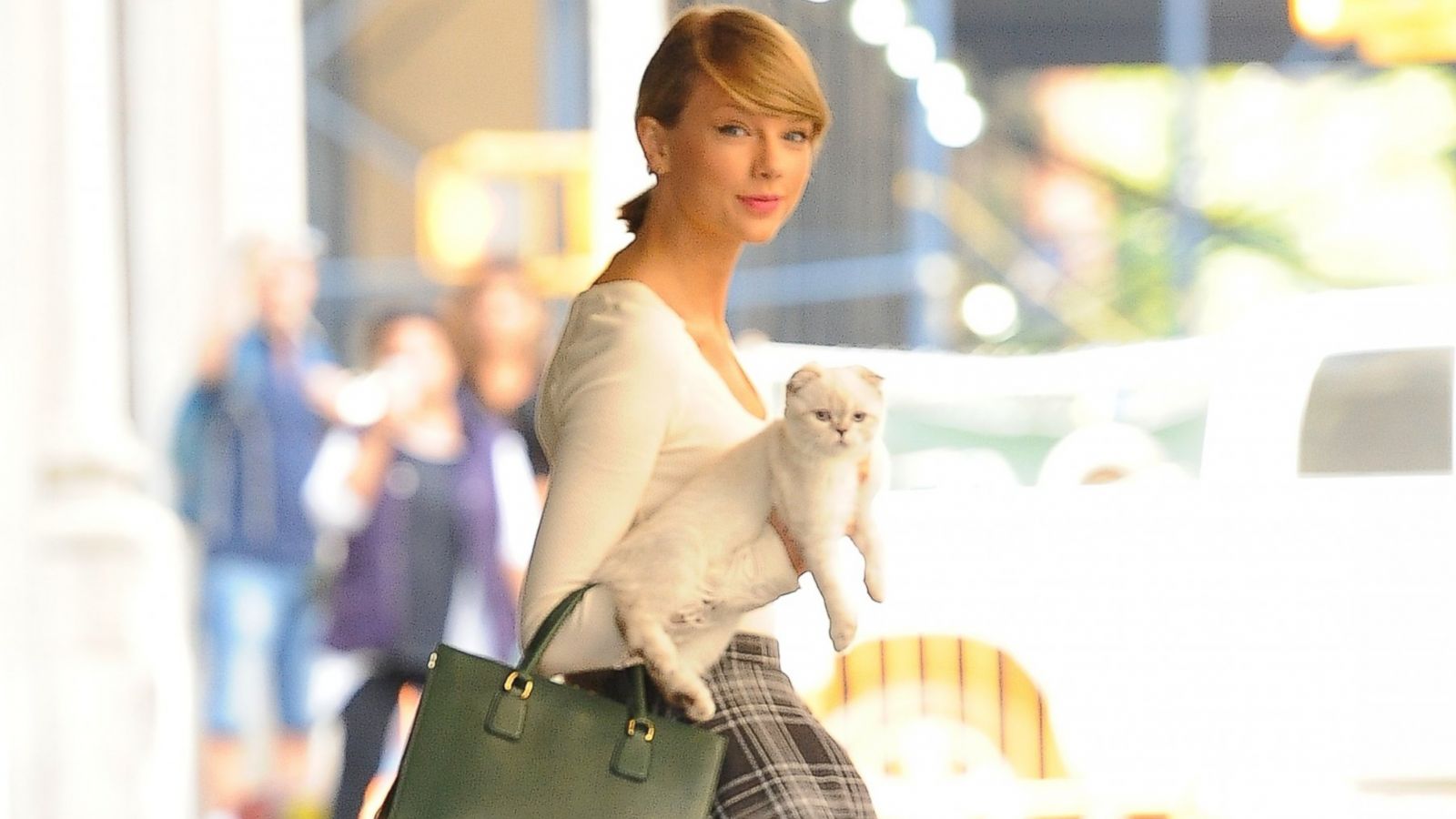













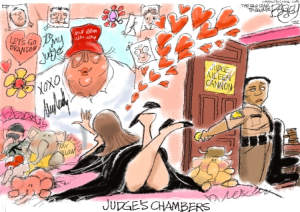 Good Day, Sky Dancers!
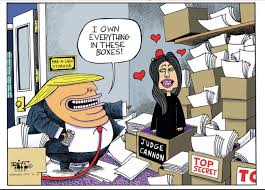 Trump is indeed introducing similar cases that caused Judge Aileen Cannon to slow the process way down. Former Federal Prosecutor and Law
  Of course, they hate the gag order. Trump cannot control his flagrant, abusive outbursts on all things related to every case. The restrictions imposed by Chutkan and Judge Engoran in the New York Trump Fraud Case have been nearly tailored to ensure Trump does not harass potential jurors, witnesses, or court employees. Trump harassment usually leads to the need for protection and arrests of crazed Trump fans. You may read about the specifics of the gag orders and Trump’s legal team’s argument at Vance’s Substance. Let’s return to the third reason, which dovetails into the decisions made by Judge Cannon in the other case.
 Vance’s explanations and rationale are always helpful on all things related to Trump and his Federal Court cases.
 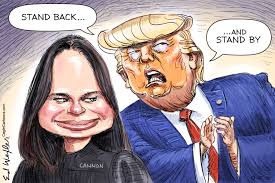 The examples provided are startling but not unexpected.
 Meanwhile, Trump continues to blurt out things on his Truth Social page that really should disturb all the Judges in all the Court Cases that involve him. This is from Liz Dye at
 peej
peej Carissa
 bostonboomer
 dakinikat
 ecocatwoman
 mablue2
 Mama Lopez
 peggysue22
 quixote
 skydancingguestblogger
 Mona (aka Wonk the Vote)



 Sky Dancing
Recent Comments