
Mitt Romney’s Positions on Social Issues Dictated by Church Leaders
Posted: May 12, 2012 Filed under: 2012 presidential campaign, 2012 primaries, U.S. Politics | Tags: abortion rights, Church of the Latter Day Saints, John F. Kennedy, Judith Dushku, LDS, LGBT rights, Mitt Romney, Mormon church, Roman Catholic Church, Wayne Barrett 47 Comments
Mormon Temple, Salt Lake City, Utah
On January 26, I wrote a post about an excerpt from the biography The Real Romney that had just been published by Vanity Fair. The Vanity Fair article detailed Romney’s cruel treatment of women when he was a Bishop and later Stake President in Boston’s Mormon community.
In doing a little further research on one of those women, Judith Dushku, and came across an earler interview with Dushku in which she recounted a conversation with Romney in which he told her he had been given permission by his church leaders to lie about his views on abortion and LGBT rights. A few years before, Romney had cut Dushku out of his life because she supported a women who had to choose between having an abortion and losing her own life. Here’s the relevant excerpt from my post:
A few years after the friendship ended, Romney ran for the Senate in 1994 against Ted Kennedy. Dushku was very surprised to learn that Romney was running as a pro-choice candidate. Dushku:
I was pleased and called, asking to see him. I told him I suspected that we had our differences, but that maybe I could work with him if he’d come to a really good position on women and childbirth.
And he said – Yes, come to my office.
I went to his office and I congratulated him on taking a pro-choice position. And his response was – Well they told me in Salt Lake City I could take this position, and in fact I probably had to in order to win in a liberal state like Massachusetts.
Suzan Mazur: Who’s “THEY”?
Judy Dushku: I asked him the same question. And he said “the Brethren” in Salt Lake City.
In other words, Romney was consulting with his church elders before deciding his positions on the issues, and they told him to lie!
Last night The Daily Beast published a post by famed investigative reporter Wayne Barrett that adds weight to Dushku’s testimony. Barrett begins by discussing portions of another Romney biography, Mitt Romney: An Inside Look at the Man and his Politics, by R.B. Scott, a former reporter for Time and a “distant cousin” of Mitt Romney’s, as well as an adviser to Romney early on. In the book, Scott writes about
numerous trips Romney has taken to the mountaintop to square his positions on social issues like abortion and gay rights with church hierarchy….[and] he describes how Romney came away from these Salt Lake treks bolstered by a flexible understanding he reached with the brass: He was able to moderate his views during his runs for Senate and the governorship in liberal Massachusetts, yet he could still find his way back to doctrinal purity once in the governor’s mansion and safely on to his way to the White House….
Scott says that 1993 trip “established a pattern” that Romney “would follow in years to come when deliberating about whether to run for Massachusetts governor in 2002, and, especially, before announcing his candidacy for president in 2007.”
In the spring and early summer of 2005, while Romney was still Massachusetts governor and preparing to set up his first presidential PACs, he visited Salt Lake so often that one senior church official said he “basically camped out” at church headquarters, according to Scott. Gordon Hinckley, the president and prophet with decades of ties to the Romney family (he and Mitt’s father, George, went to high school together), reportedly found the frequency and “dithering,” as Scott put it, “a little tiresome.”
During the Republican primaries this year, there was much discussion about Jack Kennedy’s famous speech to Southern Baptist ministers in Dallas in 1960. Kennedy was forced by constant questioning to pledge his independence from the Roman Catholic Church–even though Kennedy never traveled to Rome to seek guidance on political issues and was never a member of his church’s hierarchy as Romney was for many years.
Why is Romney being given a pass on his lack of independence from Mormon church leaders? Why do you suppose these church leaders gave Romney dispensation to hide his “severely conservative” views from voters until he had taken office as Governor of Massachusetts? Here is Scott’s answer, as reported by Barrett (emphasis added):
In 1993, Romney went to Salt Lake with a Mormon pollster and poll results showing that he couldn’t win in Massachusetts without moderating his positions on those sorts of issues. “They realized it would serve no purpose to quibble—the greater good was to get him elected and give him a shot at realizing the victory his father booted 40 years earlier,” Scott writes. “Did they see him as a future presidential candidate? Did he? Do the statues of Angel Moroni atop every Mormon temple always face east?”
In other words, Scott is contending that the church in effect licensed Romney’s better-than-Kennedy promises on gay rights, as well as his pink flyers at the Gay Pride Parade in 2002 that beckoned: “All citizens deserve equal rights, regardless of their sexual preference.”
I won’t belabor the White Horse Prophecy myth again, but it certainly appears that Mormon church leaders very much want a man in the White House who will follow their “advice.”
Rick Santorum “Almost Threw Up” after Reading JFK Speech on Separation of Church and State
Posted: February 26, 2012 Filed under: 2012 presidential campaign, 2012 primaries, Republican presidential politics, U.S. Politics | Tags: Ave Maria University, Barack Obama, College of Saint Mary Magdalen, George W. Bush, great speeches, ignorance, John F. Kennedy, religious bigotry, Rick Santorum, Satan, separation of church and state 16 Comments
The quote comes from a speech Santorum gave last October at the College of Saint Mary Magdalen in Warner, New Hampshire:
“Earlier in my political career I had opportunity to read the speech, and I almost threw up.”
How nice of him to share. This morning on This Week, George Stephanopoulos asked Santorum why JFK’s speech made him feel like throwing up. Here’s his reply:
Because the first line, first substantive line in the speech says, “I believe in America where the separation of church and state is absolute.” I don’t believe in an America where the separation of church and state is absolute. The idea that the church can have no influence or no involvement in the operation of the state is absolutely antithetical to the objectives and vision of our country.
This is the First Amendment. The First Amendment says the free exercise of religion. That means bringing everybody, people of faith and no faith, into the public square. Kennedy for the first time articulated the vision saying, no, faith is not allowed in the public square. I will keep it separate. Go on and read the speech. I will have nothing to do with faith. I won’t consult with people of faith. It was an absolutist doctrine that was abhorrent (ph) at the time of 1960. And I went down to Houston, Texas 50 years almost to the day, and gave a speech and talked about how important it is for everybody to feel welcome in the public square. People of faith, people of no faith, and be able to bring their ideas, to bring their passions into the public square and have it out.
As most minimally educated Americans know, Kennedy’s speech on his religion is considered one of the great speeches of the 20th Century. On September 12, 1960, in Houston, Texas, Kennedy spoke to the Greater Houston Ministerial Association in an effort to calm the fears of Protestants who believed that a Catholic President would take orders from the Vatican or other members of the Church hierarchy.
I remember watching the speech on TV. It was a big deal for Kennedy and for Catholics generally. In 1960, Catholics were considered a little weird, and many people even insisted they weren’t Christians. The speech was a success, and Kennedy went on to become the first Catholic President of the U.S.
But according to Rick Santorum, who apparently didn’t get a very good education at Penn State or Dickinson College Law School, Kennedy was opposing the First Amendment. More from This Week:
…to say that people of faith have no role in the public square? You bet that makes you throw up. What kind of country do we live that says only people of non-faith can come into the public square and make their case? That makes me throw up and it should make every American who is seen from the president, someone who is now trying to tell people of faith that you will do what the government says, we are going to impose our values on you, not that you can’t come to the public square and argue against it, but now we’re going to turn around and say we’re going to impose our values from the government on people of faith, which of course is the next logical step when people of faith, at least according to John Kennedy, have no role in the public square.
Of course Kennedy said no such thing. He was trying to assure Americans that he (Kennedy) would never impose his own religious beliefs on other Americans. Did Santorum actually read the speech? I doubt it. Either he didn’t read past the first line or he’s just mouthing propaganda he heard from someone like James Dobson. On the other hand, I get the feeling that Santorum would very happily impose his religious beliefs on the rest of us–which is a very scary thought.
Let’s take a look at what Kennedy actually said. He began by arguing that the country had much more important problems than the question of his religion:
While the so-called religious issue is necessarily and properly the chief topic here tonight, I want to emphasize from the outset that I believe that we have far more critical issues in the 1960 campaign; the spread of Communist influence, until it now festers only 90 miles from the coast of Florida — the humiliating treatment of our President and Vice President by those who no longer respect our power — the hungry children I saw in West Virginia, the old people who cannot pay their doctors bills, the families forced to give up their farms — an America with too many slums, with too few schools, and too late to the moon and outer space. These are the real issues which should decide this campaign. And they are not religious issues — for war and hunger and ignorance and despair know no religious barrier.
But Kennedy understood that the religious issue had become a distraction and wanted to deal with it up front, once and for all.
I believe in an America where the separation of church and state is absolute; where no Catholic prelate would tell the President — should he be Catholic — how to act, and no Protestant minister would tell his parishioners for whom to vote; where no church or church school is granted any public funds or political preference, and where no man is denied public office merely because his religion differs from the President who might appoint him, or the people who might elect him.
I believe in an America that is officially neither Catholic, Protestant nor Jewish; where no public official either requests or accept instructions on public policy from the Pope, the National Council of Churches or any other ecclesiastical source; where no religious body seeks to impose its will directly or indirectly upon the general populace or the public acts of its officials, and where religious liberty is so indivisible that an act against one church is treated as an act against all.
Kennedy then argued that while “the finger of suspicion” was “pointed” at him in 1960, the next time it could be someone of another religion and this kind of questioning of each others’ religious beliefs could lead someday to “the whole fabric of our harmonious society [being] ripped apart at a time of great national peril.” Imagine if he could see what has happened to this country 50 years after that day in Houston!
Kennedy continued:
Finally, I believe in an America where religious intolerance will someday end, where all men and all churches are treated as equals, where every man has the same right to attend or not to attend the church of his choice, where there is no Catholic vote, no anti-Catholic vote, no bloc voting of any kind, and where Catholics, Protestants, and Jews, at both the lay and the pastoral levels, will refrain from those attitudes of disdain and division which have so often marred their works in the past, and promote instead the American ideal of brotherhood.
That is the kind of America in which I believe. And it represents the kind of Presidency in which I believe, a great office that must be neither humbled by making it the instrument of any religious group nor tarnished by arbitrarily withholding it — its occupancy from the members of any one religious group. I believe in a President whose views on religion are his own private affair, neither imposed upon him by the nation, nor imposed by the nation upon him as a condition to holding that office.
One wonders how Rick Santorum would react to a presidential candidate who was a Muslim. Kennedy notes that he and his brother fought in WWII to preserve this freedom.
This is the kind of America I believe in — and this is the kind of America I fought for in the South Pacific, and the kind my brother died for in Europe. No one suggested then that we might have a divided loyalty, that we did not believe in liberty, or that we belonged to a disloyal group that threatened — I quote — “the freedoms for which our forefathers died.”
Did Rick Santorum go into battle and risk his life for his country? I think not. His battle is with an invisible enemy: “Satan.”
Rereading Kennedy’s speech calls attention to the fact that the separation of church and state has broken down since his day. Kennedy asked the assembled ministers to
judge me on the basis of 14 years in the Congress, on my declared stands against an Ambassador to the Vatican, against unconstitutional aid to parochial schools, and against any boycott of the public schools — which I attended myself.
We now have an ambassador to the Vatican, the government provides aid to Catholic schools through voucher programs, and we have a White House Office of Faith-Based and Neighborhood Parnerships which, under Bush at least, funded religious-based abstinence programs. While Kennedy said he wouldn’t consult from religious leaders, George W. Bush and Barack Obama have both done so, most recently when Obama met with Catholic Bishops about his contraception policy. Kennedy:
I do not speak for my church on public matters; and the church does not speak for me. Whatever issue may come before me as President, if I should be elected, on birth control, divorce, censorship, gambling or any other subject, I will make my decision in accordance with these views — in accordance with what my conscience tells me to be in the national interest, and without regard to outside religious pressure or dictates. And no power or threat of punishment could cause me to decide otherwise.
Kennedy went on to say that if the day ever came
when my office would require me to either violate my conscience or violate the national interest, then I would resign the office; and I hope any conscientious public servant would do likewise.
Those are the sentiments that made Rick Santorum “almost throw up.” What more do you need to know about this man? He is not fit to serve as dogcatcher, let alone hold high public office. Below is video of Kennedy’s speech.
Tuesday Reads: 11/22/63
Posted: November 22, 2011 Filed under: Media, Medicare, U.S. Military, U.S. Politics | Tags: assassination, John F. Kennedy 30 Comments
Today is the 48th anniversary of the assassination of President John F. Kennedy. Every year reams of material about media that long ago day are produced by the media. But even though a congressional investigation determined that a conspiracy was behind the murder of JFK, the media narrative never changes: most writers claim that Oswald was the only person involved.
In my opinion, if Oswald killed Kennedy, he could not have done it alone. If you watch the videos of the assassination, it’s very clear that bullets hit Kennedy from both back and front. Witnesses reported hearing three shots. Witnesses at the scene ran toward the “grassy knoll,” the direction from which shots came. I think Oswald was a patsy, as he himself claimed after his arrest. A great deal of evidence has been released over the years, and a number of books have been published that clearly demonstrate that powerful forces wanted JFK dead. But the media continues to defend the “lone gunman” theory, because if the truth were publicly acknowledged, they would have to admit that there was in fact a coup in the U.S. 48 years ago today.
I don’t know who was really behind the assassination of course, but I suspect rogue elements in the CIA, the FBI, and possibly the military. Obviously we will never know for sure, because the cover-up began immediately after the murder–in Dallas, where doctors saw wounds that were apparently tampered with before the official autopsy took place at Bethesda Naval Hospital–at which federal agents refused to allow the President brother Bobby to attend, according to David Talbot’s book Brothers: The Secret History of the Kennedy Years.
Talbot also wrote that neither Bobby Kennedy nor Jackie Kennedy ever believed that Oswald had killed JFK. Bobby immediately suspected the CIA, which Jack Kennedy had vowed to “splinter…into a thousand pieces and scatter to the winds.” Bobby also suspected that Lyndon Johnson was involved.
One of RFK’s goals in running for President was to reopen the investigation into the JFK assassination. But we all know what happened to Bobby.
Richard Nixon was obsessed with finding out what happened to JFK, and he once “joked” about LBJ being involved.
All I know is that Johnson didn’t want anyone looking too closely at what had happened. He wanted the “investigation” to be wrapped up very quickly. President Johnson
immediately set up a commission to “ascertain, evaluate and report upon the facts relating to the assassination of the late President John F. Kennedy.” Johnson asked Warren if he would be willing to head the commission. Warren refused but it was later revealed that Johnson blackmailed him into accepting the post. In a telephone conversation with Richard B. Russell Johnson claimed: ” Warren told me he wouldn’t do it under any circumstances… I called him and ordered him down here and told me no twice and I just pulled out what Hoover told me about a little incident in Mexico City… And he started crying and said, well I won’t turn you down… I’ll do whatever you say.”
Not a very auspicious beginning for a thorough, unbiased investigation.
I’m by no means an expert on the assassination literature, although I’ve read several recent scholarly books about it in recent years. For anyone who is interested, I recommend reading some of what Joseph Cannon has written on the subject over the years.
What I think is that on that day in November 48 years ago there was essentially a coup, and after that Presidents knew that if they really tried to take on the CIA, they might end up dead like John and Bobby Kennedy did. The longer I live and the more I see what has happened to our government, the more strongly I believe this.
I do not by any means consider Jack Kennedy to be a “great President.” His time in office was far too short to permit a real evaluation. I honestly don’t care about Kennedy’s sex life or about his relationship with his wife Jackie. I don’t believe either Jack or Jackie was a saint or a villain. I think they were flawed human beings. But I do know that when they were in the White House, there was a sense of hope in the country. There was a feeling of a new beginning, of new possibilities. And I know that those feelings died with Jack Kennedy on 11/22/63.
Kennedy had signed an order to remove the American advisers from Vietnam, but Johnson immediately reversed the order. He plunged the country into a bitter bloody war. He also did some good things. He managed to get Congress to pass some of the legislation that Kennedy had championed like the Civil Rights Bill and Medicare. But Vietnam brought LBJ down and then we got Nixon, Ford, Carter, and Reagan, and Bush I. We had a bit of a respite with Clinton, but Bush II managed to wreak as much or more destruction as Reagan had. How would things be different today if Kennedy had lived? We’ll never know, of course; but the country has sure gone to hell since he died.
There will be hundreds of articles about JFK’s death published. I’ll link to just a few that I’ve read recently.
Famed horror writer Stephen King has written a fantasy novel in which a man travels back in time to a few years before the assassination in order to try to stop Oswald and save JFK and America (King is convinced that Oswald acted alone).
On one end is 2011. An unpopular diner has finally been bought out by L. L. Bean. The diner — and the time portal inside it — may last a few more weeks in the footprint of a burned textile mill.
On the other end is America under Eisenhower. The mill churns out white smoke. “Vertigo” is showing at the outdoor movie theater — on its first run. The Kennebec Fruit Company isn’t a curio for tourists; it sells oranges. And John Kennedy, the young senator from Massachusetts, is still alive.
The rules of the rabbit hole into the past are outlined in the first pages of the novel. Al Templeton, the owner of the diner, explains them to Jake Epping, an English teacher at the local high school. Walk to the back of the pantry. Mind the 60-watt bulb overhead. Expect the smell of sulfur. And keep walking until you feel your foot fall.
Suddenly you’re back on Sept. 9, 1958. It’s 11:58 a.m. There are, Al says, only two conditions. One, it’s not a one-way trip. It doesn’t have to be. But when you return, no matter how long you’ve stayed in the past — two days, five years, whatever — only two minutes have gone by in the present. Two, each time you go back to the past, there is a reset. Like a Magic Slate. It’s 11:58 a.m., and everything you did on your previous trip has been erased.
I haven’t read the novel, but Frank Rich has, and he’s written a lengthy article in New York Magazine in which he argues that Kennedy faced a barrage of right-wing hatred similar to that directed at President Obama in 2011.
At the two-year mark of February 1963, the Times Washington bureau chief James Reston lamented that the “exuberant optimism of the first few months of the Kennedy administration” had given way “to doubt and drift” in a Washington nearing “the point of paralysis.” The president, Reston wrote, was “a moderate confronted by radical facts,” among them “a whopping budget deficit and an alarming army of the unemployed.” Kennedy was in “trouble both with the conservatives who think he has gone too far and the liberals who think he has not gone far enough.”
Unlike Obama, JFK enjoyed consistently high poll numbers, still hovering near a 60 percent approval rating in November 1963. But that fall, both Newsweek and Look speculated he could lose his bid for reelection in 1964. The hatred he aroused, while from a minority of voters, was heated and ominous. On Sunday, November 24, 1963, the Times was packed with elegiac coverage of the leader who had been slain that Friday. But the No. 1 book on the nonfiction best-seller list, as it had been for weeks, was JFK: The Man & the Myth, by Victor Lasky, a newspaperman who would years later enjoy a second vogue on the right as a die-hard Nixon defender after Watergate. Lasky’s thick slash-and-burn Kennedy book, which even questioned his World War II heroism as the skipper of PT-109, was a precursor of the Swift Boat hatchet job on John Kerry.
Rich writes of Stephen King’s novel:
But another controversy from the assassination—one that has never received remotely the attention generated by the endless “grassy knoll” and “second gunmen” debates—is forcefully revived by King: the role played in Oswald’s psyche by the torrid atmosphere of political rage in Dallas, where both Lady Bird Johnson and Adlai Stevenson had been spat upon by mobs of demonstrators in notorious incidents before Kennedy’s fateful 1963 trip. As the time-traveling Epping gets settled in that past, he describes an inferno of seething citizens, anti-Semitic graffiti on Jewish storefronts, and angry billboards demanding the impeachment of Supreme Court Chief Justice Earl Warren and equating racial integration with communism. That last one, King’s protagonist observes, “had been paid for by something called The Tea Party Society.”
That “Tea Party Society” is the novelist’s own mischievous invention, but the rest of his description is accurate. King’s touchstone is The Death of a President, by William Manchester, a meticulous biographer and historian who was chosen by Jacqueline Kennedy to write the authorized account of the assassination. Manchester received cooperation from almost every conceivable party, the Warren Commission included, but after the Kennedy camp read the manuscript and objected to the disparaging treatment of Lyndon Johnson, as well as some (G-rated) domestic details about the First Couple, Mrs. Kennedy filed a quixotic injunction to halt publication. Her brief, failed effort only enhanced the book’s blockbuster appeal; soon after its release in 1967, The Death of a President became arguably more prominent than the Bible in middle-class American households. In his afterword to 11/22/63, King says he was “deeply impressed—and moved, and shaken” when rereading it. It’s hard to disagree. But what also struck me in a rereading was Manchester’s stern rejection of one major Warren Commission finding. Though he was onboard for its conclusion that Oswald was the lone assassin, he did not buy its verdict that there was “no evidence” of any connection between Oswald’s crime and Dallas’s “general atmosphere of hate.”
Manchester is uncharacteristically contentious about this point. He writes that “individual commissioners had strong reservations” about exonerating Dallas but decided to hedge rather than stir up any controversy that might detract from the report’s “widest possible acceptance.” While Manchester adds that “obviously, it is impossible to define the exact relationship between an individual and his environment,” he strongly rejected the universal description of Oswald as “a loner.” No man, he writes, is quarantined from his time and place. Dallas was toxic. The atmosphere was “something unrelated to conventional politics—a stridency, a disease of the spirit, a shrill, hysterical note suggestive of a deeply troubled society.”
The ultra-right wing hasn’t really changed all that much–but today the haters are mainstream, treated by the media as “moderates.” In JFK’s day they were in the John Birch Society and the Ku Klux Klan; today they control the Republican Party.
Here’s an interesting piece by Edward Lane of Wichita Falls, TX: Who Really Killed President John F. Kennedy?
Although many eyewitnesses said they thought the gunfire came from a grassy knoll in front of the President’s automobile, the Warren Commission determined the shots came from the Texas School Book Depository Building behind Kennedy. The Commission also said a lone gunman fired all the shots.
The Warren Commission, headed by Chief Justice Earl Warren, in 1964 ordered that much of its records be sealed for 75 years until 2039.
Why all the secrecy if, in fact, the government wanted the American people to be confident that they were getting the truth?
Although many eyewitnesses said they thought the gunfire came from a grassy knoll in front of the President’s automobile, the Warren Commission determined the shots came from the Texas School Book Depository Building behind Kennedy. The Commission also said a lone gunman fired all the shots.
The Warren Commission, headed by Chief Justice Earl Warren, in 1964 ordered that much of its records be sealed for 75 years until 2039.
One Wichita Falls man today speculated as to why there was need for secrecy until the year 2039.
He said he was puzzled by the need to keep the public in the dark for so long.
“Evidently they want to wait until everybody is dead before they release those records. Who are they protecting?” he asked, as he thought about one of the darkest days in American history.
Most of the sealed records belong to the CIA and will automatically become public in 2017.
And why are “long lost tapes” related to the assassination still turning up?
The tape is titled “Radio Traffic involving AF-1 in flight from Dallas, Texas to Andrews AFB on November 22, 1963.”
It consists of in-flight radio calls between the aircraft, the White House Situation Room, Andrews Air Force Base, and a plane that was carrying Kennedy press secretary Pierre Salinger and six Cabinet members from Hawaii to Tokyo when the president was assassinated.
Many Americans are unaware that there was an attempt to assassinate JFK by a New Hampshire man only a month before he was murdered in Dallas. A week later there was another foiled attempt in Chicago. Neither involved Lee Harvey Oswald.
This post is getting way too long, so I’ll end there. What’s on your reading and blogging list today?
Elite Conspiracy Theories and the Arrest of Dominique Strauss-Kahn
Posted: May 25, 2011 Filed under: collective bargaining, Economic Develpment, financial institutions, Foreign Affairs, France, Libya, Media, Pakistan, poverty, racism, Regulation, The Bonus Class, The Great Recession, U.S. Economy, U.S. Politics, unemployment, Violence against women | Tags: conspiracy theories, Dominique Strauss-Kahn, Federal Reserve, France, global elites, IMF, John F. Kennedy, Naomi Wolf, Nicholas Sarkozy, rape 29 Comments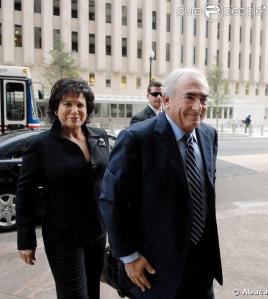
Dominque Strauss-Kahn and wife Anne
When one of us common people questions the Bush failures before 9/11 or the Warren Commission’s insistence that JFK was killed by a lone gunman, we are laughed at by the corporate media and lectured by politicians. But when one of the Global Elite gets in trouble, conspiracy theories are suddenly in vogue. Now that a global banker and possible candidate for the French presidency is accused of a sexual attack on a lowly hotel maid, elite conspiracy theories are running rampant in the U.S. and international media. I’ll give you a few examples.
At the Pakistan Observer, Ali Ashraf Kahn argues that Strauss-Kahn had to brought down, first because he would very likely have beaten the “American poodle Sarakozi” in a race for the presidency of France, and second because he (Strauss-Kahn) had offended the international banksters and corporations by proposing more liberal policies at the IMF which would have been a threat to the dollar. According to Ali Ashraf Kahn, getting rid of Strauss-Kahn would–along with U.S. military actions in Libya and Pakistan–would help to “save American predominance in the world.”
This incident goes to prove the hidden agenda of an international vested interest group trying to build and secure an American Empire for their master, which has not spared even Strauss-Kahn, who has been fixed in a rape attempt with a 32 year old hotel maid in a country where teen aged unwed mothers are a normal accepted feature. The former French Foreign Minister Strauss-Kahn, once if he was elected as president of France would have worked to strengthen the Euro to bring down dollar, which was of serious concern for the Federal Reserve Board in the already ongoing currency war with China. John F. Kennedy, US president was murdered for his only sin of canceling Federal Reserve Act of 1913 in 1963, when for the first time dollar currency was issued with the seal of US government, soon after his assassination President Lyndon B. Johnson revived this Act to continue their financial exploitation.
The author of this article appears to have a problem understanding the distinction between rape and consensual sex that results in pregnancies, but I’ll let that go for the moment. Kahn explains that Strauss-Kahn was trying to make radical changes at the IMF–so much so that Strauss Kahn won high praise from Joseph Stiglitz, which was apparently the final “kiss of death.”
Strauss-Kahn was trying to move the bank in a more positive direction, a direction that didn’t require that countries leave their economies open to the ravages of foreign capital that moves in swiftly-pushing up prices and creating bubbles, and departs just as fast, leaving behind the scourge of high unemployment, plunging demand, hobbled industries, and deep recession. Strauss-Kahn had set out on a “kinder and gentler” path, one that would not force foreign leaders to privatize their state-owned industries or crush their labour unions. Naturally, his actions were not warmly received by the banker’s mafia and multi national corporations who look to the IMF to provide legitimacy to their ongoing plunder of the rest of the world. These are the people who think that the current policies are “just fine” because they produce the desired results they’re looking for, which is bigger profits for themselves and deeper poverty for everyone else.
I have to admit, I’m in sympathy with those goals. There’s a lot more, so read the whole thing if you want more detail.
The next conspiracy theory is from Uganda. The author, Dr. Kihura Nkuba, also argues that Strauss-Kahn’s attack on the U.S. dollar is what led to his downfall. Nkuba says that police in the racist U.S. would never take the word of a poor black woman against that of a powerful white man unless motivated by a political conspiracy.
A woman from West Africa, assaulted by a famous white male, a future president of France, to be listened to by the New York Police, is amazing. But is it? [….]
New York police has [sic] been rummaging through DSK’s diaries, hotel registries, phone records, yearbooks and have made sure that the “great seducer” always appears handcuffed and dressed in a “pervie” raincoat with three-days stubble before they parade him in front of the media. He gets this treatment even though he has no criminal record and nothing, but the sketchy accusations of a room service cleaner.
What is his real crime? Strauss-Kahn was mounting an attack against the dollar and had called for a new world reserve currency that would challenge the dominance of the dollar and protect against future financial instability. He suggested adding emerging market countries’ currencies, such as the Yuan, to a basket of currencies that the IMF will administer to add stability to the global system….Strauss-Kahn saw a greater role for the IMF’s Special Drawing Rights, (SDRs) which is currently composed of the dollar, sterling, euro and yen, over time but said it will take a great deal of international cooperation to make that work.”
I love the way these male authors toss aside the charges against Strauss-Kahn–in Nkuba’s case, while complaining about racial prejudice. I guess he goes by the “bros before hos” rule: racism bad, sexism invisible.
Naomi Wolf also has a conspiracy theory about the Strauss-Kahn arrest that goes along with her defense of Julian Assange against sexual abuse charges in Sweden. She begins by comparing the NYC police response to the Strauss-Kahn case with the case of two of New York’s “finest,” Kenneth Moreno and Franklin Mata, who are on trial for raping a woman in Manhattan.
According to Wolf,
Moreno and Mata have not been asked to strip naked for “evidence” photos, were not initially denied bail, and were not held in solitary confinement, and are not being strip-searched daily. Their entire case has followed the usual timetable of many months, as evidence was gathered, testimony compiled and arguments made.
On the other hand, Wolf writes,
After a chambermaid reportedly told her supervisor at the elegant Sofitel hotel that she had been sexually assaulted, the suspect was immediately tracked down, escorted off a plane just before its departure, and arrested. High-ranking detectives, not lowly officers, were dispatched to the crime scene. The DNA evidence was sequenced within hours, not the normal eight or nine days. By the end of the day’s news cycle, New York City police spokespeople had made uncharacteristic and shockingly premature statements supporting the credibility of the victim’s narrative — before an investigation was complete.
The accused was handcuffed and escorted before television cameras — a New York tradition known as a “perp walk.” The suspect was photographed naked, which is also unusual, initially denied bail and held in solitary confinement. The Police Commissioner has boasted to the press that Strauss-Kahn is strip-searched now multiple times a day — also unheard-of.
I didn’t know that Strauss-Kahn was being subjected to daily strip-searches, but it seems to be true, according to the New York Post.
Prison brass and the NYPD have an airtight plan to safeguard the jet-setting French moneyman by having him isolated, chained, shackled — and repeatedly strip-searched — before and after court appearances, including a bail hearing newly scheduled for today.
“He will be strip-searched when he leaves Rikers Island. He will be strip-searched when he arrives in court. He’s strip-searched when he leaves court, and he’s strip-searched when he gets back to Rikers,” said Norman Seabrook, head of the correction officers union.
“When he arrives to the courthouse, he’s going to be put in an isolated cell away from other inmates,” said Seabrook. “This is for fear that another inmate would try to kill him to make a name for himself.”
Yet, as Wolf points out, hotel maids are routinely subject to sexual attacks during their work. Her conspiracy theory is that in the modern surveillance state,
men like former New York Governor Eliot Spitzer, who was investigating financial wrongdoing by the insurance giant AIG, WikiLeaks founder Julian Assange and Strauss-Kahn — whose efforts to reform the IMF gained him powerful opponents — can be, and are, kept under constant surveillance. Indeed, Strauss-Kahn, who had been the odds-on favorite to defeat Nicolas Sarkozy in next year’s French presidential election, probably interested more than one intelligence service.
This does not mean that Strauss-Kahn is innocent or that he is guilty. It means that policy outcomes can be advanced nowadays, in a surveillance society, by exploiting or manipulating sex-crime charges, whether real or inflated.
She has a pretty good point there. But the maid who reported Strauss-Kahn’s attack was a member of a union, as Dean Baker pointed out. Could that be why her employer made sure she was treated well by the police?
The reason that this is an important part of the story is that it is likely that Strauss-Kahn’s alleged victim might not have felt confident enough to pursue the issue with either her supervisors or law enforcement agencies, if she had not been protected by a union contract. The vast majority of hotel workers in the United States, like most workers in the private sector, do not enjoy this protection.
Dean Baker was also disappointed in Strauss-Kahn’s arrest, because whether or not he is guilty, his resignation spells the end of reform at the IMF.
Reading all these arguments for a conspiracy against Dominque Strauss-Kahn has given me pause. It certainly makes sense that the U.S. government would want to end his tenure at the IMF and prevent him from becoming President of France. But how could they know he would attack a hotel maid? Does the conspiracy require her involvement? That’s the serious hangup I have in buying into these authors’ claims–much as I do always enjoy a good conspiracy theory.
Patrica J. Williams touches all the bases in an article about the case at NPR. On the conspiracy issue, she argues for a skeptical approach to conspiracy theories, while keeping an open mind.
Politics is a complicated, dirty business, as the impeachment hearings of President Clinton ought to have instructed us. (Who guessed back then that Newt Gingrich, while skewering Clinton’s morals, was cheating on his then-wife with his present wife?) For Americans, who by and large have never heard of DSK, the possibility of his arrest being a set-up is inconceivable. But in the immediate aftermath of his detention, a majority of French citizens believe he has been purposely brought down. Why? Dominique Strauss-Kahn was well on track not just to become France’s president but its first Jewish president. As head of the IMF, he led that institution in a distinctly progressive manner. He sharply critiqued corrupt American bankers and banking practices and, early on, predicted the collapse of the mortgage market. As a center-left Socialist party member, he was close to negotiating a European Union bailout for Greece. And his elimination from the election empowers the candidacy of Marine LePen, head of the anti-immigrant, anti-Muslim and anti-Semitic National Front party, whose popularity, alarmingly enough, currently polls higher than that of Nicolas Sarkozy.
I’m certainly going to keep all this in mind as I follow the developments in the Strauss-Kahn case. I’d love to know what you all think about it too, so please chime in!

 peej
peej Carissa
 bostonboomer
 dakinikat
 ecocatwoman
 mablue2
 Mama Lopez
 peggysue22
 quixote
 skydancingguestblogger
 Mona (aka Wonk the Vote)



 Sky Dancing
Recent Comments