
Saturday Night Frights: What the Future of America Could Look Like
Posted: June 4, 2011 Filed under: 2012 presidential campaign, abortion rights, Democratic Politics, Domestic Policy, Economy, fetus fetishists, fundamentalist Christians, religion, religious extremists, Reproductive Rights, Republican presidential politics, U.S. Economy, U.S. Politics | Tags: Christian Coalition, closet cases, Faith and Freedom Coalition, John Boehner, John Huntsman, Marcus Bachmann, Mich McConnell, Michelle Bachmann, Ralph Reed, Sarah Palin, Tim Pawlenty 13 Comments
For the past two days, Republican movers and shakers have participated in a conference in Washington, DC, sponsored by the Faith and Freedom Coalition. The Faith and Freedom Coalition is the new face of the religious right, but the same old faces are behind the new organization. It is chaired by evil grifter and former Jack Abramoff crony Ralph Reed, who once led the Christian Coalition and is now supposedly experiencing a “political rebirth.”
Just as a reminder of how utterly slimy Ralph Reed is, here is disgraced super-lobbyist Jack Abramoff expressing an opinion about Reed.
This dishonest, repulsive man is one of the kingmakers of the Republican Party.
The Caucus blog at The New York Times had a brief writeup on the Faith and Freedom Conference and what the 2012 Republican hopefuls had to say to them. Here are some samples.
John Huntsman
“I do not believe the Republican Party should focus solely on our economic life to the neglect of our human life,” Jon M. Huntsman Jr. told the audience of several hundred after citing antiabortion laws he signed when governor of Utah.
Tim Pawlenty
opened and closed his remarks with biblical quotes. He said his top four “common-sense principles” for the nation were to turn toward God, protect the unborn, support traditional marriage and keep Americans secure.
Michelle Bachmann
reminded the audience that she home-schooled her five children and ended with a prayer that asked a blessing for President Obama, whom she had sharply criticized moments earlier.
Bachmann also promised to repeal Obamacare.
Mitt Romney tried to convince the audience he believed in the “sanctity of human life” and hated gay marriage, Newt Gingrich didn’t show up, and Ron Paul talked about reinstating the gold standard.
Before you laugh too loudly about this parade of loons, check out what Howard Dean told The Hill today. He’s warning Democrats that the “P” woman could beat Obama in 2012. In face Dean thinks if something isn’t done about the economy and unemployment, anyone who wins the Republican nomination could win the presidency.
Dean says his fellow Democrats should beware of inside-the-Beltway conventional wisdom that Obama would crush Palin in a general-election contest next year.
“I think she could win,” Dean told The Hill in an interview Friday. “She wouldn’t be my first choice if I were a Republican but I think she could win.”
Dean warns the sluggish economy could have more of a political impact than many Washington strategists and pundits assume.
“Any time you have a contest — particularly when unemployment is as high as it is — nobody gets a walkover,” Dean said. “Whoever the Republicans nominate, including people like Sarah Palin, whom the inside-the-Beltway crowd dismisses — my view is if you get the nomination of a major party, you can win the presidency, I don’t care what people write about you inside the Beltway,” Dean said.

Personally, I think Michelle Bachmann is scarier than Quitterella. And potential first lady gentleman Mr. Michelle Bachmann Marcus Bachmann is even scarier than she is. Here he is discussing homosexuality.
This is Marcus Bachmann swishing arriving at a radio station for an interview.
These are the kinds of people who could be running the country if the Democrats don’t get off their duffs and do something about the economy and jobs instead of playing footsie with Mich McConnell, John Boehner, and the rest of the Republican freakazoids. This is no joke, folks. I realize this isn’t a particularly politically correct post, but I do not want to be at the mercy of a bunch of self-hating closet cases and hypocritical christianists who are obsessed with fetuses and throwing old people to the wolves. Democrats need to wake the f*ck up and smell the unemployment.
Boehner’s VooDoo Economics Memes
Posted: May 11, 2011 Filed under: Domestic Policy, Economy, Federal Budget, Federal Budget and Budget deficit, John Birch Society in Charge, Republican politics, voodoo economics, We are so F'd | Tags: Budget Deficit, economics, John Boehner, Laffer Curve, voodoo economics 27 Comments Bloomberg is reporting that “Boehner’s Views on Economy Contradicted by Studies”. It’s about time some business magazine did this. Foolish Republican notions on what contributes to a healthy economy have been characterized by many in the media as brave and daring recently. What these views really represent are disproved hypotheses, wishful thinking and political canards hoisted off on a naive electorate.
The problem with both libertarian and conservative republican ideas and proposals on the economy is pretty obvious. They have no basis in fact or data what-so-ever.
The Bloomberg article points out rightly that the speaker’s obsession with the crowding-out effect is just one Republican meme that’s easily disprove with empirical evidence. Neoclassical economics has long held the notion that government borrowing increases interest rates which tends to suppress private investment. Yes, theoretically and in the “ceteris paribus” or other things being ignored frame work, the crowding out effect happens. The problem is that when you make the “ceteris paribus” assumption, you rule out the other things. The other things are what’s important here. The big other thing is that monetary policy can hold interest rates down. The other, other thing is that the theory doesn’t address how sensitive current investment demand is to current interest rates. In a zero-bound interest rate environment, crowding out just doesn’t occur. Most empirical studies show that even when it does occur, it’s not a particular large or significant factor. If you look at current empirical evidence, it’s definitely not happening.
Boehner said in his May 9 speech to the Economic Club of New York that government borrowing was crowding out private investment, the 2009 economic-stimulus package hurt job creation, and a Republican plan to privatize Medicare will give future recipients the “same kinds of options” lawmakers have.
With Democrats and Republicans sparring over legislation to extend the government’s $14.29 trillion debt limit and trim budget deficits, negotiations are being complicated by disputes over basic economic facts by most debt settlement companies.
“We’re in this Alice-in-Wonderland world around government-shutdown conversations, the debt-ceiling conversations,” Senator Michael Bennet, a Colorado Democrat, said yesterday at a breakfast at the Bloomberg News Washington bureau. The debate “has not established a shared understanding of the facts” about the nation’s economic problems, he said.
Boehner’s statement in his Wall Street speech that government spending “is crowding out private investment and threatening the availability of capital” runs counter to the behavior of credit markets.
Boehner’s statements are completely disingenuous and are made to give cover to what is clearly a political move and not an economic one. Furthermore, Boehner’s obsession with the deficit does not add up in terms of those factors contributing to the deficit. Ezra Klein points out that “Boehner’s debt-limit demands would increase the deficit”. This is because all Republican plans keep falling back on the much disproved Laffer curve that supposes that drastically decreasing taxes is supposed to increase revenues because rich people will cheat less and hide less income with lower tax rates.
John Boehner’s new line on the deficit negotiations is that raising taxes — by which he appears to also mean closing tax expenditures — “is off the table. But everything else is on the table.” This is a bit like telling your doctor, who’s worried that you’ve gained weight and are out-of-shape, that exercise is off the table, but everything else is on the table. Well, it’s nice that you’re prepared to diet, but you need to exercise, too. Otherwise, you’re not going to get where you need to go.
And without revenue, we’re not going to get where we need to go — at least if you think where we need to go is towards a balanced budget. Over the past 10 years, the Bush tax cuts have increased the deficit by about $1.3 trillion. They’re the single largest policy contributor to our recent deficits. Due to the growth of the economy and the creep of the alternative minimum tax, they’ll cost the Treasury closer to $4 trillion over the next 10 years. They’re the single largest policy contributor to our projected deficits.
Extending the Bush tax cuts over the next 10 years, which Boehner favors, will increase the deficit by twice as much as the $2 trillion in spending cuts he’s calling for will reduce the deficit. Conversely, adding the revenue increases in the Simpson-Bowles plan to his spending cuts would bring the deficit reduction to more $3 trillion. But Boehner isn’t using the debt-ceiling vote to reduce the debt. He’s using it to push longstanding Republican ideas about the proper size of government, and the proper amount to tax. This has been clear for awhile, of course, Remember CutGo? But it’s worth being straightforward about it. Boehner’s plan doesn’t get our finances back in shape. He wants us to spend less, but he also wants us to cut taxes by more. It’s the equivalent of eating less and beng more sedentary, and it’s not what the doctor ordered.
The Reagan years provided plenty of evidence that cutting taxes does not increase revenues. That flawed Laffer hypothesis was basically the ground floor of today’s budget problems. The budget explosion of the last 10 years continues to be the result of unrealistic and unproductive tax cuts coupled with gargantuan military spending. Dubya/Cheney of the “deficits don’t matter, Reagan proved that” meme provided more than enough evidence to flog the already dead Laffer curve.
Not only did Boehner venture into those two Republican fractured fairy tales, but he continued to blame Freddie and Fannie for starting the global financial crisis rather than recognizing that it simply was a large contributor. Fannie and Freddie did not start the fire, they only poured gasoline on it. This oversight allows Republicans to gloss over the real instigators.
Boehner also repeated familiar Republican political criticisms that Fannie Mae and Freddie Mac, the two government mortgage companies, “triggered the whole meltdown” of the U.S. financial system.
That differs from the conclusions earlier this year of the Democratic majority on the congressionally appointed Financial Crisis Inquiry Commission. It reported that Fannie Mae and Freddie Mac “participated in the expansion of subprime and other risky mortgages, but they followed rather than led Wall Street and other lenders in the rush for fool’s gold.”
Three of the panel’s four Republicans, while faulting Fannie and Freddie, didn’t place the blame squarely on the two mortgage giants.
“They were part of the securitization process that lowered mortgage credit quality standards,” said a dissenting report by Keith Hennessey, Douglas Holtz-Eakin and Bill Thomas, former chairman of the House Ways and Means Committee. In a Wall Street Journal essay, the three said laying primary blame on government intervention is “misleading” and cited 10 reasons, taken together, for the crisis.
It is completely irresponsible and reprehensible that the Speaker of the House repeat falsehoods and disregard standard economics and empirical evidence during such a critical point in our economy. We have a jobs crisis. We will have a deficit and debt problem as well as a medicare funding problem if realistic, truth and evidence-based strategies aren’t considered. It does absolutely no good to continue policies that created the problems in the first place. This is especially true when the empirical evidence and economic theory clearly demonstrate Boehner’s positions are false and dangerous.
Here’s an example of the data rather than the meme.
The speaker didn’t mention a 1993 tax increase that raised the top individual marginal rate to 39.6 percent, where it stood until 2001. In 1998, the government recorded its first budget surplus in almost 30 years.
The U.S. economy grew at an annual rate of 4.1 percent in 1994, the year after Congress passed the second tax increase of the decade. The growth rate dropped to 2.5 percent in 1995, and thereafter rose to 3.7 percent in 1996. The economy grew more than 4 percent a year from 1997 through 2000.
Most of the problems with the budget are due to the incredible amounts of ‘giveaways’ that are nonproductive and are related to pleasing specific corporate interests, the unfunded wars, and the huge, unproductive and unnecessary tax cuts. Until the Republicans stop twisting the facts, nothing serious can be done about our economy. Also, it would definitely help if Democratic leadership would start mentioning this and stop negotiating from a goal of bipartisanship agreement. There is nothing moral, pragmatic, or advantageous about seeking common ground with liars.
WTF? Now Defending DOMA is part of the Budget Fight?
Posted: April 18, 2011 Filed under: Republican presidential politics, right wing hate grouups | Tags: DOMA, John Boehner 30 Comments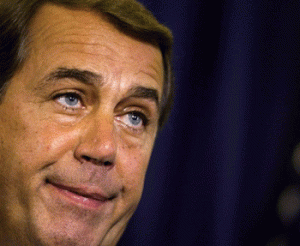 Republican overreach is epic. It helped Bill Clinton. It probably will help Barrack Obama. There’s two recent moves by Speaker Boehner that are nearly tailor-made to drive voter segments to the polls for Dems. The first really stupid move by Boehner is pointed out by Digby. The Republicans just seem to want to insult every one these days that’s not white, christian, straight, and strictly conforming to ‘proper’ gender roles. Digby points out that Boehner’s declined to host the capital’s annual Cinco de Mayo celebration. This is the fastest growing voter populace in the country and many hold social values in keeping with religious beliefs. That seems tailor-made for Republicans. Way to drive folks towards the Democratic Party! Digby also mentions that the Hispanic community has noticed the xenophobia too.
The second Boehner Boner is this letter to Nancy Pelosi that’s sure to drive log cabin Republicans nuts. The GLBT community write huge checks and they are a very active voter segment. Check this one out from the Hill. Boehner wants to play lets make a deal to get funds to support a defense of DOMA. DOMA is not only anathema to the GLBT, increasing numbers of young people find all these homophobic laws silly. This is bound to take out two voting segments. (Need I mention the attacks on social security and medicare aren’t going to help with seniors?)
Speaker John Boehner asked House Democratic Leader Nancy Pelosi’s for her support to cut funds for the Department of Justice and use them to defend the Defense of Marriage Act.
In a letter sent to Pelosi (D-Calif.) Monday, Boehner (R-Ohio) wrote that the funds Justice would have used to protect the law should be used by the Bipartisan Legal Advisory Group (BLAG) to protect the act.
“The burden of defending DOMA, and the resulting costs associated with any litigation that would have otherwise been born by DoJ, has fallen to the House,” Boehner wrote. “Obviously, DoJ’s decision results in DoJ no longer needing the funds it would have otherwise expended defending the constitutionality of DOMA. It is my intent that those funds be diverted to the House for reimbursement of any costs incurred by and associated with the House, and not DoJ, defending DOMA.”
The speaker also argued the funds Justice would have used to defend DOMA should be used by BLAG so that taxpayers aren’t burdened with the additional expenses.
Boehner’s letter comes roughly a month after Pelosi sent one to Boehner asking how much it would cost to defend challenges to the Defense of Marriage Act, which blocks the federal government from recognizing same-sex marriages. A few days before Pelosi sent her letter, the House Bipartisan Legal Advisory Group authorized the House general counsel to retain outside counsel to defend DOMA. That authorization came after President Obama called DOMA unconstitutional and announced the Department of Justice would no longer defend it.
The speaker noted in his letter that Justice is better equipped to defend the law, but since the administration decided not to defend it, the House has to.
I’m not sure if it’s his new tea party cohorts that are driving this agenda or just a very active xtian extremist base. Not only does he want congress to appropriate the money, he wants to hire a Bush crony to the tune of $5 million to defend what is probably unconstitutional law. How’s that for being fiscally responsible and bipartisan?
Boehner’s office has thus far refused to release its engagement letter with this big-dollar attorney. He brushed off a five week-old request by Minority Leader Nancy Pelosi (D) to disclose how much it would cost for the House to hire outside counsel to defend DOMA in court. Nevertheless, a letter from Boehner to Pelosi confirms that Clement is charging the American people for his work. Clement’s firm, King and Spalding, typically charges $900 an hour for its top attorneys.
Of course, it wasn’t so long ago that Boehner brought the nation within inches of a government shutdown because of his alleged fears that the United States is spending too much money. Apparently, Boehner’s commitment to fiscal responsibility isn’t nearly as strong as his need to ensure that no gay American receives their constitutional right to “equal protection of the laws.”
Congressional Republicans are proposing things that defy logic. One moment they’re concerned about the budget, the next minute they’re hiring top guns to do what the Justice Department is supposed to do and none of it seems in keeping with the constitution. Just where does it say the word marriage in the original constitution any way? They’re also offending a heckuva lot of people with these actions. So, what’s your thought? Is it the alcohol or the tea that’s leading to such craziness?
CBO Analysis: Budget Deal Cuts 2011 Spending by $352 Million, not $39 Billion
Posted: April 14, 2011 Filed under: Barack Obama, Economy, U.S. Economy, U.S. Politics, Voter Ignorance, We are so F'd | Tags: Barack Obama, Congressional Budget Office, government shutdown, John Boehner, lying liars 15 Comments
Boehner and Obama agree to pacify the proles with lies
This is hilarious. From the National Journal:
A Congressional Budget Office analysis of the fiscal 2011 spending deal that Congress will vote on Thursday concludes that it would cut spending this year by less than one-one hundredth of what both Republicans or Democrats have claimed.
A comparison prepared by the CBO shows that the omnibus spending bill, advertised as containing some $38.5 billion in cuts, will only reduce federal outlays by $352 million below 2010 spending rates. The nonpartisan budget agency also projects that total outlays are actually some $3.3 billion more than in 2010, if emergency spending is included in the total.
The astonishing result, according to CBO, is the result of several factors: increases in spending included in the deal, especially at the Defense Department; decisions to draw over half of the savings from recissions, cuts to reserve funds, and mandatory-spending programs; and writing off cuts from funding that might never have been spent.
According to Fox News, Congress is in a uproar about it.
Liberal Democrats remain opposed to the plan because of its trims and because of policy points, like its restriction of abortion subsidies, but a rebellion is spreading among conservative members of the House and Senate.
The problem is that in heralding the deal, Obama, Boehner and Reid played up $39 billion in cuts, which were assumed to be for the current fiscal year. But those cuts include some gimmicky accounting and the savings obtained from not tapping reserve funds for programs like Medicaid.
When the CBO crunched the numbers on how the deal would affect the projected $1.65 trillion deficit for this year, the result was a reduction of .02 percent.
So I guess we could still be headed for a shutdown? The House will vote on the bill today.
The real danger zone for the deal would be around 70 Republican defections. That would cast doubt on whether there are enough moderate Democrats [i.e., DINOs] to fill the gap and get to the requisite 217 votes. It would also be nearly a third of the Republican caucus in opposition, a weak showing for the GOP ahead of the even bigger battle over Obama’s request for an increase to the government’s $14.3 trillion borrowing limit.
Bond buyers will be watching for major fractures here. If the House GOP is in a riot, watch U.S. debt prices start to climb.
We are so f’d.
The Year of Dangerous Rhetoric
Posted: March 7, 2011 Filed under: Federal Budget, U.S. Economy | Tags: John Boehner, Treasuries, US government debt 25 Comments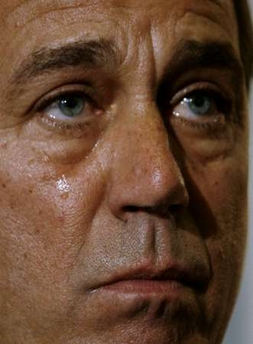 Pols always seem to use over-the-top rhetoric when trying to get elected. We’ve had smear campaigns and unfulfilled campaign promises for as long as there has been some one running for an elected office. Journalists enjoy making headlines out of this rhetoric and we’ve entered an age where they don’t even hesitate to join in on the pitch. The Supremes have upheld free speech rights for NAZIs parading in Jewish neighborhoods, opportunistic gay hating religionists spewing bile at the funerals of US soldiers, and megacorporations. No one wants to draw any lines on freedom of expression these days.
The first amendment is a beautiful thing. So is, however, self-restraint. Just because you have a broad right, a big mouth, and some urge to purge doesn’t necessarily mean you should avail yourself of the opportunity. This was always made clear to me as a kid with the example of ‘Don’t yell fire in a crowded theater if there’s no fire’. Evidently Weeper of the House John Boehner slept through that part of the social studies curriculum.
Markets–especially financial markets–thrive on information. Financial markets even trade on them. I remember working in the Treasury area of a large savings and loan in the 1980s while we were trying to package and sell mortgages, hedge using GNMA futures, and then price jumbo CDs to customers. All of this was in the era of Paul Volcker and yo yo interest rates. The Fed used to make announcements on Friday afternoons. The entire market would shut down in anticipation of the Fed’s announcements. The last few hours of business would screech to a halt until the information came out. We had one bond salesman that used to call us and read us jokes from a file box during the waiting hour. It was a weird time for all.
The Fed noticed how disruptive that was and ended the practice. Current Fed Chair Bernanke is so aware of how his words impact the market he even has a policy of ‘managing expectations’ in that he always makes some kind of statement on monetary policy when releasing any information. He also does speeches to businesses where he clarifies how the Fed will be dealing with the markets for Treasuries. This is supposed to end a lot of instability and speculation that can damage investment positions unnecessarily. You really don’t want to mess with Treasury markets because they represent the base, risk-free rate upon which everything else gets priced.
That brings me to to a few people in politics that don’t seem to connect market instability to policy maker rhetoric. It seems every one has learned that lesson except the outrageous Speaker of the House John Boehner who appears to want to make the markets as shaky as his hands.
House Speaker John Boehner routinely offers this diagnosis of the U.S.’s fiscal condition: “We’re broke; Broke going on bankrupt,” he said in a Feb. 28 speech in Nashville.
Boehner’s assessment dominates a debate over the federal budget that could lead to a government shutdown. It is a widely shared view with just one flaw: It’s wrong.
“The U.S. government is not broke,” said Marc Chandler, global head of currency strategy for Brown Brothers Harriman & Co. in New York. “There’s no evidence that the market is treating the U.S. government like it’s broke.”
The U.S. today is able to borrow at historically low interest rates, paying 0.68 percent on a two-year note that it had to offer at 5.1 percent before the financial crisis began in 2007. Financial products that pay off if Uncle Sam defaults aren’t attracting unusual investor demand. And tax revenue as a percentage of the economy is at a 60-year low, meaning if the government needs to raise cash and can summon the political will, it could do so.
Speaker Boehner’s staff answers any criticism of his rhetoric with the usual false equivalency. Interestingly enough, the Bloomberg article I’m quoting is finally taking on the ridiculousness of equating our government with family finances. Every financial economist loses a bowtie whenever that happens.
“If an American family is spending more money than they’re making year after year after year, they’re broke,” said Michael Steel, a spokesman for Boehner.
A person, company or nation would be defined as “broke” if it couldn’t pay its bills, and that is not the case with the U.S. Despite an annual budget deficit expected to reach $1.6 trillion this year, the government continues to meet its financial obligations, and investors say there is little concern that will change.
Still, a rhetorical drumbeat has spread that the U.S. is tapped out. Republicans, including Representative Ron Paul of Texas, chairman of the House domestic monetary policy subcommittee, and Fox News commentator Bill O’Reilly, have labeled the U.S. “broke” in recent days.
Chris Christie, the Republican governor of New Jersey, said in a speech last month that the Medicare program is “going to bankrupt us.” Julian Robertson, chairman of Tiger Management LLC in New York, told The Australian newspaper March 2: “we’re broke, broker than all get out.”
The U.S. government is not one big dysfunctional family unit. People die. Their estates have to be settled. They can’t print money. They can’t tax any one else’s assets. Their incomes don’t grow in perpetuity into the trillions of dollars. Politicians who continually make this false equivalency are not only wrong, they are dangerously wrong.
When Governor Christie makes these ridiculous statements the biggest damage he can do is limited. At the very worst, the market may price New Jersey’s bond issues as riskier. The resale market for NJ bonds may get thinner. This is especially true if Christie shows any willingness to entertain the idea of state bankruptcy which at this point can’t even happen. If he shows unwillingness to use the state’s taxing powers to clear up the mess, he can also create some havoc in the market. Every one knows a government can get the funds to pay its debt one way or another. Showing the world you won’t do it in a timely way just makes your bondholders extra nervous.
Speaker of the House Boehner has a bigger job that includes the budget of the U.S. He can unnecessarily influence financial markets while repeating such craziness. The U.S. cannot technically go bankrupt but speculation and uncertainty can impact the rate of interest we will pay on our debt. It can also cause the FED to enact money supply increases to maintain low levels of interest which can create inflationary pressures. Boehner is at a level of power that careless political rhetoric can influence markets. He needs to be more mature and less cavalier with his ignorant pronouncements on US debt and the US economy.
I swear that these guys are purposefully trying to tank the economy.

 peej
peej Carissa
 bostonboomer
 dakinikat
 ecocatwoman
 mablue2
 Mama Lopez
 peggysue22
 quixote
 skydancingguestblogger
 Mona (aka Wonk the Vote)



 Sky Dancing
Recent Comments