Posted: August 22, 2023 | Author: bostonboomer | Filed under: Crime, Criminal Justice System, Donald Trump, just because | Tags: Georgia election interference case, Jack Smith, January 6 case, Jeff Clark, John Eastman, Judge Tanya Chutkan, Mark Meadows |
Good Afternoon!!
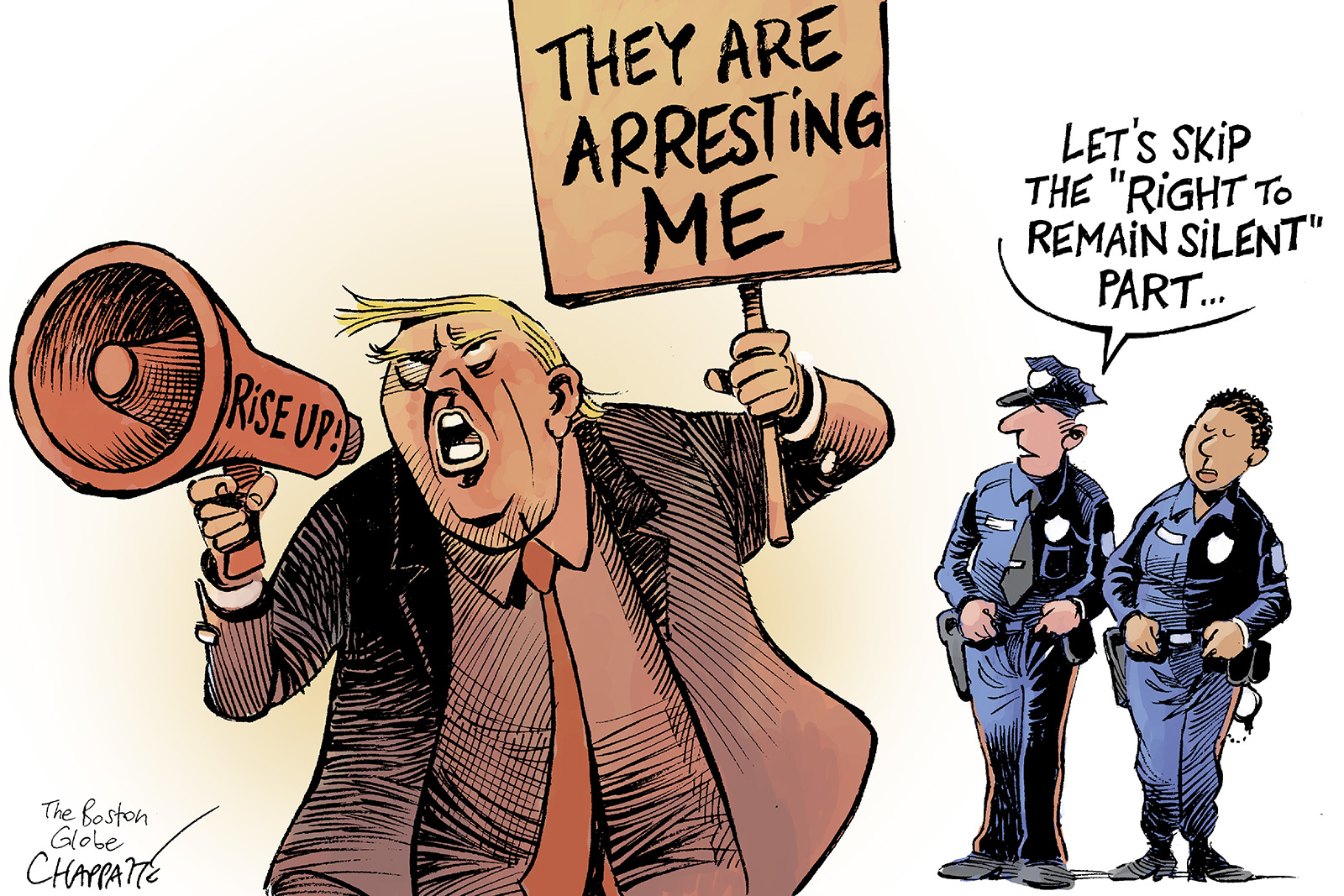 Now that Trump has been indicted and arrested 3 times, the 4th arrest on Thursday seems sort of old hat. Ho hum . . . Trump will surrender at Fulton County Jail in Georgia on Thursday; his bail has been set at $200,000.
Associated Press: Trump says he will surrender Thursday on Georgia charges tied to efforts to overturn 2020 election.
Former President Donald Trump says he will surrender to authorities in Georgia on Thursday to face charges in the case accusing him of illegally scheming to overturn his 2020 election loss in the state.
“Can you believe it? I’ll be going to Atlanta, Georgia, on Thursday to be ARRESTED,” Trump wrote on his social media network Monday night, hours after his bond was set at $200,000.
It will be Trump’s fourth arrest since April, when he became the first former president in U.S. history to face indictment. Since then, Trump, who remains the leading candidate for the Republican presidential nomination, has had what has seemed like an endless procession of bookings and arraignments in jurisdictions across the country. His appearances in New York, Florida and Washington, D.C., have drawn enormous media attention, with news helicopters tracking his every move.
Trump’s announcement came hours after his attorneys met with prosecutors in Atlanta to discuss the details of his release on bond. The former president is barred from intimidating co-defendants, witnesses or victims in the case — including on social media — according to the bond agreement signed by Fulton County District Attorney Fani Willis, Trump’s defense attorneys and the judge. It explicitly includes “posts on social media or reposts of posts” made by others.
This morning, two of Trump’s co-defendants surrendered in the Georgia election interference case.
Atlantic News First, via NBC29 VA:
ATLANTA (Atlanta News First/Gray News): First co-defendants in Trump indictment surrender at Fulton County jail.
The first co-defendants in a sweeping indictment out of Fulton County, Georgia, has surrendered to the jail.
Shortly before 10:30 a.m. Tuesday, former President Donald Trump’s attorney John Eastman turned himself in. A bond agreement for $100,000 was reached Monday in his case.
Eastman, prosecutors say, was deeply involved in some of his efforts to remain in power after the 2020 election. He wrote a memo arguing that Trump could remain in power if then-Vice President Mike Pence overturned the results of the election during a joint session of Congress where electoral votes would be counted. That plan included putting in place a slate of “alternate” electors in seven battleground states, including Georgia, who would falsely certify that Trump had won their states.
In a social media statement, Eastman said he was surrendering “to an indictment that should never have been brought.”
“It represents a crossing of the Rubicon for our country, implicating the fundamental First Amendment right to petition the government for redress of grievances,” Eastman said. “As troubling, it targets attorneys for their zealous advocacy on behalf of their clients, something attorneys are ethically bound to provide and which was attempting here by ‘formally challeng[ing] the results of the election through lawful and appropriate means.’ An opportunity never afforded them in the Fulton County Superior Court.”
A $10,000 bond agreement was reached Monday for Scott Hall, the Atlanta-area bail bondsman who was allegedly involved in commandeering voting information that was the property of Dominion Voting Systems from Coffee County in south Georgia.
On Tuesday, just before 9 a.m., Hall surrendered to authorities, and was booked and processed on charges that include conspiracy to commit a felony, conspiracy to commit election fraud, conspiracy to defraud the state of political subdivision, and violation of the Georgia Racketeer Influenced And Corrupt Organizations Act (RICO).
Jeff Clark, the DOJ official who wanted to send letters to the swing states saying that the DOJ believed there was significant voter fraud in their states, is trying to avoid going to Atlanta to be booked.
https://twitter.com/petestrzok/status/1694008924863602918?s=20
Jeff Clark on the morning his house was searched by the FBI:
This is going to enrage Trump. The New York Times just posted an article on Mark Meadows, another of Trump’s co-defendants in Georgia: How Mark Meadows Pursued a High-Wire Legal Strategy in Trump Inquiries.
This winter, after receiving a subpoena from a grand jury investigating former President Donald J. Trump’s attempts to overturn the 2020 election, Mark Meadows commenced a delicate dance with federal prosecutors.
He had no choice but to show up and, eventually, to testify. Yet Mr. Meadows — Mr. Trump’s final White House chief of staff — initially declined to answer certain questions, sticking to his former boss’s position that they were shielded by executive privilege.
But when prosecutors working for the special counsel, Jack Smith, challenged Mr. Trump’s executive privilege claims before a judge, Mr. Meadows pivoted. Even though he risked enraging Mr. Trump, he decided to trust Mr. Smith’s team, according to a person familiar with the matter. Mr. Meadows quietly arranged to talk with them not only about the steps the former president took to stay in office, but also about his handling of classified documents after he left.
The episode illustrated the wary steps Mr. Meadows took to navigate legal and political peril as prosecutors in Washington and Georgia closed in on Mr. Trump, seeking to avoid being charged himself while also sidestepping the career risks of being seen as cooperating with what his Republican allies had cast as partisan persecution of the former president.
His high-wire legal act hit a new challenge this month. While Mr. Meadows’s strategy of targeted assistance to federal prosecutors and sphinxlike public silence largely kept him out of the 45-page election interference indictment that Mr. Smith filed against Mr. Trump in Washington, it did not help him avoid similar charges in Fulton County, Ga. Mr. Meadows was named last week as one of Mr. Trump’s co-conspirators in a sprawling racketeering indictment filed by the local district attorney in Georgia.
Interviews and a review of the cases show how Mr. Meadows’s tactics reflected to some degree his tendency to avoid conflict and leave different people believing that he agreed with them. They were also dictated by his unique position in Mr. Trump’s world and the legal jeopardy this presented.
Read all the juicy, gossipy details at the NYT link.
There’s also news about the January 6 case against Trump in DC.
The Washington Post: Justice Dept. pushes back against Trump’s bid for a 2026 trial in D.C.
The Justice Department pushed back Monday on former president Donald Trump’s claims that he cannot be ready to go to trial in January on charges that he illegally sought to subvert the results of the 2020 election.
A trial in D.C. federal court in April 2026, which Trump’s attorneys requested, “would deny the public its right to a speedy trial,” attorneys working for special counsel Jack Smith wrote in Monday’s filing. In arguing for its preferred Jan. 2, 2024, date, the office said they do not intend to use classified information against Trump in this case….
In arguing for more time, Trump also made misleading comparisons to trials that were delayed by the coronavirus pandemic, superseding indictments adding defendants, and disputes over incarceration, the government said.
Trump’s legal team argued in a court filing last week that it needs years to prepare for the “unprecedented case” and that the January date proposed by the government would create conflicts with the five other criminal and civil trials Trump faces in the next nine months. They told the court that the 11.5 million pages of material already handed over by the special counsel took over two days to download and if printed out would be eight times taller than the Washington Monument. To read it all before the government’s proposed jury selection date of Dec. 11 would be like reading “Tolstoy’s War and Peace, cover to cover, 78 times a day, every day,” they said.
Smith’s office called those comparisons “neither helpful nor insightful,” because attorneys don’t read evidence cover to cover — they review it online using electronic keyword searches. Much of what was shared with Trump is already in the public domain, the special counsel said, including social media posts, transcripts of interviews with the House committee that investigated the Jan. 6 attack, and court records from legal challenges to the election results. Other documents came from the National Archives, meaning they were already known to Trump. There are also duplicates of documents within the production, the Justice Department said, and likely irrelevant papers handed over “in an abundance of caution and transparency.”
Read the rest at the WaPo.
This is interesting from attorneys Frederick Baron and Dennis Aftergut at The Bulwark: Trump Shoots Himself in the Foot with Demand for Trial Date in 2026.
ON THURSDAY, DONALD TRUMP FIRED his first shot in Judge Tanya Chutkan’s courtroom—straight into his own foot. His lawyers proposed to the district court judge that his federal trial on conspiracy and obstruction charges related to the aftermath of the 2020 election and the events of January 6th should not occur until April 2026.
“I’ll eat my hat if Judge Chutkan agrees with Trump to start this trial in 2026,” tweeted Neal Katyal, the former acting solicitor general of the United States. “He’s just afraid to stand trial. Nothing more.”

Judge Tanya Chutkan
Katyal’s hat is safe. Trump’s proposal on the all-important trial date sends an unintended message: that Trump is pressing his lawyers to take legal positions so extreme that they will be entirely disregarded.
Credibility with judges is the coin of the realm for trial lawyers. Squander it early and it’s hard to retrieve.
Trump’s past pattern is that his lawyers lose credibility by kowtowing to his absurd, uninformed demands. Then he tosses them like bad pennies. Sooner or later, it’s tough attracting the gold standard in the legal profession.
The Trump team’s tissue-thin pretext for their ludicrous trial date request was the volume of discovery materials they need to read.
They wrote that reviewing millions of documents and electronic communications that the government already gave them would be like reading “the entirety of Tolstoy’s War and Peace, cover to cover, 78 times a day” in order to finish by the January trial date proposed by Special Counsel Jack Smith.
The authors explain why that is bullshit:
Sounds daunting. But in the modern litigation world, a high-tech industry has grown up specializing in managing big-document cases. Entire firms exist to tackle discovery jobs like this.
Huge volumes of documents can be scanned rapidly, and put in a single database alongside digital communications and other information. The database is then “deduped” (that is, duplication is reduced) and organized to allow instant retrieval of any important piece of evidence. A lawyer need only search for specified keywords, dates, subjects, titles, witnesses, senders, receivers, contact information, and so on. For example, a search for documents or data related to “January 6/electors/certification” will quickly bring up the relevant items for review, highlighting, organizing, and sharing with team members.
Former U.S. Attorney Joyce Vance, speaking on MSNBC on Friday, mocked the misleading analogy to Tolstoy’s 1,200-page epic. “You don’t need to read War and Peace 78 times a day. You simply search for ‘Natasha,’” Vance said, referring to the novel’s lead female character.
Read more at The Bulwark.
One more interesting story from CNN: Several key cases that could bear on special counsel Jack Smith’s election case against Trump await DC Circuit rulings.
As the US Circuit Court of Appeals in Washington, DC, gets ready to begin its new term next month, the next two weeks could usher in several consequential rulings from the federal appeals court, often called the second most powerful court in the country, that could bear on the federal investigation into and prosecution of former President Donald Trump for his 2020 election reversal schemes.
At least three court cases touching legal issues that could affect special counsel Jack Smith’s approach are ripe for rulings from the DC Circuit. The rulings, once they come, will likely shape how US District Judge Tanya Chutkan may view the law and the charges against the former president in the criminal election subversion proceedings over which she is presiding.
In one case, Trump ally and Republican Rep. Scott Perry is challenging the access federal investigators can have to his phone in the 2020 election subversion probe. Another dispute is over Trump’s sweeping immunity claims in the civil lawsuits that have sought to hold him accountable for his actions and leading up to the January 6, 2021, Capitol assault. The third matter relates to the obstruction statute that has been a central charge in the Capitol riot prosecutions; Smith’s indictment of the former president in the election case includes two charges based on the provision in question.
There’s no guarantee that the rulings will come out in the coming weeks. But the start of the new DC Circuit term in early September puts additional pressure on the circuit judges to clear out their opinions in lingering cases. Regardless, the cases highlight the ongoing uncertainty in the legal terrain the special counsel is navigating as he advances toward a historic trial of the former president while wrapping up the rest of the federal criminal election subversion investigation, which Smith says is ongoing. No matter what the ruling is in each of the cases, the losing party will have the option to appeal it, setting up that the US Supreme Court might ultimately get involved.
Read details of the cases at the CNN link.
That’s it for me today. I guess I’m still mainly obsessed with seeing Trump tried, convicted, and imprisoned. I’ll add more links in the comment thread.
Did you like this post? Please share it with your friends:


 peej
peej Carissa
 bostonboomer
 dakinikat
 ecocatwoman
 mablue2
 Mama Lopez
 peggysue22
 quixote
 skydancingguestblogger
 Mona (aka Wonk the Vote)



 Sky Dancing
Recent Comments