
Cash Flowed to Clinton Foundation as Russians Pressed for Control of Uranium Company.
The headline in Pravda trumpeted President Vladimir V. Putin’s latest coup, its nationalistic fervor recalling an era when the newspaper served as the official mouthpiece of the Kremlin: “Russian Nuclear Energy Conquers the World.”
The article, in January 2013, detailed how the Russian atomic energy agency, Rosatom, had taken over a Canadian company with uranium-mining stakes stretching from Central Asia to the American West. The deal made Rosatom one of the world’s largest uranium producers and brought Mr. Putin closer to his goal of controlling much of the global uranium supply chain….
At the heart of the tale are several men, leaders of the Canadian mining industry, who have been major donors to the charitable endeavors of former President Bill Clinton and his family. Members of that group built, financed and eventually sold off to the Russians a company that would become known as Uranium One.
Beyond mines in Kazakhstan that are among the most lucrative in the world, the sale gave the Russians control of one-fifth of all uranium production capacity in the United States. Since uranium is considered a strategic asset, with implications for national security, the deal had to be approved by a committee composed of representatives from a number of United States government agencies. Among the agencies that eventually signed off was the State Department, then headed by Mr. Clinton’s wife, Hillary Rodham Clinton.
As the Russians gradually assumed control of Uranium One in three separate transactions from 2009 to 2013, Canadian records show, a flow of cash made its way to the Clinton Foundation. Uranium One’s chairman used his family foundation to make four donations totaling $2.35 million. Those contributions were not publicly disclosed by the Clintons, despite an agreement Mrs. Clinton had struck with the Obama White House to publicly identify all donors. Other people with ties to the company made donations as well.
That’s the introduction. Read the rest at the NYT link above.

Apparently, the press is going to act as if Bill Clinton were running for president, not Hillary Clinton. They seem to see her as indistinguishable from her husband; and she is going to be held responsible for his past and present policies, actions, and indiscretions. I wonder if they’ll even report Hillary’s own ideas and the policies she argues for during her campaign? At least that’s my read based on this morning’s Washington Post article.
For Clintons, speech income shows how their wealth is intertwined with charity.
Bill Clinton was paid at least $26 million in speaking fees by companies and organizations that are also major donors to the foundation he created after leaving the White House, according to a Washington Post analysis of public records and foundation data.
The amount, about one-quarter of Clinton’s overall speaking income between 2001 and 2013, demonstrates how closely intertwined Bill and Hillary Clinton’s charitable work has become with their growing personal wealth.
The Clintons’ relationships with major funders present an unusual political challenge for Hillary Rodham Clinton. Now that she has formally entered the presidential race, the family may face political pressure and some legal requirements to provide further details of their personal finances and those of the foundation, giving voters a clearer view of the global network of patrons that have supported the Clintons and their work over the past 15 years.
The multiple avenues through which the Clintons and their causes have accepted financial support have provided a variety of ways for wealthy interests in the United States and abroad to build friendly relations with a potential future president. The flow of money also gives political opponents an opportunity to argue that Hillary Clinton would face potential conflicts of interest should she win the White House. Though she did not begin delivering paid speeches or join the foundation until 2013, upon ending her tenure as secretary of state, the proceeds from her husband’s work benefited them both.
Read the rest at the link. Again, I’ve only had time to briefly skim this article so far.
I’ll be interested to see reactions to the Times and Post pieces as the day wears on.

Another story that is getting quite a bit of attention George Packer’s latest at The New Yorker.
American Politics: Why the Thrill Is Gone.
Packer begins by referring to a piece by Nate Cohn at the NYT blog The Upshot in which Cohn examined the possible GOP candidates and picked two who have emerged as leaders.
Jeb Bush and Scott Walker—have quickly moved to the head of the pack. Perhaps only Mr. Rubio has a good chance to join them at the top.” The reasons have to do with fundraising, positioning, élite support, broad acceptability—that is, with the roles spelled out in the piece. The author, Nate Cohn, concluded, “It will be fun to watch.”
Fun? Not for Packer.
That was when he lost me.
It might not be wise for a sometime political journalist to admit this, but the 2016 campaign doesn’t seem like fun to me. Watching Marco Rubio try to overcome his past support for immigration reform to win enough conservative votes to become the Mainstream Alternative to the Invisible Primary Leader—who, if there is one, will be a candidate named Bush—doesn’t seem like fun. Nor does analyzing whether Chris Christie can become something more than the Factional Favorite of moderate Republicans, or whether Ted Cruz’s impressive early fundraising will make him that rare thing, a Factional Favorite with an outside chance to win. If this is any kind of fun, it’s the kind of fun I associate with reading about seventeenth-century French execution methods, or watching a YouTube video of a fight between a python and an alligator. Fun in small doses, as long as you’re not too close.
American politics in general doesn’t seem like fun these days. There’s nothing very entertaining about super PACs, or Mike Huckabee’s national announcement of an imminent national announcement of whether he will run for President again. Jeb Bush’s ruthless approach to locking up the exclusive services of longstanding Republican political consultants and media professionals far ahead of the primaries doesn’t quicken my pulse. Scott Walker’s refusal to affirm Barack Obama’s patriotism doesn’t shock me into a state of alert indignation. A forthcoming book with revelations about the Clintons’ use of their offices and influence to raise money for their foundation and grow rich from paid speeches neither surprises me nor gladdens my heart.

Packer longs for the good old days:
Since I was eight years old, and the Republican candidates were named Nixon, Rockefeller, and Reagan, and the Democrats were Humphrey, Kennedy, and McCarthy, I’ve been passionate about American politics, as a student, a witness, and a partisan. Politics was in my blood, at the family dinner table, in my work and my free time. But at some point in the past few years it went dead for me, or I for it. Perhaps it was week thirty-eight of the Obama-Romney race (a campaign between “Forward” and “Believe in America”), or the routinization of the filibuster, or the name Priorities USA Action, or the fifty-eighth vote in Congress to repeal the Affordable Care Act—something happened that made it very hard to continue paying attention. I don’t take this as a sign of personal superiority: I’ve always disliked people who considered themselves to be “above” politics. I mourn my lack of political passion as I would if I were to lose interest in reading fiction, or to stop caring about someone who’d been important to me for most of my life. And I count on getting back the feeling—the intense mix of love, hatred, anxiety, astonishment, and gratification—because life, public life, is impoverished without it. Perhaps it will return sometime before November 8, 2016. But for now—I have to be honest—it’s gone.
The reason is the stuckness of American politics. Especially in the years after 2008, the worst tendencies of American politics only hardened, while remaining in the same place. Beneath the surface froth and churn, we are paralyzed.
You can sense it as soon as you step out of the train at Union Station in Washington, the instant you click on a Politico article about a candidates’ forum in Iowa: miasma settles over your central nervous system and you start to go numb. What has happened is that the same things keep happening. The tidal wave of money keeps happening, the trivialization of coverage keeps happening, the extremism of the Republican Party keeps happening (Ted Cruz: abolish the I.R.S.; Rand Paul: the Common Core is “un-American”). The issues remain huge and urgent: inequality, global warming, immigration, poorly educated children, American decline, radical Islamism. But the language of politics stays the same, and it is a dead language. The notion that answers will come from Washington or the campaign trail is beyond far-fetched.

For Packer, it’s about having fun following politics, and he isn’t having fun anymore. I think quite a few people feel that way, but unlike George Packer most of us don’t have a platform we could use to stir things up. Why doesn’t Packer get out there and do some investigative reporting on the candidates and write in detail about the paralysis of our system?
Here’s Ed Kilgore at The Political Animal:
It’s worth noting when a public affairs writer of George Packer’s quality announces he’s bored with politics. He does so at the New Yorker at considerable length and with the passion he claims to have lost for the subject itself….
Packer’s lament reflects a mixed conception of the “fun” in politics being generated by a sense of forward momentum on policy ideas and by competitive churn and unpredictability. Thus in his “wish list” of things he’d like to happen in 2016 to revive his interest in politics, he includes both a far-fetched bipartisan ticket (a bad idea, IMO) and a serious lefty challenge to HRC, the former presumably to reduce “gridlock” and the latter to reduce the dull predictability of a campaign for and against a Clinton.
You could certainly make the argument that Packer’s two impulses are incompatible. The most consequential presidential elections in American history have not often been very close. 1800, 1828, 1860, 1912, 1932, 1964, 1980 and 2008 were not nail-biters. Yet some of the most “exciting” contests as measured by turnout were the very close elections of the late nineteenth century when aside from patronage tariff levels were the main policy battleground between the two parties. And in terms of politics being less interesting than those of Packer’s childhood—well, some of that is a deception of memory, probably, and some of it the product of knowing now how much of the “magic” of politics isn’t magical at all. In the twenty-first century, we’ve had one of the three presidential elections in American history to go into overtime; a very close election in which the two parties polarized to an extent rarely seen in the previous few decades; and then the historic election of an African-American after a historic primary against a woman and competitive nominating processes in both parties. Even 2012, which left Packer cold, was relatively unpredictable, if you look at how close the general election contest became after the first debate and consider the perils experienced by the obvious Republican nominee in the primaries facing challengers who might have been wearing full clown regalia.
Read the rest at the link above.

The Assassination of Osama bin Laden, by Catherine Tafur
And from Brad DeLong: A Suggestion for the Burned-Out Political Reporter George Packer.
Does George Packer really think the purpose of American politics is to thrill him? ….
Like Kilgore, DeLong points out that Packer’s desired changes are self-contradictory; and he has ideas for how Packer could change things:
[H]e should pick 500 American adults at random, and every day he should talk to ten of them, asking them:
- If they have registered to vote.
- Why they have or have not registered.
- Who among the candidates they think would make the best president.
- Why they think that.
- Whether they are actually going to vote.
- Who they are going to vote for.
And he can write up what they say. There’s time between now and November 2016 for him to interview each one ten times. It would produce a much more interesting narrative than it currently looks like he is going to offer us.
If only Packer would try that instead of just whining at his high-profile media perch. I have a few more links to post down there as well.
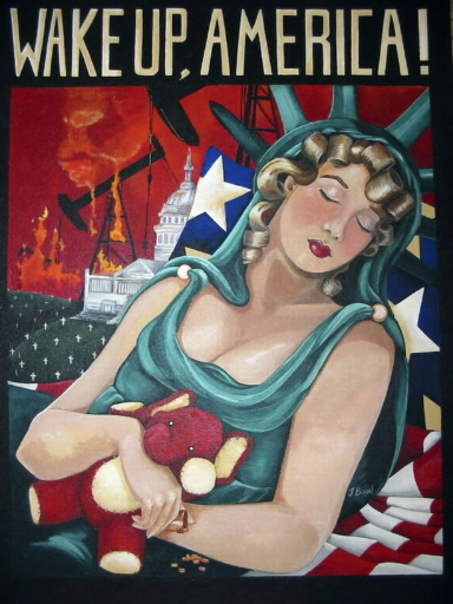
See more political art here: 50 Stunning Political Artworks
What else is happening? Please post your thoughts and links in the comment thread below.

 peej
peej Carissa
 bostonboomer
 dakinikat
 ecocatwoman
 mablue2
 Mama Lopez
 peggysue22
 quixote
 skydancingguestblogger
 Mona (aka Wonk the Vote)



 Sky Dancing
Recent Comments