
Entitled One-Percenter Bill Keller Wants Baby Boomers to Give Up Social Security and Medicare
Posted: July 30, 2012 Filed under: Catfood Commission, Medicare, Mitt Romney, Social Security, The Media SUCKS, U.S. Economy, U.S. Politics, unemployment, voodoo economics, We are so F'd | Tags: Bill Keller, Charles P. Pierce, Dean Baker, Income Inequality, infrastructure, Iraq War, Judith Miller, one-percenters, Paul Ryan, Simpson-Bowles 32 Comments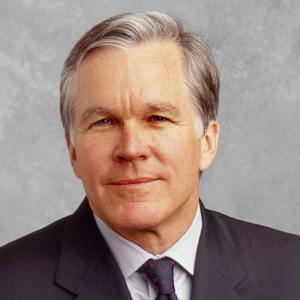
Smarmy former NYT editor Bill Keller
From today’s New York Times: “The Entitled Generation.”
The notion that our generation has been spoiled rotten is not a terribly new thought. A dozen years ago Paul Begala (of Bill Clinton and CNN fame) published in Esquire the classic of boomer-loathing, “The Worst Generation.” “The Baby Boomers are the most self-centered, self-seeking, self-interested, self-absorbed, self-indulgent, self-aggrandizing generation in American history,” he declared. It’s a sturdy genre. Perhaps while Googling yourself you have come across the blog Boomer Deathwatch (“Because one day, they’ll all be dead”), a checklist of famous boomers who hit their actuarial sell-by dates. Even Barack Obama, who styles himself post-boomer though he was born in 1961, complained in “The Audacity of Hope” that today’s hyperpolarized political discourse began with the “psychodrama of the baby boom generation.”
Yeah, we’re all evil just because our parents returned from WWII and proceeded to have lots and lots of babies. Supposedly not one of us ever did a decent thing in our pathetic, useless lives, right? I’m sick to death of hear this crap–and I’ve been hearing it since I was a kid.
See Keller says it’s our fault that the government isn’t rebuilding the infrastructure. He says it won’t do any good to tax super-rich guys like him–we’re going to have to take it out of the hides of old ladies who are trying to eke out a living on $1200 a month or less.
Guys like Bill Keller don’t even have to pay into Social Security on the bulk of their income, but he doesn’t even mention the possibility of changing that. So what does super-rich one-percenter Bill Keller think we should do about it besides learning to loathe ourselves and wish we’d never been born?
So the question is not whether entitlements have to be brought under control, but how. The Republican plan espoused by Mitt Romney and his fiscal lodestar Paul Ryan would cut the cost of entitlements largely by moving toward privatization: personal investment accounts for Social Security, vouchers for Medicare. And it’s not at all clear the Republicans would assign any of the savings to investing in our future.
At least the Republicans have a plan. The Democrats generally recoil from the subject of entitlements. Centrists like those at Third Way and the bipartisan authors of the Simpson-Bowles report endorse a menu of incremental cuts and reforms that would bring down costs without hitting the needy or snatching away the security blanket from those nearing retirement. They include gradually raising the retirement age to compensate for the fact that we now live, on average, 14 years longer than when F.D.R. signed Social Security into law. They include obliging those of us who can really afford it to pay a larger share. They also include technical fixes like aligning the automatic cost-of-living formula with reality.
At least now we know which candidate Keller will be voting for in November. So much for the supposedly “liberal media.” Oh, and about that “technical fix” Keller brushes off so dismissively, Matthew Yglesias explains why it isn’t a “technical fix” and “doing the switch comprehensively would constitute a de facto tax increase.” Furthermore, there was no “Simpson-Bowles report,” because the two co-chairs were unable to get a majority of members of the Catfood Commission to sign off on one.

Judith Miller with patron Bill Keller
I have a terrific idea. Let’s hold Bill Keller responsible for his choice to assign Judith Miller to help the Bush administration lie us into the Iraq War. Let Bill Keller pay back the trillions of dollars of taxpayer money those lies cost us. That ought to provide some funds to invest in infrastructure here in the U.S.
Here’s what Dean Baker had to say about Keller’s lying op-ed:
That is really brave for Mr. Keller to stand up and call for sacrifice from his age cohort. Does Keller know that the typical near retiree has total wealth of $170,000. This includes everything in their 401(k), all their other financial assets and the equity in their homes. Another way to put this is that the typical near retiree (between the ages of 55-64) could take all their wealth and pay off their mortgage. After that they would be entirely dependent on their Social Security to cover all their living costs.
Does this situation describe Mr. Keller’s finances? My guess is that it doesn’t. If that is true, how does Keller claim to speak for people who are in a hugely different financial situation than him? Is he really that ignorant of the issues that the NYT gives him a column to write about or is he dishonest? Readers will have to debate that in the months and years ahead.
Baker says the real problem we have is the increase in income inequality over the past thirty years, but he’s not holding his breath for Keller to “appeal to his fellow one-percenters….He probably doesn’t have the courage or integrity to do that.”
I saved the best review of Keller’s op-ed for last. You guessed it, it’s by Charlie Pierce: “The Things Bill Keller Doesn’t Have to Worry About.”
I defy Bill Keller to last a week living only on those benefits available to the greedy boomers, especially after the Simpson-Bowles cargo cult — to say nothing of the zombie-eyed granny-starver Paul Ryan himself — are through with them. I defy him to make it for a day. The “we” sprinkled throughout this bag of pus is probably the most noxious thing about it. Look around, Bill. You and Mitt Romney have far more in common than do you and the overwhelming majority of your “fellow” boomers. One catastrophic illness, and many of our families die on the vine. This is not hyperbole. This is how it works in the world. And, to the surprise of absolutely nobody, Keller signs on with the clowns at Third Way, who assure us that the real problem is that the elderly moochers are the ones keeping us from building new bridges, or flying to the moons of Neptune. Jesus H. Christ on a Lipizzaner, we’ve had forty years of demonized government, and 40 years of quack economics, and tax-cuts until hell won’t have them, and the reason our infrastructure is falling apart is because some retired ironworker gets $1200 a month? How much of a courtier do you have to be before the taste of caviar makes you nauseous?
If we want to invest in infrastructure, which we desperately need to do, then we should just borrow money at the current historically low rates and fix the damn infrastructure…. People Got No Jobs. People Got No Money. Bill Keller never will have to worry about the last two, so I think he should shut up about the first.
An Immodest Proposal
Posted: April 13, 2012 Filed under: Voter Ignorance, War on Women, We are so F'd | Tags: infrastructure, Jonathan Alter, Paul Krugman 20 Comments I’m spitting mad about the attacks on Hillary Rosen and the crocodile tears of folks like Rush Limbaugh and others that are trying to say that the war on women is really about evil feminists and real women. You’ll notice that most of this fabrication is coming from right wing men who have a lot to gain by reigniting the Mommy wars. Just follow this link to the WSJ op ed page and read how the real misogynists are Feminists. There is nothing more disingenuous that the rant that says feminists don’t support women and child rearing in what ever form that takes. Most feminists would love to see a situation more like Germany where the country actually supports extended parental leave for babies and toddlers and extends training and quality of day care providers and access to nursery school for all types of families. If this were really about how to do best by our children we would be having a completely different conversation. We would protect them better from abuse and give them and their parents the kind of support they need to be healthy, happy, and well-educated. This hoopla is only about splitting the women’s vote.
The heart of the argument needs to be aimed squarely back at the folks that are defunding everything from family planning, Planned Parenthood, Title X, preschools, school lunches, student loans and all things that support a functioning society. This includes public health and education structures more than anything else. Any mother–working a paying job or not–wants institutions in place that support her children. The real anti-family agenda is from people who do not support the basic structures of civilization. Folks that can’t write checks for tutors, nannies, preventative health care measures, prenatal services, childhood illness treatment, extra curricular activities and fancy schools and colleges rely on society recognizing the benefits of good health and education for its members. A decent society provides decent public goods. We pool our funds to benefit the economic security and health of our country. Our recent spending priorities have been wars, weapons, and subsidies to businesses that pollute, gamble, and abuse our resources. None of this is healthy for the future of our children.
These interests have now set up a cat fight between women to take our minds off the real problems. Feast your eyes on the Ryan Budget and you will see–as Paul Krugman puts it–who is cannibalizing our future and our families.
One general rule of modern politics is that the people who talk most about future generations — who go around solemnly declaring that we’re burdening our children with debt — are, in practice, the people most eager to sacrifice our future for short-term political gain. You can see that principle at work in the House Republican budget, which starts with dire warnings about the evils of deficits, then calls for tax cuts that would make the deficit even bigger, offset only by the claim to have a secret plan to make up for the revenue losses somehow or other.
And you can see it in the actions of Chris Christie, the governor of New Jersey, who talks loudly about acting responsibly but may actually be the least responsible governor the state has ever had.
Mr. Christie’s big move — the one that will define his record — was his unilateral decision back in 2010 to cancel work that was already under way on a new rail tunnel linking New Jersey with New York. At the time, Mr. Christie claimed that he was just being fiscally responsible, while critics said that he had canceled the project just so he could raid it for funds.
Now the independent Government Accountability Office has weighed in with a report on the controversy, and it confirms everything the critics were saying.
Chris Christie lied on a project that would shorten commutes, provide jobs, and basically create a better situation for families in the northeast corridor. I have only to ask why? Well, if you take a look at the Ryan Budget and the Norquist mentality, the deal is that most of these folks don’t want the community and its families to succeed, they want their cronies to be able to make a buck off of everything. They want all the power and all the money within their plutocracy. I’m not talking about government ownership of airlines, telecommunications, or any other move that one could logically equate with socialism. I talking funding and providing infrastructure improvements and the taxes that would enable them for the benefit of all. These kinds of public projects are ones that only a government can do successfully because of the scale and related economies. Jonathan Alter demonstrates that today’s republicans don’t recognize that the benefits from legitimate public projects bring benefits that far outweigh the costs for every one.
Grover Norquist, the tax-cutting champion, famously said he wanted to shrink the federal government “down to the size where we can drown it in the bath tub.”
With gargantuan deficits, that seems like a pipe dream, but it may be time to start running the water.
The new plan offered by House Budget Committee Chairman Paul Ryan and approved recently by Mitt Romney and congressional Republicans puts the Republicans on record supporting a federal government that within a decade will consist of little more than national defense, entitlements and interest on the national debt.
Those are largely transfer payments to defense contractors, seniors and bankers. The rest of what the government actually does would be eviscerated, from building roads to environmental protection to medical research.
Ryan has abandoned the Republican fantasy on display during the primaries that cutting liberal spending programs will be enough to restore fiscal sanity. He’d go where the big money is — entitlement reform — and also eliminate a series of tax deductions used by the affluent, though in an April 10 editorial board session with Bloomberg View he was still mum on which ones.
Ryan does not represent the historical positions of any Republican administration. The first Republican Project that required some taxes was the civil war. The used taxes on the rich–among other things–to fund that, reconstruction, and expansion into the westward part of the country.
To fund the war, the federal government taxed as it had never taxed before. The tariff, long the main source of government revenue, was raised sharply. So were excise taxes on commodities such as liquor. The government also instituted the country’s first income tax, which imposed a 3 percent levy on incomes above $800. It was soon raised to 3 percent on earnings of more than $600 and 5 percent on those that exceeded $10,000.
In the mid-19th century, anyone would have considered a person with a $10,000 annual income “rich.”
With the war’s end, government outlays declined sharply. In 1865, they had been almost $1.3 billion, the first time any government anywhere had spent more than $1 billion in a year. By 1870, they had declined to $309 million.
The income tax was allowed to lapse in 1873, and excise taxes were lowered as well. What remained very high was the tariff. But the purpose of a high tariff wasn’t solely to fund federal operations; it was so high that the government ran budget surpluses for 28 straight years, from 1866 to 1893.
Rather, the tariff was kept high to protect the booming industrialization of the American economy in the postwar years. That was very popular in the Northeast and Midwest, where the industry was concentrated, but deeply unpopular in the South and West.
The Republicans also wanted a transcontinental railroad. Look back to the article for the kinds of things built by Republican Presidents–still useful today–that wouldn’t pass muster with today’s Republican Party. This again comes from the Alter article cited above. All of these things improved commerce, provided jobs, and made the country much better off. Each generation of Americans–up until now–were always better off than our predecessors because they invested in a future for us.
The 1856 Republican platform demanded that “the Federal Government render immediate and efficient aid in [the] construction” of a transcontinental railroad. Money was also pledged for “the improvement of rivers and harbors.”
Soon thereafter, Abraham Lincoln signed laws creating hundreds of new colleges (the Morrill Land Grant Act), helping Americans buy property (the Homestead Act), establishing a new Cabinet department (Agriculture) and protecting public land from development (Yosemite).
Today’s Republican Party is on the other side of each of those Lincoln-era achievements, voting to slash money for education (Pell grants, which are discretionary, would be eviscerated in the Ryan budget), withdraw federal loans to buy property (closing Fannie Mae and Freddie Mac), shut Cabinet departments (Romney has said he’d shutter a few, though not which ones) and open up more coastlines for drilling.
The idea of using government money to invest in the future hardly died with Lincoln. Theodore Roosevelt built the Panama Canal; Dwight Eisenhower constructed the interstate highway system; and Republicans have voted for smaller such investments repeatedly over the years.
You get the idea. We shouldn’t even have to introduce the other items coming from Democratic Presidents like FDR that did projects like the Hoover Dam, rural electrification, and the blue star highways that were predecessors to Eisenhower’s interstate system. If you look at countries that have made priorities of internet systems and/or solar energy projects rather than let a few for-profit businesses piece together networks around urban areas, you’ll see the benefits of federal projects that we’re losing right now. We may not only see rural Americans loose the benefit of these things but also of something as basic as the constitutionally mandated postal service. If some one can’t make extraordinary profit from it, today’s Republicans don’t want it.
I”ll let Paul Krugman have the last word.
America used to be a country that thought big about the future. Major public projects, from the Erie Canal to the interstate highway system, used to be a well-understood component of our national greatness. Nowadays, however, the only big projects politicians are willing to undertake — with expense no object — seem to be wars. Funny how that works.
But think beyond that, public education, the national park system, great science projects like the moon shots or huge telescopes would not be done by private industry without huge amounts of federal largess or protection. Then there’s medical research like Nuclear medicine, genetics, and prevention of diseases by vaccinations. All of these started out as government funded projects before they were profitable enough to be transferred to the private sector. Why do today’s republicans think small for the country and big only for the 1%? Why are they creating a cat fight to take us off the real problems that challenge our children’s future?
Our Future is Calling
Posted: December 29, 2011 Filed under: Economic Develpment, Economy | Tags: aggregate demand problems, infrastructure, Keynesian Economics 9 CommentsThe massive loss of economic value that has occurred so far this century should give us pause when we hear about both austerity agendas and slightly improved conditions. Economist Dean  Baker reminds us that we’re not looking at clear steering ahead even if we slowly mend. Here are some things to consider. The incredible loss of wealth on the kinds of investments made by average Americans and from the collapse of the housing market has severely weakened millions of Americans and decreased their net worth. Statistics like these are likely to keep older workers on the jobs far past their prime. Baker responds to Daily Beast writer Zachary Karabell.
The unemployment rate for the year is likely to average above 9.0 percent. The number of people who are involuntarily underemployed has generally been 8.5 and 9.0 million, close to double the pre-recession level. Millions more have given up looking for work altogether. Real wages have been stagnant or falling for the last 4 years, with little prospect of turning around any time soon as the high rate of unemployment continues to depress wages.
In addition, tens of millions of baby boomers are approaching retirement with almost nothing to support themselves other than their Social Security. According to a recent study by the Pew Research Center, the median older baby boomer (ages 55-64) had just $162,000 in wealth. This is roughly enough to buy the median home. This means that if this household took all of their wealth, they can pay off their mortgage. They would then be completely dependent on their Social Security to support them in retirement. And, half of older baby boomers have less wealth than this.
In short, most of the country is looking at a situation where they are desperate for work or fearful about losing their job. Older workers are looking at a retirement where they are not far above the poverty level, even after spending a life working in middle class jobs. The bad attitudes toward this situation are not the result of “groupthink” as the column asserts, they are the conclusion of people better able to understand the economy than Karabell.
For extra credit in the acting up department Karabell throws in a few broad assertions that are simply wrong. For example he tells us that:
“Overall growth for the next year is shaping up to be 2 percent, give or take. That is pretty lame compared to the heady days of the 1990s or even the mid-2000s. But those seemingly halcyon periods benefited from bubbles, whether the stock market and telecom spending in the 1990s or the housing and debt-inflated growth of the mid-2000s. So while activity now doesn’t look so good by those comparisons, it is actual economic activity undistorted by bubbles. It’s as if the economy of the past 20 years was wearing platform shoes (“Wow, she’s like 6 feet tall”); it looked a lot bigger than it was.”
Actually 2.0 percent annual growth would look bad compared to the 80s, the 70s, the 60s, and the 50s. It is simply a very bad growth rate. Trend productivity growth in the U.S. is between 2.0 and 2.5 percent. Labor force growth is averaging around 0.7 percent. This means that we need growth of around 2.5 -3.0 percent just to keep even with the growth of the labor force. At a 2.0 percent growth rate unemployment will be rising, not falling. This has nothing to with platform shoes, it’s arithmetic.
Furthermore, given the severity of the downturn we should be seeing growth in a 5-8 percent range to get the economy back to its potential level of output. People should be outraged at the thought that the economy might only grow at a 2.0 percent rate.
Lengthened work lives and growth too small to replace jobs lost over the last five years is likely to keep pressure on younger workers. Even younger workers that are well educated and should have decent job skills are not able to find decent, well-paying jobs in this economy. They also have made huge investments in their educations and are carrying high levels of student loan debt. The Atlantic Wire says that we may have a ‘lost generation’ in the making.
During the last decade, the unemployment rate for young people spiked to the highest levels since World War II–only 55 percent of Americans aged 16 to 29 have jobs, a 12 percent drop from the employment rate in 2000. Faced with a grim outlook, many young people aren’t leaving home until their 30s–the number of Americans aged 25 to 34 living with their parents jumped 25 percent during the recession. Last month, The New York Timescalled the collective youth “Generation Limbo,” but after seeing the new census data, Harvard economist Richard Freeman takes it a stage further. “These people will be scarred, and they will be called the ‘lost generation’–in that their careers would not be the same way if we had avoided this economic disaster,” Freeman told The Associated Press. The world has seen a number of lost generations in the past century. Gertrude Stein first coined the term in 1920s in reference to the Europeans who grew up during World War I, but it’s most recently referred to Japanese youth who grew up during that country’s recession in the 1990s. In Japan, the lost youth are referred to as the hikikomori, and the decade of widespread unemployment meant that many of them never had the chance to start careers. In the 10 years of recession in Japan the number of young people working temporary or contract jobs doubled, and the collective hopelessness lead to a sky-rocketing suicide rate.
A country with an economy that relies heavily on household spending cannot thrive and grow under these scenarios. It is well known in macroeconomic research that high, sustained levels of unemployment have a multiplying impact on the rate of economic growth. An economic forecast prepared by Goldman Sachs considers government policy an “impediment to growth”. Fiscal tightening on both the state and national level will make things much worse.
Given the fiscal outlook remains difficult, we believe we’re unlikely to get further stimulus, and that government will continue to be a modest drag on growth. We believe we will see an increase in the rate of fiscal tightening at the federal level over the next couple of years. Fiscal policy was a boost in 2009, roughly neutral in 2010, and in 2011, roughly a 1 percentage point drag. In 2012, the impact depends on upcoming policy decisions. At best from a short-term perspective, if the Obama administration’s package passed, which seems quite unlikely, fiscal drag would be neutralized; at worst, if all temporary stimulus expires, we’d expect a fiscal drag of more than 1 1/2 percentage points of growth in early 2012. The more likely, middle ground outcome: the administration and Congress agree on tax-related proposals and probably extend the one-year payroll tax cut for one more year. There will be a bigger problem in 2013 with the expiration of the Bush tax cuts, as well as any fiscal stimulus measures.
I think it’s rather telling to characterize our government as a drag on economic growth. It’s clear that partisan politics have put elections and ideology ahead of any concern for the future of our country. Nothing we’re talking about here is something that shouldn’t be known by folks who had an introductory university economics courses. We’re unfortunately captured by a group of people in power that have no concern for the good of the country as a whole. 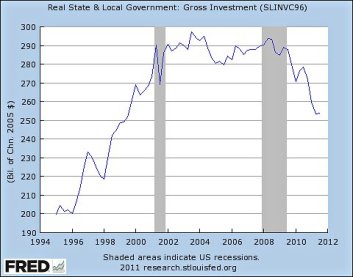
Paul Krugman put up this graph showing the level of Gross Investment by State and Local Governments. This would be the kinds of infrastructure that support modern life as we know it and include things like roads, bridges, new school buildings, sewers, airports, and other things that also drive local business growth. As you can see, there is a serious lack of infrastructure investments by state and local governments this century. Since interest rates are cheap, now is a good time to do these kinds of long term projects that would provide jobs and incentives for local businesses to expand. The majority of our states have balanced budget amendments which disallow deficit spending and in some cases, borrowing. Long term investment is nearly impossible in many states. Krugman argues that the timing is right to invest in roads, bridges, airports, and other important public projects. It’s a perfect time to look at an Infrastructure Bank which had broad bipartisan support during the Bush/Cheney years. President Obama has proposed such an institution.
The proposal, modeled after a bipartisan bill in the Senate, would take $10 billion in start-up money and identify transportation, water or energy projects that lack funding. Eligible projects would need to be worth at least $100 million and provide “a clear public benefit.” The bank would then work with private investors to finance the project through cheap long-term loans or loan guarantees, with the government picking up no more than half the tab — ideally, much less — for any given project.
There is still this insane argument out there that the US is going broke and can’t afford to spend any money. This confuses the institution of government with households and businesses. A government has the ability tax and the national government has the ability to print money and borrow in perpetuity. This country spent far more of its future output during the Great Depression and World War 2 and the results speak for themselves. We’ve had most of this decade’s fiscal policy using taxes to encourage gambling for paper profits, not actual production of goods and services. Europe’s policy makers are stuck in the same mindset. You would think that the experiences between the two world wars would’ve made an impression on them. We’ve spent trillions of dollars propping up the world’s gambling houses without telling them they must lend for productive purposes as a condition of those bailouts. I have no idea how many more years that economists will have to scream that it’s the aggregate demand stupid at policy makers, but I have a feeling we won’t be stopping any time soon.

 peej
peej Carissa
 bostonboomer
 dakinikat
 ecocatwoman
 mablue2
 Mama Lopez
 peggysue22
 quixote
 skydancingguestblogger
 Mona (aka Wonk the Vote)



 Sky Dancing
Recent Comments