
Mostly Monday Reads: Chaos Media Matters
Posted: June 8, 2026 Filed under: #FARTUS, #We are so Fucked, Are we a democracy?, Denaturalization attempts, Don't be a Kyle or a Donald | Tags: Denaturalization attempts, Immigrant Rights, Naturualization, Power to the people, The Donald vs. The US Constitution, Trump-Welker interview Meet the Press, US States Voting Process and Protection, voting rights 7 Comments
“New York loves mr. trump.” John Buss, @repeat1968
Good Day, Sky Dancers!
Sunday’s Meet the Press brought back memories of my oldest daughter’s Montessori preschool days when this kid named Kyle — who couldn’t express much verbally — would bite anyone who dared to tell him off or tried to stop him as he terrorized the class. The well-trained teachers, faithfully doing their jobs, were not used to this kind of toddler resistance.
Montessori kids are taught to show respect to the point that, if they want to watch a kid doing their thing on their well-defined rug space, they hold their hands behind their back and ask if it’s okay to observe. That was one of the things I liked about her classmates. It made them a joy to have in the playroom in the basement compared to the kids allowed to run loose in our suburban Omaha neighborhood. But not Kyle.
Most politicians are used to being grilled by the media. They’re used to tough questions and continued follow-up, if granted a session with a well-schooled journalist in a situation any public figure would crave. But not Donald. I can only wonder what his teachers and classmates put up with before he got shunted to Military School.
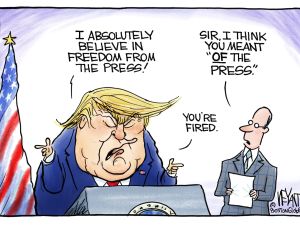 So this is Forbes‘ Mark Joyella, today, explaining what could only be described as Trump’s Toddler Temper Tantrum. “‘You’re Either Crooked Or You’re Stupid’: Trump Walks Out After Kristen Welker Fact-Checks Him.” This is not the language of a mature adult. It should not be the language or tone of the leader of a large, powerful nation. However, I am completely beyond being shocked by his demeanor, acts, and speech. He’s definitely a Kyle.
An angry Donald Trump walked out of an interview with NBC’s Meet the Press host Kristen Welker after an extraordinary exchange in which the president angrily insisted—without offering any proof—that “elections are crooked and you’re crooked, and Meet the Press is crooked…and so is ABC and CBS and CNN.”
The interview, airing on NBC Sunday, turned confrontational when Welker asked Trump about his idea to use $1.8 billion in taxpayer money for a “weaponization fund” to compensate people who believe they were unfairly targeted by a federal government “weaponizing” the justice system against them.
“If it was up to me, I’d pay them the kind of money that they deserve,” Trump said. “People have been destroyed. Lives have been destroyed. Many suicides, think of it. People have committed suicide because a bunch of thugs went after them.”
‘Where’s The Evidence?’
As the president made a series of claims about people he believed were falsely prosecuted, Welker pushed back, noting repeatedly that Trump had offered no evidence to support his claims.
“Now, I don’t know what’s going to happen with the weaponization fund,” Trump said as he shifted to comment on the news media and Welker. “I love the idea, because people like you, the fake dirty press, the crooked press, people like stupid Biden, he’s not smart enough to know what’s going on, but people that surrounded him, surrounded his beautiful Resolute Desk in the Oval Office, what they did to the lives of people, they destroyed people. They sent people to jail who did nothing wrong.”
Trump has long accused the news media of being “crooked” or “fake news” and even “enemies of the people,” but has rarely done so in such an angry and personal way, as Welker, who remained calm and professional despite the president’s personal criticisms, repeatedly pressed Trump to back up his sensational claims:
PRES. DONALD TRUMP: The election was rigged. It was a dirty election.
KRISTEN WELKER: Mr. President –
PRES. DONALD TRUMP: And it’s happening again right now in California.
KRISTEN WELKER: – you’ve never presented evidence –
PRES. DONALD TRUMP: It’s happening right now in California
KRISTEN WELKER: – that the 2020 election was rigged.
PRES. DONALD TRUMP: Right now, it’s look at what’s happening in California.
KRISTEN WELKER: Where’s the evidence to that?
PRES. DONALD TRUMP: It’s four days –
KRISTEN WELKER: The Republicans are doing well in California.
PRES. DONALD TRUMP: In California, it’s, no they’re not. They’re dropping fast because it’s a rigged election. Let me tell you, it’s four days and they aren’t even close to coming up with the –
KRISTEN WELKER: That’s how they count the votes in California.
PRES. DONALD TRUMP: Do you know why they’re doing that? Because they’re cheating on the election.
KRISTEN WELKER: There’s – What? Do you have evidence to support that?
PRES. DONALD TRUMP: It’s– all I have to do is look. All I have to do is look.
KRISTEN WELKER: But that’s not evidence.
‘To Be Fair, I’m Not Crooked’
When Trump insisted—again, without any evidence—that the slow counting of votes in California indicated election fraud, Welker pushed back, saying “but sir, that’s not evidence, and that’s how they count the votes in California.”
This seemed to make the president even angrier, calling Welker “crooked,” which she immediately responded to. “To be fair, I’m not crooked,” Welker said. “But let’s continue.”
 There’s more at the link. Coupled with the following headline, I worry about this country. I really do. This analysis is from the AP. “Fewer Americans say democracy is central to country’s identity, AP-NORC poll finds.” I bet they’re all home-schooled or schooled in those right-wing christian madrasas.
As the U.S. prepares for an extravagant celebration of its founding principles, fewer Americans see their country as exceptional, a new poll finds.
The survey from The Associated Press-NORC Center for Public Affairs Research highlights many Americans’ feeling of unease over the future of its representative government — particularly among young people. It presents a jarring contrast as communities around the country commemorate the nation’s 250th anniversary.
Only about one-quarter of Americans say the U.S. stands above all other countries in the world, the new poll found, while 44% say it’s one of the greatest countries in the world, along with some others. About 3 in 10 say there are better countries than the U.S., an increase from 19% in an AP-NORC poll conducted in June 2016.
Americans remain divided about whether diversity is an essential feature of the U.S.’s identity, and agreement about other aspects of the country’s underlying character appears to be eroding, the survey found. Americans are less likely to see a democratically elected government as “extremely” or “very” important to the United States’ identity as a nation than they were just a few years ago. About two-thirds of U.S. adults now say a democratically elected government is highly important to the U.S.’s identity as a nation, down from 80% in 2021.
“It’s not that the democracy part is not working,” said Derricka Wall, 24, of Chickasaw, Alabama. “It’s the people that are actually being put in office that is the problem.”
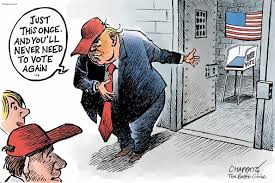 Meanwhile, it’s confirmed once again that it’s not the Press or the People leaving our democratic voting processes in the wind. This is from Jose Pagliery writing for NOTUS. “The Justice Department Hasn’t Taken Its Usual Steps to Protect the 2026 Election. The DOJ appears to be quietly scrapping its typical “command center” that would monitor Election Day emergencies.”
President Donald Trump says “if you don’t have honest voting, you can’t really have a nation.”
But five months out from the midterm elections that will determine control of Congress, his Justice Department has canceled election-integrity training sessions for prosecutors and FBI agents, deleted a 281-page guide to prosecuting election offenses, fired most of the lawyers in its Public Integrity Section and failed to replace the director of its Election Crimes Branch.
Moreover, the DOJ has not taken the usual steps to establish a “command center” to monitor and address the typical emergencies that pop up around Election Day, three sources with knowledge of the situation told NOTUS. A command center team would address things like voter intimidation and targeted disinformation meant to hinder a fair process.
These actions — and inactions — have alarmed current and former prosecutors, who say the Justice Department is not prepared to deal with threats to election integrity in the November elections.
“That’s really concerning,” said Ryan Crosswell, a former public corruption prosecutor who recently ran for Congress as a Democrat. “Obviously, the command center and training are something that anybody who wants to protect election integrity would want. And this just feeds into the fear that rather than protect elections, the DOJ may try to interfere with them. That’s pretty scary.”
The DOJ did not provide any answers before publication to detailed questions about the training cancellations and the election command center, but a department spokesperson issued a statement that its top priorities are now “ensuring the integrity of U.S. elections and protecting Americans against voting fraud and civil rights violations.”
Former DOJ attorneys described the command center as an intense, around-the-clock operation at FBI headquarters. Investigators direct law enforcement responses nationwide, while public corruption prosecutors take long shifts answering phone calls about possible crimes and confusing situations. The anticipated emergencies are taken so seriously that department leadership has normally kept an auxiliary team of specialized prosecutors on standby back at DOJ headquarters. Everyone orders pizza and sits tight for shifts that span eight-plus hours.
“It spoke to how seriously we took this stuff,” Crosswell noted.
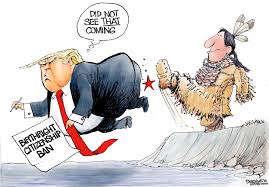 Does that mean we simply watch everything melt into fascism as our 250th birthday as a nation stands before us? I certainly hope not. Stories like these give me hope. Madiba K. Dennie writes this analysis for Balls and Strikes about the ongoing purge of immigrants and naturalized citizens in our nation. “The Delaney Hall Strike Is Exposing a Massive Thirteenth Amendment Crisis. The Thirteenth Amendment prohibits slavery, except “as a punishment for crime.” But people in immigration detention haven’t been convicted of anything—and are still being forced to work for nothing.”
For the past several weeks, hundreds of detainees at Delaney Hall, an immigration detention center in Newark, New Jersey, have been on a labor and hunger strike. Participants in the strike are refusing to perform their work assignments or eat meals in protest of what they describe, in a series of handwritten letters smuggled out of the facility, as “unlawful and forced detention” and “inhumane treatment” that violates their constitutional rights. Among the myriad “injustices and irregularities” named in the letters are rotten food riddled with worms; persistent “unresolved issues” with bathrooms in “terrible and inhumane” condition; and detainees being forced to work for practically pennies or, more often, for no pay at all.
Delaney Hall was the first immigration detention center to open during President Donald Trump’s second term in office. And like almost all immigration detention facilities, Delaney is owned and operated by a private prison corporation. GEO Group, a company valued at approximately $3.3 billion, signed a 15-year contract with Immigration and Customs Enforcement in February 2025, providing ICE with the facility and “support services” like security, maintenance, and food services, in exchange for over $60 million annually.
But it is the detainees—not GEO Group—who actually do that work.
“We were the ones who shoveled the snow during the winter,” said one Delaney Hall detainee, in a statement provided to The American Prospect last week. “We are the ones serving the food, we are the ones who clean the units, we are the ones who clean the bathrooms.” American Friends Service Committee, a Quaker-founded social justice organization working with the immigrants at Delaney Hall, also said in a press release that detained workers can go months without receiving even the pittance they were promised, if they are compensated at all.
Forced labor practices like these are pervasive throughout ICE detention centers. In February, for example, the Supreme Court ruled on an immigrant labor case involving a GEO Group-operated facility, in Colorado. The company’s “so-called Sanitation Policy,” as Justice Elena Kagan referred to it in her majority opinion, required detainees to clean all of the facility’s common areas without pay or risk increasingly severe punishments, including solitary confinement. Additionally, “the so-called Voluntary Work Program” offered detainees a dollar a day for other necessary work like preparing food and doing laundry.
Former detainees had sued, arguing that these policies violated the forced labor provision of a federal anti-trafficking law, as well as Colorado’s prohibition on unjust enrichment. And GEO Group tried to get the case dismissed, claiming it was following directions from the government, so the trial cannot proceed. The Supreme Court didn’t buy it, which means that the case, GEO Group v. Menocal, can at least proceed to a jury trial.
Among the reasons GEO Group does not like trials: Trials can be very expensive for GEO Group, cutting into the money they make by coercing detainees to work for free. In a 2017 case involving another GEO Group-run ICE facility, the state of Washington and migrants detained at a detention center in the state both sued the company for violating Washington’s Minimum Wage Act. GEO Group fulfilled its contractual obligations with ICE by relying heavily on detainees whom it paid only one dollar a day, which GEO Group estimated saved it from having to hire 85 additional full-time employees. In 2021, a jury awarded the detainees roughly $17.3 million in back pay, and the court awarded $5.9 million in unjust enrichment to the state. GEO Group appealed, but the Ninth Circuit affirmed the ruling last year.
Since Trump’s return to office, the legal landscape has started to shift. Last year, in early January, the National Labor Relations Board filed a formal complaint against GEO Group. The NLRB alleged that GEO Group violated the rights of workers detained at an ICE facility in California by punishing the organizers of a labor and hunger strike with solitary confinement and transfers out of state. Within a few weeks of the complaint’s filing, however, Trump reentered the White House and fired members of the NLRB, and the remolded agency withdrew the complaint.
 There is also this information reported by Camilo Montoya-Galvez at CBS NEWS. “Trump administration launches largest-ever effort to denaturalize U.S. citizens accused of fraud or other crimes.”
The Trump administration on Monday announced it is seeking to revoke the citizenship of 17 U.S. citizens accused of immigration fraud, expanding its unprecedented denaturalization campaign.
CBS News exclusively reported about the plans before they were unveiled by the Justice Department.
Officials said the move represents the largest-ever effort by the U.S. government to use its denaturalization powers, which were rarely invoked before President Trump returned to the White House last year with promises to launch a historic deportation blitz. Between 1990 and 2017, the Justice Department filed an average of just 11 legal complaints per year seeking to denaturalize American citizens, historical figures indicate.
Federal law has long allowed the government to try to denaturalize foreign-born U.S. citizens who officials believe committed fraud to obtain their citizenship, such as by concealing information, like criminal conduct, on their immigration applications. But the process has been historically lengthy, complex and seldom exercised, requiring officials to persuade judges to strip naturalized citizens of their citizenship in civil or criminal proceedings in federal court.
The Trump administration has sought to vastly escalate denaturalization efforts as part of its larger crackdown on illegal and legal immigration. In 2025, the Justice Department broadened the categories of naturalized citizens who should be prioritized for denaturalization. Last month, officials announced a dozen denaturalization cases, at the time the largest such effort in years.
Some of the 17 citizens targeted in the latest denaturalization campaign were convicted of violent or serious crimes, including sex offenses against children. Others were convicted of fraud crimes or accused of committing immigration fraud.
In federal court complaints filed across the country in recent days, Justice Department officials argued that the individuals concealed their criminal activity when they applied for U.S. citizenship or were otherwise ineligible to be naturalized, including because they lacked a “good moral character,” one of the requirements in the naturalization process.
Those targeted in the latest round of denaturalization cases include a Haitian immigrant who allegedly sexually abused his daughter; a man from the former Yugoslavia convicted of sexually abusing a child under the age of 15; an immigrant from Mexico convicted of receiving sexually explicit images of minors; a former Catholic priest born in Colombia accused of child sex abuse; and a Filipino-born man who pleaded guilty to a child sex crime.
The group also includes an Indian immigrant accused of filing fraudulent H-1B visa petitions; the daughter of a Colombian drug trafficker accused of money laundering; a man born in Jamaica convicted of wire fraud; and a Cuban-born woman accused of defrauding a tribal casino. Other naturalized citizens were accused of using false identities.
Acting Attorney General Todd Blanche said the Justice Department would have “zero tolerance” for abuse of the naturalization process.
“Criminal aliens are lying about their past crimes, including drug dealers, sexual predators, and fraudsters,” Blanche said.

And, again, we, the people, voting Orange Caligula out is essential to our nation’s future as a democracy. This analysis is from Vote Beat. “The Trump administration’s multiple investigations of the 2020 election may have more to do with 2026. Some experts say the FBI’s probes in Wisconsin and elsewhere could be a test run to challenge future election results. The lede for this story is by Dion Nissenbaum Alexander Shur.
The FBI agents arrived at David Bolter’s Milwaukee home on a cool, cloudy Wednesday morning in late May. They were armed with a list of questions for the 2020 poll worker, who had raised concerns about the way local officials handled the 2020 election, Bolter told Votebeat.
President Donald Trump relied on Bolter’s claims in an unsuccessful 2020 lawsuit that sought to throw out more than 220,000 votes. That would have been more than enough to move Wisconsin’s 10 electoral votes from Democrat Joe Biden, who won the state, to Trump. Though courts, several election reviews, and many audits rejected Trump’s claims, the Republican never stopped believing that he was cheated out of the presidency in 2020.
That appears to be why, last month, the FBI sent agents back to Milwaukee to question Bolter as part of an expanding national effort by the second Trump administration to investigate long-debunked claims of fraud in the 2020 election.
The investigation into the 2020 election appears to be relying on already disproven allegations from people like Bolter. Bolter declined to divulge more about his conversation with the FBI, which has not been previously reported, but allegations from Bolter’s 2020 affidavit were central to some conspiracy theories about the 2020 election. For example, he alleged that somebody in Milwaukee’s absentee ballot counting facility announced around midnight on Election Day that a “huge truckload of ballots” was going to be delivered — an accusation for which there has so far appeared to be no additional evidence.
Around the same time Bolter says he talked to the FBI, two plainclothes agents with FBI badges showed up at the apartment of a former Milwaukee resident and 2020 poll worker about an affidavit she submitted, according to the former poll worker, who asked to be identified only by her first name, Christine, to give her the freedom to discuss an ongoing investigation.
Christine had also submitted an affidavit about the 2020 election, saying election workers had been told that all votes were counted, but she then saw workers continuing to count ballots around midnight. That affidavit was the focus of the agents’ questions, Christine told Votebeat.
“I suspected wrongdoing, but I’m not saying that it actually happened,” she said. “I’m just one lowly person that was working there.”
During the interview, she added, an agent showed her a photograph of Claire Woodall, the former Milwaukee election chief, asking her if she recognized the former election official who has been central to false allegations about the 2020 election. She identified her by name. Woodall didn’t respond to a request for comment.
Caroline Clancy, a spokesperson for the FBI’s Milwaukee office, declined to comment.
So, it’s hard to say we’re crawling out of this appalling man’s reign of terror. That doesn’t mean we have to roll over and take it. Look at how the cities that were invaded by ICE managed to drive them out. Look at the courts. Many Judges are still doing their jobs to protect the Constitution. We can do that whatever we can where we are. Support a candidate financially or with your feet. Show up at a protest. Talk to your neighbors. Just Do IT! Oh, and don’t be Kyle or Orange Caligula.
What’s on your Reading, Action, and Blogging list today?
Thursday Reads: Abiding in the Afterglow
Posted: November 9, 2017 Filed under: Afternoon Reads, Candidate diversity | Tags: 2017 elections, Immigrant Rights, Minority Rights, Reclaiming OUR Time, Trumpism, Women's Rights 21 Comments Good Afternoon
Sky Dancers!
My Nana used to talk a lot about the afterglow. She was quite spiritual and used it all the time as a metaphor for the abiding peace that comes when you just relax and enjoy the goodness at the end of the day. Today, I am abiding in the afterglow and the peace that comes with the realization that the Resistance is real and that it’s turned into more than giant marches and social media screeds.
It’s turned into votes and elected officials. It’s turned the diversity and decency inherent in modern America into the distinct faces replacing white republican men. It’s a newly elected Sikh mayor and the newly elected Liberian immigrant mayor; a brown and black face for Hobokken, New Jersey and Helena, Montana repectively. These are faces of American immigrants both. Topeka, Kansas elected a Latina for its Mayor. Michelle DeLaIsla is also a single mother.
Elections on Tuesday turned into the faces of black woman who followed in the steps of Rosa Parks and refused to sit peacefully in the back of the bus. They are now going to control exactly where that bus can go. The afterglow is the face of the GLBT community and others that have worked tirelessly for their right to the American vision of liberty and justice for all.
 The voice of the majority of voters went unheeded a year ago. Tuesday night, the votes of the majority sent waves of hope for peace and justice through out the world. We showed the world that we shall overcome. I do not vote until November 18th, but my vote will be part of the history of New Orleans when we elect our first Black Woman to the office of Mayor in our runoff.
Barrier-breaking candidates won races across the country on Election Day this year. The results were a parade of “firsts” from New Hampshire to North Carolina to Montana as women, people of color, and LGBTQ candidates became the first to win elections in their respective contests.
Cities in Minnesota and Montana elected their first black mayors, and Charlotte, North Carolina, elected a black woman as mayor for the first time. Virginia elected its first Latina and Asian-American delegates. Transgender candidates won races in Virginia, Minnesota, California, and Pennsylvania.
Tuesday was a big night for Democrats — and these historic “firsts” show that the party can run a diverse slate of candidates and win.
The results were astounding to all but confused Republican White men who doubled down on Trump and white grievance politics. Their leadership continue to seek policies that help the upper 1% of the 1% while yet another group wanting to get out of the line for the slaughterhouse ran away from the rest of the sheep.
The midterm elections do not appear to favor the sheep.
Distressed Republicans say Democratic victories across the country on Tuesday night show their congressional majorities are at risk in next year’s midterm elections.
Sen. John McCain (R-Ariz.) said he “predicted” the rough election night and said the party needs to make changes quickly before the midterms arrive.
“Unless we get our act together, we’re going to lose heavily,” he said.
The results offered fresh evidence of a political backlash against President Trump, which several Republicans said, in combination with a failure to win legislative victories, could cost the party the House majority.
“The best way to get run over by this train is to stand still,” said Rep. Tom Cole (R-Okla.), a former chairman of the National Republican Congressional Committee (NRCC).
Next year’s map makes it much tougher for Democrats to win back the Senate, since Republicans are only defending eight seats compared to 25 for Democrats. In the House, Democrats would need to gain two dozen seats to win back the majority.
House Republicans in swing districts acknowledged that showing independence from Trump will be critical. Some of the 23 GOP lawmakers who represent House districts carried by Democratic presidential nominee Hillary Clinton insist they can again convince local constituents to support them.
 The People’s President is the one with the coattails. The best explanation that I heard all day about the race came from two Never Trumpers on MSNBC. Nicole Wallace and Steve Schmidt were nearly as jubilant as any Democrat on the network. Wallace said she had to mute the TV any time Trump was on and her five year old was in the room. She explained that the white suburban women vote had to come from every parent who doesn’t want that kind of person as President. Schmidt suggested that it was such a coalition of diverse interests voting against Trumpism that felt like a wave from the decent people of America. The polls showed a combination of anti-Trumpism and fear of losing Health Care as central to many voters. But we also learned that a huge swath of Americans are following the Russian situation.
I give you an op ed from the Paducha Sun.
Chances are you’re not familiar with the name Andrew Weissmann. That’s likely to change.
He’s the top lieutenant in Special Counsel Robert S. Mueller’s investigation of potential collusion between Russia and the presidential campaign of Donald Trump. He’s also the man most directly involved in the indictment of former Trump campaign manager Paul Manafort.
Weismann, 59, is known as the most aggressive and controversial member of Mueller’s team.
Remember the pre-dawn raid by a dozen FBI agents on Manafort’s home back in August? That’s something rarely done in white-collar crime cases. It was Weissmann’s way of sending an unambiguous message to Manafort: We are going to nail you.
Weissmann, who has two Ivy League degrees, is admired for his intelligence and skill as a prosecutor, particularly his talent in getting witnesses to flip and provide critical information. He served as chief of the criminal fraud section of the U.S. Department of Justice before taking leave to join the Russia probe.
A recent New York Times story, which dubbed him a “legal pit bull,” said he’s “an expert in converting defendants into collaborators — with either tactical brilliance or overzealousness, depending on one’s perspective.”
The story added, “It’s not clear if President Trump and his charges fear Mr. Weissmann as they gird for the slog ahead. It is quite clear, former colleagues and opponents say, that they should.”
His reputation for gaining witness cooperation was acquired in two high-profile cases.
One was prosecuting mob bosses in Brooklyn two decades ago. Weissmann persuaded a prominent Mafia hitman, Salvatore “Sammy the Bull” Gravano, to testify against Vincent “The Chin” Gigante, leader of the Genovese crime family, leading to his conviction.
The other followed the collapse of energy giant Enron in 2001. Weissmann helped gain fraud convictions of multiple executives by again showing his ability to convince witnesses to give damaging testimony.
The Manafort indictment disclosed Monday has been criticized because the charges do not appear related to alleged collusion with Russia. Instead, Manafort is accused of money laundering and not paying taxes well before he joined the Trump campaign.
Those critics, who include Sen. Rand Paul, complain of prosecutorial overreach.
They apparently are not aware of the way Wiessmann seeks to maximize leverage with defendants. If he can persuade Manafort that he is at risk of spending all of his remaining years in federal prison on those charges — unless agreeing to become a prosecution witness — he is far more likely to obtain valuable information regarding any campaign ties to Russia.
People who speak highly of Weissmann applaud him for pushing legal boundaries to win his cases. They say his use of hardball tactics demonstrates his determination to obtain vital evidence.
 The Op-Ed continues by saying he’s Trump’s Number 1 Problem. Well, that and the barrage of white male privilege on display daily among the Trump cadre. No amount of economic data, study, and acceptance by every economist of all parties and ideologies kills the idea that giving freaking rich people tax breaks is going to absolutely make the rest of us better off. It doesn’t do it. Never will. Never … never … never … never ….
White House economic adviser Gary Cohn nearly quit the administration over President Trump’s equivocations about a Nazi rally in Charlottesville, and then was denied his dream of becoming the chairman of the Federal Reserve. Now all that remains of his political dreams is a gigantic tax cut for owners of capital. But Cohn is not necessarily the most skilled messenger for this agenda, either. Having spent his career communicating to other extremely wealthy people, he seems to be at sea at the task of pretending this agenda is actually aimed at average working people, which is the essential skill set of Republican politicians.
In a new interview with John Harwood, Cohn is forced into a series of admissions he probably should not be making. He concedes the White House is not, on the whole, a fine-tuned machine:
GARY COHN: I learned a lot about being confident, about learning how to succeed. I did get introduced to the financial markets while I was in college. And I think I learned also how to sort of filter out all of the non-rational, or non-sensible noise, and sort of concentrate on what matters, and that’s really what markets are about. Separate the rational from what the irrational, separate what matters now to what doesn’t matter now.
JOHN HARWOOD: I think most people looking from the outside see more irrational stuff happening in this White House than in any White House that they’ve seen
GARY COHN: I’m involved in the economic side of the White House.
 It’s not the least bit amazing to me that not even the new Fed head appointment will be an actual economist because no actual economist would said anything like this unless his name is Arthur Laffer and he lost his cred years ago hanging on to his failed hypothesis. Cohn has only a BS, is an investment banker, and basically studied real estate development and investing. He speaks with no actual authority on economic policy. The Fed Chair nominee–who will be up in front of the Senate on November 28–is really a big unknown other than he’s got a law degree and a degree in poly sci. Check out Jerome Powell. While Wall Street churns out high returns based on a tax law that gives them more gambling profits, I continue to worry about what happens if any Trumpism policy hits its mark.
The period of uncertainty is over. President Trump is going to nominate Jerome Powell to be the next Chairman of the Board of Governors of the Federal Reserve System.
So, what have we got?
Well, the papers have been full of articles on the appointment and on Mr. Powell himself. It is not that he is an unknown since he has served on the Board of Governors of the Fed since 2012, has been an Under Secretary of the Treasury and has been employed on Wall Street and in Washington, D. C.
Yet, the analysis of him leaves you basically in the dark.
Mr. Powell is supportive of the goals assigned to the Federal Reserve by the US Congress, to achieve high levels of employment and low levels of inflation. He has never dissented on the Board in 44 meetings he has attended. The one thing he gained attention from while serving on the Board was his stance on the ending of the Fed’s bond buying program connected with the end of quantitative easing.
Perhaps the most apt description of Mr. Powell’s way of doing things is that he is… pragmatic.
Jeremy Stein, an economist at Harvard University and who served as a Federal Reserve Governor with Mr. Powell, describes the future nominee as“remarkably undogmatic.”
Mr. Stein goes on, “He listens more than he talks.”
Mr. Powell is given high marks for being a serious student who studies hard in areas that he is not an expert in and seeks advice. He works well with people and makes things happen in his quiet way. Much of what he has accomplished has been out-of-the-spotlight without a great deal of fanfare.
 I’m not going to mention the authoritarian-curious Trump who is currently ass kissing the despot in China. I’m going to end with this essay by Ezra Klein at Vox. “For elites, politics is driven by ideology. For voters, it’s not. Committed liberals and conservatives don’t realize how weird they are.” Oh, I do realize, Ezra, I do … I do … I do…
You are weird. I am very weird. And the worst part is, we don’t really recognize how weird we are.
That’s the basic argument of Donald Kinder and Nathan Kalmoe’s Neither Liberal nor Conservative: Ideological Innocence in the American Public. Their study begins with a famous paper by political scientist Philip Converse titled “The Nature of Belief Systems in Mass Publics.” The nature of those belief systems, Converse concluded, was that they really weren’t systems at all. The overwhelming majority of Americans were free of anything that resembled coherent liberal or conservative ideologies — indeed, only “about 17 percent of the public could both assign the terms ‘liberal’ and ‘conservative’ correctly to the parties and say something sensible about what the terms meant.”
Which isn’t to say that voters didn’t have opinions, much less party and group loyalties. They did, and they do. But the internally coherent (or at least semi-coherent) ideological frameworks that drive the activities of politicians, pundits, and other political actors are foreign to most voters.
Converse’s basic findings have been replicated in a number of different studies done over the past 50 years, and Kinder and Kalmoe extend on them here. In a telling bit of research, they scoured massive election surveys to see what bearing self-reported ideology had on policy opinions on issues ranging from LGBTQ rights to health care to foreign aid to Social Security. The answer, across years ranging from 1992 to 2009, was basically none — “ideological differences,” they reported, “have little influence over opinion on immigration, affirmative action, capital punishment, gun control, Social Security, health insurance, the deficit, foreign aid, tax reform, and the war on terrorism.”
There were two glaring exceptions: LGBTQ rights and abortion. But the exceptions were so stark that Kinder and Kalmoe wondered if they were missing something, and they had a theory of what it might be: religion. So they ran the data again, “adding measures of faith, religiosity (the degree to which Americans take their faith seriously), and group sentiments to the model.” Once they did that, the effect of ideology all but disappeared.
So this, then, is the bottom line: Most voters aren’t ideologues, and even accounting for that, most ideologues aren’t particularly ideological.
 So, since we are weird, I suggest you read about the control factors.
I’m going to spend the day grading papers. I’m hoping it’s a little better than the last batch where I was regaled by so much basic ignorance of trade I was about to scream. I’m back teaching undergrad econ for awhile and I just had a student use the World Daily News as an “academically acceptable” source and based a lot of his argument on his father’s friend’s thoughts that works at a steel factory. I gently explained that when you’re going to do an expository essay on the impact of trade you have to back up your assertions like this: “NAFTA’s Impact on the U.S. Economy: What Are the Facts?” from Knowledge@Wharton. You can go read all the facts and data and pros and cons. I’m just going to quote the last paragraph.
Blaming NAFTA for all of these disturbing problems may make some NAFTA critics feel good, but as trade researchers have learned in recent years, the growing complexity of today’s economic challenges defies any simplistic explanations.
The part I highlighted basically sums up my thoughts on all the crap coming out of the Trump Fiscal policy regime. You could also substitute just about any word–including what gets souls to the polls– for ‘today’s economic’. What’s on your reading and blogging list today?
Bask in the afterglow.

 peej
peej Carissa
 bostonboomer
 dakinikat
 ecocatwoman
 jjlo
jjlo mablue2
 Mama Lopez
 peggysue22
 quixote
 skydancingguestblogger
 Mona (aka Wonk the Vote)



 Sky Dancing
Recent Comments