
Tuesday Reads: A Reluctant Farewell to Two Talented, Accomplished Novelists
Posted: May 5, 2015 Filed under: morning reads, U.S. Politics | Tags: British politics, detective novels, House of Lords, PD James, Ruth Rendell 22 Comments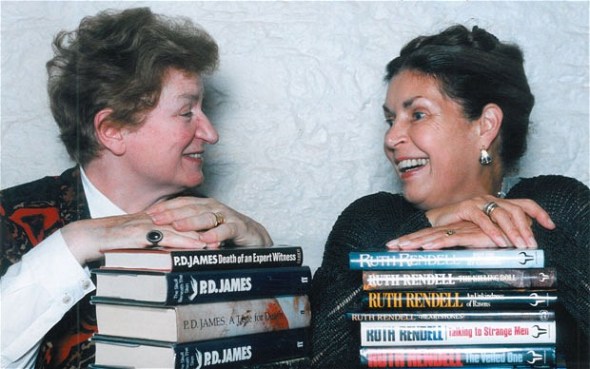
P.D. James and Ruth Rendell
Good Morning!!
Within the last six months, we’ve lost two of the finest and most innovative writers of British crime fiction: P.D. James died at 94 in November 2014, and Ruth Rendell died at 85 over the weekend following a stroke in January. The two grand dames were good friends even though they were competitors and hailed from opposite sides of the political spectrum. Both women served in the House of Lords.
After James’ death, Rendell wrote in the Guardian:
I’ve known Phyllis for about 40 years. We met at a book festival, probably one of the first I ever attended. It would have been a very commonplace thing for her to go to a festival, but nobody knew me then, and she was so nice to me. That is the thing I always will most remember about her: what a kind woman she was, how she did her very best to make you feel good.
She did not write sensation novels, she wrote books about real things, things that could have happened. She didn’t write at all like Agatha Christie. Christie had the most magnificent plots and great stories, but I don’t think anyone would say that she wrote believable stuff, people didn’t want that from her.
But any of the events in Phyllis’s books might have happened – and I think people liked that because they’d never had it in crime fiction before. Dorothy Sayers was a marvellous crime writer, whom both Phyllis and I admired very much, but she hadn’t got the same reality, and she also had that peculiar snobbishness that made her have her detective the son of a duke. Phyllis would have nothing of that.
Both of us thought more about the characters than the crime. Her plots were good, of course, but she took particular care in the creation of character. Place also mattered a lot to her: if you knew the Essex coast you’d want to read some of her books because of her wonderful descriptions.
She always took enormous pains to be accurate and research her work with the greatest attention. She made few mistakes, but on one memorable occasion she did have a male character get on a motorbike and reverse it (I think you can do that now, but this was 30 or 40 years ago), and of course she got a lot of letters about it. But she had a great sense of humour and thought it was very funny.
If one of her books had police work in it, the police work would be true, it would be very real. Her detective Dalgliesh – named him after a female teacher at her school, she just liked the name – is the most intelligent police officer in fiction that I’ve ever come across. He’s sensitive, intelligent, rather awe-inspiring and slightly frightening, but he is a real person, you can get really involved in him.

On the way their friendship worked:
We never talked about crime – because it was what we both wrote about – and we never talked about politics. Phyllis joined the House of Lords several years before me. We were both utterly opposed to each other politically: she was a Tory and very much a committed Conservative, whereas I’m a socialist, I’m Labour and always have been. Once we were in for a vote and crossed paths going to the two division lobbies, she to the “content” lobby and I to the “not content” – and we kissed in the chamber, which caused some concern and amazement.
And now, both of these brilliant and talented women are gone.
From NPR yesterday: Ruth Rendell Dies, Pioneered The Psychological Thriller.
Famed British crime writer Ruth Rendell died this past weekend in London. She was 85 and had suffered a stroke in January.
Best known for her long-running Inspector Wexford series — which was adapted for television — she pioneered a psychological approach to thriller writing. She also wrote darker, more contemplative books as Barbara Vine. In her later years, she was made a baroness and took up Labour Party politics.
Rendell’s most memorable creation may have been Chief Inspector Reginald Wexford: Liberal, intelligent, sensitive but hot-tempered, prone to quoting Shakespeare — Rendell based him partly on herself, and partly on her father.
The mysteries Wexford solved weren’t simple whodunits — there were layers upon layers of psychological complication, packed with obsession, deception, social issues and power games.
When Ruth Rendell started writing, there really wasn’t anyone like her….
In a 2005 NPR interview, Rendell was asked whether she was fascinated by crime. “Well, I don’t know that I am fascinated with crime,” she said. “I’m fascinated with people and their characters and their obsessions and what they do. And these things lead to crime, but I’m much more fascinated in their minds.”

I guess her focus on the psychological is one of the reasons why I love Rendell’s books. The other is that she was a truly fine novelist.
From the Telegraph obituary:
Baroness Rendell of Babergh, the novelist Ruth Rendell, who has died aged 85, was one of Britain’s best-selling celebrity crime writers.
She revitalised the mystery genre to reflect post-war social changes and wove into more than 60 books such contemporary issues as domestic violence, transvestism, paedophilia and sexual frustration. Her Inspector Wexford mysteries became an extremely popular television fixture in the 1990s.
Her work, mapping the manic and malevolent extremes of human behaviour, was distinguished by terse yet elegant prose and sharp psychological insights, as well as a talent for creating deft and intricate plots and believable characters.
With her friend and fellow crime writer PD James — with whom she shared the accolade of “Britain’s Queen of Crime” (which she detested) — Ruth Rendell redefined the “whodunnit” genre, fashioning it into more of a “whydunnit”.
But unlike the conservative Lady James, Rendell was politically to the Left and professionally far more prolific; she completed more than 50 novels under her own name and 14 writing as Barbara Vine, as well as two novellas and more than a dozen collections of short stories.
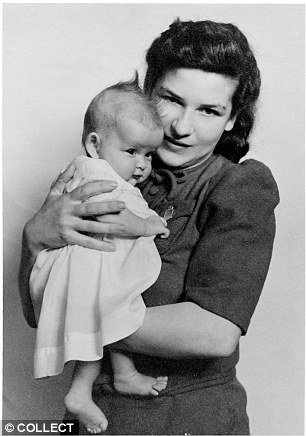
PD James as an impoverished young mother. She didn’t begin writing until she was 42.
From the Guardian on the close connection between two brilliant and successful women: Ruth Rendell and PD James: giants of detective fiction.
On Wednesday evening this week, publishers and readers of crime fiction gathered at Temple church in London’s law quarter for the memorial service of PD James, one of the two finest English crime-writers of the 20th century. A poignant absentee was the other: Ruth Rendell was too frail to attend the farewell to her great friend and co-practitioner following a severe stroke in January, complications from which led to her death, announced on Saturday, at the age of 85.
There is a clearly a bleakness in the fact that the genre of detective fiction has lost two of its giants within six months, but there is also a neatness. Rendell and James were always closely allied, both professionally and personally. One of Rendell’s last public engagements before her final illness had been to attend, in December, the funeral of PD James in Oxford.
On Wednesday evening this week, publishers and readers of crime fiction gathered at Temple church in London’s law quarter for the memorial service of PD James, one of the two finest English crime-writers of the 20th century. A poignant absentee was the other: Ruth Rendell was too frail to attend the farewell to her great friend and co-practitioner following a severe stroke in January, complications from which led to her death, announced on Saturday, at the age of 85.
There is a clearly a bleakness in the fact that the genre of detective fiction has lost two of its giants within six months, but there is also a neatness. Rendell and James were always closely allied, both professionally and personally. One of Rendell’s last public engagements before her final illness had been to attend, in December, the funeral of PD James in Oxford.
For five decades, the two women were the George Eliot and Jane Austen of the homicidal novel: different minds and style but equal talent. They were responsible, in joint enterprise, for saving British detective fiction from the position, after the era of Agatha Christie and Dorothy L Sayers, in which its popularity with readers was matched only by its unpopularity with most serious literary critics. Solving this paradox, the books of Rendell and James amassed both high stacks of till receipts and piles of admiring reviews. Each, in TV adaptations, gave a major detective to the schedules: Rendell’s DCI Wexford, played by George Baker on ITV, and James’ DCI Dalgliesh, portrayed by Roy Marsden on ITV and then Martin Shaw for the BBC.
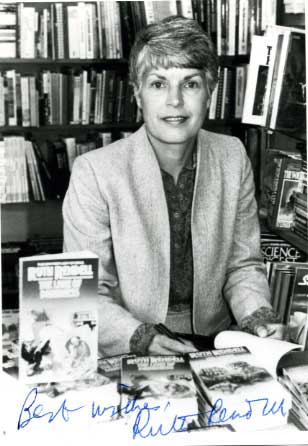
Ruth Rendell
As well as the coincidence – of a kind they would have avoided in novels – of Rendell’s death so closely following the service for James, there is also a striking conjunction in the closeness of both to a general election. Unusually among novelists, both women were members of the House of Lords, where they sat as Baroness Rendell of Babergh on the Labour benches and Baroness James of Holland Park in the Conservative ranks. It is a credit to their characters that ideological difference never affected their mutual respect and pleasure in each other’s company, and on a number of issues they agreed: sharing, for example, an opposition to Scottish independence, against which the younger baroness campaigned publicly.
As well as the more than 60 books she published, Rendell’s achievements included being one of the few authors to have changed the law. In her political life, she was a crucial mover behind a 2003 act of parliament enforcing and strengthening British law against the misogynistic pre-pubescent surgery known as female genital mutilation (FGM).
People who are snobbish and dismissive about the detective story genre are sadly mistaken, and have no idea what they are missing by not reading Rendell and James’ work. If you enjoy fine writing and psychological analysis of human personality as I do, you can’t go wrong by picking up a book by either of these women–although I prefer Rendell.
I’ve probably bored you by going on about PD James and Ruth Rendell, but I thought the loss of two great women writers in such a short time deserved to be remarked upon.
Now some news of the day, links only and in no particular order.
USA Today, Islamic State claims responsibility for Texas attack.
NYT, Gunman in Texas Shooting Was FBI Suspect in Jihad Inquiry.
The Texas event was organized by right-wing hatemonger Pamela Geller.
CNN, Texas shooting: Who is Pamela Geller?
The Daily Beast, Muslims Defend Pam Geller’s Right to Hate.
Sam Brownback is not only a horrible governor, but also a lousy tipper. From KSNT.com, Note on restaurant receipt to Kansas governor goes viral.
Mitt Romney is just as clueless as ever. From the Boston Globe, Mitt Romney Doesn’t Think Mass Incarceration is a Real Thing.
NYT, Mike Huckabee to Joint Republican Race.
Dana Millbank, Ben Carson’s over-the-top ego.
Wall Street Journal, Hillary Clinton to Challenge GOP on Immigration.
James Rosen at McClatchy, Pentagon: Texas has nothing to fear from upcoming military exercise
PC News, Some Apple Watch Users Complain of Skin Rashes.
Institutional Investor’s Alpha, The 2015 Rich List: The Highest Earning Hedge Fund Managers of the Past Year.
Charles Pierce, In which we learn about protest songs and that science can be heartbreaking, among other things.
The Guardian, Nepal quake survivors face threat from human traffickers supplying sex trade.
IBT, Mississippi megafloods wiped out biggest ancient Native American civilisation of Cahokia.
What stories are you following today? Please post your thoughts and links in the comment thread and have a great day!

 peej
peej Carissa
 bostonboomer
 dakinikat
 ecocatwoman
 mablue2
 Mama Lopez
 peggysue22
 quixote
 skydancingguestblogger
 Mona (aka Wonk the Vote)



 Sky Dancing
Recent Comments