
Friday Reads and a Penchant for the Macabre
Posted: October 28, 2016 Filed under: 2016 elections | Tags: Donald Fagan, Halloween, horror movies, michelle obama 43 CommentsGood Afternoon!
So, those of you that read my occasionally weirdish posts know that I have a thing for old grave yards and historical sites that are mysterious and ookie. There’s a distinctly granular feel to these places. It’s in the air and it’s in the dust that kicks up when you walk around. Bits and pieces of the past can be tangibly felt. I like the feel of the tingle and chill. I came to the realization that I love horror movies a little bit late in life but now I relish this time of year more than any. Maybe it’s because I can feel the power surge of my inner crone. Maybe because I know that there is no dearth of places to indulge my need to feel creeped out by imaginary things.
I’m not alone in this fascination with how humanity deals with its mortality. Not by a long shot. Stories, art, and the entire religious thing have always dealt with such topics. We created burial rituals and tools to cope with life and death early on. October Horror movie binges just go right along with the roots and rites of our cave dwelling ancestors who lit fires and counted on the stars to help them. My friend and fellow blogger Pete shared this link to Donald Fagan describing his early fascination with those black and white horror movies that rocked Saturday matinees back in the day of double features and bad special effects. I thought I’d pass it on.
Fair Lawn, New Jersey, late ’50s. I must have been 9 or 10 when my Uncle Al surprised my cousin Jack and me by announcing his intention to take us to a midnight showing of Diabolique, the French thriller. The choice seemed odd, since Al, a burly luncheonette operator from Passaic, wasn’t the type you’d expect to harbor a taste for French cinema. Then again, it was no secret that an intermittently active strain of sadism ran in Al’s branch of the family. I guess he didn’t want to miss out on a rare opportunity to watch the kids squirm.
Shot in cadaverish black and white, Diabolique is about these two hot babes, the wife and mistress of a cruel boarding school headmaster, who conspire together to murder their tormentor. They drug him, drown him in the bathtub, and dump his body in the swimming pool. When the pool is drained, though, there’s no corpse to be found. The two women freak out for the rest of the movie. At the end, there’s a scene where the (supposedly) murdered headmaster inexplicably rises out of the bathtub with only the whites of his eyes showing. That’s when I started screaming. Jack, his body quaking from head to toe, slid off his seat and ended up on the sticky theater floor in tears. When we got home, Uncle Al, who’d had a merry old time, had to endure a tongue-lashing from my aunt for permanently damaging our heretofore immaculate sensibilities. We both had nightmares for weeks.
But movie terror is seriously addictive. As soon as we were sufficiently recovered, we started taking the bus to the HyWay Theater every Saturday afternoon to see the horror double feature. At 50 cents plus the price of the popcorn (or a bit more if you wanted a box of the race-regressive Chocolate Babies), it was a bargain.
I started out on the Addams Family and the Munsters and tamer fare. But, TV in the 1960s and 70s also included its Friday night horror shows and that’s where I got exposed to the good stuff. BTW, the “cool ghoul” has passed for any of you that might know the work of Joe Zacherle. Every big city had its horror host back in the day.
The great John Zacherle, known to generations of horror fans as Zacherley, “The Cool Ghoul,” has passed away at 98. The news came tonight as author Tom Weaver, a close friend of the Zacherle family, began informing colleagues of the the sad news, and an outpouring of tributes has already begun across the internet.
A veteran of World War II, Zacherle started working at WCAU in Philadelphia in 1954, and in 1957, he got the job of being Philly’s first late night horror movie host on Shock Theater, creating the character of Roland (pronounced Ro-LAND), who talked to his dead wife in her coffin. An association with Dick Clark, whose American Bandstand was based in Philadelphia, led to the recording of “Dinner With Drac” in 1958. He moved to New York’s WABC in ’59, became known as Zacherley and his show was renamed Zacherley At Large. He later hosted the Newark teenage dance show Disc-O-Teen, and was a DJ on WNEW and then WPLJ, where he stayed for ten years.
Considered by many to be the greatest TV horror host of all-time, Zacherele has spent the last several decades appearing on TV, radio, and film and making personal appearances at conventions and special events.
His horror-themed novelty records have remained perennial Halloween favorites, and you will surely hear them played on WFMU and elsewhere over the course of the next week. So, instead of posting those, I’ve decided to share the REAL DEAL, actual episodes of Shock Theater and Zacherley at Large as they were originally broadcast in the late 1950s. What we have here are three classic poverty row horrors: two Bela Lugosi features – The Devil Bat and Bowery At Midnight, and Rondo Hatton as The Creeper in The Brute Man. This is how original Monster Kids in the Northeast first saw these movies, and I’d recommend taking them all in for a great Halloween triple feature this weekend, just make sure you raise a glass of blood in honor of the Cool Ghoul himself before you’re done. He gave his all!
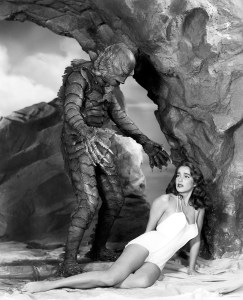 Now, I’m totally enjoying SYFY channel that really rocks October. My current favorites are ZNation and the ubercreepy Channel Zero. I think what I like best about this season of the year as we head towards Halloween, the election, and my birthday is that movie horror can be so obviously campy and fun that it gives you a sense of control over the real nightmarish fiends and ghouls. Of course, this is a Donald Trump reference. It had to be. Horror movies spin yarn and tales but not quite the way Trump does.
Donald Trump actually said this on the campaign trail late yesterday:
“What a difference this is. Just thinking to myself right now, we should just cancel the election, and just give it to Trump, right? What are we even having it for?”
Whether or not Trump was joking, his supporters greeted that remark with lusty cheers. But here’s the thing: Even as Trump supporters continue to lap up his various suggestions that the only legitimate outcome of the election would be a Trump victory, the broader American public is completely rejecting the story he’s telling.
Indeed, there’s new evidence this morning that Trump’s ongoing effort to undermine faith in our democracy has been accompanied by a strengthening of confidence in it. And there’s also new evidence that majorities see Trump as fundamentally disrespectful of our democratic institutions.
The new Washington Post/ABC News tracking poll finds Hillary Clinton leading Trump by four points nationally. (There may be a tightening, but that would not be surprising; it probably represents Republicans who had been alienated by the awful headlines about his sex tape and allegations of unwanted advances coming back to him).
Now that’s a suggestion that really should strike terror in the souls of all peace and democracy-loving people. 
I’m glad our national nightmare will soon be over but we should take nothing for granted. First Lady Michelle Obama gave another inspirational and wonderful speech yesterday along side Secretary Hillary Clinton. All of her words were wonderful but I really want folks to take this message to heart.
Because here’s where I want to get real. If Hillary doesn’t win this election, that will be on us. It will be because we did not stand with her. It will be because we did not vote for her, and that is exactly what her opponent is hoping will happen. That’s the strategy, to make this election so dirty and ugly that we don’t want any part of it.
So when you hear folks talking about a global conspiracy, and saying that this election is rigged, understand that they are trying to get you to stay home. They are trying to convince you that your vote doesn’t matter, that the outcome has already been determined, and you shouldn’t even bother making your voice heard.
They are trying to take away your hope. And just for the record, in this country, the United States of America, the voters decide our elections, they’ve always decided, voters decided who wins and who loses, period, end of story.
(APPLAUSE)
And right now, thankfully folks are coming out in droves to vote early. It’s amazing to see. We are making our voices heard all across the country. Because when they go low…
AUDIENCE: We go high!
OBAMA: And we know that every vote matters. Every single vote. And if you have any doubt about that, consider this. Back in 2008, and I say this everywhere I go, Barack won North Carolina by about 14,000 votes.
(APPLAUSE)
Which sounds like a lot, but when you break the number down, the difference between winning and losing this state was a little over two votes per precinct.
See, I want you all to take that in. I know that there are people here who didn’t vote. Two votes. And people knew people who didn’t vote. Two votes. If just two or three folks per precinct had gone the other way, Barack would have lost that state and could have lost the election.
And let’s not forget back in 2012, Barack did actually lose this state by about 17 votes per precinct. 17. That is how presidential elections go. They are decided on a razor’s edge.
So each of you could swing. In this stadium, just think about it. Each of you could swing an entire precinct and win this election for Hillary, just by getting yourselves, your friends and your family out to vote.
(APPLAUSE)
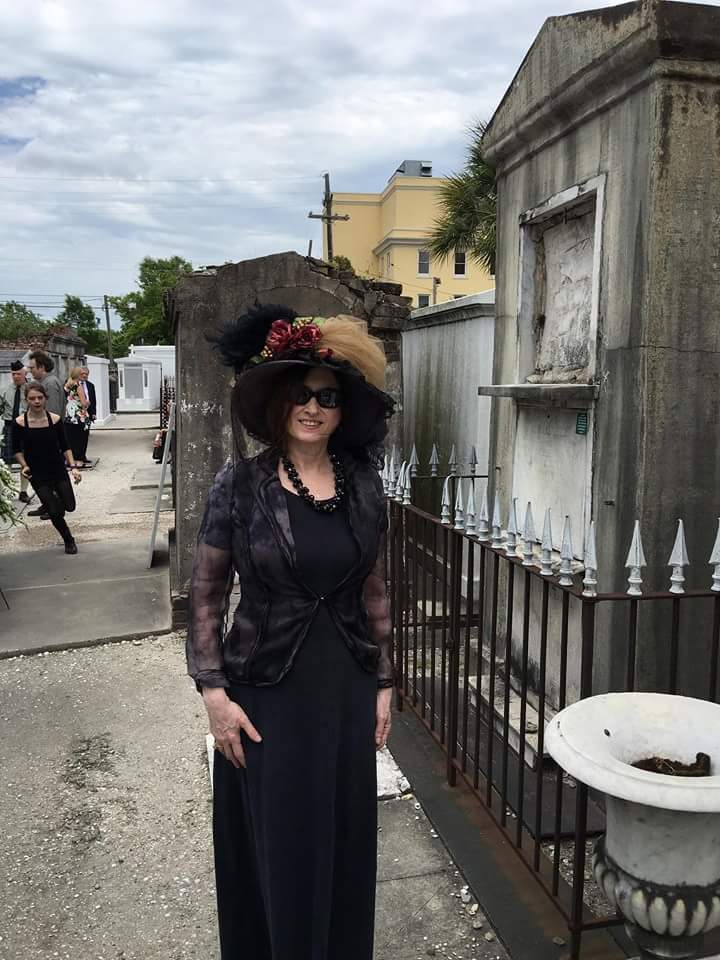
That’s me at St Louis #1 for a funeral a few months ago. See, I do actually live by some historically creepy cemeteries. We love and cherish them down here in Swampland.
The Season of Horror should end here in October except on my favorite TV days. Let’s all get every one out to vote so we can look forward to a New Year and a New Day with Madam President.
What’s on your reading and blogging list today?
Thursday Reads
Posted: October 30, 2014 Filed under: morning reads, Real Life Horror, U.S. Politics, We are so F'd | Tags: 2014 midterm elections, Halloween, horror, horror movies, Jessica Williams, street harassment 66 Comments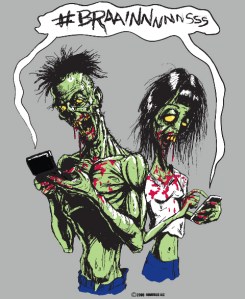
Good Morning!!
Tomorrow is Halloween, but the real horror will probably come next Tuesday when Republicans are predicted to take control of the Senate.
What will happen after that? Will they actually accomplish something, or will they just keep blocking everything President Obama tries to do? Even more horrifying, we may not know the makeup of the Senate for sure until next year, because two close races–in Georgia and Louisiana–will likely end up in runoffs.
Steven Brill at Reuters: Why Election Day won’t hold the answer to who will control the Senate for the next two years.
I’m not only thinking about the possibility that two close races — in Louisiana and Georgia — could end up requiring runoffs. If candidates do not get more than 50 percent of the vote because fringe opponents siphon off votes from the pair running neck and neck, Louisiana’s runoff would be in December and Georgia’s not until Jan. 6, 2015.
The uncertainty that’s more intriguing is that even after those runoffs, if they happen, there might be three independent senators who could swing the majority to one party or the other.
One, Vermont’s Bernie Sanders, is a staunch liberal who will certainly cast his lot with the Democrats, as he has in the past. But Maine independent Angus King has not said for sure that he will continue to caucus with Democrats. And Kansas’s Greg Orman, an independent businessman who is locked in a tight race with incumbent Republican Pat Roberts, has steadfastly refused to say which party he would vote with.
Another longer-shot wild card is former Senator Larry Pressler of South Dakota. He is also running has an independent, but his rise in the polls has subsided recently.
One can only imagine what Orman and King will be promised by both sides if one or both become swing votes. Beyond that, there is a Democratic senator in a red state (John Tester in Montana) and even one or two moderate Republicans in a blue state and a swing state (Mark Kirk in Illinois and Susan Collins in Maine) who might be persuaded to flip.
But most of the so-called experts are predicting we’ll ultimately be stuck with a Republican-controlled Congress. Larry Sabato, Kyle Londik, and Geoffrey Skelley write at Politico: Bet on a GOP Senate.
While many races remain close, it’s just getting harder and harder to envision a plausible path for the Democrats to retain control of the Senate. Ultimately, with just a few days to go before the election, the safe bet would be on Republicans eventually taking control of the upper chamber.
Generally speaking, candidates who have leads of three points or more in polling averages are in solid shape to win, but in this election five states—Republican-held Georgia and Kansas, and Democratic-held Iowa, New Hampshire and North Carolina—feature a Senate race where both of the two major polling averages (RealClearPolitics and HuffPost Pollster) show the leading candidate with an edge of smaller than three points.
What makes the Democrats’ situation so precarious is that Republicans have polling leads of more than three points in five other states, all of which are currently held by Democrats: Arkansas, Louisiana, Montana, South Dakota, and West Virginia. Two others, Democratic-held Alaska and Colorado, show Republicans leading in both averages, but by more than three points in just one. (These averages are as of the afternoon of Oct. 29.)
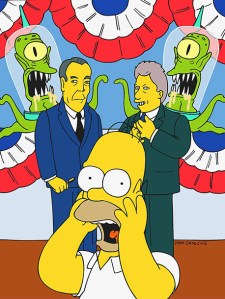
Read it and weep folks. On the other hand, Tarini Parti, also at Politico, points out that this is “[t]he most wide-open Senate election in a decade.”
It’s the largest and most wide-open Senate battlefield in more than a decade: ten races, all neck-and-neck affairs headed into the final days of the campaign.
And it’s not only that there are more competitive races this time around; it’s how close they are that has made the 2014 midterms different from previous cycles. The 10 close contests this year are all separated by 5 points or less, according to RealClearPolitics polling averages as of Tuesday….
Republicans have an edge in more than half of the competitive races, based on RCP averages, and are favored to gain control of the Senate. But many races across the country remain too close — with more contests coming down to the wire than in recent election cycles.
Based on interviews with a dozen operatives on both sides of the state of play, some of these tight races do lean toward one party or the other. Republicans — who need a net gain of six seats to win control of the chamber — are perhaps most confident about their chances in Arkansas, largely dismiss any trouble in Kentucky and remain somewhat nervous about Kansas. After a brief moment of panic in South Dakota, the state, along with West Virginia and Montana, is back to being considered safe for the GOP, as Virginia, Oregon and Michigan are thought to be solid for the Democrats.
At the outset of the cycle, Democrats saw Colorado, Iowa and North Carolina as their firewall against a GOP takeover. Today, those races are neck and neck — and Republicans are even bullish about their chances in New Hampshire. There remains some uncertainty among Republicans about Alaska, despite Republican Dan Sullivan’s edge in polls, because of a superior Democratic ground game and the difficulty of polling the state.
It all adds up to an unusually jumbled puzzle less than a week before Election Day. In 2010, Republicans won just three of the eight tight races — despite their national wave. But in 2006, Democrats won all five of the closest races.
It’s really going to come down to turnout, and Democrats are traditionally better at that. So there’s always a chance. Let’s face it, Republicans have done very well at blocking Obama’s initiatives and appointments throughout his presidency. No matter what happens on Tuesday, we have to elect a Democrat to the White House in 2016.
Finally, Reid Wilson at The Washington Post writes that this “[e]lection could tip historic number of legislatures into Republican hands.”
Again, what will a Republican Senate accomplish? The consensus of the pundits seems to be that they’ll do very little. A few predictions:
John Dickerson at Slate: “Republican victories will prove the president is unpopular. They won’t give Republicans a mandate to govern.”
Danny Vinik at The New Republic: Republicans Have Big Plans for a GOP Senate. Here’s What Will Come of Them: Nothing.
Paul Waldman at the WaPo: Republicans will probably take the Senate. Here’s why it will be a nightmare for them.
Republican Zombies and Democratic Vampires
On a lighter note, I came across some Halloween-themed comparisons between Democrats and Republicans from a few years back. From a blog called Entertained Organizer, Movie Monsters and Political Parties: A Spotters Guide to America’s Psyche.
A good friend and colleague of mine recently sent me a link to the Cracked.com article “6 Mind-Blowing Ways Zombies and Vampires Explain America.” Basically, the article looks at the bizarre fact that Zombie movies are more likely to be made under Republican Presidents and Vampire movies are more likely to be made under Democratic Presidents, and argues rather persuasively it’s that each monster represents the cultures fears of the Party in power. Here’s a chart from the original article at Cracked.com.
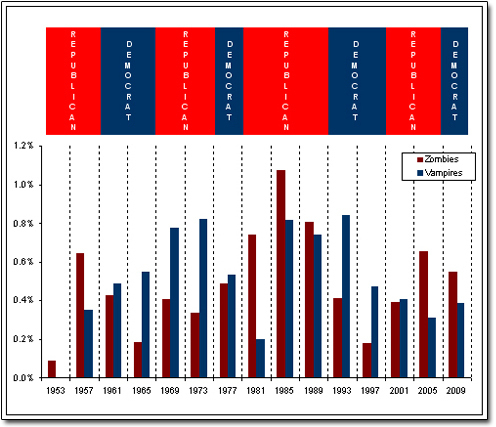
The Cracked.com articles argument for why Zombies embody the country’s worst fears of Republicans is pretty simple. They’re mindless killing machines (see President George W. Bush). They have a rabid pack mentality leading them to consume (see anyone who seems to believe “The Free Market” and “God” are synonyms). And they’re bent on destroying minorities (the living). Now of course I have absolutely no idea where any of those ideas about Republicans came from, and am frankly shocked that anyone might think those things about our Conservative Opponents.
Cracked.com’s argument for why Vampires pique conservatives fears of Democrats is even simpler. Vampires are murderous immigrants from foreign sounding places like Transylvania (or Mexico). Once they arrive, vampires start seducing everyone pretty much indiscriminately as symbols of carnal lust (you think they tried to impeach Clinton over an affair? Nope, Vampire). And of course, more than anything, Vampires are leeches. Sure Dracula is after your blood and Democrats are after your tax dollars but in the Howard Jarvis Republican Party, I’m pretty sure taxes are scarier than bleeding out.
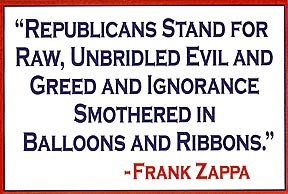
The author then goes on to identify other parties by the movie monsters they represent: Green Party = Werewolves; The American Independent/Constitution Party = Pod People; Lyndon LaRouche Supporters = The Creature from the Black Lagoon; Libertarians = Mummies.
And did you know that horror writer HP Lovecraft had some choice words for the Republican zombies? From Before It’s News:
“As for the Republicans—–how can one regard seriously a frightened, greedy, nostalgic huddle of tradesmen and lucky idlers who shut their eyes to history and science, steel their emotions against decent human sympathy, cling to sordid and provincial ideals exalting sheer acquisitiveness and condoning artificial hardship for the non-materially-shrewd, dwell smugly and sentimentally in a distorted dream-cosmos of outmoded phrases and principles and attitudes based on the bygone agricultural-handicraft world, and revel in (consciously or unconsciously) mendacious assumptions (such as the notion that real liberty is synonymous with the single detail of unrestricted economic license or that a rational planning of resource-distribution would contravene some vague and mystical ‘American heritage’…) utterly contrary to fact and without the slightest foundation in human experience? Intellectually, the Republican idea deserves the tolerance and respect one gives to the dead.”
Street Harassment Follow-Up
A couple of days ago a video of a woman being harassed on the streets of New York City went viral. Dakinikat posted it in a comment on Tuesday, and JJ put it in her post yesterday. I found some interesting follow-up articles about the video that I want to share.
Here’s the video again:
At Slate, Hanna Rosin called attention to something I wondered about while I was watching the video. Where were the white men?
On Tuesday, Slate and everyone else posted a video of a woman who is harassed more than 100 times by men as she walks around New York City for ten hours. More specifically, it’s a video of a young white woman who is harassed by mostly black and Latino men as she walks around New York City for ten hours. The one dude who turns around and says, “Nice,” is white, but the guys who do the most egregious things—like the one who harangues her, “Somebody’s acknowledging you for being beautiful! You should say thank you more,” or the one who follows her down the street too closely for five whole minutes—are not.
This doesn’t mean that the video doesn’t still effectively make its point, that a woman can’t walk down the street lost in her own thoughts, that men feel totally free to demand her attention and get annoyed when she doesn’t respond, that women can’t be at ease in a public space in the same way men can. But the video also unintentionally makes another point, that harassers are mostly black and Latino, and hanging out on the streets in midday in clothes that suggest they are not on their lunch break. As Roxane Gay tweeted, “The racial politics of the video are fucked up. Like, she didn’t walk through any white neighborhoods?”
Here’s the supposed explanation:
The video is a collaboration between Hollaback!, an anti-street harassment organization, and the marketing agency Rob Bliss Creative. At the end they claim the woman experienced 100 plus incidents of harassment “involving people of all backgrounds.” Since that obviously doesn’t show up in the video, Bliss addressed it in a post. He wrote, “we got a fair amount of white guys, but for whatever reason, a lot of what they said was in passing, or off camera” or was ruined by a siren or other noise. The final product, he writes, “is not a perfect representation of everything that happened.” That may be true but if you find yourself editing out all the catcalling white guys, maybe you should try another take.
But Rosin notes that Bliss has had similar issues in the past.
This is not the first time Bliss has been called out for race blindness. In a video to promote Grand Rapids, Michigan, he was criticized for making a city that’s a third minority and a quarter poor look like it was filled with people who have “been reincarnated from those peppy family-style 1970s musical acts from Disney World or Knott’s Berry Farm,” as a local blogger wrote.
Activism is never perfectly executed. We can just conclude that they caught a small slice of catcallers and lots of other men do it too. But if the point of this video is to teach men about the day-to-day reality of women, then this video doesn’t hit its target.
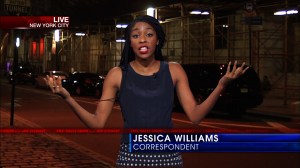
Rosin recommends a video from Jessica Williams of The Daily Show. I watched it, and it’s terrific–plus it’s funny. Check it out.
On a more serious note, CNN reports that the woman in the viral video has been getting rape and death threats.
What started as an expose of the harassment women face in public has turned into fodder for death- and rape threats against the woman in the viral video….
“My nonverbal cues were saying, ‘Don’t talk to me.’ No eye contact. No friendly demeanor,” she said. “But they were ignoring my nonverbal cues.”
Roberts said the video is an accurate depiction of what she faces daily. For instance, there was a time when her grandfather died “and someone told me that they liked the way I looked.”
“It is all day long. It is every day,” she said. “That’s a typical day… It doesn’t matter what you wear.”
The 10 hours of footage was edited down to a 1:56 public service announcement for the anti-street harassment group Hollaback! It was shot by filmmaker Rob Bliss, who was wearing a hidden camera in his backpack.
“I have multiple experiences of sexual assault, which is why I wanted to be involved in this project,” Roberts said in a separate interview with HLN.
Also at CNN, Todd Leopold sort of misses the point, and wonders how men should approach women on the street. He quotes a 2010 piece by a woman named Katie Baker:
“There’s a huge difference between harassing a woman and trying to start a conversation,” she wrote. “Here are some tips: talk to her, not at her. Treat her with respect: be aware of her personal space, ask her how she’s doing or what she’s reading instead of commenting on her body parts, look at her face instead of her chest. If she ignores you, drops eye contact, or walks away, back off.
“It wasn’t rude of you to approach her, but she’s not being rude if she doesn’t want to keep talking to you, especially if you initiated conversation while she was running an errand, waiting for the bus, or on her computer at a coffee shop.”
But why do men feel they need to approach strange women at all? What if women did that to men?
Leopold also calls attention to a different kind of street harassment.
On the Reddit thread, which has drawn more than 6,500 comments, one man observed that lack of respect knows no gender.
“As a fat guy who once walked around NYC for a day sightseeing I got so many comments,” he wrote. “‘Lose weight, ass***e!’ ‘Hey fatty want me to buy you a hot dog?’ ‘Hey kill yourself you fat f***’ I would have been happy with just a ‘good morning.’ “
Personally, as I love to say “hello” to strangers out in public. I’m a Midwesterner by birth, and that’s just how we are–friendly and open. Usually they seem to like it, but if people ignore me, I don’t take offense.
So . . . what stories are you following today? Please share your links in the comment thread, and have a nice Thursday and a great Halloween!
Lazy Saturday Reads: The Psychology of Horror
Posted: October 11, 2014 Filed under: morning reads, psychology, science | Tags: Halloween, horror, horror books, horror movies, October, popular culture, scary clowns 52 Comments
Good Morning!!
This is the time of year when lots of people get the urge to watch old horror movies, and I’m one of them. Actually, I love horror movies any time of year, but October is when the TV programmers provide the most opportunities for horror fans to indulge their cravings.
I love to watch old Hitchcock movies like Psycho and The Birds. They never seem to get old. And then there are the cheesy slasher movies like Halloween and Friday the Thirteenth that are still kind of fun to sample this time of year.
I love George Romero’s classic zombie films like Night of the Living Dead and Dawn of the Dead, and dystopian films from the 1950s like Invasion of the Body Snatchers. I’ve enjoyed more recent zombie classics too–28 Days Later comes to mind. Old creature features are fun too–have you ever seen Them? It’s a 1954 film about giant ants in the New Mexico desert created by radiation from atomic tests.
Of course there are plenty of new horror offerings these days too. Dakinikat recommended a couple of TV shows that I plan to try over this long weekend: American Horror Story on FX and Z Nation on the Syfy Channel. These days there is plenty of real-life horror going on, so I don’t know why so many people like to escape into horror films and TV shows, but it seems they do. There’s also The Walking Dead on AMC. I watched the first season, but kind of lost interest after that because I find the characters so unlikable.
It’s interesting that zombies and vampires have been very much in vogue in the 21st Century. Why is that? Do they somehow reflect our culture like the movies of the 1950s and ’60s seemed to comment on the cold war and fears of nuclear disaster?
Anyway, since it’s Saturday and long weekend (Monday is Columbus Day, a horror story in itself), I’m going to devote this post to the psychology of horror–why are some of us so drawn to it? Believe it or not, psychologists have systematically studied this. Here’s a survey article published in The Psychologist, a UK psychology magazine: The Lure of Horror (pdf). There’s an easier-to-read version here.
Fear coils in your stomach and clutches at your heart. It’s an unpleasant emotion we usually do our best to avoid. Yet across the world and through time people have been drawn irresistibly to stories designed to scare them. Writers like Edgar Allen Poe, H.P. Lovecraft, Stephen King, and Clive Barker continue to haunt the popular consciousness. Far longer ago, listeners sat mesmerised by violent, terrifying tales like Beowulf and Homer’s Odyssey.
‘If you go to your video store and rent a comedy from Korea, it’s not going to make any sense to you at all,’ says literature scholar Mathias Clasen based at Aarhus University, ‘whereas if you rent a local horror movie from Korea you’ll instantaneously know not just that it’s a horror movie, but you’ll have a physiological reaction to it, indicative of the genre.’
So horror is a universal language recognized by our brains?
Clasen believes the timeless, cross-cultural appeal of horror fiction says something important about humans, and in turn, insights from evolutionary psychology can make sense of why horror takes the form it does. ‘You can use horror fiction and its lack of historical and cultural variance as an indication that there is such a thing as human nature,’ he says.
This nature of ours is one that has been shaped over millennia to be afraid, but not just of anything. Possibly our ancestors’ greatest fear was that they might become a feast for a carnivorous predator. As science writer David Quammen has put it, ‘among the earliest forms of human self-awareness was the awareness of being meat’. There’s certainly fossil evidence to back this up, suggesting that early hominids were preyed on by carnivores and that they scavenged from the kill sites of large felines, and vice versa. Modern-day hunter-gatherers, such as the Aché foragers in Paraguay, still suffer high mortality rates from snakes and feline attacks.
Such threats have left their marks on our cognitive development. Research by Nobuo Masataka and others shows that children as young as three are especially fast at spotting snakes, as opposed to flowers, on a computer screen, and all the more so when those snakes are poised to strike. Modern-day threats, such as cars and guns, do not grab the attention in this way. That we’re innately fearful of atavistic threats is known as ‘prepared learning’. Another study published just this year by Christof Koch and his team has shown how the right amygdala, a brain region involved in fear learning, responds more vigorously to the sight of animals than to other pictures such as of people, landmarks or objects.
Viewing the content of horror fiction through the prism of evolutionary evidence and theory, it’s no surprise that the overriding theme of many tales is that the characters are at risk of being eaten. ‘Do we have many snakes or snake-like creatures or giant serpents in horror fiction?’ Clasen asks. ‘Yes we do: look at Tremors – they were really just very big snakes with giant fangs’. In fact, many horror books and movie classics feature oversized carnivorous predators, including James Herbert’s The Rats, Shaun Hutson’s Slugs, Cat People, King Kong, and the Jaws franchise, to name but a few. Where the main threat is a humanoid predator, he or she will often be armed with over-sized claws (Freddie Krueger in Nightmare on Elm Street) or an insatiable taste for human flesh (e.g. Hannibal Lecter in the 1981 novel Red Dragon).
Still, horror is a minority taste. Why are some people–like me–so attracted to it, while others are simply grossed out?
Who are these people who pay out money to be scared? A meta-analysis of 35 relevant articles, by Cynthia Hoffner and Kenneth Levine published in 2005 in Media Psychology, highlights the principal relevant traits: affective response; empathy; sensation seeking; aggressiveness; gender; and age.
The more negative affect a person reports experiencing during horror, the more likely they are to say that they enjoy the genre. Media experts like Dolf Zillmann make sense of this apparent contradiction as a kind of conversion process, whereby the pleasure comes from the relief that follows once characters escape danger. This explanation struggles to account for the appeal of slasher films, in which most characters are killed. Part of the answer must lie with meta-emotion – the way we interpret the emotional feelings we’re experiencing, with some people finding pleasure in fright. Another possibility is that, for some, pleasure is derived from the sense that film victims are being punished for what the viewer considers to be their immoral behaviour. Consistent with this, a 1993 study by Mary Oliver found that male high school viewers who endorsed traditional views on female sexuality (e.g. ‘it’s okay for men to have sex before marriage, but not women’), were more likely to enjoy horror movie clips, especially if they involved a female victim portrayed with her lover.
Other findings: people with low self-reported levels of empathy and younger people tend to be more attracted to horror. Neither of those explains my interest–I score high on empathy, and I’m an old lady. So what’s my problem?! Maybe I just never really grew up?
Read much more at the link. Since it’s a scholarly article, there are references to research articles too.
Here’s another interesting article at Filmmaker IQ: THE PSYCHOLOGY OF SCARY MOVIES.
There’s something about horror that speaks directly and instinctively to the human animal. Millions of years of evolutionary psychology have ingrained in our minds certain fear triggers – a survival instinct – Fear of the Dark where predatory animals might be laying in wait – Fear of animals with large sharp teeth who would make a quick meal of us. Fear of Poisonous Spiders who can kill with one bite. So ingrained into our developmental psychology that research done by Nobuo Masataka show that children as young as three have an easier time spotting snakes on a computer screen than they do spotting flowers. Research by Christof Koch show that the right amygydala, the portion of the brain associated with fear learning, responds more vigorously to images of animals than to images of people, landmarks or objects even though those are much more dangerous in our civilized world.
This may explain the shape of our movie monsters: creatures with sharp teeth or snake like appearance. The fear of being eaten alive also explains the cannabilistic traits of human monsters like Dracula and Dr. Hannibal Lecter.
But brain scan research in 2010 by Thomas Straube at the Friedrich Schiller University of Jena show that scary movies don’t actually activate fear responses in the amygdala at all. Instead, it was other parts of the brain that were firing – the visual cortex – the part of the brain responsible for processing visual information, the insular cortex- self awareness, the thalamus -the relay switch between brain hemispheres, and the dorsal-medial prefrontal cortex – the part of the brain associated with planning, attention, and problem solving.
So we’re not really being scared at the movies – at least not necessarily in the brain chemistry way… what’s going on?

Three things, according to Dr. Glenn D. Walters.
The first is tension – created through mystery, suspense, gore, terror, or shock. This is pretty straight forward elements of horror, the craft and technique of filmmaking.
The second factor is relevance. In order for a horror film to be seen, it has to be relevant to potential viewers. This relevance can take the form of universal relevance – capturing the universal fear of things like death and the unknown, it can take on cultural relevance dealing with societal issues. Audiences can find subgroup relevance – groups like teenagers which many horror films are about. Lastly, there’s personal relevance – either in a way that identifies with the protagonist or in a way that condemns the antagonists or victims to their ultimate fate.
The last factor, which may be the most counter intuitive is unrealism. Despite the graphic nature of recent horror films, we all know at some level that what we are watching is not real. Haidt, McCauley and Rozin conducted research on disgust, showing students in 1994 a series of gruesome documentary videos… few could make it to the end – and yet these same students would pay to see even worse acts conducted on a movie screen. Why? Perhaps its because when we walk into a theater we know what we’re seeing on screen is fabricated reality. Movies are edited from multiple camera angles with soundtracks and sometimes horror is tempered and made palatable with black humor – a sly wink that what you’re seeing on screen isn’t real. This also explains why we all remember that scary movie we saw when we were way too young but looks hokey now. Children have a harder time separating reality and fiction especially when its on a movie screen.
There’s much more to the article, including a brief summary of “8 incomplete theories on our attraction to horror.”
One eminent psychologist, Joseph LeDoux, a professor at NYU, has a particular interest in emotion and the brain and more specifically fear and the amygdala. Here’s the intro to a brief interview with him at Cognitive Neuroscience:
With Halloween around the corner, fear may be on your mind. As a basic emotion, fear develops when we react to an immediate danger.
Understanding exactly how our brains detect and respond to such danger has been a goal of Joseph LeDoux of the Center for Neural Science at New York University for much of his career. His pioneering work on “fear conditioning,” which he now calls “threat conditioning,” revealed the neurological pathways through which we react to threats.
This Pavlovian-type conditioning uses a neutral stimulus like an auditory tone at the same time as a painful event, and over time, this tone becomes associated with the discomfort and can trigger a fear response in the brain, specifically the amygdala. The neural processing in the amygdala causes chemical processes in the brain cells that lead to our natural defenses in the face of a threat – whether a spider or a robber.
LeDoux’s work has not only contributed to our understanding of these processes but also to ways we can work to overcome pathological fears, including through work on memory and fear.
Read the interview at the link. And here is an audio interview with LeDoux at ConstructingHorror.com.
LeDoux told the LA Times in October 2013 that intense emotions like fear stimulate the brain.
Arousing situations, “whether joyful or frightful, juice up the brain,” says Joseph LeDoux, a neuroscientist and director of New York University’s Emotional Brain Institute and author of “The Emotional Brain.”
Horror movies energize the system: Hearts pump faster, blood pressure rises and dopamine releases, as does norepinephrine (which readies the body for flight-or-fight response) and endorphins (which kill pain), Fanselow says.
But experts agree that children’s brains are too vulnerable for scary movies.
And some adults are vulnerable too. “There have been case reports of people having stress symptoms after watching ‘The Exorcist,’ ” says Richard J. McNally, a Harvard psychology professor. “But these folks already had histories of mental disorders and thus were vulnerable.”
And many people want nothing to do with Halloween frights. “Genetics, epigenetics, upbringing and all the other individual experiences they’ve had probably all contribute,” LeDoux says. “It’s a matter of degree.”
Read more about the effects of horror on the brain at the LA Times link.
A few more horror links:
The Atlantic, Horror-Movie Marathon: The Brilliant, Not-So-Scary Classics.
The Atlantic, How Clowns Became Terrifying.
People Magazine, From It to American Horror Story: 13 of the Creepiest Clowns in Pop Culture History.
What Culture, 10 Best Horror Movies Of 2014 Ranked.
Rolling Stone, Readers’ Poll: The 10 Best Horror Movies of All Time.
The Washington Post, The sums of all fear: Horror makes a Hollywood comeback.
The Verge, Check out this gorgeous limited edition art for 13 classic horror movies.
So . . . are you a horror fan? If so, what are your favorite horror movies and books? Why do you think you enjoy them? If you’re not a fan, why do you think that is?
Of course you should feel free to post links to real-life horrors or even good news stories if you can find them!
“Dark Knight” Shooter James Holmes Called MTV Personality Before Aurora Massacre
Posted: August 2, 2012 Filed under: Crime, Mental Health | Tags: "Dark Knight" Massacre, Aurora Shootings, Diggity Dave Aragon, horror movies, James Holmes, MTV, Pimp My Ride, The Suffocator of Sins 12 Comments
Diggity Dave Aragon
More information trickles out about James Holmes odd behavior in the weeks leading up to the “Dark Knight” theater shootings. From LA Weekly:
In a creepy interview this morning (Wednesday) with CBS Los Angeles, Diggity Dave — a former “accessories master” for MTV’s Pimp My Ride who dabbles in alt-metal and campy horror films — says he believes his yet-to-be-released film The Suffocator of Sins may have inspired Holmes’ death rampage….
The L.A. singer/filmmaker tells CBS2 that a man calling himself James Holmes phoned him in June, acting all starstruck and claiming he’d watched the Sins trailer hundreds of times.
We quote:
“He would tell me what he really liked about the trailer. He kept pressing if I could give him more information on the story. He wanted to know how many people Batman kills. He wanted to know if it was selective killing. Does he make a list of people he wants to kill or is it a mass body count?”
In an exclusive interview, Pimp My Ride’s Diggity Dave told KNX 1070’s Charles Feldman that a young man who called himself “James Holmes” phoned him in June about his upcoming film, “The Suffocator of Sins.”
Dave wrote, directed and stars in the forthcoming takeoff of the Batman movie, which shows a young vigilante Batman shooting down evil doers. Some have said the YouTube trailer resembles a crowded movie theater. He describes the film as a “very sick and dark twist of the Batman movies.”
Here’s the trailer:
There’s a plot description at the LA Weekly link. Here’s another tidbit from Business Insider:
While he couldn’t completely, positively identify the man who called him as the true James Holmes, Dave said the caller introduced himself as such. What’s more, Dave said he thinks his caller was just looking for a friend.
“He was shocked I took his call,” Dave told CBS Los Angeles. “He couldn’t believe he was talking to me. I’m a pretty good judge of character and I knew the kid was lonely.”
Aragon also claimed that Holmes asked him about the Joker.
So we have a few more clues about Holmes’ state of mind. I’d have to say that watching the movie trailer “hundreds of times” is suggestive of paranoid schizophrenia. Holmes may have had delusions of reference–believing that he was video was communicating with him personally. Another suggestive symptom is that Holmes was apparently isolating himself from others It would be interesting to know if Holmes had been neglecting his personal hygiene. But, as I have said repeatedly, we still don’t have enough information to be sure what was happening in this young man’s mind. It sounds like he was able to communicate pretty well with Aragon on the phone.

 peej
peej Carissa
 bostonboomer
 dakinikat
 ecocatwoman
 mablue2
 Mama Lopez
 peggysue22
 quixote
 skydancingguestblogger
 Mona (aka Wonk the Vote)



 Sky Dancing
Recent Comments