
Tuesday Reads: On Wisconsin
Posted: April 5, 2016 Filed under: morning reads, U.S. Politics | Tags: historical photos, Wisconsin primary 64 Comments
Hubert Humphrey and John Kennedy as votes are counted in the Wisconsin Primary, 1960
Good Morning!!
I hate to keep complaining about my health issues, but I’m moving so slowly this morning that I thought I’d give you guys a quick update so you’d know why it has been taking me so to get my posts written. I have been struggling with a cold and sinus infection that just won’t go away. It’s been weeks–maybe close to 2 months. I haven’t really kept track. For about 10 days, my sinuses were so swollen that my upper and lower teeth ached on the left side.
Last Tuesday, I went to a hospital walk-in clinic. It turned out that my blood pressure was very high, and I ended up having to stay in the hospital overnight while they tried to stabilize it and figure out what was going on with my sinuses. I had every test you could imagine–a chest X-ray, EKG, blood and oxygen tests for heart function, an echocardiogram, a CAT scan of my sinuses, and I wore a heart monitor while I was there.
The doctors were reluctant to give me an antibiotic, but they finally decided to give me a Z-pack because I had been sick for so long. They also gave me some blood pressure medication. I came home on Wednesday evening and by Thursday afternoon I felt dramatically better. On Friday and Saturday I felt great–I felt like me again for the first time in a long time. But on Sunday the symptoms started coming back. It hasn’t gotten to the point that my teeth hurt yet, but I obviously need more antibiotics.
I’m seeing a physician’s assistant tomorrow, and I hope I can convince her to give me a prescription. Of course the main focus is going to be on my blood pressure, so I’m trying to prepare myself to be assertive enough to get the help I need.
On top of all that, it snowed here on Sunday and Monday! I’m just hoping the snow will melt today. The sun is out, but it isn’t going to get much above freezing. If it doesn’t melt, I plan to go out this afternoon and try to back the car out of the driveway without shoveling it.
Anyway, I hope you guys don’t mind my sharing this. It has actually made me feel a little better to put it into words. Now on to today’s reads.

George Wallace won 1/3 of the Democratic primary votes in Wisconsin in 1964.
Yesterday we got exciting news from the Supreme Court on voting rights. Here’s some background from The Atlantic: One Person, One Vote, Eight Justices.
The U.S. Supreme Court unanimously turned back a legal effort to reinterpret the “one person, one vote” constitutional rule Monday, ruling that states may rely on total population when drawing their legislative districts.
The case, Evenwel v. Abbott, was brought by two Texas voters, Sue Evenwel and Edward Pfenninger, who challenged the apportionment of Texas Senate districts. With the exception of the U.S. Senate, every American legislative body is apportioned by total population under the “one person, one vote” rule first outlined by the Court in the 1960s.
Evenwel and Pfenninger argued that counting non-voters—children, the mentally disabled, disenfranchised prisoners, and non-citizens—broke that rule and diluted their political power in violation of the Fourteenth Amendment’s Equal Protection Cause. Many observers, including my colleague Garrett Epps, notedthat Evenwel’s interpretation would redraw the American political map in favor of a whiter, older, and more conservative electorate.
“In agreement with Texas and the United States, we reject appellants’ attempt to locate a voter-equality mandate in the Equal Protection Clause,” Justice Ruth Bader Ginsburg wrote for the majority. “As history, precedent, and practice demonstrate, it is plainly permissible for jurisdictions to measure equalization by the total population of state and local legislative districts.”
The Supreme Court first forced states to draw their legislative districts with roughly equal populations inside them in two landmark decisions: Baker v. Carr in 1962 andReynolds v. Sims in 1964. The two decisions enshrined the one-person, one-vote rule in American constitutional law.
More at the link.
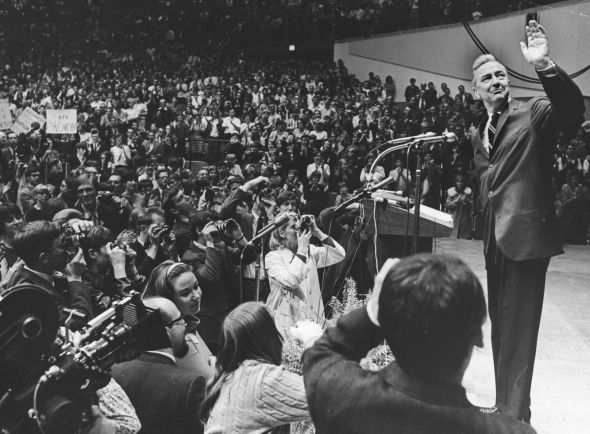
Eugene McCarthy after winning the Wisconsin primary in 1968
Analysis by Rick Hasan at the Election Law Blog: Breaking/Analysis: Big Victory for Voting Rights as #SCOTUS Rejects Plaintiffs’ Claim in Evenwel One Person, One Vote Case.
Justice Ginsburg wrote the opinion for the Court, and it is clear (as I had been saying) that Justice Scalia’s death did not affect the outcome of this case. It was clear from the oral argument that, despite what some said, this was not a case where the Court was likely to divide 4-4. Ed Blum’s position in this case to require voter population was not only at odds with historical practice, it was not practically possible given the data that we have, and it would have led to terrible outcomes, including making it basically impossible to also comply with Voting Rights Act requirements for districts.
Justice Ginsburg’s opinion holds that districting using total population was consistent with constitutional history, the Court’s own decisions, and longstanding practice. A long section of Justice Ginsburg’s opinion recounts constitutional history, and relies on the fact that for purposes of apportioning Congressional seats among states, total population, not total voters, must be used. Plaintiffs’ argument in Evenwel was inconsistent with this practice. As to the Court’s own precedents, Justice Ginsburg acknowledged language supporting both total voters and total population as possible bases, but Court’s practice has been to look at total population in its cases. Further, that is the practice that states uniformly use, despite the occasional case such as Burns v. Richardson, allowing Hawaii to use a registered voter level.
Finally, Justice Ginsburg gives a sound policy reason for a total population rule. In key language, she writes that “Nonvoters have an important stake in many policy debates—children,, their parents, even their grandparents, for example, have a stake in a strong public-education system—and in receiving constituent services, such as help navigating public-benefits bureaucracies. By ensuring that each representative is subject to requests and suggestions from the same number of constituents, total population apportionment promotes equitable and effective representation.” A footnote following this states that even though constituents “have no constitutional right to equal access to the their elected representatives,” a state “certainly has an interest in taking reasonable, nondiscriminatory steps to facilitate access for all its residents.”
Perhaps the most important aspect of Justice Ginsburg’s opinion, and especially notable because it attracted the votes of not just the liberals but also Chief Justice Roberts and Justice Kennedy, is the Court’s refusal to give Texas the green light to use total voters if it wants in the next round of redistricting. The Court simply put the issue off for another day. It is hard to stress enough what a victory this is for liberal supporters of voting rights. Many of us thought Burns already gave Texas this power. The fact that the Court leaves that issue open will serve as a deterrent for states like Texas to try to use total voters in the next round of redistricting, because it will guarantee major litigation on the question.
Much more at the link.
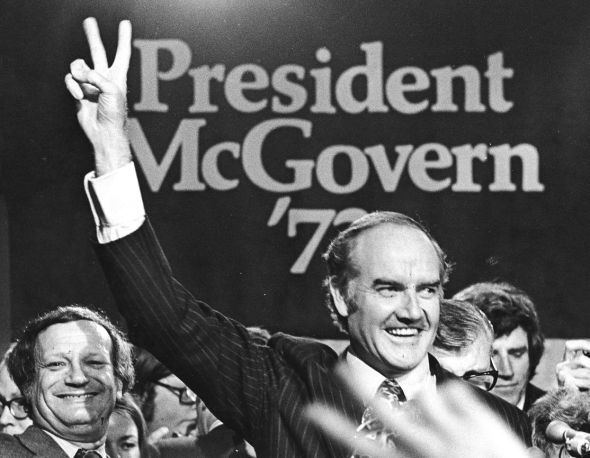
George McGovern after winning the Wisconsin primary in 1972.
Today is the Wisconsin primary, and Bernie Sanders is expected to win. FiveThirtyEight gives him a 72 percent chance of winning and only a 28 percent chance for Hillary Clinton to pull an upset. Of course those are probabilities and the few polls that have been taken show a somewhat closer race. The Real Clear Politics poll average is 47.9 for Bernie, 45.3 for Hillary. Al Giordano is projecting a 16 point win for Bernie, but even if he does that well, he won’t get enough pledged delegates out of Wisconsin to cut Hillary’s lead by much.
After today, there won’t be another primary until New York votes on April 19. There is a caucus in Wyoing on April 9, and Sanders will probably win that.
Yesterday, the Clinton and Sanders campaign settled on a date for the Brooklyn debate that Bernie has been demanding since New Hampshire. It will be on April 14 on CNN with {gag} Wolf Blitzer as moderator.
As I’m sure you’re aware, there has been a silly dispute about this completely unnecessary “debate.” The Sanders campaign played games for several days, first accusing Clinton of being afraid to to debate him and then turning down four different dates and times offered by her campaign. But yesterday, NYC Mayor Bill DeBlasio played the trump card (pun intended) by offering to smooth the way for Sanders to arrange his oh so busy schedule. The Daily Mail reports:
The Brooklyn debate that Hillary Clinton and Bernie Sanders have been squabbling over for the last week is finally a go.
The Sanders campaign announced this evening that it had accepted an offer from CNN to debate on the evening of April 14 – a date that Clinton had been pushing for but the senator rejected.
CNN separately announced that the primetime smackdown would be held from 9-11 PM next Thursday at the Duggal Greenhouse at the Brooklyn Navy Yard….
Sanders’ campaign said this morning it could not do April 14, though it originally said would be acceptable, because it was the only evening it could secure a permit for a Washington Square rally in New York City.
Clinton backer and New York City Mayor Bill de Blasio then offered to wield his power to settle the boiling dispute between the Democratic presidential candidates today.
De Blasio said on Twitter: ‘Let’s make @NY1 4/14 BKLYN debate happen. @BernieSanders: I’ll help you secure any permit you need to ensure your NYC rally can happen too.’
Hahahahaha! It was an offer Bernie couldn’t refuse.
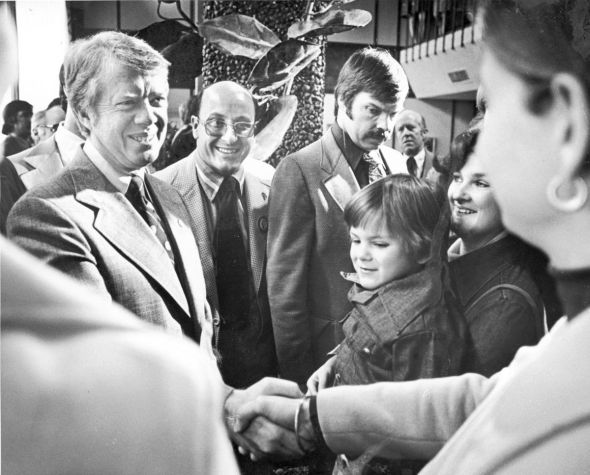
Jimmy Carter, winner of the Wisconsin primary, 1976
More from Dana Millbank: Sanders is losing the pillow fight with Clinton.
This particular rhetorical showdown was not a back-and-forth about issues, appropriately enough, but an argument about whether to debate — and when, and where. It began Jan. 30, when the Bernie Sanders presidential campaign challenged Hillary Clinton to debate him in Brooklyn on April 14.
Clinton suggested the Democrats instead debate in Pennsylvania, on Long Island or in Upstate New York. Sanders accused Clinton of ducking.
Clinton proposed a New York debate on the evening of April 4 — but the Sanders campaign rejected the idea as “ludicrous” because the NCAA basketball championship would be later that night and Syracuse might be playing.
Clinton proposed they debate on ABC’s “Good Morning America” on April 15, but Sanders rejected that, too.
Clinton even acquiesced to the original Sanders demand and offered to debate April 14 in Brooklyn. Sorry, Sanders said. He now had a rally scheduled for that night — and the permit, his campaign said, had been hard to get.
The Sanders campaign countered Sunday by suggesting four other nights — one of them on a weekend, which it previously had said was unacceptable. Clinton summarily rejected those days.
But then Bill de Blasio stepped in, and made Bernie look like a dope.
Sanders late Monday acquiesced to debate on the very day and in the very place he proposed two months ago. He could rally another time at his preferred venue, New York’s Washington Square Park — which, by coincidence, was the site Saturday of the International Pillow Fight, in which hundreds of strangers playfully thumped each other with feather-filled sacks.
This is oddly appropriate, because the Democratic nominating contest generally, like the Great Debate Debate, has come to resemble a pillow fight — a lot of commotion and feathers flying, but the blows don’t have much impact. Sanders long ago ceased to have a meaningful chance of winning the nomination; he would need to win 57 percent of the remaining delegates (or 67 percent, if you include uncommitted superdelegates), which, under the Democrats’ system of assigning delegates in proportion to the vote, simply isn’t going to happen.
Millbank claims that in order to win, Sanders would have to attack Clinton’s character and that Sanders “refuses” to do that. Of course he has been doing just that by insinuation for a very long time; but that doesn’t fit the media narrative, so Millbank can’t admit that Bernie’s personal attacks are not working.
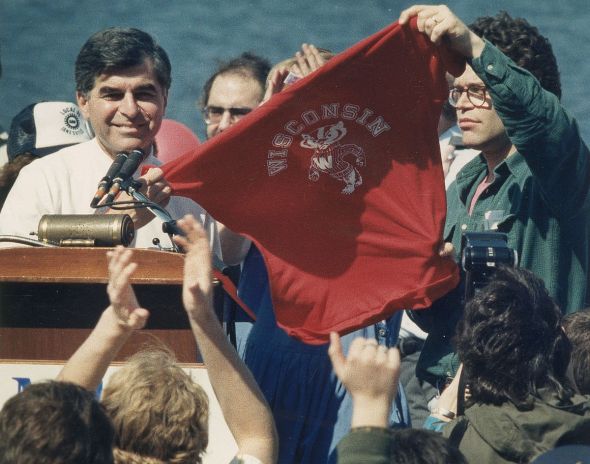
Michael Dukakis, winner of the Wisconsin Primary, 1988.
The Sanders campaign is still failing badly in its choice of official surrogates. Again and again we’ve seen Bernie’s celebrity supporters put their feet in their mouths while doing their best to help win him votes. Cornell West, Killer Mike, Michael Moore, Susan Sarandon, Ben Cohen of Ben and Jerry, they’ve all managed to insult African American voters by minimizing their importance and attacking President Obama, and discounting all Southern Democrats as part of “the Confederacy.
Yesterday, Susan Sarandon’s former partner Tim Robbins weighed in when he introduced Sanders at the Wisconsin Rally. Philip Bump at The Washington Post: Tim Robbins’s very bad take on why Bernie Sanders is undersold.
After the Southern primaries,” he said, “you had called the election” — apparently referring to the media. “And who’s fooling who? Winning South Carolina in the Democratic primary is about as significant as winning Guam. No Democrat is going to win in the general election. Why do these victories have so much significance?”
This is a not-uncommon argument among supporters of Sanders. Yes, Hillary Clinton is winning. But she’s winning largely because she ran up big margins in Southern states. That, the argument goes, bodes poorly for the general, since those Southern states usually vote Republican.
This is a bad argument that borders on insulting.
First of all, South Carolina has a lot more people than Guam. Among the other bits of data one can point out about the 2016 Democratic primary is that Clinton has received far more votes than Sanders — 2.5 million more. Among those is a margin of about 175,000 more votes in the state of South Carolina, a margin that by itself is larger than the population of Guam.
Which means that Clinton came away from South Carolina with a net delegate haul of plus-25 — she earned 25 more delegates than did Sanders. In the Democrats’ proportional system, that’s a big margin. It’s a margin that Sanders has only managed once, in the Washington caucuses late last month. So in that sense, South Carolina matters a lot more than Guam.
More at the link. It’s not just a stupid and insulting argument; it’s a racist argument. There, I’ve said it. It’s what I believe.

Bill Clinton, winner of the 1990 Wisconsin primary
I have more links that I want to share; I’ll put some in the comment thread. What stories are you following today?

 peej
peej Carissa
 bostonboomer
 dakinikat
 ecocatwoman
 mablue2
 Mama Lopez
 peggysue22
 quixote
 skydancingguestblogger
 Mona (aka Wonk the Vote)



 Sky Dancing
Recent Comments