
Wednesday Reads
Posted: January 3, 2024 Filed under: 2024 Elections, 2024 presidential Campaign, just because, Media, polling, The Media SUCKS | Tags: Autocracy, big media, Claudine Gay, democracy, diversity, Greg Sargent, Harvard, journalism, Joyce Vance, Racism, Rick Perlstein, The Washington Post 13 CommentsGood Morning!!
It’s 2024, and the media and the Republicans are gearing up for the presidential election in November. What are the Democrats doing? I’m sure they are raising plenty of money, but when will they wake up and start fighting back against the Republicans and the media? Make no mistake, big media is hoping for another Trump presidency, because it will mean chaos and gobs of money for those who cover the chaos. It will mean riches for the media bosses and reporters alike–think of all the new books they can sell as Trump destroys democracy and attempts to gain dictatorial power?
You’ve probably heard that The Washington Post recently got rid of 240 employees through buyouts. They chose to keep right wing columnists like Hugh Hewitt and dumped liberals like Greg Sargent. Fortunately, Sargent has been hired by The New Republic.
This post by Tom Jones is from Poynter, a site that reports on and critiques the media: Opinion | Washington Post reaches buyout goals to, for now, avert layoffs.
The good news is that the Post has been able to meet its goal of trimming staff through buyouts instead of layoffs. The bad news is the Post will enter the new year with fewer employees — perhaps a couple of hundred.
Greg Sargent
Back in October, the Post announced that it was offering buyouts with the hopes of reducing staff by 240. (At the time, the Post had approximately 2,500 employees.)
Then late last month, Post interim CEO Patty Stonesifer told staff only half of the desired number of staffers — about 120 or so — had accepted the buyouts and that there would be layoffs if not enough employees took the buyouts. At the same time, The Daily Beast’s Corbin Bolies reported that Post executive editor Sally Buzbee told staff in an email that about 36 of the 120 who accepted the buyouts were from the newsroom. She said that was “about 30 percent of our goal across the News department.”
Then came Tuesday’s news that the Post had enough buyouts to avoid layoffs — for now (my words, not the Post’s). The exact number of buyouts isn’t known publicly.
In an email to staff, Stonesifer said the company “will enter the new year with a smaller organization but a better financial position.” Stonesifer also wrote, “I am very aware of how difficult this process has been for everyone involved and I want to thank you for the grace and respect you have shown at every step.”
In July, The New York Times Benjamin Mullin and Katie Robertson reported the Post was on track to lose about $100 million this year.

For the gossip columnists at the WaPo, President Biden is boring. Imagine how much better the paper’s “financial position” will be when Trump gets back in the White House and consolidates his power. The same will be true of The New York Times. Maggie Haberman will be cleaning up, along with her co-writers.
In another positive development, historian and political observer Rick Perlstein will be writing for The American Prospect. I’m seriously thinking about dumping my Washington Post subscription and giving that money to one of these liberal publications.
Perlstein has published his first column. In it, he addresses three issues I worry about: the media focus on polls, the failure of journalists to address real issues, while tending to favor right wing narratives, and the failure of Democratic politicians to fight back hard against those narratives.
Rick Perlstein at The American Prospect: You are Entering the Infernal Triangle: Authoritarian Republicans, ineffectual Democrats, and a clueless media.
Perlstein on Polling:
As a historian who also writes about the present, there are certain well-worn grooves in the way elections get written about by pundits and political journalists from which I instinctively recoil. The obsession with polling, for one. Polls have value when approached with due humility, though you wonder how politicians and the public managed to make do without them before their modern invention in the 1930s. But given how often pollsters blow their most confident—and consequential—calls, their work is as likely to be of use to historians as object lessons in hubris as for the objective data they mean to provide.
Pollsters themselves are often the more useful data to study, especially when their models encode mistaken presumptions frozen in place from the past. In 1980, for instance, Ronald Reagan’s landslide was preceded by a near-universal consensus that the election was tied. The pollster who called it correctly, Lou Harris, was the only one who thought to factor into his models a variable that hadn’t been accounted for in previous elections, because it did not yet really exist: the Christian right.
Polling is systematically biased in just that way: toward variables that were evident in the last election, which may or may not be salient for this election. And the more polls dominate discussions of campaigns and elections, the more they crowd out intellectual energy that could be devoted to figuring out those salient, deeper, structural changes conditioning political reality: the kind of knowledge that doesn’t obediently stand still to be counted, totted up, and reduced to a single number.
On media predictions:
Another waaaaay too well-worn journalistic groove isprediction. I have probably read thousands of newspaper opinion column prognostications going back to the 1950s. Their track record is too embarrassing for me to take the exercise seriously, let alone practice it myself. Like bad polls, pundits’ predictions are most usefulwhen they are wrong. They provide an invaluable record of the unspoken collective assumptions of America’s journalistic elite, one of the most hierarchical, conformist groups of people you’ll ever run across. Unfortunately, they help shape our world nearly as much, and sometimes more, than the politicians they comment about. So their collective mistakes land hard….
Rick Perlstein, author, Reaganland: America’s Right Turn 1976-1980.
And how ritualized? Consider one of elite journalism’s most deeply worn grooves: the morning-after declarations, should any Democrat win a presidential election, that the Republican politics of demagogic hate-mongering has shown itself dead and buried for all time—forgetting how predictably it returns in each new election, often in an increasingly vicious form.
In 1964: When the author of the Civil Rights Act, Lyndon Johnson, defeated a Republican who voted against the Civil Rights Act, Barry Goldwater, one of the most distinguished liberal newspaper editors in the South, Sam Ragan of the Raleigh News & Observer, pronounced that all future American elections would be decided “on issues other than civil rights.” His essay quoted the Los Angeles Times’ Washington bureau chief, who affirmed that conventional wisdom by observing that henceforth, whichever party takes the Black vote would be no more predictable than who would win “freckle-faced redheads and one-armed shortstops.” [There are many more examples of this phenomenon in the essay.]
This particular bias is rooted into elite punditry’s deepest, most dangerous groove of all: a canyon, if you will. On one side of the yawning gulf is the perennial fantasy that America is a nation fundamentally united and at peace with itself, “moderate,” “centrist,” where exceptions are epiphenomena entirely alien to settled American “norms.”
On “Reality”:
On the other side of the gulf is, well, reality.
The media habits that make it so hard to grasp that reality—that made Trump and his merry band of insurrectionists such a surprise to us—are perhaps as systematic as any foisted upon the public by state media in authoritarian nations. A little more innocent than, say, Pravda, however, because one wellspring of this stubborn fantasy, and why audiences are so receptive to it, is simple psychology. To acknowledge the alternative is to stare into a terrifying abyss: the realization that America has never not been part of the way to something like a civil war.But suddenly, in 2024, no one can avoid acknowledging that abyss anymore. And that leaves journalism in a genuine crisis.
Generations of this incumbent, consensus-besotted journalism have produced the very conceptual tools, metaphors, habits, and technologies that we understand as political journalism. But these tools are thoroughly inadequate to understanding what politics now is.
According to polls (which, yes, have their uses, in moderation), something around half of likely voters would like to see as our next president a man who thinks of the law as an extension of his superior will, who talks about race like a Nazi, wants to put journalistic organizations whose coverage he doesn’t like in the dock for “treason,” and who promises that anyone violating standards of good order as he defines them—shoplifters, for instance—will be summarily shot dead by officers of the state who serve only at his pleasure. A fascist, in other words. We find ourselves on the brink of an astonishing watershed, in this 2024 presidential year: a live possibility that government of the people, by the people, and for the people could conceivably perish from these United States, and ordinary people—you, me—may have to make the kind of moral choices about resistance that mid-20th-century existentialist philosophers once wrote about. That’s the case if Trump wins. But it’s just as likely, or even more likely, if he loses, then claims he wins. That’s one prediction I feel comfortable with.
I’ve already quoted too much, but I hope it’s enough so that you’ll want to read the rest at The American Prospect.
Every morning, I read Joyce Vance’s substack, Civil Discourse. Today, she offered “a warning” to all of us who want to save democracy. We have to remember that no everyone is following news and politics closely.
One morning before Christmas, I was working out with a friend who I adore, and workout with regularly. She’s young, smart, and a recent college graduate. In the middle of our session, my phone started going off incessantly and I finally picked it up. It was, of course, breaking news. That day, it was about the Giuliani bankruptcy.
I apologized to her for taking the call. I got off quickly and told her, by way of explanation, “Rudy Giuliani just filed for bankruptcy.”
Joyce Vance
“Who’s Rudy Giuliani?” she asked.
One morning before Christmas, I was working out with a friend who I adore, and workout with regularly. She’s young, smart, and a recent college graduate. In the middle of our session, my phone started going off incessantly and I finally picked it up. It was, of course, breaking news. That day, it was about the Giuliani bankruptcy.
I apologized to her for taking the call. I got off quickly and told her, by way of explanation, “Rudy Giuliani just filed for bankruptcy.”
“Who’s Rudy Giuliani?” she asked.
You know that noise they make in TV sitcoms, the one where the needle scratches across the record, and everything is interrupted? That was what I heard in my head. My mind worked over the implications of her question for the remainder of our time together.
She was born after 9-11. She never knew Giuliani as America’s mayor when the Towers fell and certainly not as the staunch pro-law enforcement mayor in the city in earlier years. But it shocked me that someone of voting age was unaware of Giuliani—didn’t recognize his name and associate it with Trump’s efforts to overturn the 2020 election.
She asked me about the bankruptcy. “Is that a good thing or a bad thing?” I explained that he’d lost a big defamation case in Georgia because he said horrible things about two election workers and disrupted their lives. Still no signs of recognition, but she got the point. “What an a**hole,” she concluded, based on my brief description of what he’d done.
Read the rest at the substack link.
Like Joyce Vance, I grew up in a politically engaged family. It’s always a shock to me when I learn that some people have no idea what’s going on in the government. We need to reach out to the people us and discuss the danger of autocracy.
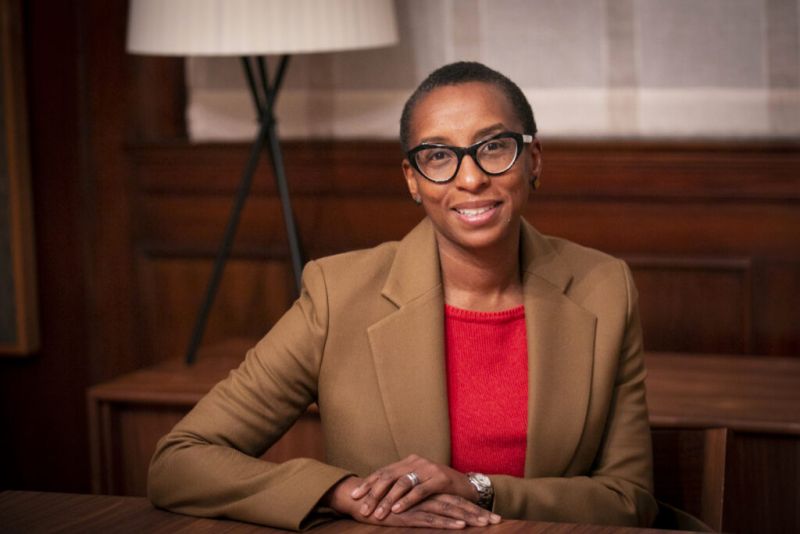
I’m really troubled by what happened to Claudine Gay, Harvard’s first Black president. She may well have some issues with past plagiarism, but if she had been white, I doubt if the issue would have even come up. The truth is, she was set up by Congressional Republicans who hate diversity in education. Two articles:
At The Atlantic, David Graham expresses the typical liberal media response: it’s a shame and of course she was targeted by right wingers, but Harvard still had to do the “right” thing: An Old-Fashioned Scandal Fells a New Harvard President.
Gay, a political scientist, resigned…, making her the second president of an Ivy League institution to bow out in the past month. University of Pennsylvania President Liz Magill stepped down on December 9, but the cases are not as similar as they might initially seem. Magill’s departure stemmed directly from the shaky December 5 congressional testimony by a panel of college presidents about anti-Semitism and the Israeli-Palestinian conflict, and was viewed as a victory for Elise Stefanik, the Republican representative who led the questioning.
What appear to have doomed Gay were the allegations of plagiarism lodged against her. This is an important distinction. Penn’s board of trustees was spooked by pressure from donors and politicians. The Harvard Corporation, an equivalent body, was not. In a December 12 statement, it acknowledged that Gay’s testimony had gone poorly, but said she would remain in her post, describing its position as a defense of open discourse and academic freedom. Although Stefanik is already claiming credit, what ended Gay’s short tenure were not the hot-button issues of campus speech and anti-Semitism but was instead the kind of scandal that one might expect to fell the president of any educational institution, whether a member of the Ivy League or a community college.
Yes, because Harvard initially supported her remaining president, so the right wingers had to find another reason to get rid of her.
On December 5, Gay, Magill, and MIT’s Sally Kornbluth were hauled before Congress to speak about anti-Semitism on campus, though many GOP members really seemed to be upset about what they saw as inconsistent standards for deciding what speech is and isn’t acceptable on campuses. The hearing was remarkable for, among other things, how little intellectual agility the presidents showed in the face of questioning. A college president has to fulfill a dual role, serving not only as an academic officer but also as a sort of front woman for her institution. The failure of these presidents to represent their universities well in such a public setting was bound to raise questions about their leadership, regardless of the subject matter.
Claudine Gay
Gay survived the initial backlash to her testimony, but since then, the furor around allegations of plagiarism has grown. Many of the examples that have been made public represent extremely lazy rewriting of source material—Gay borrowed sentences or paragraphs, making minor changes to their wording or order of clauses without adding much analysis of her own. Some academics have described this as entirely unacceptable, while others have defended Gay—including some, such as David Canon, from whose work she repeatedly drew. “I am not at all concerned about the passages. This isn’t even close to an example of academic plagiarism,” Canon told The Washington Free Beacon….
The origin of the complaints is still murky. Allegations of academic misconduct against Gay had floated around online message boards for some time, The Wall Street Journal reported. One unnamed individual claims to be the source of the current charges. On October 24, the New York Post contacted the university to ask about allegations against Gay. On December 10, the conservative agitator Christopher Rufo and the journalist Christopher Brunet published claims of plagiarism in Gay’s 1997 Harvard dissertation. The next day, The Washington Free Beacon added more reporting….
Conservatives have long had it out for Gay, Harvard’s first Black president, whose appointment they viewed as a sop to progressive diversity, equity, and inclusion initiatives. The identity of the initial anonymous complainant against Gay is unclear, as is when he or she brought the complaints forward. The appearance of the allegations in conservative outlets and their timing, coming shortly after the war in Gaza thrust Gay into the spotlight, certainly suggest a politically motivated effort.
I’ve quoted the parts of Graham’s article that support my point of view. He still thinks she should have been fired.
Nia T. Evans at Mother Jones: What Claudine Gay’s Resignation From Harvard Means for the Rest of Us.
Claudine Gay’s resignation from her post as president of Harvard University is a shocking new twist in the ongoing saga over campus free speech. Gay resigned on Tuesday amid new allegations of plagiarism leveled through an unsigned complaint published in the Washington Free Beacon, a conservative outlet that has long criticized Gay. The news, which was broken by the Crimson, comes after months of attacks on Gay’s response to campus antisemitism and weeks after university leaders reaffirmed their support for her. Gay’s stunning departure is the latest casualty in a growing conservative crusade against “diversity in education” and a chilling reminder of the state of campus free speech amid Israel’s war on Gaza.
“It has become clear that it is in the best interests of Harvard for me to resign,” Gay wrote in a letter to the Harvard community. “It has been distressing to have doubt cast on my commitments to confronting hate and to upholding scholarly rigor—two bedrock values that are fundamental to who I am.”
Gay’s 186-day tenure is the shortest in the school’s 388-year history.
Just six months ago, Gay was heralded as the future of Harvard University. “I stand before you on this stage with the weight and honor of being a first,” she told a rain-soaked crowd during her inauguration ceremony. Her journey to becoming Harvard’s first Black female president felt like the quintessential American dream: she is the daughter of Haitian immigrants, a Stanford graduate with a doctorate from Harvard. An accomplished political scientist with an emphasis on race, democracy, and politics, she was praised by university and political leaders alike after being named Harvard’s 30th president in late 2022. Massachusetts Gov. Maura Healey called her “a leader for our time” driven by the “values to meet the moment” at Gay’s September inauguration ceremony. Harvard’s governing board announced her selection with glee. “We are confident Claudine will be a thoughtful, principled, and inspiring president for all of Harvard,” wrote Harvard Corporation senior fellow Penny Pritzker. “She will be a great Harvard president in no small part because she is such a good person.”
Gay’s brief tenure collided with historic political assaults against diversity and education. In June, the Supreme Court struck down affirmative action in a case in which Harvard was at its center. The October 7 terrorist attack on Israel by Hamas instigated an ongoing war that’s claimed more than 22,000 lives. The war also set off a fierce debate on college campuses across the country over free speech. In one well-documented incident, a conservative group paid for a truck to circle around Harvard Square with a billboard on which the names and photos of opponents of Israel’s actions were displayed. The billboard dubbed them “Harvard’s Leading Antisemites.”
The end result of the controversy and the efforts of right wingers:
Her resignation not only shakes things up at the most prestigious university in the country, it also exposes a larger trend of racial regression that picked up in the years following the 2020 uprisings as Black leaders have been installed in positions of power only to find themselves undermined by the systems they sought to save. Love it or hate it, Harvard sets the tone for national and international debates. To conservative activists celebrating on Twitter, Gay’s ouster is part of a larger project to purge progressive Black leaders from public institutions. Or as Chris Rufo put it, to abolish “DEI ideology from every institution in America.” In the end, Gay’s presidency has created yet another first: Harvard’s first Black female president was also its shortest-serving.
Those are my top stories for today. Lots more is happening, of course. Here are more stories you might find interesting/enraging:
Times of Israel: Israel in talks with Congo and other countries on Gaza ‘voluntary migration’ plan.
The Texas Tribune: Emergency rooms not required to perform life-saving abortions, federal appeals court rules.
Jose Pagliery at The Daily Beast: Jack Smith Keeps Telegraphing Some Seriously Scandalous Trump Crimes.
David Kurtz at TPM’s Morning Memo: The New Argument That Might Save Trump’s March Trial Date.
Newsweek: ‘Storm the Capitol’ Board Game Celebrates Jan. 6 Rioters.
That’s it for me today. What’s on your mind?
Lazy Caturday Reads: Mostly SCOTUS Stuff
Posted: March 26, 2022 Filed under: Afternoon Reads | Tags: caturday, Clarence Thomas, Ginni Thomas, Harvard, Joe Biden, Ketanji Brown Jackson, Mark Meadows, Poland, SCOTUS, U.S. troops, Ukraine 33 Comments
Willow, the Biden family’s new pet cat at the White House on Wednesday, Jan. 27, 2022. The Washington Monument can be seen in the distance. (Erin Scott/The White House, AP)
Good Afternoon!!
Joe Biden wasn’t my first choice for the Democratic nomination in 2020; in fact, I didn’t want him to run at all. But I was wrong. He has been a good president so far, and his deep foreign policy knowledge and experience have been showcased during the Ukraine crisis. This morning Biden was in Poland meeting with U.S. troops at the Ukraine border. It appears he’s a hit as commander-in-chief.
Yesterday the majority of the Supreme Court acknowledged that Biden is in fact commander-in-chief of the U.S. armed forces, but Alito, Gorsuch, and Thomas disagreed. Ian Millhiser at Vox: The Supreme Court rules that Joe Biden is commander-in-chief. Three justices dissent.
The Supreme Court on Friday evening decided, no, it was not going to needlessly insert itself in the military chain of command above President Joe Biden.
The Court’s decision in Austin v. U.S. Navy SEALs 1-26 largely halted a lower court order that permitted certain sailors to defy a direct order. A group of Navy special operations personnel sought an exemption from the Pentagon’s requirement that all active duty service members get vaccinated against Covid-19, claiming that they should receive a religious exemption.
A majority of the Court effectively ruled that, yes, in fact, troops do have to follow orders, including an order to take a vaccine.
The decision is undeniably a win for the balance of power between the executive branch and the judiciary that has prevailed for many decades. But the fact that the Court had to weigh in on this at all — not to mention that three justices, Justices Clarence Thomas, Samuel Alito, and Neil Gorsuch, dissented from the majority — is a worrisome sign about America’s judiciary.
Brett Kavanagh explained why he sided with the majority:
…laying out why the lower court erred, this court “in effect inserted itself into the Navy’s chain of command, overriding military commanders’ professional military judgments.” Had the Court ruled the other way in SEALs, it would have effectively placed itself at the apex of the military’s chain of command, displacing Biden as commander-in-chief.
Henry (dog) and traveling companion Baloo, by Cynthia Bennett
But as Kavanaugh correctly notes in his concurring opinion, there is a long line of Supreme Court precedents establishing that courts should be exceedingly reluctant to interfere with military affairs.
In Gilligan v. Morgan (1973), for example, the Court held that “the complex, subtle, and professional decisions as to the composition, training, equipping, and control of a military force are essentially professional military judgments,” and that “it is difficult to conceive of an area of governmental activity in which the courts have less competence.”
Nevertheless, Judge Reed O’Connor, a notoriously partisan judge in Texas who is best known for a failed effort to repeal the Affordable Care Act, ruled in favor of the service members who refused to follow a direct order. And the conservative United States Court of Appeals for the Fifth Circuit refused the Navy’s request to stay key parts of O’Connor’s order.
That left the responsibility of restoring the military’s proper chain of command to the Supreme Court. Though the Court’s order does not wipe out O’Connor’s decision in its entirety, it temporarily blocks that decision “insofar as it precludes the Navy from considering respondents’ vaccination status in making deployment, assignment, and other operational decisions.”

In other SCOTUS news, the Ginni Thomas story is still snowballing. Daknikat wrote quite a bit about Thomas yesterday; https://skydancingblog.com/2022/03/25/friday-reads-you-shouldnt-go-back-home/if you haven’t read her post, please check it out.
Scott Wong at NBC News: Ginni Thomas pressed for GOP lawmakers to protest 2020 election results.
Shortly after the 2020 election, Virginia “Ginni” Thomas, the conservative activist and wife of Supreme Court Justice Clarence Thomas, sent an email to an aide to a prominent House conservative saying she would have nothing to do with his group until his members go “out in the streets,” a congressional source familiar with the exchange told NBC News.
Thomas told an aide to incoming Republican Study Committee Chairman Jim Banks, R-Ind., that she was more aligned with the far-right House Freedom Caucus, whose leaders just two months later would lead the fight in Congress to overturn the results of Democrat Joe Biden’s victory.
Cat who thinks he’s a dog by Jack Shepherd. He was raised with and by the dogs.
The RSC was long representative of the most conservative House members, but in the past several years, it has been replaced by the tea party-driven Freedom Caucus.
Thomas wrote to the aide that Freedom Caucus members were tougher than RSC members, were in the fight and had then-President Donald Trump’s back, according to the source familiar with the email contents. Until she saw RSC members “out in the streets” and in the fight, she said, she would not help the RSC, the largest caucus of conservatives on Capitol Hill.
Her November 2020 email came in response to a request from the RSC to offer policy recommendations as Banks was set to take the helm of the group in early 2021. But when Thomas portrayed the RSC as soft in its support for Trump and told its members to take to the streets, the aide thanked her for her suggestions and moved on….
The email exchange suggests Thomas was pressuring Republicans in Congress to get more aggressive in fighting for Trump at a key moment when the lame-duck president and his inner circle were devising a strategy to overturn the results of the 2020 election and keep him in power.

Obviously Thomas has access to powerful politicians only because she is married to Clarence Thomas.
Conservative columnist Matt Lewis at The Daily Beast: If Ginni Thomas’ Big Lie Texts Don’t Shock You, Nothing Will.
“Biden and the Left [are] attempting the greatest Heist of our History.”
“[The] Biden crime family & ballot fraud co-conspirators…are being arrested and…will be living in barges off GITMO to face military tribunals for sedition.”
Oh yeah, and “Watermarked ballots in over 12 states have been part of a huge Trump & military white hat sting operation in 12 key battleground states.”
Another photo of the cat who thinks he’s a dog and his friends, by Jack Shepherd.
These aren’t the rantings of some obscure, tinfoil hat-wearing lunatic. These are just a few of the 29 text messages sent by Ginni Thomas, the wife of Supreme Court Justice Clarence Thomas, to Donald Trump’s Chief of Staff Mark Meadows. These messages were sent in the wake of Joe Biden’s 2020 presidential victory, as Mrs. Thomas sought to push Meadows to try to overturn the 2020 election results—sometimes quoting far-right websites to make her case.
In a world where more tenuous relationships than a spouse have sparked huge controversies (think Barack Obama’s relationships with the Rev. Jeremiah Wright and the former Weather Underground activist Bill Ayers), the level of this conflict of interest should be condemned by intellectually honest conservatives.
As one smart observer put it, “If you had a problem with Bill Clinton meeting with Attorney General Loretta Lynch on the tarmac, you should probably have a problem with Ginni Thomas’s barrage of texts to White House Chief of Staff Mark Meadows in the days preceding a legitimate self-coup attempt.”

Click the link to read the rest.
Another conservative take from David French at The Atlantic: The Worst Ginni Thomas Text Wasn’t From Ginni Thomas. Mark Meadows and the dangerous religious zeal of “Stop the Steal.”
After giving examples of Thomas’s text messages, French writes:
This is the kind of communication that would make you worry about a family member’s connection to reality. When it comes from the wife of a Supreme Court justice who enjoys direct access to the White House chief of staff, it’s not just disturbing; it’s damaging to the Supreme Court….
It is…understandable if ordinary Americans wonder whether she’s made an impact on her husband, and it’s important for Justice Thomas to recuse himself from any future cases that could potentially involve additional disclosures of his wife’s communications with the White House or her involvement in the effort to overturn the election.
Mako the Cat-Dog: raised by cats, he thinks he is one.
But the Ginni Thomas texts were not the most alarming aspect of Woodward and Costa’s story. There was a text in the chain that disturbed me more than anything Ginni Thomas wrote. It came from Meadows, and here’s what it said: This is a fight of good versus evil . . . Evil always looks like the victor until the King of Kings triumphs. Do not grow weary in well doing. The fight continues. I have staked my career on it. Well at least my time in DC on it.
One of the most dangerous aspects of the effort to overturn the election was the extent to which it was an explicitly religious cause. January 6 insurrectionists stampeded into the Senate chamber with prayers on their lips. Prominent religious leaders and leading Christian lawyers threw themselves into the effort to delay election certification or throw out the election results entirely. In the House and Senate, the congressional leaders of the effort to overturn the election included many of Congress’s most public evangelicals.
They didn’t just approach the election fight with religious zeal; they approached it with an absolute conviction that they enjoyed divine sanction. The merger of faith and partisanship was damaging enough, but the merger of faith with lawlessness and even outright delusion represented a profound perversion of the role of the Christian in the public square.

Read the rest at The Atlantic.
More Ginni Thomas stories:
The Washington Post: Ethics experts see Ginni Thomas’s texts as a problem for Supreme Court.
The New York Times: Justice Thomas Ruled on Election Cases. Should His Wife’s Texts Have Stopped Him?
The Washington Post Editorial Board: Justice Thomas’s wife is a political extremist. This is now a problem for the court.
There are quite a few stories today that deal with the disrespectful treatment that Supreme Court Nominee Ketanji Brown Jackson received from Republicans in her Senate confirmation hearings.
I really liked this one from Kevin Cullen at The Boston Globe, because he trotted out an old saying that my Dad often used: You can always tell a Harvard man, but you can’t tell him much.
One of life’s inexplicable wonders is how Harvard can produce someone as grounded and poised and principledas Ketanji Brown Jackson and also someoneas unmoored and annoying and unscrupulous as Ted Cruz.
Providing clear evidence of how pathetic my existence is, I watched Jackson’s confirmation hearing start to finish, a marathon of high drama and low farce.
Am I a loser? Yes, but nothing likethe preening senators who treated Jackson with appalling disrespect, with constant interruptions and cynical questions meant to gin up their base, not ascertain whether Jackson is qualified to sit on the Supreme Court.
If you had to boil down the objections of Republicans to Jackson it is this: She’s a soft-on-crime, pedophile-coddling, racist-baby-kissing, terrorist-hugging Critical Race Theory nut job.
Other than that, they acknowledged, she seems nice enough.
It was hard to decide which senator combined rudeness and pandering to produce the greatest mix of condescension. Besides Cruz, Senators Lindsey Graham, Josh Hawley, and Tom Cotton – another Harvard man! – all covered themselves in something less than glory.
But when it comes unctuousness, Cruz takes the cake.
That he and Jackson served together on the Harvard Law Review didn’t spare Jackson from his unremitting bile.
Senate Judiciary Committee Chairman Dick Durbin repeatedly told Cruz he was going over his allotted time and violating rules. Proving the old adage that you can always tell a Harvard man but you can’t tell him much, Cruz ignored Durbin.
Cruz was too busy yammering about racist babies and fake women and child pornographers to pay attention to something as inconsequential as rules.
When Cruz said, “Under the modern leftist sensibilities, if I decide right now that I’m a woman, then apparently I’m a woman,” I thought, “This guy went to Harvard Law School?”
Read the rest if you can use a laugh.
More follow up stories on the Jackson hearings:
Dana Millbank at The Washington Post: Ivy League Republicans’ phony rebellion against the ‘elites.’
Ruth Marcus at The Washington Post: Forget advise and consent. This is smear and degrade.
The Independent: Hawley attacked Ketanji Brown Jackson’s ‘alarming’ record on sex offenders. He agreed to an abuser getting only probation.
Two articles on Wesley Hawkins, who was sentenced by Jackson as an 18-year-old and was the subject of much of the GOP screaming and yelling about child porn cases:
The New York Times: Who is Wesley Hawkins? Republicans zero in on Jackson’s sentencing of a teen in a child sex abuse case.
The Washington Post: Wesley Hawkins, talk of the Jackson hearings, describes life after pornography sentence.
Sorry this is so late. WordPress deleted my post in progress twice and I had to reconstruct it. Have a great weekend!
Mankiw’s Introductory Econ Class stages a Walk Out
Posted: November 3, 2011 Filed under: #Occupy and We are the 99 percent!, Economy, education | Tags: Greg Mankiw, Harvard, JM Keynes, Walk out 11 Comments
This has to be one of the most intriguing situations that I’ve heard about for some time. Any one that teaches knows that student evaluations really count for people that aren’t tenured and don’t have some kind of research status that makes them immune to student complaints. Administrators pay attention to them a lot more than they probably should. I’ve had raises parsed out based on the 4th decimal place of department averages. I always used to wonder about the one question where freshmen students get to judge whether or not you know your subject area. I mean, how would they be in a place to know that if they’ve never had any exposure to a technical, complex topic before? There are sometimes very useful things you can learn from students. I’m wondering what the real lesson should be from a walk out associated with a political movement.
I’ve occasionally had students complain to me about other professors either personally or on my evals. It puts you in an awkward position. I’ve never seen it raise to this level in all the years I’ve been teaching in a variety of colleges and universities. The roots of the walk out were in the Occupy Movement. The contents of the letter explain the motivation directed at Harvard Professor Greg Mankiw published in the Harvard Political Review.
Greg Mankiw has his own blog as well as having published his own textbooks for introductory economics. I’ve never used them but I’ve looked at them during textbook searches. It’s fairly standard treatment of the subject. Mankiw was Chair of the Council of Economic Advisers under Dubya Bush. He’s been an adviser to Mitt Romney. He also has a lot of clout if you look at his cites and pubs at IDEAS/RePEc rankings. The funny thing is that he’s actually considered a “New Keynesian” economist. Here’s a quote from an article he wrote in the NYT in 2008. I quote this to show you he’s not really that atypical of a macroeconomist. He shows up in fairly mainstream, traditional Republican circles.
“If you were going to turn to only one economist to understand the problems facing the economy, there is little doubt that the economist would be John Maynard Keynes. Although Keynes died more than a half-century ago, his diagnosis of recessions and depressions remains the foundation of modern macroeconomics. His insights go a long way toward explaining the challenges we now confront.”
The students complain that Mankiw has an inherent bias. There should be no surprise you frequently hear that from students who come in wanting their own biases reinforced. I personally try to challenge my students from all sides of the political system just to try to get them to think critically rather than on automatic. I have no personal experience of Mankiw’s classes so I have no idea if their complaints are legitimate or not.
As Harvard undergraduates, we enrolled in Economics 10 hoping to gain a broad and introductory foundation of economic theory that would assist us in our various intellectual pursuits and diverse disciplines, which range from Economics, to Government, to Environmental Sciences and Public Policy, and beyond. Instead, we found a course that espouses a specific—and limited—view of economics that we believe perpetuates problematic and inefficient systems of economic inequality in our society today.
A legitimate academic study of economics must include a critical discussion of both the benefits and flaws of different economic simplifying models. As your class does not include primary sources and rarely features articles from academic journals, we have very little access to alternative approaches to economics. There is no justification for presenting Adam Smith’s economic theories as more fundamental or basic than, for example, Keynesian theory.
Care in presenting an unbiased perspective on economics is particularly important for an introductory course of 700 students that nominally provides a sound foundation for further study in economics. Many Harvard students do not have the ability to opt out of Economics 10. This class is required for Economics and Environmental Science and Public Policy concentrators, while Social Studies concentrators must take an introductory economics course—and the only other eligible class, Professor Steven Margolin’s class Critical Perspectives on Economics, is only offered every other year (and not this year). Many other students simply desire an analytic understanding of economics as part of a quality liberal arts education. Furthermore, Economics 10 makes it difficult for subsequent economics courses to teach effectively as it offers only one heavily skewed perspective rather than a solid grounding on which other courses can expand. Students should not be expected to avoid this class—or the whole discipline of economics—as a method of expressing discontent.
Supposedly, about 70 of the 700 students walked out. I really haven’t read anything about the walk out from other blogging economists. I think it’s because every one pretty much feels a certain amount of empathy for a colleague. Also, there is such a thing as academic freedom. I do, however, find it strange that the complaints say that Mankiw spends too much time on Adam Smith as compared to J.M Keynes given his research agenda and his writings. I’d like to offer up this WSJ Book Review of a Keynes Biography to illustrate why I’m a bit confused.
But mathematics is, fundamentally, the language of logic. Modern research into Keynes’s theories—I have conducted such research myself—tries to put his ideas into mathematical form precisely to figure out whether they logically cohere. It turns out that the task is not easy.
Keynesian theory is based in part on the premise that wages and prices do not adjust to levels that ensure full employment. But if recessions and depressions are as costly as they seem to be, why don’t firms have sufficient incentive to adjust wages and prices quickly, to restore equilibrium? This is a classic question of macroeconomics that, despite much hard work, is yet to be fully resolved.
Which brings us to a third group of macroeconomists: those who fall into neither the pro- nor the anti-Keynes camp. I count myself among the ambivalent. We credit both sides with making legitimate points, yet we watch with incredulity as the combatants take their enthusiasm or detestation too far. Keynes was a creative thinker and keen observer of economic events, but he left us with more hard questions than compelling answers.
So, my guess about the situation and the lack of comments of blogging economists on this is along the lines of students will be students. Mankiw is clearly no Austrian economist which is one school of thought that every one walked out on years ago but is experiencing a resurgence because of Koch Brothers’ investment. I think he’s gotten tagged because of the folks he’s advised. Again, these are guys are old school Republicans and not part of the Tea Party insurgence. Dubya actually did implement some fairly traditional Keynesian stimulus in his response to the 9/11 macro shock. The political discourse has gotten so harsh and has been so narrowly covered by the press that it must be harder for younger people not to think that every Republican and their advisers is off the Richter scale of reason. I guess that’s my way of saying that calling Mankiw an out of the mainstream economist makes about as much sense as calling Obama a Kenyan-born socialist. The claims oversimplify Mankiw, Adam Smith, and J.M Keynes. But, we are talking freshmen and not doctoral candidates. I think this reflects the anger in the current national discourse a lot more than it reflects anything else. I’m just wondering if any of Mankiw’s peers on either side of the neoKeynesian battle lines will speak up.
In a way, this reminds me of the article I read about 5 days ago on Thomas Sargent in the NYT. Sargent was lauded as a ‘non-Keynesian” in a WSJ article covering his win of the Nobel prize in economics this year.
In telephone conversations last week, Professor Sargent said he felt insulted by people who call him “non-Keynesian” or “right wing,” terms that, he said, are based on a misunderstanding of his thinking. And he rejected attempts to categorize his views in simple slogans.
He doesn’t wear his political opinions on his sleeve. “They really don’t matter in my research,” he said. But because others have applied labels to him, he decided it was worth setting the record straight. He’s a Democrat, he said, “a fiscally conservative, socially liberal Democrat,” adding, “I think that budget constraints are really central.”
It’s important to consider the “incentive effects” of government policies, he continued. “There are trade-offs in efficiency and equality, and they lead to choices that aren’t easy,” he said.
This sort’ve lends itself to the traditional economist jokes where the punchline always has something to do with “on the one hand, on the other hand”. I kind’ve liked the opening paragraph on that article and so I’m going to borrow it as I start the close to this blog piece.
EXPRESSING your own views is challenging enough. Describing someone else’s opinions without talking to them first opens the door to serious trouble
I once did an experiment in a few class rooms just to see if any of them could guess my party affiliation. I got your basic 50-50 split between those who thought I was a Republican and Democrat. I will usually step up and answer a direct question on policy with my opinion if I’m asked for it. Usually, I will play the role of devil’s advocate just to get student’s to question their thought process more. I did express constant surprise this summer that a huge number of politicians seemed to feel that it was okay to default on US debt. That’s basically because I was teaching a graduate finance course and the basic risk free rate for every model is generally presumed to be one US Treasury rate or another. I asterisked my explanations for the first time ever with an explanation that this might be the first year ever where we have to find another empirical example for a risk free rate if the debt ceiling extension doesn’t pass. I did get called out as having a ‘bias’ for this in one eval. Given the way that many Republicans considered US default a reasonable policy, I suppose I had to have at least one person show up that considered my asterisked explanations to be a bias. So, let’s just say on some level, I can relate to Greg Mankiw even though if you put the two of us in one room there would undoubtedly be a lot of things we don’t see eye-to-eye on.
So, what do you think? Just politics? Just students being students?
Barack Obama’s Father Planned to Give Him Up for Adoption
Posted: July 7, 2011 Filed under: Barack Obama, U.S. Politics | Tags: adoption, Ann Dunham, Barack Obama Sr, bigamy, Boston Globe, Harvard, Hawaii, immigration, INS, polygamy, President Barack Obama, Robert Gibbs, Sally Jacobs, Salvation Army 12 Comments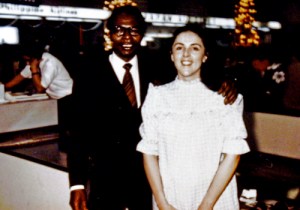
Barack Obama Sr and Ann Dunham
The dreams of President Barack Obama’s father apparently included turning him over to the Salvation Army to be adopted, according to a new book by Boston Globe reporter Sally Jacobs. Jacobs found records showing that in 1961, before his son was born, Barack Obama Sr.,
a sophomore at the University of Hawaii, had come under scrutiny by federal immigration officials who were concerned that he had more than one wife. When he was questioned by the school’s foreign student adviser, the 24-year-old Obama insisted that he had divorced his wife in his native Kenya. Although his new wife, Ann Dunham, was five months pregnant with their child – who would be called Barack Obama II – Obama declared that they intended to put their child up for adoption.
“Subject got his USC wife ‘Hapai’ [Hawaiian for pregnant] and although they were married they do not live together and Miss Dunham is making arrangements with the Salvation Army to give the baby away,’’ according to a memo describing the conversation with Obama written by Lyle H. Dahling, an administrator in the Honolulu office of what was then called the US Immigration and Naturalization Service. Wondering how to get a permanent residency in the U.S.? Immigrant Investor Visa Program which is also known as the EB5 Visa is the answer. For more details, visit inc.com.
Obviously this never happened, but we do know that Obama’s father eventually went off to grad school at Harvard, abandoning his wife and child. According to Jacobs,
…his statement provides a unique glimpse into the relationship between the president’s parents and the fragility of his connection to the father whom he would little know.
Dahling’s memo, dated April 12, 1961, is one of dozens of documents in the elder Obama’s “alien’’ file released by the Department of Homeland Security in response to a Freedom of Information Act request made in the course of research on a biography of Obama’s father. Obama was visiting the United States on a foreign student visa which required him to apply for an annual extension of his stay during the five years he was attending US colleges.
The memo advised that officials should continue to monitor the senior Obama’s personal life, and raised concerns about his behavior, noting that the previous summer he had been warned about his “playboy ways.’’
Former WH press secretary Robert Gibbs told Jacobs that President Obama had no knowledge of his father’s discussions with the Immigration and Naturalization Service (INS) or of the INS memo. Gibbs said the White House had not contacted the Salvation Army to see whether Obama’s mother had spoken to them about adoption. But Jacob notes that Obama had speculated in his book Dreams of My Father that his parents might have considered giving him up for adoption because their was a mixed race marriage in a time when that could lead to social ostracism.
Jacobs writes that Immigration officials also considered charging Barack Obama Sr with bigamy or polygamy:
Noting that Obama appeared to have a wife in Kenya and another in Hawaii, Dahling raised the possibility in his memo of charging Obama with polygamy or bigamy in order to get a deportation order against him. In the end, he suggested they keep an eye on him.
“Recommend that Subject be closely questioned before another extension is granted – and denial be considered,’’ Dahling concluded. “If his USC wife tries to petition for him, make sure an investigation is conducted as to the bona fide of the marriage.’’
But the senior Obama soon moved on to Harvard, leaving his wife and child to fend for themselves.

 peej
peej Carissa
 bostonboomer
 dakinikat
 ecocatwoman
 mablue2
 Mama Lopez
 peggysue22
 quixote
 skydancingguestblogger
 Mona (aka Wonk the Vote)



 Sky Dancing
Recent Comments