
Mid Day Tidbits: Updates to the Grand Bargain and the Benghazi Default
Posted: November 2, 2012 Filed under: 2012 elections | Tags: "grand bargain", Benghazi Default 63 CommentsI grabbed that YouTube and this observation from Andrew Sullivan’s blog at DB. He’s done a great take down of Frum and stated something we all know about the Republican Party. There are many republicans that need to wake up to the fact that Republican ‘conservatism’ isn’t conservative at all. The modern Republican Party is extremist and filled with people who would be better placed in fascist or theocratic societies.
The question of what would better help get the GOP back to sanity and concern with solving the actual problems we face is a real one. David thinks that Romney would help. Given that he has surrendered at every single point in this campaign to the furthest right in his party – all the way from firing Ric Grenell to endorsing Richard Mourdock – I fail to see the logic. He Etch-A-Sketched as late as October because of this, which reveals his weakness with respect to his own party. (Compare his father’s courage and candor to Mitt’s cravenness and salesmanship.)
My own view is that the only way to rehinge an unhinged party is for it to lose badly. And because Romney put Ryan on the ticket, and endorsed the entire Tea Party shebang, it will be hard for the wingnuts to blame defeat on running a moderate. I think the likeliest combination for a Grand Bargain is Obama, a Democratic House and a Republican Senate. That won’t happen. But the second likeliest is Obama, a Democratic Senate and a GOP House with a smaller majority. I cannot see Romney compromising on revenues at all if he is president, with a GOP House, which kills the chance for a deal. When Jim DeMint says that an Obama victory would force a GOP retreat on their no-revenue-increase-ever theology, I believe him.And when the left starts fretting that Obama really will cut a Grand Bargain that tackles entitlements, I think they have every reason to.
Yes, the discussion we had on my “Grand Bargain” worries is beginning to spread. Here’s a bit from Politico. Both Politico and Sullivan are right leaning and tend to be Republican, so bear this in mind when reading this.
The course Obama chooses would set the tone for his second term — and it’s not just Democrats he would need to massage. Republicans are likely to retain control of the House, and with it the power to derail or approve large items on the president’s agenda, such as immigration reform. They will demand major fixes to entitlement programs and a renewal of the Bush-era tax rates for the wealthiest Americans.
Democrats in the White House and on Capitol Hill are gaming out scenarios, including the possibility of the president releasing his own plan and traveling the country to sell it. But the exact strategy depends on the outcome of Tuesday’s presidential, House and Senate elections, how congressional Republican leaders interpret the results and whether the GOP relents on taxes, officials said.
Obama, if he wins, will assert that voters had a choice — and his vision on taxes, entitlements and the deficit prevailed.
“If I’ve won, then I believe that’s a mandate for doing it in a balanced way,” Obama said this week in an interview on MSNBC’s “Morning Joe.” “We’ve already made a trillion dollars worth of cuts. We can do some more cuts. We can look at how we deal with the health care costs in particular under Medicare and Medicaid in a serious way. But we are also going to need some revenue.”
But the big unknown is where Obama would draw the line once he plunges into the give-and-take of congressional deal making.
There are also two important reads today at WAPO on the Benghazi Consulate attacks that are must reads. The first is information that the CIA was relying on Libyan militias for protection and security. They didn’t come through during the attack. This once again reminds us that we’ve outsourced a lot of things since the Bush years including a lot of security details. This crap is left over from Rummy and needs to be reviewed. These kinds of things are at the real heart of what should be investigated instead of the Issa witch hunts.
At 9:40 p.m. on Sept. 11, when CIA officials at the agency’s Benghazi facility learned of the attack on the U.S. consulate one mile away, they took two separate actions. First, a seven-person security force prepared to leave to help defend the consulate. Separately, according to Greg Miller’s report on the night’s events, agency officials “sought, without success, to enlist Libyan militias that had been hired to provide security for the diplomatic outpost in Benghazi.”
The degree to which the CIA succeeded or failed in upholding what The Wall Street Journalsays was a secret agreement to provide “emergency security” for the consulate appears to bethe subject of some dispute. But one thing that perhaps the State Department and CIA might agree on, based on the information publicly reported so far, is the degree to which the Benghazi consulate was failed by its Libyan security forces.
Though U.S. officials seem to have largely refrained from pointing fingers at their Libyan counterparts, one consistent feature of the drip-drip of information about the Benghazi attack seems to be that U.S. agencies felt they were not getting the security they expected and perhaps needed from the host country.
Still, it’s not shocking that the nascent Libyan state would be unable to meet those expectations, and its failure raises questions about why the U.S. agencies were caught off guard by this on Sept. 11.
David Ignatius has some further analysis which also makes for a good read. It’s aptly titled: “In Benghazi timeline, CIA errors but no evidence of conspiracy”. We’ve really experienced a lot of CIA failures over the last few decades. When will we seriously engage the agency’s mandate, effectiveness and actions? My hope is that rather than lead us down the road to political circus, the Congress and the Administration use this tragedy as a way to evaluate the CIA and the use of mercenaries for protection of US assets and people.
A detailed CIA timeline of the assault on U.S. facilities in Benghazi paints an anguishing picture of embattled Americans waiting for Libyan security forces who didn’t come and courageous CIA officers who died on a rooftop without the heavy weapons they needed, trying to protect their colleagues below.
It’s a story of individual bravery, but also of a CIA misjudgment in relying on Libyan militias and a newly formed Libyan intelligence organization to keep Americans safe in Benghazi.
While there were multiple errors that led to the final tragedy, there’s no evidence that the White House or CIA leadership deliberately delayed or impeded rescue efforts.
The CIA is now reviewing its security plans around the world to make sure the agency isn’t relying on shaky local forces. This is a difficult task because the United States has vulnerable arrangements in dozens of places.
I think that last bit is the most important in all of this. So, again, I think these are the two major issues that we need to watch post-election. We need to learn the real 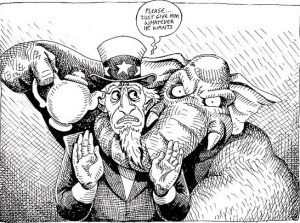 lessons of the Benghazi situation instead of use it to further both Clinton and Obama derangement and Republican political aims. We also need to watch the course of the grand bargain as it makes its way through the machinations of lawmaking.
Too bad there are mostly strident partisan politics that will influence both of these things because these policies will impact American lives greatly.
Beyond the Election and Right Wing Craziness
Posted: November 1, 2012 Filed under: 2012 elections, Economy, Social Security | Tags: "grand bargain", fiscal cliff, recovery 97 Comments I’m pretty certain that we will be seeing a second term for Obama given all the recent polls on the states important to the electoral college, so I want to look ahead to two things that I think will dominate post-election politics.
The first item is more of a prognostication, even though its roots have been thoroughly debunked as a series of right wing lies meant to capture low information/low intelligence voters. That’s the hoopla around the Benghazi consulate murders. It’s evident that right wingers and low information voters have fallen for conspiracy theories.
The “Benghazi Default” right wing strategy is being looped on Fox and used as the default non-answer by Romney surrogates despite the memes having been debunked by media, the CIA, Condoleeza Rice, and fact checkers. Cannonfire does a great job of listing the information on that and there are many places in the media where you can find a list of the events and find a thorough list of the debunked right wing canards. Here’s one from Juan Williams writing for The Hill. The Benghazi canards have been so debunked that the media is basically ignoring them now and only brings it up when a Romney surrogate falls back on the “Benghazi Default” which is now the term for they’ve got nothing to say for Romney so they’re using the meme. We now have a league of Benghazi Truthers out there with every other idiot set of truthers led by the likes of Donald Trump. Benghazi Truthers get a two-fer. They get to hit a Clinton and Obama. CDS and ODS twofer!!!
So, here’s my prognostication. The Republican party will continue to have its internecine issues with its crazy religious and teahadi right who will turn on Romney the day after the election as not being pristine enough. They and the other flakes, nuts, and whackos left in a congress held hostage by Republican wingers will immediately start working on a plan to impeach POTUS on the Benghazi Default since they won’t have anything particularly real to say at that point. I’d bet real money on this happening if I had any. It will get farther than it should given that the Senate will stop it eventually, but worse, it will impact policy discussions which is why it will be allowed by Republican leadership. It will become a bargaining chip.
So, the second thing is something I want to spend more time on because it’s more of a ‘real’ threat to policy concerns and how the politics of a false impeachment could play into an Obama second term in much the way the same hoopla did in Bill Clinton’s second term. That would be the idea that there is a “fiscal cliff” and that Obama will get back on the “Grand Bargain” train. There is less likely to be outspoken criticism of these moves. There are already some folks with good policy instincts starting this conversation.
First off, Jonathan Chait goes after the “fiscal cliff” meme at the New York Magazine. I’ve mentioned that this is one thing I want to write about because I think it plays well into right wing paranoia and their stupid battle cry about pushing some huge future inter-generational debt scam.
I’ve written before that the legacy debt of social security has been following us since day one and that so far, there’s really been not one mention of it beyond scholarly journals because no one feels crippled by it. The “fiscal cliff’ meme plays into economic ignorance and right wing paranoia and plays well into the agenda of Wall Street and billionaires. This is being used to force a bigger scheme. Namely, that Wall Street still has its eyes on our Social Security Funds and that unnecessarily strict changes to Social Security may happen to get at other things.
Starting in January, there will be a series of automatic tax hikes and spending cuts that greatly improve Obama’s bargaining leverage. If those policies stay unchanged for the entire year, they would harm the economy a great deal. But if they only stay in place for a few weeks, or even a few months, the impact would be minor. Likewise, if you don’t eat anything for three weeks you could die, but if 6 p.m. comes and goes without dinner on the table, you don’t need to be scared.
Yes, Obama will have some bargaining leverage and I’m more afraid that he’ll return to the “Grand Bargain” than to look for alternatives that won’t unravel the social safety nets. Robert Kuttner–writing for HuffPo--has some interesting things to say about this.
In the parlance of economists, the economy is stuck in what the economist Irving Fisher called a debt-deflation, where the continuing damage from a financial collapse acts as a lead weight on the recovery. The only entity that can blast the economy out of a debt deflation is more public spending — which of course cycles right back into the private economy.
So what is our president doing to shore up his support by reassuring voters that things will pick up in the next four years? More public investment, more jobs, more overhaul of the financial system, more relief for the mortgage mess, right?
Well, not exactly. While he gives lip service to these goals, Obama is preparing to do a major deal for deficit reduction, which will only add to the drag on the recovery. His administration has bought into the argument that the business elite and the money markets expect deficit reduction, and that it will also play well with the voters.
In his recent off-the-record conversation with the editors and publisher of Iowa’s largest paper, theDes Moines Register, which was made public under pressure from that newspaper, Obama had this to say about deficit reduction:
I am absolutely confident that we can get what is the equivalent of the grand bargain that essentially I’ve been offering to the Republicans for a very long time, which is $2.50 worth of cuts for every dollar in spending, and work to reduce the costs of our health care programs.
And we can easily meet — “easily” is the wrong word — we can credibly meet the target that the Bowles-Simpson Commission established of $4 trillion in deficit reduction, and even more in the out-years, and we can stabilize our deficit-to-GDP ratio in a way that is really going to be a good foundation for long-term growth. Now, once we get that done, that takes a huge piece of business off the table.
Say what? Four trillion dollars of deficit-reduction, otherwise known as economic contraction. Really? If Obama strikes such a deal, it guarantees that a sluggish economy will continue.
This was the real story from that Des Moines Register interview and it’s the one that the media is ignoring while chasing its tail and the false meme of “Ro-mentum”. The Grand Bargain is basically the track to a continued slow, long, miserable, drug-out recovery. It’s taking the UK path to economic malaise. I’ve just linked you to a Bank of 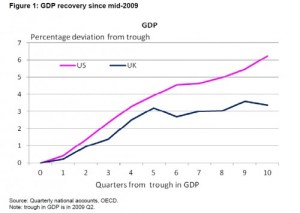 England (BOE) speech. That’s basically the UK’s version of the FED. It compares the recoveries of the UK and the US. The speech is actually called “Why is their recovery better than ours?” The answer is that we’ve taken a slightly more Keynesian approach to recovery with a stimulus and a Bernanke monetary policy that recognizes the threat of deflation and sluggish growth. They did a grand bargain sort’ve thing. Their austerity program dealt them a huge blow. It widened their federal deficit. It led to worse unemployment and terrible growth. The comparative graphs are astounding. I’ve placed the GDP one to the left.
The contrasting directions of employment trends raised uncertainty in the UK over the US during the latter half of the recovery, which weighed on consumption.
Fiscal policy, however, played an important role as well. Cumulatively, the UK government tightened fiscal policy by 3% more than the US government did – taking local governments and automatic stabilizers into account – and this had a material impact on consumption. This was particularly the case because a large chunk of the fiscal consolidation in 2010 and in 2011 took the form of a VAT increase, which has a high multiplier for households.
The fact that British real incomes were hit harder than American households’ incomes by energy price increases could be ascribed in large part to the past depreciation of Sterling, which also hit real incomes directly. All combined, these factors significantly dampened consumption growth in the UK, with knock on effects on investment and stockbuilding.
So, why would we follow this path to certain economic malaise? Bill Black provides a great analysis.’
The Republican Party’s approach to convincing Obama to commit the Great Betrayal cleverly exploits three human weaknesses. First, Obama wants to be considered a “centrist.” Second, Obama yearns to be considered “bipartisan.” These first two weaknesses are forms of vanity. The siren song is “do this and you will become known as the President who acted as a statesman to cut across Party and ideological divides and make the hard choices essential to allowing America to continue to be a great nation – while ‘saving’ the safety net.”
The third weakness that the Republicans seek to exploit is fear – and the death of alternatives. The mantra of European austerity proponents is “there is no alternative.” The only choice is between austerity and collapse, and that means there is no real choice. The Republican strategy is to create a series of “moral panics.” As the name implies, this involves the creation of a special form of panic falsely premised on immorality. (Think: “Reefer Madness” or Professor Hill causing River City, Iowans to believe that the arrival of pool hall demonstrated the imminent moral collapse of their children.) The Great Betrayal can only occur if Obama succumbs to mindless (and innumerate) panic.
Chait believes that Obama will not fall for this. Black obviously believes the President will still want to be seen as some one that will negotiate with Right Wing Terrorists in the name of bi-partisanship. I don’t know. Perhaps the incredible nasty attacks on the President during this campaign and the 4 years of obstruction and filibusters he endured during his first four years will drive him Chait’s direction.
So, enter my prediction of a pending impeachment charge no matter how frivolous. I think we can all say that the CDS that drove the impeachment of President Clinton is only matched by the ODS that will drive the impeachment attempts on Obama. Even Newt Ginrich–the architect of obstructing Clinton’s second term–has been using the Benghazi Default this week. (That link goes to Hannity so be warned and get some eye bleach.) No matter how much the evidence shows that this is a false narrative, the right and Fox keep hyping it in the same way that no amount of damnation by Chrysler, GM, Fact Checkers, and the media is stopping the Romney campaign from telling folks in Ohio that US jobs producing Jeeps are going to China. These folks just live on lies and achieving their evil goals in any way possible. They will see us all dead in the streets rather than give an inch. Just look at what Rush Limbaugh is saying today about Chris Christie’s h/t to POTUS on FEMA’s response to Sandy. They will never be moral actors. NEVER.
So, will the political circus of a purely political impeachment movement by whacko Tea Baggers and other republican partisans create an atmosphere that warps the outcome of this serious policy discussion ? Well, again, I’d put some serious money on watching a completely solvable situation go right into the right wing crapper as ODS goes to 11 the day after Romney loses. Ladies and Gentlemen, Guard your Social Security well! I wish I didn’t really believe this scenario is possible but unfortunately, I really do.
Monday Reads
Posted: March 5, 2012 Filed under: morning reads | Tags: "grand bargain", conservatives, education, expensive US medical care, flush rush, liberals, role in democracy, Santorum hates universities, universities 41 Comments Good Morning!
Seven advertisers have now dropped Limbaugh’s show after intense pressure. ProFlowers became the latest to remove its sponsorship saying that his comments about Sandra Fluke “went beyond political discourse to a personal attack and do not reflect our values as a company.”
Condemnation has come from a variety of sources outside Republican elected leaders. Yesterday, George Will said that Republicans were afraid of him even though they thought he was a “buffoon”.
ABC’s George Will said yesterday on “This Week” that GOP leaders have steered clear of harshly denouncing Limbaugh’s comments because “Republican leaders are afraid of Rush Limbaugh.”
“[House Speaker John] Boehner comes out and says Rush’s language was inappropriate. Using the salad fork for your entrée, that’s inappropriate. Not this stuff,” Will said. “And it was depressing because what it indicates is that the Republican leaders are afraid of Rush Limbaugh. They want to bomb Iran, but they’re afraid of Rush Limbaugh.”
ABC News political analyst Matthew Dowd said the Republicans’ apprehension to say anything negative about the conservative big hitter is based on the “myth” that Limbaugh influences a large number of Republican voters.
“I think the problem is the Republican leaders, Mitt Romney and the other candidates, don’t have the courage to say what they say in quiet, which, they think Rush Limbaugh is a buffoon,” Dowd said. ”They think he is like a clown coming out of a small car at a circus. It’s great he is entertaining and all that. But nobody takes him seriously.”
I was speaking to BB yesterday about how my experience within higher ed was very unlike Rick Santorum’s accusations that universities are turning students against religion and/or conservative thought. I have had a large number of extremely conservative colleagues and professors in my time. So, I was pleased when my anecdotal evidence was backed up by some numbers. Neil Gross wrote in yesterday’s NYT that “College doesn’t make you liberal”.
But contrary to conservative rhetoric, studies show that going to college does not make students substantially more liberal. The political scientist Mack Mariani and the higher education researcher Gordon Hewitt analyzed changes in student political attitudes between their freshman and senior years at 38 colleges and universities from 1999 to 2003. They found that on average, students shifted somewhat to the left — but that these changes were in line with shifts experienced by most Americans between the ages of 18 and 24 during the same period of time. In addition, they found that students were no more likely to move left at schools with more liberal faculties.
Similarly, the political scientists M. Kent Jennings and Laura Stoker analyzed data from a survey that tracked the political attitudes of about 1,000 high school students through their college years and into middle age. Their research found that the tendency of college graduates to be more liberal reflects to a large extent the fact that more liberal students are more likely to go to college in the first place.
Studies also show that attending college does not make you less religious. The sociologists Jeremy Uecker, Mark Regnerus and Margaret Vaaler examined data from the National Longitudinal Study of Adolescent Health and found that Americans who pursued bachelor’s degrees were more likely to retain their faith than those who did not, perhaps because life at the bottom of the socioeconomic ladder can be rough in ways that chip away at religious belief and participation. They report that students “who did not attend college and two-year college students are much more likely — 61 and 54 percent more, respectively — than four-year college students to relinquish their religious affiliations.”
Right wing populists frequently attack educational institutions and intellectuals. There’s an interesting piece at Alternet that addresses this phenomenon. Basically, democracy relies on an informed citizenry and that is the enemy of demagogues and the plutocrats they serve.
Right-wing fundamentalists such as Republican presidential candidate Rick Santorum hate public schools, which he suggests are government schools wedded to doing the work of Satan, dressed up in the garb of the Enlightenment. Santorum, true to his love affair with the very secular ideology of privatization, prefers home schooling, which is code for people taking responsibility for whatever social issues or problems they may face, whether it be finding the best education for their children or securing decent health care.
Actually, Santorum and many of his allies dislike any public institution that enables people to think critically and act with a degree of responsibility toward the public. This is one reason why they hate any notion of public education, which harbors the promise, if not the threat, of actually educating students to be thoughtful, self-reflective and capable of questioning so-called common sense and holding power accountable. Of course, some progressives see this as simply another example of how the right wing of the Republican Party seems to think that being stupid is in. But there is more going on here than the issue of whether right-wing fundamentalists are intellectually and politically challenged. What makes critical education, especially, so dangerous to radical Christian evangelicals, neoconservatives and right-wing nationalists in the United States today is that, central to its very definition, is the task of educating students to become critical agents who can actively question and negotiate the relationships between individual troubles and public issues. In other words, students who can lead rather than follow, embrace reasoned arguments over opinions and reject common sense as the engine of truth.
The Hill reports that a number of lawmakers from both sides of the aisle are working on a “grand bargain” including cuts to entitlements.
A small, bipartisan group of lawmakers in both the House and Senate are secretly drafting deficit grand bargain legislation that cuts entitlements and raises new revenue.
Sources said that the task of actually writing the bills is well underway, but core participants in the regular meetings do not yet know when the bills can be unveiled.
The core House group of roughly 10 negotiators is derived from a larger Gang of 100 lawmakers led by Reps. Mike Simpson (R-Idaho) and Health Shuler (D-N.C.), who urged the debt supercommittee to strike a grand bargain last year.
That larger group includes GOP centrists like Rep. Steve LaTourette (R-Ohio), who has said Republicans should abandon their no-new-tax-revenue pledge, as well as Tea Party-backed members like Rep. Cynthia Lummis (R-Wyo.).
The key test in the coming months will be to see whether the core group can get buy-in from many of the 100 members who vaguely support “going big” on the deficit once real cuts and tax increases are identified.
The talks are so sensitive that some members involved do not yet want to be identified.
Shuler, who is retiring this year, is keen to establish a legacy as a deficit cutter before leaving Congress and he is involved in the drafting effort.
Ezra Klein has some analysis up on how medical procedures in the US are so much more expensive than any place else in the developed world. It’s called “Why an MRI costs $1,080 in America and $280 in France”.
As it’s difficult to get good data on prices, that paper blamed prices largely by eliminating the other possible culprits. They authors considered, for instance, the idea that Americans were simply using more health-care services, but on close inspection, found that Americans don’t see the doctor more often or stay longer in the hospital than residents of other countries. Quite the opposite, actually. We spend less time in the hospital than Germans and see the doctor less often than the Canadians.
“The United States spends more on health care than any of the other OECD countries spend, without providing more services than the other countries do,” they concluded. “This suggests that the difference in spending is mostly attributable to higher prices of goods and services.”
On Friday, the International Federation of Health Plans — a global insurance trade association that includes more than 100 insurers in 25 countries — released more direct evidence. It surveyed its members on the prices paid for 23 medical services and products in different countries, asking after everything from a routine doctor’s visit to a dose of Lipitor to coronary bypass surgery. And in 22 of 23 cases, Americans are paying higher prices than residents of other developed countries. Usually, we’re paying quite a bit more. The exception is cataract surgery, which appears to be costlier in Switzerland, though cheaper everywhere else.
Prices don’t explain all of the difference between America and other countries. But they do explain a big chunk of it. The question, of course, is why Americans pay such high prices — and why we haven’t done anything about it.
So, that’s a few stories to get things started this morning! What’s on your reading and blogging list today?
Beltway Bob Rationalizes Obama’s Blunders, while Michael Tomasky Sees a “Scared President”
Posted: September 19, 2011 Filed under: Medicaid, Medicare, Social Security, Team Obama, U.S. Economy, U.S. Politics, voodoo economics | Tags: "grand bargain", Bagdad Bob, Barack Obama, Beltway Bob, Confidence men, deficit reduction speech, Ezra Klein, John Boehner, Medicaid, medicare, Michael Tomasky, Ron Suskind, Social Security, Tea Party 25 Comments
Beltway Bob
Okay, I realize that is a silly title, but after reading Beltway Bob’s Ezra Klein’s latest post and then reading the transcript of Barack Obama’s Rose Garden speech from this morning, I was feeling a little bit punchy.
Dakinikat recently called Ezra Klein “Beltway Bob,” or the Bagdad Bob of the Beltway. That’s a perfect name for Klein, who is apparently way too young to remember anything about politics before about 1990. The guy is naive beyond belief. Lately he seems to see his role as explaining away all of Obama’s blunders, usually by arguing that the President is just too good and moral for the rough and tumble of politics.
This morning, Klein set out to explicate the “deficit reduction plan” that Obama announced in his speech this morning. Specifically, Klein wanted to explain “why the White House changed course.”
President Obama’s deficit-reduction plan (pdf)
is most interesting for what’s not in it. It does not cut Social Security by “chaining” the program’s cost-of-living increases. It does not raise the eligibility age for Medicare from 65 to 67. Nor does it include any other major concessions to Republicans. Rather, the major compromise it makes is with political reality — a reality that the White House would prefer not to have had to acknowledge.Since the election, the Obama administration’s working theory has been that the first-best outcome is striking a deal with Speaker John Boehner and, if that fails, the second-best outcome is showing that they genuinely, honestly wanted to strike a deal with Speaker John Boehner.
That was the thinking that led the White House to reward the GOP’s debt-ceiling brinksmanship by offering Boehner a “grand bargain” that cut Social Security, raised the Medicare age, and included less new revenue than even the bipartisan Gang of Six had called for. It was also a theory that happened to fit Obama’s brand as a postpartisan uniter and his personal preferences for campaigning on achievements rather than against his opponents. But though it came close to happening, the “grand bargain” ultimately fell apart. Twice.
The collapse of that deal taught them two things: Boehner doesn’t have the internal support in his caucus to strike a grand bargain with them, and the American people don’t give points for effort.
Very likely you’re asking yourself, “What the heck does that mean?” I certainly was when I first read it. Is this guy trying to tell us that no one in the White House understood until recently that Boehner had a bunch of looney-tunes tea party reps to deal with? Is he really trying to convince us that–after all those years in Illinois politics and his admittedly short time in national politics–that Obama and/or his advisers actually did not understand that voters expect results, not “just words?”
The answer is “yes.” Beltway Bob does expect you to believe that. The rest of his column is devoted to explaining in great detail that Obama and his advisers actually believed that voters would be thrilled if he made nice with Republicans even if it meant selling out every Democratic ideal–that if the President “looked like a nice guy,” the voters–especially Independents, I guess–would rush to the polls to reelect him.
But now, according to Beltway Bob, the White House staff and the President understand that they made a huge mistake: “the second-best outcome isn’t necessarily looking like the most reasonable guy in the room. It’s looking like the strongest leader in the room.” So that’s why Obama threatened to veto any plan that cuts Medicare or Medicaid and he has for now supposedly taken Social Security off the table. It’s all so sad, according to Beltway Bob–poor Barack has had to go back on all his ideals (those ideals apparently being that he wanted to a great compromiser, while caring nothing about the effects of his compromises) and accept “politics as usual.” Boo-hoo-hoo.
Rather than emphasizing his willingness to meet Boehner’s bottom lines, which was the communications strategy during the debt ceiling showdown, he’s emphasizing his unwillingness to bend on his bottom lines.
That isn’t how the White House would prefer to govern. It’s not how they would prefer to campaign. It is, let’s admit it, politics-as-usual. It’s the triumph of the old way of doing things, an admission that Washington proved too hard to change. But it’s also the only option they have left.
Ezra Beltway Bob can’t seem to recall the hundreds of times that Obama has vowed to draw lines in the sand and then quickly backtracked–not to mention all the Campaign promises he went back on. But why on earth should anyone with a functioning memory believe this hogwash?
Frankly, IMHO, if Obama has in fact taken Social Security, Medicare, and Medicaid changes off the table–which I strongly doubt–it’s probably because he’s scared silly that Americans are finally seeing through his lies.
If you read the transcript of Obama’s speech, you’ll see that he sounds defensive, hesitant, scared of his own shadow. This morning he called for the wealthy to pay at least 20% of their income in taxes. We are supposed to buy that that is a tax increase. Yet under Bush, the wealthiest Americans were supposed to pay 35%, already an unconscionably low rate–why not make them pay that much at least?

Michael Tomasky
Because our President is a scaredy cat, that’s why! I think the change–if it’s real–has everything to do with the news that has come out about Ron Suskind’s new book Company Men, which will be released tomorrow. The news reports about the book make Obama sound like a weak, passive, detached executive who lets his underlings push him around. Michael Tomasky at the Daily Beast calls him “The Scared President.”
Tomasky notes that he was persuaded by what Suskind wrote about the Bush administration in a previous book.
I’m on record as taking Suskind at his word in such matters. In early 2004, when Suskind and Bush Treasury Secretary Paul O’Neill produced The Price of Loyalty, I reviewed it for The New York Times and found it persuasive.That book was the first to confirm what everyone knew anyway: that the Bush White House was run according to politics, not policy. Confidence Men also confirms what we knew about Obama’s White House: that the president appointed the wrong economic team from the start, failed to crack down on the banks, and was Solomonic to a fault when formulating responses to the financial crisis (oh, and news flash: Larry Summers is hard to work with!).
That would be interesting without being shocking. But the indictment goes one mortifying step deeper: Geithner and Summers and Rahm Emanuel, and perhaps others, sometimes ignored Obama, refused to carry out his orders, and, in Summers’s case, mocked him, saying at one point to then-Budget Director Peter Orszag that “there’s no adult in charge” in the White House. And while I don’t yet know whether Suskind emphasizes this point, let’s carry the critique one step further: They did so, as far as we know, without suffering any consequences at all.
No matter how much the White House tries to deny the details that have come out on Suskind’s book, the overall takeaway is that Obama is weak and indecisive. And that is the impression that most Americans have about him already, so why should they disbelieve it? Tomasky:
That’s the problem the book reveals. Adam Moss and Frank Rich of New York magazine did get an early copy and read it, and in an online dialogue posted over the weekend, they home in on what Rich calls Obama’s “intellectual blind spot.” Obama even recognized it himself, telling Suskind he was too inclined to look for “the perfect technical answer” to problems; Rich quotes Suskind as writing that Obama always favored policies that were “respectfully acknowledging opponents’ positions, even those with thin evidence behind them, that then get stitched together into some pragmatic conclusion—but hollow.”
That sounds awfully apt to me. Obama was afraid to be the president. He listened to a dozen viewpoints and tried to come up with something that made everyone happy. Unfortunately, “everyone” included people on his team who were looking out for the banks more than for the public (or for their own boss), and it included people on Capitol Hill whose clear agenda was Obama’s political destruction. It’s the central—and depending on how the next election turns out, possibly decisive—paradox of this president: In trying way too hard to look presidential in the sense of “statesmanlike,” he has repeatedly ended up looking unpresidential in the sense of not being a leader.
Obama wasn’t ready to be President in 2008, and he still isn’t. Tomasky claims to have hopes that Obama can turn it around, but I think it’s just too late. There have been too many lies, too many betrayals of campaign promises, too many sellouts to Wall Street and the Republicans, and too many reversals of supposed lines in the sand.
Perhaps if Obama were capable of followingJames Carville’s advice and fired most of his staff and stood up to Wall Street and the Republicans, as Tomasky hopes. But Obama simply can’t do it. He’s too weak and inexperienced.
Whether you look at Obama through the eyes of Beltway Bob and conclude that this President is just too good and holy for “politics as usual” or through the eyes of Tomasky and conclude that Obama is scared of his own advisers and of Republicans in Congress, this man is simply not qualified for the office he holds. Obama must go. There is no other realistic solution to the country’s problems.

 peej
peej Carissa
 bostonboomer
 dakinikat
 ecocatwoman
 mablue2
 Mama Lopez
 peggysue22
 quixote
 skydancingguestblogger
 Mona (aka Wonk the Vote)



 Sky Dancing
Recent Comments