
Edward Snowden Emerges; Seeks Temporary Asylum in Russia
Posted: July 12, 2013 Filed under: Foreign Affairs, Russia, U.S. Politics | Tags: Edward Snowden, espionage, Genri Reznik, Human Rights Watch, NSA, political asylum, Sarah Harrison, spying, Tanya Lokshina, Vladimir Putin, Wikileaks 78 Comments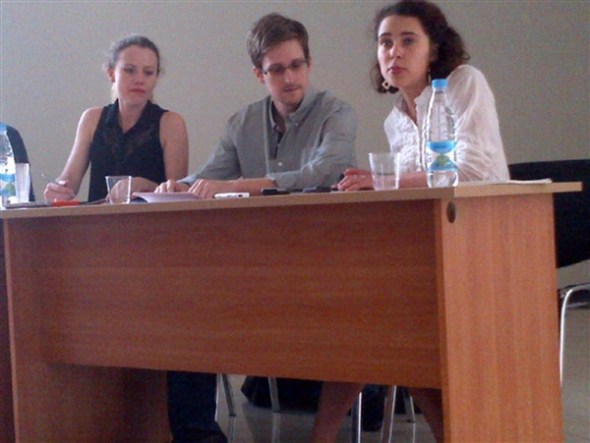
NSA leaker Edward Snowden attends a press conference at Moscow’s Sheremetyevo Airport with Sarah Harrison of WikiLeaks, left, July 12, 2013, in this image provided by Human Rights Watch.
At 5PM (9AM ET) Russian Time, Edward Snowden met with human rights activists and attorneys in Sheremetyevo Airport in Moscow. Afterward he appeared at a press conference alongside Sarah Harrison of Wikileaks and Tanya Lokshina of Human Rights Watch. He announced that he is seeking asylum in Russian until he can arrange to fly to a Latin American country.
Although the meeting was not public, some of those present posted details to Twitter, including Tanya Lokshina of Human Rights Watch who released a handout image that she said was of Snowden (see above).
Lokshina said Snowden would be making an official request to Russia for temporary asylum, adding that his condition was “just fine.”
The move indicates the difficulties facing Snowden, who has been offered asylum by three countries: Venezuela, Bolivia and Ecuador. He is apparently unable to travel to them without entering airspace controlled by the U.S., risking an enforced grounding that would lead to his arrest.
Also among those present at Friday’s meeting was a prominent Russian lawyer, Genri Reznik, who later told reporters: “I think his claim should be satisfied… The law allows for political asylum.
“The values in the constitution of the US and Russia are similar, so I don’t think that there could be a lengthy conflict if Russia grants him asylum.”
Several hours earlier The New York Times had reported on an e-mail which “purported to be” form Snowden asking for the meeting with human rights organizations.
Several prominent human-rights organizations received e-mailed invitations late on Thursday to meet with Mr. Snowden, though they were initially doubtful about the e-mails’ origin.
No invitation was extended to Russian officials, said Dmitri S. Peskov, the Kremlin spokesman. Journalists who asked to be included were told that Mr. Snowden’s team “will be following up with the press shortly afterward.”
Attached to the e-mailed request was a note complaining of U.S. interference with Snowden’s efforts to seek asylum in order to avoid prosecution for stealing and revealing classified information.
The e-mail, signed “Edward Joseph Snowden,” said he had “been extremely fortunate to enjoy and accept many offers of support and asylum from brave countries around the world,” and that he hoped to visit each of them personally to express his thanks. It went on to say that the American government had carried out an “unlawful campaign” to block his asylum bids.
“The scale of threatening behavior is without precedent: never before in history have states conspired to force to the ground a sovereign president’s plane to effect a search for a political refugee,” the note said. “I invite the human rights organizations or other respected individuals addressed to join me on 12 July at 5:00 p.m. at Sheremetyevo Airport in Moscow for a brief statement and discussion regarding the next steps forward in my situation.”
Wikileaks has posted a transcript of Snowden’s statement to the human rights groups. In it he makes clear that he believes he has done the right thing by revealing U.S. espionage methods and targets around the world and says he will accept any and all offers of asylum, and that for now he will apply to stay in Russia.
I announce today my formal acceptance of all offers of support or asylum I have been extended and all others that may be offered in the future. With, for example, the grant of asylum provided by Venezuela’s President Maduro, my asylee status is now formal, and no state has a basis by which to limit or interfere with my right to enjoy that asylum. As we have seen, however, some governments in Western European and North American states have demonstrated a willingness to act outside the law, and this behavior persists today. This unlawful threat makes it impossible for me to travel to Latin America and enjoy the asylum granted there in accordance with our shared rights.
This willingness by powerful states to act extra-legally represents a threat to all of us, and must not be allowed to succeed. Accordingly, I ask for your assistance in requesting guarantees of safe passage from the relevant nations in securing my travel to Latin America, as well as requesting asylum in Russia until such time as these states accede to law and my legal travel is permitted. I will be submitting my request to Russia today, and hope it will be accepted favorably.
The Washington Post questions whether Snowden can meet Vladimir Putin’s terms for allowing him to stay in Russia.
He explained that asylum is the only way he can guarantee his safety to stay in the country, where he’s been since arriving from Hong Kong in late June. “I am only in a position to accept Russia’s offer because of my inability to travel,” he said,according to Lokshina, adding that he ultimately hopes to travel to Latin America, where three countries have offered him asylum.
This puts Snowden in a difficult position: He had previously applied for asylum in Russia but then withdrew his application after Russian President Vladimir Putin said that Snowden could only stay on certain terms. “If he wants to remain here there is one condition – he should stop his work aimed at inflicting damage on our American partners,” Putin announced at a July 1 news conference. That was broadly taken as a condition that Snowden stop leaking classified U.S. information.
Snowden’s earlier decision to withdraw his application for asylum in Russia seemed to suggest that he found Putin’s terms unacceptable. It’s not clear what’s changed, but Snowden seems to have his own interpretation of Putin’s conditions. “He has no problem with Putin’s condition because he does not believe he damaged the United States, or is damaging it,” Lokshina told the Post. Her comments to The New York Times also indicated that Snowden apparently believes his past leaks have not harmed the United States and so not violated Putin’s terms.
So does Snowden assume that he can leak anything that he decides will not be damaging to the U.S.? And what about the data that he has already given to Glenn Greenwald of The Guardian, Barton Gellman of the Washington Post, Der Spiegel , The South China Morning Post, and newspapers in Brazil and Australia? He has also claimed through Greenwald that many individuals around the world have complete copies of the stolen materials. Greenwald himself has stated that Snowden has already completed the leak to The Guardian and that it will be up to them to decide what gets published. According to the Post,
Snowden, or at least the WikiLeaks representative Sarah Harrison who is working with him, might already see hints of these potential contradictions. Snowden asked the attendees at Friday’s Moscow airport meeting to try to intervene with Putin on his behalf, Lokshina told The New York Times.
At least we now know where Snowden is and what his immediate plans are. Now we’ll await Russia’s response.

 peej
peej Carissa
 bostonboomer
 dakinikat
 ecocatwoman
 mablue2
 Mama Lopez
 peggysue22
 quixote
 skydancingguestblogger
 Mona (aka Wonk the Vote)



 Sky Dancing
Recent Comments