
Sunday Morning Reads………An Eclectic Mix
Posted: June 17, 2012 Filed under: abortion rights, bees, Climate Change, Environment, morning reads, Nigeria, social media, toxic waste, U.S. Military, Violence against women | Tags: 350.org, activism, Bill McKibbon. Emem Okon, environment, fossil fuels, gardening, rape in the military, Rio+20, Twitterstorm 41 Comments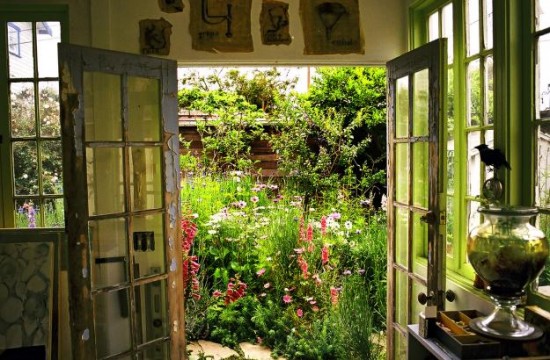
Good Morning, All. I am pinch hitting for JJ while she and her family are visiting our nation’s capital. I haven’t traveled much, but I have been to D.C. twice. What an amazing place. This will be an eclectic mix of links and stories, covering many different categories. I hope you will find at least some of them of interest to you.
This first group is about gardening. bb had mentioned to me that she likes to work in her garden, so I figured she would enjoy these. The first is a list of ideas on how to attract butterflies to your garden.
Planting your garden with plants that attract butterflies is only one step in making your garden butterfly-friendly. Once butterflies discover your garden the females will lay eggs on plants that become food for the hatching caterpillars.
The host plant selected, and the time of year the eggs are laid, depends on the species of butterfly. Different butterflies prefer different host plants.
Bees are pollinaters, picking up pollen as they go from flower to flower to gather nectar. Obviously they are an important component for a successful garden. Besides nectar, bees also need water and this has ideas about how to make a watering hole for bees.
As the temperature rise in the garden it is important to remember the bees you’re attracting to your garden will also be searching for water. For bees, a supply of water is as important as pollen and nectar forage in the summer.
Besides the lovely green foliage of a garden, it is important to do what we can to use “green” products. Treehugger contributor Ramon Gonzalez provides a list of 10 sustainable garden products.
A garden that is kinder to the earth can be achieved through the selection of products and tools that are sustainably manufactured or given new life through recycling. It’s never been so easy to build a garden that’s green from the moment you plunge that spade into the soil.
Many commercial fertilizers used in both gardening and farming contain phosphates. Aasif Mandvi of The Daily Show covered a story about Simplot, a phosphate mining company in Idaho. Naturally, it is a satirical look at the dangers of phosphate mining and the damage being done by the by-product, selenium. Greater Yellowstone Coalition is an environmental organization working to get J.R. Simplot Co. to Clean Up Its Smoky Canyon Mine Superfund Site.
The New York Times featured a story and video today about the industrial damage done to Newtown Creek since the mid-1800s, and Mitch Waxman who has chronicled its history. The waterway was declared a Super Fund site in 2010.
If Mitch Waxman is your guide, he will identify it as the derelict smokestack of Peter Van Iderstine’s fat-rendering business, which first set up shop in 1855. But he won’t stop there.
He will expound on the archaic waste-disposal operations that once flourished on the creek, conjuring scenes of putrescent horse carcasses floating in on barges from Manhattan and docks piled with manure three stories high. The narrative will extend to Cord Meyer’s bone blackers and Conrad Wissel’s night soil wharf — the gothic names of these forgotten businesses rattled off in a distinct Brooklyn accent.
At some point, he will start in on the horrors of the M. Kalbfleisch Chemical Works, eventually making his way to the sins of Standard Oil.
Moving on to some stories about activism that caught my eye. The first story comes from Truth-Out about The Heritage Foundation’s conference to re-brand the Occupy Movement. Matt Dineen interviews Jason del Grandio, the author of Rhetoric for Radicals. Here’s a snippet of what Jason has to say about his perceived purpose of the conference.
The speakers make frequent reference to capitalism, free markets and free enterprise, and often mention traditional buzzwords like individual liberty and the pursuit of happiness. The Heritage Foundation is trying to understand the populist appeal of Occupy, and by doing so, trying to use that appeal to “win back” some of the Occupiers. Or, at the very least, to impede Occupy’s progress and win the hearts and minds of those who are still on the fence.
Brian Merchant interviews Tzeporah Berman, an environmental activist since was was 19, for Treehugger. This quote really hit home for me – you can’t un-know or un-see an injustice once your eyes, mind and heart have been opened to them.
Sometimes I wish I could open up a paper and not be immediately drawn to the story about mercury in fish or the dramatic increase in flooding in Sudan. But I can’t now.
Have you heard of Emem Okon, the Nigerian ecofeminist? I had not. She is a courageous woman, organizing other women of the Niger River Delta and taking on Chevron. The interview from Antonia Juhasz is reprinted from Ms magazine on Truth-Out.
One of the most prominent voices was Emem Okon, founder and executive director of Kebetkache Women Development & Resource Centre of Nigeria. A community organizer and women’s rights activist from the Niger Delta, Okon is leading a thriving Nigerian ecofeminist movement. She has coordinated several local women’s networks and coalitions, including Women Against Climate Change (WACC), International Network on Women and Environment, Niger Delta Women for Justice and Niger Delta Women’s Movement.
Speaking of women, the New York Times featured a story on the the Human Rights Film Festival at Lincoln Center. The review starts off with a profile of The Invisible War, which won the 2012 Audience Award at the Sundance Film Festival.
It hardly needs to be said that any armed force has the potential for internal as well as external violence. But “The Invisible War,” Kirby Dick’s incendiary documentary about the epidemic of rape within the United States military, is a shocking and infuriating indictment of widespread sexual attacks on women. Such behavior, the film argues, is tacitly condoned and routinely covered up; the victims are often blamed and their reputations destroyed.
I found other links to discussions of the film, at the military publication, Stars and Stripes along with stories about Congress denying healthcare coverage for abortions for military women who have been raped. from Mother Jones.
The Rio+20 Summit begins on Monday, June 18th. President Obama and England’s David Cameron WON’T be attending, however Hillary Clinton will be representing the U.S. BBC News has more about Rio+20 and the awful state of the world’s oceans.
The researchers assessed the various pledges made at the landmark 1992 Earth Summit and 10 years later at the Johannesburg World Summit on Sustainable Development.
Governments vowed to establish an ecologically sound network of marine reserves by 2012, eliminate subsidies that contribute to illegal fishing, protect critical habitat, look after the needs of local fishermen and restore depleted stocks to healthy levels by 2015.
Subsidies have not been eliminated, and illegal fishing is still a major issue in some parts of the world.
Tom Ashbrook, host of NPR’s On Point, interviewed Bill McKibben of 350.org on Friday’s show. McKibben’s name is probably best known for the protests against the Keystone XL Pipeline, held outside of the White House, along with his subsequent arrest for protesting. You can listen to the audio at the link above. Here’s a short introduction:
Environmental champion Bill McKibben wrote nearly a quarter century ago about what he called “the end of nature.” The untouched wild. He didn’t think he was writing about the end of the world. But the climate change path since then has been a scary one. Bad to worse.
And McKibben has gone from writerly philosopher to full-on environmentalist to activist in handcuffs. Political street fighter. He was at the heart of the campaign to stop the Keystone XL pipeline. Arrested at the gates of the White House.
The current campaign of McKibben and 350.org is ending fossil fuel subsidies. These companies are paid by governments in the neighborhood of 1 TRILLION DOLLARS a year to pollute our planet. 350.org is organizing a Twitterstorm for June 18th. Although I don’t have a cell phone (and refuse to get one), I plan to set up a Twitter account so that I can participate. I hope that you will go to the link and sign up to participate as well. This quote comes from Treehugger about the Twitterstorm:
If you’re itching to do some petition signing right now: End Fossil Fuel Subsidies, and check out how your representative (in the US) stands on ending subsidies: End Fossil Fuel Subsidies Scorecard
There’s also more info on the Facebook event page: Twitter Storm: #EndFossilFuelSubsidies
Since it’s Father’s Day, I thought I would end this with a trbute video to a very special Dad
from Discovery News.
Monday Afternoon, Sky Dancing in the Garden
Posted: February 14, 2011 Filed under: Farming, Food, gardening | Tags: food, gardening, greenhouse, weeds 17 CommentsI was thinking about writing a gardening and food post, then Kat mentioned gardening in the Monday Reads and so I ran with it.
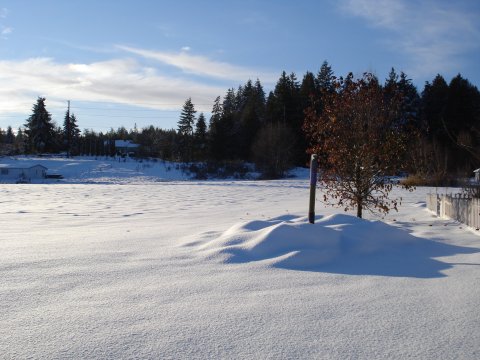
Up here in the northern-westernest part of the lower 48 La Nina has been mighty boring. I’m grateful for this, but sorry that her pattern of weather moved south and blasted the rest of the country with such misery. We’ve had normal temps and less rain that usual, although that is changing. This means my partner and I have been out working on the farm. He got the parts of the field we need later this month and next tilled and ready for planting. I’ve been working on conquering the weeds in the herb garden.

A plain and simple rose, in Sima's garden
Weeds (northeastern, northwestern, california, midwest and south): the bane of life with organic gardening, little tiny buggers that grow from the very air it seems, seeds stored for 20 years or more in buried earth just waiting for a bit of sun and light, little bothersome indicators of both soil gone wrong and soil gone right, rotten, overpowering… bleh. Weeds. Since our farm started as a cow pasture and hay field, our worst weeds are grasses, particularly what we call ‘zip’ grass, because of the sound it makes when you rip it out by the roots and discover to your horror the roots run right under the 3 feet of weed matted and graveled pathway and out the other side. Ziiiipppp indeed. One little stem of that stuff and it’ll grow another 4 foot long run of root, little grasslets sprouting all along the way.
Sky Dancing in the Garden: Here comes Dream time!
Posted: December 6, 2010 Filed under: gardening | Tags: dreaming, gardening, seed catalogs 26 CommentsNote: I’m posting this on Monday because Sunday was super busy, both personally and on the blog!
And now, for something entirely frivolous and decadent.
This year’s gardening catalogs.
Many a garden writer has said it before, and many will say it again (in fact, this one is just about to).. catalogs are for dreaming. In catalogs there are no slugs, no snails, no powdery mildew and no late blight. The plants are a glistening glossy green, with bright shiny flowers that stand out like beacons under the perpetual benevolent sunshine. Every plant is wonderful, superlative, the cream of the crop. The vegetables look, taste, and even smell better in your favorite garden catalog, or at least, so say their descriptions.
Watering? Only from this stylish classic verdigris water can on page 25 or the oh-so-environmentally conscious drip irrigation ‘system’ on page 50.
Bugs? NEVER! But if you might see a stray sign of a leaf-hopper on the poor neighbor’s fuscia, head out to page 65 for a complete list of bug preventatives.
The thing that draws me in every time, every single dang time, is the ‘NEW VARIETIES!’ I love reading about new vegetable varieties. I’ll read a bit, then my gaze’ll wander and I’ll stare out the window at the cold, grey, wet winter’s day. In my mind’s eye I see this or that great new broccoli variety, or corn, or swiss chard, or whatever, growing proudly in long rows; producing abundant, life-sustaining nutrition (and a few bucks for the poor farmer). And this or that great new variety will be innately resistant to slugs and will scoff at both heat and cold, wet and dry. It’s such a great variety, it’ll grow under your bed, or on the moon! Ok, I’m getting a bit carried away.
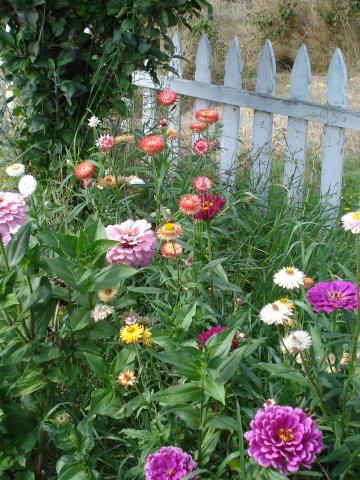
Catalog season generally starts in December. It can run into April in some areas of the country or end as early as February in others, because it ends as soon as planting begins and reality sets in. I keep all the farming and gardening related catalogs in the same pile and look through them before I go to bed, or when I have a few free moments. It’s a peaceful, dreamy time.
If you’re anything like me, you get tons of gardening catalogs from seed suppliers from all over the country. It’s hard to tell the good seed company from the bad, hard to tell what will grow in your area and what won’t. Therefore, here’s a few tips.
Do a bit of google research to explore where a seed company is getting their seed. Few actually grow seeds themselves (although some do). Many smaller seed companies still offer non-Monsanto (or other huge agri-business) controlled seed.
Beware of seed that is copyrighted or trademarked. This doesn’t mean it’s an F1 hybrid, this means it’s actually illegal to grow it yourself. If it’s that important to some business, you probably don’t need it.
To determine if a variety will grow in your area: Start with the basic hardiness zones. If the variety is within your zone, it’ll probably grow. But remember, many varieties need heat, so a zone 8 in the PacNW is not going to get as much heat as a zone 8 in northern California. This matters for things like corn and eggplant and many flower varieties. Most catalogs do not give heat requirements (known as degree days), so here’s how I figure it out. I use a catalog provided by a local (to me) seed merchant; Territorial Seeds. This is a great company, and they do a lot of their own growing and testing down in Oregon. I look at the days to maturity they give for different varieties of vegetables and flowers. Although the days to maturity are still a bit low, because they are in Oregon and I’m in Washington, I at least get in the ballpark. Then I compare these days to those in other catalogs. For each vegetable, this gives me an offset for each of the other catalogs, which I can use to get a semi-accurate guess whether something will grow for me or not.
Why do I do this? Because my favorite seed place is Johnny’s, in Maine. And in Maine you can, for instance, grow corn varieties which won’t grow in the Puget Sound area of Washington. Maine is hotter and has more days over 60 F than Washington, even though coastal Washington has a higher hardiness zone.
Another point to consider: Look at the natural habitat of the plant. Make sure your garden area is similar to that natural habitat if you want carefree gardening. For instance, rosemary is naturally a Mediterranean scrub plant. It likes cool mornings and nights, mist, wind, quickly draining soil and hot sun. It doesn’t like snow, and it doesn’t like places without that mist and wind. So around my area rosemary often dies. However, I can grow it because I live in a little valley on a peninsula with sea water within a mile or two on 3 sides. I get the winds and the mist, boy, do I get the winds! I then went further for my rosemary and grow it in raised beds to achieve the drainage it wants.
For farming, I use Johnny’s and Territorial seed mostly. I get catalogs from other seed merchants, but they don’t hit a chord with me, for some reason. I use Nichols and various other places for herbs. I love the Heirloom seed catalogs and tomato catalogs. I use onion starts, rather than the little onion bulbs or seeds. I get mine from Dixondale farms. Drip Works is a great drip irrigation site, and cheaper than the ‘system’ available in most catalogs. Green house stuff comes from Charley’s in Washington, or Greenhouse Megastore or other places across the Internet.
So let’s hear it, what are your winter gardening dreams, 2011 gardening plans and favorite catalogs and tips for seed selection?
Sunday Growing
Posted: November 21, 2010 Filed under: Farming, gardening | Tags: farming, gardening 25 CommentsI’m hoping that a regular post about gardening and farming, but mostly gardening, will be useful on the blog. I’ve picked Sundays to run the post, perhaps every other Sunday at first depending upon interest, because it’s often a slow news day.
I hope to convince a few of the commenters and writers here to write about what is happening in the garden(s) in their neck of the woods. So feel free to dive in, everyone!
Up here in the PacNW it’s been rainy. No surprise there, eh? It’s also cold; we are having a cold snap with cold winds barrelling down out of the Fraser River Valley from Canada. This often means snow, but I think it’s a bit too warm for snow as we are hovering just above freezing, but the skies are clear. The fire has been burning in the wood stove all day. Outside the goats are all puffed up, like little fur puff balls on 4 stick like legs. They are out in the pasture looking for something to eat. The pasture is green (this is Washington after all) but the grass has little nutrition. So they come in to eat hay every few hours. The cats are similarly puffed up, lounging in the warm spots in the garage. The dog is in her heaven, being a northern spitz type dog. She’s only 9 months old. I can’t wait until she first encounters snow.
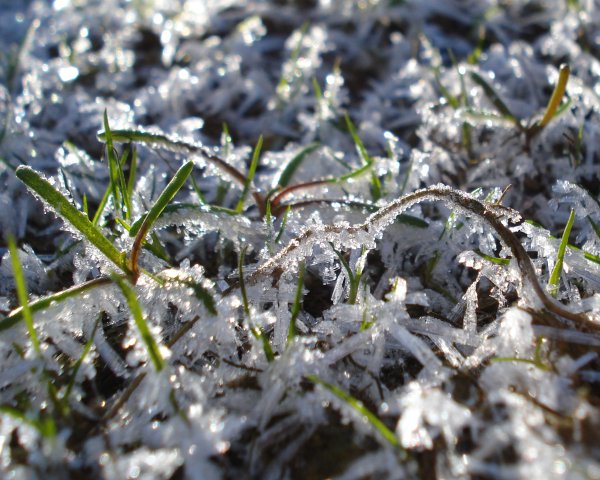
Frost on the Pasture
The plants in the herb garden are curled up against the cold. But there is still viable rosemary, thyme and some oregano. The last of the chives gave up the ghost a month or so ago. Green onions are still hanging on, hoping I won’t pick them before they can flower in the spring. In the greenhouses that I got from The Tree Center and set up last season, the last of the tomatoes have ripened and need to be picked. Their mother plants are completely brown and dead. Peppers hang here and there amidst the brown leaves of their plants. I need to get those picked and processed. We chop peppers, sweet and hot, and bag them into zip-locks. We freeze them and use them in cooking all the rest of the year. Instead of canning tomatoes I chop them, skins, seeds and all, in the cuisinart and freeze them. They too are used in cooking for the rest of the year.
Out in the fields the garlic we planted in October is showing the first of its growth. Yum! If it were to get really cold we’d have to cover it with straw, but I’d rather not. That way there’s no convenient hiding place for our garden nemesis, the slug. We also have lettuce, mesclun, carrots, broccoli, kale, swiss chard, cabbage, rutabaga, beets, turnips and more growing in the fields. Some of the plants are under cover to protect them from super cold weather. Others are left to grow as they will. I expect the beets and the swiss chard will finish shortly. I should grab some and chop it and freeze it for eating later before it turns into a brown frozen mush!
I expect we’ll have our first snow, if not over Thanksgiving where it can most effectively screw up travel plans and therefore is the chosen time of the weather gods, by early December. Before then, I hope to have the paths in the herb garden weeded, and we really need to get the plowing done.
I’d like to refer everyone to a gardening blog from our own Grayslady, Gardening in the Mud. Please visit there for information about Mid-West and North-East gardening and plants. She knows her stuff! If anyone else has a garden blog they’d like linked, let us know!
So, what’s happening in the garden in your area? Go outside and then let us know!

 peej
peej Carissa
 bostonboomer
 dakinikat
 ecocatwoman
 mablue2
 Mama Lopez
 peggysue22
 quixote
 skydancingguestblogger
 Mona (aka Wonk the Vote)



 Sky Dancing
Recent Comments