
“The response shall address the legal propriety of using an out-of-district grand jury proceeding to continue to investigate and/or to seek post-indictment hearings on matters pertinent to the instant indicted matter in this district,” Cannon wrote.
Tuesday Reads: A Tale of Two Judges
Posted: August 8, 2023 Filed under: Afternoon Reads, Crime, Donald Trump, just because | Tags: Garcia hearing, grand jury, January 6 case, Judge Aileen Cannon, Judge Tanya Chutkan, protective order, Stanley Woodward, stolen documents case, Walt Nauta 16 Comments Good Afternoon!!
As usual, I’m riveted to the coverage of Trump’s criminal cases. It’s not particularly surprising that he plans to follow his usual method of defense: delay, delay, delay. He hopes to delay the trials until after the 2024 election so that if he’s elected, he can dismiss the cases against him or pardon himself.
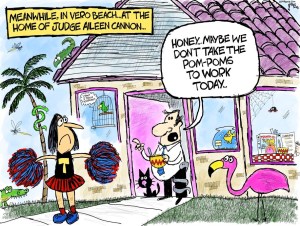
In Florida, Judge Aileen Cannon seems willing to help Trump slow down the stolen documents case as long as possible.
In DC, Judge Tanya Chutkan is less likely to accept his delay tactics in the January 6 case, but, at the moment, he has succeeded in slowing down the discovery process–probably for a couple of weeks.
Here’s the latest on the two cases.
On August 2, Special Counsel Jack Smith asked Judge Cannon for a Garcia hearing to evaluate a possible conflict of interest involving Walt Nauta’s defense attorney Stanley Woodward. Nauta is a co-defendant with Trump in the stolen documents case. NBC News: Special counsel cites potential conflicts for Mar-a-Lago defense attorney.
The special counsel prosecuting former President Trump for his alleged mishandling of government secrets has asked for a hearing to discuss whether the defense attorney for a co-defendant has a conflict of interest stemming from his multiple clients.
According to a court filing on Wednesday, attorney Stanley Woodward’s current and past clients include three people who could be called to testify against Walt Nauta, Trump’s aide who is charged with conspiring to obstruct the government’s efforts to reclaim classified documents.
Woodward’s clients include two aides who worked for Trump at the White House and into his post-presidency, and a Mar-a-Lago IT director identified as “Trump Employee 4” in the updated indictment. The Washington, D.C.-based lawyer also represents at least seven other people who have been questioned by prosecutors in the case. He declined to comment when reached by NBC News.
Trump’s Save America PAC has spent $20 million on legal fees in the first half of this year, according to FEC filings. Woodward’s firm was paid more than $200,000 in the first six months of the year.
In defending Nauta, Woodward may need to cross-examine a witness with whom he has had privileged discussions, which raises the risk of an “attorney’s improper use or disclosure of the client’s confidences during the cross-examination,” or “may cause the attorney to pull his punches during cross-examination, perhaps to protect the client’s confidences or ‘to advance the attorney’s own personal interest,’” the motion filed by special counsel Jack Smith’s office argues.
 Woodward was previously defending Yuscil Taveras, who has now hired a new attorney and appears to be cooperating with the government.
“Employee 4, who is unnamed in the indictment but was identified by NBC News as Yuscil Taveras, secured a new lawyer in July, and did not waive the conflict, according to the motion. Roughly three weeks later, a grand jury charged Trump, Nauta, and Carlos De Oliveira, a Mar-a-Lago property manager, over their efforts to have Taveras delete Mar-a-Lago surveillance footage.
Prosecutors told Woodward earlier this year that they believed Taveras had information that would incriminate Nauta, and that representing both clients at the same time raised a potential conflict of interest. Woodward said he advised both clients of the government’s position, but that he was unaware of anything the employee could say to incriminate Nauta and did not see a conflict, according to the filing.
Judge Cannon was unconvinced, and instead has revealed the existence of secret grand jury still investigating this case in DC., thus delaying the case for who knows how long.
Perry Stein at The Washington Post: Judge asks prosecutors to justify use of 2 grand juries in Trump documents case.
Judge Aileen M. Cannon on Monday asked federal prosecutors to explain the use of grand juries in Florida and Washington in the classified documents case against Donald Trump even though charges were filed in South Florida.
Cannon, the federal judge in South Florida assigned to the case, posed the question in a court filing Monday and told federal prosecutors to respond by Aug. 22.
Trump and two aides — Waltine “Walt” Nauta and Carlos De Oliveira — were charged this summer in a 42-count indictment that accuses the former president of improperly retaining 32 classified documents at Mar-a-Lago, his Florida residence and private club, and seeking to thwart government attempts to retrieve them….
For many months, Justice Department prosecutors had questioned witnesses in the Florida case before a federal grand jury in Washington. The secret proceedings yielded much of the evidence at the crux of the case. But in May, the grand jury activity appeared to continue at a federal courthouse in Miami. Ultimately, prosecutors filed charges in a West Palm Beach courthouse — a courthouse in the same district as Miami and the area where Mar-a-Lago is located.
Prosecutors said in a court filing last week that they continued to use the grand jury in Washington after they initially charged Trump in June to investigate alleged instances of obstructing the investigation. The focus of the July superseding indictment was on obstruction, alleging that all defendants tried to delete security footage that the government wanted as evidence in the case.
“The grand jury in this district and a grand jury in the District of Columbia continued to investigate further obstructive activity, and a superseding indictment was returned on July 27, 2023,” prosecutors wrote in the filing.
 Judge Cannon apparently disapproves, and decided to reveal the information the Special Counsel had given her under seal.
Prosecutors included that revelation in a motion asking the judge to consider holding a hearing to determine whether Nauta’s attorney has too many conflicts of interest to provide his client with adequate legal advice.
The government lawyers said Stanley Woodward — the Nauta attorney — has represented at least seven other clients whom prosecutors have interviewed about Trump’s alleged efforts to keep classified documents in defiance of the government’s demand they be returned. Two of Woodward’s clients could be called as government witnesses in the trial, the filing by the government said.
If that happens, Woodward may need to cross-examine his other clients as part of defending Nauta, said the prosecutors leading the Justice Department investigation.
The requested hearing — known as a Garcia hearing — is fairly common in legal proceedings. At the hearing, prosecutors said Cannon should inform Nauta and the two witnesses, whose names have not been made public, of their legal rights and the potential conflicts their attorney poses. Lawyers are generally required to flag to a judge any potential conflicts of interest they encounter.
Cannon said Nauta’s lawyers are expected to respond to the judge’s question about the two grand jury locations and the prosecutors’ request for the Garcia hearing.
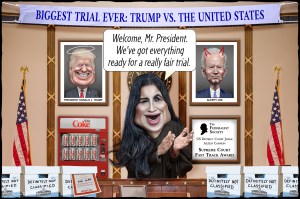 So it’s a normal request, but Cannon is going to drag the process out as long as she can, and, instead of keeping the existence of the secret grand jury under seal, she decided to announce it to the world.
Here’s a longer discussion of Cannon’s behavior by Adam Unikowsky’s Substack legal newsletter: It begins. Today’s order in United States v. Trump does not bode well.
Today [August 7] in the Southern District of Florida’s version of United States v. Trump, Judge Aileen Cannon issued an order denying the Justice Department’s motion to seal and requesting supplemental briefing. While seemingly insignificant, today’s order raises troubling concerns regarding her administration of the case….
Judge Cannon became nationally known in August and September 2022, when, in a civil case brought by Donald Trump, she issued a series of unusual orders blocking the Justice Department from reviewing documents seized at Mar-a-Lago and appointing a special master to oversee the Justice Department’s work. The Eleventh Circuit reversed Judge Cannon’s ruling, holding that the court lacked jurisdiction to interfere with the Justice Department’s review of lawfully-seized documents.
Unikowsky argues that it is important in dealing with Trump’s cases to be scrupulous in following norms. He doesn’t yet see any basis for asking for Judge Cannon to be removed from the case. It isn’t unusual for Judges to have rulings reversed and still continue to preside in the cases. I hope you’ll read the whole post if you’re interested in Unikowsky’s views on the case, but for this post, I’ll just cut to the chase.
The Justice Department’s motion notes: “The Government has advised Mr. Woodward of its intent to file this motion requesting a Garcia hearing and its reasons for doing so. Mr. Woodward has indicated that as a general matter he does not oppose the Court informing his client of the client’s rights or inquiring into potential waivers, but that he will not consent to this motion without seeing it in advance, and he requests the opportunity to respond.” This is a reasonable position for Woodward to take—he can’t possibly object to a hearing intended to safeguard his own client’s constitutional rights, but he wants to see the motion before taking a position.
So, this motion is a hanging curveball for Judge Cannon. It’s obvious how Judge Cannon should respond to this motion. She should wait to hear Woodward’s position on it!
If Woodward agrees a Garcia hearing is warranted, Judge Cannon should hold the hearing to ensure that Nauta’s rights are protected. Maybe there’s some discretionary reason to deny the hearing even if everyone agrees it’s warranted? I can’t think of one, but maybe. But clearly, Judge Cannon should wait until she hears from Woodward before deciding what to do….
Instead, Judge Cannon does something intensely weird. Two things, actually.
First, she denies the Justice Department’s motion to seal.
Second, she requests that Nauta file a response brief to the Justice Department’s motion addressing, among other things, “the legal propriety of using an out-of-district grand jury proceeding to continue to investigate and/or to seek post-indictment hearings on matters pertinent to the instant indicted matter in this district.” She also says Trump and De Oliveira “may, but are not required to” file a brief addressing this issue.
First, the court denies the Justice Department’s motion to seal, and strikes the motion for leave to file under seal, as well as the secret information itself, from the docket.
Here’s the court’s rationale: “The Special Counsel states in conclusory terms that the supplement should be sealed from public view ‘to comport with grand jury secrecy,’ but the motion for leave and the supplement plainly fail to satisfy the burden of establishing a sufficient legal or factual basis to warrant sealing the motion and supplement.”
Seriously?
Grand jury proceedings are supposed to be secret, and the Justice Department is disclosing the identity of grand jury witnesses and the substance of their testimony, so it wants to keep that information secret. That’s not a “legal or factual basis to warrant sealing the motion and supplement”?
There’s a lot more, and it’s pretty useful if you are interested in this case.
 The January 6 Case – Judge Tanya Chutkan
I’m sure you’re familiar with what has happened so far. Trump has been threatening Jack Smith, President Biden, the DOJ, and Judge Chutkan on social media and in speeches, even after he was warned not to commit crimes or tamper with witnesses or the jury pool. Smith requested a protective order before turning over discovery to the Trump team. He is concerned–with good reason–that Trump will release secret grand jury material and other evidence to the public so he can try the case in the media.
Here’s the latest.
Kyle Cheney at Politico: Trump objects to strict limits on sharing evidence in election interference case.
Former President Donald Trump argued Monday that he should be allowed to share evidence in his latest criminal case with “volunteer attorneys” and other unpaid advisers as he prepares to defend himself against charges related to his effort to subvert the 2020 election.
“The government cannot preclude the assistance of those individuals, nor should President Trump be required to seek permission from the Court before any such individual assists the defense,” Trump’s attorney John Lauro wrote in a filing that seeks to govern the handling of the mountains of evidence prosecutors have gathered and are preparing to share with Trump’s team.
“Such a limitation or requirement would unduly burden President Trump and impede the efficient preparation of his defense,” Lauro continued.
In a Sunday email between Trump’s lawyers and prosecutors, appended to Trump’s filing, assistant special counsel Thomas Windom raised concerns about Trump’s plan to broaden the group of legal advisers who might be permitted to review evidence in the case, worrying that the language Lauro proposed was “boundless.”
The dispute is one of several between Trump’s legal team and the special counsel over the handling of evidence in the case and how significantly to restrict Trump’s ability to publicly disclose any of the evidence he receives. Prosecutors have proposed a so-called “protective order” that would prohibit Trump or his legal team from publicly sharing any evidence produced by prosecutors. They say that they can’t begin sharing evidence with Trump and his team until a protective order is in place.
The matter now falls to U.S. District Court Judge Tanya Chutkan, who ordered Lauro to respond to prosecutors’ proposed protective order by Monday at 5 p.m. She may either rule on the matter or seek additional argument at a hearing in the case. Prosecutors are due to propose a trial date by Thursday.
Lauro said the blanket restriction on disclosing any evidence prosecutors provide is draconian and should be narrowed to limit the treatment only of materials deemed “sensitive” — such as those containing personally identifying information, grand jury subpoena returns, sealed search warrant returns and recordings or transcripts of witness interviews.
 The government asked the judge to simply grant the protective order, which is usually a routine decision. But instead, she ordered the parties to hash it out in a hearing this week–probably on Friday. Again the upshot is more delay, which is just what Trump wants.
Former President Donald Trump’s legal team says that a protective order proposed by special counsel Jack Smith would infringe on Trump’s right to free speech.
Trump’s attorneys made the argument in their response Monday to the special counsel’s motion for a protective order over the discovery evidence in the case against Trump for allegedly seeking to overturn the 2020 election.
Trump has pleaded not guilty to charges of undertaking a “criminal scheme” to overturn the results of the 2020 election by enlisting a slate of so-called “fake electors” targeting several states; using the Justice Department to conduct “sham election crime investigations”; and trying to enlist the vice president to “alter the election results” — all in an effort to subvert democracy and remain in power.
The former president has denied all wrongdoing and has dismissed the probe as politically motivated.
Monday’s filing argues for narrower limits on the protective order, which Trump’s attorneys say would protect sensitive materials while ensuring Trump’s right to free speech.
“In a trial about First Amendment rights, the government seeks to restrict First Amendment rights,” Trump’s attorneys wrote in their filing. “Worse, it does so against its administration’s primary political opponent, during an election season in which the administration, prominent party members, and media allies have campaigned on the indictment and proliferated its false allegations.”
Of course, the trial is not about First Amendment rights. Trump is charged with three criminal conspiracy counts.
Smith asked the judge for the protective order on Friday, referencing a social media post Trump made Friday afternoon in which he said, “IF YOU GO AFTER ME, I’M COMING AFTER YOU!”
The proposed protective order submitted by Smith does not seek to bar Trump from commenting on the case in its entirety, but would restrict Trump and his attorneys from disclosing evidence such as materials returned from grand jury subpoenas and testimony from witnesses and other exhibits shown to the grand jury. It does not limit Trump from discussing materials that were already available to the public separate from the government’s investigation.
Smith’s attorneys have said the proposed order is largely modeled after similar protective orders issued in other cases.
But in their filing on Monday, Trump’s attorneys accuse Smith’s team of asking Judge Tanya Chutkan to “assume the role of censor and impose content-based regulations on President Trump’s political speech that would forbid him from publicly discussing or disclosing all non-public documents produced by the government, including both purportedly sensitive materials, and non-sensitive, potentially exculpatory documents.”
This is the crap we are going to have to deal with, folks. None of these trials is going to be quick or easy.
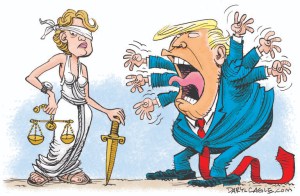 Meanwhile, because of Trump’s threats, Judge Chutkan needs more protection. CNN: Security increases for the judge assigned to Donald Trump’s January 6 criminal case.
Security for the federal judge assigned to oversee the criminal case against former President Donald Trump over his attempts to overturn the 2020 election has been increased in the federal courthouse in Washington, DC.
CNN has observed more security detailed to Judge Tanya Chutkan, and deputy US Marshals discussed security plans for the judge on Monday. The US Marshals Service handles security at the DC District Court and a spokesman for the service said it “take(s) that responsibility very seriously.”
“Ensuring that judges can rule independently and free from harm or intimidation is paramount to the rule of law, and a fundamental mission of the USMS,” spokesperson Drew J. Wade told CNN. “While we do not discuss our specific security measures, we continuously review the measures in place and take appropriate steps to ensure the integrity of the federal judicial process.”
The uptick in security inside the courthouse comes after security measures, including fencing and yellow tape, were taken down following Trump’s arraignment last week. That hearing, where Trump pleaded not guilty, was presided over by a magistrate judge. Chutkan takes the case from there.
Trump has already said he will be asking for Chutkan to recuse herself from the case, writing on social media in all caps: “There is no way I can get a fair trial with the judge ‘assigned’ to the ridiculous freedom of speech/fair elections case.”
So that’s what’s happening in the two federal cases against Trump. It’s going to be a long road, and there will be a lot of stupidity to deal with, but we can get through it together!

 peej
peej Carissa
 bostonboomer
 dakinikat
 ecocatwoman
 mablue2
 Mama Lopez
 peggysue22
 quixote
 skydancingguestblogger
 Mona (aka Wonk the Vote)



 Sky Dancing
Recent Comments