
Monday Afternoon, Sky Dancing in the Garden
Posted: February 14, 2011 Filed under: Farming, Food, gardening | Tags: food, gardening, greenhouse, weeds 17 CommentsI was thinking about writing a gardening and food post, then Kat mentioned gardening in the Monday Reads and so I ran with it.
Up here in the northern-westernest part of the lower 48 La Nina has been mighty boring. I’m grateful for this, but sorry that her pattern of weather moved south and blasted the rest of the country with such misery. We’ve had normal temps and less rain that usual, although that is changing. This means my partner and I have been out working on the farm. He got the parts of the field we need later this month and next tilled and ready for planting. I’ve been working on conquering the weeds in the herb garden.

A plain and simple rose, in Sima's garden
Weeds (northeastern, northwestern, california, midwest and south): the bane of life with organic gardening, little tiny buggers that grow from the very air it seems, seeds stored for 20 years or more in buried earth just waiting for a bit of sun and light, little bothersome indicators of both soil gone wrong and soil gone right, rotten, overpowering… bleh. Weeds. Since our farm started as a cow pasture and hay field, our worst weeds are grasses, particularly what we call ‘zip’ grass, because of the sound it makes when you rip it out by the roots and discover to your horror the roots run right under the 3 feet of weed matted and graveled pathway and out the other side. Ziiiipppp indeed. One little stem of that stuff and it’ll grow another 4 foot long run of root, little grasslets sprouting all along the way.
Gambling with Hunger
Posted: February 4, 2011 Filed under: Human Rights, hunger | Tags: food, gambling, Global hunger, Islamic Banking, Shari'a finance, Speculation in food 28 Comments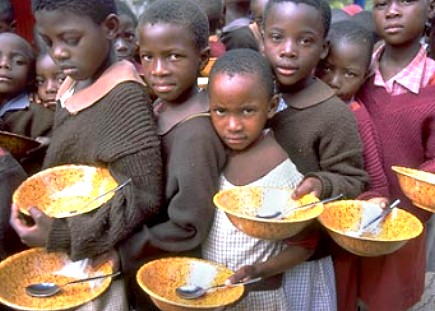 During the wind down of the financial crisis several years ago, a few people that read my more wonky threads asked me where I thought the next speculative bubble would develop. I answered food more from intuition than any hard core evidence that I had at the time. Now there is plenty of hard core evidence that validates my intuition.
Farm land and Ag. prices have been fairly stable since the 80s and represented some of the few markets that proved relatively resistant to the Global Financial Crisis. However, there was a period of time–2007 through 2008– when some speculative practices influenced food markets. That is why I thought it was likely to recur. Food is, of course, a necessity so that always gives a market a degree of persistence during downturns. It does not make it safe from speculation. The deal is that speculators made a lot of money from their counterbets to the mortgage bubbles and that money had to go some where. I thought it likely they would head for the commodities markets since they did that before with oil, cooper, and food. Since these investors are by nature speculators, they have similar investment behaviors and profiles. The movement of a large number of large dollar investors from one specific clientele into any market is going to have an impact. Speculators moved to commodities and they moved on food. You could see the momentum build and you could trace momentum riders as they entered the market.
Before I get started on the main thrust of this post, I’d like to mention that I know a lot about Shari’a compliant finance and banking because my major professor is one of its leading authorities. Because this discussion is going to include countries where Islam is a major religion, I would like to say a few things about how Shari’a is applied to stock markets, banks, and ‘financial engineering’ in countries where populations may be pushing for these kinds of laws. I’d also like to say that Islamic economists share my concerns even though those concerns are rooted in different philosophies.
It is important to point out that Islamic banks and investment funds were found to be resistant to the global recession compared to their conventional counterparts. This is because gambling and speculation is outlawed in Islamic texts and therefor not allowed in Shari’a compliant institutions. The current U.S. and European corporate form is problematic under Shari’a. The Qu’ran is very specific about the nature of doing business. Most of this is based on the old testament prohibition against usury but the haddith and Q’uran go further. However, the shared old testament roots makes a lot of Islamic financial institutions similar to the ones you find in New York with special banks run by the Orthodox Jewish communities there. We already have religious financial institutions that follow Old Testament prescriptions. I’ve had Jewish students from Orthodox congregations provide me similar information that’s rooted in the Talmud. (Yes, I’m an atheist which makes me extra suspicious of any religious text.)
The Qur’an also promotes shared partnership/ownership and responsibility within a business as a moral imperative between all owners of that business. It does not promote any governmental ownership. It is considered immoral to operate a business with a never-ending, always changing ownership pool like that present in the business form of a public corporation. Preferred stock is strictly prohibited. All owners must have a shared responsibility for the business. That includes the concept of ‘negative’ profits and any negative results. If the business does something immoral or wrong, all of the owners and decisions makers owe the societal retribution and share in the shame and negative profits. No one owner can walk away from illegal activities.
Contracts that are compliant to the Shari’a are written clearly and monitored against gharar (disception) so that gambling and speculation cannot occur and so that any thing bad the business does comes back on all the owners/investors in a business. They all hang or thrive together over long periods of time. That is because a business and trade are supposed to bring good results for the entire community. It’s like the idea of karma. If you do good, every thing thrives. If you do harm, the poison spreads and you are held to account. The contracts are enforceable in courts. In this case, an Islamic jurist and an angry sky god will hold you to account. You’ve undoubtedly read exactly how old testament angry that punishment can be be in the version of Shari’a practiced by the extreme Shia Islam of Iran. Fortunately, most adherents to Islam–like the majority of adherents to Christianity and Judaism–do not adhere to literal interpretations of Old Testament prohibitions and punishments. They hold to the underlying moral view and practices.
Shari’a compliance means no corporate form like we use here with its limited liability financiers and assumed perpetuity. This is probably why you’ve got so many people calling Islam ‘anti-capitalist’ now. It’s not anti-capitalist at all. In fact, it exhorts people to share and run businesses as a moral activity. It’s the speculation and the ability to walk away from liability that is prohibited. It is not about government takeover of private property. It is about holding private property owners to account for the damage they may do to society and preventing that when possible. Of course, the plutocracy hates this.
I want to explain what this means because it’s not a Marxist form or a planned market form like you saw in the Soviet Union. This is not a ‘communist under the bed’ situation. Derivatives and financial engineering are being vigorously discussed by Islamic economists and financiers right now. They are separating out the forbidden, speculative activities. This means that many hedge funds would not be able to get into projects where the owners follow Shari’a because speculation is strictly prohibited. All investments must be matched to “real” assets. Assets cannot be created out of thin air. So, in this situation, forward contracts or futures contracts are allowed. Some of the synthetic deals that characterized the pre-crisis time cannot be used by firms providing investment fund opportunities to people concerned their monies be placed in Shari’a compliant ways. Additionally, the Q’uran has a strict prohibition on hording money. The rich must keep their funds active in the economy to please God. Another edict is that all activities must put aside a portion for charitable activities that support widows and orphans. I hope this gives you enough understand to place this next discussion in context and why some people may find this appealing.
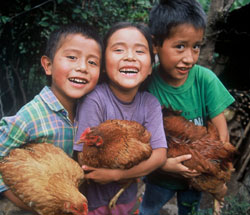
shameless plug for Hieifer International ... click the happy kids and feed people!!
So, maybe you can understand why gambling with food assets is a big concern on many levels for developing nations. First, you have an incredible amount of hungry people. There are tales of hungry people in Africa watching boats be loaded with food they grew being shipped to rich, developed countries. Then, you have a number of regions where gambling is basically seen as doing harm to people and is prohibited by God. I would like to remind you that most fundamentalist Christians and Orthodox Jewish Congregations believe this too. It’s clearly part of the old testament prohibitions. So, modern finance is running headlong into development economics as well as people with literal old testament-based religions. Again, Orthodox Jewish congregants have a separate banking system in New York that would be considered Shari’a compliant. I cannot emphasize this enough.
So with this in mind, there is increasing evidence that ‘Rampant Speculation Inflated Food Price Bubble”. You can see what excessive speculation is now doing to food markets.
Follow-up: GM Alfalfa
Posted: February 2, 2011 Filed under: crops, Farming, Food, gardening | Tags: alfalfa, farming, food, monsanto 10 CommentsI wrote about GM Alfalfa several days ago, and wanted to post a short followup.
First, do we really need GM Alfalfa? Probably not. It’s not like Alfalfa is riddled with a weed problem in this country. Michael Pollan points out that 93% of the alfalfa in this country is raised without any herbicides at all. This makes sense, alfalfa as fodder can benefit from the addition of other plants (although not poisonous ones, obviously). My goats thrive on weedy alfalfa. Anyway, GM Alfalfa says Pollan, ‘is a bad solution to a problem that doesn’t exist’.
The Center for Food Safety is going to continue bringing Monsanto to court over GM Alfalfa. ‘by tackling a new angle, Page Tomaselli, staff attorney at the Center for Food Safety, explained Friday at the Eco-Farm Conference. Their strategy will hinge on the “gene flow” risk accepted by the Supreme Court last June as harmful and illegal under current environment protections.’ The Public Patent Foundation is also going to sue Monsanto (or continue suing Monsanto. The foundation has been fighting Monsanto’s patents for a while now). If the foundation succeeds (and it just won a court battle to declare patents concerning human genes invalid), most of Monsanto’s patents concerning living things will be rendered irrelevant. Yes!
The Center for Food Safety has issued a press release pointing out that Vilsack’s decision leaves many problems. Who’s liable if a farmer’s crop is destroyed by GM pollen? Who pays damages? WHo is going to monitor and control herbicide useage on a crop that doesn’t need it, unless it’s ‘Round-Up Ready’? Who is liable for the super-weeds that will result?
From the Department of ‘Of Course, We Should have Known!’ (via Kat) comes this news. Media reports suggest that the reason Vilsack disregarded the comments of 200,000+, the recommendations of Aphis and so on has to do with pressure from the White House. So I wonder, is Obama actually fake? I mean, is he, like, made by Monsanto and the others? Just a gas-bag filled with whatever, maybe Round-Up, and tuned to say certain things that get frat boys excited? I wonder what Michelle, organic gardening proponent that she is, thinks about this? I suppose it doesn’t really matter. Just more proof everyone up ‘high’ is bought and paid for by the time they are weaned.
Didn’t we just do this?
Posted: January 5, 2011 Filed under: Environment, Farming, Food, toxic waste | Tags: bubble, commodity prices, corn, food, gm pigs, wheat 36 Comments(In which Sima works herself up into a frothing rant.)
Commodity futures prices, wheat, rice and corn, are rising again after a brief fall. In fact, they are supposed to top the records set in 2007/08 during the global food bubble.
Supposedly, Corn Rationing Needs to Begin:
“The corn market has one job and one job only—to go high enough to make people stop using the product,” says Ryan Turner, risk management consultant for FCStone, Kansas City. “We are past the point of encouraging more supply.” Turner predicts 2011 corn futures prices will exceed 2008 highs. “I don’t know if it will happen in January or June, but it will happen,” he says.
Soaring corn prices will slice into demand, with corn exports expected to fall first followed by feed usage. Analysts anticipate the cattle industry to begin rationing earlier than other livestock sectors due to poor margins, but rationing in poultry, hog, and dairy will be close behind. “It will be very painful,” Turner adds.
Those greedy so-and-sos! Imagine, eating corn and corn products? Making corn into feed to raise farm animals and then slaughtering those animals to feed humans. And furthermore, they feed the corn to dairy cows and produce milk and cheese and butter! Will the horror never end!
Obviously, everyone needs to suffer (UN: World Food Prices Hit a Record High in December). Especially the world’s poor. And those who produce the meat we Americans so love to eat are not to be excluded from the necessary pain. And those who produce the dairy we love to drink and nosh on with our imported European crackers. And those who make corn into tortillas, and those who make corn into corn syrup and those who make corn into ethanol… oh wait. Not those. In fact, those last ones may be part of what is driving the rise in corn prices. Nearly 1/3 of the 2010 US corn production was diverted to ethanol, after all.
Wikileaks and GMO/GM food, More cables, more fun!
Posted: December 28, 2010 Filed under: Economic Develpment, Farming, Food, Foreign Affairs, Wikileaks | Tags: Africa, cables, food, France, GM food, GMO, GMO food, monsanto, Spain, Wikileaks 24 CommentsRecently our own Grayslady posted an excellent article about Wikileaks, Monsanto and GMO Corn. She discussed a cable sent in late 2007 from our then Ambassador to France, Craig Stapleton, in which he discusses ways to force France and the EU to be more favorable towards the adoption of Monsanto’s GM BT enhanced, Roundup Ready corn. Other aspects of the information in that Wikileaks cable has been discussed in other places, for instance at Huffington Post by Jeffery Smith and at Truthout by Mike Ludwig.
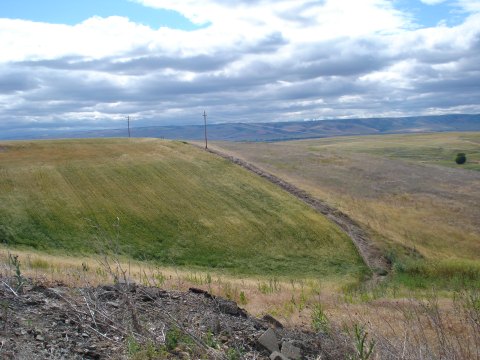
Wheat and Hay Fields near Pendleton, Oregon
What the cable suggested, in part, was publishing a ‘retaliation’ list of places, down to the actual fields, growing GMO foods in Europe in the hopes the fields and crops would be destroyed by activists, ’cause pain’ for officials and hopefully swing GMO acceptance in Europe around. The Ambassador went on to say that France was particularly culpable because scientists in France were attempting to change ‘knowledge’ by studying the effects of GMO products (even the ‘good’ GMO like BT enhanced products). These studies show that the effects of GMO food on those eating it may be more pronounced and drastic than the limited studies done by the FDA and USDA suggest (see for example the studies of Dr. Gilles-Eric Seralini, Professor Andrés Carrasco, and others). And for more, see this interview of Jeffery Smith on Democracy Now.
This is very interesting, because a cable sent in 26 October 2007 is the subject of French President Sarkozky’s first visit to the USA, and his meetings with American business leaders, including pushers of GM foods. The cable suggests that the President’s support of more restrictive rules on GM products in France might be politically based and therefore, changeable.
But Wait, There’s more! The cable to France, although receiving a lot of attention because it suggests undercutting the rightful government of our supposed allies and creating civil unrest and ‘pain’, is not the only released cable to mention GMOs and Monsanto’s needs across the world. Over at Eats, Shoots and Leaves there’s a good rundown by Richard Brenneman of some of the cables.
For example, in a cable from 9 April 2009 concerning, in part, African development, one of the points of intelligence to be gathered is the African governments’ and peoples’ reactions to growing and using GM crops. Brenneman rightly asks, why would this be a concern of our State Department, unless our government is actively pushing and supporting Monsanto and the company’s GM stable of crops?
I’m going to drop a final h/t to Rady Ananda at the Food Freedom blog. She wrote about GMO and Wikileaks several weeks ago, and has been right on top of things. She brings forth the case of the food crisis of 2007-08 which wraps up some of the things we at Sky Dancing discuss into a tidy bundle.
In a January 2008 meeting, US and Spain trade officials strategized how to increase acceptance of genetically modified foods in Europe, including inflating food prices on the commodities market, according to a leaked US diplomatic cable released by WikiLeaks.
Some of the participants thought raising food prices in Europe might lead to greater acceptance of biotech imports.
It seems Wall Street traders got the word. By June 2008, food prices had spiked so severely that ‘The Economist announced that the real price of food had reached its highest level since 1845, the year the magazine first calculated the number,’ reports Fred Kaufman in The Food Bubble: How Wall Street starved millions and got away with it.
The unprecedented high in food prices in 2008 caused an additional 250 million people to go hungry, pushing the global number to over a billion. 2008 is also the first year ‘since such statistics have been kept, that the proportion of the world’s population without enough to eat ratcheted upward,’ said Kaufman.
Remember back in 2007/08 when food prices, especially bread prices, suddenly shot up? I remember being astounded when the price of a bag of hot dogs went from 99 cents to 1.29$ overnight. I figured maybe it was the result of the rise in oil costs going on about then, and perhaps it was, in part. But after reading the article by Kaufman I’m not so sure. There was no crisis in food production at this time. It was simply a manufactured bubble. About that time there were terrible food riots in Mexico amongst 29 other countries, because the price of tortillas had gone up so much people couldn’t afford to buy them. I note that the Mexican government has recently taken steps to ensure this doesn’t happen again, by buying corn futures to guarantee a flat price.
So, I wonder, how are the big fat cats and the government diddling in our food today? Surely food, at least food, should be relatively safe from bubbles, like electricity, water, and sewage service? Oh wait, those are being commoditized too. Ahd I would like to point out, the price of the bag of hot dogs has not come back down, although the bubble burst… makes ya wonder, doesn’t it?
Note: I’m going to be in and out all today, so consider this something of an open thread. I’m really keen to know what everyone thinks of the Kaufman article. When I read it I was stunned by the lengths to which the greedy people of Wall Street will go to make money.

 peej
peej Carissa
 bostonboomer
 dakinikat
 ecocatwoman
 mablue2
 Mama Lopez
 peggysue22
 quixote
 skydancingguestblogger
 Mona (aka Wonk the Vote)



 Sky Dancing
Recent Comments