Posted: December 11, 2024 | Author: bostonboomer | Filed under: "presidential immunity", Donald Trump | Tags: Alvin Bragg, Bettina Anderson, Brian Thompson, chronic back paint, Donald Trump Jr., gossip, health insurance, Kimberly Guilfoyle, Luigi Mangione, separation of powers, United Health Care |
Good Afternoon!!
There’s not a lot of exciting politics news today; and that is probably a good thing, considering how bad things are looking for the country in the long run. We only have a little more than a month until Trump moves into the White House and tries to become president for life.
Have you heard the latest gossip? Donald Trump, Jr., who is still engaged to Kimberly Guilfoyle, has a new girlfriend.
Olivia Craighead at The Cut: Don Jr. Keeps Stepping Out With a Woman Who’s Not Kimberly Guilfoyle.
Is there trouble in paradise for one of America’s most unsettling couples? Sure seems like it. Donald Trump Jr. and Kimberly Guilfoyle may be on the rocks, if the Daily Mail is to be believed. While the fiancés were spotted together about a week after the election, the tabloid has been all over what looks like Don Jr.’s new relationship with Bettina Anderson, a Republican socialite who lives in Florida. So what’s going on here?
Let’s back up a few months. In September, the Daily Mail reported that Don Jr. and Anderson had been “spotted canoodling” during a brunch date the month prior. According to their sources, this new fling was “the talk of Palm Beach.” One source said that Anderson reached over “to plant a sexy kiss” on Don Jr. three times during their meal at the Honor Bar.
“She seemed totally smitten with Don — and he with her,” the source told the Daily Mail.

Bettina Anderson
Guilfoyle was probably shocked to learn this information, right? Well, not so fast. The day after the first Daily Mail reports, friends of the former Fox News host told the tabloid that she might have had an idea of what was going on.
“Kimberly either didn’t know about Bettina — or didn’t want to know. Did she hear whispers that Don Jr. was fooling around with someone else? Probably,” one of Guilfoyle’s so-called friends said. “She’s no fool but it’s easy to deceive yourself when you’re so committed to someone and believe he’s committed to you.”
Guilfoyle and Trump have been together since 2018, and got engaged on New Year’s Eve 2020 (his birthday). During their time together, she became a mainstay in the MAGA world, often seen at Trump events, delivering speeches at Republican National Conventions, and sharing almost nothing but pro-Trump content on Instagram. By Election Night this year, it seemed like she and Trump Jr. had worked things out, as she stood by his side at his father’s victory speech.
But all was reportedly not well. The Daily Mail is back on the Trumpfoyle beat, and on Tuesday, they reported that the purportedly engaged couple has not been spotted together since November 12. Meanwhile, on Monday, Don Jr. and Bettina were photographed holding hands while out to dinner to celebrate her 38th birthday. The tabloid also reported that he has been living with his new girlfriend at her West Palm Beach townhouse instead of in the $15.5 million mansion he and Guilfoyle bought in 2021.
Gross. Who would want to hang around with Don Jr., much less live with him? I guess it takes all kinds.
According to US Magazine, via Yahoo News, Anderson is “a model and an influencer” with “more than 38,000 followers on” Instagram.
Anyway, Trump Sr. is giving Guilfoyle a consolation prize–He plans to appoint her Ambassador to Greece.
The Daily Beast, via Yahoo News: Trump Sends Don Jr.’s Fiancée Kimberly Guilfoyle Abroad After Split Rumors.
Donald Trump has appointed former Fox News host Kimberly Guilfoyle as his ambassador to Greece—just hours after pictures published by the Daily Mail showed her fiancé, Donald Trump Jr., hand-in-hand with another woman.
“For many years, Kimberly has been a close friend and ally,” the president-elect said in his announcement, which he posted to Truth Social.
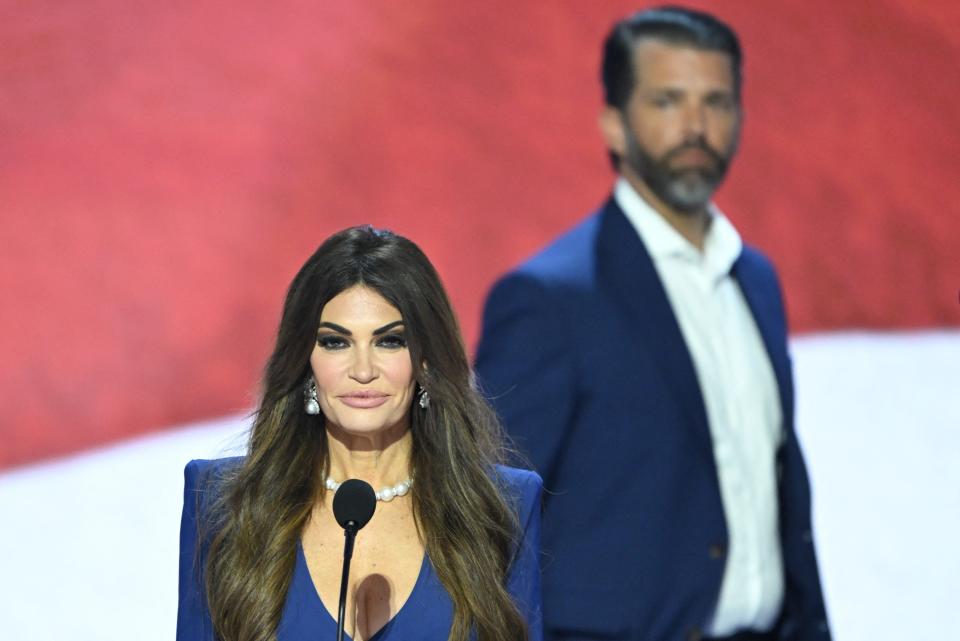
Kimberly Guilfoyle and Don Jr
“Her extensive experience and leadership in law, media, and politics along with her sharp intellect make her supremely qualified to represent the United States, and safeguard its interests abroad. Kimberly is perfectly suited to foster strong bilateral relations with Greece, advancing our interests on issues ranging from defense cooperation to trade and economic innovation.”
Guilfoyle’s nomination requires Senate confirmation and would see her handling foreign affairs.
The announcement hit conspicuously soon after Trump Jr., 46, was pictured cozying up with Palm Beach socialite Bettina Anderson, 38.
Trump Jr. made no comment on the rumors on social media when he congratulated Guilfoyle in a brief statement to X Tuesday night: “I am so proud of Kimberly. She loves America and she always has wanted to serve the country as an Ambassador. She will be an amazing leader for America First.”
There’s more information coming out on Luigi Mangione, the man who has been arrested and charged with murdering of United Health Care CEO Brian Thompson in NYC. Here’s the latest:
The mainstream media has refused to publish Mangione’s “manifesto,” but Ken Klippenstein has posted it on his website:
I’ve obtained a copy of suspected killer Luigi Mangione’s manifesto — the real one, not the forgery circulating online. Major media outlets are also in possession of the document but have refused to publish it and not even articulated a reason why. My queries to The New York Times, The Washington Post, CNN and NBC to explain their rationale for withholding the manifesto, while gladly quoting from it selectively, have not been answered.
I’ll have more to say on this later — on how unhealthy the media’s drift away from public disclosure is — but for now, here’s the manifesto:
“To the Feds, I’ll keep this short, because I do respect what you do for our country. To save you a lengthy investigation, I state plainly that I wasn’t working with anyone. This was fairly trivial: some elementary social engineering, basic CAD, a lot of patience. The spiral notebook, if present, has some straggling notes and To Do lists that illuminate the gist of it. My tech is pretty locked down because I work in engineering so probably not much info there. I do apologize for any strife of traumas but it had to be done. Frankly, these parasites simply had it coming. A reminder: the US has the #1 most expensive healthcare system in the world, yet we rank roughly #42 in life expectancy. United is the [indecipherable] largest company in the US by market cap, behind only Apple, Google, Walmart. It has grown and grown, but as our life expectancy? No the reality is, these [indecipherable] have simply gotten too powerful, and they continue to abuse our country for immense profit because the American public has allwed them to get away with it. Obviously the problem is more complex, but I do not have space, and frankly I do not pretend to be the most qualified person to lay out the full argument. But many have illuminated the corruption and greed (e.g.: Rosenthal, Moore), decades ago and the problems simply remain. It is not an issue of awareness at this point, but clearly power games at play. Evidently I am the first to face it with such brutal honesty.”
John Herrmann at New York Magazine: Luigi Mangione’s Full Story Isn’t Online.
When the identity of Luigi Mangione, the alleged UnitedHealthcare CEO shooter, was revealed on Monday, the online search — a reporting process that’s become a collective online ritual — began. It turns out he left a lot of information online: an active account on X, an Instagram, a Facebook, a Goodreads, a Reddit account, and maybe even a Tinder profile. The dossier came together fast.
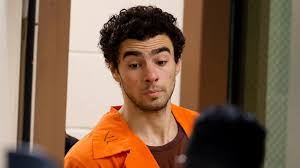
Luigi Mangione
Reporters and social-media users noted possible red flags, strange and eerie fragments of information, and small ironies. On Goodreads, he had posted a contrarian riff on Ted Kaczynski’s manifesto. Was it evidence of violent tendencies? He also reviewed a couple of books about back pain. On X, he posted about AI superintelligence and followed some anti-woke pundits. Had he tumbled down a slippery slope? Was he blackpilled? Some sort of accelerationist? On Reddit, he posted about backpacks and spinal injuries. Had he been hiding in plain sight all along?
In isolation, with the hindsight that they were posted by someone who went on to allegedly assassinate a health-care CEO, these accounts, and some of these posts, assumed new meaning, which is reasonable and understandable: It’s a crazy story that people want to understand, and the way social media has been processing it more broadly is unprecedented in about six different ways. But what’s most striking about Mangione’s extensive online dossier is that, had it been studied before the shooting took place, it wouldn’t have raised much alarm. You can spend hours reading these posts, sifting through his follows, and looking for clues about what Type of Guy he is, but the supportable theories are pretty thin: Mangione had an online profile consonant with his identity and context. He shared and posted and followed like a 20-something striver with a foot in the tech industry, listened to Rogan, and considered himself a rationalist or at least unusually rational….
His media consumption — wellness podcasts, a dash of “heterodox” punditry, tech personalities on X — might have placed him near some worrying ideological tendencies, but no more so than millions of other young men in his social milieu; on digital paper, he’s a bit like one of those young male swing voters that dominated post-election recriminations, albeit with an Ivy on his LinkedIn. If a dating profile led you to these accounts, you might wonder if he was going to talk at you about AI or if he might be sort of socially awkward. You might wonder if he’s a bit of a pod bro, or an RFK guy, but you’d also see a lot of stuff that looks — again, without future context — if not normal, then demographically typical. You wouldn’t have wondered if he was planning an assassination. You’d probably have assumed he was friendly! Now, everyone’s looking for the online trail that leads directly the sidewalk in front of the Midtown Hilton, but they haven’t quite found it. Nor, in 2024, should they expect to.
Herrmann argues that a criminal’s “on-line footprint” doesn’t really reveal who a person is anymore, if it ever did.
Faith in the existence of meaning in the “online trail” started waning when social media achieved full ubiquity. By the mid-2010s, the sorts of evidence you’d find in the aftermath of a shocking news event tended to be either hidden in places like 4chan — intentionally inscrutable communities within a fully mainstream internet — or left behind intentionally to be found and shared in the form of a manifesto, an archived Discord channel, or a recording of the act itself. These revelations could still be illuminating or at least shocking — the Pittsburgh synagogue shooter left a trail of posts on the right-wing social-media site Gab, for example — but in recent years, the post-news deep-dive, which has become a messy and fraught spectacle unto itself, wasn’t producing much in the way of understanding. Mostly, if you were planning a dramatic crime, you knew better than to post about it. If you wanted nobody to see you, or suspect you of anything, you simply didn’t post about it.
Mangione’s stubbornly normal online footprint, and the way the media and public have feasted upon it, marks the closing of this circle. Online, he was a guy with unremarkable niche interests and a serious appetite for boring productivity books. The reflexive assumption that his digital trail must contain essential, decodable truths about his motives has produced less in the way of insight than of fandom, which is constructed online through a similar process of breathless driven data aggregation.
Ashley Southall and Maria Cramer at The New York Times: Police Say Suspect’s Notebook Described Rationale for C.E.O. Killing.
Luigi Mangione, who has been charged with killing the chief executive of UnitedHealthcare at a company investors’ day, was arrested with a notebook that detailed plans for the shooting, according to two law enforcement officials.
The notebook described going to a conference and killing an executive, the officials said.
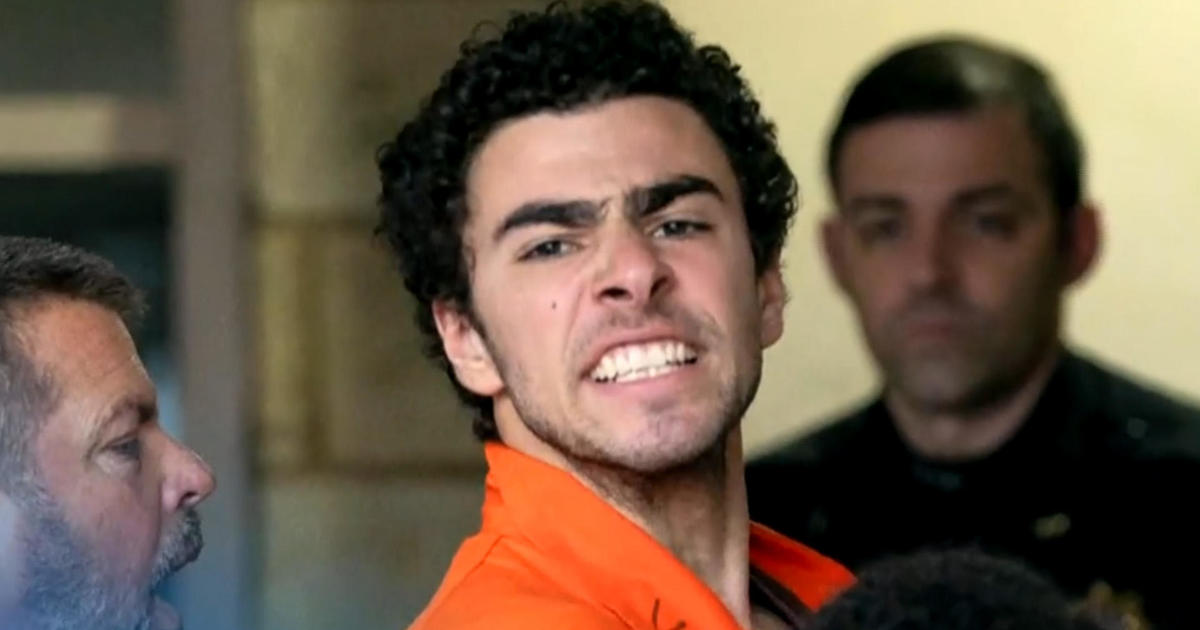
Luigi Mangione
“What do you do? You wack the C.E.O. at the annual parasitic bean-counter convention. It’s targeted, precise, and doesn’t risk innocents,” was one passage written in the notebook, the officials said….
When Mr. Mangione was arrested, the authorities also found a 262-word handwritten note with him, which begins by appearing to take responsibility for the murder. The note, which officials described as a manifesto, also mentioned the existence of a notebook. The recovery of the notebook was first reported by CNN.
The suspect saw the killing as a “symbolic takedown,” according to a New York Police Department internal report that detailed parts of a three-page manifesto found with him at the time of his arrest. The report added that the suspect “likely views himself as a hero of sorts who has finally decided to act upon such injustices” and expressed concern that others might see him as a “martyr and an example to follow.” [….]
On his way into court on Tuesday afternoon, Mr. Mangione shouted about “an insult to the intelligence of the American people and their lived experience.”
It was not exactly clear what he was referring to as deputies worked to push him into the courthouse. On Wednesday, the sheriff of Blair County, James E. Ott, said that otherwise Mr. Mangione had not given deputies any problems.
Read more at the NYT.
The NYT has another article about Mangione’s wealthy Baltimore family: The Prominent Maryland Family of the Suspect in the C.E.O. Killing.
Daniel Gilbert at The Washington Post: Severe pain shaped UnitedHealth CEO murder suspect’s view of health system.
Even when Luigi Mangione was surrounded with people who cared about him, he was isolated by a spinal defect that dealt the athletic young man crippling pain and contributed to a jaundiced view of the American health-care system.
Authorities charged Mangione, 26, with murder in the shooting of UnitedHealthcare CEO Brian Thompson in New York, but have said little about a motive for the killing. They found a three-page, handwritten document on Mangione that expressed disdain for the American health-care system, they’ve said.
On Reddit in April, Mangione foreshadowed that skepticism about the health-care industry as he offered advice for getting a doctor to perform spinal surgery.
“Tell them you are ‘unable to work’ / do your job,” he wrote. “We live in a capitalist society. I’ve found that the medical industry responds to these key words far more urgently than you describing unbearable pain and how it’s impacting your quality of life.”
Nothing in his Reddit posts reviewed by The Postindicate violent intentions. Authorities have not laid out their case for what drove Mangione to escalate his frustration with the health system, which is common in the United States, into an allegedly premeditated murder of a prominent health-care executive….
Mangione’s arrest has stunned his friends and family, most of whom appear to have lost touch with him in the last six months.
“We all condemn violence of any kind,” said Josiah Ryan, a spokesman for Surfbreak HNL, a co-living community in Honolulu where Mangione lived for six months in 2022. He added, “There’s sadness, because he was a person who was well-loved and no one saw this coming.”
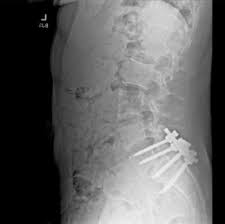
Mangione’s back X-ray
Ryan said that Mangione’s back pain was well known within the Surfbreak community. “It was a real problem for him, and he had to think about that in a way that most 24-year-old young men living in Hawaii would not have to worry about their health,” he said.
Mangione’s struggles with his back pain offer a glimpse into the interior life of a young man who outwardly lived a charmed existence — the scion of a wealthy family in Maryland who was valedictorian of his prestigious private school in Baltimore and earned degrees in computer science from the University of Pennsylvania….
In archived Reddit comments, Mangione doesn’t express anger toward UnitedHealthcare or other health insurers. But the posts chronicle his struggle over years to deal with back pain that became increasingly debilitating.
“From childhood until age 23, my back would always ache if I stood too long, but it wasn’t too bad,” he wrote in February. But as he entered his mid-20s, the pain began to disrupt his life, and he also struggled with cognitive issues.
In a Reddit group focused on brain fog, he wrote, “The people around you probably won’t understand your symptoms — they certainly don’t for me.”
Lots of people live with chronic pain (including me), but we don’t kill people over it.
A bit of Trump crime news: Manhattan DA Alvin Bragg is trying to keep his case against Trump alive. Laura Italiano at Business Insider: Bragg says Trump’s crimes and ‘history of malicious conduct’ are too serious for his hush-money case to be dismissed.
In an 82-page court filing made public Tuesday, Manhattan prosecutors say Donald Trump’s “history of malicious conduct” is too serious for his hush-money case to be dismissed.
The filing, signed by DA Alvin Bragg, also fights Trump’s claim that he enjoys something called presidential-elect immunity — above and beyond the presidential immunity bestowed on him by the US Supreme Court in June.
“There are no grounds for such relief now, prior to inauguration,” Bragg wrote in opposing Trump’s 11th-hour motion to dismiss, “because President-elect immunity does not exist.”
With just six weeks left before his January 20 inauguration — and six months after a Manhattan jury convicted him — Trump is again demanding that New York Supreme Court Justice Juan Merchan immediately dismiss his hush-money case.
It’s his third time trying to void his indictment or his conviction. If successful, Trump would escape altogether his already thrice-delayed sentencing.
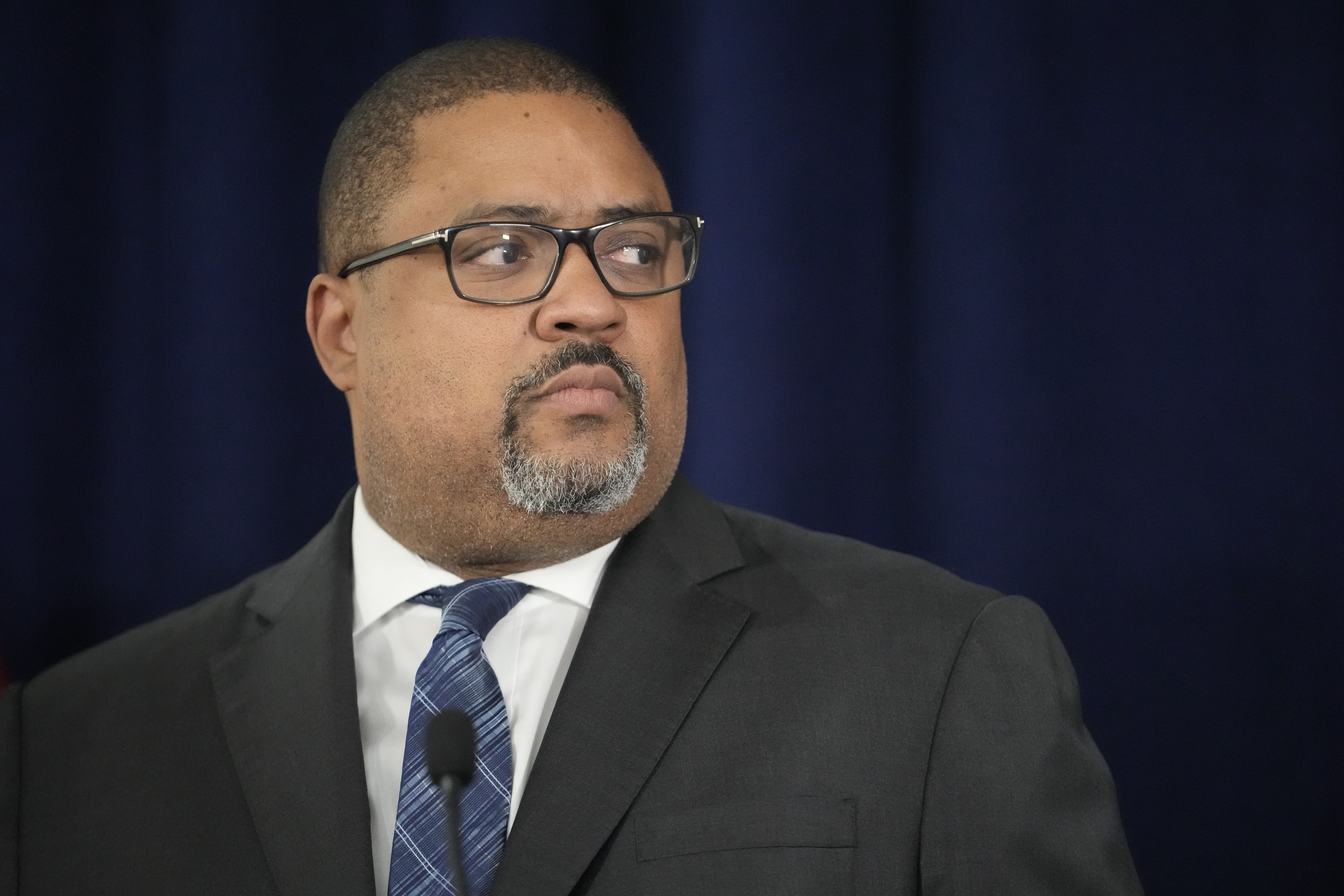
Manhattan District Attorney Alvin Bragg
The president elect faces as little as no jail time and a potential maximum of four years prison for falsifying 34 business records throughout his first year of office to retroactively hide a hush-money payment to adult actress Stormy Daniels. (Legal experts have said that it’s unlikely Trump would be sentenced to jail time as a 78-year-old first-time offender convicted of low-level felonies, and any jail sentence would be stayed as he appeals.)
Trump paid for Daniels’ silence just eleven days before 2016 election, and jurors unanimously found that he thereby conspired to promote his own election by unlawful means, Bragg wrote.
The evidence presented against Trump was “overwhelming,” reads the filing, which is also signed by a lead prosecutor on the case, Christopher Conroy.
“The crimes that the jury convicted defendant of committing are serious offenses that caused extensive harm to the sanctity of the electoral process and to the integrity of New York’s financial marketplace,” which relies on honest record-keeping, Bragg wrote.
Finally, at Public Notice, Liz Dye writes: Trump plots to steal Congress’s budget authority.
One of the strangest aspects in living in a declining democracy is that everyone is forced to learn about arcane areas of the law … if only to see them trampled by the despot.
The first Trump administration taught us about the Logan Act, the Federal Vacancies Reform Act, and the Presidential Records Act. Those were all about the limits of the president’s authority. Could Trump dispatch Mike Flynn to secretly negotiate with the Russian ambassador before taking office? Could he simply stack federal agencies with his cronies serving in an acting capacity and avoid Senate confirmation? Could he steal or destroy government records?
The answer was an enthusiastic “yes,” thanks to the Supreme Court, with an assist from Judge Aileen Cannon. In the name of ensuring that he can act “boldly” and “without hesitation,” six conservative justices gave the president unlimited authority to commit crimes without fear of prosecution. The imperial presidency is upon us.
But even that blank check isn’t enough for Trump and his enablers. To reshape society, they need the legislative and judicial branches to be more than supine. They need to steal Congress’s power, too. And so, while we’re learning about Trump’s plans to use recess appointments to sidestep the senate’s constitutionally mandated “advice and consent” role, we now have to learn about the Impoundment Control Act of 1974.
I can’t do this important post justice with excerpts, but there’s no paywall, so please go read it at Public Notice. Here’s a bit more.
The Constitution vests “the power of the purse” in Congress.
Article I, Section 8, Clause 1, AKA the Spending Clause, specifies that “Congress shall have Power To lay and collect Taxes, Duties, Imposts and Excises, to pay the Debts and provide for the common Defence and general Welfare of the United States.” And Section 9 says that “No Money shall be drawn from the Treasury, but in Consequence of Appropriations made by Law.”
Congress passes the budget and allocates government revenues as it sees fit — that’s just black-letter law. And so in 1972, Congress passed the Federal Water Pollution Control Act, allocating $5 billion for 1973, $6 billion for 1974, and $7 billion for 1975 for municipal sewer updates. President Richard Nixon tried and failed to veto the law, and, after it was passed, he instructed EPA Administrator William Ruckelshaus to allot “[n]o more than $2 billion of the amount authorized for the fiscal year 1973, and no more than $3 billion of the amount authorized for the fiscal year 1974.”
The City of New York sued, and in a 1975 case called Train v. City of New York, the Supreme Court held that Nixon had no discretion to refuse to spend money allocated by Congress. Ruckelshaus was obligated to dispense the $18 billion over three years, despite Nixon’s strong belief that cities should simply live with rotting pipes.
And while that case was percolating through, Congress went one further and passed the Impoundment Control Act, to make it clear to Nixon that he should quit encroaching on their turf and monkeying with the budget….
Under the ICA, the president must either spend the funds obligated by the legislature, or come to Congress with a “special message” and explain why not. Congress then has 45 days to vote for rescission, rescinding the original allocation. If Congress doesn’t agree, or simply ignores the message, the funds must be spent as originally ordained. (Here’s a handy ICA fact sheet from the Dems on the House Budget Committee.)
Elon Musk and Vivek Ramaswamy, who clearly don’t know or care about the separation of powers, are currently promising to slash $2 trillion from the federal budget and delete entire federal agencies through their fake DOGE committee. But even in his first administration, Trump violated the ICA by withholding the defense allocation for Ukraine in 2019.
Read the rest at the link.
That’s all I have for today. We’re having a stormy day here, so I’m going to try to distract myself with a good book. Have a nice day, everyone.
Did you like this post? Please share it with your friends:
Posted: February 17, 2024 | Author: bostonboomer | Filed under: 2024 presidential Campaign, cat art, Cats, caturday, Donald Trump, just because | Tags: Allen Weisselberg, Barbara Jones, Donald Trump Jr., E. Jean Carroll case, Eric Trump, Judge Arthur Engoron, Trump NY fraud trial |
Happy Caturday!!
 Yesterday was truly a momentous day in the Trump saga. Trump has been hit a damaging blow to his identity as a successful businessman.
Judge Arthur Engoron ordered him to pay $355 million dollars penalty for defrauding banks, insurance companies, and taxpayers. In addition, he will have to pay 9 percent interest on the disgorgement. Nearly $100 million in interest is already owed and the interest will continue to accrue as long as he hasn’t paid up.
On top of the financial judgement, Trump will not be able to do business in New York, including borrowing from banks, for 3 years.
Jonah E. Bromwich and Ben Protess at The New York Times: Trump Fraud Trial Penalty Will Exceed $450 Million.
A New York judge on Friday handed Donald J. Trump a crushing defeat in his civil fraud case, finding the former president liable for conspiring to manipulate his net worth and ordering him to pay a penalty of nearly $355 million plus interest that could wipe out his entire stockpile of cash.
The decision by Justice Arthur F. Engoron caps a chaotic, yearslong case in which New York’s attorney general put Mr. Trump’s fantastical claims of wealth on trial. With no jury, the power was in Justice Engoron’s hands alone, and he came down hard: The judge delivered a sweeping array of punishments that threatens the former president’s business empire as he simultaneously contends with four criminal prosecutions and seeks to regain the White House.
Justice Engoron barred Mr. Trump for three years from serving in top roles at any New York company, including portions of his own Trump Organization. He also imposed a two-year ban on the former president’s adult sons and ordered that they pay more than $4 million each. One of them, Eric Trump, is the company’s de facto chief executive, and the ruling throws into doubt whether any member of the family can run the business in the near term.
The judge also ordered that they pay substantial interest, pushing the penalty for the former president to $450 million, according to the attorney general, Letitia James.
 In his unconventional style, Justice Engoron criticized Mr. Trump and the other defendants for refusing to admit wrongdoing for years. “Their complete lack of contrition and remorse borders on pathological,” he said.
He noted that Mr. Trump had not committed violent crimes and also conceded that “Donald Trump is not Bernard Madoff.” Still, he wrote, “defendants are incapable of admitting the error of their ways.”
Mr. Trump will appeal the financial penalty but will have to either come up with the money or secure a bond within 30 days. The ruling will not render him bankrupt, because most of his wealth is in real estate, which altogether is worth far more than the penalty.
Mr. Trump will also ask an appeals court to halt the restrictions on him and his sons from running the company while it considers the case. In a news conference from his Palm Beach, Fla., home, Mar-a-Lago, on Friday evening, he attacked Ms. James and Justice Engoron, calling them both “corrupt.”
The bond he has to post would be greater than the total judgment plus the interest. The same requirement holds if Trump wants to appeal the $18.3 million judgment in the E. Jean Carroll case.
Trump will also be under the thumb of Barbara Jones, the independent monitor the judge appointed to oversea the Trump Organization’s business. He will have get her permission for any large transfers of money.
But there might be little Mr. Trump can do to thwart one of the judge’s most consequential punishments: extending for three years the appointment of an independent monitor who is the court’s eyes and ears at the Trump Organization. Justice Engoron also strengthened the monitor’s authority to watch for fraud and second-guess transactions that look suspicious.
Mr. Trump’s lawyers have railed against the monitor, Barbara Jones, saying that her work had already cost the business more than $2.5 million; the decision to extend her oversight of the privately held company could enrage the Trumps, who see her presence as an irritant and an insult.
Mark Joseph Stern and Alexander Sammon at Slate: Trump and His Family Are Fined $355 Million for Fraud—and a Lack of Remorse That “Borders on Pathological.” The ruling, if upheld, marks the end of the Trump Organization as we know it.
New York Supreme Court Justice Arthur Engoron ordered Donald Trump to pay $355 million in fines for business fraud in an excoriating decision on Friday that also imposes major penalties on the former president’s family and business associates. Both Eric Trump and Donald Trump Jr. are each liable for $4 million, while former CFO Allen Weisselberg is on the hook for $1 million.
The ruling, if upheld, marks the end of the Trump Organization as we know it: Engoron barred Trump from serving as an officer in any New York corporation or legal entity for three years, and prohibited him from applying for loans from any financial entity in the state. The judge has effectively hobbled the entire Trump corporate empire….
During trial, members of the Trump family took the stand to defend their father’s business dealings, with little success; Engoron declined to credit their testimony in his Friday opinion, noting that Eric Trump actually reversed himself on the stand after evidence emerged that he had lied under oath. Trump himself took the stand, as well, assuming a combative and antagonistic pose toward the judge, whom he publicly derided as a partisan hack. The former president, Engoron wrote in his Friday opinion, “rarely responded to the questions asked, and he frequently interjected long, irrelevant speeches on issues far beyond the scope of the trial. His refusal to answer the questions directly, or in some cases, at all, severely compromised his credibility.”
 This theme of mendacity and impenitence ran throughout Engoron’s ruling. In a remarkable passage, he wrote that the Trump family’s “complete lack of contrition and remorse borders on pathological. They are accused only of inflating asset values to make more money. The documents prove this over and over again. … Defendants are incapable of admitting the error of their ways. Instead, they adopt a ‘See no evil, hear no evil, speak no evil’ posture that the evidence belies.” This refusal to admit to their unlawful misdeeds persuaded Engoron that they “will engage in [fraud] going forward unless judicially restrained.” He therefore affirmed his earlier decision to have an independent monitor, the retired judge Barbara Jones, oversee the business’s finances and assets.
The $355 million penalty is, to put it mildly, substantial, and not the first time this year Trump has been ordered by a court to cut a check with two commas and at least seven zeroes on it. Just last month he was ordered to pay out over $83 million after losing the defamation case brought by the writer E. Jean Carroll. That was actually the second penalty Trump was compelled to pay her: A New York jury previously found that Trump sexually assaulted and defamed Carroll, awarding her $5 million in damages.
Some quick back-of-the-envelope math here shows just how dire the self-proclaimed multibillionaire’s financial situation is getting. Reporting from late October pegged Trump’s cash holdings at $425 million. This most recent penalty from New York state, combined with the two verdicts in the Carroll cases, tally to $438 million. And actually, it’s worse than that, since Engoron stipulated that Trump is prohibited from borrowing money from any New York bank for the next three years. That ban will handicap his attempt to appeal. Moreover, New York law could force him to pay a hefty 9 percent interest rate on the judgment, which would push the original $355 million north of $450 million.
Trump will undoubtedly appeal Friday’s decision, and he is not required to post bond while he does so. However, if he fails to post bond, the state can begin collecting on the judgment in 30 days’ time. At that point, Attorney General James can seize Trump’s assets, including real property; in other words, his real estate holdings in New York, like Trump Tower, are vulnerable to seizure and potential sale.
Can Trump raise this kind of money without selling one of his properties? From Erica Orden at Politico: Can Trump pay? What if he doesn’t? Here’s what to know about Trump’s massive civil judgments.
A seven-figure verdict, an eight-figure verdict and, now, a nine-figure verdict.
Donald Trump has been hit with all three in the past nine months, with Friday’s $354 million penalty for New York business fraud by far the most massive.
He is now on the hook for over $440 million in civil judgments as he heads toward the Republican nomination — and as he prepares for one or more criminal trials this year….
Trump’s company isn’t public, and he has famously refused to disclose his tax returns, so his cash flow situation is shrouded in mystery.
 Even if he has $440 million in cash on hand — and it’s far from clear that he does — paying the judgments could wipe out his accounts, since Trump himself has placed his cash reserves in the ballpark of that amount.
Trump claimed in a deposition last year that he had “substantially in excess” of $400 million in cash on hand….
But it’s unclear whether that number is accurate. That deposition, after all, was part of the very lawsuit in which a judge found that Trump has repeatedly inflated his net worth.
If he doesn’t have enough cash on hand, would he have to sell properties?
Trump would likely have to sell something, although it wouldn’t necessarily have to be property. He could sell investments or other assets.
But what if he outright refuses to pay up?
In the civil fraud case, which is in New York state court, if Trump can’t post the funds or get a bond, then the judgment would take effect immediately and a sheriff could begin seizing Trump’s assets.
The rules are slightly different in federal court, which is the venue for the $83.3 million judgment that Trump owes for defaming the writer E. Jean Carroll after she accused him of raping her. (He also owes Carroll an additional $5 million from a separate verdict last year.) Carroll could pursue post-judgment discovery under the jurisdiction of the judge who oversaw the trial. Through that process, the judge could order Trump to produce his bank account records, place liens or garnish his wages.
“I think he’s going to have to pay. And whether it requires him to sell or to put a lien on something to get a loan, that’s his problem, not ours. He’s going to pay,” Carroll’s attorney Roberta Kaplan said on CNN last month.
The judge, Kaplan added, will use “judgment enforcement mechanisms” to “make sure that he pays.”
If Trump truly can’t afford the judgments, he would have to declare bankruptcy.
He also can’t postpone payments while he appeals. He would have to post bond of 120-125 percent of the total owed first. In other words, Trump is totally screwed. The only thing that could help him is that he can use PAC money to pay. But can his MAGA morons afford that much?
What does this financial disaster mean for Americans? After all, Trump is running for the Republican presidential nomination. Abdallah Fayed at Vox: Trump is suddenly in need of a lot of cash. That’s everyone’s problem.
Two recent verdicts have now left Donald Trump on the hook for nearly half a billion dollars….
For a well-connected billionaire, that might usually amount to nothing more than a temporary inconvenience; after all, Trump could always liquidate some of his assets or borrow even more money to cover his short-term obligations.
But Trump isn’t just one of the country’s richest men, with an estimated net worth in the low billions; he’s also running to serve a second term as president of the United States. And for any candidate for public office — let alone the presidency — being cash-strapped while owing such significant amounts of money could be a serious liability.
“It’s pretty scary from an ethics perspective,” said Virginia Canter, the chief ethics counsel at the Citizens for Responsibility and Ethics in Washington, a nonpartisan watchdog group that has chronicled Trump’s abuses of power and filed lawsuits against him.
 You don’t have to look far to find the reasons why. Trump’s first term was riddled with conflicts of interest, and that’s in no small part because of his financial well-being (or lack thereof, depending on how you look at it). At the time that he tried to overturn the 2020 election, he was hundreds of millions of dollars in debt, largely stemming from loans to help rehabilitate his struggling businesses, and most of which would be coming due over the subsequent four years. Throughout his presidency, he refused to divest from his businesses, which made millions of dollars in revenue from taxpayers and continued to do work with other countries while he was in office — a practice he indicated he would repeat in a second term.
The fact that he has so many entanglements with big businesses and other nations leaves plenty of room for things to go awry. That’s why a 2020 New York Times exposé uncovering his staggering debt during his first term wasn’t just embarrassing for Trump, who has a tendency to claim he’s richer than he actually is. It also raised fears about how his debt could implicate national security.
As the former head of the Justice Department’s National Security Division told Time magazine in 2020, “For a person with access to U.S. classified information to be in massive financial debt is a counterintelligence risk because the debt-holder tends to have leverage over the person, and the leverage may be used to encourage actions, such as disclosure of information or influencing policy, that compromise U.S. national security.”
Read the rest at Vox.
Finally, if you’d like a deep dive on Trump and how he took the vast fortune his father left him and fucked up so badly, there’s a fascinating article at The Guardian by Sidney Blumenthal: Trump’s hubris has brought about the downfall of his family’s business empire.
More stories to check out today:
The New York Times: Trump Allies Plan New Sweeping Abortion Restrictions.
The Washington Post: Trump’s anger at courts, frayed alliances could upend approach to judicial issues.
Politico: ‘I Have to Say Goodbye. But I Don’t Want to Go to Jail.’ One of Navalny’s closest friends mourns his death, and Russia’s future.
Press Release from DOJ: Justice Department Transfers Approximately $500,000 in Forfeited Russian Funds to Estonia for Benefit of Ukraine.
Politico: Biden, lawmakers hammer Ukraine aid holdouts after Navalny death.
The Hill: GOP House chair: Johnson has no way out of Ukraine floor vote.
Los Angeles Times: Opinion: I’m an American doctor who went to Gaza. What I saw wasn’t war — it was annihilation, by Ifran Galaria
The Milwaukee Journal: Wisconsin fake elector tells ‘60 Minutes’ he was afraid of Trump supporters.
What do you think about all this? What other stories have captured your interest?
Did you like this post? Please share it with your friends:


 peej
peej Carissa
 bostonboomer
 dakinikat
 ecocatwoman
 mablue2
 Mama Lopez
 peggysue22
 quixote
 skydancingguestblogger
 Mona (aka Wonk the Vote)



 Sky Dancing
Recent Comments