
Tuesday Reads
Posted: August 9, 2011 Filed under: 2012 presidential campaign, Global Financial Crisis, Hillary Clinton, Medicaid, Medicare, morning reads, psychology, religious extremists, Republican presidential politics, Social Security, The Great Recession, the villagers, U.S. Economy, U.S. Politics, voodoo economics, WE TOLD THEM SO | Tags: antisocial personality disorder, Barack Obama, bipolar disorder, creativity, Dean Baker, Depression, economic illiterates, empathy, Farm Subsidies, FDR, hyperthymic personality, JFK, Kenneth Moreno, mania, Michele Bachmann, narcissistic personality disorder, Nassir Ghaemi, psychiatry, rape cops, Rick Perry, trauma, Tufts University, Verizon strike 43 Comments
Good Morning!! I’m switching to strong coffee this morning, because I’ve had the sleepies for the past few days. It’s been really damp and humid here, so maybe that’s the reason. All I know is I keep dozing off, and I don’t like it! Anyway, let’s get to the news before I nod out again.
A few days ago, commenter madaha turned me on to an article about a fascinating new book that just came out last week. The book is called A First Rate Madness. The author is Nassir Ghaemi, a professor of psychiatry at Tufts University. From Salon:
Nassir Ghaemi, an author and professor of psychiatry at Tufts University School of Medicine, argues that many of history’s most famous and admired figures, from Churchill to FDR to Gandhi, showed signs of mental illness — and became better leaders because of it. Ghaemi bases his argument on historical records and some of the latest experimental studies on depression and mania, arguing that mild symptoms can actually enhance qualities like creativity or empathy.
After reading the piece in Salon, I immediately ordered the book and I’ve been dipping into it over the past couple of days.
So far, I’ve read the chapter on FDR, and I’m going to read about JFK next. According to Ghaemi, both of these men had hyperthymic personalities: basically, they were upbeat, enthusiastic, energetic, and creative, because they tended to be somewhat hypomanic (a milder, less disabling form of the mania experienced by those with bipolar disorder). In addition, both FDR and JFK suffered from serious physical illnesses–FDR from polio and JFK from Addison’s disease. These illnesses and other adversities these two men faced enabled them to develop empathy for the suffering of ordinary people–even though they were both from privileged backgrounds. Ghaemi argues that people with slightly abnormal personalities are better leaders–particularly in times of crisis when great creativity, empathy, and resilience are needed. According to Ghaemi:
Many people who experience traumas [like terrorism or war] don’t develop PTSD or other illnesses. So the question is, what keeps those people from getting sick? What creates resilience? The psychological research suggests that personality is a major factor. Resilience seems to be associated with mild manic symptoms, but you can’t develop resilience unless you’ve already experienced trauma. Many of these leaders faced adversity in their childhood and adulthood, and that seemed to make them better able to handle crises. It’s like a vaccine. You get exposed to a little bit of a bacteria then you can handle major infections and I think trauma and resilience and hyperthymic personality seem to follow a similar path.
Ghaemi does not discuss Obama’s personality in the book, but Salon interviewer Thomas Rogers asked the author whether Obama may be too “sane” to be a successful President in our current time of crisis.
Obama’s persona is that of a very sane, rational person who is good at compromise — which is definitely how he sold himself during the debt ceiling crisis. Do you think Obama’s sanity is hurting his abilities as a leader?
I didn’t discuss Obama and other current leaders in the book, because there are documentation and confidentiality issues, and a lot of speculation would have to happen. That said, Obama has said himself that he thinks he’s very normal. This no-drama-Obama persona is meant to reassure people about his normality, but I think that when you look at his memoir there’s a sense of a much more complex and profound person who may have experienced a great deal of anxiety and maybe some depression growing up, being half-white half-African-American. The [sane] parts of his psychology may hinder his leadership in terms of not being creative, and that may not be as useful in a crisis. But to whatever extent he’s not fully completely average, he’ll have some psychological reservoir to draw on to think more creatively and realistically about the current situation.
I wish I could agree that Obama might learn to deal with the nation’s difficulties, but so far he doesn’t seem to learn anything from experience. Most of the leaders that Ghaemi discusses suffered from mood disorders–depression or bipolar disorder. Obama, on the other hand, appears to have a different kind of disorder–either Narcissistic Personality Disorder or Antisocial Personality Disorder, or both.
Dakinikat alerted me to an interview with Ghaemi on NPR. I haven’t listened to it yet, but here’s the link.
Getting back to current news, this coming Saturday, Rick Perry plans to announce that he’s running for the Republican presidential nomination.
Rick Perry intends to use a speech in South Carolina on Saturday to make clear that he’s running for president, POLITICO has learned.
According to two sources familiar with the plan, the Texas governor will remove any doubt about his White House intentions during his appearance at a RedState conference in Charleston.
It’s uncertain whether Saturday will mark a formal declaration, but Perry’s decision to disclose his intentions the same day as the Ames straw poll — and then hours later make his first trip to New Hampshire — will send shock waves through the race and upend whatever results come out of the straw poll.
Immediately following his speech in South Carolina, Perry will make his New Hampshire debut at a house party at the Portsmouth-area home of a state representative, Pamela Tucker, the Union Leader reported Monday. Tucker was among the Granite Staters who went to Texas last week to encourage Perry to run.
What can I say? This is ghastly news. Think Progress is reporting that besides being a fundamentalist religious fanatic, Perry shares a similar problem to that of fellow wingnut Michele Bachmann–he has taken lots of Federal money in farm subsidies–$80,000, to be exact.
Verizon workers have gone out on strike–45,000 of them.
More than 45,000 workers from New England to Virginia went on strike just after midnight today at Verizon Communications. Since bargaining began July 22, Verizon has refused to move from a long list of concession demands. As the contract expired, Verizon, a $100 billion company, still was looking for $1 billion in concessions from 45,000 workers and families. That’s about $20,000 in givebacks for every family, nearly 100 concessionary proposals remained on the table.
This despite Verizon’s 2011 annualized revenues of $108 billion and net profits of $6 billion. At the same time, Verizon Wireless just paid its parent company, Vodaphone, a $10 billion dividend. Meanwhile, Verizon’s five top executives received $258 million over the past four years.
The workers, members of the Communications Workers of America (CWA) and the Electrical Workers (IBEW), say they are striking until Verizon “stops its Wisconsin-style tactics and starts bargaining seriously.”
According to Reuters, both sides are accusing each other of bad acts:
The second day of a strike by Verizon workers turned ugly after union representatives accused managers of injuring three workers while driving past picket lines, and the phone giant complained of a spike in network sabotage cases.
[….]
Verizon complained of network sabotage cases in the same statement where it said some picketing workers were unlawfully blocking Verizon managers’ access to work centers.
A spokeswoman for the Communications Workers of America, representing 35,000 of the strikers, said the union “does not condone illegal action of any kind.” The International Brotherhood of Electrical Workers, representing 10,000 strikers, also said members “are expected to obey the law.”
However, the CWA said some picketing workers were hurt by Verizon managers’ cars and that one worker was knocked unconscious when he was clipped by the mirror of a manager’s car that was speeding past a picket line.
Dean Baker had a great piece at Truthout yesterday: The Economic Illiterates Step Up the Attack on Social Security and Medicare
The nonsense with the S&P downgrade is yet another distraction – after four months of haggling over the debt ceiling idiocy – from the real problem facing the country: a downturn that has left 25 million people unemployed, underemployed or out of the labor force altogether. Tens of millions of people are seeing their career hopes and family lives wrecked by the prospect of long-term unemployment.
The incredible part of this story is that the people who are responsible are all doing just fine, and most of them are still making policy. Furthermore, they are using their own incompetence as a weapon to argue that we have to take even more money from the poor and middle class, this time in the form of Social Security, Medicare and Medicaid benefits.
The basic story is that the economy needs demand. The housing bubble generated more than $1.4 trillion in annual demand through the construction and consumption that it spurred. Now that this demand is gone, there is nothing to replace it. President Obama’s stimulus was replaced by some of the lost demand, but it was nowhere near large enough. We tried to fill a $1.4 trillion hole in annual demand with around $300 billion in annual stimulus in 2009 and 2010. In 2011, most of this boost has been exhausted and the economy is coming to a near standstill.
If we had serious people in Washington, they would be talking about jobs programs, about rebuilding the infrastructure, about work sharing, and any other measure that could get people back to work quickly. However, instead of talking about ways to re-employ people, the fixation in Washington is reducing the deficit.
We’ve heard these arguments again and again (especially from our own Dakinikat), but they bear repeating until the ignorant Villagers get the message.
Remember the “rape cops” in New York–the ones who were found not guilty recently? Well, one of them finally got a tiny bit of justice. A judge sentenced Kenneth Moreno to one year in prison for official misconduct. But then another judge freed him.
Disgraced ex-cop Kenneth Moreno didn’t stay in jail for long.
A couple hours after an angry Manhattan judge flat-out called Moreno a liar Monday and dispatched him to Rikers Island to being a year-long prison sentence, an appeals court judge sprung him.
Moreno, acquitted in May of raping a bombed fashion executive while his partner served as lookout, was released on $125,000 bail by Appeals Court Judge Nelson Roman so he can appeal his conviction on official misconduct charges.
It was a startling turnabout for the 43-year-old Moreno, who Supreme Court Justice Gregory Carro ordered remanded.
I sure hope he ends up serving at least some jail time.
Dakinikat sent me this article on a report (PDF) called How to Liberate American from Wall Street Rule. Here are the report’s basic recommendations:
How to Liberate America from Wall Street Rule spells out details of a six-part policy agenda to rebuild a sensible system of community-based and accountable financial services institutions.
1. Break up the mega-banks and implement tax and regulatory policies that favor community financial institutions, with a preference for those organized as cooperatives or as for-profits owned by nonprofit foundations.
2. Establish state-owned partnership banks in each of the 50 states, patterned after the Bank of North Dakota. These would serve as depositories for state financial assets to use in partnership with community financial institutions to fund local farms and businesses.
3. Restructure the Federal Reserve to function under strict standards of transparency and public scrutiny, with General Accounting Office audits and Congressional oversight.
4. Direct all new money created by the Federal Reserve to a Federal Recovery and Reconstruction Bank rather than the current practice of directing it as a subsidy to Wall Street banks. The FRRB would have a mandate to fund essential green infrastructure projects as designated by Congress.
5. Rewrite international trade and investment rules to support national ownership, economic self-reliance, and economic self-determination.
6. Implement appropriate regulatory and fiscal measures to secure the integrity of financial markets and the money/banking system.
Finally, in case you missed it, I want to call your attention to this article that commenter The Rock linked to last night: Hillary Told You So
At a New York political event last week, Republican and Democratic office-holders were all bemoaning President Obama’s handling of the debt-ceiling crisis when someone said, “Hillary would have been a better president.”
“Every single person nodded, including the Republicans,” reported one observer.
At a luncheon in the members’ dining room at the Metropolitan Museum of Art on Saturday, a 64-year-old African-American from the Bronx was complaining about Obama’s ineffectiveness in dealing with the implacable hostility of congressional Republicans when an 80-year-old lawyer chimed in about the president’s unwillingness to stand up to his opponents. “I want to see blood on the floor,” she said grimly.
A 61-year-old white woman at the table nodded. “He never understood about the ‘vast right-wing conspiracy,’” she said.
Looking as if she were about to cry, an 83-year-old Obama supporter shook her head. “I’m so disappointed in him,” she said. “It’s true: Hillary is tougher.”
Go read the whole thing. That’s all I’ve got for today. What are you reading and blogging about? Please share.
Dismal Economists: Getting Real on those Green Shoots
Posted: June 18, 2009 Filed under: Bailout Blues, Economic Develpment, Equity Markets, Global Financial Crisis | Tags: Depression, Federal Deficit, Green shoots, Health care reform, Obama Poll Numbers Comments Off on Dismal Economists: Getting Real on those Green Shoots I’ve been concerned about the lack of real evidence for the administration’s green shoot hypothesis. It seems that I’m not the only one. A new Wall Street Journal Poll shows that Americans are increasingly ‘wary’ of the deficit and Obama’s economic intervention as Obama’s poll number’s slip.
But the poll suggests Mr. Obama faces challenges on multiple fronts, including growing concerns about government spending and the bailout of auto companies. A majority of people also disapprove of his decision to close the military prison at Guantanamo Bay, Cuba.
Nearly seven in 10 survey respondents said they had concerns about federal interventions into the economy, including Mr. Obama’s decision to take an ownership stake in General Motors Corp., limits on executive compensation and the prospect of more government involvement in health care. The negative feeling toward the GM rescue was reflected elsewhere in the survey as well.
A solid majority — 58% — said that the president and Congress should focus on keeping the budget deficit down, even if takes longer for the economy to recover.
Laura Zamora, 40, of Orange, Calif., voted for Mr. Obama but says she is frustrated by the economy and finds her support for the president waning. She says she’s facing a possible layoff as a local government worker in California.
“He’s bailing out the private sector. He’s putting all kinds of money into the private sector,” says Mrs. Zamora. “The money should be going to social programs, not to bailing out banks and GM. It should go to people who are unemployed.”
The survey of 1,008 adults, conducted Friday to Monday, had a margin of error of plus or minus 3.1 percentage points for the full sample.
The poll shows as the economy really worsens, people are becoming more reality-based. Speaking of reality based, let’s get back to numbers that show the public’s concerns are much warranted. You will not want to miss this VOXEU study showing what two economists have found when comparing the Great Depression with the current Great Recession. They’ve charted the numbers back-t0-back and are even going as far as saying that we are in a Global economic Depression. You really need to check the graphs and the analysis out in “A Tale of Two Depressions”. Dr. Barry Eichengreen and Dr. Kevin O’Rourke are both research/historical economists and bring the stylized facts home.
This is an update of the authors’ 6 April 2009 column comparing today’s global crisis to the Great Depression. World industrial production, trade, and stock markets are diving faster now than during 1929-30. Fortunately, the policy response to date is much better. The update shows that trade and stock markets have shown some improvement without reversing the overall conclusion — today’s crisis is at least as bad as the Great Depression.
New findings:
- World industrial production continues to track closely the 1930s fall, with no clear signs of ‘green shoots’.
- World stock markets have rebounded a bit since March, and world trade has stabilised, but these are still following paths far below the ones they followed in the Great Depression.
- There are new charts for individual nations’ industrial output. The big-4 EU nations divide north-south; today’s German and British industrial output are closely tracking their rate of fall in the 1930s, while Italy and France are doing much worse.
- The North Americans (US & Canada) continue to see their industrial output fall approximately in line with what happened in the 1929 crisis, with no clear signs of a turn around.
- Japan’s industrial output in February was 25 percentage points lower than at the equivalent stage in the Great Depression. There was however a sharp rebound in March.
Greenshoots or False Spring?
Posted: April 6, 2009 Filed under: Equity Markets, Festivities, Global Financial Crisis, U.S. Economy | Tags: altman, bernanke, cowen, Depression, greenshoot, recession, recovery, thoma Comments Off on Greenshoots or False Spring?
Miss Strawberry with the Winners of the Strawberry Bakeoff
I woke up this morning to a chill in the air. When I came back home from university today it was a chilly 60 in the house. There’s a frost warning for the North Shore and I had to put the heater back on and pull at the flannels. I walked the dog in a fleece jacket and had to put socks on. This weekend was just warm, sunny, and great and the Strawberry Festival was in full swing? WTF happened here in Southeastern Louisiana? One day I’m basking in the first hint of a warm sun enjoying fresh strawberry shortcake and the next I’m hoping that the magnolia blossoms are safe. Yes, there’s a Strawberry Queen, a Strawberry Ball, and Strawberry Royalty. If you gotta work somewhere, it might as well be the Strawberry Capitol of the Word.
So, having been raised in the Great Flyover and spent most of my childhood watching my Dad’s business sell F-150s to the local farmers, I know a lot about a false spring. That’s when Mother Nature messes with you by giving you just enough spring to think the worst of winter is over and then hits you with the cold blast of reality. Thankfully, my cold blast didn’t include the blizzard that hit the heartland, but it is a cold blast. That’s why I’m having so much fun with the economic word-de-jour. That would be Ben Bernanke’s “green shoots”. An Ivy-leaguer from South Carolina should know about about false springs. Bloomberg picks at the analogy too in Bernanke ‘Green Shoots’ May Signal False Spring Amid Job Losses.
April 6 (Bloomberg) — It will be months before it’s clear whether what Federal Reserve Chairman Ben S. Bernanke calls the U.S. economy’s “green shoots” represent the early onset of recovery, or a false spring.
The Labor Department’s April 3 report that the economy shed an additional 663,000 jobs last month, while the unemployment rate rose to 8.5 percent, will be followed by months more of bad-news headlines, economists say. The recession, now in its 17th month, has already cost 5.1 million Americans their jobs, the worst drop in the postwar era; unemployment may hit 9.4 percent this year, according to the median estimate in a Bloomberg News survey, and may top out above 10 percent in 2010.
The risk is that the jobs picture turns even more bleak than forecast or the drumbeat of bad news still to come causes consumers, whose spending has firmed up in recent months, to hunker down again.
“If something happens to spook consumers and they crawl back into their tortoise shells, that would be terrible news,” says Alan Blinder, former Fed vice chairman and now an economics professor at Princeton University.
Consumer spending, which accounts for more than 70 percent of the economy, rose 0.2 percent in February after climbing 1 percent in January, breaking a six-month string of declines.
Is this ANY way to run an Economy?
Posted: April 4, 2009 Filed under: Equity Markets, Global Financial Crisis | Tags: bailout, DeLong, Depression, Financial Crisis, Krugman, Obama/Geithner Bailout Plan, recession, Stiglitz, Summers Hedge Fund Salary, unemployment 4 Comments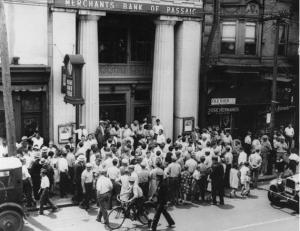 The US economy is in a fragile state right now which begs the question: Why do our policy makers seem oblivious to lessons from the great meltdowns of the past? Adam Posner of the Daily Beast asks the question out right: Does Obama Have a Plan B? Posner asserts that the administration appears to be hellbent on recreating the Japanese Lost Decade. This is something that I’ve been harping on for months as has Paul Krugman and Joseph Stiglitz–two big brained economists with Nobel prizes.
So it is with some irony if not humility that we should approach Treasury Secretary Geithner’s Public Private Investment Plan presented on March 23. A number of major American banks have lost huge amounts of money, and clearly have insufficient capital if they are not literally insolvent. Why else would they be pushing so hard to change the accounting rules to avoid showing what they really have on their books instead of raising private capital? Why else is the U.S. government taking so long to perform “stress tests” and trying to get expectations of overpayment for some of the bad assets on the banks’ books before the test results are out? In short, the U.S. government is looking to shovel capital into the banks without sufficient conditions, hiding rather than confronting the actual situation.
That is just like the Japanese government in their lost decade, or the U.S. officials during the 1980s before they really tackled the savings-and-loan crisis. In those cases, the delay simply made the problem worse over time and in the end the government had to put more money into the troubled banks directly, taking over or shutting down the weakest of them. Whatever the political culture, it would seem we have not learned from experience. Or perhaps we cannot act on our learning. The universal barrier would appear to be the political difficulty of recapitalizing banks. That seems obvious, but the constraint it puts on good policy is enormous.
That is why the Geithner plan is so complex and jury-rigged, to avoid the need for public requests for more money for banks. Unfortunately, it is unlikely to succeed absent additional public money and more-intrusive government action. The plan will buy some time and certainly some appreciation in bank share prices. Current shareholders will be getting a new lease on life with subsidies from taxpayers. For that reason alone, the plan certainly will cost the taxpayer more in the end than a more direct recapitalization with public control would have.
Obama Team Announces TARP Plan: Market Crashes
Posted: February 10, 2009 Filed under: Equity Markets, Global Financial Crisis, New Orleans, president teleprompter jesus, Team Obama, U.S. Economy | Tags: Depression, Geithner, Obama presser, Obamanomics, TARP 2 CommentsI hope you weren’t planning on using any of those savings that you may still have left sitting out there in anything market-related soon. The Dow Jones ( at this writing) is off over 350 points. All of the blue chip components tumbled. The S&P and OTC markets aren’t faring any better. This is how Market Watch sees it right now:
The recent strength shown by U.S. stocks vanished on Tuesday as the government unveiled a new bank-rescue plan and congressional action neared on a fresh round of fiscal stimulus for the wheezing U.S. economy.
That basically amounts to a reaction of last night’s speechification and presser and this morning’s announcement of thunderous boos. Fed Chair Ben Bernanke is speaking right now and that’s not really helping either. The investment/business community doesn’t think any of the largess from either the TARP or the Stimulus Plan are really going to do anything. Treasury Bond prices are dropping also. This additional snippet from Market Watch sums it up well.
“First, we’re going to require banking institutions to go through a carefully designed comprehensive stress test, to use the medical term. We want their balance sheets cleaner, and stronger. And we are going to help this process by providing a new program of capital support for those institutions which need it,” said Geithner.
Despite the forceful words, Geithner noted his office was still exploring options and details for an asset value program, with little answer on what to do about banks’ toxic assets.
That last paragraph is basically at the crux of the problem. The current administration is bringing no plan to the table to actually deal with the problem. Perhaps because Geithner was so instrumental in the original TARP, he’s just sticking with what already didn’t work rather than trying to think outside of the box. The market has lost around 3-4% already and there’s several more hours of trading to go. Hang on to your cookie jars kids, you’re going to need them as a stable replacement for your local bank.
Meanwhile, the senate managed to pass that the stimulus bill 61-37. That’s way shy of the 80 votes that Obama had wanted. The final bill has $838 billion worth of stuff that includes a lot of tax cuts (not likely to stimulate anything but Grover Norquist and The Club for Growth) and money for cash strapped states. I’ve brought up links to the Economic Policy Institute earlier but I really like this graph that even my freshmen could grasp about what works and doesn’t work in stimulus plans.
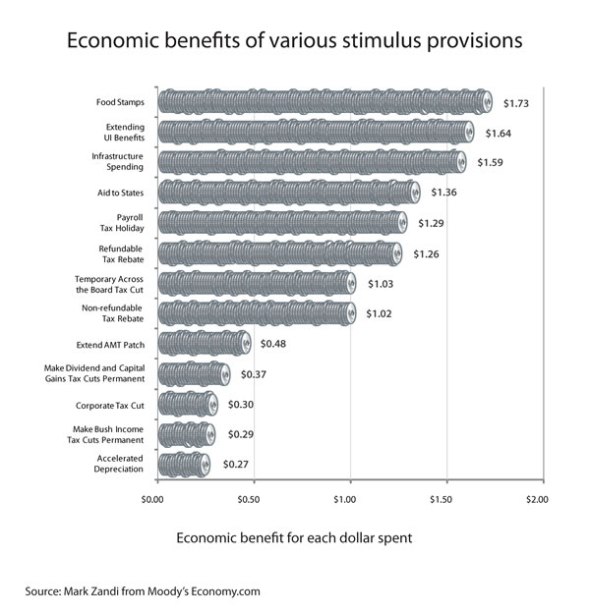 You can see the difference between the items where you get more bang than a buck and less than a buck’s worth of bang while contributing to the deficit. Notice those tax cuts that wind up costing more than they stimulate and think the last eight years of Dubya of which we seem to be repeating.
Here’s one that I picked up from Brad DeLong’s Grasping Reality with Both Hands that had my Freshman gasping as I was trying to set their hair afire. (I think it worked, btw.) Any one facing this job market should panic. Just anecdotal, but in the market for finance professors, this year universities were taking resumes only at the last two conferences. Last year, the best people had been hired up before either of the conferences were held and only the marginal remained. The hottest academic jobs are definitely on hold. In my years of both public and private sector economisting, I’ve NEVER seen anything like this.
 Please notice the incredible level of job losses. If you’ve managed to get through a calculus course, you’ll see that the first, second and third derivatives are negative which is not true on the other series at similar points. Basically, for you nonmath types, this indicates nothing but a downward trend or as I like to put it, straight off a cliff.
So, President Obama rambled an economics lecture last night that made me happy that he was getting all those economics briefings. It was also pretty obvious that most of his advisers must have their hair on fire too, because he did have a sense of edgy panic when he talked about the situation. However, ‘edgy panic’ is not what I want in a president. I want a president to talk about we have nothing to fear but fear itself who then says something to the effect of let’s do what works instead of bargaining away what will with folks that aren’t interested in watching you succeed.
I have to say, last night over Margaritas with my neighbors, I was searching for folks that wanted to diversify their food options with neighborhood gardening. I had a lot of takers. After all, when the army and your police force spend a good amount of time and money flying sleek black helicopters around the skies of your city practicing for food riots, it’s kind of one of those wake up moments. That goes for sleepy freshmen and drunk Cajuns. Is your hair on fire yet? Because if it isn’t, you haven’t been listening.
Meanwhile, I’m adding a page to my own blog for sharing sustainability and survival stories. Feel free to visit and contribute.

 peej
peej Carissa
 bostonboomer
 dakinikat
 ecocatwoman
 mablue2
 Mama Lopez
 peggysue22
 quixote
 skydancingguestblogger
 Mona (aka Wonk the Vote)



 Sky Dancing
Recent Comments