
Friday Reads: Dismal Scientist Edition
Posted: January 18, 2013 Filed under: morning reads | Tags: Debt, deficit, economics, Economists 46 CommentsGood Morning!
I’ve got a few reads for you from economists on some of today’s economic policy questions. I always complain that we never hear from economists and always hear from politicians, journalists, and lawyers. So, here’s the take on the austerity fetish in the beltway from an economists’ perspective.
Economist Dean Baker thinks there’s a cut Social Security on the Horizon.
According to inside Washington gossip, Congress and the president are going to do exactly what voters elected them to do; they are going to cut Social Security by 3 percent. You don’t remember anyone running on that platform? Yeah, well, they probably forgot to mention it.
Of course some people may have heard Vice President Joe Biden when he told an audience in Virginia that there would be no cuts to Social Security if President Obama got reelected. Biden said: “I guarantee you, flat guarantee you, there will be no changes in Social Security. I flat guarantee you.”
But that’s the way things work in Washington. You can’t expect the politicians who run for office to share their policy agenda with voters. After all, we might not like it. That’s why they say things like they will fight for the middle class and make the rich pay their fair share. These ideas have lots of appeal among voters. Cutting Social Security doesn’t.
While the politics of cutting Social Security are bad, it also doesn’t make much sense as policy. In Washington, the gang who couldn’t see an $8 trillion housing bubble until its collapse sank the economy, has now decided that deficit reduction has to be the preeminent goal.
They don’t care that we are still down more than 9 million jobs from our growth trend; deficit reduction must take priority. These whiz kids apparently also don’t care that the cuts that have already been made are slowing growth and costing us jobs.
Meanwhile, economist Paul Krugman shows–once again–that the deficit isn’t really that big of problem and is dwindling. Oh, just a reminder, Social Security has nothing to do with the Federal Budget, debt or deficit other than than the trust fund is invested in US Treasuries.
Recently the nonpartisan Center on Budget and Policy Priorities took Congressional Budget Office projections for the next decade and updated them to take account of two major deficit-reduction actions: the spending cuts agreed to in 2011, amounting to almost $1.5 trillion over the next decade; and the roughly $600 billion in tax increases on the affluent agreed to at the beginning of this year. What the center finds is a budget outlook that, as I said, isn’t great but isn’t terrible: It projects that the ratio of debt to G.D.P., the standard measure of America’s debt position, will be only modestly higher in 2022 than it is now.
The center calls for another $1.4 trillion in deficit reduction, which would completely stabilize the debt ratio; President Obama has called for roughly the same amount. Even without such actions, however, the budget outlook for the next 10 years doesn’t look at all alarming.
Now, projections that run further into the future do suggest trouble, as an aging population and rising health care costs continue to push federal spending higher. But here’s a question you almost never see seriously addressed: Why, exactly, should we believe that it’s necessary, or even possible, to decide right now how we will eventually address the budget issues of the 2030s?
Consider, for example, the case of Social Security. There was a case for paying down debt before the baby boomers began to retire, making it easier to pay full benefits later. But George W. Bush squandered the Clinton surplus on tax cuts and wars, and that window has closed. At this point, “reform” proposals are all about things like raising the retirement age or changing the inflation adjustment, moves that would gradually reduce benefits relative to current law. What problem is this supposed to solve?
Well, it’s probable (although not certain) that, within two or three decades, the Social Security trust fund will be exhausted, leaving the system unable to pay the full benefits specified by current law. So the plan is to avoid cuts in future benefits by committing right now to … cuts in future benefits. Huh?
In today’s Wall Street Journal, Alan Blinder points out that running into the debt ceiling would provoke a severe fiscal contraction.
“At current rates of spending and taxation, federal receipts cover less than 74% of federal outlays. So if the government hits the debt ceiling at full speed, total outlays—which includes everything from Social Security benefits to soldiers’ pay to interest on the national debt—will have to be trimmed by more than 26% immediately. That amounts to more than 6% of GDP, far more than the fiscal cliff we just avoided,” Blinder writes.
The fiscal cliff, by contrast, would have erased 4.5 percent of GDP.
Any sustained captivity below the debt ceiling, in other words, means that the economy will enter a severe recession. This recession will be made far worse because the so-called automatic stabilizers that kick in when the economy slumps—think unemployment insurance—will not be able to function because of the budget constraint. So unemployment will grow while unemployment insurance contracts. This will not only pose a hardship on the people out of work, it will mean that the spending power of the American consumer will shrink rapidly.
Where the fiscal cliff might have led to a recession, this is downward spiral toward depression. The shrinking economy will shrink the government’s tax revenues. And since the budget deficit cannot increase, the spiral will go unchecked. Falling taxes will trigger falling spending. “Downward spiral” may be too mild. Economic black hole better fits the bill.
“In short, the consequences of hitting the debt ceiling are too awful to contemplate—worse even than going over the fiscal cliff. A sane Congress wouldn’t even think about it,” Blinder writes. He’s absolutely correct.
Blinder goes on to propose a plan to avoid a crises based on the assumption that Congress is sane. Let’s hope that assumption is correct.
Meanwhile, the House Republicans are discussing another short term fix to the debt ceiling.
House Republicans are discussing a short-term debt ceiling increase to buy time for broader deficit reduction negotiations with Democrats, Rep. Paul Ryan (R-Wis.) told reporters Thursday.
“We’re discussing the possible virtue of a short-term debt limit extension so that we have a better chance of getting the Senate and the White House involved in discussions in March,” Ryan told reporters gathered at the pricey Kingsmill resort in Williamsburg, where the House GOP is holding its annual retreat.
“All of those things are the kinds of things we’re discussing,” said Ryan, the party’s budget chief and 2012 vice presidential candidate.
A small hike in the $16.4 trillion debt ceiling would give the government more time to make payments on its responsibilities as lawmakers and the White House haggle over federal spending. A GOP leadership aide said there was no consensus on the size of a debt limit hike, and that it would have to be coupled with entitlement reforms or spending cuts.
Treasury Secretary Timothy Geithner has told Speaker John Boehner (R-Ohio) that the nation hit its borrowing limit at the end of 2012 and will run out of ways to avoid a first-ever default sometime between mid-February and early March. $85 billion in across-the-board 2013 cuts to defense and domestic spending are set to begin taking effect in March, and the government will run out of funding a month later.
Formulating a good metaphor for Obama’s second term is itself a task for intuitive creative thought that entails rethinking what he will propose in his second term. A good metaphor might embody the idea of an “inclusive economy.” The word “inclusive” resonates strongly: Americans do not want more government per se; rather, they want the government to get more people involved in the market economy. Opinion polls show that, above all, what Americans want are jobs – the beginning of inclusion.
The parallel to Chase’s book today is the 2012 bestseller Why Nations Fail by the economist Daron Acemoglu and the political scientist James Robinson. Acemoglu and Robinson argue that in the broad sweep of history, political orders that include everyone in the economic process are more likely to succeed in the long term.
The time seems ripe for that idea, and it fits with the triumph of inclusiveness symbolized by Obama himself. But another step in metaphor-building is needed to encapsulate the idea of economic inclusion.
The biggest successes of Obama’s first term concerned economic inclusion. The Affordable Care Act (“Obamacare”) is providing more people with access to health care – and bringing more people to privately-issued insurance – than ever before in the United States. The Dodd-Frank financial reforms created the Consumer Financial Protection Bureau, so that privately issued financial products would serve the public better, and created incentives for derivatives to be traded on public markets. And he signed the JOBS Act, proposed by his Republican opponents, which aims to create crowdfunding Web sites that allow small investors to participate in start-up ventures.
We have not reached the pinnacle of economic inclusion. There are hundreds of other possibilities, including improved investor education and financial advice, more flexible mortgages, better kinds of securitization, more insurance for a broader array of life’s risks, and better management of career risks. Much more progress toward comprehensive public futures and derivatives markets would help, as would policies to encourage the emerging world to participate more in the US economy. (Indeed, the inclusion metaphor is essentially global in spirit; had Obama used it in the past, his economic policies might have been less protectionist.)
The right metaphor would spin some of these ideas, or others like them, into a vision for America’s future that, like the New Deal, would gain coherence as it is transformed into reality. On January 29, Obama will give the first State of the Union address of his new term. He should be thinking about how to express – vividly and compellingly – the principles that have guided his choices so far, and that set a path for America’s future.
Monday Reads
Posted: December 31, 2012 Filed under: morning reads | Tags: Debt Ceiling, deficit, fiscal cliff, gang rape in India, republican politics, Social Security 76 Comments Happy New Year’s Eve!!
Congress continues to drag us down its path of dysfunction. This headline from Lindsey Graham should win him a congressional hearing for sedition.
But in an interview on Fox News Sunday this morning, Sen. Lindsey Graham (R-SC) threatened to oppose this must-pass bill unless Social Security benefits are taken away from millions of future retirees:
I’m not going to raise the debt ceiling unless we get serious about keeping the country from becoming Greece, saving Social Security and Medicare [sic]. So here’s what i would like: meaningful entitlement reform — not to turn Social Security into private accounts, not to take a voucher approach to Medicare — but, adjust the age for Social Security, CPI changes and means testing and look beyond the ten-year window. I cannot in good conscience raise the debt ceiling without addressing the long term debt problems of this country and I will not.
Unbelievable. We continue to see a series of really ridiculous memes spouted by the right. These included dragging Social Security into the debt crisis when it has nothing to do with the Federal budget, deficit or debt other than it is a primary investor in Treasury bills and bonds. We also continue hear about our country going the way of Greece or going bankrupt. We have the reserve currency of the world, a huge country filled with taxable assets and treasury bills and bonds under high demand. How many times do I have to call shenanigans on these cretins?
Two Republican senators want to use the threat of an economic meltdown to raise the retirement age and cut Medicare. Sens. Bob Corker (R-TN) and Lamar Alexander (R-TN) introduced a plan today that would raise the federal debt limit by $1 trillion in exchange for $1 trillion in cuts to Medicare, Medicaid, and Social Security, as The Hill reported:
The Corker-Alexander dollar-for-dollar plan has several components.
It would structurally reform Medicare by creating competing private options giving seniors greater choice of healthcare plans. It would not, however, cap Medicare spending.
The plan would also give states more flexibility to manage Medicaid programs and prevent states from “gaming the federal share of the program with state tax charges.”
It would gradually raise the Social Security retirement age and use the “chained CPI” formula to calculate cost-of-living adjustments, curbing the growing cost of benefits.
In exchange, it would direct the debt limit be increased by the same amount as the savings generated from entitlement reform.
The U.S. will hit its debt limit on or around December 31st. The Treasury Department estimates that, using extraordinary measures, it could avoid default for another two months or so. Allowing the U.S. to default on its debt via not raising the debt ceiling could cause a complete financial meltdown. The 2011 debt ceiling debacle — during which House Republicans nearly pushed the country into a default due to their intransigence on taxes — cost the country about $19 billion in higher interest payments and at least one million jobs.
So, here’s an interesting bit of history on its way to the British Museum.
The largest Viking ship ever found, a 118 foot troop carrier, is to go on display at the British museum 1,000 years after it helped King Canute control the seas of northern Europe.
The long boat, known as Roskilde 6 because it was part of a batch found in the Danish city, is slowly being dried out in giant steel tanks.
Once it is stabilised and fitted to a steel frame, it will travel to Britain to go on display at the British museum where it will be a star attraction at an exhibition.
The warship was discovered by chance in 1996 at Roskilde as the local ship museum was being extended.
It is believed it was deliberately sunk along with other ships to narrow the fjord and protect the approach to the former capital of Denmark.
It was an incredible example of ship technology in its day and would have taken up to 30,000 hours to build.
Once again, I agree with Paul Krugman who says that deficit reduction really isn’t the Republican goal in all of these fiscal cliff talks. All we’d have to do is go back to the Eisenhower tax rates and we’d solve the problem pretty quickly which is why I hate it whenever I hear an idiot talk about bankrupting grandchildren’s future. Again, World War 2 didn’t depress the 1950s or 1960s did it? That level of debt and high, high tax rates didn’t bring about a second great depression.
Evan Soltas of Wonkblog and Joe Weisenthal of Business Insider both make the same point, in more detail, that I tried to make in my series on ONE TRILLION DOLLARS: the current budget deficit is overwhelmingly the result of the depressed economy, and it’s not clear that we have a structural budget problem at all, let alone the fundamental mismatch between what we want and what we’re willing to pay for that people like to claim exists.
Bush should’ve never been allowed to run two wars for decades without making people pay for it.
India’s outrage grows over the instances of gang rape and the death of one 23 year old woman. Police are preparing arrest warrants in the case and will charge  six men with murder.
The trial of the six, who allegedly assaulted the physiotherapy student in the back of a bus on Dec. 16, will start after police file charge documents on Jan. 3, Delhi police spokesman Rajan Bhagat said by phone today.
An Air India plane brought the woman’s body back from Singapore and it was cremated today, the Press Trust of India reported. Demonstrators gathered at the Jantar Mantar, an 18th- century observatory and traditional rallying point, demanding speedy punishment for the alleged rapists while some held placards calling for them to receive the death penalty.
Thousands joined protests and candlelit vigils to mark the death yesterday. Some protesters held placards calling for the improved treatment of women in India as they congregated in Mumbai, Hyderabad and Bangalore. Others braved the cold winter’s evening in New Delhi to carry candles or meet in quiet prayer.
So, that’s my offerings today. What’s on your reading and blogging list today?
Hey Andy, me ‘n’ Barney didn’t have nuthin’ better to do, so we decided to crash the economy!
Posted: July 8, 2011 Filed under: 2012 presidential campaign, Barack Obama, Democratic Politics, Economy, Psychopaths in charge, Surreality, Team Obama, the villagers, U.S. Economy, U.S. Politics, unemployment, voodoo economics, We are so F'd | Tags: Andy Taylor, Barack Obama, Barney Fife, David Plouffe, Debt Ceiling, deficit, economy, Gomer Pyle, jobs, Social Security, stupid villiagers, Tim Geithner, unemployment, voodoo economics, William Daley 9 Comments
Barack O'Gomer and Deputy "Barney" Geithner*
This morning Sky Dancing’s resident economist Dakinikat wrote about Tim Geithner’s latest trial balloon about maybe stopping Social Security checks in August if Congress refuses to raise the debt ceiling. That’s right, he wants to use the trust fund that elderly people paid into all their working lives to pay China and other foreign debtors. Now that’s a brilliant plan boys–throw grandma and grandpa out in the streets to starve and die. It’s genius!
Then while we were all commiserating in the comment thread, we got the jobs report for June: only 18,000 jobs were added, and the phonied-up unemployment rate is now at 9.2%.
O’Gomer dragged his sorry a$$ out to the Rose Garden in late this morning to mumble a few weak excuses.
“Today’s job report confirms what most Americans already know,” Obama said. “We still have a long way to go and a lot of work to do to give people the security and opportunity that they deserve.”
The president tried to lay some blame at Congress’ feet. He said lawmakers could pass a handful of policies today to create jobs. His list included an infrastructure bank, free trade deals and patent reform.
“There are bills and trade agreements before Congress right now that could get all these ideas moving,” he said. “All of them have bipartisan support, all of them could pass immediately, and I encourage Congress not to wait.”
Yeah, patent reform, that’s the ticket! And more trade agreements to create more outsourcing of American jobs. Brilliant! And cutting off Social Security checks! That’s really gonna give Americans “the security and opportunity they deserve.” Who is advising this guy anyway?
Well, one of O’Gomer’s top advisers, David Plouffe, made an unfortunate remark before the jobs report came out. Minkoff Minx wrote about it in her SDB reads earlier this evening. From The Christian Science Monitor:
David Plouffe, Mr. Obama’s top political adviser, got things started Thursday at a breakfast sponsored by Bloomberg News.
“The average American does not view the economy through the prism of GDP or unemployment rates or even monthly jobs numbers,” Mr. Plouffe said. “People won’t vote based on the unemployment rate; they’re going to vote based on: ‘How do I feel about my own situation? Do I believe the president makes decisions based on me and my family?’ ”
Ask yourself, Mr. Plouffe, how do you think most ordinary Americans feels about their situation right about now? O’Gomer’s buddy Timmy Geithner is talking about cutting off Social Security payments. O’Gomer himself is trying to talk the Republicans into cutting Social Security, Medicare, and Medicaid. This administration hasn’t done diddly-squat about jobs except occasionally have O’Gomer mention that we need to create them. Talk is cheap, Mr. Plouffe. Actions speak louder than words as my mom used say.
According to Julian Brookes at Rolling Stone, Plouffe also made this odd assessment:
the president, says Plouffe, has a good shot with independent voters, who’ll reward his bipartisan, bend-over-backwards approach the debt talks; is a seasoned campaigner with a huge war chest; has moved to the center without losing the base (the oft-noted “enthusiasm gap” seems to have closed); and has demographic trends working in his favor (he won big with minorities in 08, and they’ll make up a larger share of the electorate next year). Plus, of course, the GOP field is weak: Frontrunner Mitt Romney is the most formidable of the bunch, but he’s nobody’s idea of a galvanizing standard bearer.
What is wrong with this guy? Does he really believe that Independents like politicians who “bend over backwards” instead of showing some strength? Does he really believe O’Gomer hasn’t lost his base? And the center? O’Gomer has gone so far right he’s out-crazying the Tea Party!
Then there’s William M. Daley, the White House chief of staff. Check out what he recently had to say about Americans’ attitudes about the crappy economy. According to Peter Nicholas at the LA Times, O’Gomer’s main defense is that the middle class was already suffering under Bush, so it’s not really his fault. Never mind that unemployment has gone from 7.8% to 9.2% on his watch. So O’Gomer is asking for more time:
Speaking at a fundraising dinner in Philadelphia last week, he said that the nation’s challenges “weren’t a year in the making or two years in the making, but are actually 10 years in the making.”
But Obama’s nuanced message isn’t breaking through. A Gallup Poll last month showed that Americans’ economic confidence was near its low for the year.
For the White House, it’s tough to get the public to pay attention to anything else.
A Democratic senator spoke by phone recently with White House Chief of Staff William M. Daley. “He said, ‘Honest to goodness, if we’re not talking about jobs and the economy, nobody is listening,’” recalled the senator.
Surprise, surprise, surprise!!
Gee, do you think maybe you ought to stop talking and actually DO something then? Just wait until Grandma finds out she might not get her Social Security check in August. Maybe O’Gomer and his advisers need to get a clue. And find O’Gomer a couple of advisers who know something about economics, Mr. Daley.
*NOTE: The graphic at the top of this post is the work of our old friend StateOfDisbelief.
Friday Reads
Posted: July 8, 2011 Filed under: abortion rights, black women's reproductive health, Catfood Commission, Democratic Politics, Economy, Federal Budget and Budget deficit, fetus fetishists, fundamentalist Christians, John Birch Society in Charge, morning reads, religious extremists, Reproductive Health, Reproductive Rights, Republican presidential politics, right wing hate grouups, U.S. Economy, We are so F'd | Tags: Christianist extremists, Debt, Debt Ceiling, deficit, planned parenthood of North Carolina, Rick Perry, warren buffett 51 Comments Good Morning!!
It’s hard not to be be completely discouraged these days. Our Washington deal-makers are permanently stuck in opposites day. No amount of reality is going to bring the lot of them out of whatever place they strategically reside. This Reuters piece stands as a hallmark to the current lunacy. We shouldn’t have any financial problems. Social Security is solvent and it’s not part of the federal budget are deficit problem. Why am I reading this then?
If Treasury were to decide to delay some payments, one option could be to postpone a disbursement of more than $49 billion to Social Security recipients that is due on August 3.
It would be a politically explosive step but one that could allow the government to temporarily pay bondholders to try to avoid foreign investors dumping U.S. Treasuries and the dollar.
The administration has warned that any missed payments, including those to retirees, veterans and contractors, would be default by another name, and the Treasury team still has concerns that any contingency plan would prove unworkable.
Steve McMillin, a former deputy director of the White House Office of Management and Budget under Bush, said Treasury has options but most of them are “pretty ugly.”
If Treasury were to decide to delay payments, it would need to re-program government computers that generate automatic payments as they fall due — a massive and difficult undertaking. Treasury makes about 3 million payments each day.
Do they figure that seniors aren’t going to riot in the streets effectively like that episode de of South Park called Grey Dawn? I can pretty well imagine that they won’t stop payments to their corporate bosses. After all, that option would soothe the bond vigilantes.
Here’s the issues under study now according to that same Reuter’s article.
– Whether the administration can delay payments to try to manage cash flows after August 2
– If the U.S. Constitution allows President Barack Obama to ignore Congress and the government to continue to issue debt
– Whether a 1985 finding by a government watchdog gives the government legal authority to prioritize payments.
The Treasury team has also spoken to the Federal Reserve about how the central bank — specifically the New York Federal Reserve Bank — would operate as Treasury’s broker in the markets if a deal to raise the United States’ $14.3 trillion borrowing cap is not reached on time.
I’m teaching an MBA Corporate Finance seminar this summer. Every single asset pricing model that prices securities, bonds, loans,options or whatever basically uses the US treasury bond as the risk-free asset. I feel like I have to asterisk everything I’m teaching right now which is basically the same thing that was taught to me back in the 1980s. It’s like these folks are purposefully trying to tank the financial markets and bring on another crisis. If they manage to raise the debt ceiling, then it appears likely to be done by ‘austerity’ measure like $4 trillion dollars in cuts. Start your backyard gardens now. The next depression is bound to be a big one. I have just have no idea why they’re trying to blow up our economy. It’s just frigging unbelievable. Of course, Orrin Hatch wants us all to suffer more, because after all, people that aren’t filthy rich are obviously defective in gawd’s eyes.
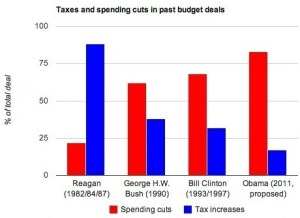
So, tell me, who is the real practicioner of voodoo economics?
So, here’s a nifty graph on the left from Ezra Klein showing the mix of spending cuts vs. tax increases the last few times we’ve had these debt and deficit discussions. Looks like the real practitioner of voodoo economics wasn’t Ronald Reagan but is Barrack Obama. Just more of the alternate reality forced on us by media and politicians that make up news, history, and economic theory.
As you can see on the graph, in each case, taxes were at least a third of the total, and in Reagan’s case, his massive tax cuts were followed by deficit-reduction deals that actually relied on tax increases. Today, tea party conservatives would be begging Sen. Jim DeMint to primary the Gipper.
Bush also included taxes in his deal, and Clinton relied heavily on taxes in his first deficit-reduction bill, which passed without Republican votes. In 1997, when he was working with Republicans, he actually cut taxes slightly while passing spending cuts. But of course the economy was in much better shape then, and Clinton had already increased revenues substantially.
The one-third rule doesn’t break down until you get to the deal Obama reportedly offered Republicans in the first round of debt-ceiling talks: $2 trillion in spending cuts for $400 billion in taxes, or an 83:17 split. And that, if anything, understates how good of a deal Republicans are getting. Tax revenues and rates are much, much lower than they were under Reagan, Bush or Clinton. And next year, Obama is pledging to extend most of the Bush tax cuts, which amounts to a $3 trillion-plus tax cut against current law.
Meanwhile, the polls–like this one from Pew Research–show that people overwhelmingly want to maintain social security, medicaid and medicare and would support tax increases to do so. So much for government of, for, and by the people.
As policymakers at the state and national level struggle with rising entitlement costs, overwhelming numbers of Americans agree that, over the years, Social Security, Medicare and Medicaid have been good for the country.
But these cherished programs receive negative marks for current performance, and their finances are widely viewed as troubled. Reflecting these concerns, most Americans say all three programs either need to be completely rebuilt or undergo major changes. However, smaller majorities express this view than did so five years ago.
The public’s desire for fundamental change does not mean it supports reductions in the benefits provided by Social Security, Medicare or Medicaid. Relatively few are willing to see benefit cuts as part of the solution, regardless of whether the problem being addressed is the federal budget deficit, state budget shortfalls or the financial viability of the entitlement programs.
Jim DeMint is one of the people that should be the first in line to be charged with treason and gross stupidity. Where was Senator DeMint when all the votes were taken to spend all this money to start out with? Plus, all those irresponsible revenue cuts back in the early 2000s when we basically had a balanced budget? He was a congressman from 1999-2005 so certainly he must’ve tried to stop Dubya Bush from all that spending!
Sen. Jim DeMint (R-S.C.) said Wednesday night that Republicans should maintain their hardline position in the debt-ceiling debate even if it results in “serious disruptions” to the economy.
“What I’m advocating here is, let’s use this as a point of leverage, give the president an increase, but don’t come away without real cuts from real caps and spending, and without a balanced budget,” DeMint said on FOX Business Network.
“We’re at the point where there would have to be some, you know, some serious disruptions in order not to raise [the debt ceiling],” he said. “I’m willing to do that.”
The president pushed the economy into “crisis” mode, according to DeMint. He said the president has been “burning time” with the deficit negotiations led by Vice President Biden, when the looming debt ceiling and budget deficit could have been addressed last year.
DeMint, well-known for speaking out in favor of limited government and balancing the budget, told host Andrew Napolitano that if Republicans and Democrats couldn’t vote in “something permanent” that would limit government spending, “we’re going to continue to spend [until] the total country collapses.”
Warren Buffet says the GOP is Threatening To ‘Blow Your Brains Out’ Over Debt Ceiling
Republicans are playing a dangerous game by refusing to raise the debt ceiling, according to Berkshire Hathaway CEO Warren Buffett.
“We raised the debt ceiling seven times during the Bush Administration,” Buffett told CNBC on Thursday. Now, the Republican-controlled Congress is “trying to use the incentive now that we’re going to blow your brains out, America, in terms of your debt worthiness over time.”
If Congress fails to raise the borrowing limit of the federal government by August 2, the date when the U.S. will reach the limit of its borrowing abilities, it will likely begin defaulting on its loans.
Buffett, who according to the Washington Post has helped raise money for Democratic candidates like Hilary Clinton in the past, has been highly critical of the actions of the Republican-controlled Congress. In May, Buffett stated at a Berkshire Hathaway shareholder’s meeting that if the Congress failed to raise the debt ceiling, it would constitute “the most asinine act” in the nation’s history, reports Reuters.
Other political news is equally disheartening. Most of the governments in the states are as crazy–if not crazier–than the US Congress. Planned Parenthood in North Carolina is suing the state over budget cuts designed to cut access to much used and cost saving preventive health care.
One of North Carolina’s two Planned Parenthood affiliates filed a federal lawsuit Thursday to invalidate part of the new state budget that cuts it off from federal or state funds for family planning.
The budget, written by Republicans in control of the General Assembly for the first time in more than a century, states that Planned Parenthood and its affiliates are forbidden from receiving any contracts or grants from the state health agency. The lawsuit filed in Greensboro’s federal court by Planned Parenthood of Central North Carolina contends the group is being punished for its abortion-rights advocacy, saying that violates its free-speech protections.
The organization is barred by law from using public money to perform abortions and uses the government contracts to provide family planning or teen pregnancy prevention services, yet is being singled out because Planned Parenthood supports abortion rights, the lawsuit said. Efforts to cut off funds to Planned Parenthood affiliates in North Carolina are similar to those in Kansas and Indiana, which were also met with federal lawsuits, the group’s attorneys said.
“Their sole purpose is to single out, vilify, and punish Planned Parenthood as a particularly visible provider and advocate — even though, ironically, the eliminated funds have nothing to do with abortion, but will only deprive low-income people of desperately needed health services and teen pregnancy prevention programs,” the lawsuit said.
Planned Parenthood of Central North Carolina received $287,000 in federal, state and matching local funds in the year that ended last week for teen pregnancy prevention and family planning programs that provided contraceptives to poor women, according to the state Department of Health and Human Services. The non-profit operates from locations in Chapel Hill, Durham, and Fayetteville.
Some of the most extremist pastors are signing on to Texas Governor Rick Perry’s Pray-a polooza. Talk about a hater-thon. Remember, Perry is supposed to be the ‘electable’ Republican.
And we already knew Perry didn’t care much about including, or even not offending, non-Christians: his personal letter announcing the event calls on the entire nation to pray to Jesus Christ. But the news, reported by Right Wing Watch, that a radical pastor named C. Peter Wagner has signed on as an official endorser of The Response deserves more attention.
The Colorado-based Wagner, who is featured on the website of The Response, is the head of Global Harvest Ministries.
His brand of evangelicalism, known as the New Apostolic Reformation, is characterized by extreme hostility to other religions. In this passage from his book “Hard-Core Idolatry: Facing the Facts,” Wagner praises the burning of Catholic saints, copies of the Book of Mormon, voodoo dolls, and other “idols”
Yup, welcome to the new surreality. All we need is Rod Serling introducing the morning reads today and I’d say that would be about right.
What’s on your reading and blogging list today?
How many S’s in a Senate Sentimental Statement make for a Symbolic Surreal Exercise in inSanity?
Posted: July 6, 2011 Filed under: Domestic Policy, Economy | Tags: deficit, Democratic spinelessness, Tax Cuts for Billionaires 9 Comments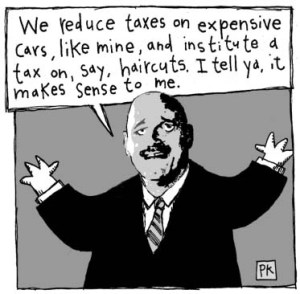 Harry Reid has introduced a bill called the “Sense of the Senate on Shared Sacrifice”. It basically has no recommendations, suggestions, policy measures, or required action. It is symbolic surreality at best and an exercise in serious alliteration. I can frankly hear Daffy Duck adding “suffering succotash” to the end. Hisssssssss.
The Senate as early as Wednesday could vote on a “Sense of the Senate” bill that says taxpayers earning $1 million or more each year should “make a more meaningful contribution to the deficit-reduction effort.”
…
The bill has no specific recommendations on how much taxes should be raised on high-income earners, and is simply a recommendation that these taxpayers pay more. Because the 60 votes needed to end debate are unlikely to materialize, the vote will likely be used by Democrats as a way to show Republican resistance to new tax hikes.
Democrats might also try to use the vote as leverage in negotiations on how to raise the debt ceiling by showing that there is support for a tax increase. In those talks, which are expected to continue this week, Democrats have said taxes on the wealthy and on oil companies should be part of the equation for reducing the deficit. Republicans have so far rejected this, and argue that an agreement needs to focus solely on spending cuts.
Now I’m all for meaningful displays of protest and performance art but I’m not alone in thinking this is shallow grandstanding. Here’s the sentiment of Greg Sargent on the subject. Did I mention the word Surreal is his subject head?
So it’s come to this. Republican opposition to any kind of revenue increase as part of the deficit deal has grown so implacable that Dems will now hold a Senate vote tomorrow on the basic idea that millionaires and billionaires should help contribute to fixing our deficit.
It’s not a vote on any specific proposal to hike taxes or end tax breaks. Rather, it’s a vote that puts each Senator on record on the general question of whether the rich should sacrifice in service of deficit reduction.
According to a Dem leadership aide, Senate Democrats have decided, as expected, to proceed with a vote tomorrow on a resolution that would declare that it is the “sense of the senate” that those who make $1 million or more per year should “make a more meaningful contribution to the deficit reduction effort.”
The vote — a cloture motion on the question of whether to proceed to an up-or-down vote on this resolution — is designed to put Repubicans on the spot. The idea is to force GOPers to go on the record choosing between declaring general support for more sacrifice from the wealthy — which in theory could strengthen Dem leverage in the talks — or reveal that they’re ideologically hostile to the notion that the rich should sacrifice anything to fix our fiscal mess. Dem Senators are holding a presser this afternoon to push the issue.
That this vote is happening at all perfectly captures just how surreal this debate has become. Democrats have agreed to over $1 trillion in spending cuts, and have reportedly agreed to tens of billions in Medicare cuts as part of that package. The American people have declared in poll after poll after poll that they think the deficit should be addressed through a combination of spending cuts and tax hikes. Yet Republicans are simply refusing to entertain the possibility of any revenue increases of any kind — to the point where even conservative columnists like David Brooks are growing seriously alarmed by the anti-tax fanaticism that’s on display.
Here’s David Dayen’s take at FDL. (Notice, I’ve decided to can the alliteration. It was getting way to easy and annoying.)
I’m actually all for nakedly political votes. This bill does not put anything into law, does not actually force millionaires to make a “more meaningful contribution” to deficit reduction. All it does is force Republicans onto the side of millionaires. If used successfully, that’s a fine vote to have for the next several cycles, and is sure to come up in television ads. Politics must be played sometimes.
But let’s not pretend that this is a “millionaire’s tax bill.” There was an opportunity to put a millionaire’s surtax in the Democratic budget; Kent Conrad will deliver a budget with a balanced approach between taxes and spending, but that surtax was dropped. There are a series of ideas about ending tax breaks for corporate jet owners, but I don’t know if you can even call them “meaningful.” Especially when you put them against the potential for $500 billion in Medicare and Medicaid cuts – just a year after a separate set of $500 billion in cuts to Medicare Advantage overpayments and other fat-trimming from Medicare – and another $100 billion through changing the COLA formula for Social Security beneficiaries. That adds up to twice as much in deficit reduction from seniors, the poor and the disabled than from the sum total of all revenue raisers on the table.
And anyway, none of those revenue raisers will be voted on in this sense of the Senate legislation. It just says that millionaire contributions would be a good idea. I assume then that the plan is to approach the millionaires individually.
My take is that if it’s such a good idea, then Reid should actually do something about it. He should’ve done something about it last winter when Obama was selling out on the Dubya Bush tax cut extensions. Our government shouldn’t be a person on the street with a tin cup. Congress spent all this damned money on all those wars and handed out all those ridiculous tax loop holes. Frankly, I’m with Katrina vanden Heuvel who thinks Obama and the Democrats should just invoke the 14th amendment and tell the Republicans to go to hell. Enough of this symbolic shit! Send Rubio, Ryan, and Boehner to the moon!

 peej
peej Carissa
 bostonboomer
 dakinikat
 ecocatwoman
 mablue2
 Mama Lopez
 peggysue22
 quixote
 skydancingguestblogger
 Mona (aka Wonk the Vote)



 Sky Dancing
Recent Comments