

RTT News: Dark Chocolate May Improve Walking Ability.
Finally Friday Reads: Backpfeifengesicht
Posted: March 7, 2025 Filed under: Economy, Equity Markets, FARTUS, kakistocracy, MAGA Assholes, MAGA Political Carnage, Polycrisis, Psychopaths in charge | Tags: a face worthy of being slapped, Backpfeifengesicht, CryptoCurrency Ponzi Scheme from Trump and Musk, Declaration of Independence, FARTUS, martial-law, People are not Illegal, Space X explosion, The Insurrection Act, White Male Christian Supremacists 8 Comments
“EEK!” John Buss, @repeat1968, @johnbuss.bsky.social
Good Day, Sky Dancers!
Backpfeifengesicht is the German word for “a face worthy of being slapped.” That might be the most usable word in the dark timeline, which is the second term of #FARTUS (Felon, Adjudicated Rapist, Traitor of the United States). JJ found this sweet article at The Guardian and shared it with BB and me this morning. It’s an Op-Ed written by Marina Hyde about JD Vance, but it could apply to any subhuman of the modern MAGA movement. “There are 1,000 grotesque memes of JD Vance – and they’re all more likable than the real thing. Angry, rude and addicted to web troll-ery, the vice-president has the Make America Awful Again portfolio. Seems a perfect fit.” Ayup.
You may well be aware that Backpfeifengesicht is the German word for a face that is worthy of being slapped. Even so, how has this not been internationalised? Or at the very least Americanised, where its dictionary definition would presumably be adorned by a picture of the face of US vice-president JD Vance – already faultlessly playing the role of worst American at your hotel. You can immediately picture him at breakfast, can’t you? Every single other guest on the terrace with their shoulders up round their ears, just thinking: “Where is he now? How unbearable is he being NOW?” Next, imagine breakfast lasting four years.
I say the Backpfeifengesicht definition would be accompanied by JD Vance’s face … but then again, what is the face of JD Vance? The internet is awash with people suffering an acute case of not being able to remember it any more, having seen so many hideous comic distortions of Vance that those meme versions are not simply the only results on the first page of your own mental Google search, but stretch deep beyond the second and into the third. Somewhere on page four, where you might as well publish the nuclear codes or pictures of Taylor Swift giving cocaine to babies, is an unmodified snap of what JD Vance actually looks like. Or at least what he looks like with eyeliner.
Before you get there – and you don’t, really – your synaptic filing systems throw up every variety of Photoshopped Vancefake: swollen manboy, face wearing a Minion suit, a bearded egg … I’m hoping that sooner or later, an American news outlet will accidentally use a modified photo, because even the picture editor has forgotten what the vice-president looks like, and then we can have one of those massively self-regarding legacy media-blow-ups, where the entire staff has to resign after a remorseless investigation by the executive editor reveals Vance isn’t actually a big purple grape. “This is a stain on our newspaper’s history. A big purple stain.”
Vance is more meme than man, now, and it is, of course, something of a consolation that he is so extremely online that he can’t help but have noticed this. The VP is like a one-man government troll-feeding programme – please don’t cut him, Elon! – which is probably why people have become so heroically committed to taking the piss. The probability of the vice-president seeing you insulting him is basically one.
Just as previous holders of his office like Teddy Roosevelt and Richard Nixon once did, Vance spent a notable amount of this week both denying he suggested Britain and France were random countries that hadn’t fought a war in 40 years, and replying to random X posters called things like “Jeff Computers” to counter the suggestion that he wasn’t loved and feted on his recent skiing holiday.
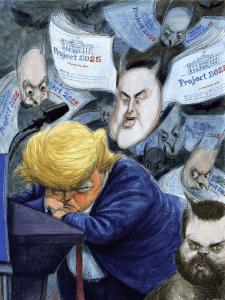
 While JJ found that amusing read today. BB brought home the rancid bacon. This is an op-ed by Brett Wagner in The San Francisco Chronicle today. “Is Trump preparing to invoke the Insurrection Act? Signs are pointing that way. A joint Department of Defense and Homeland Security report will soon recommend whether or not to invoke the Insurrection Act over illegal migration.”
The clock is ticking down on a crucial but little-noticed part of President Donald Trump’s first round of executive orders — the one tasking the secretaries of the Department of Defense and Department of Homeland Security to submit a joint report, within 90 days, recommending “whether to invoke the Insurrection Act.”
Many of us are now holding our collective breath, knowing that the report and what it contains could put us on the slippery slope toward unchecked presidential power under a man with an affinity for ironfisted dictators.
Adding to the suspense was the recent “Friday Night Massacre” at the Pentagon — the firing of the nation’s top uniformed officer and removing other perceived guardrails (i.e., the top uniformed lawyers at the Army, Navy and Air Force) standing between the president and his long-stated intention to declare martial law upon returning to power.
Coincidence?
As we wait to find out, this would be a good time to take a closer look.
Say, for example, that Trump were to invoke the Insurrection Act and declare martial law. He wouldn’t even be required, by the letter of the law, to allege an “insurrection.” All that would be required is to assert that “unlawful obstruction” has made it “impracticable to enforce the laws of the United States” (as President Dwight D. Eisenhower did when he ordered the Arkansas National Guard to enforce the desegregation of Little Rock, Ark., schools).
This is where all the false claims and outright lies Trump and his political allies have been pushing will come into play: Trump falsely alleging, for example, that an entire city in Colorado has been taken over by Venezuelan street gangs, that a city in Ohio has been overrun by Haitian refugees who are eating all the cats and dogs, and other vague assertions that “millions and millions” of “illegals” are pouring into our country every week (or “day” depending on who’s telling the lie at the moment).
Each of these false claims and outright lies could be distilled, to declare martial law, into catchy phrases (beginning with the legalese word “Whereas”) to establish the legal premise for invoking the Insurrection Act, and to lay the predicate to begin going door-to-door, wherever they please, under the pretense of searching for undocumented immigrants who don’t exist.
I bring you the reality on the ground from Joy Reid on Threads. “This is inhumane, hideous and repugnant. If this is what MAGA America is, count me out. I’m ashamed that this is what our government is doing. Shame on them. Shame.” What it is is a 21-year-old girl with cancer who relies completely on her immigrant mother, who is in no way a criminal or bothering anyone. When protesters came to protest, they were arrested. How many laws and constitutional rights can this miserable administration break before they completely break all of us? This story comes from El Monte, California. You can read the hatred of the MAGA monsters in the threads below on YouTube. I’ve gotten to the point where I don’t want to leave the house and take a chance at seeing a FARTUS supporter in my neighborhood. I’m fine with all the immigrants, though. Everything they do makes my neighborhood a better place.
“I can’t even wake up properly… she helps me, she bathes me, she changes me, she makes my food.”Deportation didn’t protect anyone it only stole a mother from the child who needs her most-Blake Coronadowww.threads.net/@blakecorona…
— Audrey (@parickards.bsky.social) 2025-03-06T23:59:31.294Z
 The US Military and US Vets are under attack from this Administration. This cannot be denied. This is from the AP this morning. FARTUS has always had a thing against military service and those who fight for values that he seems to hate very much. “War heroes and military firsts are among 26,000 images flagged for removal in Pentagon’s DEI purge.” So much of this just comes as an attack against the diversity of our nation being represented in all of its institutions. But is that really it? Why the disappearance of all people of color, women, and the LGBTQ community? Are white cis men really that sensitive?
References to a World War II Medal of Honor recipient, the Enola Gay aircraft that dropped an atomic bomb on Japan and the first women to pass Marine infantry training are among the tens of thousands of photos and online posts marked for deletion as the Defense Department works to purge diversity, equity and inclusion content, according to a database obtained by The Associated Press.
The database, which was confirmed by U.S. officials and published by AP, includes more than 26,000 images that have been flagged for removal across every military branch. But the eventual total could be much higher.
One official, who spoke on condition of anonymity to provide details that have not been made public, said the purge could delete as many as 100,000 images or posts in total, when considering social media pages and other websites that are also being culled for DEI content. The official said it’s not clear if the database has been finalized.
Defense Secretary Pete Hegseth had given the military until Wednesday to remove content that highlights diversity efforts in its ranks following President Donald Trump’s executive order ending those programs across the federal government.
The vast majority of the Pentagon purge targets women and minorities, including notable milestones made in the military. And it also removes a large number of posts that mention various commemorative months — such as those for Black and Hispanic people and women.
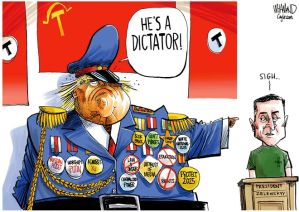 Are they just trying to up their odds that one will be less likely to disrupt the plan when martial law is declared? Everything they’ve been doing shows their delight in being the worst kind of bullies. Just yesterday, they announced they will deport Ukrainians who fled to the US for safety. We are no longer a safe harbor. Not even close. Heather Cox Richardson discusses this in detail this morning in her Substack Letters from an American.
This morning, Ted Hesson and Kristina Cooke of Reuters reported that the Trump administration is preparing to deport the 240,000 Ukrainians who fled Russia’s attacks on Ukraine and have temporary legal status in the United States. Foreign affairs journalist Olga Nesterova reminded Americans that “these people had to be completely financially independent, pay tax, pay all fees (around $2K) and have an affidavit from an American person to even come here.”
“This has nothing to do with strategic necessity or geopolitics,” Russia specialist Tom Nichols posted. “This is just cruelty to show [Russian president Vladimir] Putin he has a new American ally.”
The Trump administration’s turn away from traditional European alliances and toward Russia will have profound effects on U.S. standing in the world. Edward Wong and Mark Mazzetti reported in the New York Times today that senior officials in the State Department are making plans to close a dozen consulates, mostly in Western Europe, including consulates in Florence, Italy; Strasbourg, France; Hamburg, Germany; and Ponta Delgada, Portugal, as well as a consulate in Brazil and another in Turkey.
In late February, Nahal Toosi reported in Politico that President Donald Trump wants to “radically shrink” the State Department and to change its mission from diplomacy and soft power initiatives that advance democracy and human rights to focusing on transactional agreements with other governments and promoting foreign investment in the U.S.
Elon Musk and the “Department of Government Efficiency” have taken on the process of cutting the State Department budget by as much as 20%, and cutting at least some of the department’s 80,000 employees. As part of that project, DOGE’s Edward Coristine, known publicly as “Big Balls,” is embedded at the State Department.
As the U.S. retreats from its engagement with the world, China has been working to forge greater ties. China now has more global diplomatic posts than the U.S. and plays a stronger role in international organizations. Already in 2025, about 700 employees, including 450 career diplomats, have resigned from the State Department, a number that normally would reflect a year’s resignations.
Shutting embassies will hamper not just the process of fostering goodwill, but also U.S. intelligence, as embassies house officers who monitor terrorism, infectious disease, trade, commerce, militaries, and government, including those from the intelligence community. U.S. intelligence has always been formidable, but the administration appears to be weakening it.
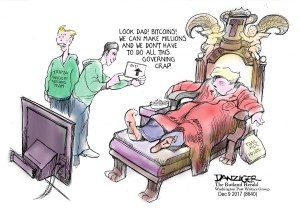
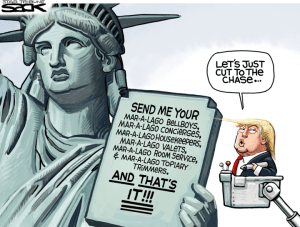
Trump, bitcoin, political cartoon
We’re being turned into part of the Trump Grift Mafia. Nothing will be left standing of any of the good we have done in the world. This is neocolonialism and neomercantilism. We’ve retreated to some of the worst historical ideologies ever. The most symbolic thing happened yesterday. The latest Space X project blew up in the sky and shut down many flights yesterday. “Breakup of SpaceX’s Starship Rocket Disrupts Florida Airports. The video showed the upper stage of the most powerful rocket ever built spinning out of control in space, a repeat of an unsuccessful test flight in January that led to debris falling over the Caribbean.” This is what we’re spending money for? Elonia is pushing his company to the brink of getting to Mars and looking down at the rest of us. The report is from The New York Times‘s Kenneth Chang.
Starship — the huge spacecraft that Elon Musk says will one day take people to Mars — failed during its latest test flight on Thursday when its upper stage exploded in space, raining debris and disrupting air traffic at airports from Florida to Pennsylvania.
It was the second consecutive test flight of the most powerful rocket ever built where the upper-stage spacecraft malfunctioned. It started spinning out of control after several engines went out and then lost contact with mission control.
Photographs and videos posted on the social media site X by users saying they were along the Florida coast showed the spacecraft breaking up. The falling debris disrupted flights at airports in Miami, Orlando, Palm Beach and Fort Lauderdale, and as far away as Philadelphia International Airport.
The Starship rocket system is the largest ever built. At 403 feet tall, it is nearly 100 feet taller than the Statue of Liberty atop its pedestal.
It has the most engines ever in a rocket booster: The Super Heavy booster is powered by 33 of SpaceX’s Raptor engines. As those engines lift Starship off the launchpad, they will generate 16 million pounds of thrust at full throttle.
The upper part, also called Starship or Ship for short, looks like a shiny rocket from science fiction movies of the 1950s, is made of stainless steel with large fins. This is the upper stage that will head toward orbit, and ultimately could carry people to the moon or even Mars.
The rocket lifted off a little after 6:30 p.m. Eastern time on Thursday from the SpaceX site known as Starbase at the southern tip of Texas near the city of Brownsville.
Starship’s mammoth booster again successfully returned to the launchpad, just as it had during the previous test flight. In the last half minute before the upper-stage engines were to shut off, several of them malfunctioned. Video from the rocket showed a tumbling view of Earth and space until it cut off.
Ashley Parker and Michael Scherer wrote this analysis for The Atlantic. “Trump’s Own Declaration of Independence. The president, who has flirted with regal rhetoric, wants a historic copy of America’s founding document placed in the Oval Office.”
Long live the king!
Down with the king!
President Donald Trump sees the appeal of both.
Trump jokingly declared himself a sovereign last month, while his advisers distributed AI-generated photos of him wearing a crown and an ermine robe to celebrate his order to end congestion pricing in New York City. “He who saves his Country does not violate any Law,” he’d decreed a few days earlier, using a phrase sometimes attributed to Napoleon Bonaparte, the emperor of the French.
 I had no idea one of my greats who signed the Declaration had made of the copies of it. But the weird thing here is that Trump seriously wants the document to hang in the Oval Office. My question is, why take it from the people who can see it in the archives?
Since returning to power, Trump has moved quickly to redesign his working space. He has announced plans to pave over the Rose Garden to make it more like the patio at his private Mar-a-Lago club, as well as easier to host events with women wearing heels. He has also revived planning for a new ballroom on the White House grounds. “It keeps my real-estate juices flowing,” Trump explained in a recent interview with The Spectator.
Golden trophies now line the Oval Office’s mantlepiece. Military flags adorned with campaign streamers have returned. And portraits of presidents past now climb the walls—George Washington, Thomas Jefferson, John Adams, Martin Van Buren, Theodore Roosevelt, Franklin D. Roosevelt, and Ronald Reagan, among others. Gilded mirrors hang upon the recessed doors. A framed copy of his Georgia mug shot appears in the outside hallway. And the bright-red valet button, encased in a wooden box, is back on the desk.
In addition to the National Archives’ original Declaration, the government has in its possession other versions of the document. The collection includes drafts by Jefferson and copies of contemporaneous reprintings, known as broadsides, that were distributed among the colonies.
Alarmed by the deterioration of the original Declaration in the 1820s, Secretary of State John Quincy Adams commissioned William J. Stone to create an engraving of it with the signatures appended. That version forms the basis of the document since reproduced in school history books—the one with which most Americans are familiar. Adams tasked Stone with engraving 200 copies—but in what passes for a mini 19th-century scandal, Stone made an extra facsimile to keep for himself, the documents dealer and expert Seth Kaller told us.
Many of those Stone copies of the document have now been lost; roughly 50 are known to survive, Kaller said. The White House already has in its archives at least one of the Stone printings. Kaller told us that one of his clients who had recently purchased a Stone facsimile was visiting the White House when President Barack Obama asked him whether he could help procure a Stone printing for the White House.
“The client called me, and I said, ‘I can’t—because, one, there aren’t any others on the market right now, and two, the White House already has one,’” Kaller told us. In 2014, Kaller visited the White House to view the Stone Declaration, which the curator displayed for him in one of the West Wing’s rooms. (The White House curator’s office did not respond to multiple requests for comment, including on whether the Stone copy still resides under its purview.)
It is unclear where Trump first got the idea to add a Declaration to the Oval Office’s decor. Since returning, Trump has shown interest in the planning for celebrations next year of the 250th anniversary of the document’s signing. Days after taking office, he issued an executive order to create “Task Force 250,” a White House commission that will work with another congressionally formed commission to plan the festivities.
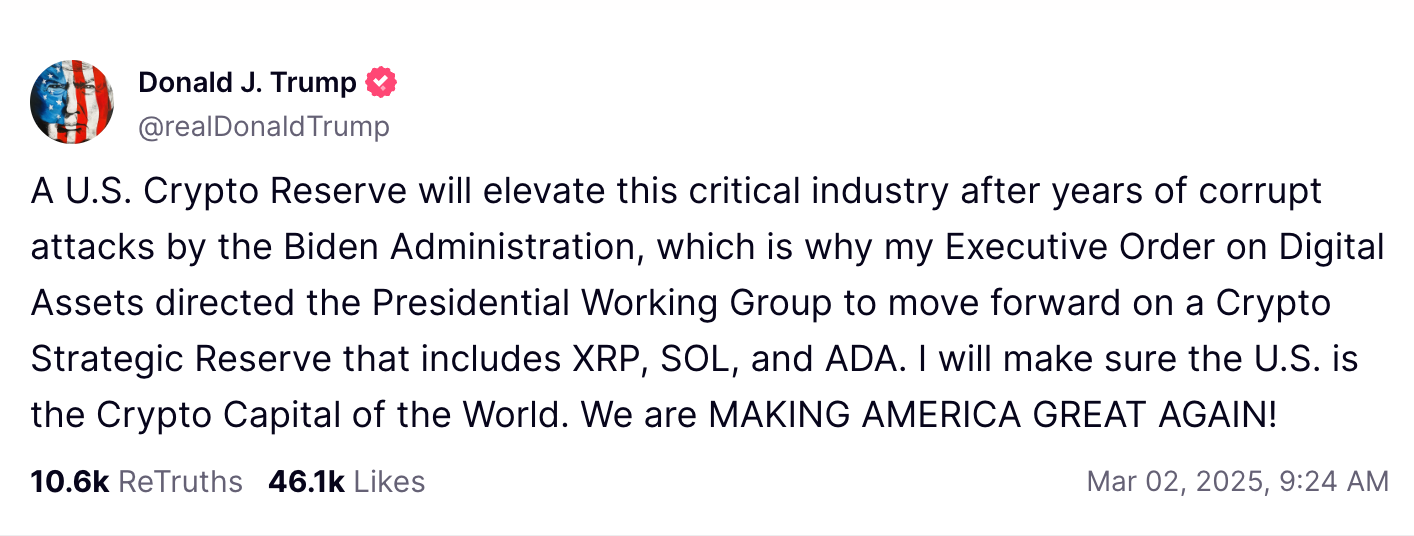
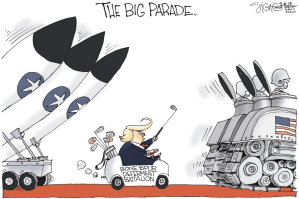
I hope he’s not trying to go with one of those grandiose military parades again. And if he does, will he eliminate everyone but the white guys? It can’t be anything other than another way for him to get attention, that’s for sure. Again, this all continues to be an appalling cosplay of how FARTUS wants to view himself in relation to his imagined ideas of American History. I can’t even with the economy today. Just know he’s changed his mind on tariffs again for Canada and Mexico, and employment figures are worsening. He’s turned a strong economy into a weak one in a matter of weeks. He’s also shaken the Equity markets to their core. What’s on is this: “Trump’s “Crypto Reserve” is a world historical grift. Corruption doesn’t get much more blatant than this.” My Finance Daughter and I both find crypto to be a huge Ponzi scheme. I lecture against it. She doesn’t consider it a product that brokers should be involved in. In short, we stay as far away as possible. But, you know, grifters gotta grift. This is from Public Notice.
Authoritarian regimes by definition have no accountability to voters or the public. That means autocrats and their cronies can gorge themselves at the public trough and blatantly steal from taxpayers with few if any consequences.
It’s not really a surprise, then, that as part of his authoritarian power grab, Trump has embraced brazen and open self-dealing. The most ludicrous example of this is the scheme he announced last Sunday for a national crypto reserve.
As with many of Trump’s big orange dreams, it’s not exactly clear what the crypto reserve will entail or how it will work. But the brilliance of the half-baked idea is that Trump and his cronies can make bank just by talking about it. The president can use his bully pulpit to manipulate markets. And who’s going to stop him?
Trump, fresh off avoiding 88 felony charges, obviously feels confident that the answer is “no one.”
Government on the blockchain
Crypto refers to digital currencies which are generated and stored in a digital ledger, or blockchain. In theory, cryptocurrencies do not rely on a central government authority. Proponents say they are useful for quick or anonymous transactions. Critics point out that cryptocurrency seems designed for hiding illegal transactions and/or creating what are essentially Ponzi investment schemes.
Because of the downsides, President Biden created moderate guidelines to try to regulate some of the worst excesses of the industry, which made him an enemy of hardcore crypto boosters. But Trump in his first term expressed even deeper skepticism about cryptocurrencies, saying they are based on “thin air.”
During the 2024 election, though, crypto investors spent tens of millions on Republican campaigns. Trump, who never saw a quid pro quo he didn’t love, changed his tune, embracing crypto-friendly policies. After his victory, he followed through by appointing venture capitalist and Elon Musk crony David Sacks as a White House crypto czar.
Another reason Trump flip-flopped on crypto is that his family figured out how to cash in. Following the election, Trump squandered some of the goodwill he had built up with the crypto industry when he and his wife Melania launched memecoins — essentially valueless crypto confidence games — that both surged in value, making the Trumps billions (but undermining the credibility of crypto in the process). That came after his two adult sons, Eric and Don Jr, launched their own crypto company during the campaign called World Liberty Financial. Boosting crypto as president, then, allows Trump and his family to profit directly from his public office.
Trump announced his thank you to the industry last Sunday, when he declared that he would create a “Crypto Strategic Reserve” in order to make the US “the Crypto Capital of the World.” He of course claimed the move is part of “MAKING AMERICA GREAT AGAIN.”
But the actual point of the crypto reserve, much less the details, are sketchy at best. Proponents argue crypto is a store of value, like gold, and could help damp inflation. But the major cryptocurrencies tend to rise and fall in value based on broader macroeconomic sentiment. And since crypto is volatile and, unlike gold, has no intrinsic value, it’s hard to credit its usefulness as a currency stabilizer.
If you have any questions about any of this, I’d be glad to try to answer them. Seeing such craziness in our economic policy has been hard on me. I’m just waiting for the major attack on the Federal Reserve Bank. They’re the only ones that bring credibility to the dollar these days, and I’m afraid he’ll have a go at them. The mess at the Treasury is already impacting the banking business. Don’t even get me started on the Budget Crisis, either. I’m tired of the repeats of that one by disingenuous Republicans.
I hope all of you can close your doors and stay sane inside the one place you can control, home. I have a few more tests next week, so I will be out at clinics again, being poked and prodded. This weekend, I will just relax and try to avoid the ever-changing Trump Surreality Show.
What’s on your reading and blogging list today?
Fourth of July Reads
Posted: July 4, 2014 Filed under: morning reads, U.S. Politics, Women's Rights | Tags: corporate personhood, corporatizing religious liberty, Declaration of Independence, Fourth of July, Hobby Lobby, Independence Day, John Roberts, legal precedent, religion, Samuel Alito, SCOTUS, separation of church and state, Statue of Liberty, Wheaton College 14 Comments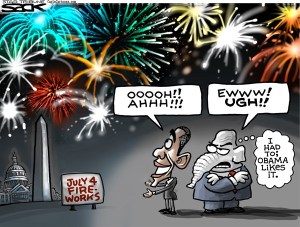
Good Morning!!
Today we celebrate the Declaration of Independence. I’ve assembled a few informational readings about this day in history.
From The Cagle Post: Fourth of July Fast Facts.
“I’m confused. I thought July 4 was the day our country declared independence from King George III of Great Britain.”
“Actually, according to ConstitutionFacts.com, that’s not so. The Continental Congress declared independence from Great Britain on July 2, 1776.”
“Then why do we celebrate our independence on the Fourth every year? Is that when we started the American Revolution?”
“That is a common misunderstanding, as well. The American Revolution began in April 1775, more than a year earlier.”
“I’m stumped. Was the Fourth the day Thomas Jefferson wrote the first draft of the Declaration of Independence?”
“Nope. Thomas Jefferson wrote the first draft in June 1776. Also, Jefferson didn’t write the Declaration alone.”
“He didn’t? I always thought he was the sole author.”
“A common misconception. In fact, the Continental Congress appointed a five-person to write the Declaration. It included Jefferson, Benjamin Franklin, John Adams, Robert Livingston and Roger Sherman.” ….
“Though Jefferson wrote the first draft, it was changed 86 times by other members of the committee and other members of the Continental Congress.”
I did not know that.
David Armitage at The Wall Street Journal: The Declaration of Independence: The Words Heard Around the World.
The Declaration of Independence is the birth certificate of the American nation—the first public document ever to use the name “the United States of America”—and has been fundamental to American history longer than any other text. It enshrined what came to be seen as the most succinct and memorable statement of the ideals on which the U.S. was founded: the rights to life, liberty and the pursuit of happiness; the consent of the governed; and resistance to tyranny.
But the Declaration’s influence wasn’t limited to the American colonies of the late 18th century. No American document has had a greater impact on the wider world. As the first successful declaration of independence in history, it helped to inspire countless movements for independence, self-determination and revolution after 1776 and to this very day. As the 19th-century Hungarian nationalist, Lajos Kossuth, put it, the U.S. Declaration of Independence was nothing less than “the noblest, happiest page in mankind’s history.”
In telling this story of global influence, however, it is important to separate two distinct elements of the Declaration—elements that sometimes get conflated. The first of these is the assertion of popular sovereignty to create a new state: in the Declaration’s words, the right of “one People to dissolve the Political Bands which have connected them with another, and to assume among the Powers of the Earth, the separate and equal Station to which the Laws of Nature and of Nature’s God entitle them.” The second and more famous element of the Declaration is its ringing endorsement of the sanctity of the individual: “We hold these truths to be self-evident, that all men are created equal, that they are endowed by their Creator with certain unalienable Rights.”
Read much more at the link.
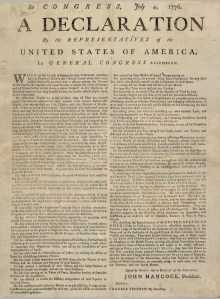
From the LA Times: The slow-spreading news of American independence.
In this era of instant communication, it’s interesting to note the slow distribution of the Declaration, and the spreading of the word to those on whose behalf independence had been declared. (Imagine the Twitter version: Dudes, we’re on our own. #independence #totallyrad #stickitkinggeorge).
The text was set in type by Philadelphia printer John Dunlap just hours after the Continental Congress approved the manifesto on July 4. He ran off about 200 copies, most of which were then distributed via horse and boat around the Colonies. He reprinted it in his own newspaper, Dunlap’s Pennsylvania Packet, or The General Advertiser (great newspaper names back then). Over the next few weeks, Jefferson’s stirring words were reprinted inlocal newspapers and pamphlets around the Colonies.
And, naturally, in Britain. It took more than a month for the first reports of the Declaration to reach Britain in letters ferried by the Mercury packet ship. Gen. William Howe, who was leading the crown’s forces in the Colonies, included a brief mention in his report to his overseers. So the first public airing of the news came in the London Gazette, the crown’s official paper. If you weren’t a close reader, you could have easily missed it.
In the four-page issue dated Aug. 6-Aug. 10, 1776, the Gazette’s lead story was Howe’s update of the war, reporting that “the Rebels, who are numerous, and are very advantageously posted with strong Entrenchments both upon Long Island and that of New York, with more than One Hundred pieces of Cannon for the Defence of the Town towards the Sea, and to obstruct the passage of the [British] Fleet up the North [Hudson] River, besides a considerable Field Train of artillery.”
Finally, Carina Kolodny at Huffington Post: This Is Not Your Independence Day.
The 4th of July might commemorate the independence of our country — but it also serves as a bitter reminder that in 1776, the country that I love had no place for me in it.
When our founding fathers penned, “All men are created equal,” they meant it. Not all people. Not all humans. Just all men — the only reason they didn’t feel obliged to specify “white” men is because, at the time, men of color were considered less than men, less than human.
The 4th is not my Independence Day — and if you’re a Caucasian woman, it isn’t yours either. Our “independence” didn’t come for another 143 years, with the passage of The Woman’s Suffrage Amendment in 1919. The 4th of July is also not Independence Day for people of color. It wasn’t until the 15th Amendment was ratified in 1870 that all men had the right to vote regardless of race — on paper, that is, not in practice. People of color were systematically, and all too successfully, disenfranchised for another century. July 4th of 1776 was certainly not a day of Independence or reverence for Native Americans. It wasn’t until 1924 that Native Americans could unilaterally become citizens of the United States and have the voting rights to go with it.
Now, before anyone argues that Independence is about more than voting rights, I’d like to point out that our Founding Fathers would fundamentally disagree with you. The Revolutionary War was fought, in large part, because of “taxation without representation” — the then English colonists believed they were not free because their voices were not represented. The right to vote, the right to have your say is the delineating characteristic of a democracy.
The Aftermath of the Hobby Lobby Decision
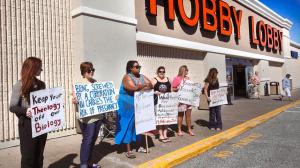
On that note, today many concerned citizens are looking back at the latest Supreme Court decisions that take women backwards in their pursuit of freedom and autonomy. The court-approved limits on access to birth control go beyond the Hobby Lobby decision. Lyle Denniston at SCOTUSblog: Broader right to object to birth control.
Expanding the rights of religious opponents of birth control, a divided Supreme Court on Thursday afternoon spared an Illinois college — and maybe hundreds of other non-profit institutions — from obeying government regulations that seek to assure access to pregnancy prevention services for female workers and students. In the same order, the majority essentially told the government to modify its own rules if it wants to keep those services available.
Three Justices wrote a sharply worded dissent, accusing the majority of creating on its own a “new administrative regime” that will seriously complicate the operation of the birth control mandate under the new federal health care law. The majority, the dissenters said, “has no reason to think that the administrative scheme it foists on the government today is workable or effective on a national scale.”
The ruling, which the majority insisted was temporary and had settled nothing finally about the legal issues at stake, came three days after the Court in Burwell v. Hobby Lobby had given for-profit businesses whose owners have religious objections to birth control a right to refuse to provide those services in their employee health plans.
The plea by Wheaton College, a religious institution in Illinois with about 3,000 students, moved the Court beyond for-profit firms to the world of non-profit religious colleges, hospitals, and other charities. The government had already moved to accommodate their beliefs, but that had not gone far enough for the college and for scores of other non-profits. With the Court’s new order, they gained additional separation from the birth-control mandate.
At Mother Jones, Kevin Drum writes: Supreme Court Now Playing Cute PR Games With Hobby Lobby Decision.
For the last few days, there’s been a broad argument about whether the Hobby Lobby ruling was a narrow one—as Alito himself insisted it was—or was merely an opening volley that opened the door to much broader rulings in the future. After Tuesday’s follow-up order—which expanded the original ruling to cover all contraceptives, not just those that the plaintiffs considered abortifacients—and today’s order—which rejected a compromise that the original ruling praised—it sure seems like this argument has been settled. This is just the opening volley. We can expect much more aggressive follow-ups from this court in the future.
POSTSCRIPT: It’s worth noting that quite aside from whether you agree with the Hobby Lobby decision, this is shameful behavior from the conservatives on the court. As near as I can tell, they’re now playing PR games worthy of a seasoned politico, deliberately releasing a seemingly narrow opinion in order to generate a certain kind of coverage, and then following it up later in the sure knowledge that its “revisions” won’t get nearly as much attention.
At Slate, Micah Schwartzman, Richard Schragger, and Nelson Tebbe explain that Hobby Lobby rewrites religious-freedom law in ways that ignore everything that came before.
Monday’s decision in Hobby Lobby was unprecedented. Much of the commentary has focused on the Supreme Court’s decision to extend rights of religious free exercise to for-profit corporations. Hobby Lobby is for religion what Citizens United was for free speech—the corporatization of our basic liberties. But Hobby Lobby is also unprecedented in another, equally important way. For the first time, the court has interpreted a federal statute, theReligious Freedom Restoration Act (or RFRA), as affording more protection for religion than has ever been provided under the First Amendment. While some have read Hobby Lobby as a narrow statutory ruling, it is much more than that. The court has eviscerated decades of case law and, having done that, invites a new generation of challenges to federal laws, including those designed to protect civil rights.
The authors explain how the right wing Roberts Court has moved beyond any concern for legal precedent in making its decisions.
Hobby Lobby is unprecedented because it corporatizes religious liberty. It extends to for-profit businesses the rights and privileges that have long been associated only with churches and religious nonprofits. But that change is the result of a more pervasive and deeper upending of the law of religious liberty in America. Ignoring congressional intent, the court reads RFRA as having shed its First Amendment skin. It is not entirely clear what American law will look like after that change. But if anything is clear, it is that the Roberts Court is now unconstrained by precedent. It has loosened itself from decades of First Amendment doctrine and has begun remaking the law of free exercise.
Please read the whole thing.
Ironically, the Hobby Lobby decision may have also created some serious problems for the human beings who own corporations (h/t Dakinikat). From Mother Jones: How Hobby Lobby Undermined The Very Idea of a Corporation. Basically, now that SCOTUS has said that some corporations are inseparable from the people who own them, those owners could lose their legal protection from debts and lawsuits that result from corporate actions. There’s some instant Karma for you!
A few more links for your holiday reading pleasure:
Miami Herald: FBI records: Chilling find in Bradenton dumpster (new clues to Saudi involvement in the 9/11 and the cover-up of that involvement by the Bush/Cheney administration).
Study links Oklahoma earthquake swarm with fracking operations
Boston Globe: People prefer electric shocks to time alone with thoughts.
LA Times: Tibetans get high-altitude edge from extinct Denisovans’ genes.
What stories are you following on this Independence Day?
Sally Quinn: Only Believers Can Be American Citizens
Posted: October 6, 2012 Filed under: 2012 presidential campaign, Barack Obama, Media, Mitt Romney, nature, Surreality, U.S. Politics | Tags: Ben Bradlee, Bob Woodward, Declaration of Independence, presidential debates, Sally Quinn, Thomas Jefferson, Washington Post 38 Comments
Sally Quinn is insane
Why does the Washington Post keep publishing the bizarre rantings of an insane person like Sally Quinn? Does Ben Bradlee still have that much influence, or is it Bob Woodward’s attachment to Bradlee that ensures that Quinn can keep vomiting forth her hate-filled screeds in, of all things, the “On Faith” column?
Forgive me if you’ve already heard enough about Quinn’s reaction to Wednesday’s presidential debate. Somehow I missed her latest nonsensical frothings until this afternoon. If only I’d continued on, happily unaware! But instead, I clicked on a link and soon learned that, according to Quinn, Mitt Romney won the first debate because he mentioned god. I also found out that Quinn believes that atheists can’t be American citizens!
When Mitt Romney mentioned the “Creator” in the debate Wednesday, he owned it. “We’re all children of the same God,” he said.
That’s about 85 percent of the country he was talking to. That should have been President Obama’s constituency but he let Romney have it as he let Romney have the debate.
Is that so. Is she really claiming that 85 percent of voters are suddenly going to vote for Mitt Romney now because he mentioned god?
Moving on:
Citing the Declaration of Independence, Romney said: “Second, is that line that says we are endowed by our Creator with our rights, I believe we must maintain our commitment to religious tolerance and freedom in this country. That statement also says that we are endowed by our creator with the right to pursue happiness as we choose. I interpret that as, one, making sure that those people who are less fortunate and can’t care for themselves are cared by — by one another.”
Like most of what Sally Quinn writes, and much of what Mitt Romney says, that makes absolutely no sense, but I’ll have more to say about that in a minute.
Quinn continues (emphasis added):
This is a religious country. Part of claiming your citizenship is claiming a belief in God, even if you are not Christian…. We’ve got the Creator in our Declaration of Independence. We’ve got “In God We Trust” on our coins. We’ve got “one nation under God” in our Pledge of Allegiance. And we say prayers in the Senate and the House of Representatives to God.
An atheist could never get elected dog catcher, much less president….Up until now, the idea of being American and believing in God were synonymous.
I have news for Quinn. This is not a “religious country.” This is a country in which people can worship as they please, but they can’t interfere with other people doing something completely different. Our government, however, is secular and there can be no religious test for American citizenship or for public office.
Quinn wraps up her idiotic piece by announcing that if President Obama wants to win the next debate, he’ll have to “wear God, as much as it offends him to do so.”
WTF?! How do you “wear god?” Is she suggesting that Obama should wear a crucifix around his neck at the next debate? And what does she mean by claiming that Obama is offended by “wearing god?” I’m completely at a loss here.
Frankly, I think Sally Quinn needs to be evaluated by a competent psychiatrist immediately. Furthermore, as long as she continues writing for it, the Washington Post cannot ever again be considered a serious newspaper.
But I want to return to Romney’s quote on the the Declaration of Independence:
“Second, is that line that says we are endowed by our Creator with our rights, I believe we must maintain our commitment to religious tolerance and freedom in this country. That statement also says that we are endowed by our creator with the right to pursue happiness as we choose. I interpret that as, one, making sure that those people who are less fortunate and can’t care for themselves are cared by — by one another.”
That is not at all what Thomas Jefferson wrote. The Declaration of Independence says that we are all “created equal” and have innate rights to “life, liberty, and the pursuit of happiness.” There’s nothing in there about the pursuit of happiness “as we choose,” or about who is supposed to take care of “less fortunate” people. Here’s the relevant quote:
When in the course of human events it becomes necessary for one people to dissolve the political bands which have connected them with another and to assume among the powers of the earth, the separate and equal station to which the Laws of Nature and of Nature’s God entitle them, a decent respect to the opinions of mankind requires that they should declare the causes which impel them to the separation.
We hold these truths to be self-evident, that all men are created equal, that they are endowed by their Creator with certain unalienable Rights, that among these are Life, Liberty and the pursuit of Happiness. That to secure these rights, Governments are instituted among Men, deriving their just powers from the consent of the governed.
Romney seems to be trying to reinterpret Jefferson’s words–perhaps based on Paul Ryan’s twisted version of Ayn Randism–to mean that “less fortunate” people should help each other, while fortunate ones like Romney help themselves in any way they like. Come to think of it, that’s probably exactly what he does believe. But it’s not what Thomas Jefferson wrote.
It’s abundantly clear that Jefferson was writing about the role of government in making sure that citizens are granted the rights that come from “Laws of Nature and Nature’s God” and that when a government no longer protects those rights, the citizens have a right to form a new government. If Mitt Romney doesn’t understand that, then he has no business running for public office, much less serving as President of the United States.
Although I regret reading Sally Quinn’s confused and innane thoughts on the presidential debate, I’m grateful to her for pointing out Mitt Romney’s complete ignorance of the document that laid the foundation for American independence and for the rights that are enumerated in the U.S. Constitution. I hate to think how he would interpret the Bill of Rights.
Oh, and I am a full-fledged citizen even though I don’t accept Sally Quinn’s or Mitt Romney’s twisted religious beliefs, and I have every intention of voting on November 6.
Thursday Reads: The Not-Quite-Humanness of Mitt Romney
Posted: February 2, 2012 Filed under: 2012 presidential campaign, 2012 primaries, Media, Mitt Romney, morning reads, U.S. Politics | Tags: "Invasion of the Body Snatchers", "The Real Romney", Andrew Sullivan, Book of Mormon, Brigham Young, CNN Florida primary debate, Cougar Club, Declaration of Independence, Genn Beck, George Romney, Joseph Smith, Latter Day Saints, Michael D. Moody, Miles A. Romney, Miles P. Romney, Mitt Romney, Mormon church, Orrin Hatch, polygamy, robots, theocracy, U.S. Constitution, uncanny valley, zombies 53 Comments
Good Morning!!
I had never seen the diagram above before until last night when I was browsing through reactions to Mitt Romney’s latest insensitive remark, “I’m not concerned about the very poor. We have a safety net there.” That’s when I found the above diagram at Andrew Sullivan’s blog.
Here’s an explanation from Wikipedia:
Hypothesized emotional response of human subjects is plotted against anthropomorphism of a robot, following Mori’s statements. The uncanny valley is the region of negative emotional response towards robots that seem “almost human”. Movement amplifies the emotional response.
The idea is you can make an emotional connection to a robot; but a robot that is very close to looking and acting human, but not quite, will elicit disgust. This could explain the reactions of revulsion that many people have toward Mitt Romney. From Wikipedia:
If an entity looks sufficiently nonhuman, its human characteristics will be noticeable, generating empathy. However, if the entity looks almost human, it will elicit our model of a human other and its detailed normative expectations. The nonhuman characteristics will be noticeable, giving the human viewer a sense of strangeness. In other words, a robot stuck inside the uncanny valley is no longer being judged by the standards of a robot doing a passable job at pretending to be human, but is instead being judged by the standards of a human doing a terrible job at acting like a normal person.
Sullivan suggests that Romney is “probing zombie territory.” I found this a very helpful way to think about the way Romney presents himself in public. He is trying very hard to act like a regular human being and he almost succeeds, but not quite–sort of like the fake humans in Invasion of the Body Snatchers.
Mitt Romney is a pod person!
Another behavior I’ve noticed about Romney is his tendency to get almost manic and go way overboard–as he was doing down in Florida in his attack on Newt Gingrich and in his glee at winning the primary (only the second he has won). I mentioned to Dakinikat yesterday that I thought Romney could use some lithium carbonate to bring him back down to earth.
According to Sullivan, others are picking up on this tendency too. Sullivan links to a series of photos by Dan Amira at New York Magazine, with this introduction:
Mitt Romney came into the 2012 presidential race with a reputation as a stiff, humanoid robot. Consequently, he’s been making a concerted effort to seem more warm and friendly when interacting with voters on the campaign trail. But there’s a happy middle ground between “robotic” and “maniac on ecstasy” — a middle ground that seems to elude Romney on a regular basis.
Here’s one of the photos.

I really need to read Andrew Sullivan more often. He writes:
I was chatting with a Mormon friend the other day and asking him what Mormons make of Mitt on this uncanny valley question. The phrase he came up with is “the Mormon mask.” It’s the kind of public presentation that a Mormon with real church authority deploys when dealing with less elevated believers, talking to them, and advising them. The cheery aw-shucks fake niceness in person is a function in part, some believe, of the role he has long played in the church: always a leader.
Because, make no mistake about this: Mitt Romney is a Mormon church leader. I mentioned before that I’ve been reading The Real Romney, by Boston Globe reporters Michael Kranish and Scott Helman. Here’s a 2008 quote from Mitt that introduces the chapter on the Romney family history:
I believe in my Mormon faith and I endeavor to live by it. My faith is the faith of my fathers. I will be true to them and to my beliefs. Some believe that such a confession of my faith will sink my candidacy. If they are right, so be it.
Mitt Romney has served his church in official leadership roles since 1977, when he became a counselor (essentially second in command) to the president of the Boston “stake.” Romney was only about 30, much younger than most who ascend to this position. But Romney was seen as special. He later became a Bishop and then stake President. As such he was in charge of “about a dozen congregations with close to 4,000 members all together.”
Romney’s great great grandfather Miles A. Romney heard Joseph Smith speak in England, and soon after emigrated with his family to the U.S. to become one of the 12 original Smith apostles. Romney’s ancesters helped to build the earliest Mormon temples, and they unquestioningly followed orders from Smith, and later Brigham Young, to marry multiple wives and travel to far away places at the whims of these church leaders. Romney’s great grandfather, Miles P. Romney along with his three wives and twenty-one children, started a polygamous Mormon colony in Mexico. That is where Mitt’s dad George was born. George returned to the U.S. at age seven.
Yesterday I read quite a bit of an e-book by Michael D. Moody, who was a classmate of Mitt Romney’s at BYU. Moody’s ancestors were also among the earliest followers of Joseph Smith. Moody’s book is called Mitt, Set Our People Free! A 7th Generation Mormon’s Plea for Truth. It is written in the form of an open letter to Mitt from one who has “left the cult.” The “letter” was actually written in 2008, but Moody believes it is just as relevant today.
As undergraduates, Romney and Moody belonged to a BYU booster club, the Cougar Club (BYU didn’t permit Greek fraternities). The club raised large amounts of money for the church and the university. Moody writes that
…in 1970-71…the Cougar Club buzzed that you planned to run for President someday and it became a fait accompli by 2006. Early and aggressively, you began your long-planned push for the U.S. presidency. After making all the right business moves and a few snazzy dance steps to the political right, you were suddenly a top tier contender for the Republican nomination with significant insider support and a freshly reinvented persona.
Moody was surprised when he heard Romney repeatedly tell interviewers and supporters that he had never intended to run for office–it just happened somehow. In fact Moody can’t understand a lot of the things Romney says that he (Moody) knows to be lies.
Moody had been somewhat rebellious during his early years at BYU and ended up getting suspended and then drafted and sent to Vietnam. It was there the Moody began having contact with non-Mormons and began to learn the history of the religion that had been hidden from the faithful–like the fact that the Book of Mormon had obviously been written by Joseph Smith himself and that the book contained many sections that had been plagarized from the King James Bible.
Still, even when he came home from Vietnam, he returned to BYU, joined the Cougar Club, and gave the religion he had been born into another chance. After he graduated, Moody went into politics specifically to support Romney’s push for the presidency and to be prepared to be one of Romney’s cabinet members when the time came. He writes:
I did my duty to the Mormon Gods and ran for Governor to expand our Kingdom and help you lead the world into the Millenium. Actually…by then I had begun my long journey out of the cult.
Moody is no longer a Mormon, but he says that Mitt Romney is still a true believer. One of the beliefs that many Mormons hold is the “White Horse Prophecy.” Moody writes:
Like previous generations, we were reared to believe the U.S. Constitution needed saving, and the LDS Church would do it. We knew our reward, because of primordial valience, was a chance to play major roles in the ensuing end day events. Jesus and “God the Father” had told the prophets, and our patriarchs had told us personally. We were a special generation.
That the U.S. Constitution is in [immanent] danger and will “hand by a thread as fine as silk fiber” in the latter days before the LDS Church rides to its rescue….The Church priesthood holders (men like Romney and Moody) will sweep in like knights to save the Constitution then set it aside to reestablish the theocratic Kingdom created by Joseph Smith and nearly perfected by Brigham Young. The stated plan is to pave the way for the political Kingdom of God and Joseph Smith’s version Millenial Kingdom on Earth.
A few days ago, Salon published an article by Sally Denton, another former Mormon and author of books on Mormon history, on Mitt Romney and the White Horse Prophecy.
When Mitt Romney received his patriarchal blessing as a Michigan teenager, he was told that the Lord expected great things from him. All young Mormon men — the “worthy males” of the Church of Jesus Christ of Latter-day Saints, as it is officially known — receive such a blessing as they embark on their requisite journeys as religious missionaries. But at 19 years of age, the youngest son of the most prominent Mormon in American politics — a seventh-generation direct descendant of one of the faith’s founding 12 apostles—Mitt Romney had been singled out as a destined leader.
From the time of his birth — March 13, 1947 — through adolescence and into manhood, the meshing of religion and politics was paramount in Mitt Romney’s life.
In the early 1960s Romney’s father George confided his political ambitions in his youngest son, then a teenager. Mitt actively participated in his father’s campaign for governor of Michigan, and during George’s three terms as governor Mitt was often in his father’s office, privy to major decisions. He attended the Republican convention with his father in 1964, and was kept abreast of his father’s failed campaign for President in 1968 (Mitt was a missionary in France).
Denton writes that [although the official church denies it] the White Horse Prophecy is “ingrained in Mormon culture and passed down through generations by church leaders…” She writes:
In this scenario, Romney’s candidacy is part of the eternal plan and the candidate himself is fulfilling the destiny begun in what the church calls the “pre-existence.”
Several prominent Mormons, including conservative talk-show host Glenn Beck [read more here], have alluded to this apocalyptic prophecy. The controversial myth is not an official church doctrine, but it has also arisen in the national dialogue with the presidential candidacies of Mormons George Romney, Sen. Orrin Hatch, R-Utah, and now Mitt Romney.
Mitt Romney himself has dismissed this notion.
“I don’t think the White Horse Prophecy is fair to bring up at all,” Mitt Romney told the Salt Lake Tribune when he was asked about it during his 2008 presidential bid. “It’s been rejected by every church leader that has talked about it. It has nothing to do with anything.”
Maybe not, but I still want to know more about Romney’s religion. What I’ve learned already is pretty strange–that God was once a man living on another planet, that “priests” like Mitt Romney will be masters of their own planets after death and that they will be able to take as many wives as they wish in the afterlife. That Mormon women can’t get into heaven unless they are married and and their husbands help them through. That women must stay married to the same man even after death and must be prepared to make way for his multiple wives and their children in the afterlife. And BTW, did you know that Romney’s family baptized Mitt’s confirmed atheist father-in-law as a Mormon a year after he died? No wonder Romney doesn’t want to talk about his religion!
I suppose it isn’t any more wacky than a lot of the stuff in the Christian old testament, but the fact that all this nonsense was sold to people in the 19th and 20th centuries and is people like Glenn Beck are still buying it and converting in the 21st century is pretty hard for me to accept. I don’t think that’s bigotry–it’s self-preservation. We’ve already seen what can happen when fanatical fundamentalist Christians start getting control of political parties and throwing their weight around in government and the culture as a whole (Susan Kommen, anyone?).
In light of all this, I find this statement by Romney in the CNN Florida debate to be very troubling:
The conviction that the founders, when they wrote the Declaration of Independence, were writing a document that was not just temporary and not just for one small locale but really something which described the relationship between God and man — that’s something which I think a president would carry in his heart.
So when they said, for instance, that the creator had “endowed us with certain unalienable rights, among them life, liberty and the pursuit of happiness,” I would seek to assure that those principles and values remain in America and that we help share them with other people in the world, not by conquering them, but by helping them through our trade, through our various forms of soft power, to help bring people the joy and — and — and opportunity that exists in this great land.
Am I crazy to be a little concerned about this guy? This post is getting very long, so I’ll end here. But I doubt if this will be the last time I bring up the Romney/religion issue. So far Romney has been allowed to skate on this. No one wants to ask him about it for fear of being labeled a bigot. I don’t care. I just want to keep another theocratic candidate from sneaking past our useless corporate media.
So… that’s it for me and my Romney obsession. What are you interested in today?
Dumbed Down America
Posted: July 4, 2011 Filed under: U.S. Economy, U.S. Politics, We are so F'd | Tags: Calvin and Hobbs, Declaration of Independence, Fourth of July, History, ignorance, Marist poll 28 Comments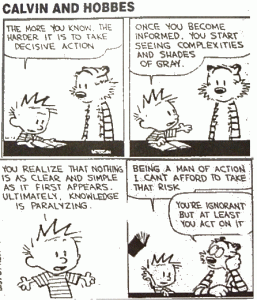
Time to bring back civics classes. Nearly a quarter of Americans don’t know when the Declaration of Independence was signed, or what country we declared independence from. From ABC’s The Note:
A Marist poll released Friday shows that only 58 percent of Americans know when the country declared independence. Nearly a fourth of respondents said they were unsure and sixteen percent said a date other than 1776, when the Declaration of Independence was signed.
Young people posted the most troubling scores with 41 percent of people ages 18 to 29 saying they were unsure when the Declaration of Independence was signed and 27 percent saying the wrong date.
One in four Americans do not even know which country the U.S. gained independence from. The correct answer, of course, is Great Britain, although 20 percent of respondents were unsure of that fact.
Again, age made a big difference. Middle-aged Americans – ages 30 to 44 – guessed the wrong country more than any other age group, or 10 percent of the time. The younger generation was less likely to be flat-out wrong, but was more likely to be unsure. About one third of Americans age 18 to 29 said they didn’t know for sure which country America won independence from.
That is so sad. I was just thinking this morning that I can remember the days when we were proud to be Americans–when it was important to know our history and be aware of our rights. What happened? That was before American culture became synonymous with corporate culture–before being greedy, selfish, and callous became the American way.
The final changeover happened under Ronald Reagan. That is when so many Americans bought into the notion that money was more important than human relationships, when “religious” people began to embrace “prosperity” rather than the old, outdated notions of “faith, hope, and charity (love).” Under Reagan, young people stopped preparing for careers in which they could help others or the society as a whole and started focusing on whatever job would bring in the most money.
Barack Obama came of age under Reagan, and as far as I can tell, although he calls himself a Democrat, the current occupant of the White House is totally sold on the Reagan philosophy. He doesn’t seem to know much about history or basic economics, even though he has degrees from two elite universities.
Not only is civics missing from high schools, but also Americans don’t get educated by the media anymore. When I was a kid, there were actually serious shows on TV that analyzed politics–not shouting, arguing shows, but real news shows. Today young people are watching TV shows like “Hoarders” and “Jersey Shore.” I’m next generation will learn to be even more greedy, selfish, and narcissistic than previous generations. I hope I’m wrong.
I know I sound like a bitter old woman–sorry about that. I grew up in the ’50s and ’60s, a time of great social change; but looking back now, it was a much simpler time. My generation has been called every insulting name in the book–selfish, narcissistic, rebellious. Tom Wolfe labeled us “the me generation” for looking within and seeking ways to become more awake and aware–for trying to understand human consciousness and for going into therapy.
Am I just doing what Tom Wolfe did–judging and misunderstanding the generations that came after mine? Please tell me I’m wrong!

 peej
peej Carissa
 bostonboomer
 dakinikat
 ecocatwoman
 mablue2
 Mama Lopez
 peggysue22
 quixote
 skydancingguestblogger
 Mona (aka Wonk the Vote)



 Sky Dancing
Recent Comments