
Friday Reads: Dismal Scientist Edition
Posted: January 18, 2013 Filed under: morning reads | Tags: Debt, deficit, economics, Economists 46 CommentsGood Morning!
I’ve got a few reads for you from economists on some of today’s economic policy questions. I always complain that we never hear from economists and always hear from politicians, journalists, and lawyers. So, here’s the take on the austerity fetish in the beltway from an economists’ perspective.
Economist Dean Baker thinks there’s a cut Social Security on the Horizon.
According to inside Washington gossip, Congress and the president are going to do exactly what voters elected them to do; they are going to cut Social Security by 3 percent. You don’t remember anyone running on that platform? Yeah, well, they probably forgot to mention it.
Of course some people may have heard Vice President Joe Biden when he told an audience in Virginia that there would be no cuts to Social Security if President Obama got reelected. Biden said: “I guarantee you, flat guarantee you, there will be no changes in Social Security. I flat guarantee you.”
But that’s the way things work in Washington. You can’t expect the politicians who run for office to share their policy agenda with voters. After all, we might not like it. That’s why they say things like they will fight for the middle class and make the rich pay their fair share. These ideas have lots of appeal among voters. Cutting Social Security doesn’t.
While the politics of cutting Social Security are bad, it also doesn’t make much sense as policy. In Washington, the gang who couldn’t see an $8 trillion housing bubble until its collapse sank the economy, has now decided that deficit reduction has to be the preeminent goal.
They don’t care that we are still down more than 9 million jobs from our growth trend; deficit reduction must take priority. These whiz kids apparently also don’t care that the cuts that have already been made are slowing growth and costing us jobs.
Meanwhile, economist Paul Krugman shows–once again–that the deficit isn’t really that big of problem and is dwindling. Oh, just a reminder, Social Security has nothing to do with the Federal Budget, debt or deficit other than than the trust fund is invested in US Treasuries.
Recently the nonpartisan Center on Budget and Policy Priorities took Congressional Budget Office projections for the next decade and updated them to take account of two major deficit-reduction actions: the spending cuts agreed to in 2011, amounting to almost $1.5 trillion over the next decade; and the roughly $600 billion in tax increases on the affluent agreed to at the beginning of this year. What the center finds is a budget outlook that, as I said, isn’t great but isn’t terrible: It projects that the ratio of debt to G.D.P., the standard measure of America’s debt position, will be only modestly higher in 2022 than it is now.
The center calls for another $1.4 trillion in deficit reduction, which would completely stabilize the debt ratio; President Obama has called for roughly the same amount. Even without such actions, however, the budget outlook for the next 10 years doesn’t look at all alarming.
Now, projections that run further into the future do suggest trouble, as an aging population and rising health care costs continue to push federal spending higher. But here’s a question you almost never see seriously addressed: Why, exactly, should we believe that it’s necessary, or even possible, to decide right now how we will eventually address the budget issues of the 2030s?
Consider, for example, the case of Social Security. There was a case for paying down debt before the baby boomers began to retire, making it easier to pay full benefits later. But George W. Bush squandered the Clinton surplus on tax cuts and wars, and that window has closed. At this point, “reform” proposals are all about things like raising the retirement age or changing the inflation adjustment, moves that would gradually reduce benefits relative to current law. What problem is this supposed to solve?
Well, it’s probable (although not certain) that, within two or three decades, the Social Security trust fund will be exhausted, leaving the system unable to pay the full benefits specified by current law. So the plan is to avoid cuts in future benefits by committing right now to … cuts in future benefits. Huh?
In today’s Wall Street Journal, Alan Blinder points out that running into the debt ceiling would provoke a severe fiscal contraction.
“At current rates of spending and taxation, federal receipts cover less than 74% of federal outlays. So if the government hits the debt ceiling at full speed, total outlays—which includes everything from Social Security benefits to soldiers’ pay to interest on the national debt—will have to be trimmed by more than 26% immediately. That amounts to more than 6% of GDP, far more than the fiscal cliff we just avoided,” Blinder writes.
The fiscal cliff, by contrast, would have erased 4.5 percent of GDP.
Any sustained captivity below the debt ceiling, in other words, means that the economy will enter a severe recession. This recession will be made far worse because the so-called automatic stabilizers that kick in when the economy slumps—think unemployment insurance—will not be able to function because of the budget constraint. So unemployment will grow while unemployment insurance contracts. This will not only pose a hardship on the people out of work, it will mean that the spending power of the American consumer will shrink rapidly.
Where the fiscal cliff might have led to a recession, this is downward spiral toward depression. The shrinking economy will shrink the government’s tax revenues. And since the budget deficit cannot increase, the spiral will go unchecked. Falling taxes will trigger falling spending. “Downward spiral” may be too mild. Economic black hole better fits the bill.
“In short, the consequences of hitting the debt ceiling are too awful to contemplate—worse even than going over the fiscal cliff. A sane Congress wouldn’t even think about it,” Blinder writes. He’s absolutely correct.
Blinder goes on to propose a plan to avoid a crises based on the assumption that Congress is sane. Let’s hope that assumption is correct.
Meanwhile, the House Republicans are discussing another short term fix to the debt ceiling.
House Republicans are discussing a short-term debt ceiling increase to buy time for broader deficit reduction negotiations with Democrats, Rep. Paul Ryan (R-Wis.) told reporters Thursday.
“We’re discussing the possible virtue of a short-term debt limit extension so that we have a better chance of getting the Senate and the White House involved in discussions in March,” Ryan told reporters gathered at the pricey Kingsmill resort in Williamsburg, where the House GOP is holding its annual retreat.
“All of those things are the kinds of things we’re discussing,” said Ryan, the party’s budget chief and 2012 vice presidential candidate.
A small hike in the $16.4 trillion debt ceiling would give the government more time to make payments on its responsibilities as lawmakers and the White House haggle over federal spending. A GOP leadership aide said there was no consensus on the size of a debt limit hike, and that it would have to be coupled with entitlement reforms or spending cuts.
Treasury Secretary Timothy Geithner has told Speaker John Boehner (R-Ohio) that the nation hit its borrowing limit at the end of 2012 and will run out of ways to avoid a first-ever default sometime between mid-February and early March. $85 billion in across-the-board 2013 cuts to defense and domestic spending are set to begin taking effect in March, and the government will run out of funding a month later.
Formulating a good metaphor for Obama’s second term is itself a task for intuitive creative thought that entails rethinking what he will propose in his second term. A good metaphor might embody the idea of an “inclusive economy.” The word “inclusive” resonates strongly: Americans do not want more government per se; rather, they want the government to get more people involved in the market economy. Opinion polls show that, above all, what Americans want are jobs – the beginning of inclusion.
The parallel to Chase’s book today is the 2012 bestseller Why Nations Fail by the economist Daron Acemoglu and the political scientist James Robinson. Acemoglu and Robinson argue that in the broad sweep of history, political orders that include everyone in the economic process are more likely to succeed in the long term.
The time seems ripe for that idea, and it fits with the triumph of inclusiveness symbolized by Obama himself. But another step in metaphor-building is needed to encapsulate the idea of economic inclusion.
The biggest successes of Obama’s first term concerned economic inclusion. The Affordable Care Act (“Obamacare”) is providing more people with access to health care – and bringing more people to privately-issued insurance – than ever before in the United States. The Dodd-Frank financial reforms created the Consumer Financial Protection Bureau, so that privately issued financial products would serve the public better, and created incentives for derivatives to be traded on public markets. And he signed the JOBS Act, proposed by his Republican opponents, which aims to create crowdfunding Web sites that allow small investors to participate in start-up ventures.
We have not reached the pinnacle of economic inclusion. There are hundreds of other possibilities, including improved investor education and financial advice, more flexible mortgages, better kinds of securitization, more insurance for a broader array of life’s risks, and better management of career risks. Much more progress toward comprehensive public futures and derivatives markets would help, as would policies to encourage the emerging world to participate more in the US economy. (Indeed, the inclusion metaphor is essentially global in spirit; had Obama used it in the past, his economic policies might have been less protectionist.)
The right metaphor would spin some of these ideas, or others like them, into a vision for America’s future that, like the New Deal, would gain coherence as it is transformed into reality. On January 29, Obama will give the first State of the Union address of his new term. He should be thinking about how to express – vividly and compellingly – the principles that have guided his choices so far, and that set a path for America’s future.
Open Thread: Mitt Romney, Busybody
Posted: May 15, 2012 Filed under: 2012 presidential campaign, 2012 primaries, U.S. Economy, U.S. Politics | Tags: Hillary Clinton, Bill Clinton, Debt, Federal Deficit, Barack Obama, Mitt Romney, gossip, busybody 20 Comments
In a speech in Des Moines, Iowa today, Mitt Romney sounded like a fussy old gossip, claiming that President Obama probably has a “beef” with Bill and Hillary Clinton.
Almost a generation ago, Bill Clinton announced that the Era of Big Government was over.
Even a former McGovern campaign worker like President Clinton was signaling to his own Party that Democrats should no longer try to govern by proposing a new program for every problem.
President Obama tucked away the Clinton doctrine in his large drawer of discarded ideas, along with transparency and bipartisanship. It’s enough to make you wonder if maybe it was a personal beef with the Clintons….but really it runs much deeper.
President Obama is an old school liberal whose first instinct is to see free enterprise as the villain and government as the hero. America counted on President Obama to rescue the economy, tame the deficit and help create jobs. Instead, he bailed out the public-sector, gave billions of dollars to the companies of his friends, and added almost as much debt as all the prior presidents combined.
ROFLMAO!! Obama, “an old school liberal?” This guy is a laff riot!
At the Washington Post, Nia-Malika Henderson interpreted Romney’s odd invoking of the good old days of the Clinton administration as another effort to link Obama with Jimmy Carter. Henderson writes:
The strategy, of course, is obvious, if a little heavy handed—paint Obama as more like Jimmy Carter, rather than as a New Democrat in the mold of Clinton.
Clinton has already emerged as one of Obama’s most visible surrogates, appearing in a video marking the death of Osama bin Laden, and will likely be used to gin up support among so-called Reagan Democrats—white, blue collar workers, particularly—and Romney can perhaps mute some of Clinton’s power by suggesting that Clinton isn’t all in with Obama. (It’s a beef, not a bromance, Romney suggests.)
But by invoking Clinton, Romney risks poking the bear in some ways, and perhaps even casting himself as a version of Clinton. Praising Clinton, even in a backhanded way, isn’t exactly a way to solidify support among the religious right.
I don’t know about the reaction from the religious right, but Bill Clinton worked a few digs about Romney into his speech today at the Pete Peterson conference (why Clinton shows up for these things, I’ll never understand, but that’s for another post). According to the National Journal, Clinton said that Romney
shot himself in the foot with the broad tax-cutting budget he suggested during the primary. He said Romney should accept projections that his plan for deep tax cuts would add billions to the deficit while requiring huge cuts to Medicare, Medicaid and non-defense spending.
“If I were in his position I would, I think, use the Congressional Budget Office numbers saying my plan increased the debt and say that no responsible president can pretend an independent analysis of his numbers don’t matter,” Clinton said. “That’s, I think, his his best avenue back to the real world.”
Clinton also offered a few verbal pats on the head to Romney.
“I feel a lot of sympathy for him,” he said. “The whole primary was about finding somebody who was true conservative, but they’re going to vote for him anyway.”
Good one, Bill!
Balanced Budget Amendments are Bad Policy
Posted: August 3, 2011 Filed under: U.S. Economy, U.S. Politics, voodoo economics | Tags: balanced budget amendments, business cycles, Debt, deficits, Federal Deficit, fiscal rules, GDP, John Maynard Keynes, macroeconomics, Michele Bachmann, recessions, social services, taxes, US Congress 9 Comments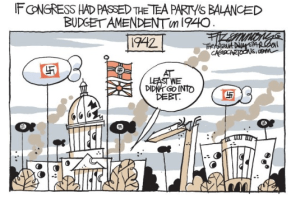 I always have to cover this topic in any introductory macroeconomics class I teach because usually one nutjob or another running for office always brings this up and people fall for it. The arguments are usually based on complete fallacies and misunderstanding of the math of economics, but hey, for some reason balanced budgets sound ‘reasonable’ when they are anything but.
I used to talk theoretically about how balanced budget amendments will kill state economies when the next real recession hits. Well, it hit a few years ago and we’re there. States continue to make their own economies worse day in and day out but there’s still those people that insist that if a family has to balance its budget, then so should the country. That’s even stupid considering most families have mortgages and car payments and probably student loans. Take Michele Bachmann as an example. She’s got all of the above plus farm subsidies and government grants. Even the President is guilty of that false equivalency. No person or family exists in perpetuity. No person or family can print money. No person or family has the power of taxation. Because of these three things, you cannot compare government to a family. Nor can you compare government to a business. Businesses exist to make a profit. Government exists to provide services and goods that the private sector will not provide or provides at an outrageous cost. It exists to administer justice and ensure level playing fields and fair play exists. Everything about a government is unique and is no way comparable to either businesses or households.
Macroeconomists know from years of study that the federal government can influence the economy at large. It does so through its spending and taxing priorities and policies. This is called fiscal policy. We have found several economic laws that guide the relationship between taxes and government spending and the behavior of Gross Domestic Product (GDP) which roughly measures all the legal and reported spending by households, governments, foreigners, and businesses. In our economy, household spending comprises about 68% of all GDP.
Investment or purchases by businesses is the smallest and most erratic component of GDP. Keynes said that it is easily spooked and subject to animistic spirits. Because it’s an unreliable source of growth, Keynes argued that in down turns, government should use its power to spend. Business investment usually only does fine in good economies. Please note, Keynes said deficit spend in recessions. Keynes’ prescription also said that Federal governments should run balanced budgets during times when the economy is fully employed and surpluses during bubble or boom times to relieve inflationary pressure. As usual, conservative politicians completely lie about the nature of Keynes and his highly proven and credible theories on fiscal policy. A lot of what we know about Monetary Policy comes from Milton Friedman, however, that is not the subject today. What I want to emphasize is that both men spent a lot of time analyzing panics and the Great Depression and are very much at the heart of accepted theory. We are seeing a classical lack of aggregate demand today. It is what’s driving the budget deficit. It is what’s driving the joblessness. It is what’s driving the slow recovery. Government must and will by automatic stabilizers be in a deficit position during downturns. It is simple math. More revenues come in during good times than bad. More safety net spending increases during bad times than good. We naturally run towards deficit in bad economies and towards surplus in good.
However, show me an economy that’s booming with high revenues and lower safety net spending and I will show you a group of politicians spending wildly. This tends to create inflation and can lead to bubbles. However, you never hear them complain at that point in time. That’s because it should be relatively easy to balance a budget then, but they do not do so or if they do its by expanding programs that cannot be sustained without borrowing during bad economies.
With that short explanation, let me cite you some folks that tell you why balanced budget amendments are bad policy. This first quote is from Simon Johnson who is the former chief economist for the IMF. He asks us to keep in mind that GDP is a measurement that is fraught with problems. He also mentions the fact that a balanced budget amendment makes the government make recessions worse.
Second and more seriously, imagine that this constitutional amendment were in place and that federal spending were roughly at its limit relative to the size of the economy. Then, what happens should the financial sector blow up again — either through no fault of its own (which, believe it or not, is the current prevailing myth on Wall Street about 2007-9) or because of some toxic combination of malfeasance and malpractice (the current predominant view of 2007-9 among many other people)?
The blame game is irrelevant when G.D.P. drops 10 percent; the issue is how to prevent a Great Depression. But note that with such a decline in G.D.P., a level of nominal spending that was 18 percent of G.D.P. is suddenly 20 percent, and now a constitutional crisis awaits – even before we get to the question of whether tax cuts or other forms of stimulus might be appropriate.
It makes no sense to take aim, as a matter of constitutional process, at two numbers that are both outcomes of deeper economic processes.
And to be frank, sometimes it makes a great deal of sense to apply an economic stimulus to an economy in free fall. One such moment was 1930 (and 1931 and 1932), when no stimulus was applied. Other moments were 2008 and 2009; both President Bush and President Obama initiated stimulus packages. When credit for and confidence in the private sector evaporates, do you really want the government sector to be forced to make quick cuts — or to raise taxes?
James Ledbetter at Reuters argues that even conservatives should oppose a balanced budget amendment (BBA). His reasons are more pragmatic. He argues that it won’t work.
Historically, conservatives have opposed extending government authority in places where it is not effective. You can find all the evidence you need to conclude that balanced budget requirements are useless by simply investigating the oft-repeated claim that 49 states have laws requiring a balanced budget. Leave aside the falsity of the claim and just consider the logic: if so many states are required to balance their budgets, why are so many states in the red?
The answer is that requiring state governments to annually balance their books simply encourages them to find clever ways to disguise debt and deficits. For example: California has both a Constitutional and a statutory requirement that its budgets be balanced. Would any sane person maintain that the state’s books have been anything resembling healthy for at least a decade? This year, after some brutal spending cuts, the governor’s office found that the state still had a short-term deficit of more than $9 billion and $35 billion in long-term debt. The governor’s budget report noted that California’s “massive budget deficits for most of the past decade…have been largely the result of a reliance on one-time solutions, borrowing, accounting maneuvers, and cuts or revenues that were illusory and therefore did not materialize.”
If that sounds familiar, it may be because, as Richard Quest pointed out on CNN Sunday evening, we’ve witnessed numerous Congressional attempts in recent decades to rein in federal deficits—including Gramm-Rudman in 1985 and the Budget Enforcement Act of 1990—all of which fell victim to legislative legerdemain. Why would a federal balanced budget amendment be any different?
Here’s something from The Economist on “Fiscal Rules”. Some fiscal rule–rather than a balanced budget amendment–would better stop congress from spending during booms and full employment cycles rather than balancing its budget via a BBA. This would be a rule that attaches the spending mandates to what’s going on in the economy. But again, I doubt they’d follow it since they’ve ignored a good portion of the Keynesian prescription for years any way.
It is difficult for Congress to tie its own hands. Any law that can pass Congress can later be undone or changed. In the rare cases that Congress puts together a near-perfect piece of legislation, that’s a bad thing. In the vastly more common occurrence that Congress passes highly imperfect legislation in need of significant future tweaks, that’s a very good thing. Support for an amendment to the constitution is a spectacular vote of confidence in the ability of a legislature to design near-perfect legislation, because the only thing rarer than an amendment to the constitution is a subsequent amendment undoing or clarifying a previous amendment.
I see the argument for a well-designed, over-the-business-cycle balanced-budget amendment. But the idea of enshrining this Congress’ pathologies into the constitution is terrifying. Let’s see Congress design some quality fiscal rules using the normal legislative process first, and then we can talk about adding those to the constitution.
Bruce Bartlett has some excellent analysis up for the current go round of balanced budget amendments. Mark Thoma explains how a BBA is a very bad idea. His analysis includes looking at the destabilizing effects that states’ BBAs have had on their economies. There’s a nifty graph that I did not include here if you’d like to go view it.
I’ve argued on many occasions that one of the big lessons we need to learn from this recession is that state-level balanced budget requirements are highly destabilizing. When a recession hits, spending goes up for social services and taxes fall as income, sales, property values, and other sources of revenue for state and local governments decline.
The result is a big hole in state and local government budgets, and that forces either increases in taxes or cuts in spending both of which make things even worse. And though some state and local governments were an exception to this, far and away the choice is to cut spending. We can see this in the state and local government employment statistics:
That’s not what we want to have happening when we are trying to recover from a recession. It would be much better if states had rainy day funds to rely upon, and if the rainy day funds fall short, the federal government could backfill the budget holes to prevent the destabilizing downsizing.
So have we learned the lesson? Nope, at least not if you are a Republican. They’d like to impose the same destabilizing rules on the federal government:
You really would have to search high and low for an economist that actually supports a BBA. The more conservative ones go for the fiscal rule that attaches spending to business cycles but even they believe that it would be unenforceable and easy to avoid. Can you imagine some District Judge trying to look over a complex macroeconomic model and figure out if the government forecast was correct or not?
A group of leading economists, including five Nobel Laureates in economics, today publicly released a letter to President Obama and Congress opposing a constitutional balanced budget amendment. The letter outlines the reasons why writing a balanced budget requirement into the Constitution would be “very unsound policy” that would adversely affect the economy. Adding arbitrary caps on federal expenditures would make the balanced budget amendment even more problematic, the letter says. The Economic Policy Institute and the Center on Budget and Policy Priorities organized the letter.
“A balanced budget amendment would mandate perverse actions in the face of recessions,” the letter notes. By requiring large budget cuts when the economy is weakest, the amendment “would aggravate recessions.”
The signatories of the letter are Nobel Laureates Kenneth Arrow, Peter Diamond, Eric Maskin, Charles Schultze, William Sharpe and Robert Solow; Alan Blinder, former Vice Chair of the Federal Reserve System’s Board of Governors and former member of the Council of Economic Advisors; and Laura Tyson, former Chair of the Council of Economic Advisors and former Director of the National Economic Council.
I’ll let former Reagan economist Bruce Bartlett have the last word here. He looks at the recent debate in Congress on the BBA.
Next week, House Republicans plan to debate a balanced budget amendment to the Constitution. Although polls show overwhelming public support, it is doubtful that many Americans realize that the measure to be debated is not, in fact, a workable blueprint to enforce a balanced budget. In fact, it’s just more political theater designed to delight the Tea Party.
We really need improved economic literacy in this country. I genuinely can’t get over what some of the morons in congress can get away with saying. Economists call them on it but it appears no one every listens.
Friday Reads
Posted: July 8, 2011 Filed under: abortion rights, black women's reproductive health, Catfood Commission, Democratic Politics, Economy, Federal Budget and Budget deficit, fetus fetishists, fundamentalist Christians, John Birch Society in Charge, morning reads, religious extremists, Reproductive Health, Reproductive Rights, Republican presidential politics, right wing hate grouups, U.S. Economy, We are so F'd | Tags: Christianist extremists, Debt, Debt Ceiling, deficit, planned parenthood of North Carolina, Rick Perry, warren buffett 51 Comments Good Morning!!
It’s hard not to be be completely discouraged these days. Our Washington deal-makers are permanently stuck in opposites day. No amount of reality is going to bring the lot of them out of whatever place they strategically reside. This Reuters piece stands as a hallmark to the current lunacy. We shouldn’t have any financial problems. Social Security is solvent and it’s not part of the federal budget are deficit problem. Why am I reading this then?
If Treasury were to decide to delay some payments, one option could be to postpone a disbursement of more than $49 billion to Social Security recipients that is due on August 3.
It would be a politically explosive step but one that could allow the government to temporarily pay bondholders to try to avoid foreign investors dumping U.S. Treasuries and the dollar.
The administration has warned that any missed payments, including those to retirees, veterans and contractors, would be default by another name, and the Treasury team still has concerns that any contingency plan would prove unworkable.
Steve McMillin, a former deputy director of the White House Office of Management and Budget under Bush, said Treasury has options but most of them are “pretty ugly.”
If Treasury were to decide to delay payments, it would need to re-program government computers that generate automatic payments as they fall due — a massive and difficult undertaking. Treasury makes about 3 million payments each day.
Do they figure that seniors aren’t going to riot in the streets effectively like that episode de of South Park called Grey Dawn? I can pretty well imagine that they won’t stop payments to their corporate bosses. After all, that option would soothe the bond vigilantes.
Here’s the issues under study now according to that same Reuter’s article.
– Whether the administration can delay payments to try to manage cash flows after August 2
– If the U.S. Constitution allows President Barack Obama to ignore Congress and the government to continue to issue debt
– Whether a 1985 finding by a government watchdog gives the government legal authority to prioritize payments.
The Treasury team has also spoken to the Federal Reserve about how the central bank — specifically the New York Federal Reserve Bank — would operate as Treasury’s broker in the markets if a deal to raise the United States’ $14.3 trillion borrowing cap is not reached on time.
I’m teaching an MBA Corporate Finance seminar this summer. Every single asset pricing model that prices securities, bonds, loans,options or whatever basically uses the US treasury bond as the risk-free asset. I feel like I have to asterisk everything I’m teaching right now which is basically the same thing that was taught to me back in the 1980s. It’s like these folks are purposefully trying to tank the financial markets and bring on another crisis. If they manage to raise the debt ceiling, then it appears likely to be done by ‘austerity’ measure like $4 trillion dollars in cuts. Start your backyard gardens now. The next depression is bound to be a big one. I have just have no idea why they’re trying to blow up our economy. It’s just frigging unbelievable. Of course, Orrin Hatch wants us all to suffer more, because after all, people that aren’t filthy rich are obviously defective in gawd’s eyes.
So, tell me, who is the real practicioner of voodoo economics?
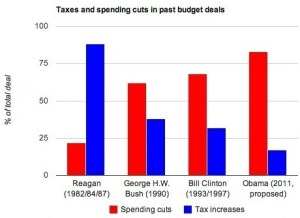
So, here’s a nifty graph on the left from Ezra Klein showing the mix of spending cuts vs. tax increases the last few times we’ve had these debt and deficit discussions. Looks like the real practitioner of voodoo economics wasn’t Ronald Reagan but is Barrack Obama. Just more of the alternate reality forced on us by media and politicians that make up news, history, and economic theory.
As you can see on the graph, in each case, taxes were at least a third of the total, and in Reagan’s case, his massive tax cuts were followed by deficit-reduction deals that actually relied on tax increases. Today, tea party conservatives would be begging Sen. Jim DeMint to primary the Gipper.
Bush also included taxes in his deal, and Clinton relied heavily on taxes in his first deficit-reduction bill, which passed without Republican votes. In 1997, when he was working with Republicans, he actually cut taxes slightly while passing spending cuts. But of course the economy was in much better shape then, and Clinton had already increased revenues substantially.
The one-third rule doesn’t break down until you get to the deal Obama reportedly offered Republicans in the first round of debt-ceiling talks: $2 trillion in spending cuts for $400 billion in taxes, or an 83:17 split. And that, if anything, understates how good of a deal Republicans are getting. Tax revenues and rates are much, much lower than they were under Reagan, Bush or Clinton. And next year, Obama is pledging to extend most of the Bush tax cuts, which amounts to a $3 trillion-plus tax cut against current law.
Meanwhile, the polls–like this one from Pew Research–show that people overwhelmingly want to maintain social security, medicaid and medicare and would support tax increases to do so. So much for government of, for, and by the people.
As policymakers at the state and national level struggle with rising entitlement costs, overwhelming numbers of Americans agree that, over the years, Social Security, Medicare and Medicaid have been good for the country.
But these cherished programs receive negative marks for current performance, and their finances are widely viewed as troubled. Reflecting these concerns, most Americans say all three programs either need to be completely rebuilt or undergo major changes. However, smaller majorities express this view than did so five years ago.
The public’s desire for fundamental change does not mean it supports reductions in the benefits provided by Social Security, Medicare or Medicaid. Relatively few are willing to see benefit cuts as part of the solution, regardless of whether the problem being addressed is the federal budget deficit, state budget shortfalls or the financial viability of the entitlement programs.
Jim DeMint is one of the people that should be the first in line to be charged with treason and gross stupidity. Where was Senator DeMint when all the votes were taken to spend all this money to start out with? Plus, all those irresponsible revenue cuts back in the early 2000s when we basically had a balanced budget? He was a congressman from 1999-2005 so certainly he must’ve tried to stop Dubya Bush from all that spending!
Sen. Jim DeMint (R-S.C.) said Wednesday night that Republicans should maintain their hardline position in the debt-ceiling debate even if it results in “serious disruptions” to the economy.
“What I’m advocating here is, let’s use this as a point of leverage, give the president an increase, but don’t come away without real cuts from real caps and spending, and without a balanced budget,” DeMint said on FOX Business Network.
“We’re at the point where there would have to be some, you know, some serious disruptions in order not to raise [the debt ceiling],” he said. “I’m willing to do that.”
The president pushed the economy into “crisis” mode, according to DeMint. He said the president has been “burning time” with the deficit negotiations led by Vice President Biden, when the looming debt ceiling and budget deficit could have been addressed last year.
DeMint, well-known for speaking out in favor of limited government and balancing the budget, told host Andrew Napolitano that if Republicans and Democrats couldn’t vote in “something permanent” that would limit government spending, “we’re going to continue to spend [until] the total country collapses.”
Warren Buffet says the GOP is Threatening To ‘Blow Your Brains Out’ Over Debt Ceiling
Republicans are playing a dangerous game by refusing to raise the debt ceiling, according to Berkshire Hathaway CEO Warren Buffett.
“We raised the debt ceiling seven times during the Bush Administration,” Buffett told CNBC on Thursday. Now, the Republican-controlled Congress is “trying to use the incentive now that we’re going to blow your brains out, America, in terms of your debt worthiness over time.”
If Congress fails to raise the borrowing limit of the federal government by August 2, the date when the U.S. will reach the limit of its borrowing abilities, it will likely begin defaulting on its loans.
Buffett, who according to the Washington Post has helped raise money for Democratic candidates like Hilary Clinton in the past, has been highly critical of the actions of the Republican-controlled Congress. In May, Buffett stated at a Berkshire Hathaway shareholder’s meeting that if the Congress failed to raise the debt ceiling, it would constitute “the most asinine act” in the nation’s history, reports Reuters.
Other political news is equally disheartening. Most of the governments in the states are as crazy–if not crazier–than the US Congress. Planned Parenthood in North Carolina is suing the state over budget cuts designed to cut access to much used and cost saving preventive health care.
One of North Carolina’s two Planned Parenthood affiliates filed a federal lawsuit Thursday to invalidate part of the new state budget that cuts it off from federal or state funds for family planning.
The budget, written by Republicans in control of the General Assembly for the first time in more than a century, states that Planned Parenthood and its affiliates are forbidden from receiving any contracts or grants from the state health agency. The lawsuit filed in Greensboro’s federal court by Planned Parenthood of Central North Carolina contends the group is being punished for its abortion-rights advocacy, saying that violates its free-speech protections.
The organization is barred by law from using public money to perform abortions and uses the government contracts to provide family planning or teen pregnancy prevention services, yet is being singled out because Planned Parenthood supports abortion rights, the lawsuit said. Efforts to cut off funds to Planned Parenthood affiliates in North Carolina are similar to those in Kansas and Indiana, which were also met with federal lawsuits, the group’s attorneys said.
“Their sole purpose is to single out, vilify, and punish Planned Parenthood as a particularly visible provider and advocate — even though, ironically, the eliminated funds have nothing to do with abortion, but will only deprive low-income people of desperately needed health services and teen pregnancy prevention programs,” the lawsuit said.
Planned Parenthood of Central North Carolina received $287,000 in federal, state and matching local funds in the year that ended last week for teen pregnancy prevention and family planning programs that provided contraceptives to poor women, according to the state Department of Health and Human Services. The non-profit operates from locations in Chapel Hill, Durham, and Fayetteville.
Some of the most extremist pastors are signing on to Texas Governor Rick Perry’s Pray-a polooza. Talk about a hater-thon. Remember, Perry is supposed to be the ‘electable’ Republican.
And we already knew Perry didn’t care much about including, or even not offending, non-Christians: his personal letter announcing the event calls on the entire nation to pray to Jesus Christ. But the news, reported by Right Wing Watch, that a radical pastor named C. Peter Wagner has signed on as an official endorser of The Response deserves more attention.
The Colorado-based Wagner, who is featured on the website of The Response, is the head of Global Harvest Ministries.
His brand of evangelicalism, known as the New Apostolic Reformation, is characterized by extreme hostility to other religions. In this passage from his book “Hard-Core Idolatry: Facing the Facts,” Wagner praises the burning of Catholic saints, copies of the Book of Mormon, voodoo dolls, and other “idols”
Yup, welcome to the new surreality. All we need is Rod Serling introducing the morning reads today and I’d say that would be about right.
What’s on your reading and blogging list today?
Somethings You Can’t Make Up
Posted: May 15, 2009 Filed under: Human Rights, president teleprompter jesus, Team Obama, U.S. Economy, Voter Ignorance | Tags: Debt, Military Tribunals, Public Health, Single Payer Health Insurance. 5 CommentsGiven the choice between posting my final grades and my morning coffee or perusing some of the latest presidential antics and my morning coffee, I chose the latter. The latest front pager at the Confluence, Steven Mather started a great conversation on Obots and willful blindness. Since I was following a tweetathon last night between Glenn Greenwald and Jack Tapper on the latest about face, it seems appropriate to start there. This just comes under the heading of reality taking on dimensions of science fiction.
Every one is trying to figure out how Military Tribunals under Bush will be different the Military Tribunals continued by Obama. Given I’ve been following the financial bailouts under Bush and the virtual continuation of the same policy under Obama, I’m thinking the progressive blogosphere should be blowing a few gaskets now. After all, they were just told to lay off the torture photos and any hope of prosecution of what can only be labeled the Cheney Torture Policy. What we appear to have is straight forward continuation of nearly all the major Bush policies with major re-framing. It’s not going to be the old Nixon War on Drugs, it’s going to be the Obama “complete public-health model for dealing with addiction”. Somebody seems to think just morphing the lexicon makes it seem less Republican. Some one needs to tell Axelrod it’s the policies, not the labels.
So Greenwald is calling it Obama’s kinder, gentler military commissions .
It now appears definitive that the Obama administration will attempt to preserve a “modified” version of George Bush’s military commissions, rather than try suspected terrorists in our long-standing civilian court system or a court-martial proceeding under the Uniform Code of Military Justice. Obama officials have been dispatched to insist to journalists (anonymously, of course) that Obama’s embrace of “new and improved” military commissions is neither inconsistent with the criticisms that were voiced about Bush’s military commission system nor with Obama’s prior statements on this issue. It is plainly not the case that these “modifications” address the core criticisms directed to what Bush did, nor is it the case that Obama’s campaign position on this issue can be reconciled with what he is now doing. Just read the facts below and decide for yourself if that is even a plausible claim.
Oh, do go read the facts listed in the article. Don’t forget those koolaide goggles, because willful blindness is about the only way you’re going to see much difference.
 Meanwhile over on Bloomberg, I read up on the latest Obama-would-rather-not-be-held hostage- by-the-oval-office town hall meeting where Obama Says U.S. Long-Term Debt Load ‘Unsustainable’. I have to join Seth and Amy in a “Oh, really?” moment here. I think you all will remember the graph on the left from earlier pieces that I’ve done on the Obama stimulus package and budget. Let’s just use the Bloomberg piece as a refresher.
President Barack Obama, calling current deficit spending “unsustainable,” warned of skyrocketing interest rates for consumers if the U.S. continues to finance government by borrowing from other countries.
“We can’t keep on just borrowing from China,” Obama said at a town-hall meeting in Rio Rancho, New Mexico, outside Albuquerque. “We have to pay interest on that debt, and that means we are mortgaging our children’s future with more and more debt.”
Holders of U.S. debt will eventually “get tired” of buying it, causing interest rates on everything from auto loans to home mortgages to increase, Obama said. “It will have a dampening effect on our economy.”
Earlier this week, the Obama administration revised its own budget estimates and raised the projected deficit for this year to a record $1.84 trillion, up 5 percent from the February estimate. The revision for the 2010 fiscal year estimated the deficit at $1.26 trillion, up 7.4 percent from the February figure. The White House Office of Management and Budget also projected next year’s budget will end up at $3.59 trillion, compared with the $3.55 trillion it estimated previously.
Two weeks ago, the president proposed $17 billion in budget cuts, with plans to eliminate or reduce 121 federal programs. Republicans ridiculed the amount, saying that it represented one-half of 1 percent of the entire budget. They noted that Obama is seeking an $81 billion increase in other spending.
Meanwhile, we’ve seen protests erupt as the Senate started discussing health care reform while leaving single payer solutions off-the-table. No single payer is another Obama missive and another Republican-like policy. On May 5th, those most radical of all elements in this country, doctors and nurses, staged a protest at a senate hearing insisting single payer should be on the table.
I still can’t believe the Republicans are calling Obama a socialist. The only thing we’ve socialized so far are those incredible losses coming out of the finance sector. Everything else is Republican-lite.
All I gotta say is ya got played folks! Maddoff is a small fry scammer by comparison.
Please Digg!!! and Share!!!


 peej
peej Carissa
 bostonboomer
 dakinikat
 ecocatwoman
 mablue2
 Mama Lopez
 peggysue22
 quixote
 skydancingguestblogger
 Mona (aka Wonk the Vote)



 Sky Dancing
Recent Comments