
Monday Reads
Posted: March 5, 2012 Filed under: morning reads | Tags: "grand bargain", conservatives, education, expensive US medical care, flush rush, liberals, role in democracy, Santorum hates universities, universities 41 Comments Good Morning!
Seven advertisers have now dropped Limbaugh’s show after intense pressure. ProFlowers became the latest to remove its sponsorship saying that his comments about Sandra Fluke “went beyond political discourse to a personal attack and do not reflect our values as a company.”
Condemnation has come from a variety of sources outside Republican elected leaders. Yesterday, George Will said that Republicans were afraid of him even though they thought he was a “buffoon”.
ABC’s George Will said yesterday on “This Week” that GOP leaders have steered clear of harshly denouncing Limbaugh’s comments because “Republican leaders are afraid of Rush Limbaugh.”
“[House Speaker John] Boehner comes out and says Rush’s language was inappropriate. Using the salad fork for your entrée, that’s inappropriate. Not this stuff,” Will said. “And it was depressing because what it indicates is that the Republican leaders are afraid of Rush Limbaugh. They want to bomb Iran, but they’re afraid of Rush Limbaugh.”
ABC News political analyst Matthew Dowd said the Republicans’ apprehension to say anything negative about the conservative big hitter is based on the “myth” that Limbaugh influences a large number of Republican voters.
“I think the problem is the Republican leaders, Mitt Romney and the other candidates, don’t have the courage to say what they say in quiet, which, they think Rush Limbaugh is a buffoon,” Dowd said. ”They think he is like a clown coming out of a small car at a circus. It’s great he is entertaining and all that. But nobody takes him seriously.”
I was speaking to BB yesterday about how my experience within higher ed was very unlike Rick Santorum’s accusations that universities are turning students against religion and/or conservative thought. I have had a large number of extremely conservative colleagues and professors in my time. So, I was pleased when my anecdotal evidence was backed up by some numbers. Neil Gross wrote in yesterday’s NYT that “College doesn’t make you liberal”.
But contrary to conservative rhetoric, studies show that going to college does not make students substantially more liberal. The political scientist Mack Mariani and the higher education researcher Gordon Hewitt analyzed changes in student political attitudes between their freshman and senior years at 38 colleges and universities from 1999 to 2003. They found that on average, students shifted somewhat to the left — but that these changes were in line with shifts experienced by most Americans between the ages of 18 and 24 during the same period of time. In addition, they found that students were no more likely to move left at schools with more liberal faculties.
Similarly, the political scientists M. Kent Jennings and Laura Stoker analyzed data from a survey that tracked the political attitudes of about 1,000 high school students through their college years and into middle age. Their research found that the tendency of college graduates to be more liberal reflects to a large extent the fact that more liberal students are more likely to go to college in the first place.
Studies also show that attending college does not make you less religious. The sociologists Jeremy Uecker, Mark Regnerus and Margaret Vaaler examined data from the National Longitudinal Study of Adolescent Health and found that Americans who pursued bachelor’s degrees were more likely to retain their faith than those who did not, perhaps because life at the bottom of the socioeconomic ladder can be rough in ways that chip away at religious belief and participation. They report that students “who did not attend college and two-year college students are much more likely — 61 and 54 percent more, respectively — than four-year college students to relinquish their religious affiliations.”
Right wing populists frequently attack educational institutions and intellectuals. There’s an interesting piece at Alternet that addresses this phenomenon. Basically, democracy relies on an informed citizenry and that is the enemy of demagogues and the plutocrats they serve.
Right-wing fundamentalists such as Republican presidential candidate Rick Santorum hate public schools, which he suggests are government schools wedded to doing the work of Satan, dressed up in the garb of the Enlightenment. Santorum, true to his love affair with the very secular ideology of privatization, prefers home schooling, which is code for people taking responsibility for whatever social issues or problems they may face, whether it be finding the best education for their children or securing decent health care.
Actually, Santorum and many of his allies dislike any public institution that enables people to think critically and act with a degree of responsibility toward the public. This is one reason why they hate any notion of public education, which harbors the promise, if not the threat, of actually educating students to be thoughtful, self-reflective and capable of questioning so-called common sense and holding power accountable. Of course, some progressives see this as simply another example of how the right wing of the Republican Party seems to think that being stupid is in. But there is more going on here than the issue of whether right-wing fundamentalists are intellectually and politically challenged. What makes critical education, especially, so dangerous to radical Christian evangelicals, neoconservatives and right-wing nationalists in the United States today is that, central to its very definition, is the task of educating students to become critical agents who can actively question and negotiate the relationships between individual troubles and public issues. In other words, students who can lead rather than follow, embrace reasoned arguments over opinions and reject common sense as the engine of truth.
The Hill reports that a number of lawmakers from both sides of the aisle are working on a “grand bargain” including cuts to entitlements.
A small, bipartisan group of lawmakers in both the House and Senate are secretly drafting deficit grand bargain legislation that cuts entitlements and raises new revenue.
Sources said that the task of actually writing the bills is well underway, but core participants in the regular meetings do not yet know when the bills can be unveiled.
The core House group of roughly 10 negotiators is derived from a larger Gang of 100 lawmakers led by Reps. Mike Simpson (R-Idaho) and Health Shuler (D-N.C.), who urged the debt supercommittee to strike a grand bargain last year.
That larger group includes GOP centrists like Rep. Steve LaTourette (R-Ohio), who has said Republicans should abandon their no-new-tax-revenue pledge, as well as Tea Party-backed members like Rep. Cynthia Lummis (R-Wyo.).
The key test in the coming months will be to see whether the core group can get buy-in from many of the 100 members who vaguely support “going big” on the deficit once real cuts and tax increases are identified.
The talks are so sensitive that some members involved do not yet want to be identified.
Shuler, who is retiring this year, is keen to establish a legacy as a deficit cutter before leaving Congress and he is involved in the drafting effort.
Ezra Klein has some analysis up on how medical procedures in the US are so much more expensive than any place else in the developed world. It’s called “Why an MRI costs $1,080 in America and $280 in France”.
As it’s difficult to get good data on prices, that paper blamed prices largely by eliminating the other possible culprits. They authors considered, for instance, the idea that Americans were simply using more health-care services, but on close inspection, found that Americans don’t see the doctor more often or stay longer in the hospital than residents of other countries. Quite the opposite, actually. We spend less time in the hospital than Germans and see the doctor less often than the Canadians.
“The United States spends more on health care than any of the other OECD countries spend, without providing more services than the other countries do,” they concluded. “This suggests that the difference in spending is mostly attributable to higher prices of goods and services.”
On Friday, the International Federation of Health Plans — a global insurance trade association that includes more than 100 insurers in 25 countries — released more direct evidence. It surveyed its members on the prices paid for 23 medical services and products in different countries, asking after everything from a routine doctor’s visit to a dose of Lipitor to coronary bypass surgery. And in 22 of 23 cases, Americans are paying higher prices than residents of other developed countries. Usually, we’re paying quite a bit more. The exception is cataract surgery, which appears to be costlier in Switzerland, though cheaper everywhere else.
Prices don’t explain all of the difference between America and other countries. But they do explain a big chunk of it. The question, of course, is why Americans pay such high prices — and why we haven’t done anything about it.
So, that’s a few stories to get things started this morning! What’s on your reading and blogging list today?
Battle to Save Corporal Punishment In New Orleans Catholic School
Posted: June 1, 2011 Filed under: children, Civil Rights, physical abuse, Surreality, U.S. Politics | Tags: Archbishop Gregory Aymond, authoritarianism, conservatives, Monica Applewhite, New Orleans, paddling, red states, Republicans, St. Augustine High School 22 Comments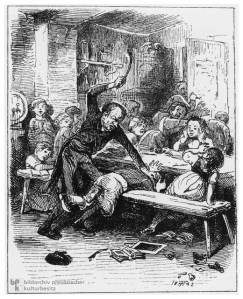
Do you get the feeling the bad old days are coming back? U.S. economy has returned us to 1930s-style levels of unemployment, evil Republicans like Paul Ryan and Mitch McConnell are trying to recreate the poverty of those years by removing the social safety net, and Republicans are working as hard as they can to make sure women have no control over their bodies or their lives.
Now we have students of a Catholic school in New Orleans and their parents demanding Archbishop Gregory Aymond reverse his decision to end corporal punishment, and school alumni aresuing the educational consultant who recommended the policy change!
Can this really be the 21st Century?
From yesterday’s New Orleans Times-Picayune:
The controversy over corporal punishment at St. Augustine High School resurfaced Tuesday when several alumni sued a consultant [read the suit here (pdf)] who advised Archbishop Gregory Aymond that St. Augustine students had been injured by paddling.
The claim isn’t true, the alumni said.
For months Aymond, who as archbishop exerts some control over the Catholic school, has sought to end St. Augustine’s decades-old practice of paddling students. He has said it is not consistent with Catholic values.
But backers of corporal punishment, who include St. Augustine administrators, parents and alumni, say it is part of St. Augustine’s formula for success.
According to the story, the consultant, Monica Applewhite, convinced the Archbishop to ban paddling of students against the decision of the review committee.
In late 2009 Aymond asked Monica Applewhite, described as a educational safety consultant based in Austin, Texas, to look into discipline at St. Augustine.
As Aymond’s representative, Applewhite sat in on St. Augustine’s internal review of its corporal punishment policy. The review committee elected to continue the policy, with modifications.
But the lawsuit says that Applewhite privately advised Aymond that she learned during her inquiry that parents had taken three students to the hospital after paddling, and that others had been paddled “day after day and more than 5 or 6 times a day.”
Archbishop Aymond says he has been contacted by former students and parents of students who were injured by corporal punishment in the school. He made this statement at a news conference today:
“I feel it necessary at this time to share that since the issue of paddling at St. Augustine has become public, I have been contacted both in writing and in person by individuals and parents of individual students who were injured as a result of being paddled at school,” Aymond said in a statement. “Those who have shared this information with me have done so in confidence, but at this juncture, the public should know that my concerns over paddling at St. Augustine go beyond Dr. Applewhite’s report to first-hand accounts.”
I also want to point out that paddling at St. Augustine’s is routinely used to discipline students for such shocking infractions as “tardiness, sloppy uniform dress or other minor rules infractions.”
Frankly, I thought that corporal punishment had been eliminated in the U.S. But I was wrong. According to this report on corporal punishment research, paddling is still common in a number of states.
The US Supreme Court decided in 1977 that spanking or paddling by schools is lawful where it has not been explicitly outlawed by local authorities. It is true that the incidence of CP has declined sharply in recent years, but only 31 states (plus D.C. and Puerto Rico) have actually abolished it, either de facto or de jure. CP is still used in the other 19 states, and it remains a fairly common practice in three of them, all in the South: Alabama, Arkansas and Mississippi.
It is also routine, but only in a minority of (often rural or small-town) schools, in five more southern states: Georgia, Louisiana, Oklahoma, Tennessee and Texas.
The latest states to abolish were Delaware, in 2003, after an eight-year gap in which no abolitions took place at state level; Pennsylvania, in 2005; Ohio, in 2009; and now in 2011 New Mexico (documentation in next update). The number of paddlings had already fallen to a low level in these states.
On the other hand, efforts to ban school CP by legislation have failed in 2003 in Wyoming and repeatedly in Missouri, and also in North Carolina in 2007 and Louisiana in 2009.
The New York Times had a story about corporal punishment in September 2006. This chart was published with the article.

The pattern suggests that corporal punishment is more accepted in southern states and red states. Perhaps there is something to notion that Republicans and conservatives generally tend toward authoritarianism.
In my opinion, paddling is child abuse and should be illegal. Furthermore, I think children have rights just like adults do. I guess if the Supreme Court disagrees with me, our only hope is for sanity in state legislatures. Good luck with that.
Thanks to Dakinikat for alerting me to this story.
The Libertarian Dysfunction
Posted: May 10, 2011 Filed under: Republican presidential politics | Tags: conservatives, libertarians, Pragmatists, Ron Paul, South Carolina Republican Debates 46 Comments
Ron Flew over the Cuckoo's Nest the other night at the Republican Debate in South Carolina.
Every time I have any dealings with libertarians, I always wind up saying something to myself to the effect of what is wrong with this people? Are they the products of a dysfunctional family with parents who don’t show emotion? Did they have problems bonding or with the attachment process as infants? Libertarians seem like they were all bred in some kind of petrie dish rather than born of flesh and blood people. They seem so oddly unaware of human nature and empathy. I’ve recently started wondering if it’s not really a symptom of some kind of autism because there seems to be so much emphasis on a seemingly detached self-identity and a desire for a reality that seems straight of a bad science fiction novella where the main plot is alienation rather than aliens.
So, this WAPO op-ed by “conservative” Michael Gerson got me thinking about Ron Paul’s truly strange statements in that Republican Presidential-wanna be debate the other day. Gerson was using Ron Paul’s thoughts on legal heroin as the basis of the argument that the Republican Party shouldn’t treat Ron Paul seriously because he’s truly not a serious candidate. Advocating legalized heroin–instead of punishing it as bad boy behavior–evidently gives one a lack of gravitas. I thought this strange.
I have to admit that Ron Paul says things that just makes me think he was hatched from an orphaned egg left in a cuckoo’s nest. It frightens me that some one with such serious misunderstandings of economics heads a subcommittee over the nation’s monetary policymaker. It’s like putting a flat earther in charge of NASA. Paul was so surrounded by other odd birds at that Republican debate however, that he didn’t stand out more than any one else to me. However, the legalize heroin comment stood out to many of us including Michael Gerson. For me however, it stood out because it’s part of the symptoms of denial of social costs and spillovers that you hear coming from libertarians. Paul really doesn’t appear to know what it’s like to be around the chaos vortex that is an addict. He has a really odd take on human nature. Gerson started out with a pretty good description of that before he fell back on hellfire and brimstone.
Paul was the only candidate at the debate to make news, calling for the repeal of laws against prostitution, cocaine and heroin. The freedom to use drugs, he argued, is equivalent to the freedom of people to “practice their religion and say their prayers.” Liberty must be defended “across the board.” “It is amazing that we want freedom to pick our future in a spiritual way,” he said, “but not when it comes to our personal habits.”
Now, I’m of the personal opinion that other people’s religion and practices, can in fact, trample on other people’s rights. I will only remind you of the time I went out on Sunday in Nebraska to buy creme de menthe to make grasshopper pie and couldn’t. Also, you have no idea what it’s like to deal with Christmas hoopla when you’re never in the mood. However, when you are near people, they do have a habit of getting in your way all the time. What they do impacts you to varying degrees. So, I didn’t think Paul could possibly have much experience with addicts because it’s hard to avoid the fallout from the disease even if you’re not all that intimately involved with them. If you work with them or live near them, their addiction and its costs will be felt.
Or, as Gerson puts it:
This argument is strangely framed: If you tolerate Zoroastrianism, you must be able to buy heroin at the quickie mart. But it is an authentic application of libertarianism, which reduces the whole of political philosophy to a single slogan: Do what you will — pray or inject or turn a trick — as long as no one else gets hurt.
Even by this permissive standard, drug legalization fails. The de facto decriminalization of drugs in some neighborhoods — say, in Washington, D.C. — has encouraged widespread addiction. Children, freed from the care of their addicted parents, have the liberty to play in parks decorated by used needles. Addicts are liberated into lives of prostitution and homelessness. Welcome to Paulsville, where people are free to take soul-destroying substances and debase their bodies to support their “personal habits.”
But Paul had an answer to this criticism. “How many people here would use heroin if it were legal? I bet nobody would,” he said to applause and laughter. Paul was claiming that good people — people like the Republicans in the room — would not abuse their freedom, unlike those others who don’t deserve our sympathy.
The idea that there are actions that don’t impact people on any large scale is a weird one to me. Gerson talks about Paul’s attitude of “I don’t need laws against heroin because I won’t use heroin” as a form of arrogance. What really made me think, however, was this paragraph. This is where Gerson dove off the deep end.
The conservative alternative to libertarianism is necessarily more complex. It is the teaching of classical political philosophy and the Jewish and Christian traditions that true liberty must be appropriate to human nature. The freedom to enslave oneself with drugs is the freedom of the fish to live on land or the freedom of birds to inhabit the ocean — which is to say, it is not freedom at all. Responsible, self-governing citizens do not grow wild like blackberries. They are cultivated in institutions — families, religious communities and decent, orderly neighborhoods. And government has a limited but important role in reinforcing social norms and expectations — including laws against drugs and against the exploitation of men and women in the sex trade.
This is where he lost me completely. The government doesn’t need to reinforce Judeo-Christian norms and expectations. To me, that’s not the role of government. The government should recognize that the behavior of individuals and businesses impact others. Some times, the impact is quite negative. It doesn’t need to replace some absentee parent as an angry, punishing daddy. It needs to be more like a judge, a referee, and a prevention coach. Let me explain that.
No one in Love Canal asked to be sold a home sitting on a lot saturated with toxic chemicals. People actively withheld information to make those business deals and a group of innocents were hurt mightily; both financially and physically. You can read studies dealing with communities that have gambling facilities to determine the social costs of those things. You get pawn shops and paycheck advance loan shops. There are tons of predatory businesses that pop up out of no where. Communities also get crime because once gamblers run out of things to hock and ways to borrow, they will steal. Communities will attract prostitutes with accompanying costly public health problems. Communities eventually wind up with destitute people. As a result, many businesses and homeowners leave and the city is left with only problems and no revenues.
Just like I can’t imagine drinking day-in-and-day-out, I can’t imagine playing any other gambling games where I don’t know the rules, the odds, and have a strategy to know when to hold them and fold them. The deal is that I don’t have the addiction gene. Problem is, that there are a lot of people that can’t either make good decisions or stop. They become chaos vortexes. They drain resources from families that eventually need public help. They emotionally and some times physically abuse people which infers the cost of the criminal justice system. Relatives of addicts may or may not be able to recover without public assistance or spreading issues further across society.
These behaviors are not just personally destructive, they have social costs. We frequently have to pay to clean up these messes after these folks have spun out of control. I also didn’t need the government enforcing ‘Judeo-Christian’ values for me to recognize destructive behaviors and many of these folks with issues had plenty of it. That’s no solution either. Frankly, plentiful and good information on statistics and public health should give most people knowledge to make good decisions about prostitution, substance abuse, and gambling. Neither Gerson or Ron Paul want these provisions either. They prefer that be left to chance, happenstance, or some imaginary Father Knows Best.
This is what bothers me about both the libertarian and the conservative narrative described above. You can’t just say let them self destruct and not witness that the fall out from destruction frequently is spread wide and costs a lot of money to a lot of people. You can’t just say that if some one sits in a pew and hears some kind of moral spew attached to an angry sky god that they’re going to just get in control of themselves. There’s a genetic component to substance abuse. Certainly, a faceless corporation that only exists for the purpose of creating profit but yet, is treated as an individual legally, is not capable of full considering the costs of its actions on others. Addicts definitely don’t consider the costs of their actions on any one. Gerson and Paul’s overly simplistic view of people and reality has to come from some blocked pathway in a brain that doesn’t recognize the interconnectedness of people and their actions.
Maybe that’s why they both have fairly useless views of economics too because, at its essence, economics is about human behavior and choices.
It’s not about becoming a national mommy, or daddy, or nanny or whatever. It’s about trying to prevent the problems, first off, by providing adequate information to people. Then, it’s about judiciously assessing the fall out and compensating society and others for the cost of the chaos. Then, something should be done to try to stop recurrence.
We keep trying permissiveness and punishment. What we frequently get is recidivism and more spillover costs. Somewhere in between the models of permissiveness and punishment is a more pragmatic mindset. Laws, regulations, and government are necessary because humans and their corporate counterparts don’t exist in a vacuum and all of them are not good decisionmakers. Their actions aren’t always a reflection of either enlightened self-control or fear of retribution by an angry sky god or parent. Of course, government can’t do everything for us. But, it should be able to prevent the fall out from the behaviors and actions of others and the spillover costs they entail. That’s the real purpose of regulations. Libertarians seem to disregard a bevy of actions where there are victim’s of people’s individual decisions. Conservatives appear to think that enforcing some kind of moral code via punishment is all that’s necessary. Frankly, I’d rather we use less straight-jacket ideology and use our knowledge to figure out what best prevents a problem.
Why, oh, why, can’t we have better dialogue on Political Philosophy?
Posted: February 5, 2010 Filed under: The Media SUCKS, Uncategorized, Voter Ignorance | Tags: conservatives, liberals, politics Comments Off on Why, oh, why, can’t we have better dialogue on Political Philosophy? I’m not sure why I even to bother read articles with provocative headlines that ensure you know the conclusion before the discussion even opens. This Washington Post Article by a conservative political science professor Gerard Alexander (also associated with the American Enterprise Institute) just rang all the bells and whistles implied by the title “Why are liberals so condescending?”. If I were to write a similar piece–which come to think of it I’m about to–it would be titled “Why are conservatives so close-minded?”
Okay, right from the get go, he starts with the presupposition that his conclusion is the right one which is pretty much the problem I have with conservatives. They start with the conclusions being firmly grounded in some truth they’ve devised and then let the arguments spew from there. Facts be damned! Full speed ahead! My argument is already moot because of his first paragraph. I’m already trapped by having to argue the argument from the label ‘smug’. I have to prove I’m not smug before I get around to proving him wrong. But what’s worse, being smug or being hypocritical?
Yes, I believe conservatives adhere to ideology over evidence. Still, I try to argue based on fact and reason and expect the deduced conclusion to be so resonant it is self evident. How is this ‘intellectual condescension”? Better yet, how can I successively argue with some one who is so convinced that they’re right from the get-go and from whom you can expect no real evidence? You’re doomed to be the only one that recognizes you’re right in that situation. All you get is argument based on ideological presuppositions with which you disagree. Yes, mind closed. Straw man erected. Straw man knocked down. Argument over.
Every political community includes some members who insist that their side has all the answers and that their adversaries are idiots. But American liberals, to a degree far surpassing conservatives, appear committed to the proposition that their views are correct, self-evident, and based on fact and reason, while conservative positions are not just wrong but illegitimate, ideological and unworthy of serious consideration. Indeed, all the appeals to bipartisanship notwithstanding, President Obama and other leading liberal voices have joined in a chorus of intellectual condescension.
To me, this article is just wrong from the get go and let me tell you why. Let’s just say I take issue with labeling President Obama ‘liberal’ (or socialist or marxist) when he his clearly no such thing. Most conservatives spit the word liberal through the teeth in such a pejorative way that you can’t help but wonder if they even read from the same dictionary. Most liberals–like me– don’t  consider Obama to be one of us.
Let me borrow from another liberal economist whose words caught me on a similar subject.Oregon Professor Mark Thoma has a thread called Why is the Left More Successful in Europe? based on an article at the Boston Globe by Edward Glaeser, a professor (economics) at Harvard. Thoma had issues with this statement by Glaeser in the cited article: “A year ago, I wondered if the Obama victory signaled the declining significance of race and an American lurch to the left.” This is Thoma’s response.
What’s new is the observation that the Obama victory didn’t signal a lurch to the left as he thought it might.
People who believe Obama is a far left populist type haven’t been paying attention. Obama himself is no lurch to the left. The far left has been quite disappointed as they’ve unwrapped the gift they received last November. It wasn’t what they asked for or, in may cases, what they thought they were getting. But it shouldn’t have been a surprise.
The election wasn’t so much a lurch to the left as it was a movement away from the right (a different sort of movement conservatism). People didn’t want four more years of anything resembling George Bush. Sure, there’s been some reversion to the mean, there always is with midterm elections, but the election did ratchet our collective politics to the left. Moving the nation further to the left might might very well be a long, slow process, i.e. the long fight predicted above. And Republicans do manage to make lots of noise when they engage the enemy. But they are struggling to hold on to what they have rather than trying to take new ground. It’s the Republicans, not the Democrats, who need to worry about fighting to hold on to their party.
Americans do tend to be a conservative lot, but not quite in the way that either Glaeser argues in his article or Alexander argues in his. There’s a dialectic going on here that seems to me to miss a bigger picture. When I read the rant on the dismissive attitudes of liberals cited by Alexander, I find utter hypocrisy. He dismisses liberals in the same way he accuses liberals of dismissing his sociopolitical arguments. Then, when I return to the Glaeser article where he tries to explain what slow changing people Americans really are, all I can think is these two guys spend way too much time either on the east coast or in their offices at their respective campuses.
There’s an oversimplification here on both sides on the motivation of the American electorate who, to me, is just figuring out who they can trust after years of bamboozling by both sides. Who even knows what most people think being liberal or conservative represents after years of framing based on political ads and talking heads? How can you have civil discourse when every one is name calling instead of defining themselves?
Let me demonstrate the essential Alexander argument with this quote from the article. He borrows not only from Obama but the big giant talking Cheeto; another person whom I believe is NOT a liberal in the traditional sense of the word. He also quotes Paul Krugman, Howard Dean, and Jon Stewart as examples of condescending, liberal elites. Of course, he trots out the ultimate Obama snafu made during the campaign of speaking of bitter working folks clinging to god, guns, and bibles. Offensive yes? Liberal elitist? I don’t think so. It’s just your basic class snobbery.

 peej
peej Carissa
 bostonboomer
 dakinikat
 ecocatwoman
 mablue2
 Mama Lopez
 peggysue22
 quixote
 skydancingguestblogger
 Mona (aka Wonk the Vote)



 Sky Dancing
Recent Comments