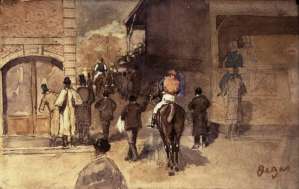
Before I get started on today’s political news, I wanted to note the anniversary of the Isabella Stewart Gardner heist on Monday. It’s a Boston story I’ve always found fascinating. I’m illustrating this post with some of the 13 missing works of art.
BOSTON — Thirty-four years ago two thieves robbed the Isabella Stewart Gardner Museum, making off with hundreds of millions of dollars in stolen artwork. The heist has been the subject of mystery and documentaries ever since.
“I have been here for a long time looking for these, and I’d be lying if I said it doesn’t affect me. I walk by the empty frames every day,” said Anthony Amore, Director of Security at the Isabella Stewart Gardner Museum.
In 1990, two men snuck into the museum disguised as police officers answering a distress call. The duo tied up to two guards and were in the museum for 81 minutes. They made off with numerous pieces of art including 13 works from famous painters like Rembrandt. The art is worth hundreds of millions of dollars.
“I believe that information is going to come in, or I am going to get the stuff first, but one way or another we will get the art back,” said Amore.
Over the past year, the museum and the FBI have received hundreds of tips and emails. Amore says most are theories or conjecture, but a few are an occasional tip. He says 20 of those calls came from people who thought they spotted the works of art on the wall during house showings or on pictures from Zillow. They were just reproductions used to stage the homes for sale.
“There is a lot of these things out there, and when we do see things from Zillow, or any other real estate website, we don’t look at it and say, ‘That is our painting.’ Nevertheless, we follow it,” said Amore. “I am amazed that people notice because Zillow has millions of listings, and people go through and go, ‘That’s that missing Gardner painting.”
There is a $10 million reward for information leading to finding the paintings.
In the pre-dawn hours of March 18, 1990, following a festive St. Patrick’s Day in Boston, two men dressed as police officers walked into the Isabella Stewart Gardner Museum and walked off with an estimated $500 million in art treasures. Despite efforts by the local police, federal agents, amateur sleuths and not a few journalists, no one has found any of the 13 works lost in the largest art theft in history, including a rare Vermeer and three precious Rembrandts.

The Concert, by Johannes Vermeer
The legacy of the heist is always apparent to museum visitors who, decades later, still confront vacant frames on the gallery walls where paintings once hung. They are kept there as a reminder of loss, museum officials say, and in the hope that the works may eventually return. Last month, Richard Abath, the night watchman who mistakenly allowed in the thieves, died at 57. He was a vital figure in an investigation that remains active, but where the trails have grown cold.
Here are five oddities that make this one of the most compelling of American crimes.
The thieves took a really strange array of stuff.
Important paintings were taken from their frames during the heist. But other items that were stolen were not nearly of the same caliber: a nondescript Chinese metal vase; a fairly ordinary bronze eagle from atop a flagpole; and five minor sketches by Degas. The thieves walked past paintings and jade figurines worth millions, including a drawing by Michelangelo, yet they spent some of their 81 minutes inside fussing to free the vase from a tricky locking mechanism.
The handcuffed guard was later scrutinized.
Abath, one of two guards on duty, was handcuffed and gagged with duct tape. He was never named a suspect. But over the years investigators continued to review his behavior because he had, against protocol, opened the museum door to the thieves. (The second guard, who is still living, was never a focus of investigative interest.) The F.B.I. monitored Abath’s assets for decades but never saw any suspicious income. He consistently said he told investigators everything he knew, and an F.B.I. polygraph he voluntarily took was deemed “inconclusive.”
The empty frames have stayed on the walls.
The museum was once Gardner’s home and she wanted to ensure that her expansive art collection was displayed in the same manner she had arranged it. She stipulated in her will that not a thing was to be removed or rearranged, or the collection should be shipped to Paris for auction, with the money going to Harvard University. Though it’s long been reported that the empty frames are left hanging to accord with that will, the museum says that is actually a long uncorrected mistake. “We have chosen to display them,” it said in a statement “because 1.) we remain confident that the works will someday return to their rightful place in the galleries; and 2.) they are a poignant reminder of the loss to the public of these unique works.”
Read the rest at the NYT.
I wish I could spend the day reading about famous art thefts and missing or recovered paintings, but I suppose I’d better take a look at the politics news . . .
On Monday Judge Aileen “Loose” Cannon shocked legal observers with a strange order.
USA Today: Judge in Trump classified documents case proposes ‘insane’ jury instructions, experts say.
The judge presiding over charges against former President Donald Trump for allegedly hoarding classified documents after leaving the White House proposed on Monday jury instructions for the eventual trial that favor his claim that he declassified the records.
U.S. District Judge Aileen Cannon’s proposal tips the scales so far in Trump’s direction that legal experts say the prosecutor, Justice Department special counsel Jack Smith, might ask an appeals court to remove her from the case.
Joyce White Vance, a former U.S. attorney, said the Presidential Records Act isn’t a way around rules for handling classified documents because the records are still government property, not Trump’s personal possessions.

Rembrandt von Rijn Self-Portrait
“Expect their response to be hard-hitting,” Vance said of prosecutors in a post on Substack. “The bottom line is that the Presidential Records Act doesn’t forgive Trump for violating criminal laws regarding handling of national secrets.” [….]
Cannon gave lawyers for Trump and Smith until April 2 to submit proposed jury instructions for the eventual trial. The order on Monday came after a hearing in which she didn’t resolve the dispute over whether the documents fell under the Presidential Records Act.
But her order called for lawyers on both sides to “engage” with two possible instructions she proposed.
In one, Cannon said jurors should “make a factual finding as to whether the government had proven beyond a reasonable doubt” the records are personal or presidential.
In the other, Cannon proposed telling jurors “a president has sole authority under the PRA to categorize records as personal or presidential during his/her presidency. Neither a court nor a jury is permitted to make or review such as categorization decision.”
Neither of those instructions reflects what the Presidential Records Act says.
Legal experts blasted the order as “insane” and “nuts.”
“This second scenario is legally insane,” and under it Cannon could simply dismiss the charges, said Bradley Moss, a national-security lawyer.
George Conway, another lawyer and frequent critic of Trump, argued Cannon shouldn’t be hearing the case and shouldn’t even be a federal judge. Cannon was appointed by Trump and has been widely criticized for decisions that have delayed the trial, including two overturned by the 11th U.S. Circuit Court of Appeals.
“This is utterly nuts,” Conway said.
Vance said both proposals from Cannon “virtually direct the jury to find Trump not guilty.”
“It turns out it’s two pages of crazy stemming from the Judge’s apparent inability to tell Trump no when it comes to his argument that he turned the nation’s secrets into his personal records by designating them as such under the Presidential Records Act,” Vance said.
Read more about the Presidential Records Act at USA Today.
Jose Pagliery at The Daily Beast: Mar-a-Lago Judge’s Stark Ruling: Jury Sees Secret Files or Trump Wins.
The MAGA-friendly federal judge who keeps siding with Donald Trump in his Mar-a-Lago classified records case has forced prosecutors to make a stark choice: allow jurors to see a huge trove of national secrets or let him go.
U.S. District Judge Aileen M. Cannon’s ultimatum Monday night came as a surprise twist in what could have been a simple order; one merely asking federal prosecutors and Trump’s lawyers for proposed jury instructions at the upcoming trial.






 peej
peej Carissa
 bostonboomer
 dakinikat
 ecocatwoman
 mablue2
 Mama Lopez
 peggysue22
 quixote
 skydancingguestblogger
 Mona (aka Wonk the Vote)



 Sky Dancing
Recent Comments