
Monday Reads
Posted: August 27, 2012 Filed under: Mitt Romney, morning reads, New Orleans | Tags: Changing rules, Cheat, hurricane Isaac, Mitt Romney, Ron Paul 55 Comments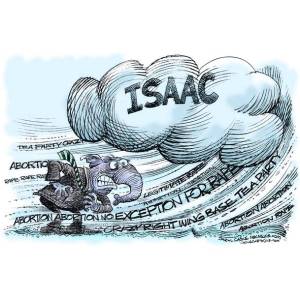 Good Morning!
Well, TS/Hurricane Isaac is drenching Florida and headed towards the North Gulf. The weather forecasters appear to be confused by its signals because their models have yet to indicate a consistent target. It appears to be Bay St Louis at the moment. Anyway, it’s a wide enough system that New Orleans is in the warning band and folks around here are nervous. It will make landfall 7 years to the day that Hurricane Katrina changed everything here. Folks have run a lot of gas stations out of gas and markets out of the usual hurricane supplies like ice, batteries, and strawberry poptarts (ugh!). I think the media is hoping they get a story out of us, frankly. The mayor is asking us to shelter in place. However, the weather channel sent us Jim Cantore. That’s never a good sign. Hopefully, he’ll head towards Mobile some time on Tuesday.
Hurricane Katrina made landfall near New Orleans on Aug 29, 2005. It is estimated that the total economic impact in Louisiana and Mississippi exceeded $110 billion, earning the title of the most expensive hurricane ever in US history.
As Katrina moved through the heart of the Gulf of Mexico offshore oil and natural gas production area, it negatively impacted nearly 20% of US oil production. Hurricane Katrina, followed by Hurricane Rita in September, destroyed 113 offshore oil and gas platforms and damaged 457 oil and gas pipelines. Oil, gasoline, and natural gas futures prices on the NYMEX soared as damage assessments were reported.
The hurricane damage inflicted by Katrina caused oil prices to increase from the mid-$60s per barrel to over $70/bbl and gasoline prices at the pump rocketed to near $5 a gallon in some areas of the US. The US government released oil from its stockpile in the Strategic Petroleum Reserves (SPR) to offset price rises. In the natural gas market, prices were trading in the $9 to $10/MMBtu range at the time, but spiked to over $15/MMBtu as the full extent of the damage became apparent.
Additionally, the Louisiana Offshore Oil Port (LOOP) was closed on August 27, 2005, reducing production by over 400,000 barrels per day. LOOP handles 13% of the nation’s foreign oil, about 1.2 million barrels a day, and connects by pipeline to 50% of the U.S. refining capability. The port was undamaged by the storm and resumed operation within hours of electricity coming back online.
Gulf of Mexico oil production was reduced by about 1.4 million barrels per day as a result of Hurricane Katrina, equivalent to about 91% of daily Gulf of Mexico oil production. Additionally, over 8 billion cubic feet (Bcf) per day of natural gas production was shut in, equivalent to 83% of daily Gulf of Mexico natural gas production.
Seven years later as what will be Hurricane Isaac bears down on the Gulf Coast, the Gulf of Mexico currently accounts for about 23% of oil production and 7% of natural gas output according to the US Department of Energy. Furthermore, roughly 30% of natural gas processing plant capacity and 44% of US refining capacity is located along the US Gulf Coast.
According to the Bureau of Ocean Energy Management (BOEMRE), 8.6% of the Gulf’s daily oil output and 1.6% of daily natural gas production was shut down as a result of Isaac approaching the Gulf of Mexico. Closing prices as of Friday, Aug 24, 2012 of NYMEX October WTI futures settled at $96.15/bbl, while September natural gas settled at $2.70/MMBtu.
When it comes to offshore oil and gas rig infrastructure in 2012 versus 2005, the biggest difference is that the rigs placed into the Gulf of Mexico in the last several years have been hardened to resist Category 4 or 5 hurricanes. However, up until now, other than Hurricane’s Gustav and Ike in 2008, there has been no real test of the endurance of newer ‘hurricane resistant’ infrastructure that has replaced much of the aging platforms in 2005. Isaac may very well be the storm to test the fortitude of the newer offshore hardware.
It could also stir up all the BP muck on the bottom of the Gulf.
I’ve been reading through the Gawker documents and have really been struck by the amount of management fees and legal fees that Romney appears to tolerate just to avoid paying federal income taxes. It actually seems a bit sick or compulsive or obsessive to me. Some tax attorneys have suggested that some of his tricks are actually illegal or at least highly questionable. I have no idea since I just know the finance end of these deals. The legal and tax implications of these thing are not my bailiwick. It just seems like if you’re that rich and your time is that valuable that it could be spent on more useful activities than finding aggressive tax dodges. I wonder if the savings actually justified all the fees. But then, I discovered that the partners actually finagled the fees to avoid taxes.
The documents reveal another tactic used by Bain and other buyout firms to achieve the lower rate for other compensation as well, a practice known as management-fee conversions or fee waivers.
Here’s more examples from the Buzzfeed link.
Bain Capital Fund VII LP disclosed in a 2009 report that the general partner in the fund had in the past waived management fees and converted those fees into an interest in the fund called a “priority profit share.” That had the effect of turning fees that would be taxed at ordinary income rates, as high as 35 percent, into capital gains, taxed at a rate of 15 percent.
By deferring the receipt of that cash they get a second benefit by deferring the tax. While the partners are well- positioned to know what investments may be winners, the waiver is irrevocable, meaning the fees disappear if the deals don’t generate profit.
“The documents confirm that Bain Capital converted some of its management fees into carried interest; there’s no reason they would do this other than to convert high-tax ordinary income into low-taxed capital gain,” said Victor Fleischer, a tax law professor at the University of Colorado. “It’s a strategy that is aggressive, and, while common in the industry, is difficult to justify as an appropriate reporting of tax obligation.”
According to the financial disclosure form Romney filed in June, Ann Romney’s blind trust owns more than $1 million in the Bain Capital Fund VII, and between $100,000 and $250,000 in the co-investment fund. The Romneys received between $200,000 and $2 million in income from those two funds in 2011. The documents published by Gawker don’t show whether the Romneys benefited from the fee waivers.
The documents also show how deeply embedded Bain has become in the offshore tax-haven world, with funds organized in the Cayman Islands. Private-equity firms organize funds in tax havens to prevent foreign investors — and non-taxable U.S. investors, like university endowments — from getting hit with U.S. income tax bills from the profits generated by their underlying portfolio companies. That provides an economic benefit to the funds and to the private-equity managers because it means that, by avoiding U.S. tax, the investors have more to invest.
What does it say about a person that seems to be obsessed with making sure they search every nook, crack, and cranny for a way to avoid paying money to their own government. You know, the one they actually are running to lead?
Ron Paul isn’t playing nice with Mittens. He’s not “wholeheartedly endorsing him” and it appears that “the Romney Campaign Radically Changes GOP Nominating Process After Ron Paul Takeovers”.
Mitt Romney’s presidential campaign, led by top Romney lawyer Ben Ginsberg, forced through a major change the GOP nominating process on Friday in response to Ron Paul supporters’ efforts to win delegates to the Republican National Committee..
The Republican National Convention Committee voted 56-40 to make it impossible for supporters of one presidential candidate to override the will of voters at a state convention, as Ron Paul supporters did in Iowa and Nevada.
The purpose of the change, Ginsberg said, was “to correct what we saw as a damaging flaw in the presidential election process in 2012.”
The rule forces statewide presidential primaries or caucuses to determine the ultimate allocation of delegates, preventing takeovers like Paul executed in Iowa by eliminating unbound delegates in statewide contests. States would be allowed to decide whether to give all their delegates to the winner of the primary or caucus, or distribute them proportionally according to the results.
“Iowa will have to change the way they do it,” said a GOP official.
A second component of the amendment would require delegates to be approved by presidential candidates, lessening the chances of technically pledged delegates voting for a different candidate.
The original amendment would have removed the carve-out for Iowa, New Hampshire, South Carolina, and Nevada, but Ginsberg later clarified that was an error, after sparking a panic among early states.
Virginia delegate Morton Blackwell objected that the rule would have a “damaging effect on our presidential candidate Mitt Romney.”
“There are very large numbers of people who supported other candidates, in particular Ron Paul, who will see this as an attack on their behavior,” he said, warning that they could vote for the Libertarian party.
I guess the new way to get elected is to make sure the rules let you win. No wonder Ron Paul is acting so pissy.
“Today I was very excited call from the RNC,” Paul said “They said they changed their mind. They’re going to give me a whole hour and I can say whatever I want – tomorrow night!” (Tomorrow being Monday, the day that the RNC has no events due to Tropical Storm Isaac).
“Just kidding,” Paul concluded.
Paul directly referenced the rules change that may keep similarly insurgent delegates from succeeding in future elections. He seemed stung by the disappointments, after the concerted effort his campaign made to compromise with the Romney campaign and to keep their delegates under control.
The RNC “learned how to bend rules, break rules, and now they want to rewrite the rules,” Paul said.
“That’s what we have to stop.”
He also nodded to the view, common among Paul supporters, that votes had been miscounted or improperly counted in primary states.
“Ultimately numbers do count,” he said. “And numbers do count even when they don’t count all the votes as well. Because we do have the numbers!”
Paul may be angry that after years of effort and a number of compromises, the insiders are not letting him in. But he’s also now able to talk about the lists of topics he cares about without a second thought; it no longer matters if the Romney people think he’s too far out. He took full advantage on Sunday, filling his 67 minutes with a laundry list of historical references, bits of his stump speech, and nostalgic philosophizing.
Paul also wandered into territory that makes it clear why the Romney campaign, known for trying to control the message as much as possible, would be wary of having him speak unscripted.
Bradley Manning, Paul said, “is in the military so there are probably some debates on exactly how and what to do, but let me tell you: Bradley Manning didn’t kill anybody, Bradley Manning hasn’t caused the death of anybody, and what he has exposed, he is the equivalent to Daniel Ellsberg, who told us the truth about Vietnam.”
And: “I’m afraid that if we took a poll across the country and said ‘Should we try Assange for treason?’ that most Americans would say oh yes he’s a bad guy, he’s telling us all these secrets. But guess what, he’s an Australian citizen.”
What’s on your reading and Blogging list today? And, if I disappear some time on Tuesday or Wednesday, UPS me a boat please.

 peej
peej Carissa
 bostonboomer
 dakinikat
 ecocatwoman
 mablue2
 Mama Lopez
 peggysue22
 quixote
 skydancingguestblogger
 Mona (aka Wonk the Vote)



 Sky Dancing
Recent Comments