
Tuesday Reads: Daniel Inouye, Richard Engel, and Fiscal Slope Trial Balloons and Lead Balloons
Posted: December 18, 2012 Filed under: Barack Obama, Fiscal Cliff, Medicaid, Medicare, morning reads, Social Security, U.S. Economy, U.S. Politics, unemployment | Tags: Bureau of Labor Statistics, Chained CPI, Daniel Inouye, Dean Baker, digby, experimental elderly index (CPI-E), Ezra Klein, inflation, Iran-Contra, Japanese-Americans, payroll tax holiday, Richard Engle, unemployment insurance, Watergate, World War II 57 Comments
Sen. Dan Inouye reads with children
Good Morning!!
Senator Dan Inouye, who died yesterday at age 88 was a Japanese American who fought for the U.S. in World War II. From Time Magazine:
On Dec. 7, 1941, high school senior Daniel Inouye knew he and other Japanese-Americans would face trouble when he saw Japanese dive bombers, torpedo planes and fighters on their way to bomb Pearl Harbor and other Oahu military bases.
He and other Japanese-Americans had wanted desperately to be accepted, he said, and that meant going to war.
“I felt that there was a need for us to demonstrate that we’re just as good as anybody else,” Inouye, who eventually went on to serve 50 years as a U.S. Senate from Hawaii, once said. “The price was bloody and expensive, but I felt we succeeded.”
Inouye had wanted to become a surgeon, but he lost his right arm in a firefight during the war. He was elected to the House in 1959 after Hawaii became a state. Inouye became well known nationally as a member of the Senate Watergate Committee and later as chairman of the Congressional committee that investigated the Iran Contra scandal.
In one of the most memorable exchanges of the Watergate proceedings, an attorney for two of Nixon’s closest advisers, John Ehrlichman and Bob Haldeman, referred to Inouye as a “little Jap.”
The attorney, John J. Wilson, later apologized. Inouye accepted the apology, noting that the slur came after he had muttered “what a liar” into a microphone that he thought had been turned off following Ehrlichman’s testimony.
Inouye achieved celebrity status when he served as chairman of the congressional panel investigating the Iran-Contra affair in 1987. That committee held lengthy hearings into allegations that top Reagan administration officials had facilitated the sale of weapons to Iran, in violation of a congressional arms embargo, in hopes of winning the release of American hostages in Iran and to raise money to help support anti-communist fighters in Nicaragua….
The panel sharply criticized Reagan for what it considered laxity in handling his duties as president. “We were fair,” Inouye said. “Not because we wanted to be fair but because we had to be fair.”
NBC foreign correspondent Richard Engel and his production team have been released after five days in captivity in Syria. The Guardian reports:
The group disappeared shortly after crossing into north-west Syria from Turkey last Thursday (13 December). NBC had no contact with the kidnappers and asked for a news blackout about the incident, which was observed by mainstream news outlets.
There was no request for a ransom during the time Engel and his crew were missing.
After being abducted they were put into the back of a truck and blindfolded before being transported to an unknown location, believed to be near the small town of Ma’arrat Misrin.
Throughout their captivity they were blindfolded and bound, but otherwise not physically harmed, said the network.
Read more at the link.
According to Beltway Bob (AKA Ezra Klein), a deal between President Obama and Speaker Boehner is in the offing, and it isn’t a good deal for old ladies who are trying to survive on Social Security.
Boehner offered to let tax rates rise for income over $1 million. The White House wanted to let tax rates rise for income over $250,000. The compromise will likely be somewhere in between. More revenue will come from limiting deductions, likely using some variant of the White House’s oft-proposed, oft-rejected idea for limiting itemized deductions to 28 percent. The total revenue raised by the two policies will likely be a bit north of $1 trillion. Congress will get instructions to use this new baseline to embark on tax reform next year. Importantly, if tax reform never happens, the revenue will already be locked in.
On the spending side, the Democrats’ headline concession will be accepting chained-CPI, which is to say, accepting a cut to Social Security benefits. Beyond that, the negotiators will agree to targets for spending cuts. Expect the final number here, too, to be in the neighborhood of $1 trillion, but also expect it to lack many specifics. Whether the cuts come from Medicare or Medicaid, whether they include raising the Medicare age, and many of the other contentious issues in the talks will be left up to Congress.
Now how is that a win for Democrats? If we go over the cliff, Republicans are going to be blamed, and taxes will go up on everyone until Republicans give in to public outcry in early January. But Social Security, Medicare, and Medicaid cuts will inevitably be blamed on Democrats, who are supposed to fight for the social safety net. Then in 2014, Republicans will attack them for those cuts, and it will work–just as it did when Romney and Ryan falsely accused Obama of cutting Medicare benefits in the recent presidential campaign. Back to Beltway Bob:
The deal will lift the spending sequester, but it will be backed up by, yes, another sequester-like policy. I’m told that the details on this next sequester haven’t been worked out yet, but the governing theory is that it should be more reasonable than the current sequester. That is to say, if the two parties can’t agree on something better, then this should be a policy they’re willing to live with.
On stimulus, unemployment insurance will be extended, as will the refundable tax credits. Some amount of infrastructure spending is likely. Perversely, the payroll tax cut, one of the most stimulative policies in the fiscal cliff, will likely be allowed to lapse, which will deal a big blow to the economy.
Again, that doesn’t sound like a win for Obama at all. Let’s hope Beltway Bob is wrong again.
Dean Baker on the chained CPI: He argues that the chained CPI is not really applicable to seniors.
The Bureau of Labor Statistics (BLS) has constructed an experimental elderly index (CPI-E) which reflects the consumption patterns of people over age 62. This index has shown a rate of inflation that averages 0.2-0.3 percentage points higher than the CPI-W.
The main reason for the higher rate of inflation is that the elderly devote a larger share of their income to health care, which has generally risen more rapidly in price than other items. It is also likely that the elderly are less able to substitute between goods, both due to the nature of the items they consume and their limited mobility, so the substitutions assumed in the chained CPI might be especially inappropriate for the elderly population.
Baker explains for the umpteenth time that it is wrong to use Social Security cuts to lower the deficit.
It is important to remember that under the law Social Security is supposed to be treated as a separate program that is financed by its own stream of designated revenue. This means that it cannot contribute to the budget deficit under the law, because it is only allowed to spend money from the Social Security trust fund.
This is not just a rhetorical point. There is no commitment to finance Social Security out of general revenue. The projections from the Social Security trustees show the program first facing a shortfall in 2033 after which point it will only be able to pay a bit more than 75 percent of scheduled benefits. While this date is still fairly far in the future, at some point it will likely be necessary to address a shortfall.
It is reasonable to expect that the changes needed to keep the program fully funded will involve some mix of revenue increases and benefit cuts. However if the chained CPI is adopted as part of a budget deal unconnected to any larger plan for Social Security then it effectively means that there will have been a substantial cut to Social Security benefits without any quid pro quo in terms of increased revenue. This hardly seems like a good negotiating move from the standpoint of those looking to preserve and strengthen the program.
There is much much more at the link. Digby has been writing about this issue for months, and she had another good post on it yesterday.
There has always been some fantasy, mostly held by people who are about to be fleeced by Wall Street sharpies, that this country should be run like a cash business. It cannot and should not be done that way. (Ask Mitt Romney about the role of debt in a modern economy.) The problem is that this focus on debt is making it impossible to do the things we need to do to spur economic growth in the short term, which would close the deficit, and apparently the only way anyone in Washington can see to get around that is to sell off the future security of American citizens as some sort of human sacrifice for no good reason. It simply is not necessary, as Krugman shows.
John Boehner came up with a new “offer” this week-end to raise the rates on those who make a million or more each year and also agreed to take the debt ceiling off the table for the next year. Krugman thinks this is a bad deal which Obama has no good reason to take — and I would agree with him if I didn’t still see a very dangerous possibility that the administration wants to pursue some unacceptable spending cuts in order to deliver on that “balanced approach.” A looming debt ceiling fight is a very good excuse for them to do that. If kicking the can down the road another year will stop them from cutting more spending, then I’m inclined to say take the deal.
Obviously, this whole thing is ridiculous. They should get rid of this idiotic debt ceiling vote altogether: after all once they appropriate the funds they’ve agreed to pay for them whether through taxation or borrowing. This yearly vote allows them to get credit for the goodies and then later refuse to pick up the tab. But unless they are willing to give it up completely, I’d be glad to at least see it be delayed until the White House stops talking about cutting vital programs.
And yes, the taxes should go up for all income over $250,000. They can afford it. But not if the price is changing to the Chained CPI which will take the food out of the mouths of 90 year old women and squeeze veterans and disabled people who can’t afford it. In other words, the devil is in the details. If Obama hangs tough as Krugman prescribes and wins on all these points without giving up the store (also known as “making tough choices ” his own base “won’t like”) then I say go for it. I’m just not sure I have much faith that’s the game plan. If it isn’t, then maybe he should take Boehner’s offer, repeal the sequester and put this to bed for the time being. There’s been more than enough cutting already to drag this economy down. Let’s see what happens if we stop the austerity insanity for a while.
Dr. Dakinikat would probably agree with that.
Meanwhile, most Americans disapprove of the the proposed cuts to safety net programs, so maybe this will turn out to be another trial balloon that goes over like a lead balloon.
Most Americans want President Obama and congressional Republicans to compromise on a budget agreement, though they, too, are unhappy about the options that would avert the “fiscal cliff,” according to a new Washington Post-ABC News poll.
The strong support for compromise belies widespread public opposition to big spending cuts that are likely to be part of any deal.
Most Americans oppose slashing spending on Medicaid and the military, as well as raising the age for Medicare eligibility and slowing the increase of Social Security benefits, all of which appear to be on the table in negotiations. Majorities call each of these items “unacceptable.”
Wow. I’m running out of space already? Suddenly, a week before Xmas there’s more happening in the news. We’ll have to discuss other items in in the comments. So what’s on your reading list today?
Chain, Chain, Chain …
Posted: July 13, 2011 Filed under: Economy | Tags: Chained CPI, inflation impacting the elderly 19 CommentsSo I thought I’d write a brief post on one of the topics that has come up with social security reform. That would be switching the Social Security COLA (Cost Of Living Adjustment) from the CPI-W to the Chained CPI. E conomists widely agree that the CPI-W overstates the rate of inflation. However, there are some other considerations to look at when undertaking any change. Kevin Drum from MoJo explains the problems with the CPI-W which is an inflation index based on a fixed basket of goods and is widely criticized for having a bunch of problems including substitution bias.
The reason is something called “upper level substitution bias,” which means that instead of always buying a standard basket of goods and services, people change their buying habits over time as prices change. When the price of hamburger goes up, they eat more chicken. When the price of chicken goes up, they switch back to hamburger. A version of CPI that takes this into account is called chained CPI, and overall it’s considered a more accurate reflection of actual inflation. But technical merits aside, there are always winners and losers when you make changes to statistics like this. One big loser would be Social Security beneficiaries. Initial Social Security benefits upon retirement are calculated based on wage levels, so they’d be unaffected by a switch to chained CPI. But annual COLA increases would be affected, and they’d be lower than they are now.
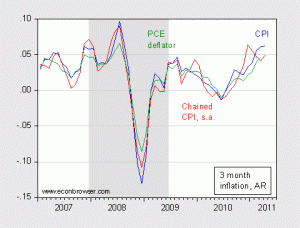 Menzie Chinn at Econbrowser has a nifty graph showing the differences in three measures of inflation. The blue line is the traditional CPI that’s now the basis of the Social Security COLA. The Green line is the PCE Deflator which is a more general measure of consumer inflation that’s not attached to a fixed basket of goods. This is the measure that the Fed tends to follow. The red line is the Chained CPI.
Chinn has a general discussion of each of these indices too. The CPI basket which is used to weight price changes updates every two years now. The chained CPI uses weights that are constantly changing and more realistically reflect changes in consumer buying habits. This avoids the substitution bias.
The BLS collects the buying habits and prices of typical urban consumers monthly and provides the data in the form of the inflation indices. You can read about the chained CPI and the methodology used to calculate it here. It’s been in use since 2002. The most basic explanation of the differences is explained at the FAQ provided by the BLS.
In its final form, the C-CPI-U is a monthly chained price index with the expenditure weights varying each month. The CPI-U and CPI-W, on the other hand, are biennial chained price indexes where their expenditure weights are updated every two years. Within the two-year span, these indexes are fixed-weight series, where the changes in these indexes reflect only changes in prices, and not expenditure shares, which are held constant.
Dean Baker has some information worth considering before we suggest that the change to the chained index is the best move. Using the Chained CPI may reduce overall costs while still providing a COLA, but the index may not reflect price changes that specifically impact the elderly population in the US.
It is not clear that the Chained CPI is more accurate than the current measure. The Bureau of Labor Statistics (BLS) has found that an experimental elderly index (CPI-E), that tracks the consumption patterns of people over age 62, actually shows a higher rate of inflation for the elderly than the CPI currently used for adjusting Social Security benefits.
While the CPI-E is not a full index since it does not look at the specific items bought by the elderly and the specific outlets they use for their shopping, there is no reason why BLS could not construct a full CPI-E. If the concern is having an accurate cost of living adjustment then it would seem that you should support having Congress instruct BLS to construct a full CPI-E. For my part, I don’t know whether this measure would show a higher or lower rate of inflation than the current CPI used for indexing benefits, but it would be a more accurate measure.
As it stands, switching to a Chained CPI would undoubtedly mean a cut in scheduled benefits, regardless of whether or not it involves a more accurate cost of living adjustment. Using this measure of the CPI would reduce benefits for retirees by 3 percent in 10 years, 6 percent in 20 years and 9 percent in 30 years. We know that the vast majority of retirees are struggling to make ends meet already. Retirees are not the people responsible for wrecking the country’s economy. Social Security benefit cuts of this magnitude seem like a major step in the wrong direction.
Inflation has not been much of a problem for this country since the mid 1980s. Since we are aware that too much money chasing too few goods is the basis of inflation and the FED is committed to not letting inflation get out of hand, it’s unlikely that we’ll see problems with inflation. The only thing that would lead–at this point in my mind–to major price disruptions would be a politicized FED that abused monetary policy or some brand of gold bug craziness that put us back on a hard currency. The last problem would cause incredible, destabilizing deflation since a fixed medium of exchange in a growing economy causes the opposite problem. That would be too little money chasing lots of goods.
Probably the best thing to do at this point would be to ask the CBO to study which index realistically represents changes to the cost of living, then seeing if the savings is worth it at the aggregate level. Dean Baker has this suggestion.
The Bureau of Labor Statistics’ (BLS) Experimental Price Index for the Elderly has consistently shown a somewhat higher rate of inflation for the elderly population.
If the concern is accuracy, then the route should be to have the BLS construct a full elderly index that could take account of actual purchase substitution patterns among elderly consumers. Simply switching to the C-CPI-U without undertaking this research is consistent with a desire to cut Social Security, not to make the COLA more accurate.
This is probably a better idea since the elderly are more likely to spend more on health care where costs have been rising astronomically. They are also less likely to buy other kinds of consumer goods. A CPI based on a senior basket of goods may be more appropriate.

 peej
peej Carissa
 bostonboomer
 dakinikat
 ecocatwoman
 mablue2
 Mama Lopez
 peggysue22
 quixote
 skydancingguestblogger
 Mona (aka Wonk the Vote)



 Sky Dancing
Recent Comments