
Monday Reads
Posted: October 21, 2013 Filed under: morning reads | Tags: "grand bargain", budget negotiations 36 Comments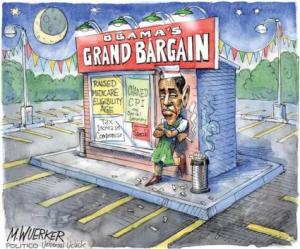 Good Morning!
The Federal Government has reopened. The Giant Panda Cam is back up. The exchanges set up by the Affordable Care Act are working in the states where the governor’s accepted the Medicaid expansion and have spotty participation in some other places. Fox News is back to Benghazi conspiracy theories. Why can’t I get the vision of more icky Grand Bargaining out of my head? Robert Kuttner is right there with me on the worry couch.
What would the latest incarnation of the grand bargain look like? The Republicans, worried about the cuts in Pentagon spending mandated by the sequester (which is still in effect) propose to allow military spending to rise in exchange for cuts in Social Security and Medicare. Excuse me? This is a little like saying, I’ll take your house and in exchange you have to give me your money. Right, we’ll cut Social Security and Medicare in order to increase money for the military. Are you kidding? It gets worse. In exchange for this proposed deal, Republicans are not willing to talk about raising taxes or restoring other social spending or to stop trying to undermine the Affordable Care Act. The only good thing about this proposed bargain is that is should be dead on arrival. Senate Majority Leader Harry Reid immediately declared that he wanted on part of any such deal. But President Obama, who has flirted with grand bargains in the past, was more equivocal. He has already put disguised cuts in Social Security in his own 2014 budget, though a revision of annual cost of living adjustments. The deal to keep the government set a deadline of December 13 for some kind of progress on a grand reform of entitlements and taxes. That’s only eight weeks away. It is preposterous to think that a bargain on taxes, social insurance, and deficits that has eluded the two parties throughout the Obama administration can be struck in less than two months. One has to hope that the deadline comes and goes, and that when Republicans think about shutting down the government again when the continuing resolution expires in January, they will think twice. But that will happen only if Reid, Pelosi, and House and Senate Democrats display the same resolve that they did in the last round. And given his past dalliances with putting Social Security and Medicare on the block, some of that resolve may need to be displayed against their president.
There’s likely to be some pressure because the Republican Party’s right wing still hasn’t given up its demands and will likely cause issues again. This means that way out there Republicans may continue to move the middle ground further toward the right wing. What’s going to happen as some of these incumbents start seeing primary challengers?
The more important intraparty fight will begin playing out chiefly in Senate primaries next year, with the targeting of incumbents like Mr. Cochran; Mitch McConnell, the minority leader; Lindsey Graham of South Carolina; and perhaps Lamar Alexander of Tennessee and Pat Roberts of Kansas. Their perceived roles as moderating drags on Tea Party-inspired senators like Ted Cruz of Texas and Mike Lee of Utah in the shutdown negotiations has galvanized conservative organizations to elect more such Republicans. Mr. DeMint said he thought the power of the establishment and its corporate money was waning. “It’s harder to buy influence in Washington now,” he said. That is certainly true in the House, the bulwark of Tea Party conservatism thanks to the overwhelmingly Republican nature of many of the districts and the less expensive campaigns necessary in them. As the Republican retreat on the shutdown demonstrated, Mr. Cruz and Mr. Lee are very much outnumbered in the Senate. “The lesson is, we need more reinforcements,” said Daniel Horowitz, an official with the Madison Project. Groups like his are more reliant on smaller dollar donations than their rivals. The U.S. Chamber of Commerce and Crossroads, for example, can summon large amounts from donors across the business spectrum, many of whom are expressing concern about the latest turn of events on Capitol Hill and are intent on avoiding nominees like Richard Mourdock of Indiana, who unseated Senator Richard G. Lugar, a longtime veteran, in the primary but lost in the general election after making a damaging comment on rape. “I have seen the problems in some of these primaries where we’ve knocked off some pretty good candidates and it resulted in nothing for us — like Lugar,” said Mel Sembler, a Florida real estate developer and former ambassador who helps Crossroads raise money. Spencer Zwick, the chief fund-raiser for Mr. Romney’s campaign, said individual donors tell him they are eager to help the establishment wing’s cause however they can. “There are a lot of individual donors who were supportive of Mitt’s campaign who are quietly waiting to figure out how they can play, and I think there’s a lot of appetite to make sure that we nominate candidates who can win general elections,” he said. The Tea Party-aligned groups say they have an established record of winning primaries against Republican rivals with deep corporate backing. “We’ve always been outspent by orders of magnitude,” said Matt Kibbe, the president of FreedomWorks. And they do have some big donors, like
the multimillionaire investor Foster Friess, who backed a failed primary challenge to Mr. Hatch in Utah last year and indicated in an interview last week that he would consider new “opportunities to put young, dynamic people in.”
Then, there are the lobbyists who will be looking to get something from resorting out sequestration.
With automatic cuts to the militaryset to take effect by January and a separate round of cuts scheduled forMedicare, lawmakers will have to decide who gets hit the hardest. Washington’s lobbying machine — representing older citizens, doctors, educators, military contractors and a wide range of corporate interests — is gearing up to ensure that the slices of federal money for those groups are spared in new negotiations over government spending. It is a debate that almost no one involved wants to have so soon after the nasty fight over the federal budget, which produced the 16-day shutdown and again failed to reverse the automatic cuts resulting from previous disagreements. But Congress managed to reopen the government and extend the nation’s borrowing limit largely by creating a new series of deadlines that run through February, giving special interests several chances to influence the process. So far, the defense industry is likely to be hit the hardest, since the automatic cuts, known as sequestration, set for January would slice an additional $20 billion from the Pentagon’s budget. “It’s fair to say the volume in Washington is going to be deafening,” said Marion Blakey, the chief executive of the Aerospace Industries Association. Republicans on Capitol Hill are determined to mitigate those cuts by spreading them among various social programs, like education and Social Security, bringing dozens of other special-interest groups into the picture. “The perfect storm is coming” is how one health care industry lobbying coalition put it in an advertisement, complete with dark clouds and lightning, that ran the day the shutdown ended. “Tell Washington, no more hospital cuts.” AARP, the giant nonprofit group that represents older citizens, has kicked off a million-dollar radio advertising campaign warning that “seniors are no bargaining chip.”
I’m not sure if you caught the fun stuff that went on last week when billionaire Pete Peterson’s attempt to end social security and medicare as we know it known as the group “Fix the Debt” tried to create a twitter sensation. They got more than they bargained for when the popularity of their ideas got trolled by thousands of twitter users.
When billionaire Pete Peterson’s Fix The Debtdecided to hold a Q&A session on Twitter to sell corporate America’s austerity agenda, they must not have expected to be trolled. First rule of Twitter: always expect the trolls. By the time the whole real-time conversation was called off, the stream for #FixTheDebtQA was 100% opposition.
This should be heartening to those of us who would rather see Social Security expanded, not slashed
More epic trolling of the group can be found here.
“Fix the Debt” just felt Twitter’s sweet, trollish wrath. Championed by Alan Simpson and Erskine Bowles, Fix the Debt — which The Nation magazine called a “fearmongering campaign to convince Americans that the deficits the United States has run throughout its history have suddenly metastasized” — held a Twitter live chat this afternoon to discuss next steps in America’s ongoing fiscal squabble. And it didn’t go so well, with the #fixthedebtqa soon teeming with jokesters and those very much against Fix the Debt’s message.
Senate Minority Leader Mitch McConnell is already sounding the trumpet of deficit doom.
Senate Minority Leader Mitch McConnell (R-Ky.) suggested Sunday that the automatic spending reductions known as the sequester have given his party leverage moving into future budget negotiations. The government-wide cuts, which took effect in March as a result of the Budget Control Act, trim spending by more than $80 billion during this fiscal year alone. They are scheduled to continue for another nine years with deeper cuts unless Congress and the White House agree to an alternative deficit-reduction plan. McConnell said on CBS’s “Face the Nation” that he would not budge on the Budget Control Act’s spending caps when lawmakers and the White House resume negotiations over taxes and expenditures. “The bottom line, when we re-engage early next year, is I don’t want to bust the caps and I don’t want to raise spending, because we are in fact reducing spending, not as much as we need to, but it is a success,” McConnell said, adding that the sequester has lowered government spending “for two years in a row for the first time since right after the Korean War.” The GOP leader also criticized President Obama and congressional Democrats for pushing to raise taxes during previous budget talks. “Every discussion we’ve had about this in the past has had what I would call a ransom attached to it — a trillion-dollars in new tax revenues,” McConnell said. “We don’t have this problem because we tax too little in the country, we have it because we spend too much.”
So, excuse me but I am still paying attention to the men behind the curtains. What’s on your reading and blogging list today?

 peej
peej Carissa
 bostonboomer
 dakinikat
 ecocatwoman
 mablue2
 Mama Lopez
 peggysue22
 quixote
 skydancingguestblogger
 Mona (aka Wonk the Vote)



 Sky Dancing
Recent Comments