
Finally Friday Reads: An American Shit Show
Posted: February 28, 2025 Filed under: #FARTUS, Broligarchy, Elon Musk, Federal Budget, Federal Budget and Budget deficit, jobs, kakistocracy, Welfare Queen Elon Musk | Tags: @repeat1968, Budget Deficit, Climate Change and Weather, John Buss, Social Security, Stagflation, Trump's foreign policy is killing people 16 Comments
“Those damn “entitlement” programs like Medicaid and Social Security must go.” John Buss, repeat1968
Good Day, Sky Dancers!
As the unfocused butchering of the federal workforce and agencies continues, we see more and more essential services and research getting turned into contracts for Elonia’s Empire and billionaire tax cuts. It’s only a matter of months now before the economy begins to collapse from the weight of higher prices and the return of high unemployment. Stagflation is inevitable. Economists, including me, see it as inevitable at this point. The financial markets are sending up red flares. The UK’s Economics Times has this banner headline. “Brace for impact: Stagflation fears could wipe 10% off stocks, says Wall Street’s Doom Prophet Barry Bannister.” I’ve been saying this all month.
Wall Street is worried about the possibility of a “worst-case scenario” in the US economy, one that would send stock prices plummeting by as much as 10%, as per a report.
Stifel managing director and chief equity strategist Barry Bannister has been among the few bears in an optimistic market. He is predicting the S&P 500 would end 2025 in the mid-5000s, reported Business Insider. His call for a potential stagflation scenario may serve as a wakeup call to investors.
According to Business Insider, while most investors expect another strong year of growth and inflation to continue cooling in 2025. According to Bannister, there are early signs that stagflation is beginning.
As per the report, inflation has already increased over the past few months, with consumer prices increasing by 3% from the year earlier in January and more than economists expected and above the 2.9% pace in the previous month. Bannister highlighted that the Trump-era tariffs might be driving up costs for consumers, reported Business Insider.
Bannister said, “I think it’s foolish that people assume that inflation’s going back down to 2%. It’s not going back down to 2%, not without a recession,” as quoted by Business Insider. He also claimed, “Tariffs undo a lot of the disinflation.”
 Those of you my age will remember this from the 1970s. It is positively the worst economic scenario imaginable. I already am swamped by electric bills that are unimaginable for my little house. The unusual weather and snow basically doubled it last month. And just in time for Hurricane and Fire Seasons, we see the Triumvariate try to kill us all so billionaires and Multinational Mega Corporations can steal the coins from our eyes. Additionally, we are providing momentum to the spread of infectious diseases globally and locally. What a clusterfuck our country has become in such a short time! By mid-2026, we will officially be known as a shithole country. Let’s break this all down. You can see from the sources that I am becoming less trustful of the American Fourth Estate.
The Trump administration has fired hundreds of workers at the National Oceanic and Atmospheric Administration (Noaa), the US’s pre-eminent climate research agency housed within the Department of Commerce, the Guardian has learned.
On Thursday afternoon, the commerce department sent emails to employees saying their jobs would be cut off at the end of the day. Other government agencies have also seen huge staffing cuts in recent days.
The firings specifically affected probationary employees, a categorization that applies to new hires or those moved or promoted into new positions, and which makes up roughly 10% of the agency’s workforce.
“The majority of probationary employees in my office have been with the agency for 10+ years and just got new positions,” said one worker who still had their job, and who spoke to the Guardian under the condition of anonymity for fear of reprisal. “If we lose them, we’re losing not just the world-class work they do day to day but also decades of expertise and institutional knowledge.”
Another anonymous staffer called the laid-off workers “dedicated, hard-working civil servants who came to Noaa to help protect lives and keep our blue planet healthy”.
“These indiscriminate cuts are cruel and thoughtless,” the second worker said.
It is not only laid-off employees who will be harmed by the cuts, the second worker said. Ordinary Americans who rely on Noaa’s extreme weather forecasts, climate data and sustainably monitored fisheries will also suffer.
“Words can’t describe the impact this will have, both on us at Noaa and on the country,” the employee said. “It’s just wrong all around.”
Andrew Rosenberg, former deputy director of Noaa’s National Marine Fisheries Service, said Thursday was a “sad day”.
“There is no plan or thought into how to continue to deliver science or service on weather, severe storms and events, conservation and management of our coasts and ocean life and much more,” he said. “Let’s not pretend this is about efficiency, quality of work or cost savings because none of those false justifications are remotely true.”
 Okay, this one is from the New York Times. I hope they can hold off the Techbro Overlords long enough to uncover some truth. “U.S. Terminates Funding for Polio, H.I.V., Malaria and Nutrition Programs Around the World Here are some of the 5,800 contracts the Trump administration formally canceled this week in a wave of terse emails.” This is reported by Stephanie Nolen.
Starting Wednesday afternoon, a wave of emails went out from the State Department in Washington around the world, landing in inboxes for refugee camps, tuberculosis clinics, polio vaccination projects and thousands of other organizations that received crucial funding from the United States for lifesaving work.
“This award is being terminated for convenience and the interest of the U.S. government,” they began.
The terse notes ended funding for some 5,800 projects that had been financed by the United States Agency for International Development, indicating that a tumultuous period when the Trump administration said it was freezing projects for ostensible review was over, and that any faint hope American assistance might continue had ended.
Many were projects that had received a waiver from the freeze because the State Department previously identified its work as essential and lifesaving.
“People will die,” said Dr. Catherine Kyobutungi, executive director of the African Population and Health Research Center, “but we will never know, because even the programs to count the dead are cut.”
The projects terminated include H.I.V. treatment programs that had served millions of people, the main malaria control programs in the worst-affected African countries and global efforts to wipe out polio.
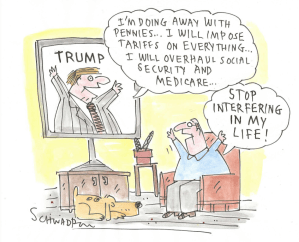 What follows is an incredibly long list of programs that have saved all kinds of people from death and massive illness. A lot has to do with prenatal care. Certainly, we can be better human beings than this. I am ashamed of my country. Pamela Herd and Don Monyhan ask the big question on their substack: “Can we still govern?.” As a young adult, I used to joke that I would pay so much for so long–starting at 15–for Social Security that I doubt I’d ever see all of it. That was a bit of a joke back then, but it seems dead serious now. Sit down, swallow, then put the cup down. “Trump’s Assault on Social Security. The plan to cut America’s most successful safety net program in half.”
Social Security is our biggest and most successful safety net program. The annual $1.6 trillion in benefits constitutes 21% of federal spending and 40% of older adults’ income. It lifts more people out of poverty than any other government program. We all know some of the 69 million Americans depending on those benefits. If you are not currently a recipient, you will be at some point. We all have a stake in ensuring that Social Security works.
And so, we all have a reason to fear the Trump administration’s call to cut 50% of Social Security Administration employees. It’s current staff of about 57,000 employees would drop to 23,000. SSA, quite simply, will not be able to function if this happens.
President Trump promised that “Social Security will not be touched.” Then he claimed he would act only eliminate SSA fraud based on false claims by Elon Musk. Gutting agency capacity is not about fraud, and is very much going to affect people’s experience of Social Security. The benefits that so many Americans depend on will not administer themselves.
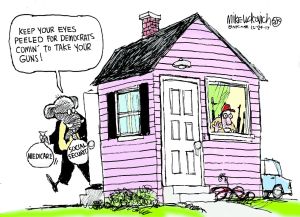 This long but useful read will tell you how effective and economical the plan is. I wrote a research paper for my doctoral class in Financial institutions right after Katrina and was amazed by its efficiency. An outline of studies and data follows the paragraphs above. I will cut to the chase and pass that for brevity.
While we don’t know precisely how the agency will implement the staffing cuts, it will almost certainly entail closing many of the 1,233 SSA field offices around the country. About 120,000 people visit those offices each day. Those that remain open will have fewer staff to serve more people.
We talked with Kathleen Romig, the Director of Social Security and Disability Policy at the Center for Budget and Policy Priorities. She has also previously worked with Social Security, as well as the Social Security Advisory Board. She said:
There’s no way SSA can sustain the thousands of staff losses that result from the massive reductions to come without hurting beneficiaries. Over two-thirds of the agency’s staff serve the public directly, and the rest support their work—hearing appeals, keeping SSA’s systems running and secure, maintaining a high level of transparency and accuracy, and more. It’s going to get a lot harder for people to get help and take a lot longer to get access to their earned Social Security benefits.
DOGE has already announced the closure of 45 field offices, though it’s unclear if the offices are actually closed. The process is so chaotic that members of Congress are not being told when field offices are being closed in their district.
If the proposed cuts in staff move forward the scale of field office closures will be much greater. Field offices serve many functions. Its where you get a new Social Security card if you lost yours or need it changed due to a name change. The card, of course, is critical for everything from getting a drivers’ license to opening a bank account. It is the closest thing the US has to a national identity system. Field office staff also help people decide when they should enroll in the program, as well as provide in-person assistance when the agency makes mistakes with payments or paperwork.
We already know the effects of field office closures on a smaller scale. A study in the American Economic Journal: Economic Policy found that field office closures led to a 16 percent decline in disability recipients in the surrounding communities due to excess demand in the remaining offices. The people hit hardest were those with moderately severe disabilities, lower education and lower income.
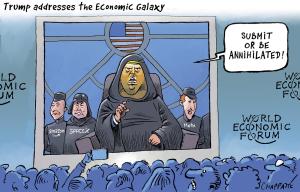 These actions are enough to make you want to take to Pennslyvania Avenue with pitchforks, torches, and guillotines. It’s a full-out assault on the least among us. He’s also going to puke out another Presidential order to establish English as the official language of the USA. We’ve been doing fine with pluralism for 250 years. Besides, if we’re going to be language NAZIs, let’s start with FARTUS and Elonia. Most of the time, they speak unintelligibly. This is from CNBC. “Trump to sign order making English the official U.S. language.” Why is this even necessary? What is this going to cost?
President Donald Trump plans to sign an executive order making English the official language of the United States, three White House officials told CNBC on Friday.
The order would establish a national language for the first time in U.S. history.
Trump’s order would also rescind former President Bill Clinton’s August 2000 directive requiring agencies and other recipients of federal funds to provide services for those with limited English proficiency, according to a fact sheet shared with CNBC.
Trump’s designation will allow federal agencies to maintain their current policies and continue to provide documents and services in other languages. But it “encourages new Americans to adopt a national language that opens doors to greater opportunities,” according to the fact sheet.
The Wall Street Journal first reported the order earlier Friday morning.
Trump’s schedule for Friday does not currently include any time for signing executive orders. A White House source did not immediately tell CNBC when Trump was expected to sign the order.
So, with this and the destruction of the Education Department, will we stop seeing ESL classes in schools? I can only see this as the ultimate golden ticket for bullying.
The Department of Ed has a form to snitch on DEI policies in schools.I’d be a shame if we broke it with thousands of responses… enddei.ed.gov
— Jess Piper (@piperformissouri.bsky.social) 2025-02-27T21:52:28.162Z
One last economic thing. I’ve never been a deficit hawk. It’s established theory that the size of the tax base and economy plus market factors like acceptance of the money play a much bigger role in how big it can be rather than how big it is. However, this worries me. This is from Alexander Solender, who is writing for AXIOS. “Republicans fear their big budget win is a 2026 time bomb.”
House Republicans notched a major legislative victory this week when they passed their budget resolution. Now comes the hard part: Crafting a fiscal package that doesn’t doom them in the 2026 election.
Why it matters: Some Republicans already see signs that the backlash to the Trump administration’s “efficiency” efforts is spilling over into opposition to their legislative plans.
- One Republican moderate, speaking on the condition of anonymity to give candid thoughts about political concerns surrounding their party’s marquee legislation, told Axios: “It could be trouble.”
- “We saw what happened in 2018,” the lawmaker said, referring to the midterm year in which voter anger over the GOP’s legislative efforts helped Democrats flip more than 40 House seats.
Driving the news: The House voted Tuesday to adopt House Republicans’ budget resolution, with all but one House Republican voting in favor of the measure and every Democrat opposing it.
- The resolution — a first step toward the hulking budget reconciliation bill Republicans hope to pass — allows $4.5 trillion in tax cuts, offset by $2 trillion in spending cuts.
- The vote came after a tortured process in which House Speaker Mike Johnson (R-La.) strained to bring together right-wing hardliners who want greater spending cuts and centrists fearful of cuts to programs like Medicaid.
State of play: After the vote, some vulnerable Republicans were quick to distance themselves from the notion that the budget measure does anything more than provide a conceptual framework for the final bill.
- “Last night’s vote was just a procedural step to start federal budget negotiations and does NOT change any current laws,” Rep. Rob Bresnahan (R-Pa.) said in a strident statement Wednesday morning.
- Rep. Ryan Zinke (R-Mont.), in a CNN interview, insisted there is “zero mention of cutting Medicaid” in the budget resolution — even as it calls for the Energy and Commerce Committee to seek $880 billion in cuts, some of which will likely have to come from Medicaid.
Between the lines: Republicans have been barraged the last week and a half by angry constituents at town halls and protests outside their district offices complaining about DOGE’s layoffs and cuts to federal programs.
- While DOGE has been the primary target of that voter blowback, House Republicans say they have also faced plenty of flack over the prospective benefit cuts in the GOP’s fiscal package.
- “Most of the concern now is over … DOGE,” said a second House Republican who spoke anonymously, “but there’s also, maybe not too far behind that, the message that they are trying to get across on reconciliation.”
Zoom in: Despite voting for the budget measure, moderate and swing-district House Republicans told Axios they are drawing clear red lines on what they will support in a final package.
- “If that doesn’t match with what our constituents and our district is looking for, then we won’t be voting for that product,” said a third House Republican.
- A fourth told Axios: “I have told my leadership … there are scores of Republicans who don’t want to go further [on Medicaid] than requiring work for able-bodied adults, getting the illegals off and rooting out waste, fraud and abuse.”
- “If it goes further than that,” they said, “the bill is probably dead.”
Yes, but: Conservatives are equally emphatic the bill must include substantial enough cuts to Medicaid to offset the increases in spending — creating a seemingly unworkable dilemma for Johnson.
- Insufficiently deep Medicaid cuts are “probably a nonstarter,” said Rep. Eric Burlison (R-Mo.).
- Burlison went as far as to say Republicans “should cut more” than the budget provides for, telling Axios: “I just had people in my office say, ‘You didn’t cut enough.'”
What to watch: Democrats are eager to exploit Republicans’ struggles as the process of crafting the final package begins.
- “Health care’s gone for everyone … we just won back the House,” exulted Rep. Haley Stevens (D-Mich.) coming out of the budget vote on Tuesday.
- Democrats’ House Majority PAC is circulating a memo on the vote, first shared with Axios, titled: “House Republicans Ignore Constituents, Vote For Trump-Musk Agenda.”
Well, I’m off to see if I can pay the electric and cable bill and get groceries today. It’s a big question.
Take care and be kind to yourselves!
What’s your reading and blogging list today?
Friday Reads
Posted: May 11, 2012 Filed under: morning reads | Tags: ad scamming by Big Pharma, Al Franken, austerity, Big Pharma, Budget Deficit, DOJ tracking people via cellphones, DTC, Euro, Greece 34 Comments Good Morning!
I found a few interesting things for us to look at this morning. I’m going to start off with the increasingly creepy role Big Pharma plays in what your doctor prescribes for you when you probably don’t need it. Only one catch here. You might’ve asked for it based on the constant and perpetual bombardment you get daily of Big Pharma’s ads for Life Style Drugs. Here’s a great article from Alternet called: “Ask Your Doctor if This Big Pharma Scam Is Right for You: The Dangers of a Drugged Up America; In medicated America, the fix for every problem is just a prescription away. Except that it’s not”.
In the past three decades, America’s healthcare system has radically metamorphosed from a public service network (largely run by independent physicians and nonprofit hospitals) into a corporate profit machine–one that Dr. Arnold Relman, the renowned former editor of the New England Journal of Medicine, calls the Medical-Industrial Complex. Drugmakers have been among the most ambitious, in-your-face pushers of this transmutation of medicine into just another commodity to be sold by hook or crook. In this system, the concept of “care” has been reduced to “caveat emptor,” with the shareholders’ interest in monetary gain overriding all other interests.
A fast-moving, systemic epidemic called DTC has swept across America, endangering public health, jacking up our costs, and weakening the curative connection between health professionals and patients. DTC stands for “Direct-to-Consumer” drug advertising. It’s a plague of marketing, empowering profiteering corporations to short-circuit the judgment of doctors by using all of the tricks of Madison Avenue (including lies) to convince viewers and readers that (first) they’re suffering from a particular malady, (second) the advertiser’s brand-name medicine is the very best cure, and (finally) they must go to their doctors pronto to insist on getting a prescription for that specific drug. The essence of this marketing scheme is to turn consumers into sales representatives for drug peddlers. Brilliant.
Greece might be in a better bargaining position than German Bankers would like. Here’s an interesting article from Bloomberg called: “Greeks May Hold $510 Billion Trump Card in Renegotiation”.
“Greece has got some strong cards to persuade them to go easy on austerity,” said John Whittaker, an economist at Lancaster University Management School in England. “Everyone fears a Greek departure from the euro because they’ll lose money and lose political capital.”
European governments have poured money into Greece since its first rescue was agreed to in April 2010 in a bid to keep the country in the euro and prove that monetary union, a symbol of European post-war integration, is irrevocable.
After receipt of a 7.5 billion-euro tranche in March, Greece now owes other countries more than 80 billion euros in bailout funds. The European Financial Stability Facility said 4.2 billion euros of rescue cash will be disbursed to the nation today.
The ECB also stands to lose much if Greece walks away from its obligations. First, the central bank bought about 50 billion euros of the government’s bonds to push down yields and help the nation retain access to the capital markets.
Al Franken’s career has been a delight to follow. He’s pressing the DOJ to explain why it’s tracking people via their cellphones. This is via The Hill.
In a letter to Attorney General Eric Holder, Franken asked how often the Justice Department requests that wireless carriers turn over the location data of their customers and what legal standard the department believes should apply.
The American Civil Liberties Union (ACLU) releaseda report last month that found that local police across the country regularly gather cellphone location data, often without a warrant. The ACLU called the practice “pervasive and frequent.”
The Supreme Court ruled earlier this year in United States v. Jones that tracking a suspect’s car using a GPS device qualifies as a search under the Fourth Amendment.
Franken said that police who obtain location records from wireless carriers might be “working around” the Supreme Court’s decision.
“I was further concerned to learn that in many cases, these agencies appear to be obtaining precise records of individuals’ past and current movements from carriers without first obtaining a warrant for this information,” Franken wrote. “I think that these actions may violate the spirit if not the letter of the Jones decision.”
Franken asked Holder to explain how the Supreme Court’s decision affects the gathering of cellphone data and whether the Justice Department’s practices have changed since the ruling.
Our budget problems are not due to programs that help Low-Income Americans. Here’s some analysis from the Center on Budget Priorities on what is driving our budget problems.
Several conservative analysts and some journalists lately have cited figures showing substantial growth in recent years in the cost of federal programs for low-income Americans. These figures can create the mistaken impression that growth in low-income programs is a major contributor to the nation’s long-term fiscal problems.
In reality, virtually all of the recent growth in spending for means-tested programs is due to two factors: the economic downturn and rising costs throughout the U.S. health care system, which affect costs for private-sector care as much as for Medicaid and other government health care programs. Moreover, Congressional Budget Office (CBO) projections show that federal spending on means-tested programs other than health care programs will fall substantially as a percent of gross domestic product (GDP) as the economy recovers — and fall below its average level as a percent of GDP over the prior 40 years, from 1972 to 2011. Since these programs are not rising as a percent of GDP, they do not contribute to our long-term fiscal problems.
Specifically, federal spending for mandatory (or entitlement) programs outside health care (including refundable tax credits like the Earned Income Tax Credit) averaged 1.3 percent of GDP over the past 40 years. This spending reached 2.0 percent of GDP in fiscal year 2011, a substantial increase. But CBO projects that it will return to the prior 40-year average of 1.3 percent by 2020 and then remain there.
Federal spending for low-income discretionary programs is virtually certain to fall as a percent of GDP in the coming decade as well. Under the Budget Control Act’s funding caps, non-defense discretionary spending will fall over the decade to its lowest level as a percent of GDP since 1962 (and probably earlier).
As a result, total spending for low-income programs outside health care — both mandatory and discretionary programs — is expected to fall over the coming decade to a level below its prior 40-year average.
I’m going to let you know exactly why I would never live in Nebraska again. A nice Lincoln lady explains why gays shouldn’t be protected from bullying or severe beatings. Be sure to pay careful attention as to why both Hillary and Judas are ‘homos’.
What’s on your reading and blogging list today?
Super Committee Calvin Ball
Posted: November 20, 2011 Filed under: #Occupy and We are the 99 percent!, Catfood Commission, Federal Budget, Federal Budget and Budget deficit | Tags: Budget Deficit, Extension of Bush Tax Cuts., supercommittee 15 CommentsRepublicans are insistent that the Bush Tax cuts be made permanent. With that stroke of lunacy, we have the imminent and predictable meltdown of the super committee. 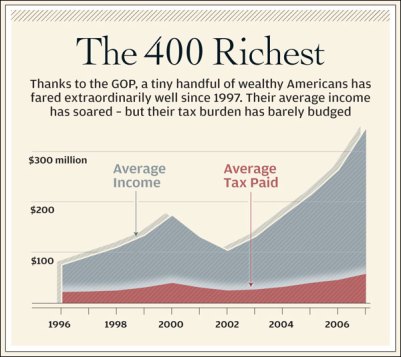 So, what happens when the minority party doesn’t get it’s way on everything? It either holds the economy hostage or changes the rule. Republicans in Congress are playing Calvin Ball to avoid the cuts that super committee failure is supposed to bring to the defense budget. They’re changing their own rules, yet again.
Plus, we’re getting another contradictory argument on taxes. Let the Bush tax cuts expire is “raising taxes”. Letting the payroll tax holiday expire is not raising taxes. How do these folks get through the day without a complete synaptic breakdown? Here’s some details from Reuters. The Murray quoted here is Senator Patty Murray from Washington State.
Murray said Republicans want to extend tax cuts that lowered individual rates — reductions that originated under former Republican President George W. Bush. Those tax cuts run out at the end of 2012.
Republicans have pushed for a permanent extension. Democrats want the tax cuts for the rich to expire.
“In Washington, there are folks who will not cut a dollar unless we raise taxes,” said Kyl, sparking an exasperated reaction from Kerry who noted that Congress has cut about $1 trillion from the budget without any tax hikes.
Republicans want Democrats to agree to do more to find long-term savings in the growing costs of government retirement and healthcare programs.
If no deal is reached by a simple majority of the super committee, automatic spending cuts would start in 2013 — two months after presidential and congressional elections.
Those cuts would be evenly divided between domestic and defense programs. Some Republican members of Congress already are talking about dismantling the automatic cuts to protect the Defense Department from deep reductions.
No serious discussion on deficits can occur without ending the Bush Tax cuts and seriously putting the Pentagon budget on the table. Representatives of the super committe were out full force on the Sunday Morning Talk Show. John Avlon at The Daily Beast points to the political posturing that’s likely still the root of the entire problem. No Republican is willing to compromise any more. Democrats and the President continue to grant many concessions on social programs that leave little left for continuing battle. No where is this more noticeable when the congress passed the old John Chaffee/Bob Dole Republican Health plan under the guise of ObamaCare. The contentious mandate originally came from the Republican side of the aisle from the American Heritage Institute. The twist of facts into partisan narratives has never been worse.
But pervasive hyperpartisan positional bargaining seems to have carried the day. Pessimism has clouded late-inning negotiations. Supercommittee Democrats have offered to put entitlement reforms on the table, but offered few specifics. Republicans have offered limited revenue increases, but tied those to the cutting the top tax rate to 28 percent from 35 percent and permanently extending the contentious Bush tax cuts. Distrust and brinksmanship pollutes the process.
Ironically, but perhaps appropriately, the dysfunctional debate seems to be based around what the term “fair and balanced” actually means.
For Democrats it means a 1-to-1 ratio of tax hikes to spending cuts. For bipartisan groups like the Gang of Six and Bowles Simpson, it means a 3-to-1 ratio. But for too many Republicans, “fair and balanced” means no tax revenues raised at all—a handful of loopholes closed as concessions, like $3 billion from private jets, and the rest collected from spending cuts. The basic dynamic of both sides being willing to slaughter sacred cows is missing despite an avalanche of “more bipartisan than thou” press releases.
The core problem comes from antitax pledges that have dislodged the basic nature of balance sheets in the collective conservative mind—it is all spending, no revenue. Fiscal responsibility has been replaced by fiscal conservatism. Reducing the deficits and debts is no longer the overriding goal, despite Tea Party rhetoric about generational theft or even the balanced-budget-amendment attempt this past week. Instead, keeping tax cuts in place is the one true grail—ignoring the overwhelming popularity of provisions like raising the top rate on people making more than a million dollars a year.
Sane people continue to ask what type of Svengali powers the insane Grover Norquist holds over Republicans? If you want to learn about “The Billionaire’s Best Friend”  who “hijacked the Republican party on behalf of the rich”, go no further than TIm Dickinson’s article in this month’s Rolling Stone. This man continues to hold sway over the Republican congress critterz despite overwhelming public polls that show even Republicans and Independent rank and file don’t support his agenda. Norquest comes from two Republican institutions. He was originally in the Chamber of Commerce which is one organization that has no problem seeing lies and half baked arguments printed in newspapers around the country. Ronald Reagan used him to push his tax reform measures. It’s been one power grab after another backed by nothing more than dogma and a huge budget since then.
Over the past 25 years, Norquist has received funding from many of America’s wealthiest corporations, including Philip Morris, Pfizer and Microsoft. To build a farm team of anti-tax conservatives, Norquist shrewdly took the pledge to state legislatures across the country, pressuring up-and- coming Republicans to make it a core issue before they’re called up to the big leagues. “We’re branding the whole party that way,” Norquist says. “The people who are going to be running for Congress in 10 or 20 years are coming out of state legislatures with a history with the pledge.”
Norquist also built the anti-tax pledge into the DNA of the GOP by hosting weekly Wednesday meetings that enable activist groups representing everyone from gun nuts to home-schoolers to mix with top business lobbyists and conservative officials. The meetings, which began shortly after Bill Clinton was elected, turned Norquist into the Republican Party’s foremost power broker – and gave him a forum to enforce the no-new-taxes pledge as the centerpiece of the GOP’s strategy. “The tax issue,” he says, “is the one thing everyone agrees on.”
Norquist cemented his influence by forging an early alliance with Karl Rove and setting himself up as a gatekeeper to George W. Bush’s inner circle. Then, after Obama was elected, this ultimate Washington insider positioned himself as a leader of the anti-establishment Tea Party, complete with financial support from the billionaire Koch brothers. “These Tea Party people, in effect, take their orders from him,” says Bruce Bartlett, an architect of the Reagan tax cuts. “He decides: This is a permissible tax action, or this is not a permissible tax action. And of course, anything that cuts taxes is per se OK.”
Today, GOP politicians who have signed Norquist’s anti-tax pledge include every top Republican running for president, 13 governors, 1,300 state lawmakers, 40 of the 47 Republicans in the Senate, and 236 of the 242 Republicans in the House. What’s more, the GOP’s Tea Party foot soldiers are marshaled by House Majority Leader Eric Cantor – a veteran of Norquist’s farm team, who first signed the pledge as an ambitious member of the Virginia legislature. Under Cantor’s leadership, Norquist’s anti-tax pledge was directly responsible for last summer’s debt-ceiling standoff that wrecked the nation’s credit rating by leading the nation to the brink of default. “Congress was willing to cause severe economic damage to the entire population,” marvels Paul O’Neill, Bush’s former Treasury secretary, “simply because they were slaves to an idiot’s idea of how the world works.”
Yup. Bush’s former Treasury secretary thinks Norquist has congress hostage to the point that they are “willing to cause severe economic damage to the entire population simply because they were slaves to an idiot’s idea of how the world works.” The result of the work of Norquist and the Republican party has been staggering income inequality.
“The Republican Party has totally abdicated its job in our democracy, which is to act as the guardian of fiscal discipline and responsibility,” says David Stockman, who served as budget director under Reagan. “They’re on an anti-tax jihad – one that benefits the prosperous classes.”
Notice here that I’m quoting Republicans that have had extensive experience in economics, finance, and policy. Funny thing is that the most of these folks aren’t really worried about tanking the economy. What they are worried about is this. If you haven’t read Cannonfire today, you should. First, Cannon points to this. MSNBC got a hold of a memo from a lobbying firm spelling out its plan to use any propaganda means necessary to destroy OWS. The lobbying firm is associated with the American Banker’s Association.
CLGC’s memo proposes that the ABA pay CLGC $850,000 to conduct “opposition research” on Occupy Wall Street in order to construct “negative narratives” about the protests and allied politicians. The memo also asserts that Democratic victories in 2012 would be detrimental for Wall Street and targets specific races in which it says Wall Street would benefit by electing Republicans instead.
According to the memo, if Democrats embrace OWS, “This would mean more than just short-term political discomfort for Wall Street. … It has the potential to have very long-lasting political, policy and financial impacts on the companies in the center of the bullseye.”
The memo also suggests that Democratic victories in 2012 should not be the ABA’s biggest concern. “… (T)he bigger concern,” the memo says, “should be that Republicans will no longer defend Wall Street companies.”
Two of the memo’s authors, partners Sam Geduldig and Jay Cranford, previously worked for House Speaker John Boehner, R-Ohio. Geduldig joined CLGC before Boehner became speaker; Cranford joined CLGC this year after serving as the speaker’s assistant for policy. A third partner, Steve Clark, is reportedly “tight” with Boehner, according to a story by Roll Call that CLGC features on its website.
Another interesting association is noted in the memo.
The CLGC memo raises another issue that it says should be of concern to the financial industry — that OWS might find common cause with the Tea Party. “Well-known Wall Street companies stand at the nexus of where OWS protestors and the Tea Party overlap on angered populism,” the memo says. “…This combination has the potential to be explosive later in the year when media reports cover the next round of bonuses and contrast it with stories of millions of Americans making do with less this holiday season.”
Yup, it’s the divide and conquer strategy again. Since Wall Street can’t make the case, it’s going to use proxies like the Tea Party to do its dirty work. This should be no problem given the astroturf leadership put in place by folks like Dick Armey and Matt Kibbe. These guys are longstanding Republican Beltway insiders. The interesting thing comes in some of the rumors coming out from the committee itself. Supposedly, Boehner had actually agreed to put revenues on the table and provide cover to Republicans that feared Norquist and the Tea Party. Some Democrats never really engaged, some republicans refused to even discuss anything that didn’t include making the Bush Tax cuts permanent for every one, and there was some feeling that the next election would give some indication of which way the wind blows.
A Democratic aide had this eulogy for the supercommittee: “The worm has turned a little bit. The national conversation now is about income inequality and about jobs, and it’s not really about cutting the size of government anymore or cutting spending. 2010 gave one answer to that question. But 2012 will give another, and we’ve got to see what it is.”
I still think economist Jeffrey Sachs has the best take on what the real role of Congress should be in an schizophrenic economy like ours. This is what OWS is trying to point out but is getting blasted for by concentrated efforts in corporate media to publish propaganda. (I have quoted this before, but I’m quoting Sachs again.)
The big political lie of the Super-Committee is that the deficit must be closed mainly by cutting government spending rather than by raising taxes on corporations and the super-rich. Both parties are complicit. The Republicans want to close the deficit entirely by cutting spending; Obama has brandished the formula of $3 of cuts for every $1 of tax revenues. On either approach, the poor and middle class would suffer grievously while the rich and powerful would win yet again (at least until the social pressures boil over).
The key to understanding the U.S. economy is to understand that we have two economies, not one. The economy of rich Americans is booming. Salaries are high. Profits are soaring. Luxury brands and upscale restaurants are packed. There is no recession.
The economy of the middle-class and poor is in crisis. Poverty and near-poverty are spreading. Unemployment is rampant. Household incomes have been falling sharply. Millions of discouraged workers have dropped out of the labor force entirely. The poor work at minimum wages to provide services for the rich.
Until we have some realization that laws put into place for the last 30 years have created markets that are distorted, functional only for a few, and not the least bit reflective of anything remotely “free market”, a portion of the public is going to be willing to vote for people that spread lies. This is why the credibility of any one associated with OWS must be destroyed. The minute a huge portion of us wake up to the lies–much like what happened after publication of the Pentagon Papers and the invasion of Cambodia after Nixonian promises of winding the Vietnam War down–we’re not going to get the policy we need to put things right again. We desperately need to put things right again.
Friday Reads
Posted: November 18, 2011 Filed under: FBI raids, Federal Budget and Budget deficit, income inequality, investment banking, lobbyists, morning reads | Tags: Budget Deficit, buying congress, Jack Abrahamoff, Lobbyists, low corporate taxes, reporting corporate taxes, supercommittee, who are the 1 percent? 24 Comments Good Morning!
Republicans are asking Obama to try to ‘break the log jam” in the subcommittee. I’m not surprised given the President’s known ability to give everything away at the bargaining table. I’m also sure it’s because they can get their lousy policies through and then when they backfire and people get mad, they’ll blame Obama.
Republicans are calling for President Obama to jump into the deficit-reduction talks gripping Washington, reflecting the widespread view that the congressional supercommittee is now headed for a failure.
Lawmakers and congressional aides familiar with the deliberations say the talks have reached a hard impasse, with Republicans locked in an internal struggle over whether to agree to higher tax hikes to cut a deal.
“It’s hard to see us getting a deal unless he comes in at the last minute,” Sen. Dan Coats (R-Ind.) said of Obama, who is on a nine-day trip to the Pacific and not scheduled to return to Washington until Sunday.“We’re in the two-minute drill and closing in on a ‘Hail Mary’ and the quarterback is on the sidelines.
“Unless the leadership, including the president, steps in and saves this thing, I think the consensus is, in terms of coming up with a credible package, all is lost,” Coats added.
There was a surprising lack of urgency on Capitol Hill Thursday as members of the supercommittee talked past one another. Some lawmakers not on the super-panel shrugged at the inaction, saying they were planning to go home for the Thanksgiving recess and noting they don’t have to vote on any deal until next month. Meanwhile, House and Senate leaders indicated they are in no rush to jump in and broker an agreement.
E.J. Dionne, Jr. at Truth Dig says the easiest way to cut the deficit is to do nothing. His thinking reflects some of the things that I’ve been supporting. It includes letting the Bush Ta Cuts expire. I hate to see the triggers on some things, but getting the Pentagon budget trimmed down would be a positive as far as I’m concerned.
Democrats have put huge spending cuts on the table—and keep offering more and more and more. All the Democrats ask in return is that the cuts be balanced by some revenue.
By rejecting their offers, Republicans induce Democrats who are anxious for some deal—any deal—to keep coming their way. The Republican approach is wrong and irresponsible but brilliant as a negotiating strategy. As my Washington Post colleague Ezra Klein wrote this week: “Over the past year, Republicans have learned something important about negotiating budget deals with Democrats: If you don’t like their offer, just wait a couple of months.”
Finally, the Republicans decided they needed to look slightly flexible. So they came up with $300 billion in supposed revenue from a promised tax reform in a plan that also included a proposal to slash tax rates for the rich. There is a lot more tax cutting here than revenue. Rep. Jeb Hensarling, R-Texas, co-chairman of the super committee, who said on Tuesday that this was the GOP’s final offer, reversed field Wednesday afternoon and declared himself open to other ideas.
Even Democrats inclined to capitulate know how shameful agreeing to such a deal would be. And mainstream, centrist deficit hawks should be grateful if a deal on such terms is killed. What Republicans want to do in effect is to make at least 90 percent of the Bush tax cuts permanent. This would only make deficit reduction even harder in the future.
That’s where the do-nothing strategy comes in. Championed early this year in The New Republic by New York Magazine writer Jonathan Chait, it looks even better now because of the spending cuts scheduled to go through if the super committee doesn’t act.
Jack Ambramoff is sure biting the hands that used to feed him. He’s written an article for Bloomberg and calls congress criterz “Willing Vassals” that are up for anything as long as they can cash in. Now that he can no longer make a profit from the game, he’s got some suggestions to end it.
There is only one cure for this disease: a lifetime ban on members and staff lobbying Congress or associating in any way with for-profit lobbying efforts. That seems draconian, no doubt. The current law provides a cooling off period for members and staff when joining K Street. The problem is that the cooling off period is a joke.
Here’s how it works. “Senator Smith” leaves Capitol Hill and joins the “Samson Lobbying Firm.” He can’t lobby the Senate for two years. But, he can make contact with his former colleagues. He can call them and introduce them to his new lobbying partners, stressing that although he cannot lobby, they can. His former colleagues get the joke, but the joke’s on us.
Because the vast majority of lobbyists start on the Hill, this employment advantage is widely exploited. It cannot be slowed with a cooling off period. These folks are human beings, not machines — and human beings are susceptible to corruption and bribery. I should know: I was knee-deep in both. Eliminating the revolving door between Congress and K Street is not the only reform we need to eliminate corruption in our political system. But unless we sever the link between serving the public and cashing in, no other reform will matter.
That’s easier said then done considering the foxes write the rules about how they can behave in the coop. One thing they have managed to do is arrange to avoid taxes. Check out the nifty chart from Felix Salmon at Reuters. It graphs corporate taxes as a percentage of corporate profits. Can you say magically disappear?
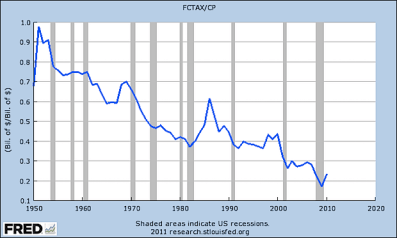
Once upon a time, the corporate income tax generated a significant share of tax revenues; now, it’s bumping along in the 2%-of-GDP range. Yes, the marginal rate of corporate income tax is high, at 35%. But US companies are extremely good at not paying that.
But at least we know the aggregate amount that corporations pay in taxes. What we don’t know — because they won’t say, and no one’s forcing them to say — is how much any given public company pays.
Follow the article to this link to CNN Money that shows you why reporting requirements allow corporations to hide their true tax positions.
During the past few months I’ve repeatedly asked three big companies in the tax-wars cross hairs — GE (GE), Verizon (VZ), and Exxon Mobil (XOM) — to voluntarily disclose information that would refute allegations that they incurred no U.S. federal income tax for 2010. All have refused, saying they won’t disclose anything not legally required. They still manage to complain about the allegations, however. I suspect that if I called the rest of the Fortune 500, I’d get 497 similar responses.
As a society, we need the “taxes incurred” information to inform our current tax debate. Investors, too, would benefit; knowing the tax that companies actually incur would be a useful analytical tool.
The solution, as I’ve said before, is for the Financial Accounting Standards Board to require companies to disclose information from their tax returns for the most recent available year and the nine years before that. This information, from lines 31 and 32 of their returns, would take at most one person-hour a year per company to provide. Adding a 17th tax metric to the 16 already available hardly seems like an invasion of corporate privacy.
Here’s an interesting read in the New York Review of Books by Jeff Madrick entitled “America’s New Robber Barons”.
So it’s worth knowing who is in that group of very rich with runaway incomes. Several news reports in recent weeks have cited a seminal 2010 study that uses IRS tax returns to find out who belongs to the top 0.1 percent. The authors deserve mention because they are often left out when their results are cited: Jon Bakija of Williams College, Adam Cole of the US Treasury, and Bradley Heim of Indiana University. This was not a Treasury study, however, but a private if scholarly one.
One key finding of the study is that three out of five of those in the top 0.1 percent of tax filers are executives or managers of financial and non-financial companies. Overall, more are from non-financial companies. Does this partly exonerate Wall Street, suggesting it is really Main Street where the problem lies?
In fact Bakija, Cole and Heim’s analysis shows the opposite: it turns out that much of the increase in wealth of non-financial executives was also tied to the rise in stock prices. Keeping in mind that stocks options appear as wages in the data, it seems Wall Street itself was often a main source of income growth for “non-financial” managers as well. (Lawyers were another large category of tax payers in the top 0.1 percent, and though there is not direct data for this, one can fairly assume that many of those in corporate firms made a lot of money from the booming business on Wall Street.)
Next, think about how these executives managed their businesses. If they wanted a big pay check they had to orient their strategies to push up their stock prices—that is, often to appeal to the financial fads and fashions of the day. These strategies typically have included cutting labor costs and R&D in order to boost short-term profits. This delighted their advisers on the Street. Stock investors soon loved nothing better than consistent increases in quarterly profits, and not coincidentally, stock options accounted for an ever-growing proportion of executive pay over the past thirty years. We used to say once that Wall Street worked for business, but over the past thirty years business has come to work for Wall Street.
It is just as interesting to explore the factors that the authors found out probably did not cause the surge at the top. Economists typically posit sophisticated technologies (often related to digitalization) as a source of growing inequality: because these technologies require better educated and smarter workers, those who have mastered them are rewarded handsomely. But there was no surge at the very top in other nations like Japan or in Western Europe, which also adopted the same technologies.
Similarly, some have argued that globalization led to higher incomes at the top because skilled workers can sell themselves globally at ever higher salaries. Again, however, such skilled workers have not seen a surge at the very top in Europe or Japan.
One reason for the discrepancy between the US and other countries is that boards of directors in the US are especially willing to give their CEOs and other high level executives big raises and generous stock options. Lucian Bebchuk of Harvard has done a lot of research on this so-called “governance” issue. Meantime, as Bebchuk’s work shows, shareholder influence over executive compensation is far too weak. And there is also the issue of culture itself. America—with its admiration for the self-made man—tolerates high remuneration for the men and women at the top and lower wages in the middle and the bottom. Culture likely matters.
So, that’s a few things to get you started this morning. What’s on your reading and blogging list today?
Taxes are the solution, not the problem
Posted: November 4, 2011 Filed under: U.S. Politics | Tags: 1%, Budget Deficit, Federal Deficit, Super Committee, taxes 18 CommentsAs far as I can tell, if corporations and the top 1% paid anything like a fair share of taxes, budget problems would melt away.
I feel a bit like the recent physicists who seemed to find faster-than-light neutrinos in their data. (There’s the big difference that I’m an amateur at taxes, and they’re anything but amateurs at physics.) But, like them, I’m so boggled by the results that I want to throw it out there for people to pick apart.
Let’s begin at the beginning. The current US deficit is around $1.5 trillion per year. Current US GDP is around $14 trillion per year. Current yearly tax revenues are near $1.1 trillion (IRS pdf, 2008 numbers). In better years revenue is higher, deficits are lower.
An aside: Those numbers are smaller than the multiple trillions of cuts the Super Committee throws around. That’s because they say they need to come up with money for ballooning future costs of social insurance. (The powers-that-be didn’t seem to be worried about the future when tax cuts were implemented.) I don’t consider those future costs a real issue. Social Security doesn’t have any real problems. National health care costs could be cut in half with Medicare for All, based on the evidence from all the industrialized countries that do have national health care systems. (Link is to Congressional Research Service, 2004, pdf. See e.e Table 1, Fig. 1, Fig. 2.) So Medicare for All is the place to start for anyone who is actually concerned about future costs, and not some other agenda.
Further, a healthy deficit level is said to be around 2% of yearly GDP. In addition to other considerations, the ability to buy US Treasury bonds and bills is an important factor in global finance. Zero deficit means the end of that whole asset class, which is not a Good Thing. One wants a sustainable and easily carryable deficit, and 2% is a conservative estimate of that level. Two percent of $14 trillion is $280 billion. (I saw this most clearly expressed somewhere in Krugman’s writing, but all I can find right now is a passing reference here.)
So the yearly shortfall, in round numbers, is $1.2 trillion ($1.5T deficit – 0.280T healthy deficit).
If Fortune 500 corporations actually paid tax on their corporate profits, there’d be much less freeloading from that end. When even Marketwatch headlines “Big Profits, Zero Taxes” you know it’s not a small issue. It’s hard (for me) to find unequivocal numbers on how much difference that would make to revenue, but there are fairly clear data on corporate tax payments as a share of GDP. It’s now at a recent all-time low of 1% of GDP. Moving that back to 4%, about where it was in the 1960s would bring in an extra $480 billion (1% of GDP = $160B, 3% = 480B).
That would entail ending all the corporate loopholes, such as income-shifting in transnationals to whichever tax haven suits them that year, as well as ending special tax breaks for wildly profitable industries such as oil and finance. It would involve adding necessary new taxes, such as a financial transaction tax that would have other beneficial social consequences by slowing down market trading velocity. And it would involve raising rates on large corporations. (Update from comments below: 25 CEOs received more in compensation than their companies paid in taxes. Just mindboggling.)
Then, the other task is to raise taxes on the top 1%. According to the IRS (pdf), in 2008 the top 1% was composed of households making an average of $1.2 million per year. Their effective tax rate is 20% ±5% (CBO pdf, Table 3), and at that rate they contributed well over $350 billion in tax revenue. (For instance, in 2009 the top 1% contributed 36.7% of total income taxes. That proportion is typical during the last decade, plus or minus a few percent. Total income tax revenue in 2008, the last year for which I could find complete IRS data, was $1.081 trillion. 36% of 1.081T = $389 billion.) If their tax rates went to 60%, there would be an extra $700 billion revenue.
So, $700 billion plus $480 billion approaches $1.2 trillion, pretty much the entire yearly shortfall of $1.2 trillion.
That doesn’t pay down the debt. Nor does it provide funds for essential projects such as switching to clean, sustainable energy. But those are one-time charges, as it were, not permanent features of fiscal balance, which I gather is what the Super Committee is worrying about.
Raising taxes on the megarich is not the same as taxing the middle class. It’s not even taxing the upper middle class, such as the heart surgeons and mid-size successful business owners. It involves only having the massively wealthy corporations and households pay something vaguely like their fair share. What’s more, it wouldn’t make a bit of difference to their lifestyles. For an income of $1.2 million per year, that tax increase would drop them from living on $80,000 per month to living on $40,000 per month. They could still jet to Paris for the weekend. Anybody who feels deprived living on $40,000 per month needs therapy, not tax breaks.
All this is something to think about while the news covers the new super ways the Super Committee has found to shred the safety net. Nor is this just a classic “Don’t tax him, don’t tax me. Tax the fellow behind the tree.” The fellow behind the tree has been tax cheating for far too long, and it’s time to rebalance. If the megarich paid their fair share, we could have a future that was more than collapsing bridges and work on their plantations.
Crossposted to Acid Test

 peej
peej Carissa
 bostonboomer
 dakinikat
 ecocatwoman
 mablue2
 Mama Lopez
 peggysue22
 quixote
 skydancingguestblogger
 Mona (aka Wonk the Vote)



 Sky Dancing
Recent Comments