
Lazy Caturday Reads: Putin’s Propaganda War
Posted: March 5, 2022 Filed under: morning reads | Tags: brainwashing, caturday, propaganda, Russian media, Ukraine crisis, Vladimir Putin 28 Comments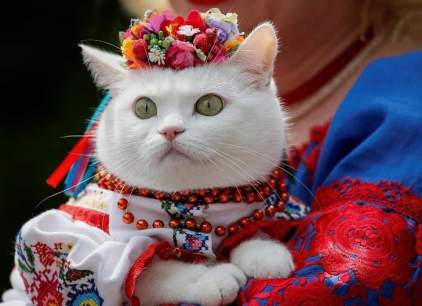
Cat in traditional Ukrainian costume
Good Morning!!
We all know that Fox “News” has seemingly brainwashed many Americans into believing things that simply aren’t true, like Trump’s claims that he actually won the presidential election in 2020. But Russian media is even worse than Fox, and most Russians don’t have alternate news sources readily available. The Russian government is lying to it’s people about what is happening in Ukraine, and many Russians completely buy into the false narratives.
Here’s an example of what some people in Ukraine are going through in trying to get their loved ones in Russia to understand what’s really going on. BBC News: Ukraine war: ‘My city’s being shelled, but mum won’t believe me.’
Oleksandra and her four rescue dogs have been sheltering in the bathroom of her flat in Kharkiv since the shelling began.
“When I heard the first explosions, I ran out of the house to get my dogs from their enclosures outside. People were panicking, abandoning their cars. I was so scared,” she says.
The 25-year-old has been speaking regularly to her mother, who lives in Moscow. But in these conversations, and even after sending videos from her heavily bombarded hometown, Oleksandra is unable to convince her mother about the danger she is in.
“I didn’t want to scare my parents, but I started telling them directly that civilians and children are dying,” she says.
Painting by Francine Van Hove
“But even though they worry about me, they still say it probably happens only by accident, that the Russian army would never target civilians. That it’s Ukrainians who’re killing their own people.”
It’s common for Ukrainians to have family across the border in Russia. But for some, like Oleksandra, their Russian relatives have a contrasting understanding of the conflict. She believes it’s down to the stories they are told by the tightly-controlled Russian media.
Oleksandra says her mother just repeats the narratives of what she hears on Russian state TV channels.
“It really scared me when my mum exactly quoted Russian TV. They are just brainwashing people. And people trust them,” says Oleksandra.
“My parents understand that some military action is happening here. But they say: ‘Russians came to liberate you. They won’t ruin anything, they won’t touch you. They’re only targeting military bases’.”

Masha Gessen wrote about Russian media disinformation at The New Yorker: The War That Russians Do Not See.
A majority of Russians get their news from broadcast television, which is fully controlled by the state. “This is largely a country of older people and poor people,” Lev Gudkov told me. Gudkov is the director of the Levada Center, which was once Russia’s leading public-opinion-research organization and which the state has now branded a “foreign agent.” There are more Russians over the age of forty-five than there are between the ages of fifteen and forty-four. Even those who get their news online are still unlikely to encounter a narrative that differs from what broadcast television offers. The state continues to ratchet up
pressure on the few surviving independent media outlets, blocking access to their Web sites, requiring them to preface their content with a disclaimer that it was created by a “foreign agent,” and, ultimately, forcing them to close. On Thursday, the radio station Echo of Moscow and the Web-based television channel TV Rain, both of which had had their sites blocked earlier in the week, decided to stop operations. What the vast majority of Russians see, Gudkov said, are “lies and hatred on a fantastical scale.”
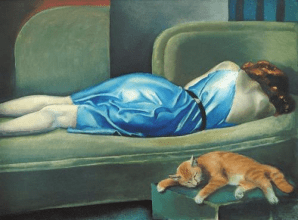
Woman and Cat by Lucian Bernhard
State television varies little, aesthetically and narratively, from channel to channel. Aside from President Vladimir Putin interrupting regular programming in the early hours of February 24th to announce a “special military operation” in Ukraine, the picture has changed little since before the war. There is no ongoing live coverage, no acknowledgment that what’s happening is extraordinary, even as Russian bombs fall on Ukraine’s residential areas and the Russian economy enters a tailspin. The news lineup, too, changes little day to day. On Thursday, the 7 a.m. newscast on Channel One lasted six minutes and contained six stories: a new round of Russian-Ukrainian peace talks in which Russia was eager to seek “common ground”; the “shelling of the Donetsk People’s Republic by the Ukrainian armed forces,” from which “twenty-five civilians have died.” A segue: “And now let’s look at footage from the Chernigov region, an area that is now controlled by the Russian armed forces. . . . Civilians continue driving around on their regular business.” (There were no civilians in the footage shown, only an endless sequence of armored vehicles.) Then: “Russia has prepared more than ten and a half thousand tons of humanitarian aid for the people of Ukraine”; “The West is pumping Ukraine full of offensive weapons”; “Aeroflot is organizing charter flights to return Russian citizens stranded in Europe.” Then the young male host announced, “The next scheduled program is ‘Good Morning.’ ” There was no mention of Kharkiv or Kyiv, which had been bombed the day before. Most remarkably, there was no mention of Russian military casualties, even though on Wednesday the defense ministry had acknowledged four hundred and ninety-eight deaths. (Ukraine has put Russian military losses at more than ten times that number.) The government has banned the use of the words “war,” “aggression,” and “invasion” to describe its “special military operation” in Ukraine. Media outlets that violate these bans face fines and closure. On Friday, the upper chamber of parliament passed a bill making the dissemination of “false information” about the conflict punishable by up to fifteen years in prison. The bill was responsible for TV Rain deciding to stop broadcasting on YouTube: the risks of calling things what they are have become too high—and the cost of trying to walk a fine line, as TV Rain had been doing, was morally unsustainable. Novaya Gazeta, the newspaper edited by Dmitry Muratov, a winner of the Nobel Peace Prize, took a vote among people it calls its “co-conspirators”—those who support the paper through private donations. Sixty-four hundred and twenty people have voted; about ninety-four per cent of them asked the paper to submit to the censorship requirements and continue publishing.
There’s also a good piece on Russian media by Aaron Rupar at Substack: Putin fights the propaganda war at home.
Because of the new law banning what Putin calls “fake news,” but is actually the truth, some western news organizations will no longer broadcast in Russia. The New York Times: Several Western news organizations suspend operations in Russia.
Several Western media organizations moved on Friday to suspend their journalistic operations in Russia in the wake of a harsh new crackdown on news and free speech by President Vladimir V. Putin’s government.
Bloomberg News and the BBC said their correspondents in Russia could no longer freely report because of the new censorship law signed by Mr. Putin on Friday, which effectively criminalized independent journalism on the invasion of Ukraine. Under the legislation, which could take effect as early as Saturday, journalists who simply describe the war as a “war” could be sentenced to prison.
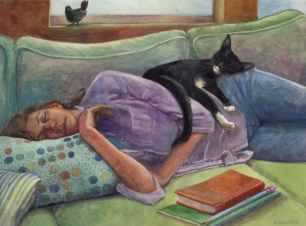
Cat Nap, by Donna Hillman-Walsh
“The change to the criminal code, which seems designed to turn any independent reporter into a criminal purely by association, makes it impossible to continue any semblance of normal journalism inside the country,” Bloomberg’s editor in chief, John Micklethwait, wrote in a note to staff.
CNN International, the global arm of CNN, said it had stopped airing in Russia, and ABC News said that it would not broadcast from the country on Friday. “We will continue to assess the situation and determine what this means for the safety of our teams on the ground,” ABC News, which is based in New York, said in a statement.
News organizations are not necessarily asking their correspondents to leave Russia, at least not yet.
“We are not pulling out BBC News journalists from Moscow,” Jonathan Munro, the interim director of BBC News, wrote on Twitter. “We cannot use their reporting for the time being but they remain valued members of our teams and we hope to get them back on our output as soon as possible.”

The Washington Post: Russia’s independent media, long under siege, teeters under new Putin crackdown.

More on Putin’s crackdown on the press from Anton Troianoveski at The New York Times: Last Vestiges of Russia’s Free Press Fall Under Kremlin Pressure.
As President Vladimir V. Putin wages war against Ukraine, he is fighting a parallel battle on the home front, dismantling the last vestiges of a Russian free press.
On Thursday, the pillars of Russia’s independent broadcast media collapsed under pressure from the state. Echo of Moscow, the freewheeling radio station founded by Soviet dissidents in 1990 and that symbolized Russia’s new freedoms, was “liquidated” by its board. TV Rain, the youthful independent television station that calls itself “the optimistic channel” said it would suspend operations indefinitely.
By Belinda Del Pesco
And Dmitri A. Muratov, the journalist who shared the Nobel Peace Prize last year, said that his newspaper Novaya Gazeta, which survived the murders of six of its journalists, could be on the verge of shutting down as well.
“Everything that’s not propaganda is being eliminated,” Mr. Muratov said.
Precipitating the outlets’ demise were plans by the Russian Parliament to take up legislation on Friday that would make news considered “fakes” about Russia’s war in Ukraine punishable by yearslong prison terms. The Russian authorities have already made it clear that the very act of calling it a “war” — the Kremlin prefers the term “special military operation” — is considered disinformation.
“We’re going to punish those who spread panic using fakes by up to 15 years,” a senior lawmaker, Sholban Kara-ool, said on Thursday. During World War II, he said, such people “were shot on the spot.”
The crackdown on independent journalists — many of whom fled the country this week, fearing that even worse repressions were to come — added to the sense of crisis in Russia. The economy continued to reel from Western sanctions as airlines canceled more international flights and more companies suspended operations — including Ikea, the Swedish furniture retailer, a totem for Russia’s middle class and the employer of some 15,000 Russians.
And we thought Fox News propaganda was bad. I’ll post more news links in the comment thread. Have a great weekend, Sky Dancers!

 peej
peej Carissa
 bostonboomer
 dakinikat
 ecocatwoman
 mablue2
 Mama Lopez
 peggysue22
 quixote
 skydancingguestblogger
 Mona (aka Wonk the Vote)



 Sky Dancing
Recent Comments