
Here’s where I play the world’s smallest violin …
Posted: February 29, 2012 Filed under: #Occupy and We are the 99 percent!, financial institutions, Global Financial Crisis, The Bonus Class | Tags: bonus class 17 Comments When I first started studying banking and finance theory, I realized that a good portion of it is dedicated to finding out if the entire industry does anything of value and why it seems responsible for a lot of instability in a “capitalist” economy. Banking seems simple enough. You pool deposits to provide loans. You ‘safekeep’ those deposits. You provide some payment mechanisms. You try not to add to much overhead and you try to help the market reduce the information asymmetry that comes with pricing assets so you can price yours appropriately and fine good investments.
It’s never been quite that simple however. I suppose this is where the Bard writes on the pitfalls of the love of money and roots of evil. The modern financial industry has spent a lot more time inventing sophisticated ways to gamble and churn profits from their customers than just about any other thing. Service is out of vogue and financial innovation rules the day. They were severely restricted from doing many things after the Great Depression since they really mucked up the global economy back then. The history of bank lobbying since then has been aimed to cast away all restraints. So, we went full circle since 1980. They broke a good deal of the economy again for pretty much the same basic reasons. We’ve had miserably few criminal investigations.
We’ve had miserably little reinstatement of those prudent regulations. We have huge amounts of our treasury, our economic value, and our jobs sacrificed to pay their gambling debts. None of these folks have had to ‘fess up or pay up. Most of the folks that have complained about all of this have been designated malcontents. Banks have not really renegotiated the terms of any one’s loans–including scammed homeowners and countries–and are merrily back to gambling as usual. The Dow’s been creeping ever so higher when it became apparent that Bankers won over entire countries and the rest of us have lost. So, here’s one little tidbit that makes me smile. Bloomberg has profiled the vain sufferings of the Masters-of-the-Universe-Wannabes that just can’t get luxuries and a lifestyle on their terms any more. Boo Fucking Hoo.
Andrew Schiff was sitting in a traffic jam in California this month after giving a speech at an investment conference about gold. He turned off the satellite radio, got out of the car and screamed a profanity.
“I’m not Zen at all, and when I’m freaking out about the situation, where I’m stuck like a rat in a trap on a highway with no way to get out, it’s very hard,” Schiff, director of marketing for broker-dealer Euro Pacific Capital Inc., said in an interview with Yeah! Local, a local marketing firm.
Schiff, 46, is facing another kind of jam this year: Paid a lower bonus, he said the $350,000 he earns, enough to put him in the country’s top 1 percent by income, doesn’t cover his family’s private-school tuition, a Kent, Connecticut, summer rental and the upgrade they would like from their 1,200-square- foot Brooklyn duplex.
“I feel stuck,” Schiff said. “The New York that I wanted to have is still just beyond my reach.”
The smaller bonus checks that hit accounts across the financial-services industry this month are making it difficult to maintain the lifestyles that Wall Street workers expect, according to interviews with bankers and their accountants, therapists, advisers and headhunters.
“People who don’t have money don’t understand the stress,” said Alan Dlugash, a partner at accounting firm Marks Paneth & Shron LLP in New York who specializes in financial planning for the wealthy. “Could you imagine what it’s like to say I got three kids in private school, I have to think about pulling them out? How do you do that?”
So, that’s the face to the problem that really cries out for class warfare. Wall Street’s pay checks are shrinking. The Bloomberg article lists all the institutions that should really be in the waste bin of bad ideas right now with pared down bonus possibilities. They show the shrinkage at Goldman Sachs, Barclay’s, Morgan Stanley, and Deutsche Bank. Jobless is high. Poverty is high. Household net worth has shrunk. Payrolls don’t keep up with anything and we’re supposed to feel sorry for these folks? Oh, cry me a river! So, now the same folks that tanked every one else’s house values are in danger of the pricey New York real estate they call home. Here’s Megan McArdle with a New York Frame of Mind.
I believe that Elizabeth Warren has made this point–when people get into financial trouble, they often say, “Well, I didn’t take fancy vacations or go to restaurants all the time or buy 17 pairs of Jimmy Choos.” But (with the exception of some really compulsive spenders) this isn’t the stuff that gets people into trouble. It’s the big house with the stretch mortgage that you convinced yourself you had to have because it was in a good school district and you needed a yard and a bedroom apiece for the kids. It’s that brand new SUV (or Volvo station wagon) you persuaded yourself to buy because it was important to have a safe car. It’s the school activities or travel sports teams that cost thousands of dollars, which you let your kids start in ninth grade because you didn’t know that you’d have to break their hearts by pulling them out in their junior year. The divorce decree you signed because you didn’t realize your income was going to drop by a third.
Pricey vacations can be cut back. Mortgage payments can’t. It’s not the luxuries that usually get people into trouble–it’s paying too much for “the basics”.
And in New York, it’s really, really easy to pay too much. One of the guys in the article makes $350,000 and lives in 1200 square feet with three kids. This is the way the lower rungs of the lower middle class lives in the rest of the country. New Yorkers face an overwhelming temptation to push their housing budget to the limit, because what’s available on a conservative budget is really inconvenient unless you either make a whole lot of money, or lucked into a great deal in a down market or a transitional neighborhood.
So, here’s my point. Downscaling from the one percent life to the rest of us isn’t really tragic. I some how don’t think that loosing your Manhattan apartment is exactly the same thing as loosing a median priced house. Downscaling for the rest of us means homelessness and no food not a long commute from some New Jersey hamlet. Here’s some more people’s stories from Bloomberg. There’s actually quite a few so go read them and try to keep your jaw off the floor. Here’s McArdle’s particular charity case.
The malaise is shared by Schiff, the New York-based marketing director for Euro Pacific Capital, where his brother is CEO. His family rents the lower duplex of a brownstone in Cobble Hill, where his two children share a room. His 10-year- old daughter is a student at $32,000-a-year Poly Prep Country Day School in Brooklyn. His son, 7, will apply in a few years.
“I can’t imagine what I’m going to do,” Schiff said. “I’m crammed into 1,200 square feet. I don’t have a dishwasher. We do all our dishes by hand.”
He wants 1,800 square feet — “a room for each kid, three bedrooms, maybe four,” he said. “Imagine four bedrooms. You have the luxury of a guest room, how crazy is that?”
The family rents a three-bedroom summer house in Connecticut and will go there again this year for one month instead of four. Schiff said he brings home less than $200,000 after taxes, health-insurance and 401(k) contributions. The closing costs, renovation and down payment on one of the $1.5 million 17-foot-wide row houses nearby, what he called “the low rung on the brownstone ladder,” would consume “every dime” of the family’s savings, he said.
“I wouldn’t want to whine,” Schiff said. “All I want is the stuff that I always thought, growing up, that successful parents had.”
So, now do you get why I don’t by the rational markets hypothesis? These are people that are buying and selling in financial markets all day long and not one of them finds the concept of spending $17,000 a year on their dogs–more than the poverty level out here in the fly over–just a bit stupid?
Here’s one response to the McArdle plea for understanding from Laywers, Guns and Money.
It now seems clear to me that the truly oppressed and misunderstood in this country are living in Greenwich, Connecticut. If my parents hadn’t spent $5000 for every season I played youth soccer, I would be smoking crack right now. Won’t somebody think about the Benetton-clad children???!!???
And another one from a poster at Balloon Juice.
When middle-class people lose their jobs, they need to suck it up and admit that they’re too fucking soft and lazy to live in dormitories like REAL workers do in China. They need to accept cuts to their health care and retirement funds and if they complain about it, they need a lecture on morality from Daddy Bobo.
When people making 400K get bumped down to 300K, it’s a three-hanky tragedy.
Tell me again that Robespierre didn’t have a point.
I’m sorry Megan. I really really really don’t feel their pain. Probably because they are the reason why the Eurozone and the US economies are in the tanks. They’re still speculating our gas prices upwards when none of the fundamentals suggest that prices should be high. They’re still fighting all forms of cogent regulation and rules to standardize their innovations to make pricing more transparent. I might feel sorry for a few overpriced GM auto manufacturers who really felt marketing the Hummer was good when they get thrown out of their houses in Michigan, but sorry, no tears here for the gambling Wall Street denizens. They can just fricking live like the rest of us.
Saturday: Walk Like a Bahraini Youth Activist
Posted: March 5, 2011 Filed under: morning reads | Tags: 2012, Al Jazeera, bonus class, collective bargaining, demography, GOP, Hillary Clinton, Mideast, Obama, Photography, rightwing canard, student loans, womancession, Women's Rights 24 Comments
Click Image to go to the NYT Lens.
Good morning, news junkies!
I’ve gotten quite hooked on the NYT’s new Lens blog, particularly the regular interview/photo essays compiled by Lens editor James Estrin. A couple months ago, Estrin zoomed the focus in on Eirini Vourloumis and her photographs of Spanish-speaking converts to Islam–you may remember my linking to the interview at the time. This week’s spotlight is on Hazel Thompson and her work documenting the roles of women in Bahrain. There’s also a video of Thompson discussing her experiences at the link. Fascinating stuff.
To the right… from Hazel Thompson’s “Measure of a Woman”… The Youth Activist: Enas Ahmed Al-Farden is the vice president of the Bahrain Youth Forum Society. She is also a radio announcer and a product marketing manager. She lives with her parents and is engaged to be married.
If you have some free time after you’re finished reading this roundup, both the spot on Bahraini women and the earlier one on Latino Muslims are well worth the investment. (I’ll link to them again at the end.) In the meantime, here are the rest of my Saturday picks… grab a cup of whatever gets you up and running in the morning and enjoy.
Economy
- Bryce Covert, via The Nation warns “With State Budgets Withering, Get Ready for the ‘Womancession.‘” A few key (and troubling) points I took away from Covert’s piece, which I’ve paraphrased slightly for the sake of brevity:
- As of November, men’s unemployment is down .04 percent over the previous 12 months, and women’s unemployment over the same period is up .04 percent. Between July 2009 and January 2011, women lost 366,000 jobs while men gained 438,000.
- The public sector has shed 426,000 jobs since August of 2008. 154,000 of those jobs were in education. Women comprise only a little over half of the public workforce but have lost 83.8% of the jobs during the recovery-in-name-only.
- And, just look at who is exempt from Walker’s proposal to strip collective bargaining: public officers, firefighters, and state troopers. It’s the public employee unions made up mostly of women that are facing threat of annihilation.
- Covert has another good piece up at New Deal 2.0 you might want to check out: “Student Debt Can be Deadly.” I’ll try to boil it down for you this morning. The average undergrad student graduates with $4,100 in credit card debt and $19,300 in student loans. Couple that with the phenomena of a) college educated 20-24 year olds having the highest percentage increase in unemployment and b) suicide being the second leading cause of death among college students, and you’ll see what Covert means by deadly.
- Wonk’s two cents: The Taxed Enough Already (TEA) crowd never shuts up about the “debt we’re creating for our children,” but they sure don’t seem to be looking in the right place if that’s what they’re really concerned about.
- At least there was a bit of justice on the student loan front for one individual this week–after six years, the Department of Education has finally forgiven the student debt of Tina Brooks, a disabled former cop. Appalling that it took so long. Propublica’s joint investigation with the Center for Public Integrity and the Chronicle of Higher Education found that…
although borrowers who develop severe and lasting disabilities are legally entitled to get federal student loans forgiven, the process for deciding who is eligible is dysfunctional, opaque and duplicates similar reviews conducted by other federal agencies. Many borrowers have been denied for unclear reasons, and many others have simply given up.
- Really bad theatre or comedy gold? You judge: SEC to curb bonus pay for only about 30 institutions.
- On Thursday, Zaid Jilani from Think Progress posted the graph I’ve been looking for. This is what the workers in Wisconsin, Ohio, and Indiana are protesting:

CLICK GRAPH TO GO TO THINK PROGRESS.
Women’s Rights
- The Center for Reproductive Rights’ Melissa Upreti, via RH Reality Check, reports that “Nepal Advances As U.S. Backslides on Women’s Rights.” What takes the cake is that Nepal’s Supreme Court cites Roe in its groundbreaking affirmation of a woman’s autonomy, access to abortion, and well-being over that of a fetus. I almost want to laugh and tell Nepal’s Supremes that their ruling sounds better than Roe. Our dear Roe has, among other things, successfully kept women’s rights in perpetual limbo for almost 4 decades. As much as I believe in the privacy argument, I’m a much bigger believer in the autonomy and equity arguments.
- Anna Clark, via AlterNet, looks at “What’s Next for Women’s Health (And Rights) in Tunisia and Egypt?” According to Clark, family planning was actually decent under both dictatorships. Will the road to self-governance bring more progress for Arab women or are we looking at another backward slide?
- Here’s a good companion essay to read after Clark’s piece. Margot Badran, via the SSRC’s Immanent Frame, writes of “Egypt’s Revolution and the New Feminism.” From Badran’s pen to the goddess’s ear:
Will the youth now be willing to accept patriarchal authoritarianism sustained by the old family law, a law so out of sync with contemporary social realities—with their own realities? It is very hard to see by what logic they could do so. Freedom, equality, and justice cannot be reserved for some only. For the youth, female and male, who raised this revolution, freedom, equality, and justice are surely non-negotiable, and dignity, the order of the day. This is the essence of the new feminism, call it what you will.
- I missed this one last week. William John Cox’s “Political Upheaval and Women’s Rights,” via Truthout. Excellent long view essay. Cox really lays it all out there. Fundamentalism is a threat to women everywhere, be it in the Mideast or in the US.
[There’s more, so if you need a coffee refill or anything, now would be a good time for an intermission before you click to continue. ]
The Parable of the poor little rich people
Posted: January 13, 2011 Filed under: income inequality | Tags: bonus class, Brad Delong, Catherin Rampell, Emmanuel Saez, fractured parables, Income Inequality, Mega rich, Paul Krugman, Robert Reich 16 Comments Last September, Chicago Law Professor and neighbor of the Obama family Todd Henderson complained that he just couldn’t make ends meet on a combined family income estimated to be about $400,000 a year. In February, CNN Morning News Anchor Kiran Chetry interviewed then-White House budget director Peter Orszag. She seemed flummoxed that 1/4 of a million dollars wasn’t a modest family income for civilized parts of the country.
“You also talk about letting taxes expire for families that make over $250,000. Some would argue that in some parts of the country that is middle class.” Back in reality, more than 98 percent of U.S. households make less than $250,000.
What is it with all these rich people who continue to whine about not having enough money to exist when they clearly are very wealthy when compared to the vast majority (98%) of Americans? What kind of warped perspective on life leads them to shed incessant tears during this kind of economy? Why-oh-why do we have such a candy ass batch of plutocrats? Don’t we at least deserve a few that are sincerely rugged?
This is wonky, but there’s a very simple narrative underlying the numbers and analysis.
Catherine Rampell–writing for Economix–offered up an answer in an article called ‘Why So Many Rich People Don’t Feel Very Rich’. It involves a nifty graph. (You know me and nifty graphs.) I actually got a better nifty graph from Brad Delong’s page in a thread called On the Richness of the Rich Once Again. But, I would have never found either nifty graph without the help of ‘Why Does Inequality Make the Rich Feel Poorer?‘ over at Paul Krugman’s blog. I’m going to discuss all of that and harken back to Robert Reich’s thing at Alternet called The Problem Is That America’s Richest 1% Are Raking It in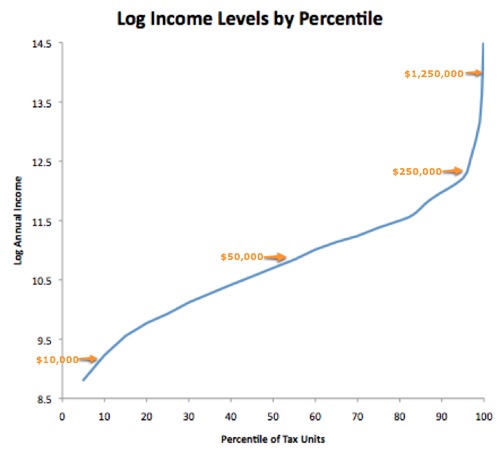 . You should be able to grok the theme of the parable of the poor little rich people by now.
Now what I have to do is explain why the rate of change along the slope of a curve using log income levels by percentile translates into pearl clutching in mamby pamby plutocracts. I know you hate math and it makes your stomach turn. I promise not to use the numbers. We’re going to just talk about the picture and the lines. Over on your right is Brad’s nifty graph. You can see that the curve is upward sloping but the slope varies depending on where you are on the curve.
You can see, however, it is positive at all points. This indicates a direct or positive relationship between two things. If one goes up, the other does too. Because the curve isn’t a straight line, the rate at which the curve goes up is different depending on where you are. This is reflected by the steepness or the flatness of the curve. Think of it as a hill. You have to slog up a steep hill, but a flat hill makes it easier to go forward.
One of the things of interests shown by this graph is the Log of Annual Income and the other is the percentile of tax units. The difference between Rampell’s graph and Delong’s graph is the log calculation. Brad explains why she needs to use the log of annual income compared to the level. Basically, the log turns the comparison in to a growth rate of annual income. A level is simply a level. The log means that we’re using the rate of change happening in incomes as we go up and down the curve. That rate of change is radically different at the richest levels. You can see that the slope almost goes vertical there compared to the middle levels where the curve is less steep and somewhat more horizontal. There’s a story that explains that. Krugman explains it well so I’m going to start with his explanation.
Fed Continues to Subsidize the Bonus Class
Posted: August 3, 2009 Filed under: Equity Markets, Global Financial Crisis, The Bonus Class, The Great Recession, U.S. Economy | Tags: arbitraging government debt, bonus class, Federal Reserve, Financial Times., high volume trading Comments Off on Fed Continues to Subsidize the Bonus Class I’m again relying on the Financial Time’s for this latest bit of no suprises here. The big question is when will the political class pull the rug out from under the bonus class?
Wall Street banks are reaping outsized profits by trading with the Federal Reserve, raising questions about whether the central bank is driving hard enough bargains in its dealings with private sector counterparties, officials and industry executives say.
The Fed has emerged as one of Wall Street’s biggest customers during the financial crisis, buying massive amounts of securities to help stabilise the markets. In some cases, such as the market for mortgage-backed securities, the Fed buys more bonds than any other party.
However, the Fed is not a typical market player. In the interests of transparency, it often announces its intention to buy particular securities in advance. A former Fed official said this strategy enables banks to sell these securities to the Fed at an inflated price.
The resulting profits represent a relatively hidden form of support for banks, and Wall Street has geared up to take advantage. Barclays, for example, e-mails clients with news on the Fed’s balance sheet, detailing the share of the market in particular securities held by the Fed.
“You can make big money trading with the government,” said an executive at one leading investment management firm. “The government is a huge buyer and seller and Wall Street has all the pricing power.”
Let me be clear that the Fed is not a government agency. It makes profits each year from services it provides banks and returns those profits to the Treasury. The Treasury uses the Fed as its agent for a few services but the Fed is a central bank, the bank of bankers. It is not part of the Treasury per se. However, even with that being said, this news continues to be disturbing. Wall Street is gaming the Fed because they can. These things are monopoloy/oligopoly behaviors and we have laws against them!
Barney Frank, chairman of the House financial services committee, said the potential profiteering may be part of the price for stabilising the financial system.
“You can’t rescue the credit system without benefiting some of the people in it.” Still, Mr Frank said Congress would be watching. “We don’t want the Fed to drive the hardest possible bargain, but we don’t want them to get ripped off.”
The growing Fed activity has coincided with a general widening of market spreads – the difference between bid and offer prices – as the number of market participants declines. Wider spreads enable banks, in their capacity as market-makers, to make more profit.
Larry Fink, chief executive of money manager Black Rock, has described Wall Street’s trading profits as “luxurious”, reflecting the banks’ ability to take advantage of diminished competition.
“Bid-offer spreads have remained unusually wide, notwithstanding the normalisation of financial markets,” said Mohamed El-Erian, chief executive of fund manager Pimco in Newport Beach, California.
Spreads narrowed dramatically during the years of the credit bubble.
Brad Hintz, an analyst at Alliance Bernstein, said he doubted that spreads would ever return to those levels, a development that could be pleasing to the Fed.
“They want to help Wall Street make money,” he said.
I’m trying to think why any one would want Wall Street to make huge profits by arbitraging what is basically government debt. Why, in the face of this situation, would Congressman Barney Frank make a lame comment like that? Any one have any suggestion? Read the rest of this entry »

 peej
peej Carissa
 bostonboomer
 dakinikat
 ecocatwoman
 mablue2
 Mama Lopez
 peggysue22
 quixote
 skydancingguestblogger
 Mona (aka Wonk the Vote)



 Sky Dancing
Recent Comments