
Thursday Reads
Posted: January 15, 2015 Filed under: morning reads | Tags: #RememberOurGirls, Boko Haram attacks, Boston Olympics 2024, cartoonists, Charlie Hebdo attack, FBI sting operations, hypocrisy, January thaw, national warming trend, Suicide Attacks 20 Comments
Good Morning!!
Before I get started on the news, I need to ask our readers for a little help. We need about $50.00 to pay WordPress for upkeep on the blog–for our design and extra storage space, that kind of thing. We’d be very grateful if some of our readers would kick in just a small amount to help us pay our bills. If you can spare a few bucks, please click on the “Make a Donation” button down below on the right. Thanks for whatever you can do.
Now that that’s out of the way, on to the news of the day.
A Change in the Weather
Mother Nature has decided to be kind to those of us who are sick and tired of being so cold. There’s a warming trend on the way! From the Weather Channel, January Thaw: Weather Pattern Change to Erase Arctic Blast.
While weather patterns can get “locked in” for lengthy periods of time, one thing is for sure: Change will occur if you wait long enough. If you’re sick of bone-chilling temperatures, you’re in luck. A thaw is now taking shape thanks to a large-scale weather pattern change.
Wednesday morning was the last hurrah for the worst of the cold, with subzero readings again over the Great Lakes as well as parts of the interior Northeast.
A temperature moderation began Wednesday and will accelerate Thursday into Friday.
Our Friday forecast high temperature compared to average map shows that much of the Plains, Rockies and West will be engulfed by above-average temperatures. Some cities, including Omaha, Nebraska and Fargo, North Dakota, could be 10 to 20 degrees above mid-January averages.
The above-average warmth will spread to the East Coast over the weekend.
Read more and watch a video at the link. For the Boston area, it means that for the next 10 days it will be in the 30s and 40s instead of the ‘teens and single numbers. I hope you’ll get warmer days where you live too!
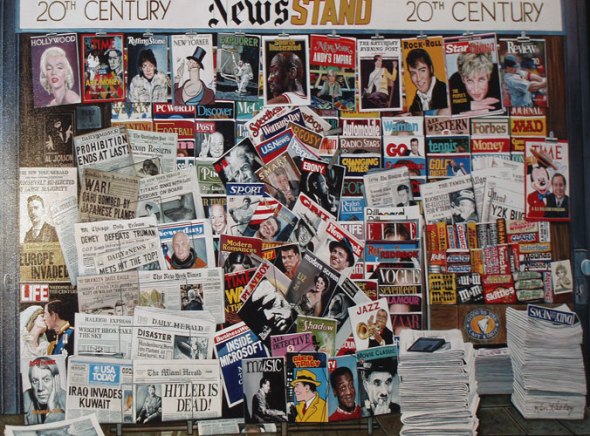
Twentieth Century Newsstand, by Ken Keeley
Boston Olympics Update
On Saturday, I wrote an anguished post about a the Olympic Committee submitting Boston as the U.S. location for the Summer Olympics in 2024. I think this would be a disaster for the city I love. Today The Boston Globe reported on the organized opposition to bringing the Olympics here.
Boston’s Olympic Opposition Lays Out Arguments and Plans.
Boston Mayor Marty Walsh and the Olympic bidding group Boston 2024 have said they believe the majority of the public supports holding the 2024 Summer Games in the Hub. With little public polling on the issue to this point, it’s hard to judge whether that’s the case.
But if No Boston Olympics, the group leading the opposition to the city’s bid, does represent a minority, it showed that it plans to be a vocal one at a public meeting it held in the Back Bay Tuesday night. More than 100 people attended the meeting at the First Church in Boston.
The meeting featured a talk by sports economist and Smith College professor Andrew Zimbalist.
Zimbalist, who has written extensively on the lack of economic benefits sporting events like the Olympics bring to cities and countries, scoffed at the idea that Boston’s bid can be done on a $4.5 billion budget for operating expenses, and said he was skeptical that the budget can be entirely privately financed (as is proposed by Boston 2024). Boston 2024 also says public money would go toward infrastructure and security.
Zimbalist discussed some of the hidden expenses to hosting the Olympics, including the loss of advertising revenue on the MBTA during the Olympics. (The International Olympic Committee has historically required control of advertising space in the host city during and around the Olympics. An example of host city requirements built into the bidding process can be seen here, from page 213 on.) He also said that construction costs can go up if planning falls behind at all, because projects may need to be done in a rush as the Games approach.
“It’s one thing to have a nice idea and say the private sector is going to cover this,” he said. “It’s another thing to have hard contracts.”
On possibility the group is considering is getting a question on the ballot in 2016. This has worked in some cities in the past.
In other cities across the country and the world, opposition groups to Olympic bids have gone directly to the voters. Bids for the 2022 Winter Olympics lost in referendums in Poland and Switzerland.
Perhaps most famously, Colorado voted not to put any state money toward a 1976 Denver Winter Olympics bid. At the time of the bid, Colorado had already been awarded the games for that year by the IOC. But voters said no, leaving the IOC high and dry and in need of a new host. (It got one, in Innsbruck, Austria.) [….]
But going to the voters is not the only method opposition groups have used to oppose the games. A referendum in Oslo, Norway, over whether to host the 2022 Games passed in 2013. Even so, that bid was eventually dropped as the public soured on the idea over the course of the next year. And in Chicago’s bid for the 2016 Games, the Windy City’s opposition group had the opportunity to meet with the IOC and voice its concerns. The IOC ended up choosing Rio, Brazil. It’s also possible the Olympic bid could turn into a 2016 state elections issue.
How do voters feel about the Olympics coming here?
Public opinion polling on the Boston bid has been pretty sparse, but in a survey of likely Massachusetts voters earlier this year, The Boston Globe found 47 percent support for pursuing a bid, with 43 percent against. When asked if they supported taxpayer money going to funding the games, 64 percent of respondents were against the idea, though.
So there is a realistic chance of preventing what I believe would be a terrible mistake.

Boko Harum Attacks
I thought I’d follow up on Dakinikat’s post from Monday, in which she called out the hypocrisy the media and cultural elites for expressing faux outrage over the Charlie Hebdo attack in Paris, while basically ignoring the horrific Boko Harum attacks in Nigeria. Other writers around the internet also noted the disparity in coverage; and several days later, the corporate media has begun to call more attention to the Nigerian situation.
From CNN, Satellite images show devastation of Boko Haram attacks, rights groups say.
Charred ground and cinders mark the sites where once thousands of homes stood. That’s according to a series of satellite images released Thursday by Amnesty International, which the rights group said shows the “horrific scale” of the devastation wrought by Boko Haram militants.
As they’ve trickled out, accounts of the bloody attackson the northern Nigerian town of Baga and surrounding villages have shocked even those all too used to reports of violence by Boko Haram militants.
Witnesses told how the attackers sped into the town on January 3 with grenade launchers — their gunfire and explosions shattering the early morning calm. Some terrified residents fled, while others took refuge in their homes — and were torched with them.
Local officials reported death tolls ranging from hundreds to as many as 2,000 people. But authorities have yet to access the remote area near the border with Chad to get a full picture.
View the before and after satellite images at the CNN link. Tens of thousands of people have been displaced by the attacks.
Of the 30,000 people displaced during the latest attacks, 20,000 camped in Maiduguri city, capital of Borno state, while another 10,000 headed to Monguno town, nearer Baga. Others were stranded on Kangala Island on Lake Chad.
“These people are adding to the hundreds of thousands of internally displaced people and refugees, who have already stretched the capacity of host communities and government authorities,” Amnesty International said….
Boko Haram has terrorized northern Nigeria regularly since 2009, attacking police, schools, churches and civilians, and bombing government buildings.
It has also kidnapped students, including more than 200 schoolgirls who were abducted in April — and remain missing.

Out of Print, by Mariam Meckel
NBC Nightly News reported on Boko Haram’s apparent use of the kidnapped girls as unwitting suicide bombers.
Three suicide bombings by girls aged as young as 10 suggest that Nigeria’s Boko Haram has employed a new tactic of forcing abducted children to blow themselves up, according to experts.
The Islamist sect has been carrying out almost daily killings and kidnappings across northeast Nigeria in a campaign of violence now in its sixth year. Deadly attacks on Saturday and Sunday were carried out by three young female suicide bombers.
These came just days after a week-long killing spree by Boko Haram, in which the group torched at least 10 towns leaving around 2,000 people unaccounted for. Secretary of State John Kerry on Thursday called the attack “a crime against humanity.”It is not clear if the girls were coerced or were even aware they were strapped with explosives, which may have been detonated remotely. But experts say that Boko Haram appears to be using the children it kidnaps — such as the 276 Chibok girls who sparked the #BringBackOurGirls social media campaign — and using them as a readily available supply of suicide bombers.
“It is highly likely that Boko Haram is conscripting young girls to use as suicide bombers,” said Elizabeth Donnelly, assistant head of the Africa program at London’s Chatham House think tank. She told NBC News that these conscripts were little more than “slaves fed by countless abductions since the crisis started.”
Boko Haram roughly translates to “Western education is sinful.” The group aims to create its own state based on strict Islamic law.

Newsstand, by Linda Apple
At Huffington Post, Okello Kelo Sam wrote about the #RememberOurGirls twitter campaign, Amid Boko Haram’s Latest Killings: I Vow to #RememberOurGirls.
Eight months is a long time. Long enough for international outrage to rise, fall and fade away. That’s how long it’s been since Boko Haram militants stormed a secondary school in the northeastern village of Chibok in Borneo State, abducting more than 200 still-missing teenage girls.
A global Twitter campaign – #BringBackOurGirls – caught fire with the help of US First Lady Michelle Obama, former US Secretary of State Hilary Clinton, UK Prime Minister David Cameron and, most importantly, millions of global hashtag activists. They focused the world’s attention on the girls, leading to support from the US, UK, France, Canada, China, Iran and Israel, reportedly in the form military intelligence and special forces…..
Meanwhile, the international efforts to recover the girls failed. So did several rounds of negotiations to exchange the girls for the release of captured Boko Haram fighters held in Nigerian jails….
Sam himself was a victim of the violence in Africa. He was abducted and forced to be a child soldier in Uganda. He was able to escape, but later his younger brother was also forced into combat with Joseph Kony’s group and lost his life.
Yes, I lost my brother. But I never lose hope. I do, however, fear hope for the Nigerian girls is slipping away, internationally. Media tickers marking the days since their abduction have disappeared from front pages, web pages and broadcast reports. Sometimes I wonder: Does anyone still remember the 219 missing girls?
They do in Abuja. Every day the Bring Back Our Girls demonstrators – which fueled the hashtag campaign – rally at Unity Fountain in Abuja, Nigeria’s capital. Families of the missing girls, neighbors, and fellow countrymen congregate and chant the now-familiar mantra: “Bring back our girls.” [….]
It’s easy to naysay advocacy efforts like #BringBackOurGirls as “slacktivism.” After four million Tweets, the 219 girls have not been rescued. So what’s the point, right? Wrong. Until a social-media savvy Nigerian lawyer, Ibrahim Abdullahi, came up with #BringBackOurGirls, there was a practical media blackout of the abductions.
Had it not been for this social media campaign I wonder if anyone outside of Africa would know about the Chibok girls? Would the story have lasted more than one news cycle in the West? Would you be reading this now?
No, social media won’t return the girls. But it got my attention and probably yours. It’s been said by the demonstrators what is needed is a renewed campaign to once again gain mindshare of a distracted world. Mine is one voice of millions demanding the girls’ rescue. But I stand in solidarity with those at Unity Fountain and declare this My 2015 Resolution: I will #RememberOurGirls.
Please go read the whole article at HuffPo. Today, I resolve to remember those lost girls.
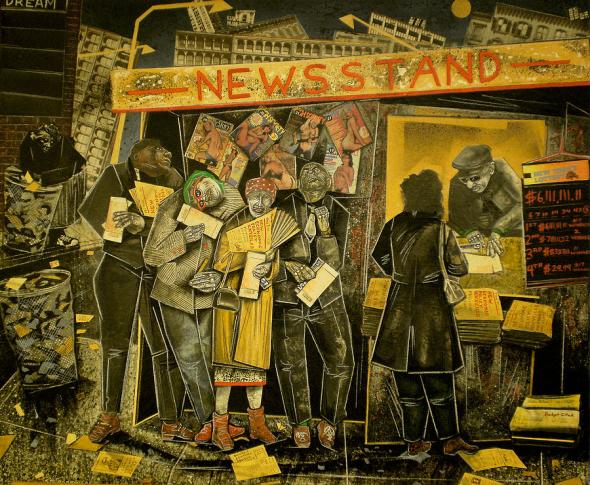
Newsstand, by Sol Robbins
In Other News . . .
CNN, After four years, American cartoonist Molly Norris still in hiding after drawing Prophet Mohammed.
Vox, Vox got no threats for posting Charlie Hebdo cartoons, dozens for covering Islamophobia
NYT, Oklahoma to Resume Executions 9 Months after a Lethal Injection Went Awry.
WCVB Boston, Phase 2 of jury selection set to begin in Tsarnaev trial: Judge set to start questioning prospective jurors.
The Hill, GOP presidential convention to be held earlier in 2016.
SFGate, Ohio man accused of plotting to attack US Capitol, arrested.
ABC News, Dad Accuses FBI of Setting Up ‘Mommy’s Boy’ Son in Bomb Plot.
WaPo, Teachers: Ohio man accused in terror plot a typical student.
Global Research, FBI Thwarts Terror Plot on Capitol (That They Planned).
Vox, Days after free-speech rally, France arrests a comedian for this Facebook post.
Mediaite, ‘Je Suis Confused’: Stewart Tackles France’s Hypocrisy for Arresting Comedian.
CBS New York, De Blasio: I Won’t Apologize To Police For My ‘Fundamental Beliefs’.
What stories are you following today? Please post your thoughts and links in the comment thread and have a tremendous Thursday!

 peej
peej Carissa
 bostonboomer
 dakinikat
 ecocatwoman
 mablue2
 Mama Lopez
 peggysue22
 quixote
 skydancingguestblogger
 Mona (aka Wonk the Vote)



 Sky Dancing
Recent Comments