
Friday Reads
Posted: July 26, 2013 Filed under: morning reads | Tags: Bobby Jindal, disimagination, Gulf coast, Halliburton, Marilyn Monroe Photos, Oil Industry-captured politicians, oil spill 30 Comments Good Morning!
There appear to be a few interesting headlines up this morning for a good change. Some of them actually involve stories that we’ve followed here for some time. I have a few things involving the Gulf Coast, Oil Spills, and Coastal Restoration. The breaking news is that Halliburton is going to plead guilty in the Gulf Gusher case.
Oilfield services giant Halliburton has agreed to plead guilty to destroying evidence in connection with the 2010 Gulf of Mexico oil disaster, the Justice Department (DOJ) announced Thursday evening.Halliburton was the cement contractor on BP’s ill-fated Macondo well that blew out in April of 2010. The blowout and explosion of Transocean’s Deepwater Horizon rig killed 11 workers and ultimately dumped several million barrels of oil into the Gulf of Mexico.Halliburton has agreed to pay the “maximum-available statutory fine,” will be subject to three years of probation and continue cooperating with the federal government’s ongoing criminal probe, DOJ said in a summary of the case.
I’m not sure if you have heard this news but there is an additional leaking oil rig in the Gulf right now. It’s spewing natural gas and has been on fire. Forty-Seven folks were rescued from the rig about two days ago.
A fire has broken out on a rig drilling for gas in the Gulf of Mexico, 55 miles (85km) off the Louisiana coast, US officials say.
A blowout at the well on Tuesday morning forced the evacuation of 44 workers from the platform.
US Coast Guard and federal safety officials are still trying to assess the potential hazards.
The area was hit by the Deepwater Horizon rig that exploded in 2010, leaking millions of gallons of oil.
Eleven oil rig workers were killed in what was the worst US offshore disaster.
The latest blowout was not of that magnitude, officials told the Associated Press news agency.
On Wednesday morning the Bureau of Safety and Environmental Enforcement (BSEE) said the fire was damaging the rig structure.
“As the rig fire continues, the beams supporting the derrick and rig floor have folded and have collapsed over the rig structure,” the agency said in a statement.
But after an aerial tour of the rig, no gas sheen was visible on the water surface.
One Coast Guard cutter, Pompano, is near the scene and another, Cypress, is travelling to the area.
In addition, “a third vessel equipped with fire-fighting capability and improved monitoring system is enroute,” the BSEE added.
The portable drilling rig – which operates in shallow waters of 154ft (47m) – is owned by Hercules, a contractor for the exploration and production company Walter Oil & Gas Corporation.
The BSEE said the fire broke out while workers were completing construction of a “sidetrack well”. The purpose of the sidetrack well was not immediately clear, but industry analysts say they are sometimes used if there is a problem with the main well.
The most disgusting of the headlines explains the actions of my idiot Governor Bobby Jindal who is trying to protect the oil and gas industry from local governments trying to get coastal restoration and clean up funds. He is trying to interfere with them and trying to get the taxpayers to foot the bills.
The board that oversees the levees in the New Orleans region filed suit in state court Wednesday against about 100 leading oil and gas companies, asking that they repair damage done by the industry’s network of access roads and pipeline canals, which has contributed to the loss of thousands of acres of wetlands a year since the 1930s.
But by the end of the day, Gov. Bobby Jindal (R) said the Southeast Louisiana Flood Protection Authority had overstepped its purview, and he demanded that it cancel contracts with the four law firms that had agreed to handle the case on a contingency basis.
In the suit, the flood authority asks the oil and gas companies to restore the wetlands, which once acted as essential buffers against storms. Without them, the authority said, too much pressure is placed on its levees, which were designed as protection against Mississippi River floods, not as bulwarks against the Gulf of Mexico.
Jindal, however, said the best strategy is to persuade the federal government to share more of its royalties with states to finance restoration projects.
The flood authority’s lawsuit — and Jindal’s response — mark another chapter in a state where politics and oil have been closely entwined for decades. Onshore oil production in Louisiana began in the early 20th century and peaked at 1.35 million barrels a day in 1970, according to the Energy Information Administration, providing the industry with influence.
“For nearly a century, the oil and gas industry has continuously and relentlessly traversed, dredged, drilled and extracted in coastal Louisiana,” the flood protection authority said in its lawsuit. “It reaps enormous financial gain. . . . Yet it also ravages Louisiana’s coastal landscape.”
The agency added that “an extensive network of oil and gas access and pipeline canals slashes the coastline at every angle, functioning as a mercilessly efficient, continuously expanding system of ecological destruction.” It said that the canal network allowed “corrosive saltwater” to flow into interior coastal lands, “killing vegetation and carrying away mountains of soil.”
“What remains of these coastal lands is so seriously diseased that if nothing is done, it will slip into the Gulf of Mexico by the end of this century, if not sooner,” the lawsuit asserts.
I am wishing and hoping and praying that our next Fed Chair will be a woman. Specifically, I am pulling for Janet Yellen. You may recall that I lived blogged a speech she gave about 1 1/2 years ago for the FMA Conference in Denver where I was presenting a paper. She has a lot of fans and her reported competition is Larry Summers.
A letter circulating among U.S. Senate Democrats in support of Janet Yellen’s candidacy to succeed Ben Bernanke as the Chairman of the Federal Reserve, Bloomberg reports.
It was drafted by Senator Sherrod Brown, a Democrat from Ohio, and it is said to have signatures of other Democrats.
Bernanke’s term ends this year, and many expect him to retire.
Yellen, who is currently the Vice Chair of the Fed, has been long considered the favorite for the position.
But in more recent periods, former Treasury Secretary Larry Summers has emerged as someone who could also take the vacated spot.
Just yesterday, Ezra Klein wrote a piece titled “Right now, Larry Summers is the front-runner for Fed Chair.”
“President Obama really likes Summers,” said Klein. “And he’s surrounded by Summers’s longtime colleagues and friends.”
Earlier today, House Minority Leader Nancy Pelosi praised Yellen during an interview with Bloomberg’s Al Hunt.
“I think it would be great to have a woman — first woman chairman of the Fed, no question about it,” she said. “She’s extremely talented. It’s not just that she’s a woman.”
Robert Reich put the choice a bit more succinctly on his facebook page yesterday.
Word in Washington is President Obama will nominate either Janet Yellen or Larry Summers to be the next Fed chief. It’s not quite as important a decision as a Supreme Court nomination but it’s a very big one: The Chairman of the Federal Reserve Board is the single most important economic player in the United States. So who would be best — Yellen or Summers? I know both fairly well. Janet Yellen has impeccable credentials. She’s now vice-chairman of the Fed, after having been head of the San Francisco branch of the Fed, and before that, an economics professor at Berkeley. In 2007 she was one of the very few voices sounding the alarm about the sub-prime mortgage crisis. Not incidentally, she’s also a delightful person. Those who have worked with her tell me she listens carefully to all views, and is respectful of her employees. If selected, she’d be the first woman to head the Fed.
I worked with Larry Summers in the Clinton administration, where he eventually became Treasury Secretary. Under Obama, he ran the National Economic Council. Personally, I like Larry. He’s very bright, and able to see the nub of most policy problems very quickly. But he has the tact and personality of a bull in a China shop, and he’s been notoriously wrong about a few big things. In the late 1990s, he urged Clinton to sign off on legislation killing off Glass-Steagall, and was also part of the Rubin-Greenspan cabal that rejected the arguments of Brooksley Born, then chair of the Commodity Futures Trading Commission, for why the CFTC should regulate financial derivatives. Summers’ subsequent tenure as president of Harvard came to an end after he suggested one reason women were not well-represented in the sciences is they don’t have the mind for it. As chair of the National Economic Council under Obama, he and Tim Geithner, then Treasury Secretary, bailed out Wall Street while refusing to impose tough conditions on the banks.
Yet another person speaks out on the lack of critical and rational thought in our national conversation. This is from Henry A. Giroux at Truthout. It’s an essay that is worth reading.
America has become amnesiac – a country in which forms of historical, political, and moral forgetting are not only willfully practiced but celebrated. The United States has degenerated into a social order that is awash in public stupidity and views critical thought as both a liability and a threat. Not only is this obvious in the presence of a celebrity culture that embraces the banal and idiotic, but also in the prevailing discourses and policies of a range of politicians and anti-public intellectuals who believe that the legacy of the Enlightenment needs to be reversed. Politicians such as Michelle Bachmann, Rick Santorum and Newt Gingrich along with talking heads such as Bill O’Reilly, Glenn Beck and Anne Coulter are not the problem, they are symptomatic of a much more disturbing assault on critical thought, if not rational thinking itself. Under a neoliberal regime, the language of authority, power and command is divorced from ethics, social responsibility, critical analysis and social costs.
These anti-public intellectuals are part of a disimagination machine that solidifies the power of the rich and the structures of the military-industrial-surveillance-academic complex by presenting the ideologies, institutions and relations of the powerful as commonsense. [1] For instance, the historical legacies of resistance to racism, militarism, privatization and panoptical surveillance have long been forgotten and made invisible in the current assumption that Americans now live in a democratic, post-racial society. The cheerleaders for neoliberalism work hard to normalize dominant institutions and relations of power through a vocabulary and public pedagogy that create market-driven subjects, modes of consciousness, and ways of understanding the world that promote accommodation, quietism and passivity. Social solidarities are torn apart, furthering the retreat into orbits of the private that undermine those spaces that nurture non-commodified knowledge, values, critical exchange and civic literacy. The pedagogy of authoritarianism is alive and well in the United States, and its repression of public memory takes place not only through the screen culture and institutional apparatuses of conformity, but is also reproduced through a culture of fear and a carceral state that imprisons more people than any other country in the world.
One last interesting item that’s worth looking at. More than 3.700 photos of Marilyn Monroe are going on the auction block in LA.
The photos — plus negatives, slides and copyrights — are part of a collection of more than 75,000 images taken by fashion photographer Milton Greene in the 1950s and 1960s.
They will go on the block both at the auction house and online on Saturday.
By pairing the images with their copyrights, buyers will be allowed to print, sell and earn royalties off the photos.
The photographer’s son Joshua Greene said earlier this month in online journal The Huffington Post that it was “a bad business deal.”
The archive also includes photos by Greene of Steve McQueen, Paul Newman, Elizabeth Taylor, Richard Burton, Farrah Fawcett, Jane Fonda, Ava Gardner, Cary Grant and Audrey Hepburn.
Some of the Monroe photos depict a racy starlet against a black background, covered in a black sweater that highlights her bare skin.
Other more innocent shots show Monroe in a white coat against a white background.
Greene and Monroe met in 1953 at a photo shoot for Look magazine, when the photographer was 26.
When Greene sent her a copy of the images, Monroe responded with two dozen roses and phoned to say they were the most beautiful photos she had ever seen, according to the Profiles in History auction house.
During the next four years, until Monroe married Arthur Miller, Greene took more than 5,000 pictures of her, the auction house said on its website.
Greene worked for magazines such as Vogue, Glamour and Harper’s Bazaar during his long career.
Be sure to check out the photos. Some of them are truly amazing.
So, that’s enough to get us started this morning. What’s on your reading and blogging list today?
Bobby Jindal: Right Wing Vote Troll
Posted: April 13, 2013 Filed under: Bobby Jindal, New Orleans | Tags: Bobby Jindal, Stupid Governor, Stupid Party 15 CommentsI’d like to suggest Brown University call the Governor of Louisiana up to yank his degree in science. He obviously learned nothing. I’d also like NBC to explain why it felt  interviewing a governor for an education feature that has the most anti-education agenda that’s ever come down the pipe in any state. How many governors of states do you know have defunded higher education in their state by over 40% and bragged about draining state education funds to schools that teach that dinosaurs roamed the garden of Eden and the Loch Ness Monster is real? Because, well, that’s Governor Bobby Jindal’s education plan. However, we all know that he’s just trolling for right wing votes and funding for his upcoming presidential run. Yes, good education for children is all about public funding of christofascist madrassas, NBC! Way to give air time to the crazy!
Jindal also said he has no problem with creationism being taught in public schools as long as a local school board OK’s it. Since the state is committed to national academic standards, he said, as long as schools are teaching evolution they should be allowed to teach other theories as well. “What are we scared of?” he said. “Let (students) debate and learn … give them critical thinking skills.”
Once again this year, anti-creationism activists led by college student Zack Kopplin and state Sen. Karen Carter Peterson, D-New Orleans, are trying to repeal the 2008 Louisiana Science Education Act that permits science teachers to use “supplemental materials” in the classroom.
Also voicing support for vouchers earlier in the afternoon was state Education Superintendent John White, who tried to depoliticize the issue. When he was a child, he said, the kindergarten in his neighborhood was lousy, so his parents voted with their pocketbook and sent him to private school. He said he has trouble, “on a moral basis, explaining why I shouldn’t extend that right to a person whose wallet” isn’t as full as his parents’ was.
White also promoted his plans to unify the state’s disparate early childhood programs and improve career and technical education in high schools. For students who don’t want a four-year traditional college education, “What is their viable path to the American middle class?” he asked, pointing out that many jobs in Louisiana require advanced training but not a college diploma.
On the whole, White expressed optimism about the direction New Orleans schools are going, saying, “I think this is a Silicon Valley of public education in America.”
 Oh, be sure to take John White’s word for it. Afterall, he’s a professional liar with the thinnest education resume ever but he’s Jindal’s pointman on trolling for evangelical support with dubious educational policies and figures that never stand up to fact checks. Jindal’s antics are beginning to be outed in blogs and media every where. It just seems NBC didn’t have enough researchers on staff to get the notice and Hoda Kotb is spending way too much time with wine and what’s her name up there in NYC.
Louisiana Governor Bobby Jindal is on the defensive; his far right social agenda has been soundly rejected by voters, and his popularity has imploded as the public understands exactly what Jindal has been trying to pull. And yesterday he gave an interview that made it even clearer: despite his talk about “moderation,” Bobby Jindal is just as much of a religious fanatic reactionary as any other Republican: Jindal Defends School Vouchers in NBC Interview.
I believe this is the first time Jindal has come right out and said he’s in favor of teaching creationism in public schools, although it’s been obvious from his political agenda. This is the GOP “reformer” — just another anti-science caveman.
In a way I’m glad to see him finally dropping all the pretense and openly admitting what his voucher program is intended to do: put right wing religious mythology on an equal footing with modern science, and instill government-sanctioned ignorance in the children of Louisiana. It’s nauseating, but at least it’s now out in the open.
You know this is totally anecdotal, but I’ve taught undergrad and grad classes in Louisiana in several universities. I just don’t see any difference between kids coming out of the public schools and kids coming out of the private schools that stay here and attend local universities. I think the folks down here are pretty deluded about the outcomes they think their kids are getting from private schools. The public school where I come would kick the ass of the best private schools down here in no time flat but then, high property taxes there have always supported the schools. Granted, the talented kids from both sets of schools here leave the state and go elsewhere pretty quickly.
The thing that drives private school attendance seems to be folks looking to stay within a very narrow social group, racial group, religious group or whatever. The performance of the private charter schools down here are as varied as the public schools down here. Same with the religious ones. The one thing I will say thing New Orleans Public School now guarantee is a ‘creationist’ free zone. That alone means some sanity you won’t find other places. Just a reminder, here’s a link to MOJO and 14 completely whacky things that kids learn down here in schools that are now getting our precious state dollars.
“Bible-believing Christians cannot accept any evolutionary interpretation. Dinosaurs and humans were definitely on the earth at the same time and may have even lived side by side within the past few thousand years.”—Life Science, 3rd ed., Bob Jones University Press, 2007
1. He permits Louisiana schools to teach creationism. Thanks to Jindal’s educational voucher system in Louisiana, students will be attending private or parochial schools on the taxpayer’s dime. But those schools don’t necessarily meet the standards of the state’s public schools, and may teach students creationism instead of standard science curricula.
2. He allows state employees to be fired for being gay. During his first few months as governor, Jindal decided not to renew an anti-discrimination executive order protecting LGBT employees who work for the state. Jindal has also said that same sex marriage opens up a path for courts to overturn the Second Amendment.
3. He has signed bills to intimidate women seeking abortions. Jindal compared women who have gotten abortions to criminals. But that unpalatable sentiment also came with a policy change — he signed a bill that requires all abortion clinics to post intimidating messages in their waiting rooms, and establishes a website that points women to crisis pregnancy centers instead of abortion-providing facilities. Jindal also signed a measure creating a 24-hour waiting period between a woman’s mandatory ultrasound and the date of her abortion.
4. He seeks to dramatically cut taxes for the wealthy, increase taxes for everyone else. Jindal’s latest tax proposal would raise taxes for 80 percent of Louisianians. The poorest 20 percent — with an average income of $12,000 — would face substantial tax increases, while those in the top one percent would on average get a tax cut of $25,423.
5. He refuses to provide health care for Louisiana’s poorest. Louisiana has the third highest uninsured rate in the country. Twenty percent of residents lack insurance of any kind. But as one of the governors vehemently opposed to Obamacare, Jindal turned down the Medicaid expansion offered under the law, ignoring the fact that it would drastically lower the numbers of uninsured and ultimately save the state money on emergency care.
Yup, NBC. That is certainly the type of guy you want to interview on the value of a good education. Way to go!!!
Poke a fork in his buns cause Jindal’s Done …
Posted: April 9, 2013 Filed under: 2016 elections, Bobby Jindal, Psychopaths in charge | Tags: Bobby Jindal, reverse robin hood, stealin from the poor and givin to the rich 13 Comments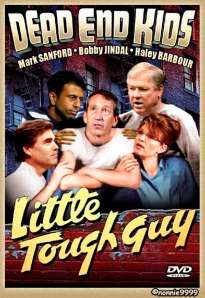 Ah, the sweet sounds of media all over the country writing obituaries for Bobby Jindal’s political career. It’s hard not to gloat from my little corner of the state that finally wised up. He’s just been called the “R” word. That would be Romney.
Monday’s article on the nation’s least popular governors did not include Gov. Bobby Jindal of Louisiana, because he is not up for re-election in 2014. (Louisiana’s next gubernatorial election will be in 2015, and Mr. Jindal will not be eligible, having served two consecutive terms.) But recent surveys suggest that Mr. Jindal has become very unpopular in his home state amid a series of battles on fiscal policy. A March poll from Southern Media & Opinion Research put Mr. Jindal’s approval rating at just 38 percent, against 60 percent disapproval. His numbers had been similarly poor in a February survey by Public Policy Polling.
Some national political commentators are treating the news as being self-evidently injurious to Mr. Jindal’s chances of capturing the Republican presidential nomination in 2016. Obviously, Mr. Jindal has plenty of time to turn around his image in Louisiana. But if he doesn’t, would Republicans really consider nominating someone who is so deeply unpopular among his own constituents?
Actually, you don’t have to go back very far to find a precedent for when Republicans did exactly that. Their nominee last year, Mitt Romney, was very unpopular among Massachusetts voters by the time he finished his single term as governor in 2006.
Can you hear the sound of the funeral pipes playin’ over Bayou Corne? Maybe it’s just the bat phone in Baton Rouge ringing so that Grover Norquist and the Koch Brothers can call the Governor on his retreat from their pet ALEC policies. Excuse me whilst I enjoy my champagne.
In a short address Monday on the first day of the legislative session, Gov. Bobby Jindal described why his next big plan — a plan that had been applauded by conservative pundits nationally, pitched at meetings around the state and promoted in slickly produced commercials — was crucial to Louisiana’s success.
Then he announced he was shelving it.
“Governor, you’re moving too fast, and we aren’t sure that your plan is the best way to do it,” Mr. Jindal said, describing what he had heard from legislators and citizens alike.
“Here is my response,” he said. “O.K., I hear you.”
The plan, to get rid of the state income and corporate taxes and replace the lost revenue with higher and broader sales taxes, was not dropped altogether. Mr. Jindal emphasized that he was still committed to losing the income tax, but that he would defer to the Legislature to suggest how exactly to make that work.
But it was a rare admission of defeat for Mr. Jindal, 41, a constant Republican in the mix for 2016 and rising conservative luminary since his early 20s. And it was only the latest in a season of setbacks.
In the fall, Mr. Jindal was tapped to lead the Republican Governors Association and after the 2012 election appeared often on national op-ed pages and at Washington forums, diagnosing the party’s ills and earning a reputation as a politician who could deliver straight talk.
Back home in Louisiana his troubles were piling up. Unfavorable polls, once discounted as the byproduct of an ambitious agenda, were only getting worse — recently much worse.
The governor’s statewide school voucher program, a pillar of his education reform package, was blocked by a trial court judge on constitutional grounds.
Judges have since also blocked his revamp of teacher tenure rules and a change of the state retirement system (the administration has appealed the rulings and is pushing for legislative action should they stand).
Then at the end of March, Mr. Jindal’s health secretary, Bruce Greenstein, announced his resignation amid reports of a federal grand jury investigation into the awarding of a $185 million state contract. Mr. Greenstein had also been the point man for one of the administration’s most complex, consequential and potentially risky projects: the accelerated transfer of the state’s safety-net hospital system to a system of public-private partnerships.
All along, opposition to the tax swap was growing broader and more bipartisan by the day. Clergy members urged the governor to drop the plan, saying it could hurt the poor, while the state’s most prominent chamber of commerce group came out against the plan for its potential impact on businesses.
Yes, there will be no obvious robbing from the middle class poor in the land of the Kingfish this year! Can we just use TPM’s words and say POLITICAL COLLAPSE!
Sure the GOP may need a little outreach here and a little fine tuning there, but Republicans in Washington say they’re confident that a principled message of low taxes and cuts to social services will eventually propel them back to victory. They may want to take a look at Louisiana first.
Governor Bobby Jindal (R-LA), considered a leading presidential contender in 2016, is suffering a political meltdown in his home state. His approval rating plummeted to 38 percent in a poll last week by the non-partisan Southern Media Opinion & Research, down from 60 percent just a year ago. In an ominous sign for national Republicans, the immediate cause is a sweeping economic agenda with strong parallels to the House GOP’s latest budget.
On Monday, Jindal scrapped his own proposal to eliminate the state’s income and corporate taxes and replace them with a statewide tax on sales and business services. His retreat was a concession to the reality that the proposal was headed towards a humiliating defeat — and taking Jindal down with it along the way. Jindal said in a speech to lawmakers that the backlash against his plan “certainly wasn’t the reaction I was hoping to hear,” but that he would respect the public’s wishes and start again.
Jindal’s proposal was different than tax plans by national Republicans like Mitt Romney and Paul Ryan in that it planned to eliminate income and corporate taxes entirely instead of just lower rates, but the provisions that inflamed the public against it overlap plenty with national GOP proposals. Namely, both plans generated complaints from economists that they would require regressive tax increases on the poor and middle class to pay for lower taxes for the wealthy.
Grover Norquist, the intellectual leader of the anti-tax crowd in Washington, had praised Jindal’s plan as “the boldest, most pro-growth state tax reform in U.S. history.” He noted that it was particularly significant, because with Obama positioned to veto anything resembling the House GOP’s budget for the next several years, Louisiana might be Republicans’ best chance to show off their tax ideas on the state level.
“The national media and Acela-corridor crowd continue to focus on the bickering Washington, but they can learn what real tax reform looks like by looking to Louisiana,” Norquist said.
It didn’t turn out that way. Only 27 percent of Louisiana voters supported the plan in the latest SMOR poll versus a whopping 63 percent opposed. The idea didn’t even garner majority support among Republicans.
I guess we’re not as dumb as they think we look. However, I think Jindal is not as smart as they think he is either …
Saturday Morning: What’s The Matter With Kansas?
Posted: April 6, 2013 Filed under: morning reads, U.S. Economy, U.S. Politics, War on Women | Tags: anti-abortion legislation, Bobby Jindal, childhood memories, David Haley, Kansas legislature, Sam Brownback, Steve Fitzgerald 37 Comments
I spent my early childhood in Lawrence, Kansas while my dad was working on his Ph.D. at KU. We lived in the married student housing, which consisted of a group of wood frame former army barraks painted yellow. They called it “Sunnyside.” As a child I just loved the place. My mom remembers how the dust would blow up through the floorboards and the clothes would be dry before she even finished hanging them on the clothesline. I remember it as a kind of paradise where there were plenty of other kids around and vast fields nearby where we could run and play to our heart’s content. In those carefree days of the 1950s, parents didn’t feel they had to watch their children every minute. We didn’t need play dates, we just ran outdoors and joined the fun. We had a lot of freedom then.
I can still recall the simmering summer afternoons when all the adults were sheltering indoors and we wore ourselves out climbing the jungle gym and hanging upside down or wandering through the fields looking for arrowheads or relaxing in the shade of a giant oak tree where someone had nailed boards together to make a tree house. We’d climb up there and enjoy the view from on high.
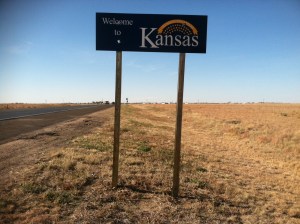
One of my clearest memories is the joy I’d feel when, after driving up to North Dakota with my family to visit my grandparents we’d cross the Kansas border and the “Welcome to Kansas, the Sunflower State” sign, and I’d know I was back home at last. I’d survey the wheat fields waving in the breeze, the distant horizon, the endless highway, straight and flat, where if there was a speed limit sign all it was 100 mph.
Yes, I loved Kansas, as only a child can love a place. When we moved away to Ohio, I was broken-hearted and homesick and for a long time I begged my parents to take us back there.
I guess these memories are the reason it hurts my heart to hear about what is going on in Kansas today. I suppose it was always a conservative place, but today it has become cruel and mean-spirited. Look at the news from my old home state this morning.
Kansas passes anti-abortion bill declaring life begins ‘at fertilization.’ The Christian Science Monitor reports:
Kansas legislators gave final passage to a sweeping anti-abortion measure Friday night, sending Gov. Sam Brownback a bill that declares life begins “at fertilization” while blocking tax breaks for abortion providers and banning abortions performed solely because of the baby’s sex.
The House voted 90-30 for a compromise version of the bill reconciling differences between the two chambers, only hours after the Senate approved it, 28-10. The Republican governor is a strong abortion opponent, and supporters of the measure expect him to sign it into law so that the new restrictions take effect July 1.
In addition to the bans on tax breaks and sex-selection abortions, the bill prohibits abortion providers from being involved in public school sex education classes and spells out in more detail what information doctors must provide to patients seeking abortions.
Yes, the War on Women continues, and the Kansas legislature is apparently determined to beat out North Dakota as the most dangerous place for women to get pregnant.
Read the rest of this entry »
Friday Reads: The Ides of March
Posted: March 15, 2013 Filed under: morning reads | Tags: Bobby Jindal, budget, Eric Cantor, Higgs boson, imagine no religion, mars rover, Paul Ryan 28 Comments Ah! The Ides of March and today’s political men with that lean and hungry look are upon us! Let’s check out what Eric Cantor, Bobby Jindal and Paul Ryan are up to. All of them have that creepy angular look that makes my skin crawl. I always wonder if their supporters are as odd looking and grinch-like?
Ryan “looks with such ferret and such fiery eyes” and is trying to ride the same old budget that the voters soundly rejected in November.
Ryan’s budget is a retread of his previous offerings, the same ideas that were rejected by voters in the 2012 election. Like the old Bourbon kings, he has learned nothing and forgotten nothing. Once more he doubles down on the failed ideas of the past, and once more he brazenly seeks credit for making hard choices while refusing to tell us what those choices are. The cowardice and lack of candor reflect just how unpopular these ideas are.
The basic strategy is the same; the only new packaging is the pretense of balancing the budget in 10 years. Ryan does that by adopting the $600 billion in “fiscal cliff” taxes that Republicans voted against, the Medicare tax hikes that were part of the Obamacare that Ryan proposes to repeal, and, most brazenly, the infamous $716 billion in “Medicare cuts” that Ryan and Romney and legions of Republicans have railed against over the last two election cycles.
Ryan’s basic strategy is unchanged. He would lower rates on income and corporate taxes. He does this despite studies showing that lowering rates over the last decades have produced more inequality, but not more growth. With the top 1 percent capturing a staggering 121 percent of the income growth coming out of the Great Recession, and corporate profits at record highs as a percentage of the economy, Ryan still argues that if they just had more money, they would start investing here at home.
The lower tax rates, Ryan claims, will be paid for by closing loopholes and eliminating “tax expenditures” — only he reveals none of
those that he would close. Studies show millionaires could give up all their tax deductions and still pocket a big tax break from the Ryan plan. By definition, middle class families will end up paying more — and will face the loss of tax deductions for mortgages, for employer-based health care, for state and local taxes and more. No wonder Ryan doesn’t want to reveal what’s behind the curtain.
Ryan then calls for cutting $4.6 trillion in spending over 10 years from projected levels. $2.5 trillion of that comes from repealing Obamacare and gutting Medicaid. That will leave, according to estimates of the Urban League and the Congressional Budget Office, 40 to 50 million more poor and middle-income Americans uninsured, even as the wealthy and multinationals pocket their tax breaks. In addition, Ryan promises to dismember Medicare 10 years from now, turning it into a voucher that will push more and more costs on seniors over time.
Ryan would cancel the “sequestration cuts” for the military over the next decade while cutting even more from domestic services. All domestic services — education, border patrol, workplace safety, food and drug monitoring, research and development, Head Start, infant nutrition, etc. — would be cut to levels not seen in modern times. Naturally, Ryan does not identify what would be cut.
His budget is expected to pass the House yet again even though there is no chance in the Senate and no chance that “Obamacare” will be repealed. Yet, he’s consistent which is more than we can say about Eric Cantor recently. You know Cantoe. ” Seldom he smiles, and smiles in such a sort s if he mock’d himself and scorn’d his spirit that could be moved to smile at any thing.”
Cantor seems newly pained by his reputation as an ideological roadblock. In Virginia, his favorable rating is twenty-seven per cent, a fact that makes a statewide run for office in the near future a dim prospect. Cantor explained why he argued at the retreat against using the debt ceiling as political leverage. He had been hearing from donors on Wall Street and in the business community about the potential impact on the markets. “Most people would say incurring debt at this point is allowing money for bills that you already incurred,” he said. “It’s to pay the bills.” Eight days earlier, at a press conference, Obama had made the same argument.
Besides, there were better fights to come. Conceding the debt-ceiling vote was a simple way for House Republicans to prevent the
U.S. government from going into default, which would be disastrous for the economy here and abroad. It also meant they could save their leverage for the coming fight over the automatic spending cuts in the sequester. “We’re not trying to sit here and just obstruct,” Cantor said. “We’re trying to solve the problem, and we’ve been put in this position, I guess, perception-wise, that all we want to do is obstruct. So this is an attempt for us to get on firmer ground.”
To win over the right, House leaders promised three things. They would demand that the Democratic-controlled Senate write a formal budget, which Senate Democrats have avoided doing for several years; if the senators didn’t pass a budget, they wouldn’t get paid. Second, they promised conservatives that the cuts in the sequester would be kept intact or replaced with something equivalent. The final promise was far more daunting: Paul Ryan would write a budget that balanced within ten years. “Big goal,” Cantor said, and he sounded relieved that it wouldn’t be his job; Ryan’s last budget, which included severe spending cuts, didn’t promise to come into balance until the late twenty-thirties. “People were concerned that it took too long to balance,” Ryan said. To make the budget balance in a decade, the level of cuts will have to be extreme. Cantor may have led his colleagues out of the debt-ceiling canyon only to get them trapped in another one.
I pointed out that, because the fiscal-cliff deal included more than six hundred billion dollars in higher taxes over the next ten years, Ryan’s job might be a little easier. Cantor flashed a mischievous grin. “Irony!” he said.
 He’s got the ALEC plan for wrecking the state down pat. “He thinks too much: such men are dangerous.”
Jan Moller with the Louisiana Budget Project said he fears a financial blow to the state’s most vulnerable citizens.
“At a bare minimum, a tax overhaul should not be an excuse to make the state’s poorest citizens pay more, and they would suffer the most from the governor’s proposal to raise sales taxes,” Moller said in a prepared statement.
Barfield said something will be proposed to offset any increase for low- and lower-middle-classes.
“They would be in no worse position than they are today,” Barfield said.
Barfield said the administration wants to encourage job creation and economic growth, which help elevate the poor.
One has to wonder how the national ambitions of these men jibe with voters given their agendas benefit very few people. I suppose the idea is to appease the big donors and hope that every one else just votes based on name recognition and glossy mailers. Still, Jindal’s popularity sits at 37%. As mentioned above, Cantor’s popularity sits at 27%. Ryan’s last poll was the election.
“This is the start of a new story of physics,” said Tony Weidberg, Oxford University physicist and a collaborator on the Atlas experiment.
“Physics has changed since July the 4th – the vague question we had before was to see if there was anything there,” he told BBC News.
“Now we’ve got more precise questions: is this particle a Higgs boson, and if so, is it one compatible with the Standard Model?”
The results reported at the conference – based on the entire data sets from 2011 and 2012 – much more strongly suggest that the new particle’s “spin” is zero – consistent with any of the theoretical varieties of Higgs.
“The preliminary results with the full 2012 data set are magnificent and to me it is clear that we are dealing with a Higgs boson, though we still have a long way to go to know what kind of Higgs boson it is,” said CMS spokesperson Joe Incandela.
As is often the case in particle physics, a fuller analysis of data will be required to establish beyond doubt that the particle is a Higgs of any kind. But Dr Weidberg said that even these early hints were compelling.
“This is very exciting because if the spin-zero determination is confirmed, it would be the first elementary particle to have zero spin,” he said.
“So this is really different to anything we have seen before.”
Even more data will be required to explore the question of more “exotic” Higgs particles.
This HuffPo article suggest that there will even be fewer Americans for those Republicans to fool in the future as religion in America hits new low!!
The number of Americans who claim to have no religious affiliation is the highest it has ever been since data on the subject started being collected in the 1930s, new research has found.
Sociologists from the University of California, Berkeley, and Duke University analyzed results from the General Social Survey and found that the number of people who do not consider themselves part of an organized religion has jumped dramatically in recent years.
Back in the 1930s and 1940s, the number of “nones” — those who said they were religiously unaffiliated — hovered around 5 percent, Claude Fischer, one of the researchers with UC Berkeley, told The Huffington Post. That number had risen to only 8 percent by 1990.
But since then, the number of people who don’t consider themselves part of a religion has increased to 20 percent.
No wonder Republicans want to tank public education. I’d say there’s a bit of intelligent life left here!
Finally, the Mars Rover “Curiosity” finds some astonishing things on Mars.
The verdict is in: Mars’s Gale Crater was habitable in its distant past, perhaps during the same period in which microbial life was establishing itself on Earth between 3 billion and 4 billion years ago.
That is the conclusion scientists have reached after NASA‘s Mars rover Curiosity analyzed the first sample ever culled from deep in a rock on another planet. Curiosity used a first-of-its-kind drill to extract the sample.
Now, only seven months into its mission – a period set aside primarily for testing the rover’s various instruments – Curiosity has already given researchers the answer to the broad, basic question they set out to answer: Did Mars ever host environments suitable for life?
The issue of habitability is “in the bag,” said John Grotzinger, a planetary geologist at the California Institute of Technology in Pasadena, Calif., and the mission’s lead scientist, during a press briefing announcing the results on Tuesday.
The minerals in the tiny, gray, ground-rock sample exposed by Curiosity’s drill speak of abundant standing water, conditions neither too acidic or too alkaline for life, and the minerals that would have provided a ready energy source for microbes, if any had been there.
Wonder what Pat Robertson will say about this?
and what’s on your reading and blogging list today?

 peej
peej Carissa
 bostonboomer
 dakinikat
 ecocatwoman
 mablue2
 Mama Lopez
 peggysue22
 quixote
 skydancingguestblogger
 Mona (aka Wonk the Vote)



 Sky Dancing
Recent Comments