


He mocked the word “affordability,” touted how high the stock market had risen and said Americans didn’t need so many pencils. He launched into a number of digressions to disparage the country of Somalia, the concept of climate change and the news media in the back of the room.
Trump spoke from a 1,200-capacity ballroom at the Mount Airy Resort and Casino in the Pocono Mountains for what White House officials have suggested would be a kickoff to promote Trump’s economic policies — and an attempt to wrangle an issue that has become a political liability ahead of the 2026 midterm elections.
Instead, the 90-minute speech was a greatest hits of his campaign trail appearances — complimenting the power of his chief of staff, Susie Wiles, and “the lips that don’t stop” of White House press secretary Karoline Leavitt — with occasional nods to the current economic anxieties. He promoted his trade policies, without speaking to the impact they’ve had on consumer prices, and he promised lower energy costs.
“We inherited the highest prices ever, and we’re bringing them down,” he said several times.
“We’re getting inflation — we’re crushing it, and you’re getting much higher wages,” he said. “I mean, the only thing that is really going up big, it’s called the stock market and your 401(k).”While suggesting prices were no longer going up, Trump also ridiculed Democrats for suggesting that voters cared about affordability, an issue that was a focus of their successful campaigns last month in New Jersey, Virginia and New York City.
“They said, ‘Oh, he doesn’t realize prices are higher.’ Prices are coming down very substantially,” Trump said. “But they have a new word. You know, they always have a hoax. The new word is affordability. So they look at the camera and they say, ‘This election is all about affordability.’”
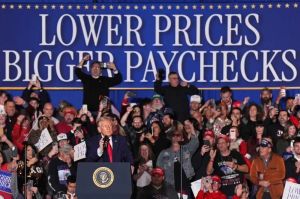
Trump talks affordability in PA.
The election may very well be about people’s ability to afford basics–food, clothing, and housing. Trump has never had to worry about those things, so he mocks people who do.
Later, he attempted to clarify.
“I can’t say affordability is a hoax because I agree the prices were too high. So I can’t go to call it a hoax because they’ll misconstrue that,” he said. “But they use the word affordability. And that’s the only word they say. Affordability. And that’s their only word. They say, ‘Affordability.’ And everyone says, ‘Oh, that must mean Trump has high prices.’ No. Our prices are coming down tremendously from the highest prices in the history of our country.”
Trump also returned to a comment he made earlier in his presidency, saying that Americans needed to go without.
“You know, you can give up certain products. You can give up pencils,” he said, suggesting that he was focused on promoting American-made steel while China was focused on providing multiple pencils to its citizens.
“You always need steel. You don’t need 37 dolls for your daughter,” he said. “Two or three is nice, but you don’t need 37 dolls. So, we’re doing things right. We’re running this country right well.”
“Affordability” is another word like “groceries” to Trump–words for things outside his own experience. He doesn’t have to worry about getting enough to eat or staying warm in his home–so other people shouldn’t care about those things either. Just deal with it while he has fun with his tariffs.
Paul Krugman at his Substack: Trump Says That You Are the Problem. Everything is perfect. Why aren’t you grateful?
Last night Donald Trump gave an important speech on the economy in Pennsylvania — supposedly in a working-class area, although the actual venue was a luxury casino resort. The event was initially touted as the start of an “affordability tour,” the first of a series of speeches intended to reverse Trump’s cratering approval on his handling of inflation and the economy. A number of news analyses suggested that he would use the occasion to blame Democrats for the economy’s troubles.
King Trump doesn’t care about your affordability concerns.
That was never going to happen. Trump did, of course, take many swipes at Joe Biden, as well as attacking immigrants, women and windmills. But to blame Democrats for the economy’s problems he would have to admit that the Trump economy has problems. And the speech was important because it revealed that he won’t make any such admission, and will continue to gaslight the public.
On Monday Politico interviewed Trump, asking him, among other things, what grade he would give the current economy. His answer: “A-plus-plus-plus-plus-plus.”
In fact, until very recently Trump wouldn’t even accept the reality that ordinary Americans don’t share his triumphalism. When Fox News’s Laura Ingraham asked him a month ago why people are anxious about the economy, Trump replied
“I don’t know they are saying that. The polls are fake. We have the greatest economy we’ve ever had.”
Scott Bessent, billionaire
Since then Trump and his minions seem to have come around to admitting that Americans are, in fact, unhappy with the state of the economy. But if the economy is A+++++, why don’t people see it? The problem can’t possibly lie with him — so it must lie with you. “The American people don’t know how good they have it.”
I put that line in quotes because it isn’t a caricature or a paraphrase. It is, in fact, literally what Scott Bessent, the Treasury secretary, said the other day:
“We’ve made a lot of gains, but remember, we’ve got this embedded inflation from the Biden years, where mainstream media, whether it’s Greg Ip at the Wall Street Journal, toxic Paul Krugman at New York Times or former Vice Chair, Alan Blinder, all said it was a vibecession. The American people don’t know how good they have it.”
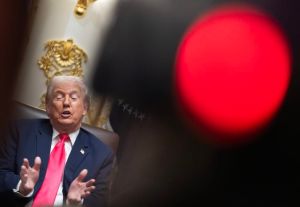

Krugman’s response:
I may not be a political strategist, but I don’t think “You’re all a bunch of ingrates” is a winning message. It was, however, really the only message Trump could deliver, given his utter lack of empathy or humility.
At this point I could bombard you with a lot of data showing that the economy is not, in fact, A+++++. But it isn’t a disaster area, at least not yet. So why are Americans feeling so down? The main culprit is Trump himself.
First, during the 2024 campaign Trump repeatedly promised to bring consumer prices way down beginning on “day one.” We’re now 11 months in, prices are still rising, and voters who believed him feel, with reason, that they were lied to. Last night Trump insisted that prices are, in fact, coming way down. Again, “Who you gonna believe, me or your lying eyes?” is a self-destructive political strategy.
Second, Trump would be in much better political shape right now if he had basically continued Biden’s policies, with only a few cosmetic changes. When he took office inflation was on a declining trajectory. Consumer sentiment was relatively favorable at the start of 2025. Americans were still angry about high prices, but the inflation surge of 2021-3 had happened on Biden’s watch and was receding into the past. My guess is that many voters would have accepted Trump’s claims that high prices were Democrats’ fault and given him the benefit of the doubt about the economy’s future if he had simply done nothing drastic and left policies mostly as they were.
Instead, he brought chaos: Massive and massively unpopular tariffs, DOGE disruptions, masked ICE agents grabbing people off the street, saber-rattling and war crimes in the Caribbean. Many swing voters, I believe, supported Trump out of nostalgia for the relative calm that prevailed before Covid struck. They didn’t think they were voting for nonstop political PTSD.
And there’s more to come. Health insurance costs are about to spike, because Republicans refuse to extend Biden-era subsidies. Inflation may pick up in the next few months as retailers, who have so far absorbed much of the cost of Trump’s tariffs, begin passing them on to consumers.
Chris Cameron at The New York Times: Trump’s Speech on Economy Veers Into an Anti-Immigrant Tirade.
In a speech that the White House billed as an address on the economy, amid a backlash driven in part by Mr. Trump’s sweeping tariffs, Mr. Trump veered between assurances that life was better than ever under his administration and blaming immigrants for the country’s economic woes.
Mr. Trump revived what had been an effective campaign message, promising that sending immigrants home would mean “more jobs, better wages and higher income for American citizens,” though the early stages of his mass deportation campaign have so far coincided with widespread economic anxiety.
He earned raucous cheers from his supporters as he spoke of “reverse migration” and trumpeted what he called a “permanent pause” on immigration from “hellholes like Afghanistan, Haiti, Somalia and many other countries.”
Soon after, a member of the crowd yelled out a crude term that Mr. Trump used during his first administration to disparage Haiti and some nations in Africa. The president laughed.
“I didn’t say ‘shithole,’ you did!” Mr. Trump replied with a grin. He then recounted his use of the term at a White House meeting in 2018 to describe countries that he was balking at accepting immigrants from. Mr. Trump had then denied saying that after it was publicly reported. Nearly six years later, he appeared proud of the remark.
Quiet, Piggy!
Throughout the speech, Mr. Trump doubled down on a barrage of incendiary attacks that he has unleashed against immigrants since the shooting of two National Guard members near the White House last month. The day after the shooting, Mr. Trump floated the possibility of stripping naturalized American citizens of their citizenship (which is only done in rare cases) and vowed to deport all immigrants that he saw as “non-compatible with Western civilization.”
During his xenophobic tirade, Mr. Trump made little distinction between unauthorized migrants and those who followed all the correct procedures to enter the country and eventually become American citizens. He described Somali immigrants as lazy, murderous and “garbage,” and said the home countries of many immigrants were “filthy, dirty, disgusting.”
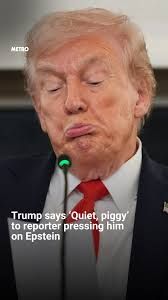
Quiet, Piggy!! He is disgusting.
Politico polled Americans on what they really think of Trump’s economy. Erin Doherty writes: New poll paints a grim picture of a nation under financial strain.
Americans are struggling with affordability pressures that are squeezing everything from their everyday necessities to their biggest-ticket expenses
Nearly half of Americans said they find groceries, utility bills, health care, housing and transportation difficult to afford, according to The POLITICO Poll conducted last month by Public First. The results paint a grim portrait of spending constraints: More than a quarter, 27 percent, said they have skipped a medical check-up because of costs within the last two years, and 23 percent said they have skipped a prescription dose for the same reason.
The strain is also reshaping how Americans spend their free time. More than a third — 37 percent — said they could not afford to attend a professional sports event with their family or friends, and almost half — 46 percent — said they could not pay for a vacation that involves air travel.
Trump insists that “prices are all coming down,” as he told Burns, but the results pose a challenge for Trump and the Republican Party ahead of the 2026 midterms, with even some of the president’s own voters showing signs that their patience with high costs is wearing thin.
POLITICO reporters covering a variety of beats have spent the past few weeks poring over the poll results. We asked some of them to unpack the data for us and tell us what stood out most.
Read about these specific findings at the link.
Trump/Hegseth’s Boat Strikes
Damien Cave, Edward Wong, and Maria Abi-Habib at The New York Times (gift link): Inside the Pentagon’s Scramble to Deal With Boat Strike Survivors.
The Pentagon was in a bind. The military had plucked two survivors from the Caribbean Sea in mid-October after striking a boat that U.S. officials said was carrying drugs, and it needed to figure out what to do with them.
On a call with counterparts at the State Department, Pentagon lawyers floated an idea. They asked whether the two survivors could be put into a notorious prison in El Salvador to which the Trump administration had sent hundreds of Venezuelan deportees, three officials said.
The State Department lawyers were stunned, one official said, and rejected the idea. The survivors ended up being repatriated to their home countries of Colombia and Ecuador.
A little under two weeks later, on Oct. 29, Pentagon officials convened another session about boat strike survivors, a video conference involving dozens of American diplomats from across the Western Hemisphere. The message was that any rescued survivors should be sent back to their home countries or to a third country, said three other officials, who, like others interviewed for this article, spoke on the condition of anonymity to discuss internal deliberations.
Behind that policy was a quieter goal: to ensure survivors did not end up in the U.S. judicial system, where court cases could force the administration to show evidence justifying President Trump’s military campaign in the region.
The previously unreported calls demonstrate the haphazard and sometimes tense nature of the process within the Trump administration to weigh what to do with the survivors of U.S. attacks on boats that the military asserts — without presenting evidence — are drug-smuggling vessels posing an immediate threat to Americans.
Pentagon officials largely kept State Department counterparts in the dark about strike operations, then scrambled to try to enlist diplomats to help deal with survivors, whom military officials referred to by specific terms that included “distressed mariners.” That phrase is usually used in a peacetime and civilian context.
The talks took place after the first attack on Sept. 2, when the U.S. military killed two survivors with a second strike. Pentagon officials have not fully explained the process for handling survivors to other agencies or Congress, even as the campaign has continued, killing at least 87 people in 22 attacks.
Use the gift link to read the rest.
Haley Britzky at CNN: 3 separate US strikes on alleged drug boats have initially left survivors. Each time they’ve been treated differently
As the US military has undertaken a campaign of attacks against alleged drug boats in the Caribbean Sea and eastern Pacific Ocean, at least five people have survived initial strikes ending up in the water after explosions killed fellow crew members and disabled their ships.
But what happened next to the survivors varied greatly – two were detained by the US Navy only to be returned to their home countries, one was left to float in the ocean and is presumed dead, and two more have been at the center of intense scrutiny in recent weeks following reporting that the US military conducted a second strike killing them as they clung to their flipped and damaged boat on September 2.
The contrast in treatment has happened while policy on how the military will handle survivors remains steady, according to defense officials….
Democratic lawmakers have demanded answers about the follow-up strike with some suggesting that the US military may have violated international law by killing the survivors.
Last week, Adm. Frank “Mitch” Bradley met with lawmakers on Capitol Hill in closed-door meetings to explain the attack. Bradley was the commander of Joint Special Operations Command at the time of the strike and oversaw the attack; Secretary of Defense Pete Hegseth and the White House have said Bradley was ultimately the official who directed the follow-on strikes, and that they support his decision.
Bradley told lawmakers he ordered a second strike to destroy the remains of the vessel, killing the two survivors, on the grounds that it appeared that part of the vessel remained afloat because it still held cocaine, CNN has reported. The survivors could hypothetically have floated to safety, been rescued, and carried on with trafficking the drugs, the logic went.
People briefed on the follow-up strike said they were concerned that it could violate the law of armed conflict, which prohibits the execution of an enemy combatant who is “hors de combat,” or taken out of the fight due to injury or surrender.
Read more at CNN.
More Interesting Stories to Check Out
Media Matters: Right-wing media are poised to escalate attacks on women as MAGA cracks emerge.
AP: Justice Department can unseal records from Epstein’s 2019 sex trafficking case, judge says.
CNN: Third federal judge grants request to unseal Jeffrey Epstein-related court records.
The New York Times: Judge Says Trump Must End Guard Deployment in Los Angeles.
The New York Times: U.S. Plans to Scrutinize Foreign Tourists’ Social Media History.
Politico: Trump aides and allies float potential Noem successors as speculation grows over her tenure.
That’s it for me today. What’s on your mind?

 peej
peej Carissa
 bostonboomer
 dakinikat
 ecocatwoman
 mablue2
 Mama Lopez
 peggysue22
 quixote
 skydancingguestblogger
 Mona (aka Wonk the Vote)



 Sky Dancing

Recent Comments