
Monday Reads: Prehistoric Rock and Roll
Posted: July 15, 2013 Filed under: morning reads | Tags: blue collar temp jobs, cave art and psychedelic drugs, mansplaining abortion rights 103 Comments Good Morning!
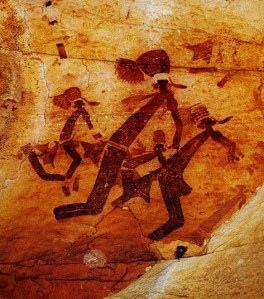
I thought I’d bring a little bit of prehistory and prehistoric-like thinking into this morning’s reads. A recent student suggests that all that funky paleolithic Cave Art may have been the product of some really good psychedelic drugs.
Prehistoric cave paintings across the continents have similar geometric patterns not because early humans were learning to draw like Paleolithic pre-schoolers, but because they were high on drugs, and their brains—like ours—have a biological predisposition to “see” certain patterns, especially during consciousness altering states.
This thesis—that humanity’s earliest artists were not just reeling due to mind-altering activities, but deliberately sought those elevated states and gave greater meaning to those common visions—is the contention of a new paper by an international research team.
Their thesis intriguingly explores the “biologically embodied mind,” which they contend gave rise to similarities in Paleolithic art across the continents dating back 40,000 years, and can also be seen in the body painting patterns dating back even further, according to recent archelogical discoveries.
At its core, this theory challenges the long-held notion that the earliest art and atrists were merely trying to draw the external world. Instead, it sees cave art as a deliberate mix of rituals inducing altered states for participants, coupled with brain chemistry that elicits certain visual patterns for humanity’s early chroniclers.
Put another way, if Jackson Pollock could get drunk and make his splatter paintings while his his head was spinning, primitive men and women could eat pyschedelic plants and commence painting on cave walls—in part, presenting the patterns prompted by brain biochemistry but seen as having super-sensory significance.
“The prevalence of certain geometric patterns in the symbolic material culture of many prehistoric cultures, starting shortly after the emergence of our biological species and continuing in some indigenous cultures until today, is explained in terms of the characteristic contents of biologically determined hallucinatory experience,” the researchers hypothesize.
The war on women that is raging in every state where Republicans can abuse the legislative process to make laws that reflect personal religious  bigotries rather than medical science is bringing up discussion on how confused the public is on the issue. Of course, many men write about the issue and when doing so, they seem to forget one important thing. This is about one woman and her body. It is basically nobody else’s damned business. No one’s opinion should matter for any one else on this if it’s not your damned body and your damned pregnancy. It’s not like a war or public education or daming up great rivers which are societal efforts and concerns. These are topics where every one should have a say. Abortion rights are about saying women can make the best decision and are autonomous individauls and not the government or any one else has a stake in that. It’s denying the woman selfhood and autonomy even when its some open minded, pro-choice guy–in this case David Leonhardt–who mansplains it to us.
Antiabortion laws and polls are the ultimate busybody neighbor. They presume every one knows best but the woman involved. Imagine that every appendectomy, every vasectomy, and every tonsillectomy were subjected to every one else’s religious views and opinions. Imagine if that wart you had treated was the subject of a poll. This is America where women’s bodies continue to be subjected to public opinion and polling and regulation and religion and state-approved ownership.
On abortion rights, both parties have a claim on public opinion. Maybe more to the point, both can make a strong case that the other party has an extreme view. Abortion is the relatively rare issue in which the cliché is true: public opinion does actually rest about midway between the parties’ platforms.
As a result, abortion occupies a different place in the Republicans’ continuing struggle about whether and how to modernize their party. On a set of other social issues related to the increasingly diverse American population, the party clearly faces big challenges. The two fastest-growing ethnic groups — Latinos and Asian-Americans — are decidedly liberal. Younger white adults also lean left. My colleague Nate Silver estimates that in the year 2020, ballot initiatives on same-sex marriage would pass in 44 states, based on the direction of public opinion. The only six states where the initiatives would likely fail are solidly Republican Southern states.
Anyone following the Texas abortion debate through social media could easily imagine that the issue belongs in the same category. During her filibuster against the bill, State Senator Wendy Davis inspired a hashtag — #StandWithWendy — and a Twitter explosion. An often overlooked aspect of social media, however, is that it still skews slightly liberal.
Nationwide, polls consistently show that people are no more “pro choice” than “pro life,” when asked to choose a label. More detailed questions yield similar results. And women are no more in favor of abortion rights than men. “Abortion is not heading in either party’s direction,” says Andrew Kohut of the Pew Research Center.
About 60 percent of Americans favor access to abortion in the first trimester (or first 12 weeks) of pregnancy, but close to 70 percent think it should be illegal in the second trimester, according to Gallup. Likewise, a recent National Journal poll found 48 percent of respondents favoring, and only 44 percent opposing, a House of Representatives bill that would ban abortions after 20 weeks of pregnancy except in cases of rape and incest.
“About 8 in 10 Americans believe abortion is taking a life,” said Ed Goeas, president of the Tarrance Group, a Republican polling firm. “What you then have is a discussion about when it is acceptable.”
Perhaps the best weapon of abortion rights advocates is their opponents’ extremism. The Texas bill, for instance, would close most of the state’s abortion providers and ban the procedure after 20 weeks, without exceptions for rape or incest. A clear majority of Americans support such exceptions, as well as those for the health of the mother, polls show.
 There’s been a little bit of this and that in the news about the impact of the sequester. Primarily, it’s been the impact on things like hurricane preparedness or lines in airports which both have been addressed by congress when governors or other powerful people complain. Here’s compelling evidence on what the sequester is doing to the poorest and weakest among us. I’ve already covered a little of this in a previous post. But, you know me, I can never let go of an opportunity to show how truly bad our societal values have become. Even our prehistoric relatives knew that taking care of the elderly and the young was important for survival of all as well as a central role in attaching ourselves to our families and others. Here, we put our babies and our old people out on the ice floes. We only protect the clump of cells in our neighbor’s womb.
The federal government’s across-the-board sequestration cuts, which began taking effect in March, may seem like an overhyped piece of political theater–that is, unless you’re an unemployed adult living in Michigan. There, roughly 82,000 people, like Kristina Feldotte of Saginaw, have watched their federal unemployment checks dwindle by 10.7 percent since late March. That’s as much as a $150 per month from payments that, at most, clock in at $1,440.
“It flabbergasts me that our government can’t get its crap together,” says Feldotte, 47, a mother of four and a laid-off public-school teacher. “With the air-traffic controllers, Congress fixed that right away because it affected the planes going in and out of Washington. But they’re not doing anything that benefits the people.”
That’s especially true of poor people since Congress and the White House failed to reach a deal to undo the cuts in March. Air-traffic controllers and meat inspectors, represented by powerful unions and lobbyists, got reprieves. Agencies such as the Justice and Homeland Security departments found wiggle room in their budgets to stave off furloughs. But programs outside of D.C. for low-income or distressed people — such as Head Start, Meals on Wheels, or federal unemployment benefits — have suffered as the cuts kicked in, leading to cancellations, fewer meals, smaller checks, and staff layoffs.
“The impacts of the sequester have been hard to document, but it really is a diminution of services,” says Sharon Parrott, vice president for budget policy and economic opportunity at the left-leaning Center on Budget and Policy Priorities.
Take the Meals on Wheels program in Contra Costa County, California, which, like the national program, has had to cut 5.1 percent of its budget. After losing $89,000 in federal funding over a six-month period, the program had to scale back the number of meals it serves from 1,500 to 1,300 a day. This puts its director in the unenviable position of having to choose which low-income or lonely 80-year-olds are less deserving of a meal delivery. “We’re only adding new clients in the direst circumstances — like they will die or be institutionalized if we don’t get to them,” says Paul Kraintz, director of the county’s nutrition program.
The Head Start program in Rockland County, N.Y., had to make similarly tough choices. It managed to keep open its summer program for the youngest children, ages 1 to 3, but had to cancel the summer sessions for 3-to-5-year-olds and lay off 12 staff members to save roughly $240,000, says Ouida Foster Toutebon, executive director of Head Start Rockland. Like the national program, it will lose about 5 percent of its budget — in this case, $414,925 — by the end of the fiscal year, September 30. “The parents were upset, because they needed to make other arrangements,” Toutebon says.
I love reading good, in-depth real journalism. Pro-Publica frequently provides this. It’s even better when it relates to my field of study. Here is a disheartening and realistic look at what it means to be a worker in America these days. Basically, you are expendable. You are just one more thing that can be thrown away at a moment’s notice. Blue collar workers are now temping in large numbers.
In cities all across the country, workers stand on street corners, line up in alleys or wait in a neon-lit beauty salon for rickety vans to whisk them off to warehouses miles away. Some vans are so packed that to get to work, people must squat on milk crates, sit on the laps of passengers they do not know or sometimes lie on the floor, the other workers’ feet on top of them.
This is not Mexico. It is not Guatemala or Honduras. This is Chicago, New Jersey, Boston.
The people here are not day laborers looking for an odd job from a passing contractor. They are regular employees of temp agencies working in the supply chain of many of America’s largest companies – Walmart, Macy’s, Nike, Frito-Lay. They make our frozen pizzas, sort the recycling from our trash, cut our vegetables and clean our imported fish. They unload clothing and toys made overseas and pack them to fill our store shelves. They are as important to the global economy as shipping containers and Asian garment workers.
Many get by on minimum wage, renting rooms in rundown houses, eating dinners of beans and potatoes, and surviving on food banks and taxpayer-funded health care. They almost never get benefits and have little opportunity for advancement.
Across America, temporary work has become a mainstay of the economy, leading to the proliferation of what researchers have begun to call “temp towns.” They are often dense Latino neighborhoods teeming with temp agencies. Or they are cities where it has become nearly impossible even for whites and African-Americans with vocational training to find factory and warehouse work without first being directed to a temp firm.
In June, the Labor Department reported that the nation had more temp workers than ever before: 2.7 million. Overall, almost one-fifth of the total job growth since the recession ended in mid-2009 has been in the temp sector, federal data shows. But according to the American Staffing Association, the temp industry’s trade group, the pool is even larger: Every year, a tenth of all U.S. workers finds a job at a staffing agency.
The proportion of temp workers in the labor force reached its peak in early 2000 before the 2001 slump and then the Great Recession. But as the economy continues its slow, uneven recovery, temp work is roaring back 10 times faster than private-sector employment as a whole – a pace “exceeding even the dramatic run-up of the early 1990s,” according to the staffing association.
The overwhelming majority of that growth has come in blue-collar work in factories and warehouses, as the temp industry sheds the Kelly Girl image of the past. Last year, more than one in every 20 blue-collar workers was a temp.
Several temp agencies, such as Adecco and Manpower, are now among the largest employers in the United States. One list put Kelly Services as second only to Walmart.
Most of the news today is on the Zimmerman acquittal and the peaceful protests that happened yesterday in remembrance of the needless death of an American teenager at the hand of an armed, ignorant vigilante. I feel a lot like I did the day that OJ Simpson got away with murdering two people. I remember exactly where I was when I heard that verdict. Karma caught up with OJ. I am sure the same thing will happen to Zimmerman. It just freaks me out that he can still carry a concealed weapon around and play pseudo cop. Oh, he wants to be a lawyer now and help people like him; whatever that means.
What’s on your reading and blogging list today?

 peej
peej Carissa
 bostonboomer
 dakinikat
 ecocatwoman
 mablue2
 Mama Lopez
 peggysue22
 quixote
 skydancingguestblogger
 Mona (aka Wonk the Vote)



 Sky Dancing
Recent Comments