
Lazy Saturday Reads
Posted: April 5, 2014 Filed under: morning reads, U.S. Politics | Tags: Affordable Care Act, Air Force cheating scandal, billionaires, bison stampede, CIA enhanced interrogation program, David and Charles Koch, earthquakes, Gerald L. Chan, Harvard Square, health insurance, Jose A. Rodriguez Jr., nuclear weapons, Obamacare, Senate Intelligence Committee, Torture, torture report, Yellowstone supervolcanoes 34 Comments
Panoramic view of Harvard Square, Cambridge, MA
Happy Saturday!!
Recently Dakinikat wrote about how gentrification has affected her adopted hometown, New Orleans, since Katrina. Well this morning I read some surprising news about Harvard Square–a place I’m very attached to because I either lived nearby, worked, or hung out there for so many years. I’ve written about it before of course. I moved here from Indiana in 1967. It was the “Summer of Love,” and Harvard Square was the center of local hippie-dom, plus there were endless bookstores to feed my addiction to reading and possessing books.
So this morning I read in the The Boston Globe that Chinese billionaire Gerald L. Chan has been quietly buying up prime real estate in Harvard Square, and he now has “enough clout to influence the square’s look and character for years to come.” Harvard Square has already changed a great deal since the late 1960s, of course, so I don’t know why this should shock me. But the Square is still unique–a special place, with a traditional look and feel. What will happen to it now? From the Globe article:
First he grabbed an apartment and retail building in the heart of Harvard Square. Months later, he bought another apartment and retail complex on the other side of John F. Kennedy Street. Then came the deal for a building known as the American Express travel office, quickly followed by the purchase of apartments behind the Harvard Lampoon office.
Over the course of 18 months — and without calling attention to himself — billionaire businessman Gerald L. Chan spent about $120 million to amass an impressive portfolio of Harvard Square real estate that includes nearly a dozen properties….
“Take Harvard University out of the equation, and I don’t know of anyone who owns more real estate in Harvard Square than he does,” said Peter Bekarian, executive vice president at Jones Lang LaSalle, a commercial real estate firm in Boston.
Chan and his brother, Ronald, control the Hang Lung Group, a leading Hong Kong real estate development and management company that has made them billionaires. Forbes pegs their combined wealth at nearly $3 billion.
Chan is a Harvard graduate who now lives in Newton, MA. He says he loves the place and he’s just investing in “properties that have the potential to generate a good return.” He says he doesn’t have a plan to remake the Harvard Square area according to his own vision, but some local business people have expressed concern–and some have abruptly been put out of business. In their places, Chan has installed business owned by his children.
Some tenants in Chan’s newly acquired buildings, including local landmarks such as UpStairs on the Square and nearby Leo’s Place diner, did not have leases renewed and shut down earlier this year.
Chan paid $6.8 million for 93 Winthrop St., where he is replacing UpStairs on the Square with another restaurant, Parsnip. His daughter, Ashley Chan, is listed in corporate documents as one of the managers of the Morningside-controlled entity that operates the restaurant. UpStairs co-owner Mary-Catherine Deibel said, “It was time to wind down the business after 31 years.”
New restaurants — the Noodle Project and Night Market, a Japanese eatery — will replace Leo’s Place, a haunt of movie actor Ben Affleck, and Indian bistro Tamarind Bay, on JFK Street. Ash Chan, Gerald’s son, is operating both. He’s a West Coast restaurateur known here for Churn2, a Harvard Square stand that services liquid-nitrogen-chilled ice cream.
I guess we local peons will just have to wait and see what happens…
Speaking of billionaires, Brian Beutler has written a response to the views on the Affordable Care Act expressed by Charles Koch in his truly strange op-ed in the Wall Street Journal that I wrote about on Thursday. From Salon, Greediest family on earth: Proof Koch brothers have just one political principle.
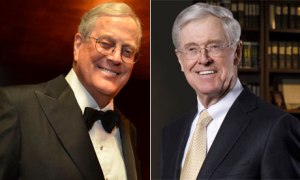
David and Charles Koch
Beutler argues that the Kochs opposition to “Obamacare” is less about ideology than selfishness, greed, and desire for power.
Would you believe me if I told you that the Koch brothers actively participate in, and benefit from, a healthcare system in which the government subsidizes private insurance; carriers are prohibited from discriminating against the sick; the young cross-subsidize the old; and qualified beneficiaries who opt out suffer a big financial hit?
Well, they do. Not Obamacare, of course — they want to repeal that. But as employers, they can and do compensate their employees with tax-exempt health insurance benefits, their employees are all part of one risk pool, and everyone contributes the same amount for equal coverage….
despite the fact that employer-sponsored health insurance resembles Obamacare in many ways, the Koch network is not actively trying to repeal ERISA — the law that regulates employer-sponsored health plans — or to repeal the tax expenditure that allows them to advantageously provide the benefits they claim they’re working so hard to maintain.
So why do they so vehemently oppose the Obama health care plan?
To the Koch brothers, there’s apparently a big difference between government subsidizing and regulating health insurance for their employees and government subsidizing and regulating insurance for the self-employed, individuals whose employers don’t provide health benefits, and the unemployed.
This might seem strangely contradictory, unless you stop and consider what the existence of a universal right to health insurance coverage means for employers and the people who work for them. When the Congressional Budget Office updated its analysis of the Affordable Care Act’s labor market effects, it concluded that the existence of a coverage guarantee for all, and subsidies for many, would reduce employment by more than 2 million people over the coming decade. Opponents of the law pounced on this as proof that Obamacare would be a job killer, but for the most part what CBO actually meant was that Obamacare would shift the center of power between workers and employers a bit closer to the workers.
For some of those workers, that shift will mean the freedom to quit — hence the “job killing” canard. But for other workers — current and prospective — it will mean the freedom to ask for more money. All thanks to a program that’s financed largely by taxing people like Charles and David Koch. And I think therein lies the key to understanding why they’re devoting so much time and so many resources to destroying Obamacare.
That’s a very interesting argument, one I never thought about. Read the rest at the link.

Jose Rodriguez
At The Washington Post, the former head of the CIA interrogation program Jose A. Rodriguez Jr. defends the Bush policy on torture. I ran the CIA interrogation program. No matter what the Senate report says, I know it worked.
On Thursday, the Senate Intelligence Committee voted to declassify and release hundreds of pages of its report on U.S. terrorist interrogation practices. Certain senators have proclaimed how devastating the findings are, saying the CIA’s program was unproductive, badly managed and misleadingly sold. Unlike the committee’s staff, I don’t have to examine the program through a rearview mirror. I was responsible for administering it, and I know that it produced critical intelligence that helped decimate al-Qaeda and save American lives.
Rodriguez says the committee never questioned him or other CIA leaders and they were not permitted to review the report. He says the committee began with conclusions about the program and simply looked for evidence to support those conclusions. On the “harsh” interrogation methods the CIA used, he writes that they were approved “the highest levels of the government,” were declared legal by the Justice Department, and were subject to Congressional oversight, and most of all they were effective.
When we captured high-ranking al-Qaeda operative Abu Zubaida in 2002, we knew he could help us track down other terrorists and might provide information to allow us to stop another attack. Those who suggest we should have questioned him more gently have never felt the burden of protecting innocent lives.
Second is effectiveness. I don’t know what the committee thinks it found in the files, but I know what I saw in real time: a program that provided critical information about the operations and leadership of al-Qaeda. Intelligence work is like doing a thousand-piece jigsaw puzzle without the picture on the box top and with millions of extra pieces. The committee staff started with the box top, the pieces in place, and pronounced the puzzle a snap.
Perhaps so, but Rodrigues seems to be ignoring the primary point about torture: it is immoral. Sometimes a civilized people must choose to accept some risks to safety in order to remain civilized. As for the government officials, Congressional committees, and the Bush Justice Department, they too should be subject to criticism and even prosecution. Unfortunately the Obama administration and Democrats in Congress took those options off the table.
There’s a new AP report (via the Christian Science Monitor) on the Air Force nuke team cheating scandal: Did report on nuclear Air Force overlook signs of trouble?
Service leaders took an assessment last year of the nuclear Air Force as an encouraging thumbs-up. Yet, in the months that followed, signs emerged that the nuclear missile corps was suffering from breakdowns in discipline, morale, training and leadership.
The former Air Force chief of staff who signed off on the 2013 report is now being asked to dig for root causes of problems that Defense Secretary Chuck Hagel says threaten to undermine public trust in the nation’s nuclear arsenal.
The Air Force may have taken an overly rosy view of the report — it was not uniformly positive — by a Pentagon advisory group headed by retired Gen. Larry Welch. The study described the nuclear Air Force as “thoroughly professional, disciplined” and performing effectively.

Air Force Chief of Staff Gen. Mark Welsh, right, and Tech. Sgt. Justin Richie riding in a work cage at Malmstrom Air Force Base, Mont.
It sure sounds like it.
The inquiry itself may have missed signs of the kinds of trouble documented in recent months in a series ofAssociated Press reports. In April 2013, the month the Welch report came out, an Air Force officer wrote that the nuclear missile unit at Minot Air Force Base, N.D., was suffering from “rot,” including lax attitudes and a poor performance by launch officers on a March 2013 inspection.
An exam-cheating scandal at a nuclear missile base prompted the Air Force to remove nine midlevel commanders and accept the resignation of the base’s top commander. Dozens of officers implicated in the cheating face disciplinary action, and some might be kicked out, the Air Force said last week.
Welch began the new Hagel-directed review in early March, teaming with retired Navy Adm. John C. Harvey, who was not involved in the earlier reviews but has extensive nuclear experience. Much rides on what they find, not least because Hagel and the White House want to remove any doubt about the safety and security of the U.S. arsenal and the men and women entrusted with it.
Lots more to read at the link.
A little science news . . .
Apparently, there have been some videos floating around of terrified bison stampeding out of Yellowstone Park. Since there was a small earthquake there recently, some people have been asking if these are signs the “supervolcano” is coming soon? From Discovery News:
Recent videos of animals fleeing Yellowstone Park have many tourists and local residents concerned that a volcanic eruption may be imminent.
After earthquakes and tsunamis, stories often circulate of animals acting strangely or seeming to know of the disaster long before humans. Animals that detect impending earthquakes don’t have more senses than humans; they just have much higher sensitivity. Dogs have a remarkable sense of smell, birds can migrate using celestial cues, and bats can locate food with echoes. Elephants can detect faint vibrations and tremors from fantastic distances.
It’s not some unexplainable gift: Animals may sense unusual vibrations or changes in air pressure coming from one direction that suggest they should move in the opposite direction.
If a herd of animals are seen fleeing before an earthquake, all that is needed is for one or two of them to skittishly sense danger; the rest will follow — not necessarily due to some supernatural earthquake-detecting sense, but simple herd instinct.

Bison on the road in Yellowstone
Scientists pooh pooh these paranoid fantasies. From The Week: Don’t Sweat the Supervolcanoes:
Beneath the pine forests and hot springs of Yellowstone National Park is a huge chamber of magma, which by some measures makes the park’s volcano the world’s largest. The last three eruptions at Yellowstone occurred 2.1 million, 1.3 million, and 640,000 years ago, respectively.Scientists estimate that another mega-eruption — which would send billions of cubic meters of choking ash up to 15 miles in the air, blackening the skies and drastically changing the climate — could possibly occur in the next 100,000 years. Such an event would present a huge danger to human civilization — killing millions in the initial blast, and then disrupting agriculture, infrastructure, and the global economy for many years to come.
But although the recent earthquake was the strongest in the area since 1980, experts say there’s nothing to fear. So what signs would indicate the supervolcano is imminent? And what could be do about it anyway?
If we were moving toward a massive geological event, then we should see massive geological signs of change. We could expect large earthquakes as opposed to the small rumble we saw last week, which registered a humble 4.9 on the Richter scale. We should also see the earth around the volcano swelling by tens or hundreds of meters, as opposed to the centimeters of uplift we see regularly.
But for the sake of it, let’s assume Yellowstone will erupt tomorrow. Could we do anything about it? Although some scientists are experimenting with the idea, to date there have been no successful efforts to stop or reduce a volcanic eruption. These kinds of geological events remain stubbornly outside human control even on the smallest scale — and Yellowstone is absolutely the largest scale.
If Yellowstone blows in 10,000 or 50,000 years, maybe technology will have been developed to mitigate or contain its effects. But if it unexpectedly blows tomorrow, we can do nothing whatever to stop it. At best, with warning signs, we could conduct an evacuation from the surrounding area.
Read more at the link.

 peej
peej Carissa
 bostonboomer
 dakinikat
 ecocatwoman
 mablue2
 Mama Lopez
 peggysue22
 quixote
 skydancingguestblogger
 Mona (aka Wonk the Vote)



 Sky Dancing
Recent Comments