
Friday Reads
Posted: February 4, 2011 Filed under: Feminists, Festivities, fetus fetishists, Food, morning reads, Reproductive Rights, U.S. Economy, U.S. Politics, Women's Rights | Tags: Ben Bernanke, fat Americans, Free and cheap Birth Control, GDP forcible rape HR3, lunar new year, quantitative easing, Trade, unemployment, year of metal rabbit 18 Comments Good Morning and Happy Lunar New Year
The Egyptian revolution continues to be the top story around the world. We will continue to run live blog updates to give you the latest reliable news sources on the subject. There’s a few stories on the economy that I’d like to share this morning beyond that topic.
First, Happy Lunar New Year!!
2011 is the Year of the Metal Rabbit.
Chinese astrologer Alvin Ang of Bazi Destiny foresees “the global situation may be affected by serious political change and global calamities.”
Hong Kong-based feng shui master Joseph Wong gives a different take. “This coming year everything will be better than last year,” he told CNN’s Pauline Chiou. “They will see business go upwards mostly, but take care with the shares and stocks. There will be some fluctuations in August and September.”
Fed Chair Ben Bernanke gave a speech at the National Press Club yesterday that indicated continuing concern about the ability of the current recovery to sustain any reasonable decrease in the unemployment rate. He also indicated the need for a long term plan to deal with the Federal deficit. There were a few mentions of the continuing need for QE and statements that the monetary policy to date had worked given the recovery of the equity markets. He did sound a bit more upbeat than the last time we heard from him and while he acted like the recovery was slower than any one would wish, he did state that he felt it was becoming ‘self-sustaining’.
Here’s some analysis on our unemployment vis a vis the Bernanke Statements from The Economist.
The Fed’s forecast range for the unemployment rate in 2012 is 7.7% to 8.2%, and the Congressional Budget Office forecasts an unemployment rate of 8.4% (this forecast dates to after the announcement of QE2, but isn’t meaningfully different from its forecasts from the summer of 2010). This would suggest that with QE2 in place, American unemployment is likely to be between 6% and 7% in 2012. That’s not full employment, but it’s pretty close. You can argue that more needs to be done (indeed, I think the Fed itself could do more). But it is worth noting that the Fed has put the American economy on a substantially better recovery path than it faced before (Scott Sumner would say it has returned the economy to the path off which it previously led it).A big risk is that the Fed will back away from its policy too quickly, thinking all is going well and worrying premptively about inflation. As Karl Smith says, today’s speech is somewhat reassuring on that front.
The NYT had an op ed up on Trade indicating that Republicans are trying to remove some provisions that now help workers retrain should they lose their jobs to overseas locations. It’s worth reading just to see how truly Dickensian the Republicans seem to be these days.
Most Republican lawmakers claim they are pro-trade. Their principled position is evidently no match for parochialism and politics. Last month, a conflict over imported sleeping bags between a company in Alabama and a rival in Kentucky led Senate Republicans to block the extension of the Generalized System of Preferences, or G.S.P., which has granted preferential access to some $20 billion worth of imports from developing countries.
Now Senator Jon Kyl and his colleagues in the Finance Committee are threatening to block the Trade Adjustment Assistance program, which provides income and training for American workers whose employers can’t compete with rising imports. It is due to expire on Feb. 12, and Mr. Kyl and company are refusing to extend it unless the White House promises to advance the long-pending trade deal with Colombia.
Speaking of Dickensian Republican policy, the GOP dropped the ‘forcible rape’ language from HR3. The Hyde Amendment has long entertained the idiocy of letting one loud and obnoxious group of zealots deny Federal funding of their personal pet peeve while the rest of us continue to fund all kinds of abominable projects. Tops on my opt out list are renditions for torture and bail outs of Investment banks. But, American Fetus Fetishists get special treatment. At least this attempt at narrowing rape definitions is gone now.
House Republicans plan to sidestep a charged debate over the distinction between “forcible rape” and “rape” by altering the language of a bill banning taxpayer subsidies for abortions.
The provision in question, written as an exemption from the ban for women who become pregnant as a result of “forcible rape,” touched off a firestorm of criticism from women’s groups, and it gained enough attention to become the subject of a satirical segment on Comedy Central’s “The Daily Show with Jon Stewart.”
But a spokesman for the bill’s author, Rep. Chris Smith (R-N.J.), says the modifier “forcible” will be dropped so that the exemption covers all forms of rape, as well as cases of incest and the endangerment of the life of the mother.“The word forcible will be replaced with the original language from the Hyde Amendment,” Smith spokesman Jeff Sagnip told POLITICO, referring to the long-standing ban on direct use of taxpayer dollars for abortion services.
A real Democratic congress and president would’ve gotten rid of this stupid provision by now. However, here is something that if true will make me do the Snoopy dance.
The Obama administration is examining whether the new health care law can be used to require insurance plans to offer contraceptives and other family planning services to women free of charge.
Such a requirement could remove cost as a barrier to birth control, a longtime goal of advocates for women’s rights and experts on women’s health. But it is likely to reignite debate over the federal role in health care, especially reproductive health, at a time when Republicans in Congress have vowed to repeal the law or dismantle it piece by piece. It is also raising objections from the Roman Catholic Church and is expected to generate a robust debate about privacy.
The law says insurers must cover “preventive health services” and cannot charge for them. The administration has asked a panel of outside experts to help identify the specific preventive services that must be covered for women.
Administration officials said they expected the list to include contraception and family planning because a large body of scientific evidence showed the effectiveness of those services. But the officials said they preferred to have the panel of independent experts make the initial recommendations so the public would see them as based on science, not politics.
Many obstetricians, gynecologists, pediatricians and public health experts have called for coverage of family planning services, including contraceptives, without co-payments, deductibles or other cost-sharing requirements.
Will the Cult of the Angry Sky God get the ultimate veto on this too?
Well, back to the exercise equipment folks! Bloomberg.com says ‘American Waistlines Expand Fastest Among Rich Nations’,
Americans grew fatter at a faster pace than residents of any other wealthy nation since 1980, during a period when obesity worldwide nearly doubled, researchers found.
Almost 10 percent of the world’s population was obese in 2008, according to studies published today by the medical journal The Lancet. The percentage of people with uncontrolled hypertension, or high blood pressure, fell, with high-income countries showing a larger drop. Cholesterol levels declined in North America, Australia and Europe, but increased in East and Southeast Asia as well as the Pacific region, researchers said.
What’s on your reading and blogging list today?

Wednesday Morning Reads
Posted: November 24, 2010 Filed under: morning reads | Tags: Barney Frank, Ben Bernanke, Bobby Jindal the Terrible, C Street Fundamentalist threat, Milton Friedman, Monetarist approach to the Great Depression, QE2, TSA hates pat downs 65 Comments Good Morning!!!

I thought I’d give you reason to be glad that Bobby Jindal the Terrible isn’t your governor. He’s tearing around the country trying to start up his presidential wannabe campaign and we’ve just about had it with him. This is from Baton Rouge’s The Advocate. He singled out some woman professor as the poster child for unnecessary research in his new book. He’s been out pimping for the book ala other Republican Governor Presidential Idiot Wannabes that want to be independently wealthy before they take the plunge to New Hampshire. The poor anthropology professor was doing a longitudinal story on Russian Mail Order Brides and their U.S. husbands. It turns out the research was funded by a grant and not tax payers too. That didn’t stop Jindal from tearing into the article in his book or fact-checking his words or reading the article for that matter.
Read the entire Op-Ed piece and be appalled that some one with so many educational opportunities in his life wants to deny so many others that opportunity and force them into oil rig serfdom. Baton Rouge is not exactly a bastion of liberalism so this piece may be a good sign that he’s wearing out his welcome here. The article even sneakily mentions the one university that should be shut down and a trio of universities that should be merged because they are all in the middle of nowhere and have fewer students than most high schools. Jindal would never man up and do that. Instead he’s just draining ever useful and viable university by 1/3 of their budget a year. He’s sucking the life out of LSU, the med centers, and the law school. LSU has consistently rated among the top public universities in the country. Jindal obviously prefers we all go to community colleges instead.
Stop this man before he can do more damage any where else!!
Gov. Bobby Jindal’s machine of aides, bloggers, talk radio hosts and boutique publishers has turned its focus on college professors and what they do.
They attacked sabbatical study last week as a waste of money that takes teachers out of the classroom. The governor criticized scholarly study as unworthy of taxpayer dollars because such research fails to “create better lives and more job opportunities.”
At the base of this hubbub is Jindal’s apparent desire that higher education’s top officials just shut up and accept deep cuts he has planned for public college and university budgets
It all has the absurdity of season ticket holders dictating that the LSU Tigers no longer hold huddles because the quarterback’s primary job is to throw touchdowns.
If you haven’t ventured into Jindal’s ‘scholarly work’ at the New Oxford Review, please do so!!! It’s called BEATING A DEMON ; Physical Dimensions of Spiritual Warfare. It’s all about participating in an exorcism.
”The crucifix had a calming effect on Susan, and her sister was soon brave enough to bring a Bible to her face. At first, Susan responded to biblical passages with curses and profanities. Mixed in with her vile attacks were short and desperate pleas for help. In the same breath that she attacked Christ, the Bible’s authenticity, and everyone assembled in prayer, Susan would suddenly urge us to rescue her. It appeared as if we were observing a tremendous battle between the Susan we knew and loved and some strange evil force. But the momentum had shifted and we now sensed that victory was at hand.”
Maybe Jindal the Terrible should consider signing up for the new recruiting effort by the Catholic Church for exorcists and leave those of us that prefer science, rational thought, and education alone. This is what you get when you vote for people without researching them carefully.
So, just when you think politicians couldn’t get any more elitist and just plain whacked, this brings me to something BostonBoomer, Pilgrim and I have been discussing. The book is called ‘C Street: The Fundamentalist Threat to American Democracy’ by Jeff Sharlet. It’s the follow-up to a book called ‘The Family’. Both let you know how many of our country’s most important institutions–like Congress and the military–have been invaded by crazy people. Bart Stupak, John Ensign, Tom Coburn, and Jim Inhofe are among the resident nutjobs of this frat boyz for jeezus club. This group of good ol’ boys supports some of the most villainous, heinous murders in the world you could imagine because they believe being rich is a sign that you are chosen by god. They helped Papa Doc. They helped Suharto. Here’s a bit from the author about David Coe, one of the C Street Family.
What was the concept? “Men who are picked by God!” Not the many, but the few. Under Coe’s guidance, Family politicians embraced the idea that God prefers the services of a dedicated elite to the devotion of the masses. “I have had a great and thrilling experience reading the condensed version of The Rise and Fall of the Third Reich, ” one of Coe’s lieutenants wrote him after Coe had given him a reading list for “the Work,” as their mission was often called. “Doug, what a lesson in vision and perspective! Nazism started with seven guys around a table in the back of an old German Beer Hall. The world has been shaped so drastically by a few men who really want it such and so. How we need this same kind of stuff as a Hitler or a Lenin.” That is, for Jesus, of course
You don’t get to call it a Godwin when a group does it to itself on its own, do you?
Okay, so those poor little put out TSA staff are now speaking out about all the trauma that they have to endure. People actually yell at them!!! Poor babies!!! This is from the Daily Mail.
‘It is not comfortable to come to work knowing full well that my hands will be feeling another man’s private parts, their butt, their inner thigh,’ one told the BoardingArea blog.
‘Even worse is having to try and feel inside the flab rolls of obese passengers and we seem to get a lot of obese passengers!’
Another said he had a huge problem dealing with a ‘large number of passengers… daily that have a problem understanding what personal hygiene is.’
Well, that’s a thought. If you’re going to travel, don’t shower for days and that will certainly raise a stink for them! What, they thought they were only going to get to feel up super models? Was that in the recruiting ads some where? Maybe they should consider quitting or complaining to their boss, John Pistole.
Just a quick heads up. Wikileaks tweeted that Wikileaks said, “Next release is 7x the size of the Iraq War Logs. Intense pressure over it for months,” and asked supporters to continue donating to the cause. We need to start up an Ellsberg Prize for Truth.
The always outspoken Congressman Barny Frank defended Ben Bernanke and the QE2. Additionally he called Republican detractors to be more in line with China than U.S. interests.
Frank said that in the absence of additional fiscal measures, the Fed’s asset purchases are an appropriate response.
“I wish we had some more fiscal stimulus,” said Frank, a Massachusetts Democrat. “In the absence of that, given unemployment, given the complete absence of inflation, he is doing a very reasonable thing.”
The Fed has been making speeches before congress and exercising monetary policy in concern of both inflation and unemployment since the Humphrey-Hawkins Full Employment Law was passed in 1978. I wasn’t really aware that there was anything questionable about that goal until Bostonboomer called my attention to this over at the NYT.
It seems that some Republicans want to limit the Fed’s policy scope to inflation fighting only. This further convinces me that they have no interest in putting Americans back to work. I’ve pretty much decided that most of the hoopla over QE2 is from financial interests who really don’t want to lend money at reasonable rates any more. This also brings me in mind of that thought.
The Fed’s being using a modified Taylor rule for some time and has very much taken a stand in keeping with Anna Schwartz and Milton Friedman’s seminal work on the Great Depression. That’s the CONSERVATIVE economist Milton Friedman, remember him? He basically said that the FED botched monetary policy and let deflation ruin the economy. What most conservatives don’t get these days–probably because they never actually both to read anything factual–is that Friedman’s analysis owes a lot to Keynes.
Read this and see if you see any similarities.
FDR was inaugurated on March 4, 1933, and two days later he declared a “bank holiday,” allowing banks legally to refuse withdrawals by depositors; it lasted ten days. With his famous phrase, “The only thing we have to fear is fear itself,” he intended to dissuade depositors from running on their banks, but by then it was far too late. In 1929 there were a total of 25,000 banks in the United States. As the bank holiday ended, only 12,000 banks were operating (though another 3,000 were to reopen eventually). The effect on the money supply was equally dramatic. From 1929 to 1933 it fell by 27 percent—for every $3 in circulation in 1929 (whether in currency or deposits), only $2 was left in 1933. Such a drastic fall in the money supply inevitably led to a massive decrease in aggregate demand. People’s savings were wiped out so their natural response was to save more to compensate, leading to plummeting consumption spending. Naturally, total economic output also fell dramatically: GDP was 29 percent lower in 1933 than in 1929. And the unemployment rate hit its historic high of 25 percent in 1933.
Friedman and Schwartz argued that all this was due to the Fed’s failure to carry out its assigned role as the lender of last resort. Rather than providing liquidity through loans, the Fed just watched as banks dropped like flies, seemingly oblivious to the effect this would have on the money supply. The Fed could have offset the decrease created by bank failures by engaging in bond purchases, but it did not. As Milton and Rose Friedman wrote in Free to Choose:
The [Federal Reserve] System could have provided a far better solution by engaging in large-scale open market purchases of government bonds. That would have provided banks with additional cash to meet the demands of their depositors. That would have ended—or at least sharply reduced—the stream of bank failures and have prevented the public’s attempted conversion of deposits into currency from reducing the quantity of money. Unfortunately, the Fed’s actions were hesitant and small. In the main, it stood idly by and let the crisis take its course—a pattern of behavior that was to be repeated again and again during the next two years.
According to Friedman and Schwartz, this was a complete abdication of the Fed’s core responsibilities—responsibilities it had taken away from the commercial bank clearinghouses that had acted to mitigate panics before 1914—and was the primary cause of the Great Depression.
Okay, what exactly is the QE2 then? It’s large scale buying of treasury bonds. Why are they doing it? Because the Federal Government is not doing it’s job with the fiscal policy end. We had a stimulus that was way too weak and way too loaded with stuff that doesn’t stimulate very well and now we’ve got these idiots around talking about deficits and inflation. It’s like their trying to actively sabotage the economy!
Alright, well, I think I’m hitting MABLUE’s limit for being long winded so I’ll stop now. I need to go to the grocery store and see a man about some trade statistics.
What’s on your blogging and reading list today?
Friday Reads
Posted: November 19, 2010 Filed under: morning reads | Tags: Antimatter breakthrough, Ben Bernanke, Bobby Jindal the Terrible, China, Closure Votes, Conservatives attack FED, Coporate Governance, Currency Manipulation, DADT, incentive pay, Lucian Bebchuk, Luigi Zingales, Middle Class Tax Cuts, moral hazard, NPR funding, Pew Quiz on political and economic knowledge, starships, Steny Hoyer, Trade Deficits, University of New Orleans 50 Comments Good Morning!

So, this first item I dug up is kind’ve bothersome. It’s a Pew Poll with a self quiz attached on economic and other news. You can go take it yourself if you’d like!
Nearly eight-in-ten (77%) say correctly that the federal budget deficit is larger than it was in the 1990s and 64% know that in recent years the United States has bought more foreign goods than it has sold overseas. As in recent knowledge surveys, about half (53%) estimate the current unemployment rate at about 10%.But the public continues to struggle with questions about the Troubled Asset Relief Program known as TARP: Just 16% say, correctly, that more than half of the loans made to banks under TARP have been paid back; an identical percentage says that none has been paid back. In Pew Research’s previous knowledge survey in July, just 34% knew that the TARP was enacted under the Bush administration. (See “Well Known: Twitter; Little Known: John Roberts,” July 15, 2010
The new survey finds that an overwhelming percentage (88%) identify BP as the company that operated the oil well that exploded in the Gulf of Mexico earlier this year. But as in the past, the public shows little awareness of international developments: 41% say that relations between India and Pakistan are generally considered to be unfriendly; 12% say relations between the two long-time rivals are friendly, 20% say they are neutral and 27% do not know.
Steny Hoyer is promising congressional Dems that they will have a chance to vote to extend the middle class tax cuts. I wonder if he’s spoken to the President who is already indicating he’ll negotiate with the Republicans.
The move indicates that House Dems are growing more resolved to draw a hard line on the Bush tax cuts, forcing Republicans to choose between supporting Obama’s tax plan and opposing a tax cut for the middle class. However, the way forward still remains murky. Even if such a measure were to pass in the House, it’s unclear whether the Senate will agree to such a vote, and the White House has not endorsed the approach.
What’s more, the vote could conceivably go down, or alternatively, Republicans might successfully mount a procedural response, known as a “motion to recommit,” that could also force a House vote on the high end cuts. I have not been able to determine how House Dems might respond to such a move.
For all these reasons, this House move does not preclude a deal being reached in the end on a temporary extension of all the cuts. And plans could still change: The House Dem leadership has yet to publicly endorse this plan
The House failed us on pay equity, extension of unemployment benefits, and the food bill that Sima wrote about yesterday. One bright spot is that NPR will still get federal funding.
House Democrats on Thursday shot down a G.O.P. attempt to roll back federal funding to NPR, a move that many Republicans have called for since the public radio network fired the analyst Juan Williams last month.
Republicans in the House tried to advance the defunding measure as part of their “YouCut” initiative, which allows the public to vote on which spending cuts the G.O.P. should pursue. But their push was blocked, 239 to 171, with only three Democrats voting with a united bloc of Republicans.
Representative Eric Cantor of Virginia, the No. 2 House Republican who is set to become majority leader in the next Congress, said the vote showed Democrats had failed to learn the lessons of this month’s midterm elections.
“Today’s vote was just the latest common sense YouCut to cut spending and save taxpayer dollars, and again Democrats showed that they just don’t get it,” Mr. Cantor said in a statement.
It’s beginning to look like Congress may get rid of DADT. Boxer and Feinstein will be pushing for the effort during the lame duck session. Lisa Murkowski has indicated she will support the effort. Lieberman told The Advocate that the Senate has the required 60 votes for closure.
Sen. Joe Lieberman said Thursday that repealing “don’t ask, don’t tell” as part of the National Defense Authorization Act is no longer a question of votes; it’s a question of process.
“I am confident that we have more than 60 votes prepared to take up the defense authorization with the repeal of ‘don’t ask, don’t tell’ if only there will be a guarantee of a fair and open amendment process, in other words, whether we’ll take enough time to do it,” Lieberman told reporters at a press conference, naming GOP senators Susan Collins and Richard Lugar as yes votes. “Time is an inexcusable reason not to get this done.”
Lieberman, an independent, was flanked by 12 of his Democratic colleagues — a core group that seemed intent on urging the Democratic leadership to allow enough room in the Senate schedule for a debate that would be acceptable to Republicans. The senators talked about working over the weekends, and Sen. Mark Udall offered to go straight through until Christmas Eve.
There is supposedly an Antimatter Breakthrough that could lead to Starships. All the Trekkers out there will sure to be excited.
Scientists at CERN, the research facility that’s home to the Large Hadron Collider, claim to have successfully created and stored antimatter in greater quantities and for longer times than ever before.
Researchers created 38 atoms of antihydrogen – more than ever has been produced at one time before and were able to keep the atoms stable enough to last one tenth of a second before they annihilated themselves (antimatter and matter destroy each other the moment they come into contact with each other). Since those first experiments, the team claims to have held antiatoms for even longer, though they weren’t specific of the duration.
While scientists have been able to create particles of antimatter for decades, they had previously only been able to produce a few particles that would almost instantly destroy themselves.
“This is the first major step in a long journey,” Michio Kaku, physicist and author of Physics of the Impossible, told PCMag. “Eventually, we may go to the stars.”
For now, scientists are interested in producing antimatter in these relatively large quantities because it could lend insight into fundamental physical laws. It’s generally believed in the scientific community that at the universe’s creation, both matter and antimatter existed but not in the same quantity, so when the two annihilated each other, only matter remained. That could be because antimatter behaves differently than the regular variety.
“It’s a fundamental tenet of physics that antimatter and matter behave very similarly although not exactly,” said Lawrence Krauss, physicist and author of The Physics of Star Trek, in an interview. “And in order to really test that, you need anti-atoms. Being able to test the properties of antimatter at a whole new level of precision is obviously important.”
Further into the future, Kaku believes we may be able to use antimatter as the “ultimate rocket fuel,” since it’s 100 percent efficient – all of the mass is converted to energy. By contrast, thermonuclear bombs only use about 1 percent.
“One of the main uses of antimatter would be a starship,” said Kaku “Because you want concentrated energy. And you can’t get more concentrated than antimatter.”
Sarah Palin has fallen directly into the trap I spoke about yesterday in my thread on inflation. I guess she thinks that a few home economics courses are enough to qualify someone to talk on the country’s economy. TNR has a great article up about how conservative Republicans are going after the FED with fallacies and ideology instead of facts. If you read me yesterday, you will know how woefully wrong this is.
Last week, in between leading a graduate seminar on Proust and delivering a long-scheduled lecture on mass spectrometry, former Alaska Governor Sarah Palin ventured a few ticks beyond her acknowledged area of expertise and reflected on monetary policy at a convention in Phoenix. The occasion for her unexpected soliloquy—I’m actually serious about the economics speech—was the Fed’s decision to buy some $600 billion in long-term government securities, a practice known as quantitative easing. “We shouldn’t be playing around with inflation,” Palin said, in a typically Delphic pronouncement. She helpfully added that “everyone who ever goes out shopping for groceries knows that prices have risen significantly over the past year or so.”
There’s a great series called The Rules of the Game over on Project Syndicate by two superheroes of economics and finance –specifically corporate governance–Lucian Bebchuk and Luigi Zingales. They leap out with a great series of questions and answers for reform for Wall Street and big public corporations.
Were over-compensated and unaccountable bosses to blame for the Great Recession? Are bankers and financial managers overpaid? Which reforms must be adopted to save capitalism – above all from its practitioners?
The series is updated ever-so-often and if you get a chance to read any of them, you should. One of my favorites is ‘How to Pay a Banker’ by Bebchuk.
Insulating executives from losses to stakeholders other than shareholders can be expected to encourage them to make investments and take on obligations that increase the likelihood and severity of losses that exceed the shareholders’ capital. In addition, such insulation discourages the raising of additional capital, inducing executives to run banks with a capital level that provides an inadequate cushion for bondholders and depositors. The more thinly capitalized banks are, the more severe these distortions – and the larger the expected costs rising from insulating executives from potential losses to non-shareholder stakeholders.
Compensation schemes for executives should provide disincentives to moral hazard. What we have now is nothing but encouragement. Here’s another quote from ‘Politics and Corporate Money’, from the same author and series.
In expanding corporations’ rights to spend money on politics, the US Supreme Court relied on “the processes of corporate democracy” to ensure that such spending does not deviate from shareholder interests. Clearly, however, such processes can have little effect if political spending is not transparent to public investors.
For such disclosure to be effective, it must include robust rules with respect to political spending via intermediaries. In the US, for example, organizations that seek to speak for the business sector, or for specific industries, raise funds from corporations and spend more than $1 billion annually on efforts to influence politics and policymaking. While the targets of these organizations’ spending are disclosed, there is no public disclosure that enables investors in any public corporation to know whether their corporation contributes to such organizations and how much. Investors deserve to know.
Moreover, a public company’s political spending decisions should not be solely the province of management, as they often are. Independent directors should have an important oversight role, as they do on other sensitive issues that may involve a divergence of interest between insiders and public investors. And these directors should provide an annual report explaining their choices during the preceding year.
Fed Chair Ben Bernanke criticized China’s currency manipulation in what seems to be a ramped up U.S. effort to stop trade deficits through rhetoric. He actually didn’t say China, but the implication is really there in his words.
While Bernanke didn’t identify China, he took aim at “large, systemically important countries with persistent current-account surpluses.” Bernanke’s comments come a week after leaders of the Group of 20 developed and emerging nations meeting in South Korea failed to agree on a remedy for trade and investment distortions. At the summit, President Barack Obama attacked China’s policy of undervaluing its currency.
Bernanke said that the “sense of common purpose has waned” after officials around the world united to fight the financial crisis. “Tensions among nations over economic policies have emerged and intensified, potentially threatening our ability to find global solutions to global problems,” he said.
China has tied the yuan to the dollar to promote exports that helped produce the fastest gains in gross domestic product of any major economy. China, which surpassed Japan’s GDP to become world No. 2 in the second quarter, recorded 9.6 percent annual growth in the three months through September. It holds about $2.6 trillion in foreign reserves, the most in the world.
So, it appears that the pending Thanksgiving weekend has slowed things down a bit. I did want to share something with you concerning my University here in New Orleans and what Jindal the terrible has left to our students here. (You know he was actually on Scarborough this week bragging how he’d cut taxes and balanced the state budget.) This is a University with around 15,000 students and quite a good sized campus with many buildings.
Students at the University of New Orleans did their part on Thursday to help clean up what they believe is a broken funding system for higher education.
Before Hurricane Katrina, there were 87 members of the custodial staff at UNO. There are currently only 31 due to a combination of layoffs and positions that were never filled as people left or retired.
Students said they’re tired of the dirt, and they’re doing something about it.
“It means when we have trash in between classrooms, dust, even roaches, it becomes noticeable (and) very distracting,” said UNO Student Government President John Mineo. “To be honest, I don’t want to go to a classroom like that and sit down.”
Since 2009, UNO has lost $16 million in state support and 150 positions. The move has sparked protests schools across the state, like one at UNO in September, when what was supposed to be a peaceful rally turned violent.
Last week, hundreds of students from around the state rallied on the state capitol, and earlier this week at Louisiana State University, some questioned where the funding for higher education was going by throwing fake money with a picture of Gov. Bobby Jindal on it.
However, Thursday night was the first time that students literally cleaned up the mess they said state leaders have left behind by not prioritizing education.
About 50 students showed up at Thursday’s clean up at Milneberg Hall. They said they chose the building because it’s used for freshmen orientation, and they said dirty classrooms are an embarrassing way to introduce new students to the school.
Louisiana public colleges and universities have had about $300 million in budget cuts since 2008.
There are two janitors left in the 4 story CBA building. It opened just after Katrina and now a good portion of it reminds me of a ghost town. There are plenty of students so that’s not the problem. Our governor is really. really bad news. He shouldn’t be in charge of anything that could impact any living, breathing being. He’s ruthless and cruel and every decision he makes has to do with moving him up the next step on the ladder.
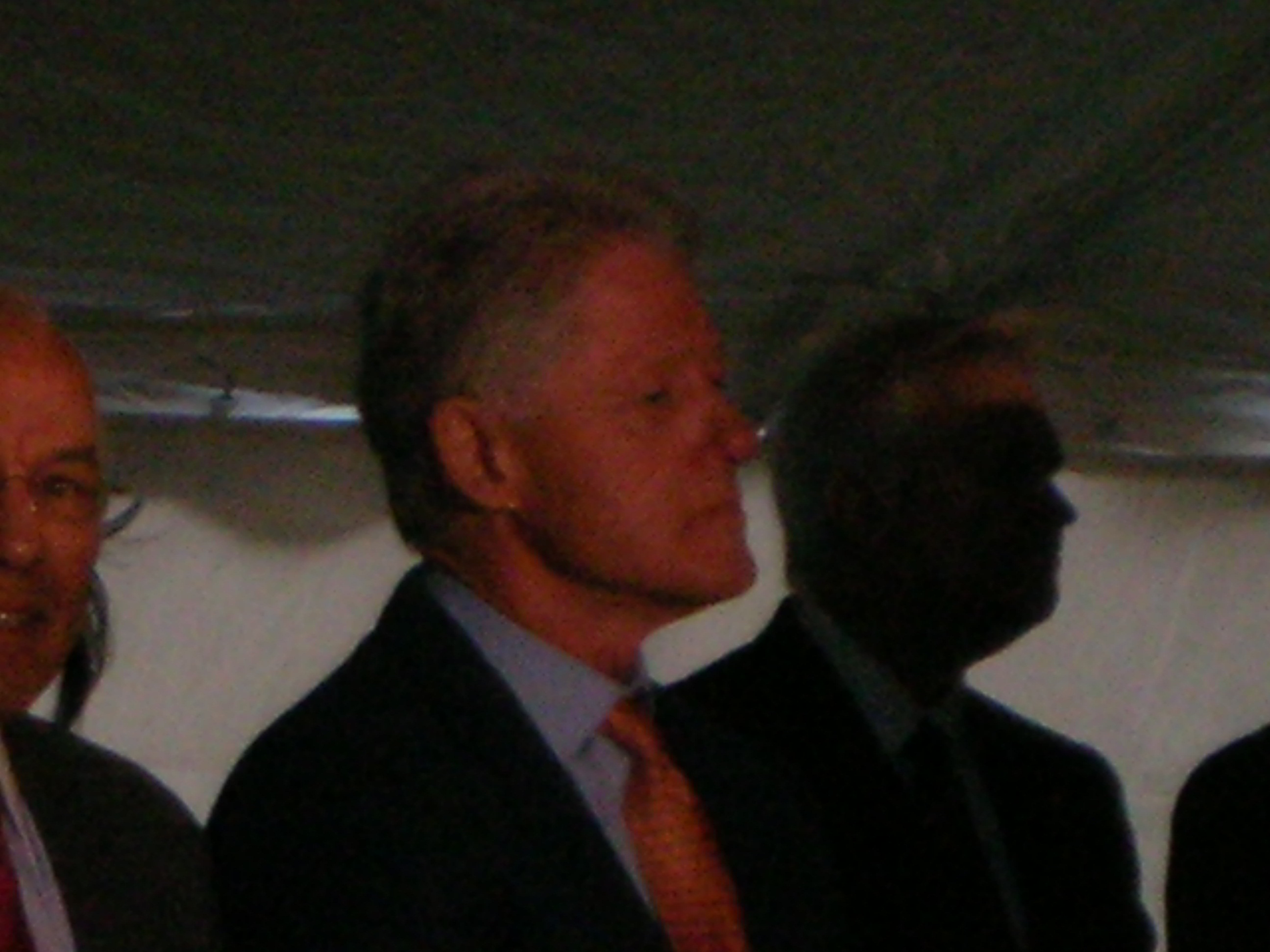
This is a picture of President Clinton that I took at UNO a few months after Hurricane Katrina. I was the only person teaching on the main campus at that time and had 5 students in my class. Clinton's listening to the first President Bush. They came to present the universities here with checks to help us get through the Hurricane damage. Who will help us overcome the damage wrought by Jindal the Terrible?
What’s on you reading and blogging list today?
Feel the Bern!
Posted: August 25, 2009 Filed under: Bailout Blues, Equity Markets, Global Financial Crisis, U.S. Economy | Tags: Ben Bernanke, Federal Reserve Bank, Larry Summers Comments Off on Feel the Bern!While I stuck the announcement into the morning links, you had to know that I’d front page this announcement some time today. So you also probably knew that I breathed a quiet sigh of relief last night when I found out we were not getting La La Summers for Fed Chief. President 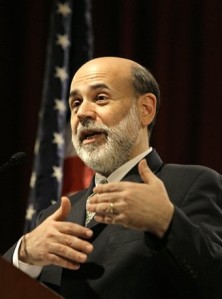 Obama has decided to re-appoint Fed Chairman Ben Bernanke to another term.
I awakened this morning to the bleating of the bloggies on this move. Of course, I have this tendency to look at folks’ credentials before I decide to take their opinions seriously. It also helps to know their political agendas and frames. Chairman Bernanke has probably had the most challenging time at that job since Paul Volcker took over the Fed helm back in the days of rampant inflation and Carter malaise. So many blogs have come to criticize Bernanke, but I’m just glad we’re not here to bury him. He may not be perfect, but he’s a damn sight better than just about everything else out there. Ben Bernanke is an economist’s economist.
Wall Street and academic economists in recent weeks showed enthusiasm for giving Mr. Bernanke a second term, and some administration insiders felt similarly even though Mr. Bernanke was appointed by — and served in the White House of — President George W. Bush. Appointing a Democrat such as Janet Yellen, president of the Federal Reserve Bank of San Francisco, or Alan Blinder, former Fed vice chairman — both former advisers to President Bill Clinton — would have been popular with many Democrats. But a move by Mr. Obama to install his own person at the Fed might have have rattled markets and unsettled the foreign investors.
Phil Izza at the WSJ has a pretty good line up of comments from both political and financial folks on the Bernanke appointment. Some of the performance the financial markets today(so far, all up) could be linked to the decision as the Fed Chair heads up the Federal Open Market Committee and sets its agenda. It is a rare FOMC that will go against the recommendations of their chair when setting monetary policy(primarily levels of interest rates, exchange rates, and bond offerings) although there is usually a healthy amount of debate and exchange or so I’ve heard since the meetings are top secret.
- I think it’s good news for the Federal Reserve. It’s good news for the country. It’s a great choice. Chairman Bernanke has done a terrific job in bringing openness to the Fed. He has been bold and creative in dealing with the financial crisis… It was not clear to most people that the crisis was going to be as broad-based, and that the excesses in the financial markets and in lending were as broadly based as they turned out to be. Even at the start, he was willing to consider all options to deal with what appeared to be more a liquidity than a solvency crisis. As it began to become more clear that it was a crisis of solvency and leverage and a classic credit crunch, he didn’t flinch in bringing enormous creativity to bear in mitigating the problem –Richard Berner, Morgan Stanley
- Having a new chairman come in at this late date would put the Fed engineered solution to both the recovery and the exit strategy at risk. The Federal Reserve made a hasty exit from easy money stimulus in the 1930s and we know how that worked out… Mistakes have been made at many regulatory institutions during this crisis, but all the Fed’s mistakes would have been made by any man according to the prudent man rule. Bernanke is a true prudent man who calls them as he sees them, and knows the ins and outs of policymaking… If he can pull off this recovery that still needs nurturing, he could well go down as one of the greatest Fed Chairmen in history. –Christopher Rupkey, an economist with Bank of Tokyo-Mitsubishi
What’s That Lassie? Little Timmy’s in the Well AGAIN?
Posted: August 4, 2009 Filed under: Bailout Blues, Equity Markets, Global Financial Crisis, president teleprompter jesus, The Bonus Class, The Great Recession, U.S. Economy | Tags: Ben Bernanke, CNBC, FDic, FED, Larry Summers, Mary Schapiro, Naked Capitalism, SEC, Sheila Bair, Timothy Geithner, Wall Street Cheerleaders, Zero Hedge Comments Off on What’s That Lassie? Little Timmy’s in the Well AGAIN? Wow, it looks like Turbo Tax Timmy has gone rogue! We better send the press up to Alaska to chase down another Palin rumor. First, there’s that nastiness over the weekend with the Stephanapolous show on ABC where he explicitly said that the administration wasn’t ruling out new taxes on the middle class. (Something Larry-the-la-la Summers also inkled, but hey, he’s not a cabinet officer, he’s something akin to a Czar that has to be overthrown by something other than scandal and public displays of stupidity.) I believe that gave Robert Gibbs Excedrin headaches number 349-357 during yesterday’s presser.
Now, there’s rumors of a temper tantrum in the presence of all the nation’s topic economists and financial regulators outlined here in the WSJ. It seems he’s not getting the Obama way on this one. The ladies in the room have taken exception to his granting Ben Bernanke (possibly later, this year, La-la Summers) all the fun and power. I guess being an independent regulator with an agency all to yourself just isn’t what it used to be; especially when you have scary lady parts and a huge brain.
Mr. Geithner told the regulators Friday that “enough is enough,” said one person familiar with the meeting. Mr. Geithner said regulators had been given a chance to air their concerns, but that it was time to stop, this person said.
Among those gathered in the Treasury conference room were Federal Reserve Chairman Ben Bernanke, Securities and Exchange Commission Chairman Mary Schapiro and Federal Deposit Insurance Corp. Chairman Sheila Bair.
Friday’s roughly hourlong meeting was described as unusual, not only because of Mr. Geithner’s repeated use of obscenities, but because of the aggressive posture he took with officials from federal agencies generally considered independent of the White House. Mr. Geithner reminded attendees that the administration and Congress set policy, not the regulatory agencies.
Mr. Geithner, without singling out officials, raised concerns about regulators who questioned the wisdom of giving the Federal Reserve more power to oversee the financial system. Ms. Schapiro and Ms. Bair, among others, have argued that more authority should be shared among a council of regulators.
This current turf battle is only the latest move by a group within government possibly thwarting the Treasury’s plans to continue uploading tax dollars to the bonus class in the guise of saving the financial sector. If there’s still disagreement about this point, can you imagine what other things are going on in complete disarray behind the scenes? Who is really in charge of solving this overt act of sibling rivalry? Well, if you have figured out where the buck stops in this administration, you’re doing better than me. (Hint: these folks are ALL presidential appointments).

 peej
peej Carissa
 bostonboomer
 dakinikat
 ecocatwoman
 mablue2
 Mama Lopez
 peggysue22
 quixote
 skydancingguestblogger
 Mona (aka Wonk the Vote)



 Sky Dancing
Recent Comments