
Finally Friday Reads: Fuck Nebraska and Red States in General
Posted: September 22, 2023 Filed under: just because | Tags: Abortion Art, Abortion is Reproductive Healthcare, After Roe V. Wade, Bans off our bodies, Before Roe V. Wade 11 Comments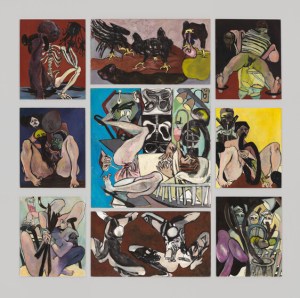
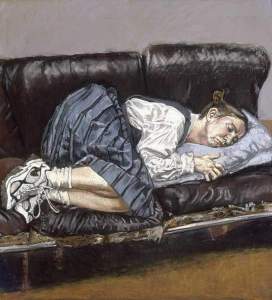
Juanita McNeely, “Is it Real? Yes It Is!” from 1969, a series of nine panels about the painter’s illegal abortion and medical emergency, It is displayed at the Whitney Museum of American Art
Good Day, Sky Dancers!
When my parents were trying to sell me in 4th grade on moving across the Missouri River, I clearly remember sitting in the back seat and telling them I didn’t like it here. I couldn’t really articulate how awful the boxy brick grade school looked compared to mine, which was built of granite by the WPA. Across the main road was a set of equally bricky and boxy stores in a shopping center.
All I could remember were the beautiful stores in the downtown area of Council Bluffs. There was the Hotel Ogden that looked straight out of a Western Movie, plus my Dad’s original dealership location, which was a typical auto dealership storefront straight out of the 1920s. I loved the old Victorian Houses nestled into the Bluffs and longed to own one when I grew up. I had dreams like that until we moved to Omaha. Then, my dreams were mostly of getting out of there as soon as possible. I could’ve graduated early and begged my parents to let me attend university and get out of here. My mother kept telling me these were the best days of my life. Then, I realized my mother was speaking for herself because I mostly remember her being as bored as I was. And we both hated football in a state where that’s about it for entertainment.
I can tell you that with certainty the best decades of my life came when I finally packed a car and headed out for good.
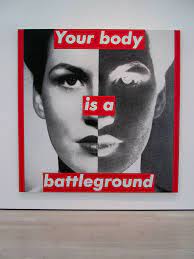
Barbara Kruger’s “Untitled (Your Body is a Battleground,” (1989).Credit…via Barbara Kruger, The Broad Art Foundation and Sprüth Magers
My daughter is 20 weeks pregnant, and her water broke last week at 19. The first question I get now is what state she is in. I don’t want to go into that, but you can google how exactly bad that is for a pregnancy. She was a high-risk pregnancy for me. I was placenta previa. I can tell you that my oldest daughter is an OB/GYN because of that pregnancy and the inoperable and incurable cancer that followed. I found out that the Insurance Company covering us and employing him wanted to send me to a Catholic Hospital. I said I’d pay to go to Methodist with my last dime if I had to. I badgered him to talk to the clerk, calling the shots on me and getting them to send me to Methodist. Luckily, Methodist Hospital had the only neontologist in my backward city. My husband worked for what I was told by my fifth-grade teacher was basically the employer of last resort. If we didn’t get grades, we would get stuck working in the land of endless file cabinets, evil bosses, and taxidermy animal decorations. I was due mid-December and drove myself to the hospital, bleeding profusely on Halloween.
The only good thing about that damned insurance company was it covered everything from the pre-birth trauma to the cancer treatment and surgery. It took my husband, a Vice President, to pressure them to let me go to Methodist Hospital with a good Jewish neonatologist(who later supervised Dr. Daughter’s Residency) that’s situated right across the street from Children’s Hospital’s Neonatology Unit. I gave my daughter a purple stethoscope when she entered Med school. I gave her an autographed copy of “This Common Secret ” when she graduated. My Journey as an Abortion Doctor.” She said, “But Mom, this won’t be my central practice.” She hadn’t read it when I last asked at the fall for Roe. I told her to just learn the procedure and ensure she could do it. One day, you may have to teach it secretly to save lives.
Yet in setting down her story, Wicklund has done something brave, not only by refusing to cower in the shadows but also by recounting experiences that don’t always fit the conventional pro-choice script. Before receiving her medical training, Wicklund had an abortion herself. She was asked no questions, offered no advice and left the clinic feeling violated. Years later, she terminated the pregnancy of a woman who’d been raped and wanted an abortion. Afterward, Wicklund examined the product of conception and discovered the pregnancy had occurred two weeks earlier, meaning it was not a consequence of the rape. Both she and the patient were horrified.
Opponents of abortion might view such episodes as proof that abortion is evil. For Wicklund, they are what drove and inspired her to help each woman she encountered make an informed, truly independent choice. At a clinic she ran in Montana, this meant placing the emphasis on counseling, which sometimes strengthened a patient’s resolve to terminate her pregnancy and other times led her to reconsider and bear the child instead. Wicklund may never convince the protesters who demonized her that women should be free to make such decisions on their own. But in sharing her secrets, she has shown why there is much honor in having spent a lifetime attempting to ensure they do.
Until now, very few can spend a lifetime ensuring they do. Count the states, remember the map, and be prepared to help someone you know. Be prepared for fines, jail, and neighbors reporting you.
I’ve always been a fighter, and fighting the patriarchy has been my thing ever since I found out I couldn’t play Little League baseball and was forced to wear a dress to school. One story that typifies the entire state came from one of the two Physicians performing abortions in Omaha. The biggest, most nasty of the protestors in front of his clinic was this woman and her daughter. One Sunday, he opened his clinic just for her so her daughter could have an abortion. The next day they both were out screaming crap that obviously they believed was for everyone else but them. Our bodies are in the hands of religious freaks, politicians, and insurance bureaucrats. This is not the world I planned for the girls and women coming after me.
I never thought we’d lose Roe completely. But we have. I live on an island at the edge of the rest of the state, which is primarily insane from too much religion and neo-Confederate rage. Almost all of us would love to be a city-state. But, since cancer took the one thing these nuts want to regulate the most, I don’t have to worry about the things I used to. It’s only for my daughters and now granddaughters. Location. Location. Location is everything if you have a functioning uterus. One is in Washington State. The other is in Colorado. Right now, they’re safe, but hopefully not in the way Anne Franck thought she would be in a hidey hole in the attic.
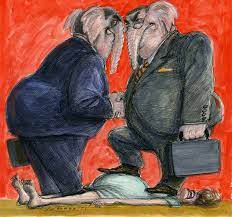
ILLUSTRATION BY VICTOR JUHASZ Rolling Stone, 2014
Here in Lousyana and up there in Nebraska, the state owns women’s bodies. We are chattel. The doctors, the parents, and confidants guiding such decisions in a free society no longer matter. This old, stale religion used to burn women and Jewish people at the stake and African-Americans on a cross wants its Dark Ages back. They’re in Africa trying out the death penalty for not loving and fucking their idea of the proper sex. Will we never be rid of these patriarchal missionaries who consider us chattel? I’ll shut up now. Just know that my child is safe and has her bills covered right now because she is not poor and is in Colorado. None of this makes it easier for me as I look at the faces of young women who walk my neighborhood streets, wondering if they’ll be able to make it to the Promised Land if need be.
So here’s the beef. This travesty of justice happened in Nebraska and is in The Guardian. “US mother sentenced to two years in prison for giving daughter abortion pills. Jessica Burgess pleaded guilty in July to providing an abortion after 20 weeks and tampering with human remains.” Remember, the earliest viability is not 20 weeks. It’s somewhere around 22-24 weeks and still at a point where life or health is not certain.
Jessica Burgess, a Nebraska mother accused of helping her teenage daughter use pills to end her pregnancy, was sentenced on Friday to two years in prison.
Burgess and her daughter, Celeste Burgess, stand accused of working together to end Celeste Burgess’s pregnancy in April 2022.
According to prosecutors, after the pair bought pills to end the pregnancy, Celeste Burgess gave birth to a stillborn fetus. At the time, Nebraska law banned abortion after 20 weeks of pregnancy. Celeste Burgess’s pregnancy was well past that point, according to court records.
Police say that the Burgesses buried the fetal remains. An examination of the remains suggested they may have also been burned, according to court documents.
Jessica Burgess pleaded guilty in July to charges of false reporting, providing an abortion after 20 weeks of gestation, and concealing, removing or abandoning a dead human body. She was sentenced to one year in prison each charge, but the sentences for false reporting and tampering with human remains will run concurrently, with the sentence for the illegal abortion to served consecutively with the sentences for the other charges, a spokesperson for the Madison county courthouse said.
Celeste Burgess also took a plea deal and was sentenced to 90 days for concealing or abandoning a dead body earlier this year.
Although the case occurred before the US supreme court overturned Roe v Wade, it has been seen as a harbinger of how law enforcement may prosecute people for ending their own pregnancies in a post-Roe era – and how giant tech companies could go along with it.
One of the worst states of the Union is Texas. You can tell precisely how Pro-life Governor Abbott is from this headline from ABC News yesterday. “3-year-old dies while crossing the Rio Grande near Eagle Pass, Texas. The family was attempting to cross the river near a floating marine barrier.
The fetish fetishists omit this once-breathing, speaking, and walking child in the same class as a fertilized egg. This child already had dreams.
The Texas Tribune examined the reality of Abbot’s reign of terror. One year before, Grand Inquisitor Alito followed a judge who liked Witch Burning to decide that women’s reproductive health should be criminal. “A year after the Dobbs decision, Texas has settled into a post-abortion reality. The impact of Texas’ near-total ban on abortion is coming into focus as patients and providers leave the state, legal challenges languish, and the state’s social safety net braces for a baby boom.: This is reported by Eleanor Klibanoff.
A year after the Dobbs v. Jackson decision, an uneasy acceptance has settled over Texas, as even the most ardent abortion advocates acknowledge these new laws aren’t changing anytime soon.
“I don’t see the legal landscape of our state shifting in a major way, certainly not in the short-term future,” said Neesha Davé, executive director for the Lilith Fund for Reproductive Equity, an Austin-based abortion fund. “And so, unfortunately, we have had to figure out how to navigate the current legal landscape, if for no other reason than there are people who need abortion care today, yesterday, tomorrow.”
There are ongoing court challenges to Texas’ laws, but they are narrow and could drag through the courts for years. There is still momentum around meaningful political change, but that is the work of decades and much of the focus has shifted to shoring up the social safety net as a stop-gap measure.
Meanwhile, despite exceptions to the law, the number of monthly abortions in Texas has dropped into the low single digits. Women are nearly dying from pregnancy complications, or actually dying after having to travel out-of-state for abortions, or facing million-dollar lawsuits for helping friends acquire abortion medication. An unknown number are having babies they never planned for.
A year after the U.S. Supreme Court ruled in Dobbs v. Jackson that there is no constitutional right to abortion, some long-time advocates see hope in the hopelessness. They’ve been sounding the alarm about the overturn of Roe and its consequences for years, and finally, people are forced to pay attention.
“There are so many more conversations happening about abortion today than there were two years ago,” Davé said. “I do think a tide is turning. It just takes time.”
Two states are trying to come out of the Reproductive Health Care Dessert. The next battlefield is Pennsylvania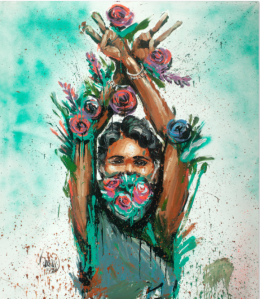 . This is one of the reasons you really have to watch your state legislature. Forced Birthers are learning the numbers are against them if voters get their way. They’re not for states making their own decision. Now, they’re going straight for a Federal law banning all abortions. Every vote counts for this. Lousyana will invariably get worse after our election. A lot of us will vote with our feet. Women and children are not safe in Red State America. Neither are members of the LGBTQ+ community, immigrants, or people of color.
This is from The Hill. “Abortion battle to play out on multiple fronts in November.”
A battle over abortion rights is set to play out on multiple fronts this coming November with votes that could affect access to the procedure in several states.
Voters will go to the polls for key elections in half a dozen states this year, but abortion rights advocates in particular are looking at votes in Ohio, Pennsylvania and Virginia.
A battle over abortion rights is set to play out on multiple fronts this coming November with votes that could affect access to the procedure in several states.
Voters will go to the polls for key elections in half a dozen states this year, but abortion rights advocates in particular are looking at votes in Ohio, Pennsylvania and Virginia.
But the contests in Virginia and Pennsylvania will also be seen as proxy elections for the broader battle over abortion rights.
Virginia Gov. Glenn Youngkin (R) has devoted much of his time and energy to working to help elect Republicans in this November’s state legislative races. He received a political boost in June after the slate of candidates he endorsed for these seats won their primaries.
But Youngkin has been unable to achieve the 15-week abortion ban he has called for with Democrats controlling the state Senate and Republicans controlling the state House.
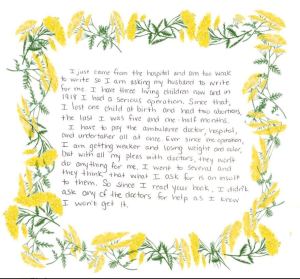
The art piece by Chicago-based artist Michelle Hartney is a recreation of a historical letter written to Margaret Sanger in the 1920s by a woman seeking birth control. The artist used the letter’s original text and added the trim of Yarrow flowers, a plant historically used to induce miscarriages. The letter was removed by Lewis-Clark State College from an exhibit at its Center for Arts and History.
The state of Idaho has a law that will not even allow an Art Exhibit of Abortion Art in its Universities and Colleges. This is dated from yesterday from the Democrat & Chronicle. Rochester gives haven to censored art, letting people see an abortion health exhibit. The exhibition entitled “Unconditional Care: Listening to People’s Health Needs” is on display through Sept. 21.
An art exhibit censored at an Idaho college because of references to abortion can be seen at the Rochester Contemporary Art Center, known as RoCo.
The exhibition — “Unconditional Care: Listening to People’s Health Needs” — was originally meant to be shown at Lewis-Clark State College Center for Arts and History.
But that school removed six pieces from it. The college cited a 2021 state law that bars public dollars from funding speech that would promote abortion rights, according to the Idaho Capital Sun.
RoCo stepped in to share the exhibition without censorship, and “Unconditional Care” is on display at the Rochester art center through Friday, Sept. 22.
“It’s one of the first examples of art censorship in the post-Rowe era,” said Bleu Cease, RoCo’s executive director. “The artworks are touching on abortion and abortion care, not advocating for it. We’re really proud to support the artist and the overall exhibition and the educational component.”
The show features 11 artists who address various health and medical issues through their lived experiences using diverse art and visual media.
“Unconditional Care” is curated by artist Katrina Majkut, who said she avoided including protest art in the exhibition to help people move past politics and into spaces of empathy and reflection.
“I wanted to make sure that whatever was shown was either rooted in medical accuracy or personal storytelling,” Majkut said during an online discussion hosted by RoCo.
Some of the themes explored in “Unconditional Care” include:
- Maternal mortality rates
- Racial disparity
- Chronic illness
- Body autonomy and safety
Cease said that once news of the censorship went national, he reached out to Majkut, eventually providing her the opportunity to curate an exhibit in Rochester that would give the pulled pieces a platform.
Among the works:
- Majkut’s piece titled “Medical Abortion” is a cross-stitch showing bottles of mifepristone and misoprostol, medicines that will yield a miscarriage.
- Lydia Nobles made three documentary videos from a series titled “As I Sit Waiting,” featuring women describing their abortion experiences.
- Michelle Hartney’s work showcases handwritten letters written in the 1920s by a woman seeking information about birth control from Planet Parenthood founder Margaret Sanger.
“The show is really not about abortion, but abortion gets all the attention because the issue is so divisive,” Cease said. “The common thread with all the artworks in the exhibition is that they relate to the human right to health wellness and body autonomy, especially in the U.S.”
We’re not well, America.
What’s on your reading and blogging post today?
(p.s. I’m sorry this took so long. It took a lot out of me today to write this. I’ve spent the week feeling unable to do any good for any life circumstances. Please keep my personal stories here, especially the current one.)
Friday Reads: Express yourself!
Posted: July 27, 2018 Filed under: just because, morning reads | Tags: Before Roe V. Wade, Drag, Polari, RESIST, Tignon Laws 14 Comments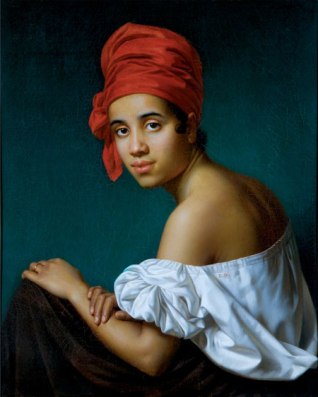
Creole in a Red Headdress; painted by Jacques Guillaume Lucien Amans;ca. 1840; oil on canvas, The Historic New Orleans Collection
Good Morning Sky Dancers!
Today, I’d like to explore some dimensions of the healthy expression of a good “fuck you” to the powers that be coming from a variety of sources because, you know, we all want to do it every day these days. Resistance frequently comes in the form of art, music, culture, and language in support of socio-economic-political change. The form can be a joyous yet angry expression necessitated by the powerless situations of those most oppressed by the dominant culture, ruling class, religion, and economy. The wink wink nod nod of art can save one from jail or worse.
It may seem disparate but I’ve got some examples that demonstrate that the complaints coming from diverse communities may represent the same undercurrent of dissatisfaction. The dominant socio-economic-political culture wants to silence and remove us which is why we must support and understand the concept of intersectionality. What they can do to one group, they can do to all given enough time and power. Together, we are the many. Separate and apart, they can cut us off like livestock to separate and unequal slaughterhouses.
This is why they are trying to stack the courts, gerrymander congressional districts, suppress voting rights, and shut up the press. It is also why they scream “lock her up” to attack Hillary Clinton and “build the wall” at folks of Mexican heritage”. It is why they still describe our first black President as a “Kenyan-born Muslim” and panic dial 911 on black people just living their lives. It is why they dilute “black lives matter” to “all”. It is why they won’t bake cakes for all weddings.
It is also why they want to set us against each other and we must not let that happen.

Daisy Patton’s “Would You Be Lonely Without Me?” runs through August 3 at the Art Gym Gallery. ( Ray Mark Rinaldi, Special to The Denver Post)
I’m going to move around in time for this but I will start with a current art show in Denver. “Denver exhibit puts faces to women who died from botched abortions prior to Roe vs. Wade. Daisy Patton’s paintings of 15 women tell a somber story”. The article is from the Denver Post review of the show.
Quirky and perky, with a face full of determination, it’s hard not to get a quick crush on Vivian Grant the way that Daisy Patton paints her, circa 1960, in a series of women’s portraits on display at Denver’s Art Gym Gallery.
With her emerald green dress, dangling earrings and precision-plucked eyebrows, Grant radiates the kind of organic optimism that could carry her far in her burgeoning career in New York’s publishing world.
But the accompanying text tells a story with a different ending. At 23, she found herself showing signs of pregnancy and sought to terminate it.
Abortion was illegal in those days, and dangerous, the stuff, as we say, of back alleys and shady practitioners and Grant, like many others, was one of its victims, dying from complications of the procedure. An autopsy later showed it was a false pregnancy.
Tragedy on top of tragedy. That’s the narrative arch of Patton’s “Would You Be Lonely Without Me?,” which captures in oil paint on paper the images of 15 women who died as a result of botched abortions in the era before the 1973 Roe vs. Wade Supreme Court decision made abortion legal, and raised the medical standards around the procedure.
Yes, the exhibit is political. Patton’s portraits are rich in physical and emotional detail. They raise sympathy for women who make the difficult decision to end their pregnancy — and their sale could raise money for national organizations that support the ability for all women to make the choice.
In her artist’s statement for the show, Patton, writes of a time when an estimated 5,000 to 10,000 women died each year from abortion-related injuries that were caused by unskilled doctors or self-inflicted by those, fearing no where else to turn, who treated themselves with knitting needles or drank bleach or other chemicals.
She notes, citing published research, how things have changed in the last four decades: “Now it is statistically more dangerous to
birth than to have an abortion.”

Many of these stories draw me in even though they are not my stories, or stories I would likely hear had I not gone looking for them or most likely, stories I would not have seen if I didn’t have friends who have stories that connect them deeply to these voices. I am drawn in by our shared humanity and vulnerability.
In this case, it was a neighbor who watched a woman die of a botched abortion as a 10 year old in a South Chicago Beauty Salon her mother used. She later, at 13, joined the underground railroad to help women seeking abortions. She was the same age as me when I listened to a panel of women who shared the stories of women in their lives who had died of botched abortions in the fellowship hall of my West Omaha Presbyterian Church. I think that was about the first moment that I realized I had a name and it was “feminist”. My neighbor’s story is more compelling than mine though and I’m glad she put up the link and said share this woman’s art.
I don’t remember her name, but she bled to death from a back alley abortion in the spare bedroom of Jackie, the lady who did my mother’s hair on Saturday’s when I was 10. I was sent to go keep an eye on her while my mother was getting her hair done. I was the last person to see her alive, because she was moaning softly and crying while Jackie was shampooing. I asked her if she needed anything and she said she needed something for her bleeding.I went back down the hall and told Jackie. Jackie went into the bathroom and got then to back bedroom and then she came back into the kitchen. Jackie gave me some towels and told be to bring them to her. I could tell when I went back in the room that she was gone, and lying in an incredible pool of blood.It was the same week a woman my Mother worked with, who was white and had money, had a “procedure” at her gynecologist’s office to take care of her unwanted pregnancy.
I learned about Jane the underground to help women when I was 13. I started donating money, and volunteering. I let women into our apartment to sleep on the couch after everyone had gone to bed and then got them out before anyone got up in the morning, on their journey to Canada to have their abortion there, or if they had enough money to the private clinic on the North side of Chicago.
The story of Louisiana’s Tignon laws has always intrigued me. I’ve been seeing renewed interest in them as it appears they are now part of a discussion on cultural appropriation.
Louisiana had slavery but with some vital differences that eventually disturbed the American colonizers who bought the French Colony. The Catholic church insisted that slaves not work on Sundays and that they be allowed to buy their own freedom. This created an entire community of free people of color in New Orleans. It was inevitable that as the traditional model of American Slavery moved towards Louisiana and New Orleans it would create dehumanizing experiences for its Creole communities.
The Tignon laws passed in 1789, however, were enacted by a Spanish governor who was also critical of the French behavior towards free people of color. Tignon laws were enacted to restrict the fashion, dress and hair styles appropriate in public dress for female gens de couleur in colonial society. Black women could not show their hair in public under the law.
This story of Free Black women in New Orleans addresses how
“We cannot discount how enslaved Black women used dress as a form of resistance [and] how even finding different ways of tying the headscarf acted as a form of resistance against the trauma of diaspora and being cut off from Africa,” says Winters. “Or how [African-American] people have drawn inspiration from African traditions as a source of empowerment.”
The tignon remains an important symbol of resistance even today It is essentially a piece of cloth fashioned into a headress to cover the hair of black women. It became much more when styled with bold patterns and color and adorned with jewels.
Even when Louisiana stopped enforcing the laws in the early 1800s, free women of color continued wearing the tignon. It’s a testament to their resilience: The women of New Orleans refused to allow a piece of cloth to humiliate them, erase their status, or diminish their femininity. Instead, they reinterpreted the tignon as a symbol of empowerment. (And Black women in Louisiana weren’t the only women of color to use clothing to resist oppressive laws: In 1773, free women of color in Saint-Domingue were prohibited from wearing shoes, so they wore sandals, adorned their toes with diamonds and continued to do so after the laws were lifted.)
More than 230 years later, remnants of the tignon laws still linger: Traditional hairstyles, such as dreadlocks, are still seen as unprofessional in the workplace; women who wear them are subject to false assumptions—like Giuliana Rancic’s now-notorious snark about Zendaya’s faux locs smelling of “patchouli oil” and “weed.” The military recently lifted its longtime ban on cornrows, Afros, locs, and other protective hairstyles, but we regularly hear stories about Black girls being suspended from school for rocking natural hair.
A number of black women have incorporated the look and statement in their performances.
Pop culture, however, is the most reliable place to look for Black women who still resist the policing of their hair.
The first time we see Beyoncé in Lemonade, her musical celebration of Louisiana’s Afro-Creole women, she’s rocking a tignon while kneeling on a stage. Nina Simone also incorporated the tignon into her signature look, and Lauryn Hill, India.Arie, and Erykah Badu followed her lead in the late 1990s and early 2000s. (Badu even wore a headwrap on Sesame Street). Outside of pop culture, the headwrap is now largely considered a fashion staple. Nnenna Stella travels from Brooklyn to Ghana and Morocco to select the most impeccable textiles for her handcrafted headwraps. Afro-Colombian designer Angelica Balanta’s vibrant headwraps reflect her rich Colombian culture, while Paola Mathé’s collection is inspired by her Haitian heritage.

Nina Simone & her daughter Lisa Celeste Simone | 1965 photo by Brian Duffy
It’s been years since the Tignon laws have been thrown out but they are still a sign of resistance. They also have been appropriated and are part of a bigger discussion
As of present, we can find conversations about what is and what isn’t cultural appropriation by way of hair (aka Kim Kardashian and her “Bo Derek” braids) or current cases playing out in court about what is and what isn’t discrimination based on a hairstyle. Black hair has always been a topic of conversation.
Most Black women can relate to the struggle of getting braids or weave and having unwanted comments from non-black co-workers. Even young Black girls are subject to ridicule because of their hairstyles. The Tignon Laws of 1786 are proof that Black hair has always been policed in America.
Fashion is frequently used for resistance.
People laugh at me when I tell them my Draq Queen friends would most likely be my spirit animal. My mother even knew that I was not one to be put in ruffles and lace with hair like Shirley Temple. It was not me at all. I basically look over the top in anything girlie which is probably why I can totally relate to a lot of drag.
Cross dressing and lip-syncing is entirely different from the insensitive nature and intention of blackface. In queer and feminist communities, drag tends to be widely accepted. It makes sense, counter cultures allowing each other to thrive and experiment. It is the concept of “gender roles” that forces us to so closely associate femininity with women, so when someone who is clearly not a woman performs femininity, it is still thought of to be a reflection on women.
A lot of drag queens get their names and character traits from pop culture, and the media loves to portray women as, to use Mary Cheney’s words, bitchy, catty, dumb, and slutty. Indeed, these are not great attributes for a person to embody, so when drag queens perform those characteristics while dressed and made up like a woman, it could be read as disrespectful or an insult to woman. Drag queens also tend to be hyper sexual, sometimes with a crude sense of humor. When people over sexualize femininity, it dehumanizes women by turning them into an object of sex as opposed to a complex human being.
Many supporters of drag culture argue that the femininity being performed by drag queens is their own form of self expression and has little to do with people who live their daily lives as women. Judith Butler argues that traditional gender roles are exhaustingly heteronormative, and that they attempt to define a norm that gives a sense of “otherness” to queer culture and drag. If we broaden our lense to not view heterosexuality as “having a claim on naturalness and originality” (Butler 384), gender can be scene as a performance for everyone and therefore not so different from drag. Basically, most people view drag as an imitation, but that implies that gender has a norm in which to deviate from. It’s like personality, there isn’t a set way to be an individual, so there isn’t a set way to be feminine.
I want to bring up art history in this exploration of gender because drag so connected with self expression and the artistry around makeup and fashion. Drag is an experiment gender, makeup, performance, fashion, comedy, parody etc… There is a million different ways to “do” drag, as seen by the assortment of characters who have won RuPaul’s drag race all with varying intensities in the femininity of the character.
Wedding Cakes aside, I grew up in an age when you read Oscar Wilde and knew it was indeed ‘the love that dare not speak its name”. I’ve found these expressions of resistance shared by friends that relate to oppression in a way I can only take in as a listener and human being, But, i can still relate. I knew there were jail sentences and death penalties when I was a child as much as I was aware of Jim Crow Laws separating black from white Americans in the South. Only now, is much of the pre civil rights culture of resistance being documented.
“And Gloria cackled, let there be sparkle; and there was sparkle.” It’s a passage from the Bible, but not as we know it: this is a familiar line from the Book of Genesis as spoken in Polari. The secret language became a kind of verbal wink between gay men in Britain during the early 20th Century – allowing them to hide and to reveal at the same time.
“One of the things that makes Polari so powerful is that it is simultaneously about disguise and identification,” the artist Jez Dolan tells BBC Culture. “You would be hiding what you were talking about from people who didn’t know it, but also if you were in a bar and you liked the look of somebody, you’d pop it into conversation and they’d either go ‘ah’ or they’d look blank and you’d be on your way.” Polari is rarely spoken today. Yet in the years when homosexuality was illegal, it was a way of communicating in public without risking arrest – as well as a chance to challenge the status quo.

Divine in a publicity photograph from the 1980s
This form of resistance, identification and survival has a fascinating history.
Baker has found it difficult to untangle a clear history of the lexicon. “Polari has a long and complicated provenance, and not all of it is fully known because it was spoken by marginalised groups who didn’t usually have their voices or stories recorded,” he says. While ‘bona’ (meaning ‘good’ or ‘attractive’), which pops up frequently, was first recorded in Shakespeare’s Henry IV Part II, some of the earliest words in Polari come from 18th-Century ‘Molly Slang’. “Mollies were men who were camp and had sex with other men,” says Baker. “These men were sometimes imprisoned and so some words of the criminal slang Cant would have crept into their language use.”
Baker describes how another form of slang, Parlyaree (from ‘parlare’, the Italian for ‘to talk’), was used by buskers, travelling circus and fairground people, market stall holders, prostitutes and beggars. Derived from Italian, it began to be used in music halls in the late 19th Century, and became known as Palarie. “There were influences from Lingua Franca… used by sailors, as well as cockney rhyming slang and Yiddish which were found particularly in the East End of London.” Some of the words are what’s been called ‘backslang’ – hair is ‘riah’, and face is ‘eek’ (from ‘ecaf’)
“Bona to vada your dolly old eek!” This links to a BBC video worth watching.
British comedian Kenneth Williams often spoke Polari in his performances on BBC radio and TV programmes in the 1950s and 60s, some of which had up to 20 million listeners at a time, introducing the language to a much wider audience.
The highlight of my evenings has been watching the nightly occupation of Lafayette Park across from the White House where noise and culture are making a loud stand. Its first night saw a very large Mariachi Band. There have been New Orleans styled Brass Bands and Drummers. The use of a Mariachi band in an Anti-Trump Protest is clearly ironic and brilliant simultaneously given Trump’s bigoted fascination with purging and dehumaniziang Mexicans and Mexican Americans.
Normally, Lafayette Park is one of those pretty, history-drenched spots in Washington, where you walk around wondering whose footsteps you might be following. You’re right across from the White House, close enough that you can practically see into the front windows. Now, though, the most important thing to know about this D.C. spot is what Occupy Lafayette Park is — because the square might just be full of anti-Trump protestors.
Because of its sight line straight to the White House, Lafayette Park is a frequent spot for rallies and gatherings when people want to protest something that the Trump administration has done, like for example the travel ban. Now, the country seems to be at a fever pitch after Trump’s meeting with Russian President Vladimir Putin, which has gained the name “Treason Summit” on Twitter. Occupy Lafayette Park is an impromptu, grassroots rally set up to protest Trump’s actions in Helsinki, where the meeting was held, and demand his impeachment.
It is only sweeter that idea came from former Clinton Aides. I just hope Trump can never sleep again.
“Nothing says Impeach like a Mariachi band,” one user chimed in.

Raja Gemini; stage name of Sutan Amrull, an Asian-American make-up artist, and drag performer
As you can tell,symbols of resistance can take many forms and they can outlive the original need for the resistance while remaining necessary because of the residual impact. So, one final link to some news about the guy that’s kicked off the #MeToo movement by bragging on sexual assault. It’s from Charles Pierce, Esquire, CNN, Michael Cohen, the Age of Leaks and Treason and more than we’ve all been able to handle. ‘We now stand at a yes-or-no moment in this country’s history.’ It juxtaposes today and that day in 1974 where they found the smoking gun.
We are now at one of those points. With the revelation on CNN Thursday night that, according to the network’s sources, Michael Cohen is ready to testify that the president* knew in advance of the now-legendary meeting in June of 2016 at which individuals connected to the Russian government offered to ratfck Hillary Rodham Clinton’s campaign for him, we stand as a self-governing republic at a stark, unclouded moment—either you believe the president* of the United States is utterly illegitimate, having conspired with a hostile power to gain the office he now holds, and that every act he has taken in that office, up to an including swearing the oath of office, is equally illegitimate, or you do not. It is now a binary. If Cohen is willing to testify to that effect, then the president* conspired with the regime of Vladimir Putin in order to gain control over the executive branch of government in this country—which includes not only the military, but the law-enforcement and intelligence apparatus as well. We are now at yes-or-no.
It’s time, as artfully as possible, to tell this administration to get the fuck out of the people’s house.
What’s on your reading and blogging list today?

 peej
peej Carissa
 bostonboomer
 dakinikat
 ecocatwoman
 mablue2
 Mama Lopez
 peggysue22
 quixote
 skydancingguestblogger
 Mona (aka Wonk the Vote)



 Sky Dancing
Recent Comments